Identification, or perceived similarity to oneself, is a cognitive process by which an individual thinks of himself or herself as similar to another individual.Reference Fullerton, Ursano and Osuch 1 - Reference Wayment 3 Perceived similarity may be based on various features, including demographic characteristics, personality, and comparable histories.Reference Klohnen and Luo 4 , Reference Westmaas and Silver 5 Perceived similarity or identification with another as oneself or a close relative or friend may increase emotional involvement, elicit feelings of closeness, and increase the likelihood of helping behaviors.Reference Westmaas and Silver 5 - Reference Feldman, Ullman and Dunkel-Schetter 7
In the context of a stressful life event, greater identification or perceived similarity has been associated with psychological distress and functional impairment, including increased post-traumatic stress, depressive, and grief symptoms.Reference Fullerton, Ursano and Osuch 1 , Reference Wayment 3 , Reference Cetin, Kose and Ebrinc 8 - Reference Ursano, Fullerton and Vance 10 Identification with the victim of a traumatic event may increase one’s feelings of being vulnerable to a similar experience,Reference Westmaas and Silver 5 which can in turn trigger feelings of anxiety and threat. In disaster workers and those responsible for body recovery following natural and human-made disasters, identification is related to higher levels of post-traumatic stress and somatic complaints.Reference Cetin, Kose and Ebrinc 8 , Reference Ursano, Fullerton and Vance 10 - Reference Ursano and McCarroll 12 Individuals may attempt to emphasize their dissimilarities to those who experienced the event in an effort to establish psychological distance, reduce their perception of risk, and maintain a sense of control.Reference Wayment 3 , Reference Brown, Messman-Moore and Miller 13 , Reference Gump and Klik 14
Although predictors of identification with victims have rarely been examined, a better understanding of their role as mechanisms in the relationship with adverse psychological outcomes will provide opportunities for intervention and promote resilience. In a previous study, we found an association of greater identification with victims of a terrorist attack with higher levels of post-traumatic stress and depressive symptoms, highlighting the importance of further examination of the role of identification in the response to traumatic events.Reference Mash, Ursano and Benevides 9 A primary source of information regarding terrorist attacks and its associated graphic images is through media exposure.Reference Busso, McLaughlin and Sheridan 15 - Reference Silver, Holman and Andersen 17 New York City residents who viewed extensive television coverage of the 9/11 terrorist attacks reported higher levels of perceived similarity to the victims following the attacks.Reference Wayment 3 Previous exposure to life-threatening events, including childhood abuse and early traumatization, has also been related to envisioning oneself as a victim during a subsequent traumatic event and feelings of threat.Reference Frieze, Hymer and Greenberg 18 Prior to trauma exposure, individuals generally expect that they are less likely to experience a negative event in relation to others.Reference Helweg-Larsen and Shepperd 19 However, elevated feelings of threat and perception of future risk that occur following a traumatic eventReference Busso, McLaughlin and Sheridan 15 may either influence identification with victims as oneself or increase the perception that a close friend or family member may be at risk, particularly if the current event shares similar features with the past experience.Reference Frieze, Hymer and Greenberg 18
Demographic characteristics may also affect individuals’ identification with trauma victims. For parents, news of a terrorist event may result in feelings of concern and being overwhelmed by their reduced ability to protect their children and manage their fears.Reference Beauchesne, Kelley, Patsdaughter and Pickard 20 , Reference Cicchetti, Toth and Lynch 21 In these cases, parents have been found to increase their television viewing in an effort to seek information, and consequently reduce feelings of fear and arousal, and reassure them of their safety.Reference Pfefferbaum, Nixon and Tivis 16 , Reference Kennedy, Charlesworth and Chen 22 , Reference Schuster, Stein and Jaycox 23 To our knowledge, there has been no examination of whether events in which children were among the victims produce qualitatively different psychological responses in parents, who may be influenced by this perceived similarity to their own children.
For more than 3 weeks in October 2002, a series of sniper attacks in the Washington, DC, metropolitan area left 10 people dead and 3 others wounded. The Washington, DC, sniper attacks can be distinguished from other terrorist events by the numerous shootings across time and locations, the continuing threat of attack, and the diversity of the ages, races, and genders of the victims. In a series of studies examining DC community residents, hospital workers, and homeless individuals in the initial weeks during and following the sniper attacks, individuals reported increased post-traumatic stress, acute stress disorder, and depressive symptoms, and substance and alcohol use,Reference Fullerton, Gifford and Flynn 24 - Reference Grieger, Fullerton and Ursano 27 with post-traumatic stress disorder (PTSD) symptoms persisting up to 7 months.Reference Schulden, Chen and Kresnow 28 In particular, greater identification with sniper attack victims was associated with elevated post-traumatic stress and depressive symptoms in community residents.Reference Mash, Ursano and Benevides 9
Understanding the factors that may predict increased identification will help guide the development of preventive strategies and target at-risk populations, potentially reducing adverse responses to trauma exposure. The present study examined the unique relationships of sniper-related television viewing and prior life-threatening events to identification during the DC sniper attacks. Although perceived similarity based on demographic characteristics, such as parental status, has been theorized to affect individuals’ responses to traumatic events, these associations with identification have not been systematically examined in previous research. To address this relationship, we explored the extent to which parental status may play a role in the interrelationship among media exposure, previous life-threatening events, and identification. The aim of this study was to develop a model of identification by examining both the independent influences of these factors as well as their interactions, which will further refine the conceptual role of identification in psychological response to trauma. Given the increasing frequency of both domestic and international terrorist attacks, additional knowledge concerning the predictors of post-event sequelae is particularly important and timely. Study findings may also have public health implications for messaging following terrorist events.
METHODS
Participants and Procedures
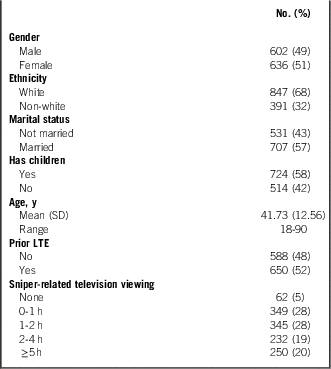
Participants were 1238 residents living in the Washington, DC, metropolitan area during the sniper attacks in October 2002. Participants ranged in age from 18 to 90 years (mean=41.7 years; SD=12.56; Table 1). Approximately one-half of the participants were female (51%; n=636) and had earned a Bachelor’s or graduate degree (50.1%; n=621). The majority were employed (79%; n=978), married (57%; n=707), white (68%; n=847), and had children (58%; n=724). Approximately 52% (n = 641) of the participants lived within 25 miles of downtown Washington, DC.
Demographics, Prior Life-Threatening Events, and Sniper-Related Television ViewingFootnote a

a N=1238. LTE, life-threatening event.
Participants were recruited in collaboration with the NetZero internet service provider (ISP) from a group of approximately 40,000 Washington, DC, area residents who indicated interest in participating in survey research. The ISP was available to the general public at no charge at the time of the sniper attacks, potentially allowing for access from a representative sample of community residents. The online survey was made available to the pool of subscribers who expressed interest in participation in survey research. Data were collected at one time point approximately 3 weeks after the first sniper shooting and before their apprehension. At the time of assessment, all of the shootings had occurred; however, the participants were not aware that there would be no additional attacks. Potential participants were contacted via e-mail to assess interest in participating in the study. They were informed that participation would be voluntary and anonymous. Information regarding the survey was provided in a written format. Individuals indicated consent by filling out the survey and returning it via anonymous transmission. Participants were informed that the survey included questions about their health, lifestyle, current feelings, and health practices and would take approximately 10 minutes to complete. The study was approved by the Institutional Review Board of the Uniformed Services University of the Health Sciences in Bethesda, Maryland.
Measures
Participants completed an online questionnaire that assessed demographic characteristics, items related to identification with the victims, experience of past life-threatening traumatic events, and amount of daily sniper-related television viewing.
Identification
A total identification score was computed by summing the scores of 3 identification variables: identification with the victim as self, as a friend, and as a family member. These categories were assessed by using the following 5 items: “It could have been me,” “One of the victims reminded me of a close friend or relative,” “It could have been my spouse/significant other,” “It could have been my son/daughter,” and “It could have been my father/mother.” Response to the “It could have been me” item was used as the identification-self variable. The survey item “One of the victims reminded me of a close friend or relative” was used to define the identification-friend/not immediate family variable. The identification-family variable was defined by using 3 items that characterized immediate family members, including spouse/significant other (“It could have been my spouse/significant other”), son/daughter (“It could have been my son/daughter”), and father/mother (“It could have been my father/mother”). The highest score among the spouse/significant other, son/daughter, and father/mother individual items was used to represent the identification-family variable. The 3 items included in identification-family exhibited good internal consistency (Cronbach’s α=0.753). Participants scored each identification item on a 4-point scale ranging from 0 (not at all) to 3 (very much), with an additional option for “not applicable.” “NA” responses were combined with the “not at all” responses for each identification category. The identification-self, identification-family, and identification-friend items demonstrated good internal consistency (Cronbach’s α=0.736). The total identification score, which was the sum of the identification-self, identification-friend/not immediate family, and identification-family (derived from the highest score of the 3 family items) scores, ranged from 0 to 9.
Prior life-threatening traumatic event and parental status
Past experience of a life-threatening traumatic event was measured by a single yes or no item that asked, “Have you ever been involved in any experience that caused you to fear you would be killed or injured (eg, serious accident)?” Parental status was measured by a single yes or no item that asked, “Do you have children?”
Sniper-related television viewing
The number of hours of sniper-related television viewing per day was assessed by the following item: “During the past week, how many hours per day did you watch television coverage of the sniper attack?” with responses including (1) none, (2) 0-1 hours, (3) 1-2 hours, (4) 2-4 hours, and (5) 5 hours or more. Initial analyses were conducted by using these 5 categories, and sniper-related television viewing was subsequently stratified into low television viewing (0-2 hours) and high television viewing (≥2 hours).
Statistical Analyses
Rates of prior life-threatening traumatic events and mean levels of daily sniper-related television viewing were identified by using descriptive statistics. Chi-square analyses, analyses of variance, and bivariate correlations were conducted to assess significant demographic differences in total identification responses and television viewing. For cases in which differences were found, these background variables were included in analyses as covariates. Multiple linear regression analyses were performed to investigate the relationships of gender, parental status, exposure to a life-threatening traumatic event, and daily sniper-related television viewing to identification (ie, total identification score), followed by a regression model that included the interactions between sniper-related television viewing and gender, television viewing and parental status, and television viewing and life-threatening traumatic event. To more closely examine the influence of the significant predictor variables and sniper-related television viewing on identification, separate models that stratified life-threatening traumatic event groups (no prior life-threatening traumatic event/life-threatening traumatic event) and parental status groups (not a parent/parent) were examined. Statistical analyses were conducted by using SPSS Statistics 22. 29
RESULTS
Identification scores ranged from 0 to 9 (mean=4.43, SD=2.65). Approximately one-half of the participants (52%; n=650) reported experiencing a life-threatening event before the sniper attacks, and almost 40% (39%; n=482) of the sample reported 2 or more hours of daily sniper-related television viewing (Table 1). Among individuals who watched 5 or more hours of sniper-related television per day, 63% (n=157) were female and 62% (n=154) were parents.
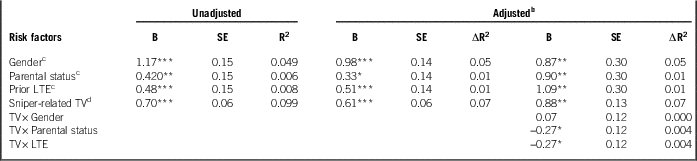
In univariate linear regression analyses, female participants and those with children (parental status) reported greater identification with victims (B=1.17, P≤0.001, and B=0.42, P=0.006, respectively; Table 2). Age, race, and marital status were not significantly associated with identification. Those who experienced a prior life-threatening event reported greater identification with sniper victims (B=0.48, P≤0.001), and viewing more sniper-related television daily was associated with greater identification (B=0.70, P≤0.001).
Multiple Linear Regression of Association of Prior Life-Threatening Events and Sniper-Related Television Viewing With IdentificationFootnote a

a N=1226. Identification is the sum score of the identification-self, identification-friend, and identification-family items (range, 0-9). Abbreviations: LTE, life-threatening event; TV, television viewing.
b Variables in the full model accounted for 14.8% of the variance in identification.
c Gender: 0=male, 1=female; Parental status: 0=not a parent, 1=parent; Prior LTE: 0=no prior LTE, 1=prior LTE.
d TV: 1=none; 2=0-1 hours; 3=1-2 hours; 4=2-4 hours; 5=5 hours or more.
*P≤0.05; **P ≤ 0.01; ***P ≤ 0.001.
After adjustment for gender in a multivariate regression analysis, parental status, life-threatening event, and sniper-related television viewing continued to be significantly associated with identification (B=0.33, P≤0.05; B=0.51, P≤0.001; and B=0.61, P<0.001, respectively). Parental status and a life-threatening event each accounted for 1% and television viewing accounted for 7% of the variance in identification. We further explored the two-way interactions of television viewing with each of the predictor variables in a model adjusted for gender (Table 2). The interactions of television viewing with parental status and of television viewing with a life-threatening event were each significantly associated with identification (B=-0.27, P≤0.05, and B=-0.27, P<0.05, respectively), indicating that the effect of television viewing was modified by parental status and prior exposure to life-threatening events. The interaction of television viewing and gender was not significant, and therefore was not included in subsequent models. Addition of the three-way interaction of television viewing×life-threatening event×parental status in the model was not significant.
To better understand the contribution of television viewing to level of identification found in the significant two-way interactions of television viewing×life-threatening event and television viewing×parental status, we first stratified groups based on prior life-threatening event. Among participants with a prior life-threatening event, television viewing was significantly associated with identification (B=0.63, P≤0.001) and accounted for 5% of the variance in identification. Among those who reported no prior life-threatening event, television viewing again was related to identification (B=0.94, P≤0.001), accounting for 11% of the variance in identification. Therefore, television viewing was significantly associated with identification in those with and without a prior life-threatening event, although the effect was relatively greater among those with no prior life-threatening event.
Participants were subsequently stratified into groups based on parental status (ie, parents/not parents). In a multivariate model including gender, prior life-threatening event, and the interaction of television viewing×life-threatening event, television viewing was again associated with identification among parents (B=0.63, P≤0.001), and accounted for 5% of the variance in identification. Among participants who were not parents, television viewing was also associated with identification (B=0.95, P≤0.001), accounting for 12% of the variance in identification. As with a life-threatening event, television viewing was significantly related to identification in those who were and were not parents, although the effect was relatively greater among those who were not parents.
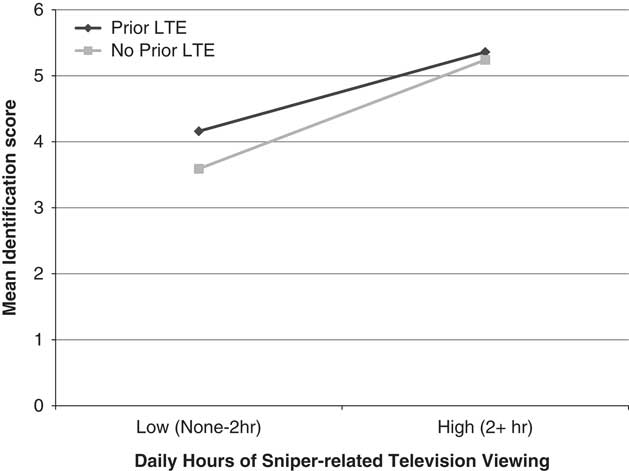
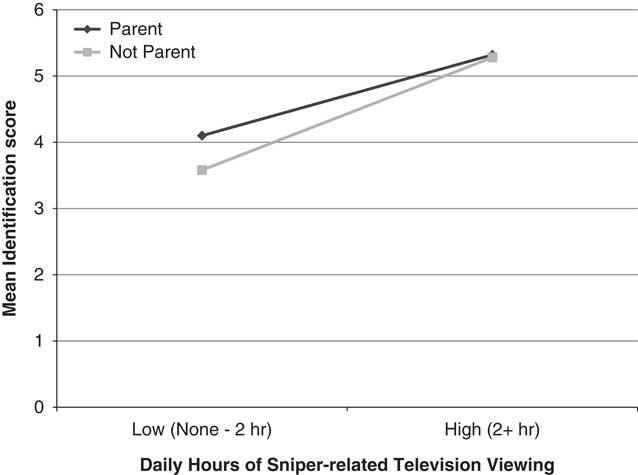
To further describe the interactions between television viewing and life-threatening event and television viewing and parental status, we depicted the relationships among the predictor variables and identification by dichotomizing the television viewing categories into categories of low television viewing (0-2 hours) and high television viewing (≥2 hours) (Figures 1 and 2). In summary, for participants who reported low levels of television viewing, identification was greatest among participants who either experienced a prior life-threatening event or were parents. However, those who reported higher levels of television viewing reported greater identification, regardless of whether they had experienced a life-threatening event or were parents.
Association of Sniper-Related Television Viewing and Prior Life-Threatening Event (LTE) With Identification.

Association of Sniper-Related Television Viewing and Parental Status With Identification.

DISCUSSION
Following the Washington, DC, sniper attacks, we investigated factors that may have influenced identification with victims of a traumatic event. Few empirical studies have focused on features associated with this series of attacks and, in particular, their possible role in the development of perceived similarity with the victims. Strong feelings of identification were reported by a majority of community residents, with participants indicating that they identified with the sniper victims as themselves (86%; n=1062), a family member (84%; n=1039), and/or a friend (41%; n=508). Female participants and those with children were more likely to report greater identification with sniper victims, which is comparable to the higher levels of perceived similarity to victims found in women following 9/11.Reference Wayment 3 The higher levels of post-traumatic stress and depression reported by women and those with children following traumatic eventsReference Grieger, Fullerton and Ursano 26 , Reference Balasinorwala and Shah 30 , Reference Janke-Stedronsky, Greenawalt and Stock 31 may be influenced in part by the increased identification with victims reported by these individuals.
Previous experience of life-threatening events was related to greater identification with victims during the sniper attacks, even after adjustment for demographics. Recall of the cognitive and affective details of past traumatic events influences the narrative of one’s current experience and may contribute to the present perception of similarity to the sniper victims, thus serving as symbolic vehicles for the representation of current traumatic events.Reference Holloway and Ursano 32
In this study, higher levels of sniper-related television viewing were related to greater identification with sniper attack victims, even after adjustment for demographics and life-threatening events, accounting for 7% of the variance in identification. Media coverage of terrorist attacks is predictive of adverse psychological responses, such as acute stress disorder and PTSD.Reference Pfefferbaum, Nixon and Tivis 16 , Reference Cardeña, Dennis and Winkel 33 - Reference Torabi and Seo 36 Extensive event-related television viewing was associated with high levels of post-traumatic stress symptoms and probable PTSD from 3 days up to 4 months after the 9/11 attacks.Reference Ahern, Galea and Resnick 37 - Reference Schlenger, Caddell and Ebert 39 High media exposure was also associated with acute stress symptoms 2 to 4 weeks after the Boston Marathon bombings,Reference Holman, Garfin and Silver 40 regardless of whether the participants were directly exposed to the bombings. Specifically, those who viewed 6 or more hours of media coverage daily were 9 times as likely to report high acute stress as were those reporting little television viewing.
Identification with victims as a result of sniper-related media exposure may function as a mechanism for adverse psychological and behavioral responses following terrorist attacks. Previous research has found independent relationships of higher perceived similarity and media exposure to reports of negative affect following the sudden loss of a public figure.Reference Pillow and Cassill 41 In the current study, high levels of sniper-related television viewing were associated with greater identification, regardless of whether participants experienced a life-threatening event. Interestingly, however, those individuals who reported a life-threatening event and low levels of media exposure reported greater identification than did those with the same amount of media exposure and no trauma history, highlighting the role of previous life-threatening events in the development of feelings of identification with victims. Even with limited television exposure, the experience of a life-threatening event may influence feelings of perceived similarity to victims in a subsequent event. Extended television viewing, however, provided community residents with detailed information about each of the shooting victims, who varied in age, gender, race, and by occupation, and this demographic diversity increased the possibility that viewers would perceive similarities between their lives and those of the attack victims. Although the contributions of life-threatening events and parental status were relatively small, they served as mechanisms to better understand the primary influence of sniper-related television on identification and to further refine the conceptualization of this cognitive process.
Interpretation of the study findings is limited by design and measurement issues, including the study’s cross-sectional design and the timing of survey administration, prior to the apprehension of the snipers. Further, the study design precludes a causal interpretation of the relationship of sniper-related television viewing to identification, as higher levels of identification may alternatively result in more event-related television viewing. Future research would benefit from examination of the directionality of this relationship. Longitudinal assessment following the capture of the snipers would provide additional information regarding the influence of identification on the trajectory of trauma response. This study focused specifically on television viewing related to the DC sniper attacks and did not inquire about other forms of television content; thus, its influence on psychological response cannot be determined from this examination and merits attention in future research. Recruiting online may limit the generalizability of results. Although the ISP was available to the general public at no charge, study participation was necessarily limited by those who had access to the Internet. In 2002, 59% of Americans reported Internet use;Reference Perrin and Duggan 42 however, this may underestimate use, specifically in the Washington, DC, area at that time. Determination of accurate response rates to online survey administration is complicated by a number of factors, including limited information regarding how many surveys were successfully received, the number of e-mails that were opened by potential participants, and whether those individuals attempted to access the survey. Although previous research has found demographic biases using online survey administration,Reference Sax, Gilmartin and Bryant 43 demographic variables were controlled for in the analyses of this study, and did not affect the outcomes. Since the DC sniper attacks, there have been changes in the frequency of mass shootings and media coverage that should be taken into account in future research. Finally, study findings were limited by the use of self-report measures. Research focused on further developing the conceptualization and measurement of identification would help to better understand this important factor and its role following trauma exposure.
CONCLUSIONS
The results of this study identify factors that may influence identification with victims during a terrorist event. Importantly, high levels of sniper-related television viewing were associated with more perceived similarity with the victims, over and above the effects of a previous life-threatening event. This finding has implications for recommendations during a terrorist event, which may include limiting media exposure or selecting media communication methods that would provide essential information and direct emergency guidance from community leaders. Although the media can be a critical resource during and following a traumatic event, providing information and guidance regarding available community services, it can also have an adverse impact at high levels, resulting in significant distress and negative psychological and behavioral outcomes. Attention to the amount and type of media exposure would help influence the extent to which individuals identify with victims of a terrorist event and minimize adverse psychological and behavioral responses. The Dart Center for Journalism and Trauma (www.dartcenter.org) also provides important information regarding the media’s responsibility in trauma reporting. Further, study results indicate a need for increased public health education related to the psychological, cognitive, and behavioral impact of event-related television, as well as increased awareness by mental health care providers and community leadership on the possible role of life-threatening events and media exposure during traumatic events. These factors may play critical roles in shaping public health response and interventions related to major terrorist attacks or other disasters. To this end, additional study is needed to better understand the specific features of prior life-threatening events that may be responsible for increasing feelings of perceived similarity, or being more susceptible to identification during exposure to subsequent events. Future research that examines the longitudinal trajectory of identification with victims following a traumatic event would provide additional valuable information regarding the role of identification as a mechanism in psychological response.
Disclaimer
The opinions expressed are those of the authors and, therefore, do not necessarily reflect the views of the Department of Defense and the Uniformed Services University of the Health Sciences.
Conflict of Interest
The authors have no conflicts of interest or financial support, including direct or indirect financial or personal relationships, interests, or affiliations relevant to the subject matter of the manuscript, to disclose.