Introduction
The central nervous system (CNS) embryonal tumour is formly known as primary neuroectodermal tumour (PNET) and currently medulloblastoma (MB), which is regarded as a highly malignant tumour comprising small round cells of neuroectodermal origin affecting the soft tissue and bone. This rare tumour predominantly occurs in children and young adults under 25 years of age. CNS embryonal tumour is prone to distribute through the cerebrospinal fluid (CSF) as well as other parts of the brain and spinal cord. Surgery is the key approach for maximal safe resection of the tumour tissue. The treatment of MB may result in untoward outcomes such as impairment in neurologic function. Upon treatment completion, survivors enter follow-up for endocrine functions, imaging studies and psychosocial support. Reference Pickles, Hawkins, Pietsch and Jacques1,Reference Behdad and Perry2
In this case study, we present a rare case of a patient treated with radiation therapy (RT) and a novel treatment with a chemotherapy regimen including temozolomide (TMZ).
Case Presented
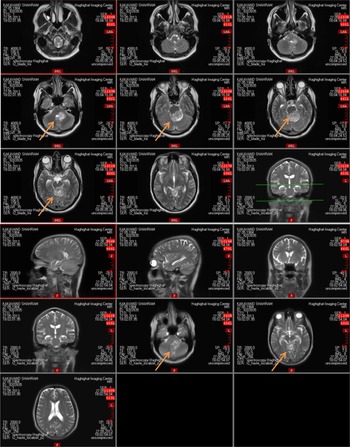
A 29-year-old patient primarily complained of abrupt unsteadiness and double vision in February 2013. CT scan imaging revealed a space-occupying lesion in the posterior fossa area. A stereotactic biopsy and pathological study of this 0.5×0.5×0.4 cm mildly edematous brain tissue suggested a brain stem tumour. Given the incongruity of presenting symptoms and pathology, a second opinion was sought from another pathologist. The study showed a small area of white matter representing proliferated cellular elements of the round to slightly ovoid hyperchromatic nuclei and scattered small spotty aggregates. Congested vessels were accompanied by infrequent small haemorrhage. The diagnosis was a low-grade astrocytic glioma, rather than medulloblastoma with cerebellar involvement. Nevertheless, given the discrepancy between imaging results and morphological findings, the possibility of medulloblastoma could not be excluded as per the pathology report. MRI confirmed the existence of the lesion (Figure 1). Intracranial pressure (ICP) rose following biopsy, and a ventriculoperitoneal shunt was inserted.
Sagittal, coronal and axial T2-weighted contrast-enhanced MRI of the brain confirm the existence of a lesion in the posterior fossa clearly shown by arrows.

Diagnosis
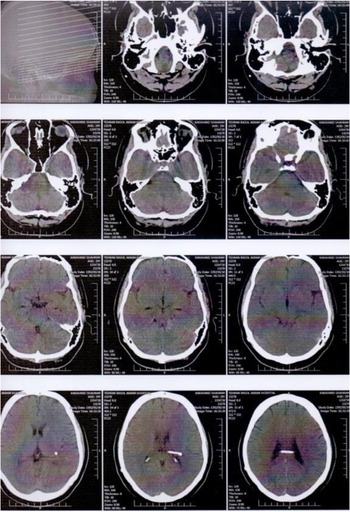
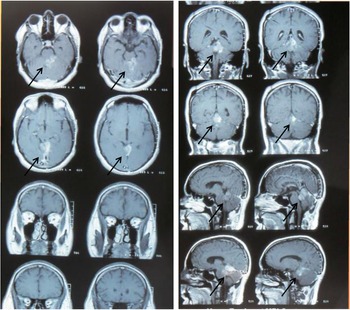
The tumour started to shrink and symptoms ameliorated on intravenous dexamethasone 8 mg/day in September 2013. The lesion almost fully regressed the following three months of dexamethasone treatment (Figure 2). Dexamethasone was tapered by February 2014 and discontinued due to the patient’s stable condition and lost follow-up because no sign of the tumour was consequently observed in the post-treatment imaging, and it seems that lesion responded to the treatment by dexamethasone per se (Figure 2). In January 2015, the patient referred with the symptoms of vomiting and vertigo, with the CT scan imaging showing tumour recurrence (Figure 3). The patient underwent neurosurgery with the impression of a primary CNS lymphoma. Pathological studies based on immunohistochemistry (IHC) suggested desmoplastic/nodular medulloblastoma. IHC demonstrated positive synaptophysin, negative CD45 and chromogranin and positive Ki-67 in 40% of cancerous cells. Synaptophysin can occur in normal and neoplastic neuroendocrine of neural types. CD45 is regarded as a common marker of human lymphoid and myeloid immune cells. Chromogranin is used as a marker of neuroendocrine differentiation. Ki-67 protein is a cellular marker associated strictly with cell proliferation. Therefore, IHC results proposed medulloblastoma with desmoplastic type according to the presence of synaptophysin and positive Ki-67 staining. Whole spine MRI and CSF evaluation did not indicate involvement in other CNS areas other than the posterior fossa.
CT scan imaging of the brain. No signs of the tumour were observed.

CT scan imaging results display 1.5×1.5×0.5 cm lesion resulted from tumour regrowth after treatment by dexamethasone. The tumour was clearly shown by arrows.

Treatment
The patient underwent 18 fractions of 1.80 Gy spine and whole-brain RT, at the total dose of 32.40 Gy, and 54 Gy in 12 fractions was proposed for posterior fossa concurrently with 2 mg vincristine (VCR) weekly during 6 weeks. Following a 3-week break, the patient was initiated on 150 mg/m2/day TMZ for 5 days, 2 mg VCR and 65 mg/m2/day cisplatin every 3 weeks for 8 cycles. The patient received 300 mg granulocyte colony-stimulating factor subcutaneously every 28 days. Follow-up MRI showed no signs of the tumour after 12 months follow-up. Despite the infiltrative nature of medulloblastoma, no spinal extension of the tumour was observed during the entire treatment period.
Discussion
The CNS-PNET was initially explained by Hart and Early in 1973. Reference Hart and Earle3 While PNET is usually observed in 2.8% of all primary cerebral tumours of childhood and adolescence, the condition is rare in adults comprising <0.5% of all intracranial tumours. Reference Kim, Lee, Paek, Chi, Choe and Jung4 This type of tumour is usually found in children and young adults with over 80% located in the hemisphere and only 10% found in and around the third ventricle. The tumour is highly malignant with a high mitotic rate. Endothelial proliferation may be observed, and necrosis is common. Reference Becker and Hinton5
Most PNET patients (or more accurately CNS embryonal tumours according to World Health Organization (WHO) 2016 new classification) display signs of ICP rising including a headache, vertigo, nausea, confusion and papilledema as the tumour starts to grow. Reference Abuzayed, Khreisat, Maaiah and Agailat6,Reference Smee and Williams7
RT plays a crucial role in the treatment of MB. In adults, most of the meningeal failures are related to the blood–brain barrier and take place in the posterior fossa root exploring the possibility of incomplete resections at the primary site. The dose for RT, volume, sequence and concurrence with chemotherapy have all been implicated as factors affecting the survival rates. The intensified irradiation doses are usually adjusted in excess of 50–54 Gy to optimise the treatment efficacy in the posterior fossa. Reference De, Beal and De Braganca8
MBs are usually well vascularized and grow rapidly. As such, chemotherapy can be an appropriate option with a significant outcome. Hence, a combined chemotherapy regimen including VCR, prednisone and l-(2-chloroethyl)-3-cyclohexyl-1-nitrosourea (CCNU) is customary given following RT in the range of 40–60 Gy. Reference Kosnik, Boesel, Bay and Sayers9
Cisplatin is also considered an effective agent for the treatment of MBs resulting in an almost 50% reduction in tumour size in treated children; however, cisplatin may demonstrate some adverse events including irreversible sensorineural hearing loss and renal toxicity. Reference Walker and Allen10 The management of MBs has evolved over time. In 1990, the combination of VCR, cisplatin and CCNU was used for the treatment of children suffering MB in Children’s Hospital of Philadelphia. The trial resulted in a 100% objective response rate for a median overall survival of 18.8 months. Reference Lefkowitz, Packer, Siegel, Sutton, Schut and Evans11 Therefore, this treatment protocol turned into a recommended regimen in newly diagnosed MB in children following RT. The aggressive application of eight chemical agents simultaneously, so-called “eight drugs in one day therapy” including VCR, CCNU, cisplatin, hydroxyurea, prednisone, cyclophosphamide, arabinosylcytosine and procarbazine over a 24-hour period, demonstrated promising results with tolerable toxicity. The lack of long-term efficacy with this eight drug regimen in comparison with the other treatments could be as a result of the unclear role of some agent in this treatment approach. Reference Packer12 Prednisone per se plus RT has disclosed better result in comparison with eight drugs in one day therapy in children. Reference Zeltzer, Boyett and Finlay13 A phase III study has revealed that 55.8 Gy of RT followed by adjuvant chemotherapy including CCNU, cisplatin and VCR, or cyclophosphamide, cisplatin and VCR can result in the encouraging 5-year event-free survival rate. Reference Packer, Gajjar and Vezina14 Chemotherapy can play a protective role against RT alone, and dose intensity of the chemotherapy regimen can be a promising factor. Reference Smith, Shi and Estlin15 During the various protocols of MB treatment including RT and chemotherapy as described previously, Reference Bouffet16 finding a new strategy with high efficacy and low toxicity is emerging because the patients may not tolerate neutropenia and thrombocytopenia resulted from the chemotherapy.
In this case, dexamethasone was firstly used in order to alleviate the patient’s neurological symptoms. MRI imaging displayed no signs of tumour so that the patient consequently decided to discontinue the treatment. It was previously shown that dexamethasone is able to decrease murine and rodent glioma tumour growth in a dose-dependent manner suggesting neuroprotective effects and reduced tumour-induced angiogenesis. Reference Fan, Sehm, Rauh, Buchfelder, Eyupoglu and Savaskan17 An animal study revealed that dexamethasone can activate the Sonic hedgehog-Smoothened (Shh-Smo) signalling pathway in the cerebellum leading to prohibit the medulloblastoma growth and significantly prolongs the survival. Reference Heine, Priller, Ling, Rowitch and Schuller18
In this study, following the recurrence of the tumour, the patient underwent RT with weekly VCR which is highly recommended for the treatment of MB. Reference McLean19 Goldwein et al. elucidated that 18 Gy RT to the craniospinal axis, a posterior fossa boost to 50.4–55.8 Gy and chemotherapy consisting of VCR weekly during irradiation followed by VCR, cisplatin and CCNU for eight, 6-week cycles, which resulted in 70% (standard error = 20%) actuarial survival for over 6 years in children. Reference Goldwein, Radcliffe and Johnson20 Some evidence confirmed that chemotherapy by VCR, cisplatin and CCNU after irradiation improves PFS, elongates the meantime to progression and elevates the response rate dramatically. Reference Rutkauskiene21
To pursue an even more efficient approach upon the treatment course of our patient, CCNU was replaced by TMZ which is an alkylating agent with a mechanism of action similar to CCNU. TMZ crosses the blood–brain barrier with a high penetration rate and shows more efficacy and safety in the treatment of high-grade gliomas as well as less adverse effects rather than CCNU. Reference Weller, van den Bent and Hopkins22,Reference Brandes, Nicolardi and Tosoni23 Additionally, it has been shown that TMZ is an active agent in the treatment of medulloblastoma/PNET with a tolerable toxicity profile, Reference Cefalo, Massimino and Ruggiero24 and a negative relationship between CCNU (in the dose-intensity chemotherapy regimen including cyclophosphamide, cisplatin, VCR and CCNU) and 5-year overall survival was previously observed. Reference Smith, Shi and Estlin15
The patient demonstrated a notable survival benefit from the above approach and continued to survive with no signs of tumour recurrence and reported an acceptable quality of life and performance status at present. His neurological symptoms have been alleviated mainly over the past few months. The patient has survived for about 6 years to date with the latest clinical follow-up recorded in December 2018.
Conclusion
A response to dexamethasone may at least partly be due to its potential neuroprotective and anti-angiogenesis effects through activation of the Shh-Smo signalling pathway resulting in the inhibition of the tumour growth, and making the tumour sensitive to chemotherapy and RT. If a pathological re-assessment had not been sought, we could have mistakenly considered lymphoma treatment for this patient. Thus, taking a biopsy should not depend on the response to dexamethasone since such a response is not solely attributed to lymphoma. A combined chemotherapy regimen comprising TMZ, VCR and cisplatin could be regarded as an effective and tolerable choice to treat such cases. Based on our observation and depending on emerging evidence in MB, TMZ might be considered as a preferred option over CCNU owing to its efficacy, more tolerability and better safety profile.
More experimental evidence is needed to turn this proposed approach into a preferred clinical approach in the treatment of MB.
Acknowledgements
We would like to express our profound gratitude for the Roshana Institute cooperation, and we are really thankful to all staff working at Roshana. Moreover, the cooperation of Behestan Darou is deeply appreciated owing to providing TMZ (Temodal®) from Merck Sharp & Dohme (MSD, Belgium).
Authors’ Contributions
Dr. Farshid Arbabi-Kalati has run the study and treated the patient as a practitioner and a clinical oncologist. Ali Dadras and Dr. Mohammad Nami have collected and analysed the obtained data as the scientists. Ali Dadras has prepared the paper as a corresponding author.
Conflicts of Interest
The authors declare that there are no conflicts of interest.
The Patient Consent
The patient and his next of kin are aware of this study and have consented to the submission of the case report for the journal.
Funding
There was no funding received from any specific institutes, and this study was self-funded.