


Imagine a citizen with antiregime feelings who is considering becoming involved in a revolutionary movement. He or she only wants to mobilize if he or she believes the movement is sufficiently likely to succeed. Success depends on many people mobilizing. So his or her assessment of the likelihood of success depends on his or her beliefs about how many of his or her fellow citizens will mobilize.
Because he or she dislikes the government, he or she suspects that many of his or her fellow citizens dislike the government as well, although he or she faces uncertainty about his or her fellow citizens' views. The more extreme his or her own antigovernment feelings, the more confident he or she is that his or her fellow citizens also oppose the regime. Hence, more extreme citizens are doubly more willing to join the revolutionary movement. They care more about replacing the regime. And they are more confident that others are ready to join, so they believe the movement is more likely to succeed.
A revolutionary vanguard wants to persuade citizens to mobilize. To do so, it must convince our citizen (and others like him or her) that the probability of success is sufficiently high. To do this, it must convince him or her that his or her fellow citizens are in fact quite antigovernment.
The tool that the vanguard has at its disposal is insurgent violence, such as guerilla or terrorist attacks. These attacks may be persuasive to our citizen because she believes that the vanguard cannot produce a high level of violence without the support of the surrounding population. Thus, high levels of vanguard violence suggest, to our citizen, a high level of antigovernment sentiment in the population as a whole.
Suppose that our citizen observes a series of unexpectedly successful vanguard attacks. These attacks convince him or her that his or her fellow citizens are quite hostile to the regime and, thus, likely to mobilize. As such, although his or her views of the regime have not changed, he or she becomes more willing to participate because he or she thinks the odds of the movement succeeding are higher. This is precisely the goal of the vanguard. (Of course, if vanguard violence had been lower than expected, the result would have been the opposite.) Thus, the vanguard has incentives to invest in violence to try to persuade citizens to participate.
I model such an informational role for vanguard violence and explore the incentives and strategic dynamics it creates. I do so within a coordination model of regime change with a stage in which a revolutionary vanguard (e.g., insurgents, terrorists, guerillas) engages in publicly observable political violence before population members decide whether to mobilize.
The mechanism I consider differs from standard accounts in several ways. First, although my model has multiple equilibria, I explicitly assume that vanguard violence cannot create focal points. Hence, to the extent that vanguard violence influences mobilization, it does so via the information it communicates, not by changing citizens' fundamental conjectures about one another.Footnote 1 Second, the vanguard has no private information about factors related to the likely success of the revolution, such as antigovernment sentiment or regime capacity. As such, this is not a model of the vanguard signaling private information.Footnote 2 Instead, the idea here is that vanguard violence is inherently informative because the existence of antigovernment sentiment is crucial in its production. The vanguard are, to paraphrase Mao, fish swimming in the sea of the people—depending on the population for material support, safe havens, information, and recruits. [See Berman, Shapiro, and Felter (Reference Berman, Shapiro and Felter2009) and Kalyvas (Reference Kalyvas1999) for discussions of the relationship between insurgents and populations.]
In addition to explicating a novel mechanism by which vanguard violence may foment revolution, the results also contribute more broadly to ongoing debates regarding the origins of revolution and political violence. Structural theories of revolution argue that revolutions are caused by constellations of structural factors—regime capacity, international pressure, grievances, the economy, and so on—that make a society ripe for revolution (Skocpol Reference Skocpol1979). Yet, as Geddes (Reference Geddes1990), DeNardo (Reference DeNardo1985), and others point out, the structural conditions often identified as root causes of revolution occur far more often than do revolutions themselves. My model, although not itself a structural account of regime change, casts some doubt on the logic of this empirical critique. The model has multiple equilibria—one in which structural factors influence expected mobilization and one in which they do not. Hence, the model is consistent with the possibility that structural factors are causes of revolution (or effect the probability of revolution) in some societies but not in others.
This fact suggests a general problem both for empirical assessments of root causes and for policy making. Much of the variation in the data may be due to whatever cultural or historical factors determine equilibrium selection, rather than those structural factors that we often believe are of first-order importance for explaining political violence and instability. Structural factors may matter (for a given equilibrium selection) but be difficult to detect empirically because we cannot observe which equilibrium a society is playing. From the perspective of policy making, this implies that, even though the data are not well explained by structural variation, it may be that, within a given society, changing key structural factors would reduce political violence or the likelihood of violent regime change. The model provides some suggestions for ways forward in empirical work, in light of the challenges posed by multiple equilibria.
The model also highlights a difficulty in assessing the efficacy of vanguards. The literature points to many mechanisms—providing selective incentives, building effective institutions, creating focal points, spreading information, and so on—by which vanguards may play a role in fomenting revolution.Footnote 3 Proponents of such arguments point to a variety of examples of vanguards engaging in violence that appears to have inspired a larger insurrection. For instance, the FLN's (National Liberation Front's) terrorist campaign helped spark the Algerian War of Independence (Kalyvas Reference Kalyvas1999). Violence by Argentine guerilla groups such as the Montoneros and the ERP (People's Revolutionary Army) in the late 1960s and early 1970s led to much larger-scale insurgency by the mid-1970s (Gillespie Reference Gillespie and Crenshaw1995). Terrorist tactics and other forms of violent agitation by Russian revolutionaries helped set the stage for the “spontaneous” uprisings of 1905 and 1917 (DeNardo Reference DeNardo1985; Hardin Reference Hardin1996).
My model predicts that vanguard violence may facilitate mobilization and even spark spontaneous, large-scale uprisings. However, it also suggests that empirical arguments for the efficacy of vanguards may be less convincing than previously thought. In equilibrium, there are selection effects. The vanguard engages in higher levels of violence in those societies that are coordinated on a participatory equilibrium. Such societies would be relatively more likely to experience regime change, even in the absence of a vanguard. Hence, a correlation between vanguard activity and mass mobilization may not constitute evidence for the causal efficacy of vanguards—be it through creating focal points, providing selective incentives, or communicating information.
The article proceeds as follows. The first section relates my informational mechanism to existing literature on vanguards and revolution. The next several sections lay out the game and solve for the equilibria. I then discuss implications of the model. Finally, I consider two extensions—one in which the regime can strategically invest in countering the vanguard and another in which vanguard violence directly damages regime capacity—and conclude.
RELATIONSHIP TO THE CONCEPTUAL LITERATURE
I build on the familiar idea that credible revolutionary threats are at least as much a problem of coordination as of collective action (Schelling Reference Schelling1960). The theoretical literature on the role of vanguards in coordination models of revolution has two key strands, which I call pure coordination and informational models of revolution.
Pure Coordination Models
On the pure coordination view, the key to the revolutionary threat is equilibrium selection. Consider a complete information model of regime change in which the regime falls if enough people mobilize. People only want to participate if the regime will fall. In this environment, there is an equilibrium with no participation and an equilibrium with full participation.
The role of a revolutionary vanguard, in such a model, is to shift a society's focal equilibrium. If vanguard activity can somehow change people's fundamental conjectures about each other's intentions, then it can move society from a nonrevolutionary equilibrium to a revolutionary equilibrium. Hence, Hardin (Reference Hardin1996) describes the protests that led to the fall of the Romanian dictator Ceausescu in 1989 as “tipping events” that coordinated the mass of people. Kuran (Reference Kuran1989) develops a dynamic model of such tipping behavior, integrating the idea that the costs of participation are decreasing in total participation.
An important challenge to such focal point models comes from the recent literature on “global games” (Carlsson and van Damme Reference Carlsson and van Damme1993; Morris and Shin Reference Morris and Shin1998, Reference Morris and Shin2000, Reference Morris, Shin, Dewatripont, Hansen and Turnovsky2003). This research shows that introducing small amounts of uncertainty into coordination games can often generate a unique equilibrium prediction. For instance, Morris and Shin (Reference Morris and Shin2004) consider the game of regime change described previously, but introduce uncertainty regarding the number of people needed to overthrow the regime. They show that if players receive correlated, private signals about the level of mobilization required for regime change that are sufficiently informative, then the game has a unique equilibrium. In it, a player participates if and only his or her private information is sufficiently encouraging about regime weakness (i.e., if and only if his or her signal lies beyond some cutoff rule). In such a model, there is no possibility of a vanguard creating a focal point because there is a unique equilibrium.
The fact that the equilibria of such incomplete information coordination models involve cutoff rules suggests a different role for vanguards. Vanguards would like to manipulate the equilibrium cutoff rule itself. Suppose vanguard violence can lead the population to use a less stringent cutoff rule (i.e., convince people to participate if and only their signal is above some lower threshold than before). Then, at least on the margin, the vanguard can foment revolution by increasing participation. It does so not by convincing people to shift from a nonparticipatory to a participatory equilibrium, but by encouraging more participation within a participatory equilibrium. My model suggests an informational mechanism by which a vanguard might do precisely this.Footnote 4
It turns out that, despite the presence of incomplete information, the game I analyze has multiple equilibria—each one involving the population using a different cutoff strategy. However, my solution concept rules out the possibility of the vanguard creating focal points. This allows me to focus on vanguards using informative violence to manipulate the cutoff rule used by the population.
Intriguingly, despite ruling out focal point effects, my model yields the same correlation between vanguard activity and the population playing an equilibrium favorable to mobilization as would a model with focal points. Here the correlation is derived as an equilibrium phenomenon within the game.
Informational Models of Revolution
Lohmann (Reference Lohmann1994) presents a model in which people participate in costly collective action in order to communicate their desire for policy change. The citizens in Lohmann's model are differentiated both by how extreme their preferences are and by differences in information about the actual impact of a policy shift. Players with moderate preferences condition their behavior on their information and dynamically adjust their beliefs and behavior based on the level of participation in prior periods. Hence, early participation can lead to a cascade of future participation. Importantly, the most extreme players have a dominant strategy to participate. Because their only communication tool is participation itself, and their participation decision is not sensitive to their information, extremists cannot convey any information to others. As such, to the extent that early participators cause future participation, it moderates who does so.
The key idea of my model is that extremists have tools for transmitting information other than just the participation decision itself (e.g., insurgent attacks). (It is also worth noting that, in my model, even the most extreme antigovernment types do not have a dominant strategy to participate.) Hence, extremists in my model communicate information that may lead moderates to participate by using tactics that are outside the scope of Lohmann's analysis. (Similarly, the information cascades that are Lohmann's focus are outside the scope of my analysis.)
Chwe (Reference Chwe1999, Reference Chwe2000) studies how close a communication network needs to get to creating common knowledge of payoffs in order to make coordinated outcomes feasible. In Chwe's model, increasing the informativeness of a network is always beneficial for coordination. In particular, even adding information that informs some players that others are quite reluctant to participate makes coordination more feasible. As such, when Chwe examines the role of insurgents in facilitating coordinated outcomes, he is concerned with how efficiently they spread information, even if that information is in some sense “bad news.” Thus, the role of an informative vanguard in Chwe's model is fundamentally different than in mine. In my model, the vanguard is attempting to manipulate players' beliefs to make them more willing to mobilize. The information generated by the vanguard can increase or decrease mobilization, depending on the nature of the information.
Other Roles for Vanguards
The accounts described previously, and the model presented here, focus on relatively limited roles for revolutionary vanguards. In my case, the focus is exclusively on communicating information about antigovernment sentiment. The goal, in so doing, is to understand the type of incentives that such an informational role creates for a revolutionary vanguard. I do not intend to suggest that this is the only, or even the most important, thing that vanguards do in the revolutionary process. Indeed, my model abstracts away from at least two vanguard functions that have been central themes in the literature on revolutions.
A major focus in the rational choice tradition is on the idea that vanguards provide selective incentives to overcome collective action problems (Lichbach Reference Lichbach1995; Olson Reference Olson1965; Popkin Reference Popkin1979; Tullock Reference Tullock1971, Reference Tullock1974). Such selective incentives can be either positive or negative. Positive selective incentives include giving supporters of a revolutionary movement special access to social services, protection, and so on. Negative selective incentives might include intimidation of people who fail to support the revolutionary movement.
Another literature emphasizes a different type of communication from vanguards to the population. In particular, vanguards, in attempting to mobilize a population, must find ways to signal the type of regime that they will put in place once they take power (Finkel, Muller, and Opp Reference Finkel, Muller and Opp1989; Migdal Reference Migdal1974; Tilly Reference Tilly, Greenstein and Polsby1975; Wickham-Crowley Reference Wickham-Crowley1992). This may deter vanguards from engaging in too much intimidation, but it may also lead them to construct quasigovernmental institutions—a strategy followed by many Maoist groups—to demonstrate a capacity to govern.
Clearly, these (and other) considerations create important additional incentives and constraints for revolutionary vanguards. As such, the analysis here should be understood as only one step toward a more complete model of the role of vanguards in revolution.
THE MODEL
There are a revolutionary vanguard (labeled E for “extremists”) and a continuum of population members of mass 1. At the beginning of the game, each member of the population, i, learns his or her type θi = θ + εi, which I interpret as his or her level of antigovernment sentiment. The common component θ is drawn by nature from a normal distribution with mean m and variance σ2θ. The idiosyncratic components εi are independent draws by nature from a normal distribution with mean 0 and variance σ2ε. Members of the population observe only θi, not θ or εi. After each population member observes his or her type, the vanguard, which has no private information, chooses a level of effort to expend on a campaign of violence (e.g., terrorist or guerrilla attacks). Individuals observe the level of violence and then decide whether to join an attempted revolution against the government. The game ends with the government either being overthrown or remaining in place.
I refer to the stage of the game in which the revolutionary vanguard engages in violence as the vanguard stage and the stage in which population members decide whether to participate as the revolution stage.
The “number” of people who join the revolution is N. The regime is replaced if and only if N is greater than or equal to a threshold T ∈ (0, 1), which is commonly known.
A member of the population, i, takes an action ai ∈ {0, 1}, where ai = 1 is the decision to participate. A person's type, θi, determines how much he or she values regime change. He or she derives a portion, γ ∈ (0, 1], of that value only if the revolution succeeds and he or she participated. The other portion, 1 − γ, is realized by all players, if the revolution succeeds, whether that player personally participated in the revolution. Participating imposes a cost k > 0 on the individual. The payoff to a failed revolution is 0. The following matrix gives the von Neuman-Morgenstern expected utility function for a population member i.

Payoffs for a representative population member i
Denote by t ∈ [t, ∞) (with t ≥ 0) the level of effort exerted by the revolutionary vanguard. The total level of vanguard violence is v = t + θ + η, where η is random noise drawn by nature from a normal distribution with mean 0 and variance σ2η. Vanguard violence is increasing in both vanguard effort and the average level of antigovernment sentiment in society. As discussed at the beginning of this article, the idea is that when the public has a higher level of antigovernment sentiment, it is easier for the revolutionary vanguard to produce violence, because it will have the support of the population.
The vanguard benefits from regime change and finds effort costly. The vanguard's payoffs are given by the following von Neuman-Morgenstern expected utility function:

where cE represents the costs of vanguard effort. I assume cE(t) = 0 and cE is strictly increasing, convex, and satisfies c′E(t) = 0 and limt → ∞ c′E(t) = ∞.
A Comment on the Primitives
Several assumptions merit further comment. First, there is some portion (γ) of the payoffs from regime change that can only be accessed by those who participate in the revolution. (This relaxes the standard collective action problem.) Substantively, this could be because those who actively participate in revolution gain privileged status after regime change occurs or because there are expressive benefits to having participated in a victorious uprising.
Second, there is heterogeneity in the level of antigovernment sentiment, but population members' views are positively correlated. The idea is that particularly bad (resp. good) governments are likely, on average, to generate more (resp. less) antigovernment sentiment.
Third, it is worth pointing out that, although the revolution stage of this model is similar to a global game of regime change (Angeletos, Hellwig, and Pavan Reference Angeletos, Hellwig and Pavan2006, Reference Angeletos, Hellwig and Pavan2007; Edmond Reference Edmond2007; Morris and Shin Reference Morris and Shin1998, Reference Morris and Shin2000), it is not a global game. In particular, the model here does not satisfy the two-sided “limit dominance” property of global games (Morris and Shin Reference Morris and Shin1998)—there is no θi such that participation is a dominant strategy.Footnote 5
Fourth, vanguard violence is an increasing function of both vanguard effort and antigovernment sentiment in society. As mentioned previously, a supportive population is important for the operation of a revolutionary vanguard for a variety of reasons. The vanguard is likely to rely on the surrounding population for intelligence, safe houses, recruits, and resources. Moreover, it is difficult for vanguards to function in an environment where the surrounding population is hostile to their efforts and likely to turn them in to the authorities. The additive functional form of v is a tractable reduced form.Footnote 6
It is also worth noting that the outcome v can be interpreted more broadly. Any action that is publicly observable and increasing in both effort and antigovernment sentiment could play a similar role. In repressive regimes, violence may be one of the few strategies available that satisfies these conditions.
Finally, the vanguard chooses its effort without a private signal of the level of antigovernment sentiment. (The informational structure is related to Holmström's (Reference Holmström1999) model of “career concerns.”) The idea is to focus on violence as an inherently informative act (because its production requires support) and the incentives that creates. If the vanguard had private information the issue would be muddied because the vanguard's strategy itself might be informative within a separating equilibrium. Situations in which vanguards have private information are certainly of interest. [See Baliga and Sjöström (Reference Baliga and Sjöström2009) for a model with cheap talk and Ginkel and Smith (Reference Ginkel and Smith1999) for a model with costly signaling.] However, because the situation in which the vanguard does not have a large informational advantage over the population is also descriptive of many cases, it is also worth studying the pure informational value of violence generation in the absence of private information.
Equilibrium Concept
A pure strategy for the vanguard is a choice of effort directed at violence, t. A pure strategy for a member of the population is a mapping s(θi, v): ℝ × ℝ → {0, 1}; from personal antigovernment sentiment and vanguard violence into a decision of whether to participate.
The solution concept is pure strategy perfect Bayesian equilibrium (PBE). Here this solution concept simply requires that beliefs be consistent with the strategy profile and Bayes' rule, and that strategies be sequentially optimal given beliefs and the strategies of the other players.
I further restrict the set of equilibria in two ways. First, I restrict attention to those pure strategy PBE of the full game in which, in the revolution stage, players use cutoff strategies of the form, “choose ai = 1 if and only if θi ≥  (v, t*),” where v is vanguard violence and t* is the population's common belief about the level of effort by the vanguard. (I allow for the possibility of infinite cutoff rules.)
Second, for some values of v and t*, the revolution stage has multiple equilibria in cutoff strategies: one with an infinite cutoff (i.e., no participation) and two with finite cutoffs. I focus on equilibria of the full game in which players play the same selection—i.e., the lower cutoff, the higher cutoff, or the infinite cutoff—whenever there are multiple equilibria. This imposes continuity of the cutoff rule in v (except, at most, at one jump).
The idea behind this second requirement is twofold. First, equilibrium selection is likely to be a fact about the culture and history of a society (Chwe Reference Chwe1998, Reference Chwe2001). I do not allow small changes in revolutionary violence to alter the fundamental conjectures players have about one another's behavior—that is, to change society's focal equilibrium. Second, as already emphasized, the model is concerned with how revolutionary violence can affect mobilization by communicating information about antigovernment sentiment. To study this phenomenon, I want to explicitly rule out the possibility of the vanguard affecting mobilization by creating focal points.
I refer to a pure strategy PBE that satisfies these two criteria as a cutoff equilibrium.
Beliefs
Applying Bayes' rule for the case of normal priors and normal signals, a population member of type θi, after observing his or her type but not the level of violence v, has posterior beliefs about θ that are distributed normally with mean

and variance

with  (DeGroot Reference DeGroot1970). Substantively, the more antigovernment an individual is, the more antigovernment he or she believes society is likely to be (i.e., mi is increasing in θi.)
Suppose it is common knowledge that population members believe the level of effort by the vanguard is t*. Then population members believe that v − t* is a mean θ normally distributed random variable with variance σ2η. After observing a level of violence, a person of type θi has posterior beliefs about θ that are normally distributed with mean

and variance

with  . Here we see that violence communicates information. The more violence the vanguard generates relative to expectations, the more antigovernment sentiment a population member believes there is in society (i.e., mi, v − t* is increasing in v − t*).
THE REVOLUTION STAGE
Denote by Pr(N ≥ T | θi, v − t*, s−i) an individual's assessment of the probability of regime change, given his or her type (θi), vanguard violence (v), beliefs about vanguard effort (t*), and a strategy profile for all other players (s−i). Comparing the expected payoff from participating and not participating, a population member of type θi participates if and only if

That is, player i participates if his or her incremental benefit from participating (the left-hand side) is at least as large as his or her incremental cost from participating (the right-hand side).
The first fact to note is that there is always an equilibrium with zero participation. If an individual believes that no one else will participate, regardless of his or her type, he or she believes the regime will not fall. Hence, he or she too will not participate, as formalized here.
Lemma 1. There is always an equilibrium of the game characterizing the revolution stage in which no player participates (i.e., with (v − t*) = ∞ for all v − t*).
All proofs are in the Appendix.
There may also be cutoff equilibria with positive participation. To solve for such an equilibrium, I follow the following four steps:
1. Conjecture a mapping,
 (⋅) that gives a cut-off rule, (v − t*), for each level of vanguard violence and beliefs about vanguard effort (v − t*).
2. Compute a player i's subjective belief about the probability of regime change, Pr(N ≥ T | θi, v − t*,
(v − t*)), given v − t* and the belief that all other players, j, participate if and only if θj ≥ (v − t*).3. Find which players will participate given the subjective belief from step 2. That is, for which players is Pr(N ≥ T | θi, v − t*,
(v − t*))γ θi ≥ k?4. To be part of an equilibrium, the following must be true of the mapping
(⋅). For each value of v − t*, the answer to the question in step 3 is that players of type θi ≥ (v − t*) will participate and no one else will.
Begin with step 1 by conjecturing a mapping from levels of unexpected violence (v − t*) into cutoff rules, (⋅): ℝ → [−∞, ∞]. Fix a v − t*. A player j using the cutoff rule (v − t*) participates if θj = θ + εj ≥ (v − t*). Put differently, a player j participates if he or she is antigovernment enough, which can be reexpressed as εj ≥ (v − t*) − θ.
Now proceed to step 2—computing a player i's subjective belief about the probability of regime change, given v − t* and the belief that all other players use the cutoff rule (v − t*). As we have just seen, from player i's perspective, if all other players use the cutoff rule (v − t*), then total participation is the mass of players j with εj ≥ (v − t*) − θ. Refer to either panel of Figure 1. Here, we see that, for a given θ, this mass is equal to

where Φ is the cumulative distribution function of the standard normal.
For a fixed cut-off rule ((v − t*)), the shaded portion [which represents participation, N(θ, (v − t*))] is increasing in antigovernment sentiment (θ). Thus, because θ > θ′, participation is higher in (a) than in (b)

The revolution succeeds if enough people participate—in particular, if N(θ, (v − t*)) ≥ T. Refer again to Figure 1. Comparing the two panels, we see that, for a fixed (v − t*), participation is strictly increasing in θ—the more antigovernment sentiment in society, the more participation. This implies that, for a given (v − t*), there is a minimal level of antigovernment sentiment necessary for regime change to be achieved. This is precisely the amount that makes the mass of people who mobilize equal to the government's threshold for withstanding revolution, T. Call this minimal level of antigovernment sentiment necessary for achieving regime change θ*((v − t*)). It is implicitly defined by

which can be rewritten

So, suppose player i observed v − t* and believes all other players use the cutoff rule (v − t*). His or her subjective belief about the probability of regime change is simply how likely he or she believes it is that θ is greater than θ*((v − t*)). Recall that he or she believes that θ is distributed normally with mean mi, v − t*, which is increasing in θi and v − t*. That is, the more extreme is player i, the larger he or she believes θ is. The more (unexpected) violence the vanguard generates, the larger he or she believes θ is. Formally, player i's subjective belief about the likelihood of regime change is given by

Now turn to step 3—determining which players will participate, given v − t* and the belief that everyone else uses the cut-off rule (v − t*). Substituting the Pr(N ≥ T | θi, v − t*, (v − t*)) just calculated into equation (2), a player i who believes that everyone else is using the cutoff rule (v − t*) will participate if

The interpretation is the same as equation (2). Player i participates if and only if his or her incremental benefit from participating given v − t* and a belief that everyone else uses the cut-off rule (v − t*) (the left-hand side) is greater than her incremental cost from participating (the right-hand side). This incremental benefit will be important. As such, I introduce the following notation:

Lemma 2. Fix v − t* and a finite . For θi > 0, IB(θi, , v − t*) is increasing in its first argument.
Lemma 2 says that, among players who are at all antigovernment (i.e., θi > 0), if all players use a cutoff strategy, the incremental benefit of participating is higher for more antigovernment members of the population. This is true for two reasons. First, more antigovernment types have higher payoffs from regime change. Second, more antigovernment types believe the probability of regime change is higher, because they believe there is more antigovernment sentiment in society. Lemma 2 implies that, if player i believes all other players use a cutoff rule, then player i will use a cutoff rule. That is, he or she will only participate if he or she is sufficiently antigovernment. (Note that a player with θi ≤ 0 has a dominant strategy not to participate.)
Finally, step 4 says that it is not enough for player i to want to use any cutoff rule, given that he or she believes everyone else uses the cutoff rule (v − t*). To make an equilibrium, player i must want to use that same cutoff rule, (v − t*). For this to be the case, the following must be true. If (v − t*) is a finite cutoff rule, then a player whose type is right at the cutoff (i.e., θi = (v − t*)) is exactly indifferent between participating and not. If this holds, then population members who are more (resp. less) antigovernment than (v − t*) will have a strict preference to (resp. not to) participate. Formally, then, equilibrium requires

The left-hand side of this condition is the incremental benefit from participation to a player of type θi = (v − t*), when (v − t*) is used as a cutoff rule by all other players. Because this quantity is critical to characterizing the equilibrium, I notate it as follows:

Finding a mapping, (⋅), that is consistent with a cutoff equilibrium is now straightforward. First, whenever it yields a finite cutoff rule, it must satisfy  ((v − t*), v − t*) = k. Second, if for some v − t*,
 (, v − t*) < k, then there is no finite cutoff rule consistent with equilibrium. In such a case, the population members can do only one thing in equilibrium: not participate. Third, except at values of v − t*, where (, v − t*) = k, the mapping must be continuous. These facts are summarized in the following result.
Lemma 3. A strategy profile in which all population members use the same strategy s: ℝ × ℝ → {0, 1}, which is not the strategy “never participate,” is consistent with a cutoff equilibrium if and only if:

with (v − t*) satisfying
1.
((v − t*), v − t*) = k for all v − t* such that (, v − t*) ≥ k2. Continuity in v − t* for all v − t* such that
(, v − t*) > k
Given all this, what does the mapping (⋅) look like? That is, what are the equilibrium cut-off rules used by the population? The answer depends on the shape of the function .
As formalized in Lemma 4 and illustrated in each panel of Figure 2, (⋅, v − t*) is single peaked and goes to zero as the cut-off rule goes to zero or infinity. This implies that there could be multiple mappings consistent with cut-off equilibrium because could cross k more than once.
The solid curve represents (, v − t*)—the incremental benefit to a player of type , should be adopted as the cutoff, given a v − t*. The dashed line represents the costs of participation. Intersections, where (, v − t*) = k, are finite cutoff rules that are consistent with equilibrium for that value of v − t*

The intuition for why is nonmonotonic is as follows. For a fixed v − t*, increasing (i.e., making the cutoff rule more stringent) has three competing effects on the incremental benefit to a player of type θi=. First, when the cutoff rule is more stringent, a player whose type equals the cutoff rule has a higher private belief about the level of antigovernment sentiment (i.e., mi, v − t* is increasing in θi). Hence, he or she believes that for any given cut-off rule, more people will participate. This implies that he or she believes the probability of successful regime change is higher, increasing his or her incremental benefit from participation. Call this the beliefs effect of increased stringency. Second, when the cutoff rule is more stringent, a player whose type equals the cutoff rule simply has higher personal payoffs from regime change, which increases his or her incremental benefit from participation. Call this the payoff effect of increased stringency. Third, when the cutoff rule is more stringent, given a belief about θ, the amount of participation a player anticipates is lower (Figure 1). This implies that the probability of successful regime change is lower, decreasing the incremental benefit from participation. Call this the participation effect of increased stringency. The beliefs effect and the payoff effect tend to make the function increasing in . The participation effect tends to make the function decreasing in . Together, these competing effects lead to nonmonotonicity, as formalized here.
Lemma 4. For all parameter values and all v − t*, (⋅, v − t*) has the following properties:
1. Any
satisfying (, v − t*) = k is strictly positive.2.
(⋅, v − t*) is single peaked in positive values of its first argument.3.
(, v − t*) = 0.4.
(0, v − t*) = 0.

As illustrated in Figure 2, the shape of implies that, for a given value of v − t*, there are generically either zero (the first panel) or two (the third panel) finite cutoff rules consistent with equilibrium. For values of v − t* where two finite cutoff rules are consistent with equilibrium, I label the lower L(v − t*) and the higher M(v − t*) (for low and middle). The second panel of Figure 2 shows the knife-end case where there is one finite cut-off rule consistent with equilibrium. Recall that there is also always a cutoff equilibrium with no participation [i.e., H(v − t*) = ∞].
I can now characterize equilibrium behavior in the revolution stage.
Proposition 1. There are three strategies for the population members in the revolution stage that are consistent with a cutoff equilibrium of the full game:


The game is only interesting if it is possible for there to be positive participation. Hence, I assume that the parameters of the game are such that, for some realization of v − t*, the strategies sM and sL actually yield a finite cutoff rule.
Assumption 1. maxv − t* (, v − t*) ≥ k.
The result in proposition 1 is reminiscent of standard results for games with strategic complements. There are a highest, and lowest equilibrium (here s ∞ and sL) that behave intuitively, and there is a middle equilibrium that does not. The middle equilibrium seems unstable in a way that is analogous to the instability of the mixed strategy equilibrium in a standard complete information coordination game (Echenique and Edlin Reference Echenique and Edlin2004). To see this, imagine a simple learning dynamic, such as players playing best responses to the distribution of play in a previous round. Suppose v − t* is such that there is a finite cutoff strategy in equilibrium. If play is slightly perturbed away from M(v − t*), then the learning dynamics do not return play to M(v − t*). If a few too many players participate, then players with types slightly less than M(v − t*) want to participate, making more players want to participate, until everyone with a type greater than L(v − t*) is participating. Similarly, if a few too few players participate, then players with types slightly higher than M(v − t*) do not want to participate, making more players not want to participate, until no one is participating. Given this, I restrict attention to the strategies s ∞ or sL.
Assumption 2. Population members do not play the strategy sM.
VANGUARD VIOLENCE AND REVOLUTION
Before studying how the vanguard behaves, it will be useful to understand how the population responds to changes in vanguard violence. If the population plays the strategy s ∞ so that no one ever participates, then vanguard violence has no effect on population members' behavior. But if population members play sL, violence can affect their behavior. How does it do this?
Producing violence requires public support. Hence, the more vanguard violence there is relative to expectation (i.e., higher v − t*), the more antigovernment sentiment each population member believes there is in society (i.e., mi, v − t* is increasing in v − t*). As the two panels of Figure 1 make clear, for a fixed cut-off rule, the higher θ is, the more people will participate. As a result, the higher population members believe θ is, the more likely they believe it is that participation will be sufficient to achieve regime change. Hence, higher levels of v − t* make population members believe that revolution is more likely to succeed. This increases the incremental benefit of participation.
Substantively, the idea would be something like the following. Imagine an IRA sympathizer who is on the fence about whether to participate in some mass action. On the one hand, he or she sympathizes with the IRA's antiregime stance. On the other hand, he or she is not sure how well attended the mass action will be (and, consequently, how likely it is to achieve its goals) and is concerned about government reprisal. Then he or she observes a series of unexpectedly successful IRA attacks that he or she does not believe could have been achieved without support from the surrounding population. He or she concludes that his or her neighbors support the cause and, thus, that the mass action is likely to be well attended. This change in his or her beliefs about his or her fellow citizens' views does not change his or her preferences over regime change. But it changes his or her beliefs about the likely efficaciousness of the mass action. This leads him or her (and others like him or her) to participate. Put differently, the cut-point shifts down as a result of unexpected vanguard violence.
More formally, unexpected vanguard violence has two effects on behavior at the revolution stage. First, the greater v − t*, the more likely it is that (⋅, v − t*) crosses k (so that positive participation is consistent with equilibrium), as formalized in the following lemma.
Lemma 5. If the population plays sL, then for any η + t − t*, there exists a unique, finite  (η + t − t*) such that there is positive participation in the revolution stage if and only if θ ≥ (η + t − t*). Moreover (η + t − t*) is decreasing in η + t − t*.
Second, as argued previously, given that a finite cutoff rule exists, vanguard violence changes the cutoff itself. In particular, unexpected violence by the vanguard convinces population members that there is a higher level of antigovernment sentiment, resulting in a lower cutoff rule and more participation. This fact is illustrated in Figure 3 (where L(⋅) decreases with an increase in v − t*) and formalized in the following lemma.
The solid and dashed curves represent (⋅, v − t*) for lower and higher realizations of v − t*, respectively (i.e., v″ > v′). The horizontal line represents the cost of participation. An equilibrium finite cutoff rule for a given v − t* is a point where the line and the relevant curve intersect. The lower cutoff rule, L(⋅), is decreasing in v − t*

Lemma 6. Fix θ ≥ (η + t − t*). L(v − t*) is strictly decreasing in v − t*.
Two further points are worth mentioning. First, (unexpected) vanguard violence affects participation without creating focal points. When v − t* increases, L(v − t*) decreases, leading to more participation on the margin. Increased vanguard violence does not convince players to switch from playing H to L, which would be a focal point effect. Second, as discussed in greater detail later, if the population plays sL, it is possible for society to jump discontinuously from no mobilization to high mobilization. This happens at the one point where a finite cutoff rule goes from not existing to existing, as formalized in lemma 5.
THE VANGUARD STAGE
The vanguard is only willing to invest in costly violence insofar as doing so increases the probability of regime change. If the population is playing the strategy s ∞ such that there will be no participation in the revolution stage no matter what, then this is not possible, so the vanguard will not engage in violence.
Lemma 7. If the population members use the strategy s∞, then the revolutionary vanguard exerts minimal effort in the vanguard stage (t = t).
Suppose, instead, the population uses the strategy sL so that positive participation is possible. Two conditions must be met to achieve regime change. First, a finite cutoff rule consistent with equilibrium must exist. As shown in lemma 5, such a rule only exists if θ ≥ (η + t − t*). Second, participation must exceed the threshold for regime change, T. As shown in equation (3), this is true if and only if θ is greater than θ*L(η + t − t*) implicitly defined by

The regime will fall as long as θ is larger than max{(η + t − t*), θ*L(η + t − t*)}. Which constraint binds depends on the realization of η + t − t* as formalized in the following result.
Lemma 8. Suppose the population uses the strategy sL.
1. For any realization of η + t − t*, there is a unique, finite θL(η + t − t*) = max{θ*L(η + t − t*),
(η + t − t*)} such that there will be regime change if and only if θ ≥ θL(η + t − t*).2. θL(η + t − t*) is decreasing.
3. There exists a unique η(t − t*) such that θ*L(η + t − t*) >
(η + t − t*) if and only if η > η(t − t*).
Figure 4 illustrates the three possible outcomes when the population plays sL:
1. Successful revolution: Successful revolution occurs if (η, θ) lies northeast of the curve defined by
(η + t − t*) (the dashed line) and θ*L(η + t − t*) (the solid curve).2. Failed revolution: A failed revolution (i.e., an uprising but not regime change) occurs if (η, θ) lies between
(η + t − t*) and θ*L(η + t − t*).3. No mobilization: No mobilization occurs if (η, θ) lies to the southwest of
(η + t − t*).
The probability of each outcome is found by integrating the area corresponding to that outcome with respect to the distributions of θ and η.
If the population plays sL, then there is successful regime change when the realization of (η, θ) lies to the northeast of the curve defined by (the dashed line) and θ* (the solid curve). Increasing t shifts this curve to the southwest, thereby increasing the probability of successful regime change

Figure 4 illustrates two key points. First, increasing antigovernment sentiment (the y-axis) or unexpected vanguard violence (the x-axis) moves the outcome in the direction of revolution. Second, increasing vanguard effort (t) relative to expectation (t*) shifts the curves to the southwest, increasing mobilization and the probability of successful revolution (see lemma 8, item 2.) This is precisely because (unexpected) violence communicates information to the population, and thereby changes population members' behavior in the manner described in the previous section. This is what gives the vanguard incentives to invest in violence.
Given this, the vanguard chooses a level of effort, t, to solve the following:

which implies the following.
Lemma 9. If a cutoff equilibrium in which the population plays the strategy sL exists, then the vanguard's action, t*, is characterized by:

There is a unique such t*.
The lemma states that, if there is a cutoff equilibrium, then the vanguard's effort is given by the first-order condition in lemma 9. Such a cutoff equilibrium exists if the cost function is sufficiently convex. The next lemma shows that there are such cost functions.
Lemma 10. There exists a nonempty set of cost functions,  , such that a cutoff equilibrium in which the population plays the strategy sL exists.
Assumption 3. The cost function cE is in the set .
Lemma 9 shows the vanguard's fundamental trade-off. Increased violence increases the population's beliefs about the level of antigovernment violence. This has two effects. First, as shown in Lemma 5, there is a greater probability of positive participation. Second, as shown in Lemma 6, given positive participation, the level of mobilization is increasing in violence. Both effects increase the likelihood of regime change, which is a marginal benefit for the vanguard. However, there are costs to resources expended on violence.
Given this analysis, the following result describes the cutoff equilibria of the game.
Proposition 2. Given assumptions 1–3, there are exactly two cutoff equilibria:
1. The vanguard chooses minimal effort, t, and the population plays s∞.
2. The vanguard chooses a level of effort, t* > t, and the population plays sL.
COMPARATIVE STATICS
In the equilibrium where the population plays the strategy sL, the level of mobilization and the probability of successful regime change are decreasing in the government's capacity to withstand an uprising (T) and to impose costs on those who organize against it (k). They are increasing in the extent to which the benefits associated with regime change only go to participants (γ). Intuitively, when the probability of or payoff to success increases (i.e., T decreases or γ increases) or the cost of participation decreases (i.e., k decreases), it becomes more attractive to participate.
Proposition 3. In the equilibrium in which the population uses the strategy sL, the number of people who mobilize and the probability of successful regime change are decreasing in T and k and increasing in γ.
These comparative statics highlight the fact that structural factors can affect the level of mobilization in equilibrium. They are also useful for determining how the model relates to standard intuitions about historical cases. For instance, in the early 20th century, Russia experienced two major attempts at revolution: a failed uprising in 1905 and the successful revolution of 1917. The fact that the 1905 uprising occurred suggests that the success of the 1917 revolution was not caused by the population shifting to a new focal equilibrium. In both cases, the people were willing to mobilize (i.e., they were playing a strategy akin to sL).
Rather, the model is consistent with a familiar structuralist account (Skocpol Reference Skocpol1979). The 1905 failure can be attributed to the uprising being insufficient to overcome the repressive capacity of the state. That is, T and k were too large, relative to the level of antigovernment sentiment (θ) and the success of extremists in producing vanguard violence (v − t*). By 1917, World War I had diminished the government's capacity to repress (k) and withstand (T) rebellion. Thus, without changing focal equilibria, the revolutionary vanguard and the Russian population were now able to wage a successful revolution because structural conditions had become more favorable to regime change. These structural changes simultaneously increased the population's willingness to mobilize and the likelihood that such mobilization would lead to the government's downfall. In terms of Figure 4, the two curves shifted down, moving the situation from one (in 1905) that was between and θ*, to one (in 1917) that was above θ*.
VANGUARDS AND REGIME CHANGE
The model has implications both for empirical research and for conceptual debates over the causes of revolution and political violence.
Structure versus Culture: The Problem of Root Causes
Structural theories of revolution argue that revolutions are caused by constellations of structural factors—regime capacity, international pressure, grievances, the economy, and so on—that make a society ripe for revolution (Skocpol Reference Skocpol1979). Yet, as DeNardo (Reference DeNardo1985), Geddes (Reference Geddes1990), and others point out, the structural conditions often identified as root causes of revolution occur far more often than do revolutions themselves.
My model, although not itself a structural account of regime change, casts some doubt on the logic of this empirical critique. The discussion of comparative statics highlighted several parameters of the model that can be interpreted as representing structural features of a society. Proposition 3 shows that, in the equilibrium where the population plays the strategy sL, structural factors influence mobilization and the likelihood of a successful revolution. Hence, these structural factors can be viewed as causes of revolution in a society playing that equilibrium. But they are not structural causes of revolution in a society playing the other equilibrium. Moreover, if two structurally identical societies play different equilibria, then they have very different likelihoods of revolution occurring.
More concretely, return to the structuralist claim that World War I was a cause of the Russian Revolution. As discussed previously, my model is consistent with this argument. Geddes (Reference Geddes1990) critiques this claim by noting that in other settings, international pressure does not seem to cause revolution. But my model is also consistent with this observation. Both claims can be true, simultaneously, if the population is playing the strategy sL in those societies where international pressure increases the risk of revolution, but is playing the strategy s ∞ in those societies where international pressure does not increase the risk of revolution. (Of course, whether this is indeed the reason for the differential impact of foreign pressure on revolution across countries is an open question.)
This argument suggests a quite general problem both for the empirical literature on the root causes of political violence and for policy making. In a world characterized by multiple equilibria, much of the variation in the data may be due to whatever cultural or historical factors determine equilibrium selection, rather than those structural factors that we often believe are of first-order importance. Thus, structural factors may matter (for a given equilibrium selection) but be difficult to detect empirically because we cannot observe which equilibrium a society is playing. Moreover, from the perspective of policy making, this implies that, even though the data are not well explained by structural variation, it may be that, within a given society (playing its particular equilibrium), changing key structural factors would reduce political violence or the likelihood of violent regime change.
Given this argument, how might we proceed to study the root causes of violence and regime change empirically? The model offers two modest suggestions.
First, if one believes that countries are unlikely to switch equilibria, then one could study the effects of both vanguards and of structural variation within a country. [For instance, Dube and Vargas (Reference Dube and Vargas2009) study the effects of economic variation on violent mobilization in Colombia, exploiting within-country geographic variation in economic shocks.] On this logic, Geddes (Reference Geddes1990) specific finding that some countries in her sample did have uprisings at some point but that international pressure did not seem to be a correlate is a more compelling piece of evidence than the general critique.
Second, the behavior of actors within the model can serve as indicators of equilibrium selection for the empirical researcher. For instance, my model predicts that a vanguard will only be active in the event that the population is playing the strategy sL. Although this prediction may be a bit stark, given the stylized nature of the model, it does suggest a strategy for addressing the empirical challenges associated with theoretical models yielding multiple equilibria, by using the predictions of the theoretical models themselves.
In particular, suppose there are two players in a model, A and B. B has two strategies consistent with equilibrium, each with different comparative statics. An empirical researcher (or policymaker) needs to know which strategy B is following in order to know the empirical predictions (or policy implications) of the model. (This is the case in my model, where the population has two equilibrium strategies.) Unfortunately, B's strategy choice may not be observable. Suppose the theoretical model predicts that player A behaves differently depending on B's selection (as does the vanguard in my model, depending on the population's strategy), and A's behavior is observable. Then an empirical researcher can determine the equilibrium selection, and proceed to study the fit of B's behavior to the theoretical model, by using A's observed behavior to inform the researcher about B's strategy. Put differently, the theoretical model allows the researcher to exploit the “expertise” of player A (which comes from being an actual player in the game) to learn what the theoretical model predicts about the behavior of player B.
Vanguards, Selection Effects, and Focal Points
As discussed at the beginning of this article, many observers and theorists of revolution argue that the emergence of vanguards is a critical factor that differentiates “structurally ripe” societies that do or do not experience mass political violence. [See Goldstone (Reference Goldstone2001) for a summary of this and many other issues related to revolution.] The model, however, suggests that the fact that the level of vanguard activity is a predictor of a society having a high risk of revolution should not necessarily be interpreted as evidence that vanguards help cause revolutions. In particular, the model predicts that in equilibrium there will be selection effects—even controlling for all relevant structural factors, vanguards will be active in societies that would have been more likely to have successful regime change, even without a vanguard. This is true because violence is only useful to the vanguard if the population's mobilization decision is responsive to the level of vanguard violence. And this is only the case if the population uses the strategy sL (see lemma 7). Hence, the fact that the presence of an active revolutionary vanguard appears to empirically distinguish societies that do and do not experience violent regime change (all else equal) may not constitute evidence for the causal efficacy of vanguards in any simple way.
This point is particularly striking when one considers its implications for focal point arguments (Hardin Reference Hardin1996; Schelling Reference Schelling1960). Such arguments suggest that there will be a correlation between vanguard violence and revolution because vanguard activity somehow coordinates people on believing others will play a participatory equilibrium, thereby causing the revolution.
In the context of my model, a focal point argument would go as follows. Consider two levels of violence, v′ and v″, such that L(v − t*) exists for both. For one level of violence, the population uses the cutoff rule H(v′ − t*) = ∞ and for the other (perhaps higher) level of vanguard violence, the population uses the cutoff rule L(v″ − t*). That is, by changing the level of violence, the vanguard is able to persuade population members to change their fundamental conjectures about each other's behavior.
Recall that I explicitly rule out such focal points through my selection criteria.Footnote 7 Instead, vanguard violence plays a more modest role. If the population plays sL, then increased vanguard violence can incrementally increase mobilization by shifting the cut point that the population uses from L(v′ − t*) to L(v″ − t*) (Figure 3). But it cannot convince the population to shift from no mobilization to mobilization by convincing population members that their fellow citizens have qualitatively changed the strategies they follow.
This suggests a challenge to the focal point view, to the extent that that view hinges on the empirical claim that vanguard activity is correlated with society playing an equilibrium favorable to mobilization (suggesting that vanguard violence is what coordinates society on this equilibrium). Precisely the same correlation emerges in my model. The vanguard engages in violence if and only if the population plays the equilibrium strategy favorable to mobilization, sL. Yet, the vanguard is not creating a focal point. Rather, it only finds engaging in violence profitable if it believes society has already coordinated on the strategy sL. Hence, an empirical correlation between vanguard violence and society coordinating on a high mobilization equilibrium does not constitute evidence for vanguards creating focal points. Indeed, in my model, such a correlation exists because focal points “create” vanguards—the vanguard only invests in violence if it anticipates that society has coordinated on a participatory equilibrium.
The Efficacy of the Revolutionary Vanguard
The previous subsection points out that any correlation between the vanguard activity and the probability of regime change could be a selection effect. This raises the question: is the vanguard able to increase mobilization and make regime change more likely?
When the population uses the strategy sL, at least from an ex post perspective, the answer is “yes.” A higher level of (unexpected) vanguard violence increases mobilization and the likelihood of successful revolution in two ways: it increases the probability of a finite cutoff rule consistent with equilibrium existing (see lemma 5) and, conditional on one existing, it increases mobilization by decreasing the cutoff rule (see lemma 6).
These two effects are illustrated in Figure 5. Figure 5 shows what happens to the level of mobilization for a fixed θ as η increases (thereby increasing the level of unexpected violence) when the population plays sL. For low levels of unexpected violence, there is no finite cutoff rule consistent with equilibrium, and mobilization is zero. When the level of unexpected violence becomes high enough, a finite cutoff rule consistent with equilibrium exists, leading to a discontinuous jump in participation. The level of mobilization then increases continuously as vanguard violence increases. Thus, the model is consistent with cases, such as Russia or Algeria, where successful vanguards seem to ignite or further inflame mass uprisings against a government.
Equilibrium mobilization as a function of unexpected vanguard violence (i.e., of changes in η for a fixed θ). The simulations assume m = 1, θ = 1, T = 0.3, γ = 0.5, σ2ε = σ2η = σ2θ = 1

The previous discussion focuses on the ex post effects of higher levels of violence. To assess the expected efficacy of vanguards, we must take an ex ante view. From this perspective, the vanguard is not efficacious in the following sense. Ex post, higher than expected levels of vanguard violence increase mobilization and lower than expected levels of vanguard violence decrease mobilization. Ex ante, these two possibilities are equally likely. (Put differently, on the equilibrium path, the expected value of v − t* is θ, the true level of antigovernment sentiment.) So, in expectation, the vanguard is equally likely to increase mobilization (by generating greater-than-expected violence) or to decrease mobilization (by generating lower-than-expected violence). The vanguard nonetheless exerts effort because, if it did not do so the population would likely observe lower-than-expected levels of violence and conclude that the level of antigovernment sentiment is lower than it is in reality. However, if the vanguard could commit to low effort, the population would then update based on that commitment. As a result, the ex ante probability of a successful revolution would be unchanged.
Although, within the current model, the vanguard would like to (but cannot) commit to devoting minimal effort toward violence, it would be an overinterpretation to conclude that this means vanguards should never emerge. The informational mechanism studied here constitutes only one role for vanguards in organizing violence. The vanguard may be more efficacious, even from an ex ante perspective, at other tasks such as providing selective incentives (Lichbach Reference Lichbach1995; Popkin Reference Popkin1979; Tullock Reference Tullock1971, Reference Tullock1974), constructing a highly committed revolutionary movement (Berman Reference Berman2009; Berman and Laitin Reference Berman and Laitin2008; Migdal Reference Migdal1974; Tilly Reference Tilly, Greenstein and Polsby1975), provoking the government (Bueno de Mesquita and Dickson Reference Bueno de Mesquita and Dickson2007; Siqueira and Sandler Reference Siqueira and Sandler2007), drawing international attention, or degrading government capacity (a possibility explored later in the article). Once one of these other mechanisms motivates a vanguard to form, the informational mechanism studied here will come into play.
Vanguards and Spontaneous Revolution
Scholars of revolution are particularly interested in understanding how vanguards can account for the seemingly spontaneous nature of many revolutions (Hardin Reference Hardin1996; Kuran Reference Kuran1989, Reference Kuran1991; Lichbach Reference Lichbach1995; Opp, Voss, and Gern Reference Opp, Voss and Gern1995). The model presented here is consistent with vanguards sparking such spontaneous revolutions, through a mechanism that weds informational and spark-and-tinder models. To see this, consider Figure 4. A population that plays the strategy sL is primed for revolution. Nonetheless, if the realization of (η, θ) lies to the southwest of , then there will be no mobilization at all. If the realization of these two random variables just crosses the dashed line in Figure 4, then there will suddenly be mass mobilization. (This mobilization may or may not successfully overturn the regime, depending on the relationship to θ*.) Recall that an increase in vanguard violence relative to expectations shifts these curves to the southwest. Thus, a small increase in the level of vanguard violence can, without changing the focal equilibrium, spontaneously move a population from no mobilization to mass mobilization and even to successful regime change. This effect also can be seen in Figure 5, where, at one critical point, an increase in unexpected vanguard violence leads to a discontinuous jump in mobilization.
EXTENSIONS
In this section, I briefly consider extensions to show how the model can be enriched without undoing the previous key findings.
Efficacious Vanguard
The fact that the vanguard is not efficacious from an ex ante perspective might be troubling because it suggests that vanguard organizations should not emerge. Here I address this concern by considering an extension where the vanguard is ex ante efficacious and show that none of my key results are altered.
Suppose vanguard violence degrades the government's capacity to withstand an uprising, in addition to communicating information. In particular, suppose T is a decreasing, differentiable function of v. An argument identical to that surrounding equation (3) shows that, for a given mapping and a fixed v and t*, the revolution will succeed if θ is greater than θ*((v − t*, T(v)), T(v)) = (v − t*, T(v)) − Φ−1(1 − T(v))σε. Given this, an equilibrium cutoff rule must satisfy:

The left-hand side of this equality behaves essentially identically to the function from the main analysis. As such, the qualitative structure of equilibrium in the revolution stage is unaffected.
How do the vanguard's incentives change? Because vanguard violence now directly degrades government capacity, increased vanguard violence (even if not unexpected) makes participation more attractive because it makes revolutionary success more likely. So, violence is more valuable to the vanguard.
Slightly more formally, when the population plays the strategy analogous to sL, increases in vanguard violence now increase the probability of regime change in two ways that they did not before. First, an increase in vanguard violence heightens the probability of there being positive participation (i.e., lowers ) by decreasing T (see lemma 15 in the Appendix). Second, conditional on θ ≥ , an increase in vanguard violence now decreases the cutoff rule the population uses, L, for two reasons: (1) the informational effect discussed in the main analysis and formalized in lemma 6 and (2) because an increase in vanguard violence decreases T, which decreases L. (See lemma 14 in the Appendix.)
The preceding argument has two implications. First, if vanguard violence can directly diminish government capacity, the vanguard has an additional marginal benefit from violence. Second, and more important, vanguard violence degrades government capacity independent of the population's expectations. That is, T is a function of v, not of v − t*. As such, the vanguard benefits from this aspect of violence (when the population plays sL) even from an ex ante perspective. Hence, the ability to degrade government capacity could serve as an ex ante rationale for forming a vanguard organization. Once it is created, the informational incentives modeled in the main analysis come into play and all the key results—the importance of structural factors in only one of the equilibrium, selection effects, the possibility of spontaneous revolutions—continue to hold.
Counterterrorism
The regime was left unmodeled in the main analysis. However, governments are obviously a key strategic player here. As such, I consider an extension in which the regime can invest resources in trying to prevent vanguard violence.
Suppose the game is played just as in the main analysis, except that at the same time that the vanguard chooses t, the regime invests in counterinsurgency measures r ∈ [r, ∞) [at cost cR(r)], with r ≥ 0. The total level of vanguard violence is now v = θ + η + t − r.
Population behavior in the revolution stage will be just as in the original game, except that they will now condition their beliefs on v − t* + r*. That is, population members will still learn about antigovernment sentiment from vanguard violence, but they will now have to filter out both vanguard and regime effort to obtain an unbiased signal.
The vanguard's objective is

Assuming the regime wants to minimize the probability of regime change, its objective is

In equilibrium, population members' beliefs about the vanguard's choice of t and the regime's choice of r are correct. Hence, in a pure strategy equilibrium, vanguard behavior is described by the same first-order condition as in the main analysis. Regime counterterrorism is described by an analogous first-order condition. (An argument identical to that in lemma 10 shows that we can find a sufficiently convex cost function for the regime.) In any such equilibrium, behavior by the vanguard and the population is just as described in the main analysis, and the key results continue to hold.
This extension, of course, only considers one aspect of counterrevolutionary policy—minimizing vanguard violence. In reality, such policies are more complicated. For instance, governments must consider the possibility that repressive measures will backfire, increasing, rather than decreasing, mobilization. Such concerns, although of clear interest, are outside the limited scope of this extension. They are discussed in detail elsewhere. [For formal models, see, for instance, Bueno de Mesquita (Reference Bueno de Mesquita2005), Bueno de Mesquita and Dickson (Reference Bueno de Mesquita and Dickson2007), Lichbach (Reference Lichbach1987), Rosendorff and Sandler (Reference Rosendorff and Sandler2004), and Siqueira and Sandler (Reference Siqueira and Sandler2007).]
CONCLUSION
I study how a vanguard may use violence to mobilize members of a mass public by convincing them that antigovernment sentiment is high. The model is consistent with the idea that violence by vanguards can affect mobilization and sometimes even spark spontaneous uprisings. However, the model also suggests that the microfoundations of revolution, in general, and the role of vanguards, in particular, are complicated and subtle.
The model has an equilibrium where successful regime change is possible and another where it is not. Structural factors affect the likelihood of revolution in the former equilibrium but not the latter. These findings imply that it may be difficult to empirically identify root causes of political violence or instability. Moreover, it suggests that the standard empirical critique of structural accounts—that many more societies possess the putative structural causes of revolution than actually experience revolution—may have weaker logical foundations than the current literature acknowledges. The model also suggests some ways forward in terms of empirical assessment.
The model also predicts the presence of selection effects. Revolutionary vanguards only emerge in societies that are already prone to regime change. Thus, even if vanguard violence is ineffective, a society with a more active vanguard will be more likely to have a successful revolution (all else equal) than a society without one. These selection effects complicate attempts to empirically validate various theories about the role of vanguards in causing revolution. Moreover, they suggest that one should be cautious when interpreting correlations between vanguard activity and mobilization as evidence that vanguards are a cause of revolution—be it through creating focal points, providing selective incentives, or communicating information.
APPENDIX
Notation
Throughout the Appendix, I make use of the following notations not introduced in the text:
•
•
• f(
, v − t*) ≡ α − β• x*(v − t*) ≡ arg
(, v − t*)


Rremark 1. (, v − t*) = [1 − Φ(f(, v − t*))]γ .
Proof. Follows immediately from substituting for  , v − t* and θ*((v − t*)) in (, v − t*).
Additional Results
I also make use of three additional results.
Lemma 11. For > 0, (, v − t*) is increasing in if and only if 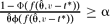 .
Proof. Follows directly from differentiating and rearranging.
Lemma 12. (x*(v − t*), v − t*) is increasing in v − t*.
Proof. Let 2 be the partial derivative of with respect to its second argument. By the envelope theorem,  .
Lemma 13. 1(L(v − t*), v − t*) > 0.
Proof. By lemma 4, is single peaked in its first argument. The combination of single peakedness and the fact that (, v − t*) = k at all equilibria with finite , implies that L(v − t*) < x*(v − t*) < M(v − t*). Because x*(v − t*) is the maximum and is single peaked, is increasing in its first argument to the left of x*(v − t*).
Proofs of Numbered Results
Proof of Lemma 1. Suppose players play a strategy profile with ai = 0 for all θi. The probability of victory is 0. If an individual were to consider deviating to participation, then the probability of victory would still be zero, because all individuals are measure 0. Thus, the payoff to the deviation is −k, whereas the payoff to not participating is 0 > −k.
Proof of Lemma 2. Differentiating, we have  . Now the result follows directly from the fact that mi, v − t* is increasing in θi.
Proof of Lemma 3. The argument in the text demonstrates that, given v − t*, a necessary condition for a cutoff rule (v − t*) being part of an equilibrium is ((v − t*), v − t*) = k. Thus, if (, v − t*) < k, then the strategy must assign the choice ai = 0. Furthermore, the second equilibrium selection criterion requires that if the strategy uses a finite cut-off rule for any v − t* satisfying (, v − t*) ≥ k, then it must use a finite cutoff rule for all such v − t*. Hence, if s ever chooses a finite cutoff rule, then it must do so whenever (x*(v − t*), v − t*) ≥ k as in the strategy in the lemma. The definition of equilibrium further requires that the cutoff rule be continuous in v − t*, except at the v − t* satisfying (, v − t*) = k.
All that remains is to show sufficiency of ((v − t*), v − t*) = k. For sufficiency, consider a profile in the revolution stage where all players employ such a cutoff rule. Fix v − t* such that a finite cutoff rule consistent with equilibrium exists, and consider a player with type θi < (v − t*). By lemma 2, IB(θi, (v − t*), v − t*) < k, so there is no profitable deviation to participating. Now consider a player with type θi > (v − t*). By lemma 2, IB(θi, (v − t*), v − t*) > k, so there is no profitable deviation to not participating. By construction, a player of type (v − t*) is indifferent.
Proof of Lemma 4.
1. Because k > 0, at any
that satisfies equation (5), (, v − t*) must be positive. Because 1 − Φ(f(, v − t*)) > 0 for all , this means that for (, v − t*) = [(1 − f(, v − t*))]γ to be positive, must be positive.2. From lemma 11,
(, v − t*) is increasing in if and only if is greater than the finite positive constant α. Furthermore, f(, v − t*) is clearly increasing in . Now, notice that because the normal density satisfies the monotone hazard rate property, is decreasing monotonically in , which implies that is decreasing monotonically in , for > 0. Thus, to prove that (, v − t*) = [1 − Φ(f(, v − t*))]γ is single peaked in for > 0, it is sufficient to show that there exists a sufficiently small that and a sufficiently large that . If this is true, then the fact that (, v − t*) is continuous and its slope is strictly decreasing will imply single peakedness.I start by showing that
. To see this, note that the limit of the numerator as goes to 0 is some positive finite number and the limit of the denominator is zero. Thus, for > 0 sufficiently small, (, v − t*) is increasing.Next I show that there is a sufficiently large
that (, v − t*) is decreasing. To see this, first note that (1, v − t*) is strictly positive. Next the following chain of inequalities shows that :
where f 1(, v − t*) = α is the partial derivative of f with respect to its first argument (). The first equality is due to l'Hopital's rule, whereas the second equality uses the fact that φ′(x) = −xφ(x), the third equality is algebra, and the fourth equality follows from the fact that f(, v − t*) is increasing in and f 1(, v − t*) = α is constant in . These equalities show that somewhere between = 1 and the limit, as goes to infinity, (, v − t*) is decreasing. The fact that the derivative of (, v − t*) is strictly decreasing for positive implies that whenever (, v − t*) first slopes down, it slopes down forever after, establishing that there is a single peak for positive .3.
where, in order, the equalities follow from (1) simple rearrangement, (2) l'Hospital's rule, (3) the definition of the PDF of the standard normal, (4) l'Hospital's rule, (5) the definition f(, v − t*) = α − β, (6) l'Hospital's rule, and (7) the numerator is a positive constant and the denominator goes to infinity.4. This point is immediate.
 is greater than the finite positive constant α. Furthermore, f(
 is decreasing monotonically in
 is decreasing monotonically in
 and a
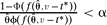 . If this is true, then the fact that
 . To see this, note that the limit of the numerator as
 :


Proof of Proposition 1. Lemma 1 shows that s∞ is consistent with cutoff equilibrium.
From lemma 3, we have that a strategy, s, that includes a finite cutoff rule is consistent with cutoff equilibrium if and only if the cutoff rule satisfies equation (5) and

Because sM and sL take this form and, by definition, L and M satisfy equation (5), both sM and sL are strategies consistent with cutoff equilibrium.
To see that there are no other cut-off rules consistent with cutoff equilibrium, it suffices to show that for any v − t* such that (x*(v − t*), v − t*) ≥ k, if (, v − t*) = k, then ∈ {L(v − t*), M(v − t*)}. By lemma 4, item 1, it suffices to consider positive cutoff rules. Now, recall from lemma 4 that (0, v − t*) = 0 and the limit of (, v − t*) as goes to infinity is also 0. Because is continuous and single peaked in its first argument, with peak (x*(v − t*), v − t*), it follows that, for ∈ (0, ∞), (, v − t*) takes all values in (0, (x*(v − t*), v − t*)) exactly twice. Because (x*(v − t*), v − t*) > k, this implies that (, v − t*) takes the value k exactly twice for ∈ (0, ∞), at L(v − t*) and M(v − t*).
Proof of Lemma 5. From proposition 1, an equilibrium finite cutoff rule exists if and only if (x*(v − t*), v − t*) ≥ k. From lemma 12, (x*(v − t*), v − t*) is strictly increasing in v. Thus, if there is a (η + t − t*), it must satisfy

From the definition of , it is immediate that limv → −∞ (x*(v − t*), v − t*) = 0. Because v = θ + η + t, and θ and η have full support on the real line, v has full support on the real line. Thus, for sufficiently small realizations of η + θ a finite cutoff rule consistent with equilibrium does not exist. Moreover, because (x*(v − t*), v − t*) is strictly increasing (by lemma 12) and continuous in v, and because by assumption 1. there exists some v such that (x*(v − t*), v − t*) ≥ k, then there is some v where the inequality holds with equality and for any larger v it continues to hold strictly, which establishes that a (η + t − t*) exists.
To see that (η + t − t*) is decreasing, notice that θ, η, and t are substitutes in v and do not enter anywhere else.
Proof of Lemma 6. Implicitly differentiating equation (5), we have that

The numerator is clearly negative. By lemma 13, the denominator is positive.
Proof of Lemma 7. If the population plays the equilibrium with no participation, then the payoff to any level of violence is simply −cE(t) and the optimal choice is t*= t.
Proof of Lemma 8.
1. This point follows from the argument in the text.
2. θ(η + t − t*) =
(η + t − t*) if and only if x*((η + t − t*) + η + t − t*) − Φ−1(1 − T)σε ≥ (η + t − t*). From lemma 5, (η + t − t*) is decreasing. This implies that the right-hand side of the previous inequality is decreasing in η. Now consider the left-hand side.
Differentiating equation (8), we haveSubstituting back in yields, so the left-hand side of the inequality is constant. Thus, the inequality holds for η sufficiently large. Label the minimal η as η(t − t*), given by x*((η + t − t*) + η + t − t*) − Φ−1(1 − T)σε = (η + t − t*).3. If θ =
, then it is decreasing (.) Suppose instead that θ = θ*. Implicitly differentiating equation (6) yields:
It is immediate from equation (5) that. An argument identical to that in the proof of lemma 13 shows that both derivatives are negative. Taken together, this implies that the numerator in the previous displayed equation is negative and the denominator is positive.


 , so the left-hand side of the inequality is constant. Thus, the inequality holds for η sufficiently large. Label the minimal η as
 .) Suppose instead that

 . An argument identical to that in the proof of lemma 13 shows that both derivatives are negative. Taken together, this implies that the numerator in the previous displayed equation is negative and the denominator is positive.
Proof of Lemma 9. There cannot be a corner solution and t because cE(t) = c′(t) = 0. If there is an interior pure strategy best response, then it must satisfy the first-order conditions. Differentiating the objective function yields the following first-order condition:

I use the following facts:
1. Implicitly differentiating equation (8) shows that
2.
does not depend on the over which we are integrating in the first and fourth terms of the first-order condition.3. In equilibrium, beliefs about t are correct.

 does not depend on the

Given these facts, we can rewrite the first-order condition as follows:

By the definition of η, θ*(η(0)) = (η(0)), so the third term on the left-hand side is equal to 0. Thus, the first-order condition reduces to

which is equivalent to the statement in the lemma.
To see that there can only be one such cutoff equilibrium, notice that the left-hand side of the equilibrium condition in equation (9) is finite and constant in t, while the right-hand side is strictly increasing. Thus, there is only one t* satisfying this condition.
Proof of Lemma 10. Differentiating the vanguard's objective function twice, the global second-order condition can be written:

for all t ∈ [t, ∞). It is straightforward that for any finite t, the left-hand side is finite. Thus, it is feasible to choose a cost functions such that σθ ση cE″(t) is greater than the left-hand side for all t. For any such cost function, the global second-order conditions are satisfied.
Proof of Proposition 2. Follows from proposition 1, lemma 7, and lemma 9.
Proof of Proposition 3. I make use of the following lemmata.
Lemma 14. L(θ + η) is increasing in T, increasing in k, and decreasing in γ.
Proof. Implicitly differentiating equation (5), we have

where the inequality follows from the facts that the numerator is positive and the denominator is positive by lemma 13.

where the inequality follows from the fact that the denominator is positive by lemma 13.

where the inequality follows from the fact that the numerator is negative and the denominator is positive by lemma 13.
Lemma 15. (η) is increasing in T, increasing in k, and decreasing in γ
Proof. Implicitly differentiating equation (8) and using the fact that because x*( + η) is a maximizer of with respect to x, we have 1(x*( + η), v − t*) = 0, yields

where the inequality follows from the fact that x * > 0 and (Φ−1)′ is positive because Φ is strictly increasing.


The number of people who mobilize is

Differentiating we have

where the inequality follows from the fact that  and
 from lemmata 14 and 15, respectively. Thus, as T increases, mobilization decreases and the number of people needed for victory increases, so the probability of victory also decreases.

where the inequality follows from the fact that  and
 from lemmata 14 and 15, respectively. Thus, as k increases, mobilization decreases and T stays constant, so the probability of victory also decreases.

where the inequality follows from the fact that  and
 from lemmata 14 and 15, respectively. Thus, as γ increases, mobilization increases and T stays constant, so the probability of victory also increases.
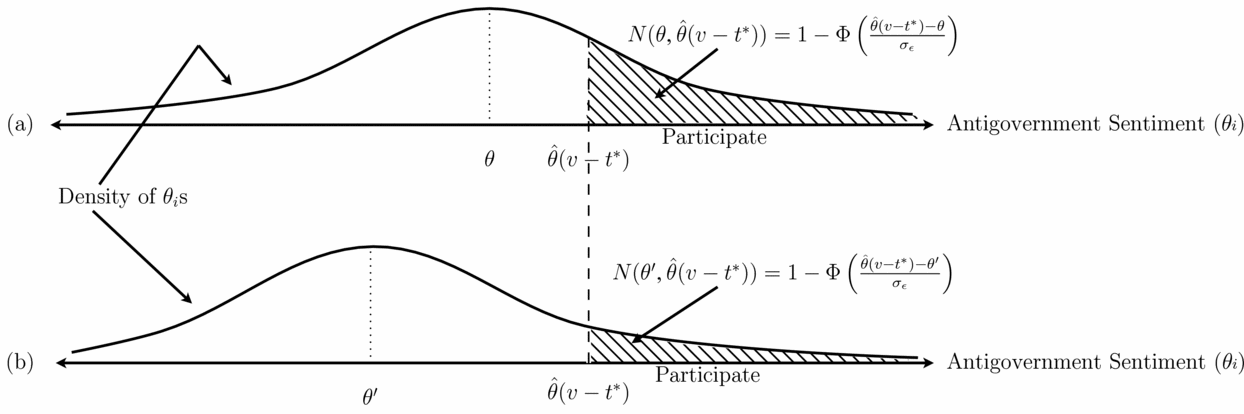
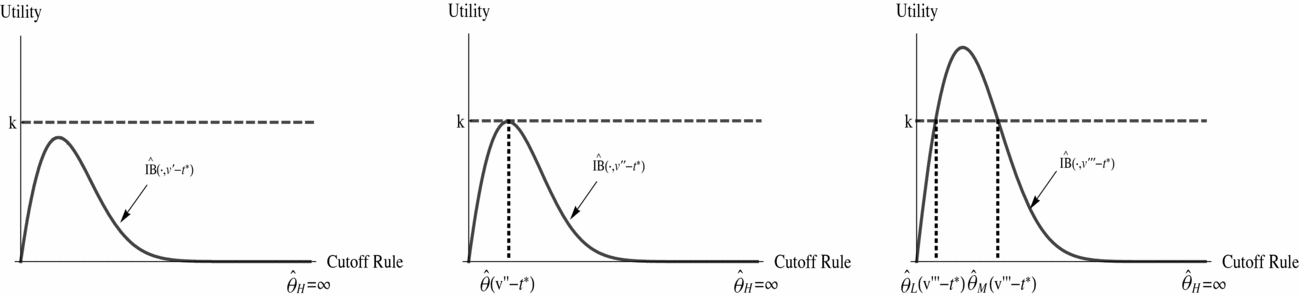
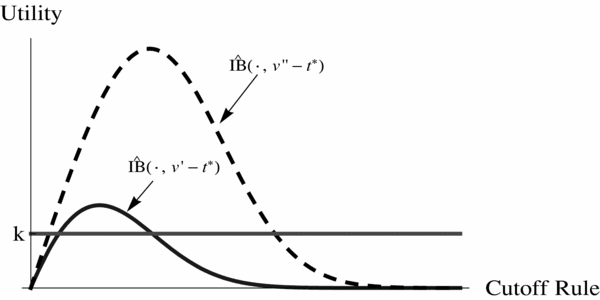
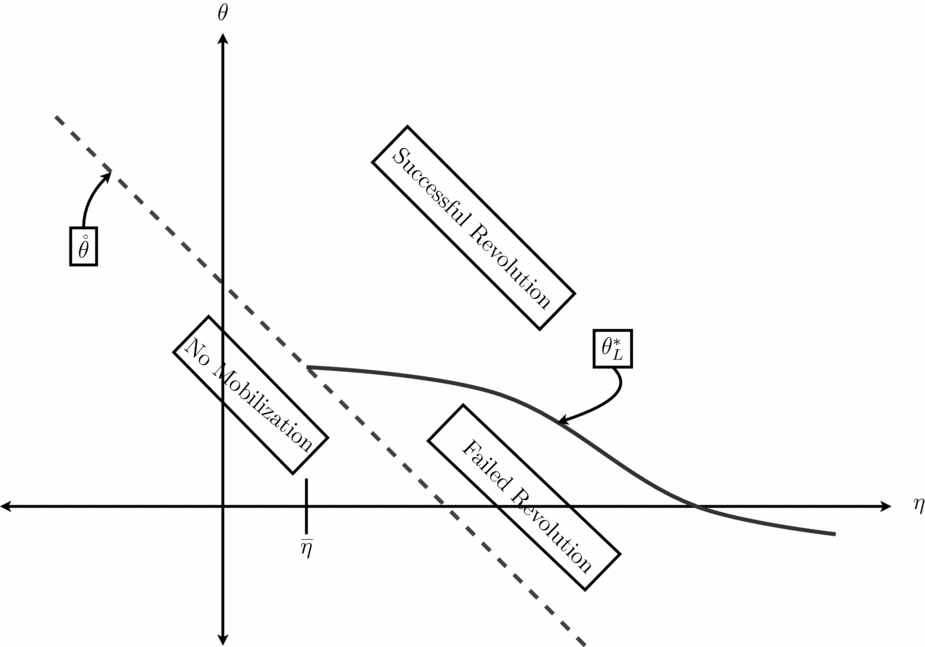
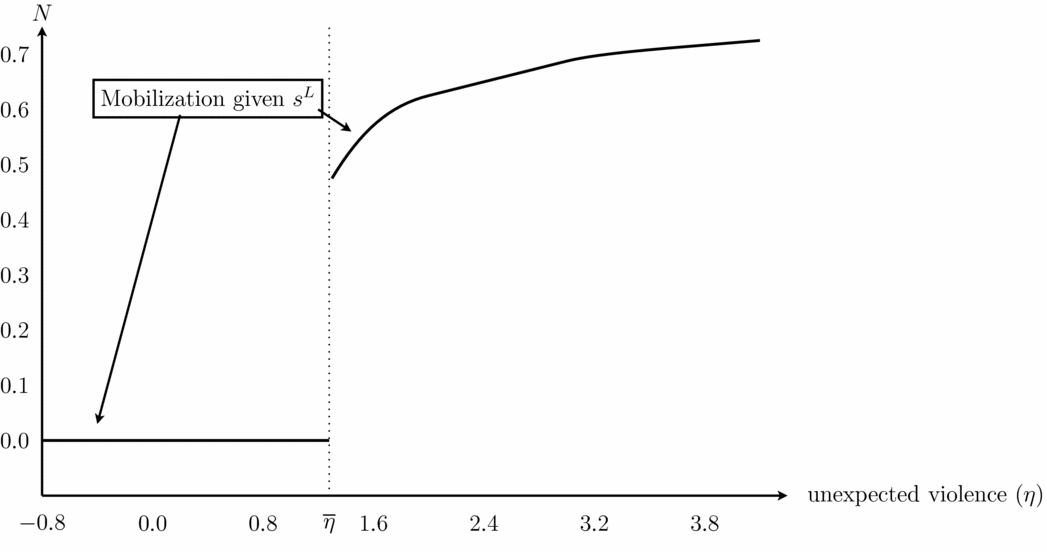



Comments
No Comments have been published for this article.