

The concept that artefacts can have biographies is now well established in archaeological discourse. The key tenet of the biographical approach is that objects accumulate histories over time as they become involved in different activities and move between different spaces and social contexts. It is only by considering this complete life history that the significance of a given piece of material culture can be fully understood (Kopytoff Reference Kopytoff1986). The biographies of objects are bound up with those of the people that interact with them, and the ‘birth’, ‘life’, and ‘death’ of an artefact may be seen as analogous to that of a person (Hoskins Reference Hoskins1998; Gosden & Marshall Reference Gosden and Marshall1999; Joy Reference Joy2009). Applications of these insights to Bronze Age metalwork include York’s (Reference York2002) analysis of finds from the Thames and Fontijn’s (Reference Fontijn2002) study of the southern Netherlands.
While there has been much discussion of the relationships between the lifecycles of humans and artefacts, entanglements between the biographies of different material objects have attracted less attention (Rainbird Reference Rainbird1999; Hodder Reference Hodder2012, 40–59). One way in which such an entanglement might arise is when one artefact is used to manufacture another. The tools used to make a given artefact will influence its form and attributes and hence its subsequent biography. Furthermore, in some cases the particular characteristics of a specific tool may leave a distinctive, recognisable trace on the object produced, making visible the ‘genealogical’ relationship between the two. This is particularly the case with metalworking moulds, which can in principle be matched with specific objects cast in them. Jones (Reference Jones2012) touches on this point by suggesting that Scottish Early Bronze Age axes cast from the same mould were conceptually linked by their common origin, thus forming ‘extended assemblages’. How this might have related to the significance or life histories of the moulds themselves is not considered, however. The same observation applies to other discussions of Bronze Age metalwork: while the role that moulds play in the lifecycles of other metal objects has been acknowledged, there is rarely much sense that they were artefacts with biographies of their own.
The large corpus of moulds from Middle and Late Bronze Age Britain provides good scope for examining this issue. Piece moulds made of three different materials are attested in this period: single-use clay moulds and reusable stone and bronze moulds (Tylecote Reference Tylecote1986, 84–93). Lost-wax (investment) moulds were probably also used to cast a few elaborate metal objects during the Late Bronze Age (Bowman & Needham Reference Bowman and Needham2007), though no such moulds have yet been discovered. The use of sand moulds is a further possibility, but would leave no archaeological trace (Ottaway & Seibel Reference Ottaway and Seibel1998).
This paper focuses on the life histories of the little-studied bronze moulds. The aim is not to reconstruct the complete biographies of individual moulds, which is problematic given the inevitably incomplete nature of the archaeological evidence (Joy Reference Joy2009, 543). Nor is it intended to present a single idealised biography of bronze moulds in general, which runs the risk of oversimplifying reality. Rather, we will discuss the range of possibilities that existed for the life courses of these objects during the three broadly defined stages of manufacture, use, and deposition. This is not therefore a pure application of the biographical approach as used by anthropologists (eg, Kopytoff Reference Kopytoff1986; Hoskins Reference Hoskins1998), but an adaptation tailored to the archaeological material. Two points will be emphasised. First, it will be shown that the biographical pathways available to bronze moulds differed significantly from those of moulds made from stone or clay, which may embody the differing properties and conceptual associations of these three materials. Secondly, the relationships between the life courses of bronze moulds and the objects cast in them will be explored, focusing particularly on cases in which moulds and their castings were deposited together in the same hoard. It will be suggested that the genealogical link between a mould and its ‘offspring’ could have formed a significant element of the biography of both objects.
The Corpus Of Bronze Moulds
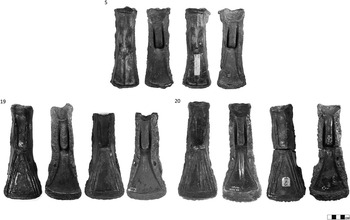
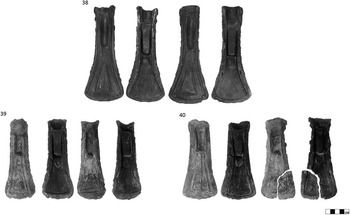
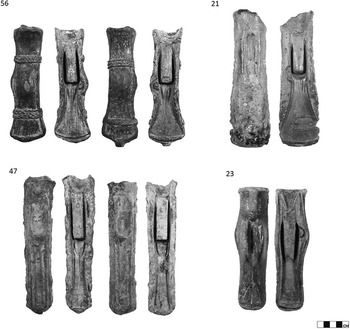
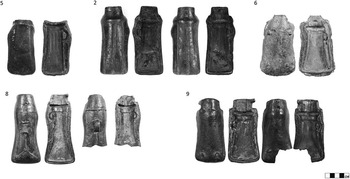
The most comprehensive previous catalogue of Bronze Age bronze moulds from Britain was produced by Tylecote (Reference Tylecote1986, table 53), based largely on earlier work by Hodges (Reference Hodges1960). Tylecote listed 29 moulds, of which two are erroneous duplicates.Footnote 1 Today at least 55, and possibly 57, moulds can be identified. These are catalogued in Appendices S1–S3, and selected examples are illustrated in Figures 1–6. Most of the moulds held in museum collections were examined first hand during the research for this paper.
Palstave moulds. 5: Hotham Carrs, East Yorkshire (© Trustees of the British Museum). 19–20: Deansfield, Gwynedd (© Trustees of the British Museum & Cambridge Museum of Archaeology and Anthropology)

Palstave moulds. 38: Harling, Norfolk (© Norfolk Museums Service). 39–40: Hempnall, Norfolk (Portable Antiquities Scheme, reproduced under creative commons licence)

Palstave, palstave-chisel, and end-winged axe moulds. 21: Llwyn-mawr, Gwynedd (© Trustees of the British Museum). 23: Boughton Malherbe, Kent (© Maidstone Museum). 47: Sutton Courtenay, Oxfordshire (© Trustees of the British Museum). 56: South Wiltshire (© Trustees of the British Museum)

Socketed axe moulds. 2: New Street, Cambridge (© Cambridge Museum of Archaeology and Anthropology). 5: White Edge, Froggatt, Derbyshire (© Derby Museums). 6: Heathery Burn, County Durham (© Trustees of the British Museum). 8–9: Brough on Humber, East Yorkshire (© Trustees of the British Museum)

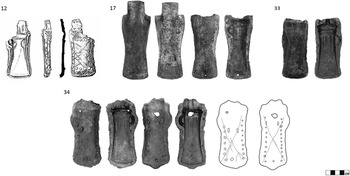
Socketed axe moulds. 12: Barling, Essex (drawing J. Johnston, originally published in Crowe Reference Crowe2003, © Essex Society for Archaeology and History). 17: Southall, Greater London (© Trustees of the British Museum). 33: Beacon Hill, Leicestershire (© Charnwood Museum). 34: Rothley, Leicestershire; sketch shows detail of external decoration (© Charnwood Museum)

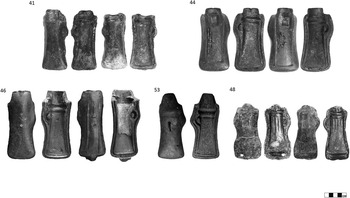
Socketed axe moulds. 41: Hevingham, Norfolk (© Norfolk Museums Service). 44: Unthank Road, Norwich, Norfolk (© Norfolk Museums Service). 46: Blewbury, Oxfordshire (Portable Antiquities Scheme, reproduced under creative commons licence). 48: Gobowen, Shropshire (© Shrewsbury Museum and Art Gallery). 53: Sutton, Suffolk (Portable Antiquities Scheme, reproduced under creative commons licence)

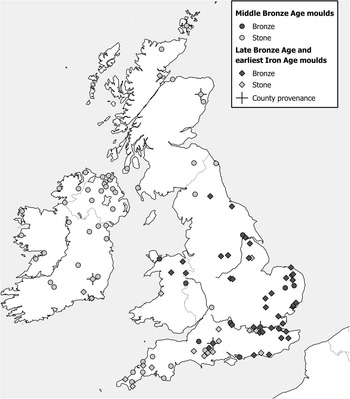
The moulds have been found in hoards or as unstratified single finds, many of the recent discoveries resulting from metal detecting. None comes from controlled archaeological excavations. The moulds are distributed across much of England and north Wales, but are absent from Scotland, south Wales, and the south-west peninsula. They are particularly numerous from East Anglia and the Thames estuary, reflecting both the large numbers of later Bronze Age hoards and the high intensity of metal detectorist activity in these areas. The distribution of bronze moulds is largely complementary to that of the other form of reusable mould, those made of stone (Fig. 7); clay moulds were used across the whole of Britain and Ireland. In parts of the south and east the use of bronze rather than stone to make reusable moulds may reflect a lack of suitable lithic resources, but this does not explain the dominance of bronze in areas such as north Wales. There was therefore an element of cultural choice in which material to use. On a European scale, south-eastern Britain and northern France form the main focus of the distribution of bronze moulds of this period, though a scattering of finds stretches from Iberia and northern Italy in the south to Sweden in the north and Lithuania in the east (Hansen Reference Hansen1991; Čivilytė Reference Čivilytė2004; Jantzen Reference Jantzen2008, pls 116–18). It is also possible that bronze moulds were used on a small scale in Ireland. A palstave mould held in the National Museum in Dublin is attributed to Ireland, though there is no record of its discovery (Ó Faoláin Reference Ó Faoláin2004). This mould – or just possibly another very similar one – is illustrated by Vallancey (Reference Vallancey1786), who states that such objects ‘are found in our [ie Irish] bogs’. The implication is that more than one Irish mould was known at the time, but it should be said that Vallancey’s writings are notorious for fanciful speculation.
Distribution of later Bronze Age bronze and stone moulds in Britain and Ireland. Not depicted are one bronze mould and c. 26 stone moulds with a vague/uncertain provenance to Ireland

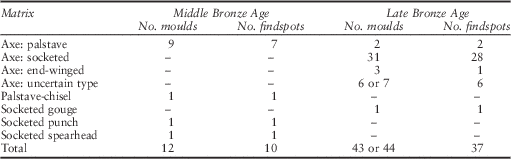
All of the moulds are bivalve (formed of two interlocking halves). Those from Britain were only used to cast a limited range of implements: almost all are for axes, with three for other tools (palstave-chisels, gouges, and punches), and one for spearheads (Table 1). The axe moulds are for palstaves, end-winged axes, and above all socketed axes. The socketed axes are of various styles, including the South-eastern, Southern English ribbed, Yorkshire, and Meldreth types (cf. Needham Reference Needham1990; Schmidt & Burgess Reference Schmidt and Burgess1981), though the South Welsh/Stogursey type is notably absent. The main focus of the latter axe type lay outside the distribution of bronze moulds, and their production instead involved stone matrices (Needham Reference Needham1981). Axes and other tools also dominate the moulds from the Continent, with rare examples for ornaments and weapons (Hansen Reference Hansen1991).Footnote 2
Summary of Bronze Age bronze moulds from Britain

Moulds from hoards are listed by date of hoard deposition. In this and other tables the uncertain mould from Heathery Burn (Cat. No. 57) is excluded
Though a few Continental bronze moulds may date to the Early Bronze Age, they were not used in Britain until the Middle Bronze Age (c. 1500–1150bc). Accepted typological schemes would place the spearhead mould and most of the palstave moulds in this period, though one palstave mould fragment (Isleham) has been found in a hoard dated to the early part of the Late Bronze Age (Wilburton metalworking tradition, c. 1150–1000bc). The socketed axe moulds are ascribed to the Late Bronze Age, and occur in hoards dating through to c. 1050–800bc (Ewart Park/Carp’s Tongue metalworking traditions). The Roseberry Topping mould might date to as late as the transition to the Iron Age, around 800bc (O’Connor Reference O’Connor2007, 66).
The Design And Manufacture Of Bronze Moulds
Chemical analyses have shown that the moulds were made of tin bronze, the Late Bronze Age moulds also generally having a significant lead content (up to 11%: see Appendix S4). The alloy compositions of the moulds were thus typical for bronzes of the period: the tin and lead contents were not reduced to raise the melting points of the moulds. In fact, analyses of the Hotham Carrs and Brough on Humber hoards have shown that moulds and axes actually cast in them shared a similar alloy recipe (Cat. Nos 9 & 10), though this is less evident for the other mould from the Brough on Humber hoard (No. 8).
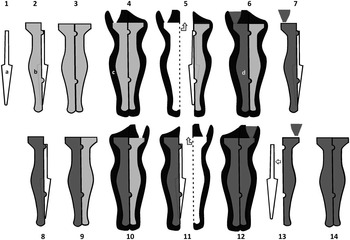
We have two main clues for the method of manufacture of the moulds. First, the exterior surface finish of these objects makes it clear that they were cast using clay moulds, though no such moulds have yet been discovered. The clay mould used to make one of the Gobowen mould valves had evidently cracked during casting, leaving a rough ridge across the exterior of the finished object (Fig. 6.48). Secondly, the often remarkably close fit between the articulating surfaces of the two mould valves suggests that they were made in sequence, the second perhaps being cast directly against the first. One mould from the Isle of Harty hoard (No. 29) has a crack on the articulating surface of one valve – presumably a casting flaw – reproduced in relief on the corresponding surface of the other valve. Beyond these observations, the exact method of production is uncertain, though it must have been a lengthy and complex process. One possible multi-stage method proposed by Hodges (Reference Hodges1960) is outlined in Figure 8. Alternatively, it has been proposed that at least some bronze moulds from the Continent were cast using the lost wax technique (Armbruster Reference Armbruster2000; Wirth Reference Wirth2003).
One possible method of casting a bronze mould, after Hodges (Reference Hodges1960). a: Pattern for object to be cast in the mould; b: Clay forming shape of mould; c: Clay encasing mould model for casting; d: Bronze. The suggested stages are as follows. 1: Make the pattern to form the matrix of the mould; 2: Encase one side in clay forming the desired mould shape; 3: Encase the second side in clay to correspond with the form and fixings of the first side; 4: Wrap entire clay mould model in clay leaving a gap that will form the gate or sprue cup; 5: Separate the two halves and remove one side of the clay mould; 6: Re-join the two halves and pour molten bronze into the cavity; 7: Remove all clay parts and separate the sprue cup from the mould; 8–9: Re-use existing clay mould model or make a new one (Hodges assumes the former); 10: Encase the entire part metal and clay mould in clay; 11: Remove the clay half of the mould keeping the outer casing; 12: Re-join the outer casing and pour molten bronze into the cavity; 13: Remove the clay casing plus the sprue cup and pattern from the second half of the mould; 14: The finished bronze mould. Although not mentioned by Hodges, the clay mould models and outer mould shell would need drying or firing before use

As a group, the moulds show some consistent features in design but also variations, reflecting differing local traditions and the choices of individual smiths. One change over time relates to the registration of the two valves. The Middle Bronze Age palstave and spearhead moulds mimic clay moulds in having raised tenons on one valve which fit into corresponding sockets on the other. In the Late Bronze Age a new method was developed, with a raised ridge running around the edge of one valve fitting into a slot on the other valve. This can be seen on most of the socketed axe moulds, and also on the palstave mould from the Isleham hoard. A few moulds show a combination of both the ridge and tenon technique (eg, Fig. 6.44). The Gobowen mould uses another approach: the valves are of slightly different sizes, so that the smaller nestles within the raised rim of the larger (Fig. 6.48). A further innovation seen on some Late Bronze Age socketed axe moulds was the provision of a small chamber adjacent to the loop part of the matrix and connected to it by a narrow channel (eg, Figs 4.2, 4.5, 4.6, & 4.9). A similar chamber alongside the blade edge of the matrix can be seen on the Gobowen mould (Fig. 6.48). Needham (Reference Needham1993) suggests that these helped to prevent miscasting of the axe loops: the chamber acted as an overflow allowing the escape of gases and some metal during casting, thus ensuring that the loop matrix filled fully with no gas pockets. Some axes have small ‘spurs’ on their loops resulting from the use of such a mould.
Another feature of some Late Bronze Age moulds is a loop-handle on the exterior of each valve (eg, Fig. 6.53). These may have been used for manipulating the moulds when hot, or to anchor cords tied to secure the valves together. Raised knobs or pellets on the exterior of some other moulds could also have helped to prevent cords from slipping, though many may rather have had a decorative or symbolic role, given that they were often integrated into a more complex ornamental design.
At least 25 moulds show cast decoration on their exterior, mostly formed of raised ribs and pellets. In addition, a number of the plain moulds have a carefully smoothed exterior that suggests aesthetic concern, though some others had been left quite rough. Some moulds share similar decorative motifs, notably the five palstave moulds from Harling and Hempnall in Norfolk and Deansfield in north Wales, which are all ornamented with nested triangles formed of raised lines (Figs 1.19–20 & 2.38–40). Others have patterns of parallel ribs along the length of the mould (eg, Figs 3.47, 4.2, & 6.46). The overall impression, though, is of diversity. The Barling and Rothley moulds, for example, have elaborate though differing designs incorporating criss-crossing lines and rows of pellets (Figs 5.12 & 5.34). Entirely unique is the South Wiltshire palstave mould, which has raised ‘cords’ around the exterior of each valve, evidently cast from impressions of actual cord or twine (Fig. 3.56). The process by which this may have been achieved has been described elsewhere (Evans Reference Evans1881; Clark Reference Clark1905; Hodges Reference Hodges1960). While it has been assumed that the cord effect was an incidental by-product of the process used to manufacture the mould, it is certainly visually arresting. It can be regarded as a skeuomorphic representation of the cords that would have been bound around the mould when it was used for casting. The same might also be true of the raised bands on the Barling and Rothley moulds.
While some axes also have simple decoration formed of ribs and/or pellets, the specific designs on the moulds never correspond to features on the objects cast in them. In fact, the decoration on some moulds such as the Barling and South Wiltshire examples is difficult to parallel on any other Bronze Age metalwork. The idiosyncrasy of the decoration gives the moulds an individuality, contrasting with the plain and generic nature of the implements that they were used to make. If the moulds were made by smiths for their own use, or the use of others in the same workshop, then they may not have been subject to the same strictures as objects such as axes which circulated widely and hence had to conform to certain culturally acceptable designs. It was never considered appropriate to decorate moulds made of other materials, though stone moulds often have well finished exteriors.
The most obvious inference to draw from the practice of decorating bronze moulds is that these were regarded as significant or prestigious objects. However, ethnographic case studies suggest that decoration is applied to some items of material culture not so much to emphasise their value as to confront their ambiguous, transgressive, or dangerous nature. For example, Braithwaite (Reference Braithwaite1982) argues that among the Azande of Sudan decoration is applied to pots used in situations that may compromise the idealised distinctions between men and women. Denyer’s (Reference Denyer1978) survey of African traditional architecture similarly shows that decoration is often applied to points of potential social stress or ambiguity, as well as to elements at risk of structural failure. This is relevant as metalworking is a transformative process that in some societies involves ritual and taboo, though it should be stressed that this does not apply everywhere (Kuijpers Reference Kuijpers2008). Furthermore, in all pre-industrial settings metalworking is risky and prone to failure, potentially resulting in physical harm to the participants. The decoration of Bronze Age bronze moulds may thus have been a means of dealing with the conceptual and physical dangers of metalworking and ensuring success in the casting process. It is tempting to suggest, for example, that the skeuomorphic cords around some of the moulds might have carried connotations of strength and security intended to aid successful casting.
The Use Of Bronze Moulds
There has in the past been resistance to the idea that bronze moulds would have been used for the direct casting of bronze objects, some arguing that their purpose was for making lead or wax patterns for investment casting (eg, Tylecote Reference Tylecote1986, 92). It is true that some Late Bronze Age socketed axe moulds were used for lead casting, as at least six, and possibly nine, examples show deposits of lead coating the upper part of the matrix of one or both valves (Cat. Nos 2, 17, 31, 33, 37, & 54; reported lead on No. 45 no longer visible; Nos 4 & 46 have unidentified metal residues). In some cases this deposit forms a layer with a sharp, broken edge, suggesting that the lead broke as the casting was prised from the mould.Footnote 3 A few lead or lead alloy socketed axes found in southern Britain – all within the distribution area of bronze socketed axe moulds – provide examples of the intended product (Needham & Hook Reference Needham and Hook1988; Guilbert Reference Guilbert1996). Why these lead axes were made is however unclear; it is possible that they had nothing to do with bronze casting, but instead served as ingots or as symbolic or votive models of axes. There are serious practical difficulties with the idea of ‘lost-lead’ casting (Foltz Reference Foltz1980), and casting flashes are routinely found on later Bronze Age bronze axes, indicating that they were normally made in bivalve moulds (Needham & Hook Reference Needham and Hook1988). Lead axes could of course have been used as patterns for making bivalve clay moulds, but there would be little sense in going to the effort of making a bronze mould just to produce this kind of one-off pattern (Needham & Hook Reference Needham and Hook1988).
Lead deposits are not found on Middle Bronze Age moulds, nor to the authors’ knowledge on any of the many moulds from the continent. As such, there is no reason to doubt that the main purpose of bronze moulds was for direct bronze casting, the casting of lead axes being a later secondary development. Experimental bronze castings using replica bronze moulds (Drescher Reference Drescher1957; Stansby Reference Stansby1984; Jochum Zimmermann et al. Reference Jochum Zimmermann, Künzler Wagner and Kunnert2003; Wirth Reference Wirth2003; Ottaway & Wang Reference Ottaway and Wang2004; Fregni Reference Fregni2014, 154; Heeb & Ottaway Reference Heeb and Ottaway2014, 180) and an original axe mould from France (Voce Reference Voce1951) have shown that they were well suited for this purpose. Perfect refits between moulds and corresponding bronze implements from individual hoards (see below) suggest direct casting; if bronze moulds had been used to make patterns for clay moulds then one would expect the final casting to be rather smaller than the original bronze matrix (Howard Reference Howard1983, 492). A few moulds have what appear to be small patches of bronze accretions on their interior, though it is difficult to be certain that these are residues of castings.
Some details of the casting process can be deduced. To help prevent the cast from adhering, the mould matrix was probably dressed with a substance such as soot, charcoal, or fine clay. Possible traces of a carbon coating have been identified on the Isleham mould (Coombs Reference Coombs1971, 397–8) and on a bronze mould from France (Mohen Reference Mohen1978, 29). Another from Poland has beeswax residues, argued to be a fixative for a carbon dressing (Baron et al. Reference Baron, Miazga, Ntaflos, Puziewicz and Szumny2015), though this seems unlikely as the wax would tend to cause casting failures. For casting socketed implements, a core would be required. These were probably made of clay (Howard Reference Howard1983), and are not usually preserved except in rare cases where traces were retained in the casting, though reusable bronze cores are known on the Continent (eg, Cordier Reference Cordier2012, figs 4–5). The mouths of the moulds show varying arrangements for securing the core in place (Hodges Reference Hodges1960, 158; Leahy Reference Leahy1977; Tylecote Reference Tylecote1986, 92). As we have seen, the mould valves were probably then bound together using a cord to prevent dislocation, though a hermetic seal was not desirable, as it would prevent the escape of gases during the casting. Finally, it was essential to heat the mould to at least 100°C for the casting to be a success (Drescher Reference Drescher1957).
Several moulds show wear or damage that may have resulted from use. Some have fine cracks at the edge of the matrix, though as we have seen these could have been casting flaws. In other cases the loop-handle on the exterior has broken off (eg, Fig. 4.8). Smoothing through wear can be seen on some of the matrices and occasionally on the exterior decoration. The potential use life of the moulds is unknown. Ottaway and Wang (Reference Ottaway and Wang2004) found that their experimental moulds were cracked and unusable by the tenth casting, but Drescher (Reference Drescher1957) achieved 15 castings without any trace of damage, using a much more faithful replica mould. In recent experimental work, Fregni has used the same mould multiple times without mishap (E. G. Fregni pers. comm.). Assertions that around 50 castings would have been the limit (Coghlan Reference Coghlan1975; Tylecote Reference Tylecote1986, 92) are baseless.
As all of the bronze moulds were deposited in the landscape, away from excavated sites (see below), we have no direct evidence for the spatial or social contexts in which they were used for casting. However, the distributions of finds such as casting waste, broken crucibles, and clay and stone moulds from excavated settlements suggest that there were social conventions in later Bronze Age Britain concerning the appropriate settings for different kinds of metalworking.Footnote 4
It is known that later Bronze Age stone moulds were sometimes transported considerable distances from their lithological source (eg, Needham Reference Needham1981). Bronze moulds may well have moved in similar ways during their life histories, either through exchange networks or the mobility of individual metalworkers, though this is difficult to prove. The moulds have generally been found within the main distribution area of the object type they produced, and refits between moulds and their castings have so far only been identified within the same hoard (see below) or on a fairly local scale. For example, a casting from the Roseberry Topping mould was reportedly found 40 km away at Forcett, North Yorkshire (Schmidt & Burgess Reference Schmidt and Burgess1981, 243).
The question of why bronze moulds were used to cast such a limited range of artefacts – almost exclusively axes and a few other tools – has not received enough attention. Stone moulds were used to make a much wider range of objects during the British Middle Bronze Age, including tools, weapons, razors, and personal ornaments, though by the Late Bronze Age they were restricted to axes and ornaments. Clay moulds were often associated with weapons during both the Middle and Late Bronze Age, but were also used for axes, other craftworking tools, sickles, razors, and ornaments (cf. Tylecote Reference Tylecote1986, tables 49–50; Needham & Bridgford Reference Needham and Bridgford2013, table 3.7). With the possible exception of long, complex castings such as swords (Howard Reference Howard1983, 493), there is no essential reason why the artefact types represented only by clay and/or stone moulds could not also have been cast in bronze moulds. Indeed, bronze piece moulds were used for casting small personal ornaments in the Romano-British and medieval periods (eg, Bayley et al. Reference Bayley, Mackreth and Wallis2001), yet as far as we know this never occurred in the British Bronze Age.
Part of the explanation may lie in the distinction between single-use and reusable moulds. A key feature of bronze moulds is that while their manufacture required a significant investment of time, they could then be used repeatedly, with several castings per day possible. This made them particularly suitable for casting objects such as axes, which were produced in large numbers during the later Bronze Age and were often quite generic in form. It may have been regarded as too much effort to make a bronze mould for one-off artefacts, or those required in small numbers, when single-use clay moulds could have served this purpose. This does not provide a full explanation, however, as effort was expended in producing reusable stone moulds for a number of artefact types not represented among the bronze moulds. It should also be stressed that the manufacture of clay moulds could be a rather lengthier and more complex procedure than many archaeologists have assumed (Ó Faoláin Reference Ó Faoláin2004).
Another part of the explanation may relate to the functional properties of mould materials. Experimental work has shown that bronze cast in moulds of different materials has a differing microstructure (Staniaszek & Northover Reference Staniaszek and Northover1983; Jochum Zimmermann et al. Reference Jochum Zimmermann, Künzler Wagner and Kunnert2003; Wirth Reference Wirth2003; Ottaway & Wang Reference Ottaway and Wang2004). Ottaway and Wang found that axes made in bronze moulds had a smoother surface finish and were harder than those cast in clay or sand moulds. The differences were only slight, however, and caution is needed as the experimental mould used was very different in design from actual Bronze Age examples. The smoothness and hardness of a completed implement will also very much depend on the smithing work carried out after casting. Furthermore, hardness was hardly likely to have been less of a concern when making bladed weapons, which were normally cast in clay or stone moulds.
We have to conclude that certain materials were considered appropriate or auspicious for casting particular artefact types partly for cultural reasons that are not easy for us to grasp today. A comparison can be drawn with Martinón-Torres and Uribe-Villegas’ (Reference Martinón-Torres and Uribe-Villegas2015) ethnographic and archaeological study of Muisca metalworking in Colombia, in which they argue that the performance of production and the materials used were as important as the final product. Thus the lost wax process was employed to make ritual gold objects even when this does not seem the most logical method, and this preference is argued to relate to the cultural significance of wax and bees in this region of South America. In a similar way, the three materials used for mould making in Bronze Age Britain may have had particular conceptual associations, perhaps relating to their contrasting origins, or to their sensory properties such as colour, feel, or sound. There are also differences in the performative aspects of using the three mould types. Thus in contrast to bronze and stone moulds, clay moulds usually had to be smashed to release the casting within. Perhaps this dramatic procedure was seen as particularly appropriate for the manufacture of certain object types.
Breakage And Deposition Of Bronze Moulds
It is assumed that most bronze moulds would have been melted down and recycled once their use life was over. We have only those whose biographies took a different path by being deposited in the ground.
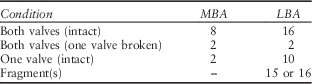
Twenty-four of the moulds are essentially complete and intact. Some of these seem to have been deposited in a usable condition, though several others have lead deposits or some form of damage that would have made their use difficult or impossible. Other moulds are broken and incomplete, this becoming much more common in the Late Bronze Age (Table 2). In a few cases the breaks are irregular and could perhaps have resulted from accidental fracturing during use, but several others were clearly broken deliberately, such as the Grays Thurrock and Isleham moulds which have been quite cleanly chopped in half. Such breakage – which may have required the skills of metalworkers – would have been a dramatic way of ending the use stage of the lifecycle of these objects. The missing parts of the incomplete moulds may have been recycled, though it seems that different parts of a single broken bronze object were sometimes circulated and deposited separately during this period (Bradley & Ford Reference Bradley and Ford2004).
Condition of bronze moulds as recovered

Evidently modern breaks have been disregarded. Note that some incomplete moulds are single finds that could have originally been deposited in a more complete state. Moulds from hoards are listed by date of hoard deposition
The majority of the moulds (n=37) had been placed in hoards with other bronze objects, with up to four moulds per hoard. Not included in this tally is the mould from Heathery Burn, which is part of a large collection of Late Bronze Age metalwork and other artefacts recovered from different locations within a cave. Hoards containing moulds fall into two broad groups. The first consists of relatively small hoards in which the moulds are usually complete – or represented by one intact valve – and are mainly accompanied by unbroken axes (eg, Gwernymynydd; Washingborough). The second group, dating only to the Late Bronze Age, comprises large so-called ‘scrap’ hoards of deliberately broken bronze objects in which the moulds are usually only represented by a single fragment (eg, Crundale; Isleham). The remaining moulds have been found singly (or in one case as a pair) as unstratified finds. Some of the single finds may of course derive from disturbed hoards. In common with many other categories of metalwork, bronze moulds seem to have been deliberately excluded from deposition in settlements. This contrasts with moulds made of clay or stone, which could be deployed in deliberate deposits marking the foundation or abandonment of an enclosure or building (eg, Brück Reference Brück2006, 303).
Whatever the exact motivations for accumulating bronze artefacts and burying them in the landscape, a ritual aspect to this practice is clear (Bradley Reference Bradley1998). Burying metal objects in the ground did not mark the end of their life histories so much as a threshold: they were transferred from one realm to another, perhaps being placed in the care of deities or ancestors. The incorporation of moulds in such deposits, in some cases accompanied by ingots, casting jets, or smithing tools, may suggest that the associated rites made reference to the metalworking process. Perhaps at least some were acts of offering intended to maintain supplies of raw metal (Helms Reference Helms2012) or ensure success in metalworking. Alternatively, as moulds served to transform metal from one form to another the significance of their inclusion in deliberate metalwork deposits could have been as metaphors for other processes involving transformation and rebirth, such as the lifecycles of people, livestock, or crops (Brück Reference Brück2006).
Certain landscape contexts were preferentially selected for metal deposits during the Bronze Age, many being placed on valley slopes or low rises overlooking watercourses (Yates & Bradley Reference Yates and Bradley2010), though other locations such as prominent hills, rock clefts, or caves also recur. The find locations of the bronze moulds follow these wider trends. Several hoard and non-hoard finds overlook rivers (eg, Sutton; Wilmington). The Roseberry Topping hoard was deposited in a rock cleft near a spring, half way up a tall hill with an unusual and dramatic profile (Pearce Reference Pearce2006). The Beacon Hill mould is also from a prominent rocky hill, crowned by a hillfort of uncertain date. The White Edge mould and Donhead Clift hoard were associated with steep scarps. As we have seen, the Heathery Burn mould came from a cave, located in a ravine formed by a small river. The recovery of large quantities of Late Bronze Age metalwork, other artefacts, animal bone, and human remains suggests that the cave was a focus for repeated rituals.
Though the Isleham hoard was shown by excavation to have been placed in a pit cut into a boundary ditch close to a fen inlet (Malim Reference Malim2010), it is notable that bronze moulds were only ever deposited on dry land. This contrasts with some other bronze artefact types, especially weapons, which were often placed in rivers and other wet places. It also contrasts to the situation on the Continent, where several bronze moulds have been found in bogs or rivers, including the Meuse and Saône (Evans Reference Evans1881, 441; Čivilytė Reference Čivilytė2004; Jantzen Reference Jantzen2008; Kuijpers Reference Kuijpers2008; Baron et al. Reference Baron, Miazga and Nowak2014). However, the deposition of the British bronze moulds does echo that of their main products – axes – which were also generally deposited in hoards or as single finds on dry land (eg, Roberts & Ottaway Reference Roberts and Ottaway2003). The deliberate breakage of these objects can also be similar, as for example in the Grays Thurrock hoard where the socketed axe mould and several of the socketed axes had been chopped in half in the same manner (Turner Reference Turner2010).
Material Genealogies: Hoard Associations Of Moulds And Their Castings
The connections in the treatment of moulds and their products go further than this, as several hoards containing moulds also contain implements that had actually been cast in them. This is demonstrated by exact refits between mould and casting, allowing for the fact that the blade edges of axes would normally have been hammered out after they were cast. In addition, in some cases casting flaws on the mould matrix have left a clear ‘fingerprint’ on the implements produced. The most striking example is the Isle of Harty hoard, containing three socketed axe moulds and castings from each of them (five castings from No. 29; one from No. 30; three from No. 31).Footnote 5 Other examples include the hoards from Isleham (palstave mould fragment and at least one casting); Hotham Carrs (palstave mould and two castings); Hayling Island (punch mould and one casting); Blewbury (socketed axe mould and three castings, these objects comprising the entire hoard); and Brough on Humber (two socketed axe moulds and one surviving casting from each). In addition, Greenwell and Clinch (Reference Greenwell and Clinch1905, 204) state that some of the axes from the Heathery Burn cave ‘were probably cast in the mould’ found there, but this cannot be verified as many of the axes are now lost. The nine moulds known to have been deposited with their castings represent just under a quarter of all moulds from hoards. The practice may well have been more widespread than this, as several hoards containing moulds have not been examined for refits.Footnote 6 Hoards with moulds and their castings are also known on the Continent (eg, Vron, Picardy: Agache Reference Agache1968, 298–9).
The evidence should not be pushed too far, and it should be stressed that most bronze moulds were not deposited with their castings. If one views (many) hoards simply as random accumulations of scrap assembled within a given community, then one might expect associations between moulds and their castings to occasionally occur through chance. However, given the abundant evidence for deliberate structuring in the contents and arrangement of some hoards (eg, Barber Reference Barber2003), we should not dismiss the possibility that such associations could be meaningful. The Hayling Island example hints at this, as here the casting was actually nestled within and fused to one valve. Though there is a small possibility that this was a failed casting that could not be removed, it is more likely that the punch was placed back into the mould when it was deposited in the hoard, and subsequently adhered to it through corrosion (S. Needham pers. comm.). This could suggest a desire to emphasise the connection between these two objects. The same practice might also have occurred in the Brough on Humber hoard. Few details are known about the discovery of this hoard – and most of it is now lost – but a tantalising near-contemporary account implies that axes were found enclosed within their matrices (Briggs et al. Reference Briggs, Leahy and Needham1987, 13).
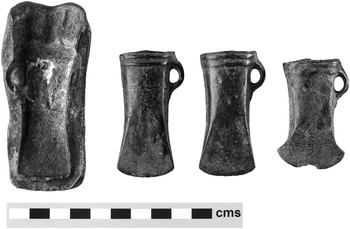
How moulds and their castings came to be deposited together seems to have varied. In the case of the Blewbury hoard, the axes were recorded as having fresh, undamaged edges and casting seams (Portable Antiquities Scheme report BERK-56BD17). They may thus have been deposited together with the mould soon after they were cast – perhaps being made specifically for deposition – though it is also possible that they had been lightly used and then resharpened. The Isle of Harty hoard is quite different. Examination of the nine refitting axes using a hand lens (×15 magnification) suggests that all had been used to varying degrees. In other words, after casting each accumulated their own history of use, perhaps passing into different hands along the way, before they were reunited with their parent mould in the hoard. The blade edges variously show diagonal scratches, blunting, burring, or nicks, which can be confidently identified as traces of activities such as woodworking, by comparison with observations from experiments using replica bronze axesFootnote 7 (Kienlin & Ottaway Reference Kienlin and Ottaway1998; Roberts & Ottaway Reference Roberts and Ottaway2003; Moyler Reference Moyler2007). The three axes cast from mould No. 31 showed markedly divergent histories of use (Fig. 9). While two are in a reasonable condition, the third has a significantly shortened and splayed blade indicating repeated use and resharpening, and a large chip in its cutting edge. This shows how objects sharing the same origin and beginning life in a near-identical form could develop a quite different appearance, tangibly displaying their own history of use.
Socketed axe mould (Cat. No. 29) and three castings from the Isle of Harty hoard, Kent (© Ashmolean Museum)

Conclusion
The corpus of bronze moulds presented here provides a platform on which further research can be built. Much scope still remains for traditional typological study of these objects, such as more detailed examination of the specific artefact styles cast, and the distributions of these compared to the moulds. Further scientific analysis would also be useful to shed more light on how the moulds were made and used.
The present paper has explored the range of biographical possibilities available to bronze moulds. While these artefacts were not all made, used, and deposited in the same ways, certain practices did tend to recur – in other words, some life courses were more culturally acceptable than others (Fontijn Reference Fontijn2002). It is notable that the treatment of bronze moulds often differed from that of moulds made of clay or stone. For example, at the stage of manufacture bronze moulds were distinguished from those of other materials through the fact that many were decorated. The use of bronze moulds was almost exclusively limited to casting axes and other craftworking tools; stone or clay moulds were normally seen as the only appropriate media for casting other artefacts such as weapons, razors, or ornaments, even in those areas in which bronze moulds were in use. The appropriate treatment of the three mould types at the end of their use life also diverged. While the deposition of clay and stone moulds was often linked to significant episodes in the histories of settlements or enclosures, the deposition of bronze moulds was associated with rites involving the placing of metalwork in the wider landscape, though they were never included in metal deposits in water. The distinctive material properties and attendant cultural associations of bronze, stone, and clay may have been a factor in determining these divergent life paths.
It has also been suggested that the biographies of moulds could have been bound up with those of the implements that they produced. At a general level, a conceptual association between bronze moulds and the objects cast in them may be shown by similar treatment through deposition and breakage. It also seems possible that a specific genealogical link between a ‘parent’ mould and its ‘offspring’ castings could be remembered and marked through their deposition together in a single hoard. The example of the Isle of Harty hoard shows that axes with markedly contrasting use histories could be reunited with each other and with the mould that created them. Perhaps this in turn embodied social ties between the metalworker that had produced the axes and those that had used them. This illustrates the point that the life histories of artefacts should never be viewed in isolation; they would always have been entangled with the biographies of other objects and people.
Acknowledgments
This paper forms part of the project The Social Context of Technology: Non-ferrous metalworking in later prehistory, funded by the Leverhulme Trust. Many thanks are due to Joanna Brück, Jody Joy, Stuart Needham, and Neil Wilkin for their helpful comments on an earlier version of this paper. Giovanna Fregni, Andrew Lawson, and Brendan O’Connor kindly provided information and Paul Craddock generously made his unpublished mould analyses available for inclusion. Thanks also to the many museum and HER staff who assisted our research, including Alan West at Norfolk HER, Lisa Brown at Devizes Museum, Rose Nicholson at North Lincolnshire Museum, and staff of the Ashmolean Museum, the British Museum, Cambridge Museum of Archaeology and Anthropology, Charnwood Museum, Derby Museums, Maidstone Museum, Norwich Castle Museum, Sheffield Museums, Shrewsbury Museum and Art Gallery, and West Stow Museum.
Supplementary Material
To view supplementary material for this article, please visit http://dx.doi.org/10.1017/ppr.2016.8