Stigma towards persons with a mental illness may be associated with substantial negative psychological, physiological and economic outcomes. (Day et al. Reference Day, Edgren and Eshleman2007). Stigma has also been shown to lead to withdrawal, secrecy and lowered self-esteem (Ritsher & Phelan, Reference Ritsher and Phelan2004; Ilic et al. Reference Ilic, Bohner, Hans-Onno, Beblo, Driessen, Frommberger and Corrigan2012), and has been identified as a barrier to both seeking treatment and adhering to treatment programmes (Clement et al. Reference Clement, Schauman, Graham, Maggioni, Evans-Lacko, Bezborodovs, Morgan, Rüsch, Brown and Thornicroft2014; Rüsch et al. Reference Rüsch, Corrigan, Wassel, Michaels, Olschewski, Wilkniss and Batia2009; Sirey et al. Reference Sirey, Bruce, Alexopoulos, Perlick, Friedman and Meyers2001a, Reference Sirey, Bruce, Alexopoulos, Perlick, Raue, Friedman and Meyersb). Identification of factors associated with stigma can improve the targeting and design of stigma reduction campaigns and has implications for clinical treatment (Griffiths et al. Reference Griffiths, Christensen and Jorm2008).
Mental illness stigma can manifest in a number of ways. Most stigma research has focused on attitudes towards others with mental illnesses, commonly referred to as personal stigma (Wang & Lai, Reference Wang and Lai2008; Aromaa et al. Reference Aromaa, Tolvanen, Tuulari and Wahlbeck2011; Calear et al. Reference Calear, Griffiths and Christensen2011), or public stigma (Corrigan & Watson, Reference Corrigan and Watson2002; Corrigan et al. Reference Corrigan, Morris, Michaels, Rafacz and Rüsch2012). Two other forms of stigma are: perceived and self-stigma. Perceived stigma is the perceived attitudes of others towards mental illness (e.g., Griffiths et al. Reference Griffiths, Batterham, Barney and Parsons2011). Self-stigma is the acceptance of the negative attitudes of others and the internalising and application of these beliefs towards the self (Corrigan & Watson, Reference Corrigan and Watson2002; Lysaker et al. Reference Lysaker, Roe, Ringer, Gilmore and Yanos2011). Different factors may be associated with different degrees with each of these forms of stigma. Previous research has identified a range of variables potentially associated with stigma, and has focused largely on stigma towards depression (as a common mental disorder (Wang et al. Reference Wang, Berglund and Kessler2000)) and schizophrenia (as a less prevalent, but highly stigmatised disorder (Birchwood et al. Reference Birchwood, Trowera, Bruneta, Gilbert, Iqbac and Jackson2006)). In general, studies have primarily used definitions of stigma aligned with personal (public) stigma as described above, with relatively less known about perceived and self-stigma.
Mental health literacy, an individual's knowledge of mental illness, is an awareness of typical symptoms, risk factors and treatments for that mental disorder (Jorm, Reference Jorm2000; Copelj & Kiropoulos, Reference Copelj and Kiropoulos2011). Those with higher levels of knowledge typically show lower levels of personal stigma (Ventieri, Clarke & Hay, 2011; Griffiths, Christensen, Jorm, Evans & Groves, 2004; Kiropoulos, Griffiths & Blashki, 2011; Copelj & Kiropoulos, 2011; although see Lauber, Nortd, Falcato, & Rossler, 2004) and may also demonstrate lower perceived stigma (Copelj & Kiropoulos, Reference Copelj and Kiropoulos2011). Prior history of a mental illness or exposure to individuals diagnosed as mentally ill are also associated with lower personal stigma, and higher perceived stigma (Griffiths et al. Reference Griffiths, Christensen and Jorm2008; Jorm & Wright, Reference Jorm and Wright2008; Corrigan et al. Reference Corrigan, Edwards, Green, Diwan and Penn2001; Calear et al. Reference Calear, Griffiths and Christensen2011).
Demographic factors such as age and gender have also been identified as possible predictors of stigma, although findings are somewhat inconsistent. There is evidence that older participants hold higher perceived stigma while younger participants report higher personal stigma (Jorm & Wright, Reference Jorm and Wright2008; Calear et al. Reference Calear, Griffiths and Christensen2011; Griffiths et al. Reference Griffiths, Christensen and Jorm2008), although other studies show no age effects (Batterham et al. Reference Batterham, Griffiths, Barney and Parsons2013; Ward & Heidrich, Reference Ward and Heidrich2009). Similarly, males typically report higher personal stigma, whereas females tend to report higher perceived stigma (Griffiths et al. Reference Griffiths, Christensen and Jorm2008; Jorm & Wright, Reference Jorm and Wright2008; Calear et al. Reference Calear, Griffiths and Christensen2011; Batterham et al. Reference Batterham, Griffiths, Barney and Parsons2013; however see Lauber et al. Reference Lauber, Nordt, Falcato and Rossler2004).
Some research suggests that individuals may become more reluctant to seek help as they experience increased symptoms of mental disorders (Hoge et al. Reference Hoge, Castro, Messer, McGurk, Cotting and Koffman2004; Rickwood et al. Reference Rickwood, Deane, Wilson and Ciarrochi2005; Barney et al. Reference Barney, Griffiths, Jorm and Christensen2006). Some studies have found that people with a higher level of depression symptoms reported higher perceived stigma (Pyne et al. Reference Pyne, Kuc, Schroeder, Fortney, Edlund and Sullivan2004; Griffiths et al. Reference Griffiths, Christensen and Jorm2008), but not personal stigma (Griffiths et al. Reference Griffiths, Christensen and Jorm2008). Other studies have found depressive symptomatology to have no effect on levels of perceived stigma (Roeloffs et al. 2003; Chowdury et al. 2001). Yen et al. (Reference Yen, Chen, Lee, Tang, Yen and Ko2005) have reported that higher depression symptoms predicted higher self-stigma, suggesting that those with higher depression hold more stigmatised views of themselves. There is also evidence that higher general psychological distress is associated with higher perceived stigma (Griffiths et al., 2008; Raguram, Weiss, Channabasavanna & Devins, 1996), and higher personal stigma (Griffiths et al. 2008, Masuda, price, Anderson, Schmertz, & Calamaras, 2009). Only one study to date has examined correlates of stigma for anxiety disorders, finding no significant relationship between anxiety and depression symptoms on personal and perceived anxiety stigma (Batterham et al. Reference Batterham, Griffiths, Barney and Parsons2013), but whether anxiety symptoms are linked to self-stigma for anxiety is unknown.
This study has investigated the influence of knowledge, contact, age, gender and current symptomatology of depression and anxiety, on personal, perceived and self stigma towards depression and anxiety. This focus on all the three types of stigma across the two most common mental illnesses within one study sought to facilitate clearer differentiation of the roles these factors may play in stigma. The aim was to further clarify potential predictors and their relationships with different forms of stigma, and lead to the development of more targeted methods to reduce stigma and inform treatment.
Method
Participants
Participants (N = 350), 109 males and 241 females, aged 17–63 years (M = 22.2, s.d. = 6.7), were composed of two cohorts. The student cohort included 275 participants, 99 males and 176 females, aged 17–52 years (M = 21.5, s.d. = 5.9); recruited from students enrolled in the first year psychology unit at the University of Canberra. The 75 participants in the general public cohort included 10 males and 65 females, aged 17–63 years (M = 24.8, s.d. = 8.4).
Measures
Participants completed an online survey, which presented vignettes depicting characters displaying typical behaviours of people diagnosed with anxiety disorders (Christensen et al. Reference Christensen, Batterham, Busby Grant, Griffiths and Mackinnon2011) and depression (Griffiths et al. Reference Griffiths, Nakane, Christensen, Yoshioka, Jorm and Nakane2006). Participants then completed measures of personal, perceived and self-stigma in relation to each vignette.
Personal and perceived stigma for anxiety was measured using two 10-item Generalised Anxiety Stigma Scales (GASS personal and GASS perceived; Griffiths et al. Reference Griffiths, Batterham, Barney and Parsons2011), while personal and perceived depression stigma were measured using two 9-item Depression Stigma Scales (DSS personal and DSS perceived; Griffiths et al. Reference Griffiths, Christensen, Jorm, Evans and Groves2004). Responses on both scales were given on a 5-point scale (Strongly Agree to Strongly Disagree), with scores ranging 0–40 for the GASS scales and 0–36 for the DSS scales. The scales had high internal consistency in the present sample (Cronbach α = 0.900 anxiety personal; α = 0.902 depression personal; α = 0.937 anxiety perceived; α = 0.936 depression perceived). Self-stigma for depression was measured using the Self-Stigma of Depression Scale (SSDS; Barney et al. Reference Barney, Griffiths, Christensen and Jorm2010), which includes 16 items rated on a 5-point scale (Strongly Agree to Strongly Disagree). To create an equivalent scale for self-stigma of anxiety, each use of the term ‘depression’ in the SSDS was replaced with the term ‘anxiety’ (e.g., ‘If I had depression I would feel disappointed in myself’ became ‘If I had anxiety I would feel disappointed in myself’). Both these scales had high internal consistency in the present sample (Cronbach α = 0.900 anxiety self; α = 0.899 depression self).
Contact with people experiencing a mental disorder was measured using a 9-item level of contact adapted from Holmes et al. (Reference Holmes, Corrigan, Williams, Canar and Kubiak1999), in which participants identified situations in which they may have encountered people with depression or anxiety. Knowledge of depression and anxiety was assessed using eight multiple choice questions (Gabriel & Violato, Reference Gabriel and Violato2009), four of each assessing knowledge of treatment, prevalence and symptoms of depression or anxiety.
To assess symptomatology, participants completed the Centre for Epidemiological Studies-Depression Scale (CES-D; range 0–60; Radloff, Reference Radloff1977) and Generalised Anxiety Disorder 7-item Scale (GAD-7; range 0–21; Kroenke et al. Reference Kroenke, Lowe, Spitzer and Williams2006). Both scales have strong psychometric properties (Radloff, Reference Radloff1977; Kroenke et al. Reference Kroenke, Lowe, Spitzer and Williams2006). Participants also provided demographic details.
Procedure
Participants in the student cohort were recruited through their class; a description of the study was provided during a lecture and a link to the survey was provided on the class website. The students were awarded 30 min of research credit for their time. Participants in the general population cohort were recruited through snowball sampling, conducted through online social networking by one of the researchers, and were offered the chance to go into a draw to win a US$100 gift voucher. After reading detailed information about the study and providing informed consent, participants completed the survey online using the survey software Qualtrics. Sections of the survey (CES-D, GAD-7, depression stigma/contact, anxiety stigma/contact) were administered in random order to participants to address possible practice and fatigue effects. Responses were collected between 11th May and 16th July 2012.
Analysis
Descriptive statistics were reported for all variables across the two study groups, with series of independent samples t-tests conducted to compare differences between the student and community groups. A correlation matrix was constructed to examine interrelations between the measures of stigma. Separate linear regression analyses were used to assess the effects of symptomatology and other factors on each of the six stigma measures. Analyses were conducted using SPSS version 21. Casewise deletion was used for participants with missing data.
Results
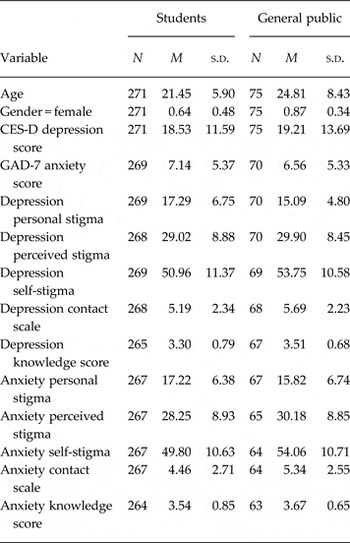
Table 1 depicts the descriptive statistics for each of the cohorts (students and general population). A series of independent samples t-tests identified significant differences between the groups for five variables: age (t 95.0 = −3.42, p = 0.002), proportion of females (t 163.4 = −4.57, p < 0.001), personal depression stigma (t 148.2 = 3.11, p = 0.002), anxiety self-stigma (t 95.0 = −2.87, p = 0.005) and anxiety contact (t 100.2 = −2.44, p = 0.016). However, after adjusting for age and gender using ANOVA, no significant differences in stigma scores were found between the student and general population groups. Consequently, recruitment groups were combined for subsequent analyses, although an indicator variable for group (student or public) was included as a potential confound in multivariate analyses. Using casewide deletion, up to 6.4% of the sample was excluded from analyses due to missing data.
Characteristics of the sample based on recruitment group

Notes: CES-D, Center for Epidemiologic Studies-Depression scale score; GAD-7, Generalised Anxiety Disorder scale.
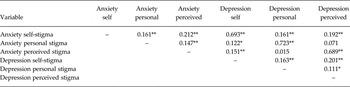
The correlation matrix for the measures of stigma was calculated (see Table 2). Personal, perceived and self-stigma towards anxiety were all found to be significant positively correlated with each other at a weak level. A similar pattern was seen among the depression stigma measures. Corresponding measures of the same type of stigma for depression and anxiety (e.g., self-stigma towards anxiety and self-stigma towards depression) all had significant and strong correlations.
Correlations between stigma measures

Notes:*p < 0.05; **p < 0.01. Correlations within disorder type. Correlations within stigma type.
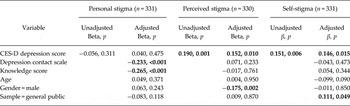
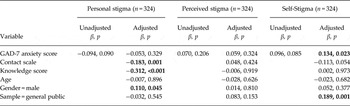
Separate linear regression analyses were conducted to examine predictors for each of the six types of stigma assessed. Two models were estimated for each stigma category: (i) a univariate model of convergent depression/anxiety symptomatology, (ii) a model adding all the other predictors (knowledge score, contact, age and gender). Estimates from the depression stigma models are shown in Table 3, whereas Table 4 presents the anxiety stigma models.
Linear regression models of the three forms of depression stigma

CES-D, Center for Epidemiologic Studies-Depression scale score.
Notes: bold values indicate p < 0.05.
Linear regression models of the three forms of anxiety stigma

GAD-7, Generalised Anxiety Disorder scale.
Notes: bold values indicate p < 0.05.
Depression symptoms were significantly associated with perceived and self-stigma of depression in both the univariate and adjusted model. There was no effect of depression symptoms on personal stigma. Female gender was also associated with greater perceived depression stigma, while higher depression contact and knowledge were significantly associated with less personal stigma. As with depression, higher levels of anxiety symptoms showed an association with greater self-stigma even after adjustment for other factors. Increased knowledge of anxiety and contact with people with anxiety disorders was strongly associated with less personal anxiety stigma. Male gender was also associated with higher personal anxiety stigma. Age was not significantly associated with personal, perceived or self-stigma for either depression or anxiety.
Discussion
The current study investigated the role of a range of variables on personal, perceived and self-stigma towards depression and anxiety. Consistent with previous research, greater knowledge of depression (Griffiths et al. Reference Griffiths, Christensen, Jorm, Evans and Groves2004; Copelj & Kiropoulos, Reference Copelj and Kiropoulos2011; Kiropoulos et al. Reference Kiropoulos, Griffiths and Blashki2011; Ventieri et al. Reference Ventieri, Clarke and Hay2011) and contact with people with depression (Griffiths et al. Reference Griffiths, Christensen and Jorm2008; Jorm & Wright, Reference Jorm and Wright2008; Corrigan et al. Reference Corrigan, Edwards, Green, Diwan and Penn2001; Calear et al. Reference Calear, Griffiths and Christensen2011) was associated with lower personal stigma towards depression. The current findings suggest that this relationship also holds for anxiety, such that higher knowledge of anxiety and greater contact with people with anxiety both predicted lower personal stigma for anxiety. This provides significant data in favour of stigma reduction campaigns that target improving knowledge of/contact with mental illness (Griffiths et al. Reference Griffiths, Christensen, Jorm, Evans and Groves2004; Rüsch et al. Reference Rüsch, Angermeyer and Corrigan2005; Taylor-Rodgers & Batterham, Reference Taylor-Rodgers and Batterham2014), and is consistent with the substantial evidence for the effectiveness of such campaigns (Corrigan et al. Reference Corrigan, Morris, Michaels, Rafacz and Rüsch2012; Griffiths et al. Reference Griffiths, Carron-Arthur, Parsons and Reid2014). In particular, the anxiety-related findings of this study are novel, and align with a stigma reduction study which found that increasing anxiety literacy was associated with decreased anxiety stigma at follow-up (Gulliver et al. Reference Gulliver, Griffiths, Christensen, Mackinnon, Calear, Parsons and Stanimirovic2012).
One focus of this study was the role of current symptoms in stigma. Consistent with Griffiths et al. (Reference Griffiths, Christensen and Jorm2008) and Pyne et al. (Reference Pyne, Kuc, Schroeder, Fortney, Edlund and Sullivan2004), higher scores on the CES-D were associated with higher perceived stigma towards depression, suggesting that individuals currently experiencing depression also perceive heightened levels of stigma from the community. A similar relationship was seen between symptoms of depression and self-stigma, consistent with Yen et al. (Reference Yen, Chen, Lee, Tang, Yen and Ko2005) and suggesting that seeking help might become more difficult as depression symptoms increase. These relationships highlight the additional difficulties people with depression experience when attempting to seek help and these factors need to be considered when encouraging people to seek treatment. Interestingly, greater levels of anxiety symptoms (GAD-7) did not predict higher levels of either perceived or personal stigma towards anxiety. However, a relationship was found between higher scores on the GAD-7 and higher levels of self-stigma for anxiety, mirroring the association observed for depression. This provides preliminary evidence that anxiety symptomatology might affect help-seeking as for depression, but this relationship needs to be confirmed with future research.
The findings with regards to gender in the current study are similar to previous literature. As in previous research, females in the current study reported higher perceived stigma for depression, suggesting they felt more stigma for that disorder from the community than males (Griffiths et al. Reference Griffiths, Christensen and Jorm2008; Jorm & Wright, Reference Jorm and Wright2008; Calear et al. Reference Calear, Griffiths and Christensen2011; Batterham et al. Reference Batterham, Griffiths, Barney and Parsons2013). There was some evidence that males had higher personal stigma for anxiety, consistent with the findings of Batterham et al. (Reference Batterham, Griffiths, Barney and Parsons2013), but this needs to be further confirmed. Age was not significantly associated with any of the three stigma types for either depression or anxiety. This reflects some previous findings (Ward & Heidrich, Reference Ward and Heidrich2009; Batterham et al. Reference Batterham, Griffiths, Barney and Parsons2013); however, given the young, narrow age range of the participants, a lack of variation in age may well be driving the finding in the current study, so conclusions are necessarily limited.
One interesting finding to emerge from the analysis was the high correlation within the same stigma type for the different disorders, such as between self-stigma for depression and self-stigma for anxiety. These strong positive relationships were seen for all the three types of stigma; personal, perceived and self-stigma. This pattern contrasts with the much lower (though still significant) correlations between different stigma types for the same disorder (e.g., self-stigma for depression and personal stigma for depression). These findings can be interpreted in light of studies such as Yap et al. (Reference Yap, Mackinnon, Reavley and Jorm2014), which seek to identify the underlying structure of personal and perceived stigma. Consistent with Yap et al. (Reference Yap, Mackinnon, Reavley and Jorm2014), the current data suggest differentiation of perceived and personal stigma, as illustrated by lower correlations. The current findings add to this discussion by providing evidence for the further differentiation of self-stigma from the other two types of stigma. The very high correlations within types of stigma suggest that there may be a degree of global, disorder-independent stigma for each type, which could then be combined with disorder-specific beliefs to influence how people report stigma. This remains speculative, but these very high correlations are worth investigating further.
One factor limiting the general ability of the findings of this study is the nature of the sample. While students and the general population were sampled, both cohorts were young (aged in early–mid-twenties) and predominantly female. Whether the relationships found here, particularly those between symptomatology and stigma, are replicated in a sample representative of the population at large remains to be established. Another limitation of the study was the elevated levels of depression and anxiety scores in the sample, with higher mean CES-D and GAD-7 scores than observed in the general population. It is likely that selection biases increased participation by individuals with experience of depression or anxiety, and it is possible that those with fewer symptoms show a different pattern of relationships between symptoms and stigma. Likewise, future research in clinical populations may also reveal differing relationships between symptoms and stigma. Further studies should also include other potential factors which may be related to both symptomatology and stigma. Only age and gender were examined in the current study, but variables such as socio-economic status and ethnicity should be included to investigate their potential role in stigma.
This study provides preliminary data establishing relationships between several forms of stigma and a number of factors, but this research now needs to be expanded using different populations, including clinical samples, a broader age sampling, and in other cultural groups across the community. Interpretation of the data also needs to be cautious given the cross-sectional nature of the current study, meaning that conclusive statements cannot be made about the predictive nature of relationships. Theoretically, and based on previous research, we have interpreted our findings as supporting the case that factors such as contact with and knowledge of disorders causally influence reported stigma (supported by evidence from intervention studies), but it is likely at least some causal impact occurs in the other direction: from held stigma to level of contact. Similarly the identified relationships between symptomatology and self-stigma for both anxiety and depression could be the outcome of bidirectional influence or mediating factors. Longitudinal studies and intervention studies can both help in addressing these important theoretical questions.
By examining associations between a range of potential predictors and the three forms of stigma, personal, perceived and self-stigma, for the two most common mental disorders, anxiety and depression, this study provides evidence as to the relationships between different factors and forms of stigma. The diversity of the findings across stigma types, consistent with previous research, illustrates the necessity of clearly defining which form of stigma is being investigated, suggesting factors that play different roles depending on both the disorder type and stigma type. The relationships between symptomatology and self-stigma in particular, for both anxiety and depression, suggest key avenues for investigation for both clinicians and those designing stigma reduction campaigns.
Acknowledgements
Colleagues at the Centre for Applied Psychology, University of Canberra, provided advice and support in the development and running of the project on which this paper is based.
Financial Support
P. J. B is supported by National Health and Medical Research Council Early Career Fellowship 1035262. This research received no specific grant from any funding agency, commercial or not-for-profit sectors.
Declaration of Interest
None.
Ethical Standards
The authors assert that all procedures contributing to this work comply with the ethical standards of the relevant national and institutional committees on human experimentation and with the Helsinki Declaration of 1975, as revised in 2008.