Introduction
Infective endocarditis remains a life-threatening condition associated with substantial morbidity, mortality, and long-term complications. CHD, even after repair, is recognised as a lifelong substrate for infective endocarditis, primarily due to factors such as turbulent non-laminar blood flow leading to shear stress and endothelial injury, the presence of intracardiac foreign material—including prosthetic valves and cardiac implantable electronic devices—cyanosis, and repeated exposure to invasive cardiac procedures. Advances in paediatric cardiology and surgical techniques have markedly improved survival, resulting in a growing adult CHD population.Reference Verheugt, Uiterwaal and van der Velde1 The incidence of infective endocarditis among adults with CHD is 27–44 times higher than that of the general adult population (1.33 cases per 1000 persons per year),Reference Kuijpers, Koolbergen and Groenink2 whereas in children with CHD, the incidence is 0.41 cases per 1000 persons per year.Reference Rushani, Kaufman and Ionescu-Ittu3 Groups at highest risk include individuals with untreated cyanotic CHD and those in whom surgical repair involves prosthetic material, such as valved conduits or systemic-to-pulmonary shunts.Reference Kuijpers, Koolbergen and Groenink2
Although CHD represents a highly heterogeneous population, the clinical presentation and microbiological profile of infective endocarditis in these patients may differ significantly from those without CHD. Factors such as prior cardiac surgeries, comorbidities, age, severity of illness, and nosocomial exposures likely contribute to these differences.Reference Verheugt, Uiterwaal and van der Velde1,Reference Jenkins, Correa and Feinstein4 Despite this, the broader prognostic landscape in these distinct populations remains incompletely understood. Moreover, contemporary reports mention Streptococcus species (spp.) as the most common microbiological aetiology among individuals with CHD,Reference Moore, Cao, Kotchetkova and Celermajer5–Reference Tutarel, Alonso-Gonzalez and Montanaro7 whereas others identify Staphylococcus spp. as the predominant pathogen.Reference Brida, Balint and Bence8
In addition, only a limited number of studies have evaluated paediatric populations in direct comparison with non-CHD patients, resulting in a scarcity of age-stratified data. Such information is essential to improving prevention, diagnosis, and management across the full spectrum of CHD.Reference Delgado, Ajmone Marsan and De Waha9
Overall, comprehensive data describing the distinct clinical course and outcomes of infective endocarditis in patients with CHD—spanning both children and adults—compared with those without CHD remain limited. Accordingly, this systematic review and meta-analysis aims to synthesise existing evidence to more clearly characterise the clinical profiles and outcomes of infective endocarditis in patients with CHD compared with those without CHD.
Methods
This systematic review was performed and reported following the Cochrane Collaboration Handbook for Systematic Reviews of InterventionsReference Higgins, Thomas and Chandler10 and the Preferred Reporting Items for Systematic Reviews and Meta-Analysis (2020) Statement guidelines.Reference Page, McKenzie and Bossuyt11 The meta-analysis protocol was registered with the International Prospective Register of Systematic Reviews under registration number CRD420250655423.
Search strategy and screening
We systematically searched PubMed, Embase, and Cochrane from inception to January 2025 using the following terms: “endocarditis,” “congenital heart disease,” “CHD,” “congenital heart defect,” “congenital heart defects,” “cardiac anomaly,” “congenital cardiac,” “cardiac malformation,” “heart anomaly,” “heart anomalies,” “heart malformation,” “cardiac defect,” “cardiac anomalies,” “adult,” and “children.” The detailed search strategy is provided in the Supplementary Material.
Three authors (G.V.R., B.B., and V.S.) independently screened titles and abstracts and evaluated the articles for eligibility based on pre-specified criteria. Additionally, we used backward snowballing (i.e., review of references) to ensure that no relevant studies were missed. Discrepancies were resolved by consensus.
Eligibility criteria
Studies were included in this meta-analysis if they met all of the following criteria: (1) observational cohort studies; (2) enrolling patients diagnosed with infective endocarditis; (3) comparing patients with CHD to those without CHD; and (4) reporting at least one clinical outcome of interest.
Studies were excluded if they: (1) did not meet the inclusion criteria; (2) involved overlapping patient populations; (3) lacked a comparative group; (4) consisted of cross-sectional studies, case-control studies, case reports, or case series; or (5) were reviews, abstracts, protocols without results, or duplicate data from the same clinical registry. No restrictions were applied regarding sample size or duration of follow-up.
Data extraction
Two authors (G.V.R. and J.P.) independently extracted data to characterise the included studies. Extracted information included authors, study location, publication year, sample size, study period, anatomical diagnosis, and patient demographic characteristics. For outcome analysis, two independent authors (J.P. and B.B.) extracted the data. For categorical outcomes, the number of events and total sample sizes were recorded for each group. For continuous outcomes, means and standard deviations were extracted. All collected data were subsequently reviewed by an independent author (Z.C.) to ensure consistency and accuracy of the included data.
Endpoints
We analysed outcomes separately for children and adults. For clinical outcomes, we evaluated (1) all-cause mortality at 1 year, defined as death from any cause within 12 months of follow-up; (2) in-hospital mortality, defined as mortality occurring during the index hospitalisation; (3) surgical intervention, including any cardiac surgical procedure performed during the acute episode; and (4) recurrence of infective endocarditis at 2 years, defined as a documented relapse or reinfection within 24 months.
For the clinical profile analysis, we examined: (1) valve involvement, extracted as the proportion of cases affecting each specific valve or prosthesis, and analysed separately for adults and children; and (2) causative organisms, grouped according to the microbiological categories consistently reported across studies (e.g., Streptococcus spp., Staphylococcus aureus, Enterococcus spp., HACEK, anaerobic pathogens, fungal organisms, and negative blood cultures).
When multiple definitions or follow-up durations were provided, we used the definition most comparable across studies and prioritised the time point closest to our prespecified endpoints.
Quality assessment
The quality of the included studies was assessed using the Newcastle–Ottawa Scale,Reference Wells, Shea and O’Connell12 following the recommended domains for cohort studies (selection, comparability, and outcome). Two reviewers (J.P. and V.S.) independently evaluated each study, and disagreements were resolved through consensus after discussing the source of the discrepancy.
Because fewer than 10 studies were available for each outcome, publication bias was not formally assessed. In accordance with Cochrane guidance, funnel plots and statistical testing (e.g., Egger’s test) were not performed, as the limited number of included studies would provide insufficient power to reliably detect small-study effects.Reference Higgins, Thomas and Chandler10
Statistical analysis
Binary outcomes were analysed using the Mantel-Haenszel random-effects model, with the restricted maximum likelihood estimator for τ2. Risk ratios were used for binary outcomes and mean differences for continuous outcomes, both reported with 95% confidence intervals as effect size measures. Statistical significance was defined as a p-value < 0.05. To assess the consistency of the results, a leave-one-out sensitivity analysis was performed, systematically excluding each study. Study consistency was evaluated based on I 2 values, with thresholds of 0%, ≤25%, ≤50%, and >50% indicating no observed, low, moderate, and substantial heterogeneity, respectively. All analyses and visualisations were conducted using R software (version 4.3.1) with the “meta” package.13
Results
We identified 4500 reports through the initial search. After removing 1254 duplicates, 3215 records were excluded during title and abstract screening. Thirty-one studies underwent full-text review, of which six observational cohort studies met the inclusion criteria and were included in the analysis.Reference Ware, Tani, Weng, Wilkes and Menon14–Reference Havers-Borgersen, Østergaard and Holgersson19 The study selection process is summarised in Figure 1.
PRISMA flow diagram of study screening and selection. PRISMA, preferred reporting items for systematic reviews and meta-analyses.

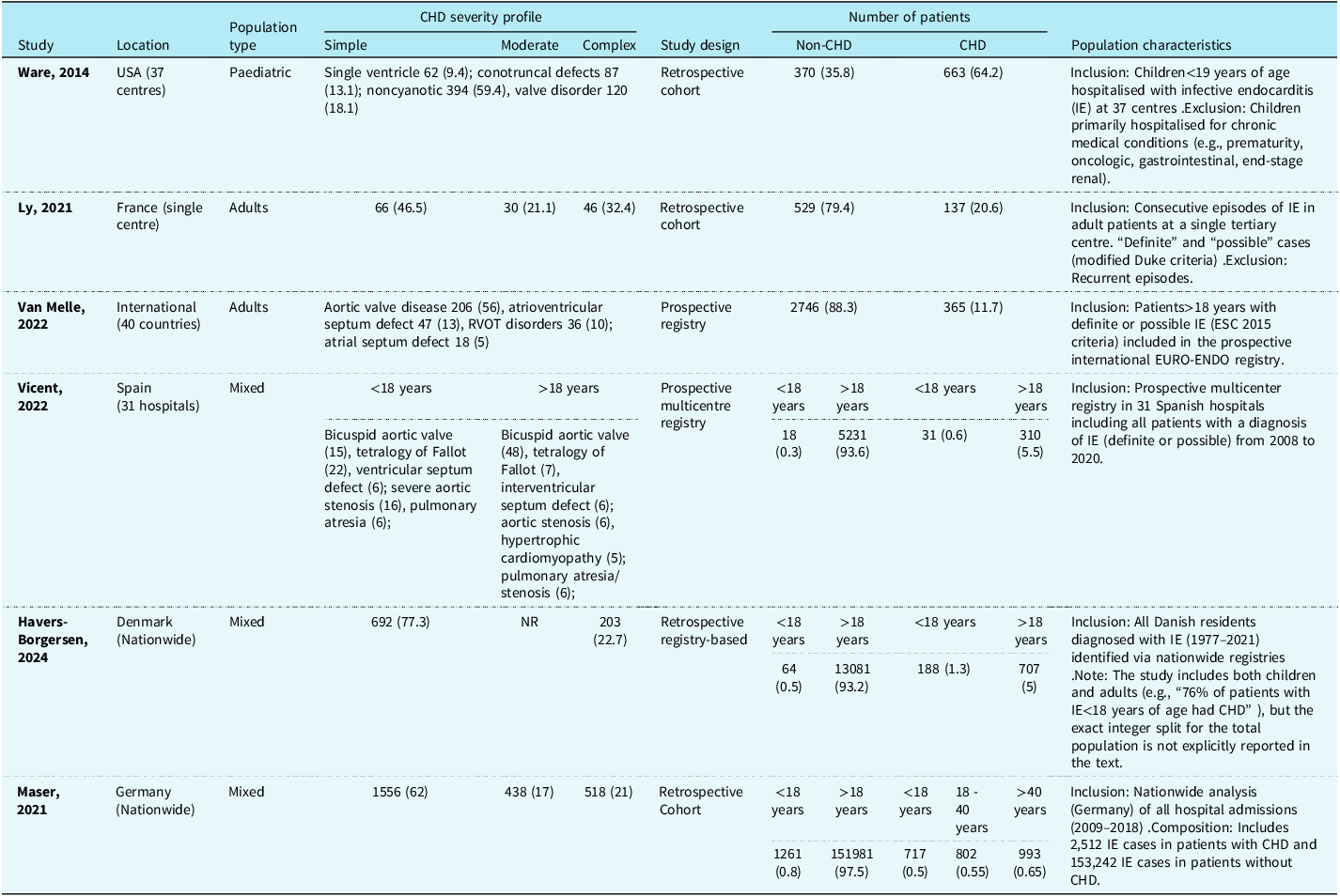
Among the six cohorts, three included both adults and children, two focused exclusively on adults, and one enrolled only paediatric patients. Most studies were multicentre cohorts or registries originating from Europe, with one cohort conducted in the United States. Overall, 180,194 patients with infective endocarditis were included, comprising 4913 individuals with CHD and 175,281 without CHD. In the paediatric subset, there were 1599 patients with CHD and 1713 without CHD. A detailed breakdown is provided in Supplementary Table 1. Across included studies, patients with CHD were generally younger and less comorbid than those without CHD. Overall, 65% of the population were male. The severity and distribution of underlying anatomical diagnoses also varied across cohorts. Detailed study and patient-level characteristics are presented in Tables 1 and 2, respectively.
Characteristics of included studies. CHD: congenital heart disease

CHD = Congenital Heart Disease.
Patient baseline characteristics. CHD: congenital heart disease

CHD = Congenital Heart Disease.
Clinical outcomes
Adults
In-hospital mortality was lower in adults with CHD compared to those without CHD (RR 0.44; 95% CI 0.39 to 0.50; p < 0.01, I 2 = 0%; Figure 2(a )). Similarly, one-year mortality was significantly lower among adults with CHD (RR 0.42; 95% CI 0.34 to 0.53; p < 0.01, I 2 = 60%; Figure 2(b)). The need for surgical intervention was significantly more frequent in adult patients with CHD (RR 1.22; 95% CI 1.08 to 1.37; p < 0.01, I 2 = 82%; Fig. S1). No significant differences were observed between groups regarding recurrence at two years (RR 0.77; 95% CI 0.35 to 1.65; p = 0.49; I 2 = 77%, Fig. S2) or hospital length of stay (MD −2.06 days; 95% CI −4.24 to 0.13; p = 0.07; I 2 = 0%; Fig. S3).
Clinical outcomes and microbiological profiles in adults and children with infective endocarditis (IE), stratified by the presence of congenital heart disease (CHD). Forest plots displaying meta-analysis results for (a) in-hospital mortality in adults; (b) one-year mortality in adults; (c) in-hospital mortality in children; (d) length of hospital stay in children; (e) streptococcus aetiology in adults; and (f) streptococcus aetiology in children. Results are expressed as risk ratios (RR) or mean differences (MD) with 95% confidence intervals (CI).

Central illustration. In this meta-analysis of 180,194 patients with infective endocarditis (IE), congenital heart disease (CHD) was associated with lower mortality in adults and higher mortality in children. Streptococcus spp. IE was more frequently identified in adults with CHD, whereas Staphylococcus aureus IE was less common across all age groups. CHD = congenital heart disease; IE = infective endocarditis; RR = risk ratio.

Children
Among children, in-hospital mortality was higher in patients with CHD compared to those without CHD (RR 1.59; 95% CI 1.08 to 2.32; p = 0.02; I 2 = 30%; Figure 2(c)). No significant differences were found between groups regarding hospital length of stay (MD 1.24 days; 95% CI -1.33 to 3.81; p = 0.34; I 2 = 0%; Figure 2(d)), surgical intervention (RR 0.91; 95% CI 0.33 to 2.52; p = 0.86; I 2 = 75%; Fig. S4), or one-year mortality (RR 0.49; 95% CI 0.22 to 1.09; p = 0.08; I 2 = 0%; Fig. S5).
Microbiological and valvular profiles
Adult microbiological profile
Adult patients with CHD were more likely to be infected with Streptococcus spp. endocarditis (RR 1.28; 95% CI 1.09 to 1.50; p < 0.01; I 2 = 61%, Figure 2(e)), HACEK infective endocarditis (RR 2.39; 95% CI 1.09 to 5.26; p = 0.03; I 2 = 57%; Fig. S6), and anaerobic infective endocarditis (RR 2.81; 95% CI 1.61 to 4.91; p < 0.01; I 2 = 0%; Fig. S7) compared to patients without CHD. In contrast, patients” infection with Staphylococcus aureus (RR 0.71; 95% CI 0.58 to 0.88; p < 0.01; I 2 = 56%; Fig. S8) and Enterococcus spp. (RR 0.39; 95% CI 0.30 to 0.49; p < 0.01; I 2 = 0%; Fig. S9) were less common in patients with CHD. No significant differences were observed between the groups in rates of negative culture infective endocarditis (RR 0.20; 95% CI 0.03 to 1.27; p = 0.09; I 2 = 58%; Fig. S10), fungal infective endocarditis (RR 1.05; 95% CI 0.25 to 4.38; p = 0.95; I 2 = 66%; Fig. S11), Coxiella burnetti infective endocarditis (RR 2.53; 95% CI 0.28 to 23.27; p = 0.41; I 2 = 75%; Fig. S12), or coagulase-negative staphylococcal infective endocarditis (RR 1.08; 95% CI 0.83 to 1.40; p = 0.58; I 2 = 17%; Fig. S13).
Paediatric microbiological profile
Children with CHD were less likely to be infected with Staphylococcus aureus (RR 0.73; 95% CI 0.64 to 0.84; p < 0.01; I 2 = 74%; Fig. S14) compared to children without CHD. No significant differences were observed between the groups in rates of Streptococcus spp. infective endocarditis (RR 1.13; 95% CI 0.47 to 2.71; p = 0.39; I 2 = 0%; Figure 2(f), Enterococcus spp. infective endocarditis (RR 0.20; 95% CI 0.03 to 1.27; p = 0.39; I 2 = 0%; Fig. S15), negative culture infective endocarditis (RR 0.53; 95% CI 0.17 to 1.61; p = 0.26, I 2 = 0%; Fig. 16), or coagulase-negative Staphylococcus infective endocarditis (RR 2.15; 95% CI 0.57 to 8.10; p = 0.26; I 2 = 0%; Fig. S17).
Adult valve involvement
In terms of valve involvement, adult patients with CHD showed more frequent aortic (RR 1.31; 95% CI 1.17 to 1.47; p < 0.01; I 2 = 71%; Fig. S18), pulmonary (RR 12.88; 95% CI 9.24 to 17.96; p < 0.01; I 2 = 0%; Fig. S19), and right-sided valve (RR 2.68; 95% CI 1.42 to 5.07; p < 0.01; I 2 = 92%; Fig. S20) involvement compared to non-CHD patients. Additionally, prosthetic valve involvement was more frequent in patients with CHD (RR 1.21; 95% CI 1.01 to 1.46; p = 0.04; I 2 = 67%; Fig. S21). Conversely, mitral valve (RR 0.50; 95% CI 0.43 to 0.57; p < 0.01; I 2 = 0%; Fig. S22) and left-sided involvement (RR 0.93; 95% CI 0.90 to 0.96; p < 0.01; I 2 = 0%; Fig. S23) were less common in patients with CHD. No significant differences were observed between groups regarding tricuspid valve (RR 0.83; 95% CI 0.54 to 1.27; p = 0.39; I 2 = 52%; Fig. S24) or native valve involvement (RR 0.99; 95% CI 0.91 to 1.08; p = 0.83; I 2 = 34%; Fig. S25).
Paediatric valve involvement
Data on valvular involvement in children with and without CHD were insufficient across included studies, preventing a meaningful comparison of paediatric valve involvement profiles.
All pooled estimates for clinical, microbiological, and valvular outcomes are summarised in Supplementary Table 2.
Leave-one-out analyses
For most outcomes, leave-one-out sensitivity analyses showed that the exclusion of individual studies did not change the statistical significance or direction of the pooled estimates. Although minor fluctuations in heterogeneity were observed, no single study materially influenced the overall findings. These results indicate that the associations reported in this meta-analysis are generally stable and consistent.
Quality assessment
The quality of the included studies was assessed using the Newcastle–Ottawa Scale. All six studies were rated as moderate quality, with total scores ranging from 6 to 8 out of 9. Given the nature of these observational designs, susceptibility to selection bias and residual confounding were noted, along with minor limitations in comparability and outcome assessment. Newcastle–Ottawa Scale ratings are presented in Supplementary Table 3.
Discussion
In this systematic review and meta-analysis of six cohorts comprising 180,194 patients, we evaluated the clinical profiles and outcomes of infective endocarditis in both paediatric and adult CHD populations. Among adults, CHD was associated with lower mortality compared with non-CHD patients. Adult CHD populations also demonstrated a higher proportion of Streptococcus spp. Infective endocarditis and a lower proportion of Staphylococcus aureus infective endocarditis, with right-sided endocarditis being more frequently reported.
In contrast, among paediatric populations, CHD was associated with higher in-hospital mortality and lower rates of S. aureus infective endocarditis, whereas no significant differences were observed in the proportion of Streptococcus spp. infective endocarditis.
Patients with infective endocarditis continue to experience substantial morbidity and mortality despite advances in clinical care. CHD represents an important subgroup at increased risk due to mechanisms previously described. In the contemporary era, adults with CHD now outnumber children, largely attributable to improvements in preventive strategies, surgical interventions, and longitudinal management.Reference Verheugt, Uiterwaal and van der Velde1 However, the long-term prognosis of these patients compared with the general population remains unclear, with individual studies yielding conflicting results.Reference Moore, Cao, Kotchetkova and Celermajer5–Reference Brida, Balint and Bence8,Reference Van Melle, Roos-Hesselink and Bansal17,Reference Vicent, Goenaga and Muñoz18 Additionally, infective endocarditis in children is relatively uncommon.Reference Baltimore, Gewitz and Baddour20 As a result, available data remain limited, preventing a clear understanding of how CHD presence influences outcomes across different stages of life.
The fact that CHD was associated with lower mortality in this study may be explained by several important factors. First, patients in the CHD group were significantly younger and had fewer comorbidities compared with the non-CHD population.Reference Ly, Compain and Gaye15,Reference Van Melle, Roos-Hesselink and Bansal17–Reference Havers-Borgersen, Østergaard and Holgersson19 As previously described, age is a well-recognised risk factor for mortality in infective endocarditis.Reference Delgado, Ajmone Marsan and De Waha9 Even so, with increasing age, degenerative valvular conditions become more prevalent, far outnumbering congenital lesions as potential infective endocarditis substrate.Reference Delgado, Ajmone Marsan and De Waha9 Moreover, the higher burden of comorbidities among patients without CHD may partly account for their worse survival. Included cohorts, meta-analyses and prior studies have shown that comorbidities such as chronic kidney disease, diabetes, and heart failure are among the strongest independent predictors of mortality in infective endocarditis.Reference Delgado, Ajmone Marsan and De Waha9,Reference Ly, Compain and Gaye15–Reference Van Melle, Roos-Hesselink and Bansal17,Reference Wilbring, Tugtekin, Alexiou, Matschke and Kappert21–Reference Ong and Low23 These observations suggest that clinicians should not focus solely on underlying CHD but also carefully assess comorbid burden and end-organ dysfunction, which may exert a greater influence on outcomes in this vulnerable population.
It is also important to mention that patients with CHD represent a unique clinical group spanning a broad spectrum, from repaired simple lesions to single-ventricle physiology with significant haemodynamic vulnerability. Individuals with CHD often receive care at specialised referral centres with extensive experience in congenital cardiology, which may positively influence clinical outcomes. Likewise, preventive strategies and structured long-term management programmes in this population typically involve closer follow-up, patient education, and heightened awareness of infective endocarditis risk.Reference Delgado, Ajmone Marsan and De Waha9 These factors may enable earlier recognition of symptoms and contribute to more timely diagnosis of endocarditis. Moreover, CHD patients who reach adulthood often represent a more resilient subset—individuals with previously treated or non-lethal congenital lesions—whereas in paediatric populations, the prevalence of severe and complex CHD is higher and associated with substantially greater mortality, as observed in our study.Reference Rushani, Kaufman and Ionescu-Ittu3,Reference Delgado, Ajmone Marsan and De Waha9,Reference Baltimore, Gewitz and Baddour20 Overall, this reinforces the importance of a multidisciplinary heart team approach in the management of endocarditis, as well as the essential role of preventive strategies and patient education in reducing infective endocarditis risk.
In addition, it is important to note that this finding may not apply to patients with severe or highly complex CHD. The heterogeneity of congenital anomalies is considerable, particularly in referral centres such as those represented in the registries and cohorts included in this meta-analysis. This may have resulted in an over-representation of less complex lesions. Even so, it remains unclear how CHD complexity modifies prognosis, although there is general consensus that patients with complex defects have worse overall outcomes.Reference Delgado, Ajmone Marsan and De Waha9 For instance, included reports by Ly et al. and Maser et al. showed that, when cases were stratified by complexity, higher-complexity CHD was not associated with a statistically significant decrease in mortality compared with non-CHD patients.Reference Ly, Compain and Gaye15,Reference Maser, Freisinger and Bronstein16 However, in our analysis, the primary studies did not provide outcome data stratified by valve involvement, ventricular physiology, or CHD complexity. As a result, we were unable to perform subgroup or quantitative analyses to determine the impact of these clinically relevant variables on patient prognosis.
Staphylococcus aureus is a well-recognised pathogen across all forms of infective endocarditis, including in patients with CHD. Our findings showed that S. aureus infections were significantly less frequent in CHD patients compared with non-CHD individuals. This difference may be partly explained by the higher proportion of healthcare-associated infective endocarditis in the non-CHD population, who often experience prolonged exposure to healthcare environments, indwelling devices, or immunosuppressive states that increase susceptibility to S. aureus.Reference Delgado, Ajmone Marsan and De Waha9,Reference Fowler, Miro and Hoen24 Notably, S. aureus has been consistently identified as a predictor of mortality in prior reports and meta-analyses, which may partially account for the better survival outcomes observed among CHD patients in our study.Reference Vicent, Goenaga and Muñoz18,Reference Ong and Low23,Reference Chirouze, Cabell and Fowler25 However, this observation should be interpreted as hypothesis-generating, as formal quantitative interaction modelling for microbiological involvement was not feasible due to the lack of granular data reported in the included studies, thereby precluding meta-analytic interaction testing. Nevertheless, S. aureus remains an important pathogen in this population and should not be overlooked when considering diagnostic or treatment strategies.
Interestingly, our findings showed that among paediatric patients, the prevalence of Streptococcus species did not significantly differ between children with CHD and those without CHD. This contrasts with adult populations, in whom Streptococcus was clearly more common among individuals with CHD. The primary portal of entry for viridans streptococci is typically dental, often associated with poor oral hygiene, periodontal disease, or recent dental procedures.Reference Wilson, Gewitz and Lockhart26 One possible explanation for this discrepancy is the greater adherence challenges observed in adults. As patients transition from childhood and adolescence into independent adulthood, they progressively assume responsibility for routine preventive care and clinical follow-up. This transitional period may be a vulnerable phase during which continuity of care may be disrupted, leading to inconsistent healthcare practices and suboptimal adherence to recommended prophylactic or therapeutic measures.Reference Havers-Borgersen, Østergaard and Holgersson19,Reference Kovacs and Utens27
As recommended by the ESC/AHAReference Delgado, Ajmone Marsan and De Waha9,Reference Wilson, Gewitz and Lockhart26,Reference Baddour, Wilson and Bayer28 guidelines on endocarditis prevention in patients with CHD, antibiotic prophylaxis targeting streptococcal spp. remains crucial in preventing infective endocarditis in this vulnerable population, particularly during dental and other high-risk procedures. Our findings support this recommendation and add other key microbiological considerations, such as infections caused by anaerobic organisms, HACEK species and Enterococcus spp., which could carry important implications for preventive strategies and may guide clinicians in selecting empiric antibiotic treatments.
In our study, adults with CHD showed higher rates of right-sided and pulmonary valve involvement, with mitral involvement less common. Valve subtype is clinically important, as right-sided infective endocarditis often follows distinct courses and surgical pathways compared with left-sided disease.Reference Delgado, Ajmone Marsan and De Waha9 Few included studies reported valve-specific mortality interaction; Ly et al.Reference Ly, Compain and Gaye15 found lower mortality (OR 0.37) in right-sided infective endocarditis, highlighting prognostic heterogeneity. Most cohorts, however, did not stratify mortality by valve, preventing pooled estimates or valve-by-CHD interaction analyses.
To our knowledge, this is the first meta-analysis to specifically compare infective endocarditis outcomes between patients with and without CHD, integrating age-specific analyses, allowing comparison of paediatric and adult populations—an aspect that has been absent from prior literature. The decision to include only multicentre and registry-based cohorts ensured broad representation across diverse healthcare settings.
Limitations
This study has limitations. First, heterogeneity across studies, including differences in design, local epidemiological risk, and healthcare settings, may have influenced the results. To address this, we performed a sensitivity analysis that showed consistent results across most endpoints. Second, included studies were observational in nature. To reduce potential confounding, we employed a random-effects model to account for between-study heterogeneity. Third, because our study was a study-level meta-analysis, the absence of individual patient data limited a more detailed evaluation of high-risk subgroups. Additionally, most primary studies did not stratify outcomes by CHD complexity, valvular involvement, microbiology, or ventricular physiology (single vs. biventricular). As a result, we were unable to quantitatively assess the impact or interaction of these factors on key outcomes. Fourth, the included studies provided insufficient data on valvular or ventricular variables in the paediatric population, limiting the potential for meaningful comparisons or assessments of these features in our study. Finally, the limited number of available studies (fewer than 10) precluded the use of meta-regression to explore the potential influence of age, clinical characteristics or comorbidities, which differed substantially across groups. For the same reason, assessment of publication bias using funnel plots or Egger’s test was not feasible.Reference Higgins, Thomas and Chandler10 Nonetheless, the risk of bias evaluation indicated overall moderate study quality.
Conclusion
In this meta-analysis of age-stratified outcomes in 180,194 patients, mortality associated with CHD differed between age groups, with lower mortality observed in adults and higher mortality in children. In adults with CHD, Streptococcus species were more commonly identified, while Staphylococcus aureus appeared less frequently across all age groups. These findings support the value of an age-specific, multidisciplinary heart-team approach and underscore the importance of individualised management strategies in patients with CHD.
Supplementary material
The supplementary material for this article can be found at https://doi.org/10.1017/S1047951126111755.
Data availability statement
The data used in this meta-analysis were extracted from publicly available sources, including published observational studies. All relevant data supporting the findings of this study are included within the manuscript. Due to the nature of this analysis, no new primary data were generated. Additional details can be made available upon reasonable request to the corresponding author.
Competing interests
The authors have no relevant financial or non-financial interests to disclose. This research did not receive any specific grant from funding agencies in the public, commercial, or not-for-profit sectors.
Ethical standards
This meta-analysis did not require informed consent or Institutional Review Board approval, for all data are publicly available and did not involve access to individual patient data.