INTRODUCTION
Despite Tanzania's dominant ideology that it is a postethnic nation united by Standard Swahili (SS), a number of young Tanzanian artists involved in the Bongo Flava music scene have begun depicting their own ethnic groups through the use of verbal imagery, their mother tongues or mother-tongue-influenced Swahili, and visual symbols such as clothing, jewelry, and dance styles. If “language and identity are produced in the performance” (Pennycook Reference Pennycook2007:58), which languages and which identities are produced through ethnicized Bongo Flava? Does such stylization challenge hegemonic ideologies of language, ethnicity, and modernity, as scholarship on hip hop linguistics would suggest? In this article I explore the stylized performance of Tanzanian ethnicities through language in Bongo Flava, using Maasai rapper Abel Loshilaa Motika (a.k.a. Mr. Ebbo, or in this article simply Ebbo) as my primary example.Footnote 1 Through an examination of Ebbo's ethnically stylized persona—known for his playful use of Maa pronunciation and a Swahili language game known as kinyume ‘backwards style’—I argue that while he strategically disrupts the sociolinguistic order that privileges Standard Swahili, his persona leaves dominant ideologies of language and ethnicity intact. Moreover, in arguing that Ebbo's parodic stylization of ethnicity undermines his stated intent, the study not only questions approaches to hip hop that treat rappers as cultural theorists but also the assumption that hip hop language practices are necessarily subversive.
HIP HOP LINGUISTICS
This project builds on recent scholarship in the burgeoning field of hip hop linguistics, the study of speech and performance contextualized in the lives of those involved in hip hop culture (Alim Reference Alim2009:5). The majority of studies have focused on either the reception of English language rap “in places where English is rarely spoken” (Rose Reference Rose1994:19) or on the interplay between English and other major languages in diverse international hip hop scenes (Oumano Reference Oumano1999a,Reference Oumanob, Pennycook Reference Pennycook2003), including English and Swahili in Tanzania (Englert Reference Englert2008a, Higgins Reference Higgins2009, Perullo & Fenn Reference Perullo, Fenn, Berger and Carroll2003, Reuster-Jahn & Kießling Reference Reuster-Jahn and Kießling2006). The use of subnational languages in rap and hip hop has received scant attention, despite recognition that “regional dialects and indigenous languages other than English [are] coming to the fore as important markers for the vernacular expressions and construction of identity” in globalized rap and hip hop (Mitchell Reference Mitchell and Mitchell2001:32). Mitchell's (Reference Mitchell2000) work on “resistance vernaculars” is an important exception, offering a wide-ranging survey of language use in hip hop in various contexts, as is Omoniyi's (Reference Omoniyi2009) work, which offers detailed context on specific language practices in Nigerian hip hop.
A recurring theme within hip hop linguistics studies (as well as in studies of hip hop that are less focused on language) is hip hop's potential subversiveness. For example, Alim argues that “Hip Hop artists, wherever they are located … often challenge the sociopolitical arrangement of the relations between languages, identities, and power” (2009:13) and that hip hop culture not only “challenge[s] dominant ideologies of language” but also espouses “subversive language ideologies” (2009:5), loosening linguistic boundaries used to include and exclude others (2009:12). Alim, Ibrahim, and Pennycook (Reference Alim, Ibrahim and Pennycook2009) provide numerous contextualized examples of these processes as work, from Cantonese vulgarities that “subvert mainstream linguistic taboos and social norms” in China (Lin Reference Lin2009:164) to the linguistic and discursive marking of Whiteness as “a way for White and Black competitors to challenge hegemonic Whiteness” in the United States (Cutler Reference Cutler2009:80).
Though less focused on language, studies of Tanzanian rap have similarly emphasized artists' challenge to the status quo by giving voice to otherwise powerless members of society. Perullo (Reference Perullo2005), for example, writes of rap as a medium through which artists voice the concerns of youth and other underprivileged urban Tanzanians—a powerful medium because it does not require literacy. Saavedra Casco (Reference Saavedra Casco2006) makes a similar argument, focusing on protest within rap as Tanzanian youth discourse.
In contrast to these trends, recent research on the Bongo Flava music scene points to a move away from subversiveness as a dominant feature. For example, Englert argues that “Bongo Flava music has helped to shape a generational identity of those who grew up in the era of liberalisation and multi-party politics—an identity which transcends social classes, ethnicities and gender” (2008b:76), and therefore, I would add, supports the dominant nationalist ideology that suppresses ethnicity and devalues ethnic languages. She finds that, in contrast to those Tanzanian rappers who set themselves apart from mainstream society through slang, many rappers aim to reach “the broadest possible audience” (2008b:79). Similarly, Reuster-Jahn argues that Bongo Flava is becoming more and more mainstream and less political: “Since approximately 2006, romance, amusement and lifestyle seem to have become prevailing in Bongo Flava … This would suggest that Bongo Flava has successfully established itself as a mainstream cultural phenomenon with the characteristics that initially defined it—i.e. social-consciousness—becoming shifted to the margin” (2008:43). The shift from socially conscious music to mainstream entertainment coincides with a move away from styles labeled as “hip hop” toward a broader range of styles under the umbrella of Bongo Flava, also widely known as muziki wa kizazi kipya ‘music of the new generation’.
Illustrating the range of terminologies used to define Tanzania's new music, Tanga-based rapper Abel Loshilaa Motika (a.k.a. Mr. Ebbo) told me, “I still haven't gotten a name for my songs. They call it [rap cartoon] because it's different from other songs. Very different! … If they call it rap cartoon, fine, if they call it contemporary, I don't know, African, whatever, that's fine. What I know is this: it's Bongo Flava. But it has a local flavor” (Motika Reference Motika2006). The Swahili term Bongo Flava (pronounced /boŋgofleva/) derives from two slang terms. Bongo means ‘brains’ and is used as a slang term for Tanzania where, it is said, one has to survive by one's wits. Flava is borrowed from the English word ‘flavor’, so Bongo Flava suggests ‘the flavor of Tanzania’. The term is used in at least three ways to describe contemporary popular music produced by young people who are highly influenced by US popular music but add a “local flavor” to it through the use of the Swahili language and local themes: (i) as local hip hop, (ii) as local commercial rap, and (iii) as all local music produced by young people. Many Tanzanians call Ebbo's work rap katuni ‘rap cartoon’, a subcategory of commercial rap that uses parody and satire extensively and in which performers act out the humorous lyrical content of their songs in stage performances and music videos.
Although Bongo Flava artists are known for their linguistic creativity, the majority of published research has relied on the content of Bongo Flava lyrics rather than their form (Englert Reference Englert2003, Perullo Reference Perullo2003, Reference Perullo2005, Reference Perullo and Lawi2007, Saavedra Casco Reference Saavedra Casco2006, Stroeken Reference Stroeken2005a,Reference Stroekenb, Suriano Reference Suriano2006, Thompson Reference Thompson2008, in press). Language has been examined with respect to the choice to use Swahili over English (Perullo & Fenn Reference Perullo, Fenn, Berger and Carroll2003, Remes Reference Remes1998), slang (Englert Reference Englert2003, Higgins Reference Higgins2009, Perullo Reference Perullo2005, Perullo & Fenn Reference Perullo, Fenn, Berger and Carroll2003, Suriano Reference Suriano2006) and the appropriation of “(African American) Hip Hop Nation Language” (Higgins Reference Higgins2009). While scholars have noted in passing that some of Tanzania's other languages are being used in Bongo Flava (e.g. Aunio Reference Aunio2008, Englert Reference Englert2003), their use has not yet been analyzed.
Bongo Flava's “home sound” (Brennan Reference Brennan1994:684) is an informal register of Swahili sung or rapped with standard grammar and pronunciation but with extensive use of slang, borrowed words, and English code-switching (Reuster-Jahn & Kießling Reference Reuster-Jahn and Kießling2006). Tanzanians call both slang and heavily code-switched Swahili lugha ya mitaani ‘street language’ or Kiswahili cha mitaani ‘street Swahili.’ In contrast to Higgins, who defines lugha ya mitaani as “a term used by Tanzanians to refer to nonstandard Swahili” (2009:100), I make a distinction between it and other forms of non-Standard Swahili, including not only Swahili that is code-switched with, or otherwise influenced by, Tanzania's other ethnic languages but also the language game kinyume, that is, those features I examine in Ebbo's work. Because Swahili has been used to develop a national identity explicitly identified as both modern and nonethnic (Askew Reference Askew2002, Blommaert Reference Blommaert1996, Thompson Reference Thompson2006), lugha ya mitaani—a form of Swahili that is even more modern than SS—is more acceptable in public discourse than is the use of Swahili that is ethnically marked (cf. Thompson Reference Thompson2006); thus the two are treated as distinct.
Alongside the majority of Bongo Flava in various registers of SS, a few artists have drawn on Tanzania's other languages, through the use of code-switching, pronunciation that is influenced by them or deliberately imitates them, and grammar that is nonstandard. For example, the name of the Tanga-based rap group Wagosi wa Kaya is a Sambaa expression used to translate the African American slang expression “homeboys” (Busara Promotions 2009, cf. Saavedra Casco Reference Saavedra Casco2006). The two rappers in this group, Frederick Mariki (a.k.a. Mkoloni) and John Simba (a.k.a. Dr. John), although not ethnically Sambaa themselves, are known for “copycatting the accent of Sambaa,” performing Sambaa dance styles (John Reference John2006), and sometimes using Digo accents (Hassan Reference Hassan2007). Similarly, Dr. Leader sings “Mi Msambaa” ‘I am a Sambaa’ with a distinctive Sambaa accent and a chorus that is entirely in Sambaa. Another crew, X Plastaz, includes one Maasai rapper in its ranks, who sings and raps almost entirely in Maa, while other members of the group are Haya and Pare, who rap primarily in Swahili; they called their first album Maasai Hip Hop. Englert Reference Englert2003 also cites examples of underground rappers in Morogoro including some Pare lyrics. Abel Motika (Ebbo), the rapper whose work I will discuss in more detail here, includes code-switched Maa lyrics in many of his recordings, along with various other symbols of ethnicity.
Although still limited, the use of Tanzania's diverse languages in Bongo Flava is part of a larger trend toward the localization or “Africanization” of this new music. Alongside computerized beats heavily influenced by American pop and rap music, some Bongo Flava artists use indigenous instruments such as xylophones, drums, and animal horns; styles influenced by other African music such as Congolese rumba/soukous/lingala (Saavedra Casco Reference Saavedra Casco2006); and long-standing Tanzanian genres ngoma, dansi, taarab, and beni (Englert Reference Englert2008a,Reference Englertb, Karega Reference Karega2006, Saavedra Casco Reference Saavedra Casco2006). Alongside such “Africanization,” Bongo Flava also draws on other “ethnic” world-music imports that have been popular in Tanzania for decades such as African diasporic music (e.g zouk, tumba, and jazz) and Indian film music (Karega Reference Karega2006), as well as more recent imports, such as bhangra (Englert Reference Englert2008a). Research in other world rap music has shown that the use of regional languages, dialects, and instrumentation “serves as a cultural repository for ‘tribalized’ local cultural forms” (Mitchell Reference Mitchell and Mitchell2001:22). In the case of Tanzania, the positive aspects of such a “cultural repository” are complicated by equivocal, often negative, local attitudes toward displays of ethnicity.
In contrast to those artists aiming for success in the world market “by making the beats sound more ‘African’ ” (Englert Reference Englert2003:82), Ebbo claims to have little interest in the market beyond East Africa (Motika Reference Motika2006), positioning himself instead as a proud Maasai within a local music scene. As such, he differentiates himself from other local rappers by performing Maasainess but nevertheless must remain comprehensible through the use of Swahili (cf. Jaffe Reference Jaffe2000).
In performing Maasainess, Ebbo has suggested in interviews that he aims to offer a positive representation of Maasai ethnicity: “We've got our own beautiful culture and we need to be respected for that. That's what I'm talking about in [‘Mi Mmasai’]” (Motika n.d.). A more positive depiction of the Maasai would be a necessary corrective to widespread stereotypes. “Discrimination against the Maasai exists. Discrimination exists. We are working hard to reduce it. But, you know, many people think that the Maasai is a backwards person, the Maasai has not made progress, the Maasai is dirty” (Motika Reference Motika2006).
Bongo Flava scholars appear to have accepted at face value Ebbo's claims to represent the Maasai more positively. Englert, for example, refers to “Mi Mmasai” as “a positive confirmation of his Maasai identity” (2003:79), and Künzler echoes, “Mr. Ebbo is proudly stating his Maasai identity in ‘Mi Mmasai’ ” (2006:21). Similarly, Aunio (Reference Aunio2008) cites Ebbo as an example of a new trend in Bongo Flava that “represents the Tanzanian youth culture even more widely and adds to the pride and self-respect of the ethnic groups whose languages are not recognised in the official institutions.” In contrast, I argue that these readings place too much stock in Ebbo's intent, decontextualize his work from existing ideologies of ethnicity in Tanzania, and ignore the polysemy inherent in his parodic persona.
ABEL LOSHILAA MOTIKA AND THE “MR. EBBO” PERSONA
Abel Loshilaa Motika was born in Arusha, Tanzania, and entered the local music scene in the mid-1990s under the stage name Mr. Ebbo (an Africanization of his given name, Abel), originally as an unsuccessful reggae and R&B artist. After dropping out of music for a few years, Mr. Ebbo became a household name in Tanzania in 2002 when he released his first hit song, “Mi Mmasai” ‘I am Maasai’ on the album Fahari Yako ‘Your pride’. His family belongs to the “branch of the urban Arusha” Maasai, who “don't dress in a Maasai way nor pierce our ears” like the Kisongo Maasai do, he told me (Motika Reference Motika2006). In other words, he is one of the “many educated ‘swahilised’ Maasai in towns who share cultural norms with the Waswahili and speak Standard Swahili” (Drolc Reference Drolc1999:11–12), and yet in performance he wears the iconic red lubega and beaded jewelry characteristic of the Kisongo Maasai, and parodies Kisongo Maasai speech styles.
Being Maasai has become Ebbo's signature, marking him as distinct from other Bongo Flava musicians from whom he seeks to differentiate himself. For example, in the Tanzanian popular press he is referred to by the following epithets: “mwanamuziki anayerap Kimasai” ‘the musician who raps in a Maasai style’ (Hkibari 2004), “Mmasai Mr. Ebbo” ‘the Maasai Mr. Ebbo’ (Hassan Reference Hassan2006), “a young Masai” (Nkwame Reference Nkwame2002), and “rapa wa Kimasai Mr. Ebbo” ‘Maasai rapper Mr. Ebbo’ (Hassan Reference Hassan2007). While being Maasai itself marks Ebbo as different from other Tanzanian artists, intentionally marking one's ethnicity in any visible way is also unusual among Bongo Flava artists (and indeed among Tanzanians more generally). “So many tribes have lost their identity,” Ebbo told a BBC journalist; “A Maasai is the only person who knows who he is” (Yahya n.d.). Indeed, the Kisongo Maasai referenced by the Ebbo persona are exceptional precisely for their refusal to concede to the hegemonic ideology that encourages Tanzanians to become postethnic and thereby modern.
While Ebbo has become well-known as a character whose ethnicity is always visibly on display and whose lyrical content also frequently references his ethnicity, little attention has been paid to the linguistic features of his rap-cartoon style. I turn now to an examination of his use of non-Standard Swahili (NSS), demonstrating the polysemy inherent in his language use as it relates to the Maasai identity he projects as well as to Tanzanian attitudes toward language and ethnicity. The analysis aims to show that his use of parody does not simply challenge but also reproduces “influential images and stereotypes” of the Kisongo Maasai, a group Ebbo himself does not “(straightforwardly) belong to” (Rampton Reference Rampton1999:421).
Ebbo's most well-known songs include “Mi Mmasai” ‘I am Maasai’, “Nisamehe” ‘Forgive me’, and “Mbado” ‘Not yet’. Musically, his work is described as “very catchy,” typically with a “sing-a-long chorus and beat up [upbeat?] track.”Footnote 2 As part of the rap-cartoon genre, his songs have been described as “funny,” “tongue-in-cheek” and “naughty.”Footnote 3 For example, one journalist wrote about the song “Nisamehe,” which also features Mkoloni of Wagosi wa Kaya: “Ni mfululizo wa vituko ambavyo ukisikiliza vitakufanya ushike mbavu kwa kucheka.” ‘It is a series of surprising events which if you listen will make you clutch your sides laughing’ (Mollel Reference Mollel2006). Another writes similarly that it is “guaranteed to crack the ribs of any person who dares to withstand it.”Footnote 4 Part of the humor in Ebbo's songs comes from his use of language that Tanzanians call “Maasai intoned, broken Swahili”Footnote 5 and that is assessed as an accurate representation of “matamshi ya kabila la ‘nyumbani’ Umasaini Arusha” ‘the pronunciation of the “home” ethnic group in Maasailand, Arusha’ (Hassan Reference Hassan2006).
“MI MMASAI”
In “Mi Mmasai,” Ebbo introduced his trademark style: humorous content about Maasai identity juxtaposed with a humorous use of non-Standard Swahili (NSS), and in live performances and videos, Kisongo Maasai costumery. In terms of content, Ebbo artfully draws on local stereotypes of the Maasai in ways that not only include his non-Maasai listeners in the humor attached to these stereotypes but also, paradoxically, make urban Tanzanians the butt of his jokes. His humorous content draws on stereotypes and yet subtly subverts them (Thompson in press). In the remaining sections I address how his humorous use of language functions in a similarly equivocal way. In linguistic terms, his style is marked by Maa and English code-switching, Maa-influenced pronunciation of Swahili words, NSS grammar, an ironic misunderstanding of SS words and grammar, and a Swahili language game known as kinyume ‘backwards style.’Footnote 6 I examine each of these features in turn. The full transcript of the song, and my translation, are including in the appendix.
CODE-MIXING AND CODE-SWITCHING
The song opens with two lines of code-mixing and code-switching:
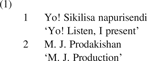
The song begins with a word from African American Vernacular English, Yo!, a interjection intended to grab the listener's attention and to identify the genre as rap (cf. Pennycook Reference Pennycook2003, Reference Pennycook2007). The call to attention is further emphasized with the Swahili command, Sikilisa ‘listen!’, in which Ebbo first introduces his Maa accent by replacing the voiced /z/ in the SS sikiliza with a voiceless /s/. These two attention-grabbers are followed by the Swahinglish verb, napurisendi ‘I present’, a borrowing from the English verb present, here made to follow SS morphological rules through the affixation of the first-person singular subject marker na- ‘I’ and phonotactic rules that require CV syllables (cf. Higgins Reference Higgins2007 on Swahinglish). Similarly, Ebbo integrates the English noun production into Swahili by inserting vowels between the English consonant clusters to create CV syllables. The song contains a few other English borrowings, shown in (2).
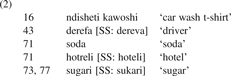
Unlike these borrowings, Yo! Sikilisa napurisendi M. J. Prodakishan in lines 1–2 can be more clearly identified as code-switching and code-mixing, as they require knowledge of English in order to make sense of them. Their function here is to establish the rapper as a skilled wordsmith and, more specifically, a skilled imitator of various accents.
Maa code-switching is more marked in the song than English code-switching, both because code-switching between English and Swahili is widespread in urban Tanzanian speech (Higgins Reference Higgins2007) and because Maa is a Nilotic language with a phonological and morphological structure markedly different from Swahili and other Bantu languages spoken by the majority of Tanzanians. As I demonstrate, the use of Maa lexical items adds to the sense that Ebbo is a skilled rapper, identifies him as a Maa speaker, adds a Maasai “flavor” to his work, allows him to avoid taboo SS words, and adds to the song's theme of linguistic (and other) misunderstandings; here boldface indicate Maa.
In lines 3 and 4, Ebbo raps:
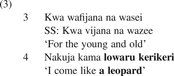
The Maa words lowaru kerikeri ‘leopard; lit. spotted lion’ (Mol Reference Mol1978:95) identify the narrator as a Maa speaker, adding a sense of authenticity. Although the word is written as kerikeri in Maa, in Ebbo's pronunciation the /r/ is nearly elided, producing (to my ear) keikei, a near-rhyme with wasei (SS: wazee ‘old people’) in line 3. The use of a Maa lexical item here, while denotationally meaningless to most Swahili speakers, adds rhythm and rhyme to these lines that would be absent had Ebbo used the SS equivalent chui ‘leopard’.
The majority of Maa words in “Mi Mmasai” are proper names and other “untranslatable” expressions. For example, Ebbo asks:
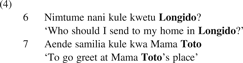
Longido is a small village north of Arusha in Tanzania and south of the town of Namanga, on the Kenya-Tanzania border, while Toto or Chocho is a term of endearment in Maa.Footnote 7 While Swahili speakers may not recognize Toto as Maa (perhaps mistaking it for NSS toto ‘child’), the word Longido doubly connotes Maasainess in that it is both a Maa word and a real village in Maasailand. In lines 53–54, Ebbo parodies the Maasai taboo against eating fish and their stereotyped bravery around lions, rapping:
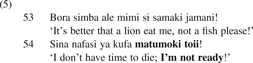
Matumoki toii! is a Maa interjection of fear that is only partially translated here by the English phrase ‘I'm not ready!’. While its literal meaning remains opaque to those who do not speak Maa, a Swahili speaker understands the overall meaning of these lines because of the preceding SS expression, Sina nafasi ya kufa ‘I don't have time to die’. The phrase also serves a poetic function; like the Maa in line 4 discussed above, here toii (line 54) creates a vowel rhyme with jamani in line 53, again displaying Ebbo's verbal ingenuity (cf. Alim Reference Alim2006). The use of both Maa interjections and proper names gives the song a Maasai “flavor” (a dominant metaphor among Bongo Flava artists and listeners; cf. Karega Reference Karega2006) with little loss of denotational meaning for non-Maasai listeners.
The use of Maa also allows Ebbo to refer to concepts that would be impolite in SS and in Maa, while obscuring their meaning. In lines 79–80, he raps:
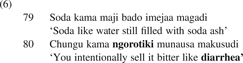
While most listeners will not understand the denotative meaning of the Maa word ngorotiki ‘diarrhea,’ the description of it as chungu ‘bitter’ makes the overall meaning of these lines clear: the soda tastes bitter and ashy. Interestingly, most listeners will also not be aware of the taboo nature of the word in Maa: according to a Maa speaker I consulted, “The Maa use it as a very belittling word. One can swear to another saying ‘you are shit’ but to be called engorotiki is much more potent and enlists more harm and/or response.”Footnote 8 The word ngorotiki, used in place of the crude SS maharisho, also displays Ebbo's verbal virtuosity: following a traditional caesura form common to Swahili poetry (Mazrui Reference Mazrui2007) as well as the poetic technique of assonance that is central to rap (Alim Reference Alim2006), he creates assonance by ending each half-line with the vowel /i/ in maji, magadi, ngorotiki, and makusudi.
MAA INFLUENCE
The word Kimasai in reference to Ebbo as “mwanamuziki anayerap Kimasai” (Hkibari 2004) and “rapa wa Kimasai Mr Ebbo” (Hassan Reference Hassan2007) can be read not only as references to his style and ethnicity, but also to his language. The morpheme ki- (capitalized for proper names) in Swahili denotes both language and style, much like the suffixes -ish and -ese do in English ethnonyms such as Swedish and Chinese. Although Ebbo does not rap in Maa, Tanzanians identify his “Maasai style” in part through his use of Maa-influenced Swahili.
Most Tanzanians speak Swahili as their second language, and therefore many exhibit interference from their first language, particularly in pronunciation (Roehl Reference Roehl1930). Because Swahili has more consonants than Maa, for example, the following sound replacements occur in the Swahili speech of both Kenyan and Tanzanian Maasai speakers of Swahili in both Kenya and Tanzania (Drolc Reference Drolc1999, Musau Reference Musau1993), shown in (7).

The Maasai traditional practice of removing the bottom two front teeth (Wanzala Reference Wanzala2006) may also have an effect on their pronunciation of dental consonants.Footnote 9 However, the more formal education Maa speakers receive, the less likely they are to exhibit such interference.
During a 2006 interview with Ebbo, who received ten years of formal schooling, I observed that he speaks SS with minimal interference from Maa. Yet in rapping as Ebbo, he deliberately uses Maa pronunciation to add to his Maasai persona:
KDT: Many people say you insert Maa pronunciation into Swahili.
Is that normal for you? Or do you do that intentionally?
Ebbo: I do it intentionally. (Motika Reference Motika2006)
Consider the following examples from “Mi Mmasai”.
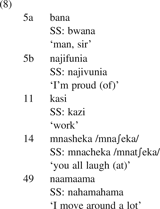
The consonant cluster /bw/ and the phonemes /v/ and /z/ do not exist in Maa, and are thus replaced with /b/, /f/, and /s/ respectively. Although the sound /t∫/ does occur in Maa, it changes to /∫/ when the gender prefix is dropped (Mol Reference Mol1978:79). Alternately, this could also indicate familiarity with the same feature in Sambaa (Werner Reference Werner1906), a major language in Tanga, where Ebbo has lived for many years. Similarly, the phoneme /h/ is rare in Maa, occurring primarily in interjections and songs (Mol Reference Mol1978), and thus is simply dropped before the vowel /a/. In all of these examples, the Maa-inflected pronunciation adds no denotative meaning to the Swahili words. All of these examples can be explained through stylized imitation of Maa; Ebbo is aware of the dialect features of Maa-influenced Swahili, and exploits them creatively. That he does so more in performance than in conversation illustrates Rickford's claim that “some verbal (and non-verbal) performances—especially those that involve radio broadcasts, large audiences, and public occasions are more stylized than others. … People in such situations are trying more consciously than most of us may do in everyday life, to project personas of various types” (2001:230). While Ebbo is proficient in SS and uses it in conversation, when performing he refuses to choose between Maa and SS, instead imposing Maa pronunciation on Swahili, subverting a language ideology that treats Swahili and ethnic languages as occurring in isolation from one another.
In one example, Ebbo's Maa pronunciation creates humor on several levels. In lines 23 and 24, he raps:
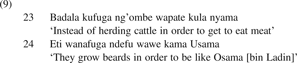
As in a previous example, Ebbo performs the Maa /f/ instead of the Swahili /v/, which does not exist in Maa, replacing the SS ndevu ‘beards’ with the Maa-inflected ndefu. Here, Ebbo plays with the multiple uses of the SS verb kufuga ‘to herd, domesticate, grow’. In line 23, kufuga is used in the expression kufuga ng'ombe ‘to herd cattle’, a stereotypical activity of Maasai males. In line 24, the rapper repeats kufuga in reference to another common SS expression, kufuga ndevu ‘to grow a beard’. He references Osama bin Ladin, both alluding to global events and rhyming with nyama ‘meat’ in the previous line. Kufuga ndevu also has a slang meaning of ‘to live with a homosexual partner’, used to describe gay men (Reuster-Jahn & Kießling Reference Reuster-Jahn and Kießling2006:37). Ebbo's pronunciation of the SS ndevu as ndefu creates irony in that these words are minimal pairs, with ndefu an SS word meaning ‘something long.’ Thus, while kufuga ndefu ‘to grow something long’ is not an expression in SS, here it complements the slang reference to homosexual sex, a taboo topic that often elicits laughter in Tanzanian conversations, and possibly a reference to stereotypes of coastal Muslims as homosexuals. This usage is similar to the “bilingual puns” described by Woolard, who suggests that their humor comes from the juxtaposition of “languages that are usually constructed socially as mutually exclusive, and the humorous move provides a release from the tension of the sociolinguistic opposition” (1998:10). In this case it is not two languages which are juxtaposed, but rather two forms of Swahili, standard and ethnically-marked.
NON-STANDARD SWAHILI (NSS) GRAMMAR
Standard Swahili (SS) is an agglutinative language in which verbs (and other parts of speech) are formed through the joining of morphemes. A typical verb contains a subject marker, tense marker, possibly an object marker, and a verb stem. For example:

In violating SS grammar, Ebbo frequently leaves off the subject marker of verbs, performing the speech of a Maasai learner of Swahili (Drolc Reference Drolc1999). Of the seventy-six conjugated verbs in “Mi Mmasai” (counting those in the chorus only once), forty-four (57.8%) are missing subject markers. When these are present-tense verbs (with the tense marker -na-), the absence of a subject marker creates polysemy because in SS na- can also function as a first-person singular subject marker in the simple present tense (where ni- and -a- elide to form na-). Consider the example in (11).
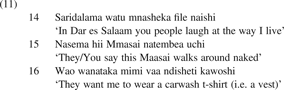
In line 15, Ebbo leaves off the subject marker in both verbs, nasema ‘(someone) say(s)’ and natembea ‘(someone) walk(s).’ Heard or read alone, this line might mean, ‘I say this Maasai (i.e. myself), I walk around naked.’ Yet the context provided by lines 14 and 16 offer the meaning that the grammar does not: the absent subject marker in line 15 is either the second-person plural m- ‘you all’ repeated from line 14, or the third-person plural wa- ‘they’ that appears in line 16. Yet the polysemy also allows the interpretation that Ebbo is aligning himself with those who stereotype the Maasai for wearing traditional and/or insufficient clothing.
Other examples of NSS grammar in “Mi Mmasai” include adjectives that do not agree with the noun class of the nouns they modify, as shown in (12).
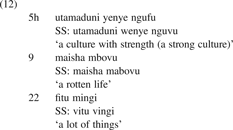
Unlike the dropping of subject markers, the nonstandard use of adjectives does not change the denotational meaning of words nor hinder the listener's comprehension. Rather, it mimics the process by which a non-Bantu speaker acquires a Bantu language, acquiring the stems before the prefixes. Their use here thus adds to Ebbo's performance of a Maasai character who does not speak SS.
PARODYING MISUNDERSTANDING
A fourth aspect of Ebbo's language use is his parodied misunderstanding of SS words and English borrowings. In the first example, Ebbo performatively “misunderstands” the SS word jinai ‘crime,’ taking it for a proper name:

The humor here comes from the dramatic irony created by the listener's and Ebbo's knowledge of the word jinai ‘crime,’ juxtaposed with his “mistaking” of the word for a person named Jinai who is blamed for simple errors. By addressing this situation through humor and irony, Ebbo offers a subtle criticism of the Dar es Salaam police, their application of criminality to simple mistakes, and their practice of asking for bribes.
In a similar example, Ebbo “mistakes” the borrowed word bise ‘busy’ for a proper place name:

Here, Ebbo plays on an unusual grammatical construction in SS. Typically in present-tense SS sentences that involve a subject complement, the linking verb ni ‘am, are’ unites the subject and adjectival subject complement, as in (15a).

Yet there are a small number of adjectives that are used as subject complements after the locative verb ‘to be’ (-ko), including tayari ‘ready’ and bise ‘busy’, as in (15b,c). Outside of its use with subject complements, the locative verb ‘to be’ (-ko) is more typically used to indicate the location of the subject, for example, in (15d). Thus Ebbo parodies Maasai misunderstanding of the function of -ko in the expression iko bise ‘it's busy’ (SS: yuko bise ‘s/he is busy’), taking it for a location rather than the introduction of an adjective complement. The performed “misunderstanding” suggests not only Maasai ignorance of common Swahili vocabulary but also of the geography of Dar's urban landscape (further suggested by Ebbo's NSS pronunciation of place names throughout the song).
KINYUME
The fifth and final aspect of Ebbo's style I address is the use of kinyume ‘backwards style.’ Kinyume is a Swahili language game similar to verlan and Pig Latin, in which syllables are transposed. Its origins are not known, but as early as 1910 kinyume was identified as “an artificial jargon” of Zanzibar (Werner Reference Werner1910:252). A decade later, Ingrams wrote about it in his study of Zanzibari dialects: “Kinyume is not a dialect, but an enigmatic way of speaking. The commonest form, at which many natives are expert, is the transposition of the last syllable of a word to the beginning. This causes a shift of the accent” (1924:535). Trevor encountered it in 1930 south of Dar es Salaam and speculated that “Zanzibar and the adjacent Tanganyika coast may well be its center of distribution” (1955:96), though he found examples in Kenya and the Comoros islands as well. The Tanzanian variety he encountered was said to be used only by women and children.
I now compare Ebbo's kinyume examples to those in the literature, in order to show the degree of creativity involved in Ebbo's language game. Consider the examples in (16) from “Mi Mmasai.”

In the limited examples from the literature, kinyume appears to follow a simple rule of syllable transposition. Trevor (Reference Trevor1955:96) cites the following example from Mbwa Maji, just south of Dar es Salaam:
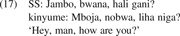
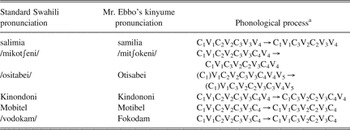
In Trevor's example, syllable order S1S2 changes to S2S1 through “syllable metathesis” (Lefkowitz Reference Lefkowitz1989:314), a common process of phonological transformation in language games the world over, including verlan (Walker Reference Walker, Gess and Arteaga2006, Weinberger & Lefkowitz Reference Weinberger, Lefkowitz, Laeufer and Morgan1991), Pig Latin, and Sheng (Githiora Reference Githiora2002). This process partially accounts for Ebbo's production of Kindononi in which he changes the internal syllabic order of the SS Kinondoni from S1S2S3S4 to S1S3S2S4.
Ingrams (Reference Ingrams1924:535) provides an additional example from Zanzibar that uses words with more than two syllables:

Ingram's example illustrates syllable methathesis with syllable order changes from S1S2S3 to S3S1S2; in other words, the finally syllable moves to the syllable-initial position and all other syllables stay in place. Since all of Ebbo's examples are polysyllabic, we can see that Ebbo does not follow the Zanzibari rule for forming polysyllabic kinyume words. In all but one of the rapper's examples the first and last syllables do not shift.
Goyvaerts (Reference Goyvaerts1996) also locates kinyume in Bukavu, Democratic Republic of the Congo (DRC), a city near the Western border of Tanzania. He writes: “In Kinyume—also known as Musekembo or Kilamanyuzi—words exhibiting the syllabic structure S1S2 undergo a structural change yielding S2S1 (similarly, S1S2S3 will become S3S2S1, etc.)” (Goyvaerts Reference Goyvaerts1996:126). One of Ebbo's examples comes close to the Bakavu kinyume: in his pronunciation of Saredalama, he changes the syllabic order of the first four syllables in SS Dar es Salaam /daresalaam/ from S1S2S3S4 to S3S2S1S4 and changes the final syllable (S5) from the VC structure borrowed from Arabic to a more Bantu-sounding CV structure.
Sheng, an “age-marked, urban dialect of Kenyan Swahili whose outer form is pidgin-like” (Githiora Reference Githiora2002:176) also shares features with kinyume. Githiora discusses the use of pig Latin within Sheng and provides five examples. The majority of these examples are bisyllabic, following the same phonological rule as Trevor's examples from coastal Tanzania, that is, a shift from S1S2 syllable order to S2S1. Yet Githiora (Reference Githiora2002:167) includes two examples of polysyllabic words that provide an additional possible phonological transformation, given in (19).
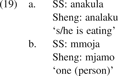
In both of these examples from Sheng, the prefixes and infixes are not affected by the phonological rule (e.g. the subject marker prefix a- and the tense marker -na- in anakula and the class 1 noun prefix m- in mmoja), while the syllables in the stem of the verb or noun shift from S1S2 to S2S1. None of Ebbo's examples are words with prefixes or infixes, since salimia is a verb stem and his other examples are proper names. It appears that he has avoided using kinyume for morphologically complex words.
Unlike the three documented varieties of kinyume and similar processes in Sheng, Ebbo's version of kinyume is based on a phonological rule of consonantal (rather than syllabic) methathesis. Table 1 illustrates the phonological process for the remainder of Ebbo's examples. In all cases here, the second and third consonants shift positions. Kinondoni can be considered a case of either syllabic or consonantal metathesis, since its second and third vowels (V2 and V3) are both /o/. Overall, it appears that Ebbo's use of kinyume has some similarities to other varieties but also relies on Ebbo's playfulness with a less common phonological rule, consonantal metathesis, which has not previously been documented in kinyume. His creativity contributes to the uniqueness of Ebbo's style.
The phonological processes of Mr. Ebbo's kinyume.

aSince Swahili has a CV syllabic structure, I inserted an absent C1 in the example of Oyster Bay /ositabei/, which allows one to see the shared rule among all of the examples listed here.
INTERPRETATIONS
What does Ebbo's use of NSS—in the form of code-switching, Maa-influenced pronunciation of Swahili words, NSS grammar, an ironic misunderstanding of SS words and grammar, and kinyume—add to “Mi Mmasai” and to his signature style? The relationship between language and identity in the song is equivocal and can be understood in (at least) two contradictory ways.
On the one hand, Ebbo's NSS (kinyume in particular) may function like other urban youth languages, language games, hip hop performances, and even anti-languages—deliberately flaunting the “misuse” of SS in order to critique the dominant ideology that SS is superior to NSS. Ebbo's NSS shares the following features with other anti-languages: “a certain degree of flaunting, as well as a significant reshaping of, the standard variety by means of phonological and semantic skewing and … systematic morphological manipulations.” Whereas standard languages are associated with “respectable society,” anti-languages are associated with “impoverished or outcast groups” (Goyvaerts Reference Goyvaerts1996:127). The Maasai are the quintessential impoverished and outcast group in Tanzania, not only cast as the “noncontemporaneous ‘other’ ” to modern Tanzanians (Schneider Reference Schneider2006:103) and perceived and depicted as “primitive” (Hodgson Reference Hodgson, Lindsay and Miescher2003:212–13), but also with less access to the material benefits of development (Galaty Reference Galaty2002).
NSS may carry with it a certain prestige among the Maasai and other NSS speakers, even though it is perceived as negative by SS speakers. Goyvaerts, in his examination of Kibalele (an anti-language spoken in the DRC near the Tanzanian border) suggests that such
(covert) prestige should be explained as a result of the fact that [an anti-language] compensates for the lack of knowledge among its speakers (who have enjoyed no formal education) of any prestigious language… To show off, these speakers may occasionally speak [the anti-language] amongst themselves in public places in order to impress bystanders (and gain some social status by doing so). (1996:128)
Here “bystanders” can be understood as the majority of listeners to Ebbo's music, who will understand his language but be positioned as “other” to it. Ebbo's Maa-inflected Swahili, Maa code-switching, playful misunderstandings of SS words, and NSS grammar, can be understood as “flaunting” and “showing off” precisely because they are so exceptional and marked in relation to the typical language practices of Bongo Flava: SS, code-mixing with English, and urban slang.
Like Swahili slang more generally, Ebbo's NSS fits with the typical profile of urban youth languages and anti-languages:
where a general attitude of jocular disrespect towards social and linguistic norms entails what one might call disrespectful ways to deal with the linguistic forms that serve as a basis in lexical manipulation. This disrespect is expressed in linguistic shape by [among other features] phonotactic “violence” which distorts the linguistic icons of the ‘standard’ … (Reuster-Jahn & Kießling Reference Reuster-Jahn and Kießling2006:51)
The emphasis on “jocular disrespect” is important here since it allows Ebbo to simultaneously critique and support hegemonic attitudes toward SS, NSS, Maasai ethnicity, and by extension, marked ethnicity more generally. Indeed, his ability to play with Maa and Swahili by rhyming code-switched Maa words with Swahili ones, to create polysemy through his dropping of SS subject markers and NSS pronunciation, to riff on polysemous Swahili grammatical constructions, and to metathesize consonants all point to Ebbo's linguistics skills and verbal virtuosity in both SS and NSS.
On the other hand, Ebbo's performance of Maasai identity remains uncomfortably close to local stereotypes of the Maasai and may therefore lend support to an ideology that critiques those Tanzanians who refuse to abandon their ethnicity in favor of a postethnic version of modernity. One example of such a reading comes from a Tanzanian journalist's comments on “Mi Mmasai”:
[T]he real rap words as churned out by Mr. Ebbo (able), also known as Abel Loshilaa Motika, in his Masai intonation chants, portray the Maasais as some ignorant, backward and totally out of touch, people. … For many years now, various local and foreign NGOs, have been striking it rich in the pretext of doing something or another, for the Masai. So, Mr. Ebbo is simply following suit. … To make the matter worse, he backs all these claims, with a full length video recordings [sic], that remind you of those; “The gods must be crazy,” movie series! What Mr. Ebbo (able), have not been “able” to realise is that, most people loving this song are Non-Masai fellows, who simply enjoy being reminded that, there are some certain ethnic groups that are more inferior, than theirs. No wonder some smart street fellows have already dubbed the third line of Mr Ebbo's “Mi Masai!” Chorus, by singing in the same intonation; “Nadumisha Ujinga, ile wengine nakwisha acha!” (“I maintain Stupidity! Something that, others have long abandoned”) (Nkwame Reference Nkwame2002; spelling, grammar and use of punctuation as in the original)
Nkwame's critique illustrates a reading of Ebbo's style as a mockery of the Maasai similar to Tanzanian comics in which interference from one's ethnic language is stereotyped, mocked, and used to indicate distance from a modern, urban, postethnic “Swahili” identity that is valorized (Thompson Reference Thompson2006). Ebbo's use of Maa code-switching suggests his attachment to his own language and ethnicity and refusal to fit into mainstream Tanzanian language practices, a refusal some may interpret as an inability. His NSS grammar relies on stereotypes of Maasai-influenced Swahili and also creates more than one meaning in the song. His playful misunderstandings of SS vocabulary and grammar call to mind popular stereotypes of the Maasai as poorly educated and ignorant of the urban space in which they are depicted as wandering aimlessly. Likewise, Ebbo's kinyume feeds into stereotypes of Maasai ignorance of SS. Although using it for proper place and brand names helps assure his listeners' understanding of these unusual lexical items, it also plays into stereotypes of Maasai ignorance of the urban, modern space of Dar es Salaam. If it is true that kinyume in coastal Tanzania is a language game of women and children (Trevor Reference Trevor1955), Ebbo's use of it also emasculates the Maasai.
CONCLUSIONS
How is it that these two contradictory readings can coexist? Woolard argues that “bilingual practice can dismantle (but does not simply neutralize) binary distinctions, in this case between language varieties” (1998:6). Her own work suggests, however, that it is not merely “bilingual practice” per se but more specifically the humorous practice of bilingualism that dismantles binary distinctions between languages or language varieties. I would add, too, that Ebbo's use of humor in this context does not merely upset the binary distinctions between SS and NSS (both of which Ebbo knows, indeed must know, in order to play with them the way he does), but also between the two interpretations of his work that I mapped out above.
Woolard's (1998) focus on the fundamental undecidability of bilingual parodic texts is useful here as is Johnstone's (1999) work on self parody. Ebbo's performance of ethnicity through his NSS is open to multiple interpretations depending on the social positioning and ethnolinguistic identification of the audience. His extensive use of NSS in a public arena both marks his identification with Maasai ethnicity and disrupts dominant language ideologies that are used to disparage the Maasai; and yet some take his work to be based in an anti-Maasai attitude, hearing his stylings as yet another biting parody of the most stereotyped ethnic group in Tanzania. It is impossible to discern whether it is a out-group Swahili(zed) or an in-group Maasai voice—in other words, Ebbo or his narrator—that comments on Maasai who bring an impure linguistic code to the urban modern space of postethnic Swahili identity. An equivocal parody, Ebbo's stylized performance of the Maasai rapper simultaneously offers both a “purist mockery” of non-Standard Swahili and a critique of Swahili linguistic hegemony. “The ironizing voice is ambiguous and the comedy is bivalent, simultaneously heard differently by different segments of the audience” (Woolard Reference Woolard1998:22–23), and therefore undecidable.
For these reasons, we cannot place too much stock in Ebbo's romantic claims to represent the beauty of, and his respect for, the Maasai. While acknowledging Ebbo's stated intent is a necessary part of the hiphopographic goal of engaging “the cultural agents of the Hip Hop Culture-World directly, revealing rappers as critical interpreters of their own culture” (Alim, Meghelli, & Spady Reference Alim, Meghelli, Spady, Spady, Alim and Meghelli2006:28), we should not mistake Ebbo's agency for subversiveness. While he has successfully carved out and created a space for himself within the Bongo Flava scene, the Maasai as a whole still remain marginalized within Tanzania, and it remains unclear whether Ebbo's parody of local stereotypes has been complicit in their marginalization. The humorous content and parodic use of NSS in “Mi Mmasai” simultaneously create the sense of Ebbo as a skilled rapper and of his Maasai persona as a stereotypical Maasai who “has not made progress,” belying a simplistic interpretation of Ebbo and the representations of Tanzanian ethnicity he offers.
APPENDIX: “MI MMASAI”
Below is the transcript of the lyrics to “Mi Mmasai” by Mr. Ebbo, from the album Fahari Yako (2002), transcribed and translated by Katrina Daly Thompson.
Key:
Bold indicates non-Standard Swahili pronunciation.
Underlining indicates non-standard Swahili grammar.
Double underlining indicates kinyume ‘backwards style’.
Italics indicate Maa vocabulary.