Introduction
The bruchid Callosobruchus maculatus (F.) is a pest of worldwide importance that causes damage to legumes by feeding and/or oviposition (Utida, Reference Utida1967, Reference Utida1972; Messina, Reference Messina1991; Fox et al., Reference Fox, Bush and Messina2010). Lathyrus sativus L. (Leguminosae), commonly known as khesari, is one of the important grain legumes in Bangladesh, Ethiopia and India (Gaur & Maloo, Reference Gaur and Maloo2011; Girma & Korbu, Reference Girma and Korbu2012). The crop is cultivated by the farmers of developing countries for production of pulse seeds, which are consumed as food. The adult females lay eggs on the khesari seed surface, and the newly hatched larvae of C. maculatus pass through four instars to complete their larval development within 12–16 days and finally the adults emerge from the seeds (Adhikary & Barik, Reference Adhikary and Barik2012). The heavy infestation by this insect in storage reduces food value of the legume. Hence, it is prerequisite to control outbreaks of this insect. Use of methyl bromide as a fumigant for control of this insect will be discontinued worldwide by 2015 under the terms of Montreal Protocol (United Nations Environment Programme, 1998). Further, use of phosphine gas is also harmful as it causes fire in wet conditions and reacts with copper which ultimately damages electrical fittings in the storage (Mbata, Reference Mbata and Hodges2004). It is noteworthy that some insecticides such as aluminum phosphide is of no more use, and a strain of C. maculatus is tolerant to dimethoate, permethrin, etc. (Bogamuwa et al., Reference Bogamuwa, Weerakoon and Karunaratne2002). Management of the pest typically entails chemical-based insecticide (pyrethroids, organophosphates) application, which might have potential impacts on non-target organisms and human health. Such concerns result in development of alternate control strategies such as baited traps, which might be incorporated into integrated pest management (IPM) schemes for this pest.
Volatile organic compounds (VOCs) such as saturated and monounsaturated six carbon aldehydes, alcohols and corresponding esters, terpenoids, etc. from the seeds play an important role in seed–insect interaction (Schoonhoven et al., Reference Schoonhoven, Van Loon and Dicke2005). Some synthetic monoterpenoids, such as E-anethole, estragole, S-carvone, L-fenchone, geraniol, γ-terpinene and DL-camphor might act as oviposition deterrent to C. maculatus populations including mortality of eggs, first and fourth instar larvae, pupae and adults (Mbata & Payton, Reference Mbata and Payton2013). Fatty acids from mung bean seed coat surface waxes have been shown as ovipositional stimulant to C. maculatus (Parr et al., Reference Parr, Tran, Simmonds, Kite and Credland1998), but no information is available on long-range volatiles from khesari seeds, which act as attractants of C. maculatus. A cursory review of literature indicate that semiochemicals involved in host location might contribute to novel and sustainable pest management program, such as baited traps. To address this, long-range volatiles from four varieties, i.e., Bio L 212 Ratan, Nirmal B-1, WBK-14-7 and WBK-13-1 of uninfested khesari seeds were collected by push–pull technique, and subsequently identified and quantified by gas chromatography mass spectrometry (GC-MS) and gas chromatography flame ionization detector (GC-FID) analyses, respectively. The behavioral responses of mated C. maculatus females to whole volatile blends from four varieties of khesari seeds were examined using a Y-shaped glass tube olfactometer bioassay. We further studied the role of individual synthetic volatile compounds and combinations of synthetic compounds that were characteristic of uninfested khesari seeds as an olfactory cue to C. maculatus.
Materials and methods
Seed materials
Twenty bags (each bag contained 500 g uninfested seeds) of each variety (Bio L 212 Ratan, Nirmal B-1, WBK-14-7 and WBK-13-1) of khesari seeds were collected from Pulses and Oilseeds Research Station, Behrampore (24°6′N and 88°15′E), West Bengal, India and taken in this laboratory.
Test insects
Callosobruchus maculatus were collected from local stores containing chickpea seeds at Burdwan (23°16′N, 87°54′E), West Bengal, India. They were maintained in 1 liter glass jars containing chickpea seeds for one generation, which were covered with fine-mesh nylon nets at 12 L: 12 D photoperiod in a ‘BOD’ incubator (ADS instruments and Tech., Calcutta). Active/inactive male and female forms were determined by flight activity, elytra size and intensity of pigmentation on elytra. Newly emerged F2 inactive males and females (male: antennae long and deeply serrated, and pygidium uniformly covered with golden setae; female: antennae short and subserrated, and pygidium with a pair of black postero-lateral spots) were separated morphologically from the stock cultures everyday at 9 AM and 9 PM and were kept in separate glass jars without chickpea seeds. For mating, virgin inactive females collected within 12 h of adult emergence were provided with a single virgin inactive male in a 60 mm Petri dish. After a single copulation, inactive females were transferred to a 15 cm (length) × 8 cm (diameter) glass jar containing a small Petri dish (2 cm × 1 cm) with water (Howe & Currie, Reference Howe and Currie1964; Fox, Reference Fox1993). The behavior of 4–6 day-old mated inactive females was observed in olfactory bioassays. Females were used in the bioassay as the females are guided by olfactory cues for finding of a suitable habitat and host for egg laying (Parr et al., Reference Parr, Tran, Simmonds, Kite and Credland1998).
Chemicals
HayeSep Q (80–100 mesh), nonyl acetate (grade: nature identical), trans-2-Penten-1-ol (95%), 1-hexanol (≥99.5%), α-pinene (≥99%), benzaldehyde (≥99%), 1-heptanol (98%), 1-octen-3-ol (≥98%), 3-octanone (≥98%), 3-octanol (99%), benzyl alcohol (99.8%), linalool oxide (≥97%), 1-octanol (≥99%), linalool (97%), nonanal (95%), 1-nonanol (≥98%), decanal (≥98%), geraniol (98%), 1-decanol (99%), α-humulene (≥96%), 1-tridecanol (97%), 1-tetradecanol (97%), farnesyl acetone (≥90%), geranyl linalool (≥95%) and phytol (≥97%) were purchased from Sigma Aldrich, Germany. Methylene chloride (≤99%) was purchased from Merck Limited, India.
Volatile collections
Four hundred grams of each variety of khesari seeds from each bag were placed in 5-liter glass made Erlenmeyer conical flask separately, and a glass stopper fitted with two 0.5 cm radius glass tubes (the orientation of the glass tubes was in opposite direction) was placed in the mouth of the Erlenmeyer conical flask (Supplementary Figure 1). Charcoal-filtered air was pushed (2 liters min−1) though one glass tube into the Erlenmeyer conical flask and pulled (0.5 liter min−1) through another glass tube which was fitted with a volatile collector trap (150 mm long × 5 mm o.d.) containing 80 mg of HayeSep Q as an adsorbent. Volatiles from all treatments (N = 5 replicates for each treatment, i.e., 400 g of each variety of seeds from each bag were used separately for collection of volatiles and a total of five volatile samples were collected separately for each variety) were collected over 10 h from 9 AM to 7 PM.
Volatiles were eluted from the adsorbent washing with 500 μl methylene chloride, and concentrated to 200 μl by a nitrogen flow. One hundred micro liters of each extract were used for olfactory bioassays, and the remaining 100 μl were used for chemical analyses. For olfactory bioassays, 20 μl of an aliquot (equivalent to volatiles released by each variety of khesari seeds in ~1 h) were applied to Whatman No. 41 filter paper (1 cm2). For quantification through GC, nonyl acetate was added as internal standard (IS), at 20 ng μl−1.
Chemical analysis of volatile samples
Five separate volatile samples from each variety of khesari seeds were analyzed with an Agilent 6890 GC coupled with a 5973 Mass Selective Detector with an HP-5 column (Agilent; Palo Alto, CA, USA; length: 30 m × 0.25 mm × 0.25-μm film thickness). The oven temperature program was initially 50 °C held for 3 min, and then raised at 3.75 °C min−1 to 240 °C and finally held for 5 min. Helium was the carrier gas. The MS parameters were 250 °C at the interface, ionization energy 70 eV, scan speed approximately 1 s. One μl sample was injected with a split ratio of 1:10. The volatile compounds were identified by comparison of mass spectra and retention time with those of authentic standards.
For quantification of identified volatile compounds, the volatiles from each treatment were analyzed by a Techcomp GC (Em Macau, Rua De Pequim, Nos. 202A-246, Centro Financeiro F7, Hong Kong) model 7900 fitted with an HP-5 capillary column and a flame ionization detector, which was run under same temperature conditions as described for GC-MS analysis. The carrier gas was nitrogen with a flow rate of 18.5 ml min−1. The injector port temperature was 280 °C. Components were characterized and quantified against the retention times of authentic standards.
Olfactometer bioassays
The behavioral responses of adult female C. maculatus to volatiles were carried out in a glass made Y-shaped olfactometer (15 cm stem and each arm 15 cm long, 0.6 cm radius, 45° Y angle). The stem of the olfactometer was connected to a porous glass vial (1 cm radius × 3 cm long) in which test insect was released. Each arm of the olfactometer was connected to a glass-made micro kit adapter fitted into a glass vial (1 cm radius × 3 cm long). One glass vial contained a piece (1 cm2) of Whatman No. 41 filter paper moistened with 20 μl of volatiles, whilst the other glass vial contained a filter paper of same size moistened with 20 μl of the control solvent (methylene chloride). Charcoal-filtered air was pushed into each arm of the olfactometer at 200 ml min−1. All the connections between different parts of the set-up consisted of silicon tubing.
The effectiveness of volatiles as attractant was evaluated in the following manner in the laboratory at 27 ± 1 °C, 70 ± 3% relative humidity (RH), and light intensity 150 lux. For each experiment, 20 μl of volatile sample and the control solvent were applied to separate filter paper pieces, allowed to evaporate and introduced into the glass vials before the first insect was released into olfactometer. One adult female C. maculatus was introduced into the porous glass vial, which was then attached with the stem of the olfactometer and exposed to a particular odor plus one control. The choice behavior of each female in response to individual synthetic volatile compounds or blend of synthetic volatile compounds was observed for 2 min. This insect was not attracted by the control solvent (methylene chloride) in preliminary assays. The olfactory response of bruchids was recorded as one of the three categories choosing between methylene chloride or the treatment volatiles or ‘non-responding’ (individuals remained in the common arm of the Y-tube by the end of the observation period) (Magalhães et al., Reference Magalhães, Borges, Laumann, Sujii, Mayon, Caulfield, Midega, Khan, Pickett, Birkett and Blassioli-Moraes2012; Mukherjee et al., Reference Mukherjee, Sarkar and Barik2014; Sarkar et al., Reference Sarkar, Mukherjee and Barik2014). Each experiment with one volatile sample was conducted until a total of 90 näive female insects had responded. The olfactometer set-up was cleaned with petroleum ether followed by acetone after testing five insects, and the position of the two arms was systematically changed in order to avoid positional bias. After testing five insects, the filter paper pieces containing volatile sample and control solvent have been replaced with new filter paper pieces with volatile sample and control solvent.
Bioassays
Bioassay 1. Volatiles from uninfested khesari seeds tested against solvent control. Responses of female C. maculatus to volatiles collected from four varieties of khesari seeds (A: Bio L 212 Ratan, B: Nirmal B-1, C: WBK-14-7 and D: WBK-13-1), respectively, were tested against solvent control (methylene chloride).
Bioassay 2. VOCs from four varieties of khesari seeds tested against each other. Responses of female C. maculatus to volatiles collected from khesari seeds were tested in the following combinations: (A) Bio L 212 Ratan vs. Nirmal B-1; (B) Bio L 212 Ratan vs. WBK-14-7; (C) Bio L 212 Ratan vs. WBK-13-1; (D) Nirmal B-1 vs. WBK-14-7; (E) Nirmal B-1 vs. WBK-13-1; (F) WBK-14-7 vs. WBK-13-1 to find out more attractive khesari seeds.
Bioassay 3. Individual synthetic compounds or synthetic blends of volatile compounds mimicking each variety of khesari seeds tested against solvent control. Individual synthetic compounds detected from 400 g of each variety of khesari seed (μg/10 h) were dissolved in 200 μl methylene chloride, and 20 μl of this odor (equivalent to individual volatiles released by each variety of khesari seeds in ~1 h) were tested against 20 μl solvent control to find response of the insect.
The individual synthetic compounds that produced response to the insect were combined mimicking each variety of seeds and combinations of synthetic compounds (20 μl volatile odors) (Supplementary Table 1) [Bio L 212 Ratan: 4.48 μg 3-octanone + 3.90 μg 3-octanol + 11.82 μg linalool oxide + 6.59 μg 1-octanol + 81.14 μg nonanal were dissolved in 200 μl methylene chloride and 20 μl of this odor (equivalent to volatiles released by Bio L 212 Ratan khesari seeds in ~1 h) or Nirmal B-1: 7.31 μg 3-octanone + 1.26 μg 3-octanol +14.59 μg linalool oxide + 10.96 μg 1-octanol + 21.14 μg nonanal were dissolved in 200 μl methylene chloride and 20 μl of this odor (equivalent to volatiles released by Nirmal B-1 khesari seeds in ~1 h) or WBK-14-7: 4.25 μg 3-octanone + 1.52 μg 3-octanol + 7.16 μg linalool oxide + 7.04 μg 1-octanol + 29.36 μg nonanal were dissolved in 200 μl methylene chloride and 20 μl of this odor (equivalent to volatiles released by WBK-14-7 khesari seeds in ~1 h) or WBK-13-1: 4.05 μg 3-octanone + 1.29 μg 3-octanol + 6.14 μg linalool oxide + 6.72 μg 1-octanol + 32.37 μg nonanal were dissolved in 200 μl methylene chloride and 20 μl of this odor (equivalent to volatiles released by WBK-13-1 khesari seeds in ~1 h)] were tested against 20 μl solvent control.
Further, two most abundant volatile compounds (nonanal and farnesyl acetone) in each variety of khesari seeds were tested as a synthetic blend (ng/20 μl) at ratios equivalent to that of each variety of khesari seeds (Supplementary Table 2) against solvent control to observe whether the blend displays any change in insect response than individual synthetic compounds to test insects.
Bioassay 4. Volatiles extracted from Bio L 212 Ratan khesari seeds (most attractive stimulus) vs. individual synthetic compound or a combination of synthetic compounds in the proportions presents in 400 g of Bio L 212 Ratan khesari seeds. Twenty μl volatiles extracted from most attractive khesari seed (Bio L 212 Ratan) were compared with the individual compound (ng/20 μl) or combination of synthetic compounds (ng/20 μl) [equivalent to the proportions detected in 400 g Bio L 212 Ratan khesari seeds in ~1 h].
Bioassay 5. Dose-dependent responses to five synthetic volatile compounds. Responses of female C. maculatus to five compounds were tested at different doses against solvent control (3-octanone or linalool oxide or 1-octanol: 5, 10, 20 and 40 μg were separately dissolved in 200 μl methylene chloride, respectively, and 0.5, 1, 2 and 4 μg/20 μl were used for olfactory bioassays; 3-octanol: 2, 4, 8 and 16 μg were separately dissolved in 200 μl methylene chloride, respectively and 0.2, 0.4, 0.8 and 1.6 μg/20 μl were used for olfactory bioassays; and nonanal: 15, 30, 60 and 120 μg were separately dissolved in 200 μl methylene chloride, respectively, and 1.5, 3, 6 and 12 μg/20 μl were used for olfactory bioassays).
Statistical analyses
The data on amounts of individual volatiles from each variety of khesari seeds were log (x + 1) transformed prior to performing statistical analysis. In order to highlight the variation in volatile composition within and among the varieties of khesari seeds, a two-way ANOVA was carried out against the individual components as dependent variable and the variety and replicate as explanatory variables. The amounts of individual VOCs present in Bio L 212 Ratan, Nirmal B-1, WBK-14-7 and WBK-13-1 of khesari seeds were subjected to principal component analysis (PCA) to reduce the redundancy of the data of individual volatile compounds and provide ordination of the variables and their each other relationship. Further, in order to interpret the levels of similarity of the volatile compounds in terms of their relative abundance, a cluster analysis (CA) based on Ward's method was carried out using XL STAT software and SPSS version 16. A Kruskal–Wallis nonparametric ANOVA was applied to compare the treatment effects of individual VOCs, and if found significant for Kruskal–Wallis test, the data were analyzed using a Steel–Dwass–Critchlow–Flinger multiple pair wise comparisons test with α = 0.05 to find any difference between individual volatile components among four varieties of khesari seeds using XLSTAT software. The log (x + 1) data on total amounts of volatiles from four varieties of khesari seeds were subjected to one-way ANOVA followed by Tukey's test. The data obtained on responses of C. maculatus to VOCs were analyzed by a Chi-square (χ2) test, i.e., probability of scores for the test compound(s) or control solvent is equal to 50% (Roy et al., Reference Roy, Laskar and Barik2012; Magalhães et al., Reference Magalhães, Borges, Laumann, Sujii, Mayon, Caulfield, Midega, Khan, Pickett, Birkett and Blassioli-Moraes2012; Mukherjee et al., Reference Mukherjee, Sarkar and Barik2013; Sarkar et al., Reference Sarkar, Mukherjee and Barik2013a , Reference Sarkar, Mukherjee and Barik b ; Sarkar & Barik, Reference Sarkar and Barik2014). Significance was set to P < 0.033 using a Bonferroni correction. Insects that did not respond by selection either arm of the olfactometer were excluded from the analysis.
Results
Chemical analysis
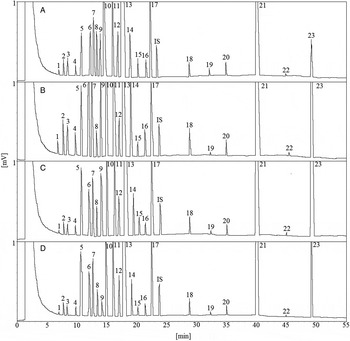
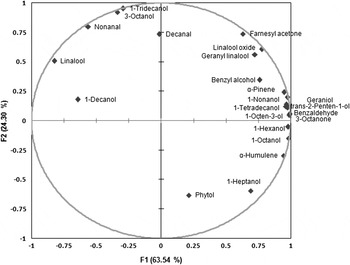
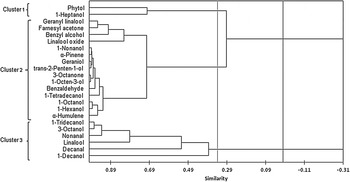
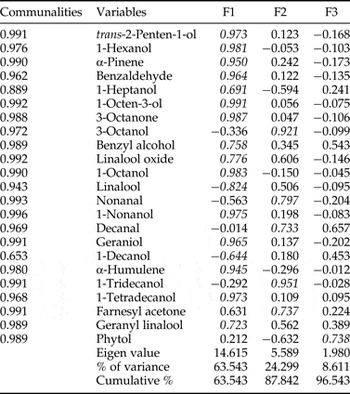
Chemical analyses of volatiles emitted from four varieties, i.e., Bio L 212 Ratan, Nirmal B-1, WBK-14-7 and WBK-13-1 of khesari seeds revealed 23 compounds (fig. 1, table 1). A two-way ANOVA results indicated that for all volatile compounds the F-values were consistently non-significant (P > 0.05) for replicates (within), while for varieties (among) the F-values were consistently significant (P < 0.05) across all the compounds (Supplementary Table 3). This suggested that the variation in volatile composition within a variety was less than among the varieties of khesari seeds considered in this study. The PCA revealed that two factors, F1 and F2, explained more than 87% of the variation in the observed abundance of volatile compounds (table 2, fig. 2). The biplot represented the spatial orientation of the variables against two extracted factors and excepting for phytol, all the variables showed loading for the first two factors (table 2). The communalities of the variables considered were >0.6 with the lowest value shown by 1-decanol. The factor loadings and the contribution of the variables to the factors were shown in table 2. On the basis of the relative abundance per sample, CA allowed classification of 23 volatile compounds under three central classes (fig. 3). Phytol and 1-heptanol representing cluster 1 exhibited greater similarity than that of 1-tridecanol and 1-decanol which represented cluster 3. The relationships of the volatile components in terms of their similarity in relative availability in the khesari seed variety were aptly represented in the cluster and the biplot as well.
Example GC-FID chromatogram (HP-5) of volatiles collected from four varieties: (a) Bio L 212 Ratan, (b) Nirmal B-1, (c) WBK14-7 and (d) WBK-13-1 of uninfested khesari seeds. Identification of peaks: 1. trans-2-penten-1-ol, 2. 1-hexanol, 3. α-pinene, 4. benzaldehyde, 5. 1-heptanol, 6. 1-octen-3-ol, 7. 3-octanone, 8. 3-octanol, 9. benzyl alcohol, 10. linalool oxide, 11. 1-octanol, 12. linalool, 13. nonanal, 14. 1-nonanol, 15. decanal, 16. geraniol, 17. 1-decanol, 18. α-humulene, 19. 1-tridecanol, 20. 1-tetradecanol, 21. farnesyl acetone, 22. geranyl linalool and 23. phytol.

The biplot showing the ordination of the volatile compounds.

Dendogram showing relationship among 23 compounds based on their relative abundance in the samples. The similarity is based on Pearson correlation coefficient and the classification is based on unweighted pair-group average.

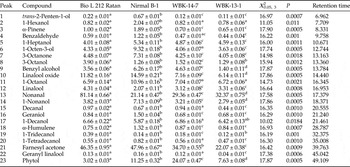
GC-FID analysis of VOCs emitted (μg/10 h) by 400 g uninfested Bio L 212 Ratan, Nirmal B-1, WBK-14-7 and WBK-13-1 L. sativus seeds (mean ± SE, N = 5).

Χ 2value is for Kruskal–Wallis test. Within the row means followed by different letters are significantly different by Steel–Dwass–Critchlow–Flinger multiple pair wise comparisons test with α = 0.05. For identification of peaks see fig. 1.
The PCA of the dataset on the 23 volatile compounds obtained from four varieties of L. sativus seeds.

The highest loading of the variables for the factors are in italics.
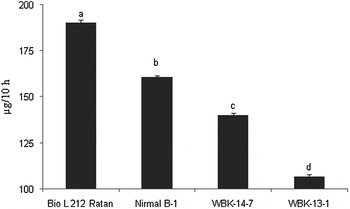
For individual VOCs in four varieties of khesari seeds, log (x + 1) transformed data did not reduce the heterogeneity of variances among the groups and, therefore, the original values were used for Kruskal–Wallis nonparametric ANOVA followed by Steel–Dwass–Critchlow–Flinger multiple pair wise comparisons test. Nonanal was predominant followed by farnesyl acetone in Bio L 212 Ratan and WBK-13-1 khesari seeds; whereas farnesyl acetone was predominant followed by nonanal in Nirmal B-1 and WBK-14-7 khesari seeds (table 1). Geranyl linalool was the least abundant in Bio L 212 Ratan and WBK-13-1 khesari seeds; whereas 1-tridecanol was the least abundant in Nirmal B-1 khesari seeds (table 1). Both trans-2-penten-1-ol and geranyl linalool were the least abundant compounds in WBK-14-7 khesari seeds. Rest of the identified VOCs displayed different patterns in four varieties of khesari seeds (table 1). The Levene's test (W) for homogeneity of variance indicated that the data for total amounts of VOCs from four varieties of khesari seeds were homogenous conforming to application of ANOVA (W = 0.653; df = 3, 16; P > 0.05). It was observed that the total amounts of VOCs varied significantly with treatments through one-way ANOVA (F = 915.132; df = 3, 16; P < 0.05), and the Tukey's multiple pair wise comparisons test revealed that total VOCs were significantly higher in Bio L 212 Ratan followed by Nirmal B-1, WBK-14-7 and WBK-13-1 khesari seeds (fig. 4).
Total amounts of volatiles (mean ± SE) emitted from four varieties of uninfested khesari seeds.

Behavioral bioassays
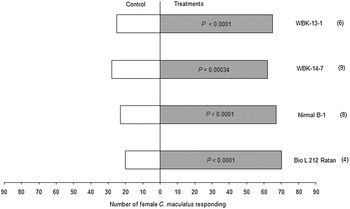
Bioassay 1. Volatiles from uninfested khesari seeds tested against solvent control. In Y-tube olfactometer bioassays, all four varieties of khesari seed types were more attractive than control solvent for female C. maculatus (Bio L 212 Ratan: χ2 = 27.78, df = 1; Nirmal B-1: χ2 = 21.51, df = 1; WBK-14-7: χ2 = 12.84, df = 1; WBK-13-1: χ2 = 17.78, df = 1) (fig. 5).
Female C. maculatus responses to four varieties of khesari seeds volatiles: Bio L 212 Ratan or Nirmal B-1 or WBK-14-7 or WBK-13-1 vs. solvent (CH2Cl2) control in Y-tube olfactometer bioassay. Numbers in brackets are the number of insects that did not respond to either treatment.

Bioassay 2. VOCs from four varieties of khesari seeds tested against each other. The insect showed preferences for some varieties over others: Bio L 212 Ratan > Nirmal B-1 > WBK-13-1 and WBK-14-7 [Bio L 212 Ratan seeds (χ2 = 7.51, df = 1) against Nirmal B-1 seeds; Bio L 212 Ratan seeds (χ2 = 17.78, df = 1) against WBK-14-7 seeds; Bio L 212 Ratan seeds (χ2 = 11.38, df = 1) against WBK-13-1 seeds; Nirmal B-1 seeds (χ2 = 6.4, df = 1) against WBK-14-7 seeds; Nirmal B-1 seeds (χ2 = 5.38, df = 1) against WBK-13-1 seeds; WBK-13-1 seeds (χ2 = 4.44, df = 1) against WBK-14-7 seeds] (fig. 6).
Female C. maculatus responses to four varieties of khesari seeds volatiles tested against each other: Bio L 212 Ratan vs. Nirmal B-1, Bio L 212 Ratan vs. WBK-14-7, Bio L 212 Ratan vs. WBK-13-1, Nirmal B-1 vs. WBK-14-7, Nirmal B-1 vs. WBK-13-1, and WBK-13-1 vs. WBK-14-7 in Y-tube olfactometer bioassay. Numbers in brackets are the number of insects that did not respond to either treatment.

Bioassay 3. Individual synthetic compounds or synthetic blends of volatile compounds mimicking each variety of khesari seeds tested against solvent control. Callosobruchus maculatus insects were attracted to five individual synthetic volatile components, 3-octanone, 3-octanol, linalool oxide, 1-octanol and nonanal; whereas rest of the identified 18 individual compounds did not provoke any response to the test insect.
The insect indicated clear positive responses to 3-octanol (χ2 = 6.4, df = 1), linalool oxide (χ2 = 6.4, df = 1) and nonanal (χ2 = 14.4, df = 1) at the proportions equivalent to the Bio L 212 Ratan seeds against solvent control, respectively; whereas the insect did not indicate clear positive and negative responses to 3-octanone (χ2 = 1.6, df = 1) and 1-octanol (χ2 = 1.6, df = 1) against solvent control (fig. 7A). The insects displayed attraction to the combination of nonanal and farnesyl acetone like nonanal alone. The insects were attracted to a synthetic blend of five volatile components equivalent to the proportions of five volatile components of Bio L 212 Ratan seeds (χ2 = 21.51, df = 1) against solvent control (fig. 7A).
Female C. maculatus responses to individual synthetic compounds and their combinations equivalent to the proportions of: Bio L 212 Ratan (a) or Nirmal B-1 (b) or WBK-14-7 (c) or WBK-13-1 khesari seeds (d) vs. solvent (CH2Cl2) control in Y-tube olfactometer bioassay. Numbers in brackets are the number of insects that did not respond to either treatment.

The insect displayed attraction to linalool oxide (χ2 = 8.71, df = 1) at the proportion equivalent to the Nirmal B-1 seeds against solvent control; whereas the insect did not indicate clear positive and negative reactions to 3-octanone (χ2 = 4.44, df = 1), 3-octanol (χ2 = 0.4, df = 1), 1-octanol (χ2 = 4.44, df = 1) and nonanal (χ2 = 1.6, df = 1) against solvent control (fig. 7B). The insects produced same response to the combination of nonanal and farnesyl acetone like nonanal alone. The insects were attracted to a synthetic blend of five volatile components equivalent to the proportions of five volatile components of Nirmal B-1 seeds (χ2 = 16.04, df = 1) against solvent control (fig. 7B).
The insect showed attraction to nonanal (χ2 = 5.38, df = 1) at the proportion equivalent to the WBK-14-7 seeds against solvent control; whereas the insect did not indicate clear positive and negative responses to 3-octanone (χ2 = 1.11, df = 1), 3-octanol (χ2 = 1.11, df = 1), linalool oxide (χ2 = 2.84, df = 1) and 1-octanol (χ2 = 2.18, df = 1) against solvent control (fig. 7C). The insects displayed same attraction response to the combination of nonanal and farnesyl acetone like nonanal alone. The insects were attracted to a synthetic blend of five volatile components equivalent to the proportions of five volatile components of WBK-14-7 seeds (χ2 = 11.38, df = 1) against solvent control (fig. 7C).
The insect displayed attraction to nonanal (χ2 = 6.4, df = 1) at the proportion equivalent to the WBK-13-1 seeds against solvent control; whereas the insect did not indicate clear positive and negative responses to 3-octanone (χ2 = 1.11, df = 1), 3-octanol (χ2 = 0.4, df = 1), linalool oxide (χ2 = 1.6, df = 1) and 1-octanol (χ2 = 1.6, df = 1) against solvent control (fig. 7D). The insects produced same attraction response to the combination of nonanal and farnesyl acetone like nonanal alone. The insects showed attraction to a synthetic blend of five volatile components equivalent to the proportions of five volatile components of WBK-13-1 seeds (χ2 = 10, df = 1) against solvent control (fig. 7D).
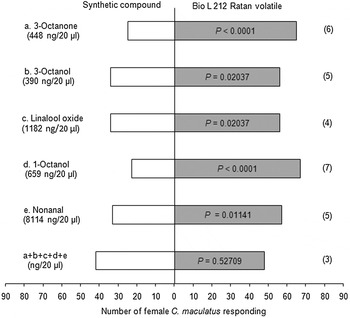
Bioassay 4. Volatiles extracted from Bio L 212 Ratan khesari seeds (most attractive stimulus) vs. individual synthetic compound or a combination of synthetic compounds in the proportions present in 400 g of Bio L 212 Ratan khesari seeds. The insects were attracted to the volatiles extracted from Bio L 212 Ratan seeds against five individual synthetic compounds in the proportions detected in Bio L 212 Ratan seeds [Bio L 212 Ratan seeds (χ2 = 17.78, df = 1) vs. 3-octanone, Bio L 212 Ratan seeds (χ2 = 5.38, df = 1) vs. 3-octanol, Bio L 212 Ratan seeds (χ2 = 5.38, df = 1) vs. linalool oxide, Bio L 212 Ratan seeds (χ2 = 21.51, df = 1) vs. 1-octanol, Bio L 212 Ratan seeds (χ2 = 6.4, df = 1) vs. nonanal]; whereas the insect did not indicate clear positive and negative responses to the volatiles extracted from Bio L 212 Ratan seeds (χ2 = 0.4, df = 1) against a combination of five synthetic compounds equivalent to the proportions present in Bio L 212 Ratan seeds (fig. 8).
Female C. maculatus response to volatiles extracted from Bio L 212 Ratan khesari seeds vs. individual synthetic compound or a combination of synthetic compounds in the proportions present in Bio L 212 Ratan khesari seeds.

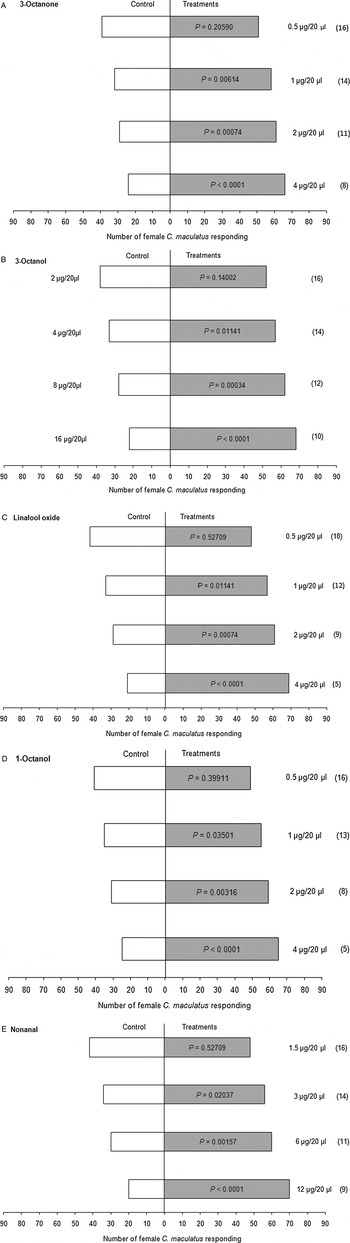
Bioassay 5. Dose-dependent responses to five synthetic volatile compounds. In Y-tube olfactometer bioassays, the insect displayed attraction to 3-octanone, 3-octanol, linalool oxide, 1-octanol and nonanal against solvent control (fig. 9). The insect showed attraction to 3-octanone at 1 μg/20 μl (χ2 = 7.51; df = 1), 2 μg/20 μl (χ2 = 11.38; df = 1) and 4 μg/20 μl (χ2 = 19.6; df = 1) (fig. 9A). The insects were attracted to 3-octanol at 0.4 μg/20 μl (χ2 = 6.4; df = 1), 0.8 μg/20 μl (χ2 = 12.84; df = 1) and 1.6 μg/20 μl (χ2 = 23.51; df = 1) (fig. 9B). The insect produced attraction to linalool oxide at 1 μg/20 μl (χ2 = 6.4; df = 1), 2 μg/20 μl (χ2 = 11.38; df = 1) and 4 μg/20 μl (χ2 = 25.6; df = 1) (fig. 9C). The insect displayed attraction to 1-octanol at 2 μg/20 μl (χ2 = 8.71; df = 1) and 4 μg/20 μl (χ2 = 17.78; df = 1; P < 0.0001) (fig. 9D). The insect was attracted to nonanal at 3 μg/20 μl (χ2 = 5.38; df = 1), 6 μg/20 μl (χ2 = 10; df = 1) and 12 μg/20 μl (χ2 = 27.78; df = 1) (fig. 9E).
Female C. maculatus response to synthetic volatiles vs. solvent (CH2Cl2) control in Y-tube olfactometer bioassay, (a) 3-octanone, (b) 3-octanol, (c) linalool oxide, (d) 1-octanol, (e) nonanal. Numbers in brackets are the number of insects that did not respond to either treatment.

Discussion
This study indicated presence of 11 alcohols, 3 aldehydes, 2 ketones and terpenoids among the 23 VOCs identified in the four varieties (Bio L 212 Ratan, Nirmal B-1, WBK-14-7 and WBK-13-1) of khesari seeds. Nonanal was the major compound followed by farnesyl acetone in Bio L 212 Ratan and WBK-13-1 khesari seeds; whereas farnesyl acetone was predominant followed by nonanal in Nirmal B-1 and WBK-14-7 khesari seeds. Thirteen VOCs were detected from uninfested cowpea seeds, and nonanol was the major compound followed by benzaldehyde, decanal, tridecane and hexanal in uninfested cowpea seeds (Babu et al., Reference Babu, Hern and Dorn2003).
The olfactometric bioassay results clearly revealed that C. maculatus could discriminate between the whole volatile blends released from each variety of khesari seeds against control solvent, and the insect preferentially respond to Bio L 212 Ratan seeds among the four varieties of seeds due to presence of higher amounts of 3-octanol and nonanal than other three varieties of khesari seeds (as seen in table 1). Insects employ between the ranges of 3–10 compounds as host location cue (Bruce & Pickett, Reference Bruce and Pickett2011). Callosobruchus maculatus showed attraction to 3-octanol, linalool oxide and nonanal at the minimal amounts of 390, 1182 and 2936 ng/20 μl in initial bioassays at the proportions detected in the khesari seeds, respectively; whereas the insect did not produce any positive and negative responses to 3-octanone and 1-octanol at 405 and 659 ng/20 μl, respectively. However, the insect showed attraction to 3-octanone and 1-octanol at the minimal amounts of 1000 and 2000 ng/20 μl in dose response bioassays, respectively. Hence, the ratio of volatiles released by khesari seeds becomes vital components, which act as olfactory cue for C. maculatus (Bruce et al., Reference Bruce, Wadhams and Woodcock2005; Bruce & Pickett, Reference Bruce and Pickett2011). Except linalool oxide, the above mentioned four volatile compounds have been reported to affect behavioral responses in a number of stored grain insect pests (Pierce et al., Reference Pierce, Pierce, Borden and Oehlschlager1991; Sinha, Reference Sinha, Fleurat-Lessard and Ducom1991; Collins et al., Reference Collins, Bryning, Wakefield, Chambers and Cox2007). However, the polyphagous beetle, Popillia japonica Newman showed attraction to linalool oxide with other compounds which are emitted from Malus domestica (Rosaceae) leaves (Loughrin et al., Reference Loughrin, Potter and Hamilton-Kemp1995).
The VOCs from four varieties of khesari seeds indicated emissions of several compounds including benzyl alcohol and linalool. It is well established that benzyl alcohol and linalool might play an important role in defense such as facilitating attraction of natural enemies to the insect pest (De Moraes et al., Reference De Moraes, Lewis, Paré, Alborn and Tumlinson1998; Tabata et al., Reference Tabata, De Moraes and Mescher2011). In the present olfactory bioassay result, we also observed no significant attraction of the test insect to synthetic benzyl alcohol and linalool when these compounds were tested in isolation. Farnesyl acetone, which was predominant in Nirmal B-1 and WBK-13-1 khesari seeds, did not indicate any attraction to the beetles. Further, 1-heptanol, 1-octen-3-ol, 1-nonanol, 1-decanol and phytol, were moderately abundant in the khesari seeds (as seen in table 1), did not display attraction of beetles in Y-shaped olfactometer bioassays. However, the attraction to the overall blend of VOCs released by uninfested khesari seeds cannot be ruled out, as insect responses to olfactory foraging cues depend on overall volatile blend rather than on attraction of individual compounds (Riffell et al., Reference Riffell, Lie, Christensen and Hildebrand2009; Webster et al., Reference Webster, Bruce, Pickett and Hardie2010).
In summary, our findings document that total amount of volatiles were higher in Bio L 212 Ratan followed by Nirmal B-1, WBK-14-7 and WBK-13-1 khesari seeds, and female C. maculatus displayed the lowest attraction toward WBK-14-7 and WBK-13-1 khesari seeds. Hence, this study indicates that farmers should be promoted for production of WBK-14-7 and WBK-13-1 khesari seeds, but it remains to be seen whether the food value of the two varieties of seeds are less than Bio L 212 Ratan and Nirmal B-1 khesari seeds. Further, C. maculatus were most attractive to a synthetic blend of 448, 390, 1182, 659 and 8114 ng/20 μl of 3-octanone, 3-octanol, linalool oxide, 1-octanol and nonanal, respectively, which might be used for the development of much needed eco-friendly trapping tools for pest management of C. maculatus. However, female C. chinensis prefer to oviposit uninfested cowpea seeds and egg-carrying seeds over L1- and L4-infested seeds (Ignacimuthu et al., Reference Ignacimuthu, Wäckers and Dorn2000), and feeding by the fourth instar larva of C. chinensis within the cowpea seeds is directly and or indirectly responsible for production of volatiles which are clearly repellent to conspecific females (Babu et al., Reference Babu, Hern and Dorn2003). In a recent study, Arnold et al. (Reference Arnold, Stevenson and Belmain2012) reported that inactive-form of C. maculatus was more attractive to cowpeas than active-form, and inactive females showed strong attraction over inactive males. They further indicated that young and intermediate aged beetles preferred infested and uninfested cowpeas, respectively (Arnold et al., Reference Arnold, Stevenson and Belmain2012). Hence, further studies are needed to observe whether feeding by larvae of C. maculatus induces repellence of conspecific females, and role of sex and age in the olfactory behavior of this insect toward uninfested and infested khesari seeds.
Supplementary Material
The supplementary material for this article can be found at http://www.journals.cambridge.org/BER
Acknowledgements
We thank two anonymous reviewers for many helpful comments on the previous version of the manuscript. The financial assistance from the Department of Science and Technology (DST) (SR/WOS-A/LS-106/2011), India as a Women Scientist Scheme and DST–PURSE are gratefully acknowledged.