In broad terms, 1% of newborn babies have congenitally malformed hearts. The lesions are considered to have a multifactorial aetiology, and treatment is frequently surgical, either by thoracotomy or sternotomy, depending on the specific cardiac lesion. Such patients, having undergone cardiothoracic surgery, are known to have a higher risk of developing scoliosis, with over two-fifths reported to develop this complication in some series,Reference Van Biezen, Bakx, De Villeneuve and Hop1 compared to no more than 2 to 3% of the general population.Reference Drennan, Campbell and Ridge2 The aetiology of the developing scoliosis is unknown.Reference Pérez-Caballero, Burgos and Martos3 although various factors have been implicated. These range from the suggestion that the vascular anomalies that exist in cyanotic congenital cardiac disease could produce abnormal irrigation of the spine, to the possibility that the thoracic deformity caused by the sternotomy and the thoracotomy could impact on the structure of the spine. In fact, the incidence of scoliosis after a combined sternotomy and thoracotomy is 10 times greater than that of idiopathic scoliosis.Reference Ruiz-Iban, Burgos and Aguado4, Reference Herrera-Soto, Santiago-Cornier, Segal, Ramírez and Tamai5 It has also been suggested that the association between the embryonic development of the cardiovascular and musculoskeletal systems could account for the high incidence of scoliosis in these children. Despite these speculations, it remains that, for most cases of scoliosis found in association with congenital cardiac disease, it is not possible to find a specific reason for the abnormal structure of the spine.Reference Farley, Phillips, Herzenberg, Rosenthal and Hensinger6
Advances in the fields of paediatric cardiology and paediatric cardiac surgery have led, over the last two decades, to an increase in the rates of survival of these patients,Reference Marino7 creating at the same time a subset of patients which will require spinal orthopaedic surgery for the correction of their spinal deformity. The risk of spinal surgery in children who have previously undergone cardiothoracic surgery is not well established.Reference Coran, Rodgers, Keane, Hall and Emans8 It is generally accepted, nonetheless, that the surgical time is directly proportional to the number of complications. Spinal surgery in these children is difficult, and is associated with a significant number of complications, including severe coagulopathies, excessive intraoperative and postoperative bleeding, infection of deep wounds, atelectasis, arrhythmias, congestive cardiac failure, cardiopulmonary arrest, and death.Reference Pérez-Caballero, Burgos and Martos9 In this report, we describe the medical complications detected in our department over a period of 7 years in children undergoing spinal surgery who had previously undergone cardiothoracic surgery for treatment of their congenitally malformed hearts.
Materials and methods
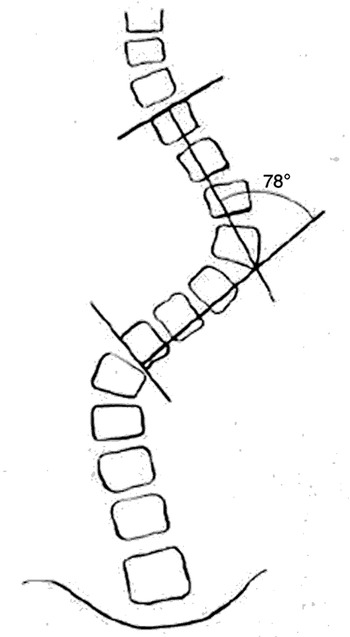
Our retrospective study was designed to include all episodes of surgery for correction of scoliosis that had taken place in our Hospital from January, 2000, to December, 2006, in children who had previously undergone cardiothoracic surgery for treatment of their congenitally malformed hearts. We excluded those patients with acquired cardiac disease, and those who had a syndrome associated with the development of scoliosis. In these patients, measurements of Cobb anglesReference Cobb10 were taken before and after surgery (Fig. 1). We analysed the existence of costal fusions, or other anomalies associated with a previous thoracotomy, in the presurgical X-rays.
Measurement of the Cobb angle.

We also analysed the specific congenital cardiac malformation, whether or not it was associated with cyanosis, and whether the cardiac surgery had been corrective as opposed to palliative. Cyanosis was defined as a saturation of oxygen below 90% as measured using pulsed oximetry. Patients who had a cyanotic lesion at birth, but who had normal saturations of oxygen subsequent to the cardiac surgery, were classified as being acyanotic. All patients received antibiotics for endocarditic prophylaxis.
All the operations for scoliosis were carried out by the same surgical team, using a posterior approach and pedicular or extrapedicular screws. We analysed the need of inotropic drugs, any use of aprotinin to control bleeding, and requirements for transfusion of blood during the surgical procedure, including transfusion of autologous blood, which is a common procedure in our Centre. We monitored arterial and central venous pressures carefully in all patients during the surgery. In order to detect any motor injury, we also monitored somatosensory-evoked potentials during the surgery, following the indications of the American Encephalographic Society.11 Complete and persistent loss of such potentials suggested a high risk of injury to the spinal cord, whereas a transitory loss of potentials followed by recovery was shown not to be linked to a higher risk of motor sequels.12
During the postoperative period in our paediatric intensive care unit, all patients received morphine chloride for management of pain as a continuous intravenous infusion. This was started at a dose of 25 μg/kg/h, and increased as required in the following hours depending on the needs of each patient. We analysed the mean time spent in our unit, the need for inotropic drugs and mechanical ventilation, the beginning of oral intake, the amount and duration of surgical drainages, the requirements for drug relief of pain, and the incidence of postoperative complications. All data was processed using an Excel programme, and is presented as descriptive values, providing the mean and ranges.
Results
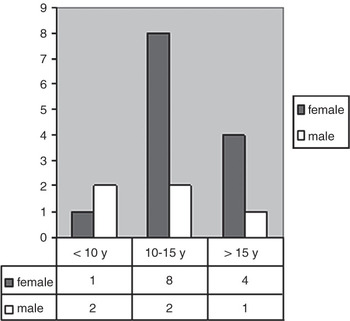
During the period of study, from a total of 87 patients undergoing spinal fusion, 18 had previously undergone surgery for treatment of congenital cardiac disease. Of these 18, 13 (72%) were girls, and 5 (28%) were boys. The mean age at surgery was 14 ± 4.2 years. Cardiothoracic surgery had taken place at a mean age of 2.6 ± 2 years (Fig. 2).
Distribution of gender and age amongst our patients with congenitally malformed hearts undergoing spinal orthopaedic surgery.

The mean Cobb angle was 64.3° ± 9.8°. In 60% of our patients, there were double structured curves, but none had undergone costal fusion during the initial thoracotomy. In 7 of the children (39%), the procedures were palliative as opposed to complete correction, meaning that more than one thoracotomy or sternotomy had been performed prior to the spinal surgery.
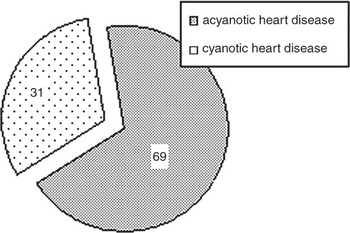
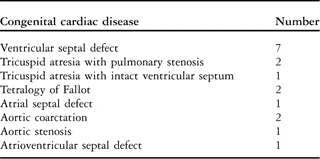
In 12 of the patients (69%), the cardiac lesion was deemed to be acyanotic, leaving 6 (31%) with cyanotic lesions (Fig. 3). The specific lesions are shown in the Table 1. Prior to the orthopaedic surgery, all underwent a complete cardiologic evaluation, including electrocardiography and echocardiography. At the time of our surgery, 5 patients were receiving furosemide and captopril, these being the 3 patients with tricuspid atresia and the 2 with tetralogy of Fallot.
The proportions of acyanotic as opposed to cyanotic lesions in our patients.

Classification of congenital cardiac lesions.

During the surgery for correction of scoliosis, 4 patients (22%) needed inotropic support with dopamine at 5 to 10 μg/kg/min, and milrinone at 0.7 μg/kg/min. All patients needed transfusions of blood during the surgery, although in 43% the amount of heterologous packed red blood cells infused was reduced by the use of a cellsaver, and in 56% use of heterologous blood was avoided by the pre-donation of autologous blood. Packed red blood cells were transfused to maintain a haematocrit above 30% during surgery, although a number of factors, such as acidosis, hypovolaemia, and decreases in central venous pressure, together with bleeding during the operation, influenced the decision to transfuse. Fresh frozen plasma was also transfused in all the patients during surgery, either because of prolonged coagulation times or because of significant bleeding during the surgery. In 13 instances (73%), aprotinin was used at a dose of 1 mg/kg when fresh frozen plasma alone proved insufficient to control the bleeding.
The targeted central venous pressure during the surgical procedure depended on the previous congenital cardiac lesions, aiming levels as high as 18 to 20 centimetres of water in patients with the Fontan circulation, but accepting levels of 5 to 7 centimetres in the other patients. The mean time spent in our intensive care unit was 2.4 ± 5 days, with a total time spent in hospital of 11.3 ± 2.9 days. The mean Cobb angle was transformed from 64.3° before the surgery to 42.9° after the surgery, indicating a correction of 33% of the deformity.
During the immediate postoperative period, inotropic support with dopamine at a maximal dose of 10 μg/kg/min was needed for 2 patients (11%) for 34 and 46 hours, respectively. Of the patients, 8 (44%) had been extubated prior to their arrival at the paediatric intensive care unit, while the remaining 10 (56%) required mechanical ventilation for a maximum period of 14 hours. The mean time to extubation was 4.3 hours.
Oral intake with good tolerance was achieved at a mean time of 24.4 ± 5 hours. Surgical drainages were maintained for a mean time of 80.25 hours ± 14.2 hours, with a mean loss of fluid of 1010.8 ± 152.35 centilitres. A continuous intravenous infusion of morphine chloride was provided for 44.4 ± 6.3 hours, this then being replaced by oral morphine. Maximum doses were not analysed.
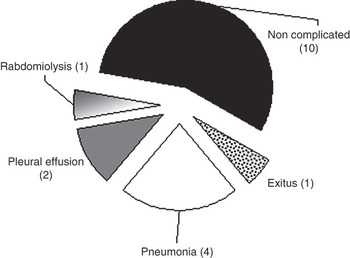
In 10 (55%) of our patients, there were no complications during their stay in the intensive care unit (Fig. 4). A patient with the Fontan circulation, however, died in the immediate postoperative period due to hypovolaemic shock caused by massive bleeding. In 2 further patients (11%), pleural effusions developed requiring insertion of chest tubes for their resolution. Infectious symptoms compatible with pneumonia were present in 4 children, who required intravenous antibiotics. Another patient developed rhabdomyolysis, probably associated with the prolonged time of surgery.Reference Alterman, Sidi, Azamfirei, Copotoiu and Ezri13, Reference Lachiewicz and Latimer14 He was treated with hyperhydratation, urine alkalization, and furosemide, with a favourable outcome. The observed rate of complications is higher than that found in a previous study carried out on our non-cardiac patients over a period of 10 years, where complications occurred in 27%, 8% due to infections, 9% to pleural effusions, and 10% to atelectasis.Reference Pérez-Caballero, Burgos and Martos3
Medical complications occurring during the immediate postoperative period in the children with congenitally malformed hearts undergoing surgery for correction of scoliosis.

Discussion
The number of patients with congenitally malformed hearts needing spinal orthopaedic surgery for correction of scoliosis has increased in recent years. More than 85% of children with congenitally malformed hearts undergoing surgical treatment now reach adulthood as a result of advances in surgical and medical management.Reference Perloff15 A progressive spinal deformity can induce problems in patients with a previous cardiovascular lesion, the main ones being related to a significant reduction of pulmonary function. Using ultrasonography, a significant increase in pulmonary pressure, right ventricular dysfunction and cor pulmonare has been demonstrated in patients with idiopathic scoliosis.Reference Primiano, Nussbuaum and Hirschfeld16 We found a higher prevalence of scoliosis associated with congenital cardiac disease in girls, as opposed to previous studies where the prevalence was not significantly different between sexes.Reference Durning, Scoles and Fox17
It has been previously suggested that cyanotic lesions carry a higher risk for development of scoliosis than acyanotic ones, albeit that subsequent studies have not supported this theory.Reference Wright and Niebauer18, Reference Herrera-Soto, Vander Have and Barry-Lane19 We found ventricular septal defects to be the most frequent individual lesion, a not unexpected finding in that they have a higher prevalence than complex cyanotic cardiopathies. To our knowledge, no study has yet shown a higher risk of scoliosis associated with any specific congenital cardiac lesion. We also failed to find any association between the risk of developing scoliosis and the number of previous thoracotomies, again in contrast to previously published data.Reference Gilsanz, Boechat, Birnberg and King20 Neither does our data support the notion of an association between the side of the thoracotomy and the direction of the spinal deformity.
Management of these patients during the correction of their scoliosis is difficult due to the need to maintain a central venous pressure that guarantees an adequate flow to the lungs, which can hinder the hypotension ideally required to control the bleeding.Reference Hedequist, Emans and Hall21 An incidence of perioperative anaesthetic problems has been reported in almost half of patients with congenitally malformed hearts undergoing spinal orthopaedic surgery.Reference Stafford and Henderson22 Anaesthetic morbility and mortality of such patients, however, is less than 2%. In 2 previous studies carried out in our hospital,Reference Pérez-Caballero, Burgos and Martos3, Reference Pérez-Caballero, Burgos and Martos9 we analysed the surgical and postoperative complications of children undergoing scoliosis surgery without the complication of congenitally malformed hearts. None of these patients required inotropic support during surgery, as opposed to one-fifth of the patients in our present study. The medical complications found in our patients are similar to those reported in previous studies, albeit that no complications were detected in over half our cohort. Pleural effusions developed in 2 patients, nonetheless, caused by a pre-existent poor systemic circulation and congestive cardiac failure.
We lost 1 of our patients (6%) during the immediate postoperative period. In this patient, the need to maintain high central venous pressure because of his functionally univentricular physiology ruled out the possibility of using the strategy of induced intraoperative hypotension, which could have facilitated the management of his bleeding. In a larger series of 226 patients, the reported mortality was 12%.Reference Hennein, Mendeloff, Cilley, Bove and Coran23 In another series of 26 patients,Reference Bitan, Rigault and Houfani24 2 patients died (7,7%), with another 2 developing severe complications (7,7%).
The duration of drainages, and total amount of loss of fluid, were higher than that found in our previous study in patients with normal hearts undergoing spinal surgery.Reference Pérez-Caballero, Burgos and Martos3 Every patient in the current study needed transfusion of blood during the surgery. Moreover, in three-quarters, aprotinin was required to control the bleeding. Different aetiologies can be suggested to explain the excessive bleeding. The association of cardiopathy and coagulopathy due to platelet and coagulation dysfunction is well established.Reference Mahdy and Webster25 Moreover, some of these patients had been treated chronically with coumarin anticoagulants because of their cardiac disease, being switched to heparin prior to the spinal surgery. The need to maintain a higher central venous pressure during the surgery also limits the use of controlled hypotension to minimise the bleeding.
Recent studies have shown that the use of aprotinin or ε-aminocaproic acid decreases perioperative bleeding in patients with idiopathic scoliosis undergoing surgical correction of their spinal deformity.Reference Lentschener, Cottin and Bouaziz26–Reference Florentino-Pineda, Thompson, Poe-Kochert, Huang, Haber and Blakemore29 Excessive perioperative bleeding can also be controlled by the infusion of one or multiple doses of factor VII. This is based on the fact that levels of factor VII are decreased in patients with certain congenital cardiac diseases.Reference Rafique, Stuth and Tassone28, Reference Tobias30 Aprotinin is no longer available in Spain. Our experience with ε-aminocaproic acid is limited, but previous data suggests that this could be routinely used during these surgical procedures to prevent excessive bleeding. A prompt correction of coagulative disorders, if present, using the correct blood products, is also essential. If intraoperative bleeding continues to be excessive after these measures have been instituted, a dose of Factor VII should be considered.
No neurological complications were detected in our patients after the surgery. The incidence of neurological damage after surgery for scoliosis is small but real. Various multicentric studies have shown that neurophysiologic monitoring during spinal surgery diminishes by half the risk of postoperative neurological damage. Monitoring the spinal cord ensures its functional integrity, promptly detects the existence of an aggression, and identifies the mechanisms that cause the injury, thus enabling the prevention of permanent damage in the spinal cord.Reference Pérez-Caballero, Burgos and Martos3
All our patients received intravenous antibiotics to prevent endocarditis. Of the cohort, one-fifth suffered infection, all due to pneumonia. During the spinal procedure, mechanical ventilation causes the lung to become hyperaemic, which increases the production of mucous, and thus the rate of lung infections increases. None of our patients developed infection of deep wounds.
No other previously recognised complications occurred in our patients, and none developed the mesenteric arterial syndrome, which has previously been frequently described in the literature.
We carry out, in our hospital, a significant number of operations for spinal problems in patients with congenitally malformed hearts. The risk of the spinal procedure in these patients depends on their previous cardiac situation. We believe that the experience of a multidisciplinary team, consisting of anaesthesiologists, cardiologists, and intensive care paediatricians with experience in congenital cardiac disease, is essential for the appropriate management of these patients.