Introduction
CHD is the most common birth defect and a leading cause of infant death regardless of gestational age, occurring in approximately 1 per 100 live births. 1 Despite the exponential advancement in neonatal cardiac surgical and anaesthesia techniques, the reported mortality rates in preterm newborns with CHD range from 20 to 65%, Reference Andrews, Simpson, Sharland, Sullivan and Yates2,Reference Cheng, Almodovar and Laussen3 with most deaths occurring during the first 28 days of life.
Studies describing cardiac surgical outcomes in low-weight infants with CHD have been limited to a single diagnosis, focused on weight, CHD defect, and defined perioperative periods. In a single-centre study by Cheng et al., Reference Cheng, Almodovar and Laussen3 out of 180 premature neonates with CHD referred for early intervention, 37 (21%) died during their initial hospitalisation, including 6 (4%) before and 31 (17%) after cardiac intervention. For the 174 surviving patients, independent risk factors for mortality included a 5-min Apgar score of ≤7 with the requirement for pre-intervention mechanical ventilation and a Risk Adjustment in Congenital Heart Surgery category of ≥4 or not assignable. Costello et al. Reference Costello, Polito and Brown4 found that neonates born at 37 to 38 weeks had increased mortality and morbidity rates and required a longer duration of mechanical ventilation when compared to neonates who were delivered at 39 to 40 weeks of gestation. In another study, 71 infants with CHD born at gestational age 22–31 weeks or birth weight <1,500 g had a significantly higher likelihood of infection, bronchopulmonary dysplasia, retinopathy of prematurity, and hospital mortality. Reference Polito, Piga and Cogo5
Unlike these studies, we hypothesise that mortality risk is not static or limited to data collected shortly after birth. Instead, mortality risk for preterm and early-term neonates with CHD is dynamic and impacted by a confluence of factors, including CHD, the perioperative course, complications, and comorbidities associated with prematurity. Thus, our study aimed to identify significant independent risk factors of mortality in the first 24 months of life in preterm and early term neonates with CHD undergoing cardiac surgery.
Materials and methods
Study design, setting, and population
After IRB (P00028833) approval with a waiver of consent, data on premature/early term neonates undergoing cardiac surgical procedures at a tertiary care centre from January 2013 to December 2018 were collected from electronic medical records and through manual medical record review. In addition, follow-up data until 2020 were also collected. December 2018 was used as a cut-off so that all patients would have 24 months of postoperative follow-up. The inclusion criteria for the final analytic cohort were patients born <39 weeks of gestation who underwent an initial cardiac surgical procedure within the first month of life. The extent of gestation has been classified as prematurity before birth: extremely preterm (<28 weeks of gestation), very preterm (28 weeks to 31 weeks 6/7 days), moderately preterm (32 weeks to 33 weeks 6/7 days), and late preterm (34 weeks to 36 weeks 6/7 days). An additional category, early term, was created to include patients born between 37 weeks and 38 weeks 6/7 days. Patients born ≥39 weeks of gestation or with a primary cardiac diagnosis of isolated patent ductus arteriosus were excluded.
Primary outcome
The primary outcome measure was time to postoperative mortality in the first 24 months of life.
Patient and surgical characteristics
Data on demographics and patient characteristics that were collected included age at the first cardiac surgical procedure (days), gender, weight (kilograms-kg), and gestational age as defined by the World Health Organization 6 (WHO), the American Academy of Pediatrics 7 guidelines, and the American Society of Anesthesiologists Physical Status (ASA-PS) Classification System. 8
Surgical characteristics were collected and defined as follows. The use of blood products, as defined by the usage (yes or no) of any of the following blood products during perioperative care during index neonatal cardiac surgery hospitalisation: autologous blood, cell saver washed PRBC, platelets, cryoprecipitate, fresh frozen plasma, packed red blood cells, or whole blood. The administration of epinephrine or albuterol defines bronchodilations. An inotropic agent given was defined as administering any of the following agents during index neonatal cardiac surgery hospitalisation: milrinone, epinephrine, norepinephrine, phenylephrine, or vasopressin. The medication administration data were collected pre- and post-operatively throughout the hospital admission. The Society of Thoracic Surgeons-European Association for Cardio-Thoracic Surgery (STAT) mortality category was determined for each patient based on the primary (index) cardiac surgical procedure. Reference O’Brien, Jacobs and Pasquali9–Reference Jacobs, O’Brien and Pasquali11 In addition, the number of cardiopulmonary resuscitation events, extracorporeal membrane oxygenation, operative type for the index procedure (full repair vs palliative), the number of operative surgical procedures (cardiac and non-cardiac) that each patient underwent, subsequent cardiac procedures requiring bypass, subsequent non-cardiac procedures, and the need for any type of mechanical respiratory support or gastrostomy tube. Cardiac procedures excluded chest closures and washouts during the first two years of life for each patient was collected. The non-cardiac procedures included gastrostomy tube, ventricular peritoneal shunt, direct laryngoscopy and/or bronchoscopy, cleft palate repair, circumcision, diaphragmatic hernia repair, liver or multivisceral transplant, dental maxillary appliance insert, tympanostomy tube insertion, laparotomy, tracheostomy, pheresis catheter/haemodialysis catheter placement, and cleft lip repair.
Complex chronic conditions
Complex chronic conditions were determined using Feudtner’s paediatric Complex Chronic Conditions (CCC) classification system version 2 with ICD-9/10-CM codes. The CCC categories are cardiovascular, congenital or genetic, gastrointestinal, haematologic or immunologic, malignancy, metabolic, neonatal, neurologic or neuromuscular, renal, respiratory, technology dependence, and transplant. Reference Feudtner, Feinstein, Zhong, Hall and Dai12,Reference Berry, Ash, Cohen, Hasan, Feudtner and Hall13
Statistical analysis
Continuous data are presented as median and interquartile range, and categorical data are presented as frequency and percentage. Denominators are presented for variables with missing data. Kaplan–Meier estimates were used to determine survival in the first 24 months of life, with 95% confidence bands derived using Greenwood’s formula. Numbers at risk are presented at 3-month intervals. Kaplan–Meier estimates for patient survival at 1, 3, 6, 12, and 24 months were presented numerically, presented with 95% confidence intervals. Univariate and multivariable time-to-event analyses of mortality following surgery were performed using Cox proportional hazards regression modelling to identify independent predictors. All patients had at least 2 years of follow-up for survival. Patient and surgical characteristics, as well as complex chronic conditions with p < 0.05 upon univariate Cox regression screening, were included in the multivariable-adjusted model. Backwards elimination model building was implemented with p > 0.05 for variable removal to obtain the final multivariable model. The results of univariate and multivariable modelling are presented using hazard ratios with corresponding 95% confidence intervals and p values. Stata (version 17, StataCorp LLC, College Station, Texas) was used for statistical analyses. Statistical significance was set at a two-sided alpha level of 0.05.
Results
Among the 205 premature neonates who met the inclusion criteria, 33 (16.1%) died within 24 months of the index neonatal cardiac surgical procedure, and 172 (83.9%) survived. Details with primary diagnosis and procedures by STAT mortality category for non-survivors and survivors are included in Supplementary Table 2.
Among the 33 deceased patients, outcomes were distributed across different categories of procedures. Seventeen patients (51%) died following procedures requiring cardiopulmonary bypass. Of these, 7 patients (21%) died after their first cardiopulmonary bypass procedure, while 10 patients (30%) died following a second cardiopulmonary bypass procedure. The remaining 16 patients (49%) died after procedures performed to support underlying medical conditions. In summary, deaths were nearly evenly divided between those occurring after major cardiac procedures involving cardiopulmonary bypass (51%) and those occurring after supportive or secondary procedures for underlying medical conditions (49%). Details are included in supplementary Figure 2.
Of the neonates included in the study, 35 (17%) were classified as extremely preterm, 5 (2%) as very preterm, 10 (5%) as moderate preterm, 57 (28%) as late preterm, and 98 (48%) as early term. The median weight at the time of the first surgery was 2.6 (interquartile range: 1.9, 3.1) kilograms, and the majority of patients were male (n = 116, 57%). The majority of patients had a high ASA-PS classification, with 28 (14%) having ASA-PS III, 169 (85%) having ASA-PS IV, and two (1%) having ASA-PS V. There was one patient with an ASA-PS II, who survived for 24 months. Blood products, bronchodilators, and inotropic agents were given to 155 patients (76%), 120 patients (59%), and 139 patients (68%), respectively. A review of mechanical respiratory support required at any time during the index hospitalisation or the 24 months of follow-up revealed that intubation with conventional ventilation was performed in 177 patients (86%), while high-frequency ventilation was used in 28 patients (14%). Out of 28 patients managed with HFOV, 11 (39%) required HFOV preoperatively and 17 (61%) required it postoperatively. The primary indications were hypoxaemia/desaturation or ventilation failure in 7 patients (25%), respiratory acidosis/hypercarbia in 20 patients (71%), and anasarca in 1 patient (4%). Regarding surgical procedures, 17 patients (61%) underwent PDA ligation, 8 (29%) had a palliative repair, and 3 (11%) underwent complete cardiac repair.
Within the first 24 months of life, 22 patients (11%) had one or more cardiopulmonary resuscitation events, 151 patients (74%) had multiple operative procedures (cardiac or non-cardiac), 18 patients (9%) required extracorporeal membrane oxygenation support, and 58 patients (28%) underwent palliative procedures. Among the 18 patients who required extracorporeal membrane oxygenation, 12 (67%) had palliative repair, 3 (17%) underwent complete cardiac repair, and 3 (17%) had PDA ligation. Of these, 3 patients (17%) were cannulated in the operating room immediately following their primary cardiac procedures (2 palliative repairs and 1 PDA ligation). The remaining 15 patients (83%) were cannulated during the postoperative recovery period, including 2 patients (11%) who required cannulation after laparotomy.
STAT mortality categories ranged from 1 to 5. There were 71 patients (35%) who underwent subsequent cardiac procedures requiring bypass, and 83 patients (41%) who underwent subsequent non-cardiac procedures. Of the 71 patients who underwent subsequent cardiopulmonary bypass procedures, 60/71 (85%) received initial palliation procedures. The majority of patients, 39/71 (55%), had a diagnosis of HLHS or single ventricle. Supplementary Table 3 lists the fundamental diagnosis, palliative (Yes/No), and all surgical procedures in the 71 patients who underwent subsequent cardiopulmonary bypass procedures.
The most common categories in which a complex chronic condition was observed were neonatal (peribirth adverse event) (n = 38, 19%), technology dependence (n = 28, 14%), gastrointestinal (n = 19, 9%), and congenital or genetic (n = 16, 8%). The least commonly observed CCCs were malignancy (n = 0, 0%), renal (n = 1, 0.5%), and haematologic or immunologic (n = 1, 0.5%). The most common specific CCCs in each category are listed in Supplementary Table 1.
A Kaplan–Meier survival curve for the premature neonatal cohort is presented in Figure 1. The median time to mortality in the cohort was 2.5 months (interquartile range: 0.9–7.4). Nine deaths (27%) occurred within one month, 5 deaths (15%) occurred between one and two months, 4 deaths (12%) occurred between two and three months, and 15 deaths (45%) occurred after three months. Survival to one month was calculated using the Kaplan–Meier estimator as 95.6% (95% confidence interval: 91.7%, 97.3%), which decreases to 91.2% (95% confidence interval: 86.4%, 94.4%) at 3 months. Survival to 24 months was estimated to be 83.9% (95% confidence interval: 78.1%, 88.3%). The median hospital length of stay was 26.1 days (interquartile range: 14.5, 46.8). Of the 33 total deaths, 16 occurred in-hospital during the initial cardiac surgery procedure.
Kaplan–Meier curve for patient survival. Survival is shown with 95% confidence intervals calculated using Greenwood’s formula at any time during the index hospitalisation or the first 24 months of life. The number of patients at risk is displayed every 3 months under the graph. Survival to 1 month was calculated using the Kaplan–Meier estimator as 95.6% (95% CI: 91.7%, 97.3%), which decreases to 91.2% (95% CI: 86.4%, 94.4%) at 3 months. Survival to 24 months was estimated to be 83.9% (95% CI: 78.1%, 88.3%).

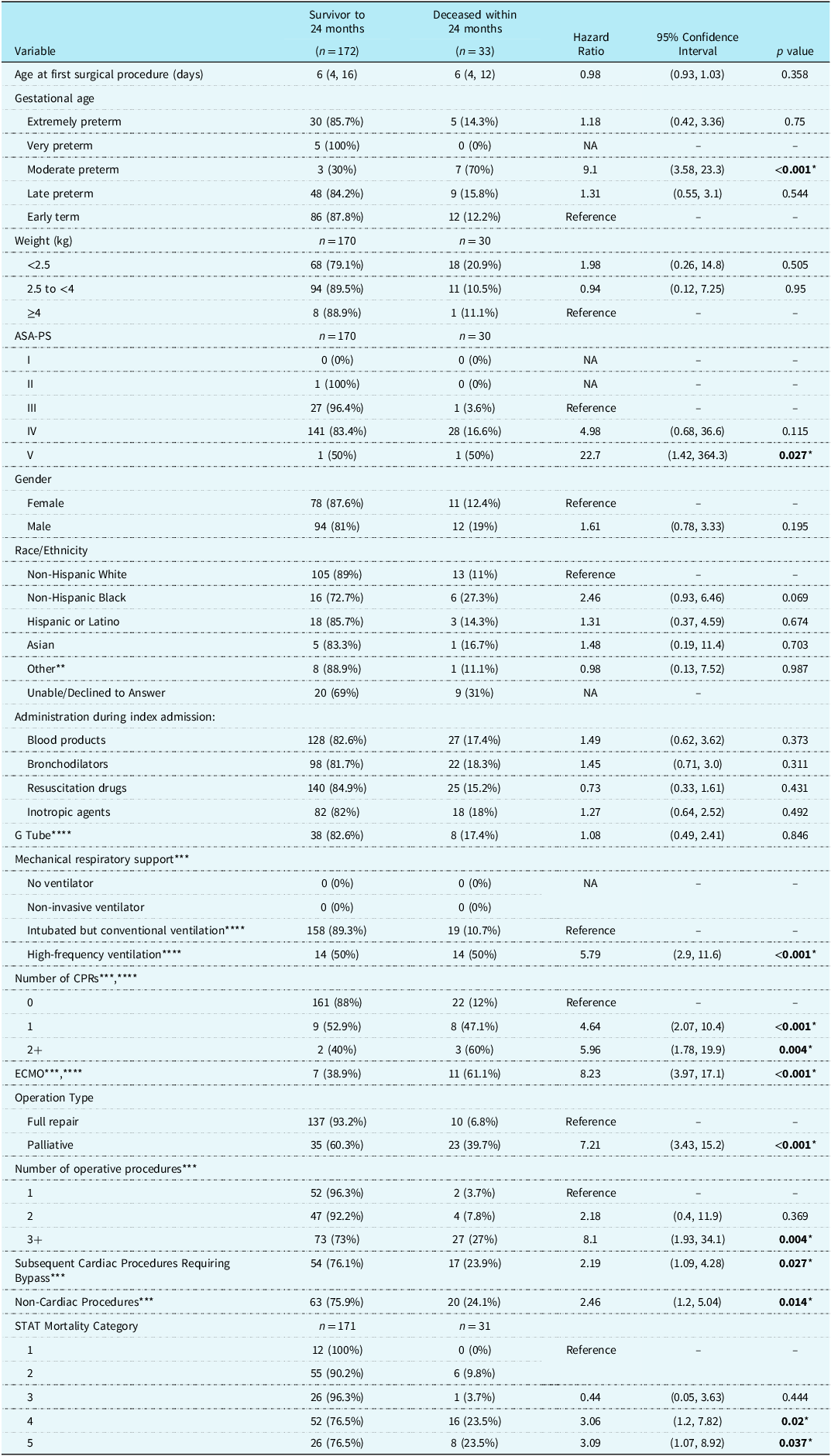
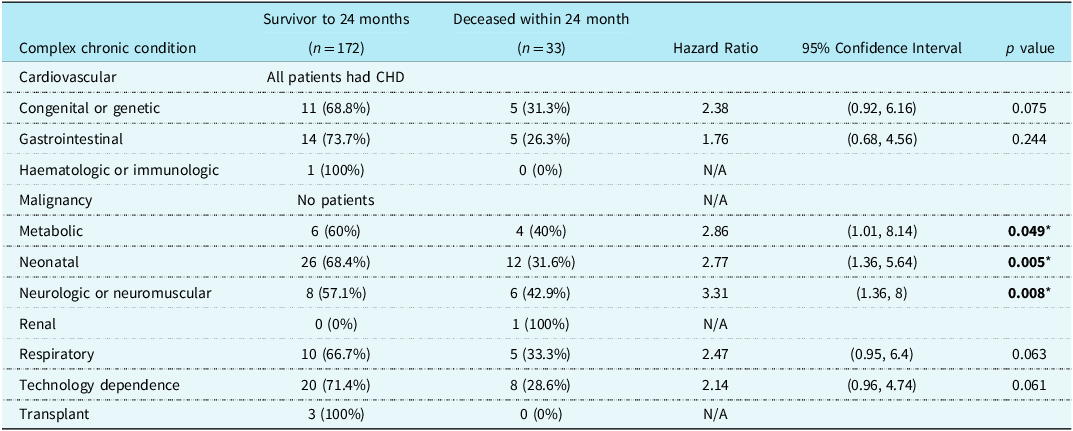
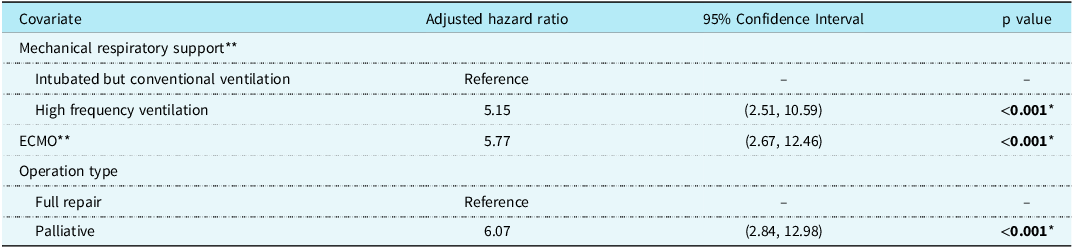
Baseline patient and surgical characteristics are shown in Table 1, and univariate analysis of complex chronic conditions on mortality in the first 24 months of life is presented in Table 2. Findings of the multivariable-adjusted Cox regression model is presented in Table 3. The following risk factors were identified as independent predictors of mortality in the first 24 months of life: high frequency ventilation (required at any time during the index hospitalisation or the 24 months of follow-up) (adjusted hazard ratio = 5.15; 95% confidence interval: 2.51, 10.6; p < 0.001), extracorporeal membrane oxygenation support (required at any time during the index hospitalisation or the 24 months of follow-up) (adjusted hazard ratio = 5.77; 95% confidence interval: 2.67, 12.5; p < 0.001), and CHD requiring palliative surgical procedure (adjusted hazard ratio = 6.07; 95% confidence interval: 2.84, 13; p < 0.001).
Baseline and surgical characteristics of pre/early-term neonates with congenital heart disease within the index hospitalisation or the first 24 months

ASA-PS, American Society of Anesthesiology Physical Status; G-Tube, gastrostomy tube; CPR, cardiopulmonary resuscitation; ECMO, extracorporeal membrane oxygenation; Kg, kilogram; STAT, Society of Thoracic Surgeons-European Association for Cardio-Thoracic Surgery.
Data are presented as n (%) or median (interquartile range).
Hazard ratios for mortality with 95% confidence intervals and p values were obtained using univariate Cox proportional hazards regression modelling.
* Statistically significant.
** Other race includes Arab, Asian Indian, and Other.
*** During the first 2 years of life.
**** Occurred in preop period.
Univariate analysis of Complex Chronic Conditions on mortality at any time during the index hospitalisation or the first 24 months of life among pre/early-term neonates with congenital heart disease

Data are presented as n (row %).
Hazard ratios for mortality with 95% confidence intervals and p values were obtained using univariate Cox proportional hazards regression modelling.
* Statistically significant.
Multivariable Cox Regression analysis of mortality of pre/early-term neonates with congenital heart disease within the index hospitalisation or the first 24 months

Multivariable Cox proportional hazards regression modelling was used to obtain hazard ratios, 95% confidence intervals and p values.
Variables with p < 0.05 in univariate analysis were included in multivariable modelling. Backwards elimination model building was implemented with p > 0.05 as removal criteria.
* Statistically significant.
** During the first 2 years of life.
ECMO, extracorporeal membrane oxygenation.
Discussion
Despite advances in technology, neonatal critical care, minimally invasive surgical techniques, perfusion techniques, and specialised paediatric anaesthesia for neonates, preterm and early-term neonates with CHD experience prolonged hospitalisations and multiple interventions, and are at risk of ongoing morbidity. Reference Dees, Lin, Cotton, Graham and Dodd14–Reference Brief, Guimber and Baudelet16 Prognostic uncertainty characterised by underlying CHD, surgical management, and clinical course, compounded by complications, can be challenging to the care team members, and the point beyond which survival is unlikely is often unclear. Though well-meaning, the involvement of multiple highly specialised multidisciplinary teams for these particularly fragile patients can transmit subtle differences in opinions and messaging, which may lead to differences in views about therapies and interventions and may exacerbate the myriad of stressors faced by families and healthcare providers. Reference Lee and Ahn17–Reference Cantwell-Bartl and Tibballs19
This study describes objective and dynamic mortality risk predictors that could be used when contemplating the benefits and burden of surgical intervention or the continuation of medical treatment. Three readily accessible independent risk factors were found to be predictive of mortality at any time during the index hospitalisation or the 24 months of follow-up of life in preterm and early-term neonates with CHD. From over 20 variables studied, the degree of prematurity, ASA-PS V, cardiopulmonary resuscitation, multiple surgical procedures, and ≥4 surgical STAT score, while statistically significant, were not found to be independent risk predictors of survival. In contrast, in the final multivariable Cox regression model, the need for high-frequency ventilation, extracorporeal membrane oxygenation support, and CHD requiring a palliative surgical procedure were significant independent risk factors of mortality at any time during the index hospitalisation or the first 24 months of life. The specific predictive risks of mortality are objective and dynamic, comprising three readily identifiable clinical variables. Another advantage is that they can be identified throughout the 24 months of life following the patient’s hospitalisation perioperative experience by including underlying surgical risks associated with CHD and adding acute changes in the patient’s clinical course, evolving complications, and interventions.
Our study has several limitations, including a single-centre retrospective study design and missing data, which resulted in the exclusion of some variables of interest from the analysis. Additionally, while we included in the analysis the potentially confounding effects of certain socio-economic factors, the scope of this study did not encompass a comprehensive analysis of all factors associated with the risk of preterm birth. In particular, the potential roles that may lead to preterm birth, such as education, income, access to prenatal care, and place of residence, vary significantly across socio-economic groups.
In conclusion, the three objective, data-driven, and dynamic risk factors derived from routinely collected clinical patient information may help to predict mortality at any time during the index hospitalisation or the first 24 months of life in preterm and early-term neonates with CHD. Understanding the mortality predictive variables as an adjunct to clinical practice may help guide care management, counsel families, prioritise treatment options, improve shared decision-making, and enhance communication while minimising unnecessary medical interventions.
Supplementary material
The supplementary material for this article can be found at https://doi.org/10.1017/S1047951125110482.
Financial support
No funding was received to assist with the preparation of this manuscript. Data are available upon request.
Competing interests
The authors confirm that there are no potential real or perceived conflicts of interest.
Clinical perspective
-
a. What is new?
-
Published data on mortality risk factors for early-term neonates with CHD is limited to risks associated with CHDs and other clinical findings collected shortly after birth.
-
-
b. What are the clinical implications?
-
This study identified three dynamic mortality risk factors of perioperative mortality, derived from readily available clinical data for preterm and early-term neonates with CHD at any time during the index hospitalisation or the first 24 months of life.
-
Recognising mortality risk predictors can assist clinicians with treatment and resource utilisation as the patient’s clinical condition changes.
-