


Introduction
Elections vary systematically in how much they matter to voters. When political authority is fragmented across levels of government, citizens face elections in which fewer high-salience issues are decided, media coverage is thinner, partisan competition is less clearly structured, and accountability is more diffuse. This is a feature of several types of “second-order” elections, including subnational, regional and local elections (Bolgherini and Paparo, Reference Bolgherini and Paparo2023), and supranational elections, such as those for the European Parliament (EP) (Hix and Cunningham, Reference Hix and Cunningham2025). Voters frequently treat these contests as lower-stakes or as an opportunity to express attitudes about national politics rather than to influence policy at the relevant level (Hix and Marsh, Reference Hix and Marsh2007). A central question for research on voting behavior and democratic participation is therefore whether low-turnout elections can be “activated” by shifting perceptions of what is at stake, either by increasing the salience of the consequences associated with the election, or by reducing informational deficits about the institution’s role and capacity to shape outcomes. This paper builds on that general problem by asking, in the context of the 2024 EP elections, whether targeted informational cues about the European Parliament’s representative role and policy stakes increase willingness to vote, and whether cues about institutional empowerment raise participation or instead provoke resistance.
In line with other secondary elections, turnout in EP elections has consistently fallen behind that of national elections. Turnout is a sign of civic engagement and therefore crucial for the democratic legitimacy of the EU. Public participation in elections is the hallmark of accepting the “social contract” of representative democracy (Beetham, Reference Beetham2013; Lijphart, Reference Lijphart1997). Low turnout is a sign of disengagement. If the EU is to maintain its legitimacy in the face of a perceived “democratic deficit,” and perhaps attempt to expand its powers in the face of crises, it needs to bolster public participation. We do not yet fully understand what drives participation in EP elections.
The main reason usually given for the lower turnout in European Parliamentary (EP) elections is that they are “second order,” reflecting domestic politics (Reif and Schmitt, Reference Reif and Schmitt1980), as voters use them to signal their (dis)approval of national governments (Hix and Cunningham, Reference Hix and Cunningham2025; Hix and Marsh, Reference Hix and Marsh2007). While the many crises that the EU has experienced since 2009 have steadily increased the salience of EU issues in EU elections (Maier et al., Reference Maier2021), and turnout has also increased (Gattermann et al., Reference Gattermann, de Vreese and van der Brug2021), voters still turn out less to vote for the EP. Two types of explanations have been proposed for this lower turnout. The first is the “don’t know” explanation: European citizens are not adequately informed about what the EU does, what the role of the European Parliament is, and what impact their vote can have. Giving voters more information about party positions on European integration has been shown to increase their propensity to vote (Hobolt and Wittrock, Reference Hobolt and Wittrock2011). However, there is no experimental evidence to date to show whether information on the role of the EP matters. The second type of explanation is that voters “don’t care”: voters think that EU policies don’t affect them or that the European Parliament does not have enough power to influence EU policies (Moravcsik, Reference Moravcsik2002).
We know that it is not only the salience of EU issues that matter for voting in EP elections, but perceptions of the European Parliament itself. Those with more trust in the EP are more likely to turn out (Clark, Reference Clark2014). However, we know less about what determines attitudes towards the EP. It remains unclear whether voters want “more or less” from it. Voters treat EP elections as “second order” partly because they perceive the EP to be weak or inconsequential (Carrubba and Timpone, Reference Carrubba and Timpone2005). But does this necessarily imply that voters want a stronger EP? Can the EU fix what voters perceive is wrong with the Parliament by giving it greater powers? Not necessarily. Euroskeptic voters want to scale it back. Other voters may prefer current institutional arrangements in the EU, or they might prefer a stronger role for the Commission or the Council. Voters may feel better represented in the Council through their national representatives, in a delegative logic. Or they might consider the Parliament dysfunctional for other structural reasons, and thus be loathe to grant it greater powers. Importantly, it may be that voters simply don’t know enough about the EP to have a strong opinion about whether it should be more consequential in EU decision-making.
A separate literature, developed for national elections, looks at ways of mobilizing voters through interventions carried out in field experiments (see Green et al., Reference Green, McGrath and Aronow2013, for a review). The get-out-the-vote (GOTV) literature has tested numerous interventions aimed at increasing turnout, including partisan and non-partisan messages across various mediums such as personalized letters, phone calls, emails, and texts (Bhatti et al., Reference Bhatti2018; Dale and Strauss, Reference Dale and Strauss2009; Gerber and Green, Reference Gerber, Green, Banerjee and Duflo2017). These studies utilize some form of cost-benefit analysis to inform their interventions, most notably the “Calculus of Voting” theory of (Downs, Reference Downs1957), as developed by Riker and Ordeshook (Reference Riker and Ordeshook1968).
This paper brings these insights together to derive a series of hypotheses regarding participation in supranational, European, elections. I test these expectations by employing a survey experiment in 16 EU countries one month before the 2024 European elections, with a follow-up in the days after the vote, to see whether giving voters more information about what the European Parliament does and presenting respondents with hypothetical increases in the powers of the European Parliament, affects their likelihood to vote, their views of the European Parliament, and eventual real-world vote. On the informational side (“don’t know”), this study contributes to the literature by exposing voters to information regarding the democratic and policy roles of the EP. The study further contributes by exploring whether the limited powers of the EP make them consider their vote less important (“don’t care”). It proposes two realistic increases in the powers of the EP, making it more similar to the roles carried by national parliaments who have legislative initiative and executive oversight.
Results show that increasing information about the policies that the EP impacts and its representation role are potent interventions for increasing voting likelihood and actual vote in the European Parliament elections. Informing voters of the policies that the EP will handle increases their voting likelihood by 4 percentage points and their actual voting propensity a month later by 2 percentage points. Hypothetical power increases of the EP, contrary to expectations, depress voting likelihood across countries and across ideological groups. The backlash to power increases is concentrated among Euroskeptics and those who are dissatisfied with democracy in the EU. Increasing the powers of the EP, at least in the ways proposed here, does not appear to be a solution to the EU’s democratic deficit. The paper contributes to our understanding of voting behavior in supranational elections. When the legitimacy of the EU as a polity comes under question, voters choose to “exit” by abstaining. The implications of these results is that the EU has to first build greater legitimacy before raising the stakes of EU elections. The paper also contributes to our understanding of which interventions can drive actual turnout, by showing that informational primes can have cascading effects and increase real-world voting.
Explaining the turnout of European elections
Don’t know
What explains the lower turnout of European elections compared to national ones? Two sets of explanations are usually put forward. The first is that voters “don’t know” enough about EU politics (Marquart et al., Reference Marquart, Goldberg and de Vreese2020). The EU polity is complex and its politics are convoluted. EU citizens for the most part do not know which competences are at the EU or national level. Even if they do, they might not know what input the EP has, compared to other EU bodies. EU policies are technical and their impact is uncertain. The party system is not yet Europeanized. While there are EU party families and groups in the EP, voters select among national parties. Nonetheless, cross-national cleavages, based on ideology, are becoming more important than territorial divides (Kriesi et al., Reference Kriesi, Moise and Oana2024b).
Voters know little about the EU in part due to low media coverage (Peter and de Vreese Reference Peter and de Vreese2004), which tends to focus on the role of national actors (de Vreese et al., Reference de Vreese2006). The EU hoped to change this dynamic with the introduction, in 2014, of the “Spitzenkandidaten,” thus creating a link between voting in EP elections and the presidency of the Commission. However, even for 2014 there is little evidence that this made a difference for voters (Gattermann and Marquart, Reference Gattermann and Marquart2020; Hobolt, Reference Hobolt2014), while in the 2019 EP elections the system was circumvented (de Wilde, Reference de Wilde, Kritzinger, Plescia, Raube, Wilhelm and Wouters2020).
In a low information media environment, facing complex policies of a political system that appears confusing and far removed from their daily concerns, it is no wonder that EU citizens “don’t know” enough to show up to vote. Knowledge has been robustly shown to be related to electoral turnout (Lassen, Reference Lassen2005), including for European elections (Bhatti, Reference Bhatti2010; Hogh and Larsen, Reference Hogh and Larsen2016). Knowledge has been linked to the lower turnout in Central and Eastern European countries (Petričević & Stockemer, Reference Petričević and Stockemer2020). Experimental evidence for this phenomenon, however, has been scarce. Most studies to date have focused on the effects of voting advice applications (VAA’s). Mahéo (Reference Mahéo2017) found that VAA’s make voters more engaged but found no effect on turnout. Tilley and Wlezien (Reference Tilley and Wlezien2008) show that voters update, to some degree, their placement on EU issues when exposed to information through a VAA. Hobolt and Wittrock (Reference Hobolt and Wittrock2011) use an experimental design akin to a VAA, by showing voters their position on EU issues compared to parties, showing that this increases their propensity to vote. However, no experimental evidence to date has shown whether providing voters with more information on the European Parliament increases their propensity to vote.
Causal evidence is critical to understanding whether recent trends in turnout are due to higher levels of media salience on EU issues and more diffusion of knowledge on the EU. There are reasons to believe that the information environment is becoming richer as EP elections are becoming increasingly focused on EU issues (Braun, Reference Braun2021; Maier et al., Reference Maier2021). The EU has become more politicized in the era of “constraining dissensus” (Hooghe and Marks, Reference Hooghe and Marks2009; Hutter et al., Reference Hutter, Grande and Kriesi2016), partly due to the many crises it has faced since 2008 (Kriesi, Reference Kriesi2016; Kriesi et al., Reference Kriesi2024a; Truchlewski et al., Reference Truchlewski, Oana and Moise2023). Experimental evidence can give us a clue as to whether these trends are behind the higher turnout in EP elections in 2019 and 2024 by showing the effect of increased information in a controlled setting.
What type of information should we expect to influence voting behavior in European Parliament (EP) elections? The range of potentially relevant knowledge is vast. Citizens may be informed about party positions (e.g., VAA’s), factual details about EU leaders, the outcomes of EP sessions, European Council summits, the composition of party families, the track record of individual Members of the European Parliament (MEPs), or the procedural functioning of EU institutions, among many others. It is likely that informational effects are specific to each type of knowledge, and perhaps to individual events. For example, exposure to media coverage of the 2016 Bratislava Summit, held in the aftermath of the Brexit referendum, decreased performance evaluations of the EU (Marquart et al., Reference Marquart2019). This highlights that information may alter attitudes depending on its content and context.
An exhaustive classification of all types of EU-related knowledge is beyond the scope of this paper. Instead, I focus on information directly related to the European Parliament as an institution and on the aspects of knowledge that are conceptually most relevant for participation. Drawing on the distinction between input and output legitimacy (Scharpf, Reference Scharpf1999), information about the EP’s legislative competences and policy impact relates primarily to output legitimacy, that is, the capacity of the institution to produce consequential decisions. Information emphasizing the EP’s representative and electoral character relates to input legitimacy, namely the extent to which citizens perceive the institution as democratically grounded and responsive. Both dimensions plausibly affect the perceived stakes and meaningfulness of participation. By contrast, procedural knowledge about how the EP operates internally, for instance, committee structures or legislative procedures, may be politically relevant but is less directly connected to citizens’ evaluation of whether voting matters. For this reason, and given the constraints of experimental design, the treatments in this study focus on output-related competences and input-related representative functions, rather than on detailed procedural information. This approach aligns with research suggesting that political knowledge influences participation primarily when it increases perceived efficacy and institutional relevance (Hobolt, Reference Hobolt2009; van der Brug and van der Eijk, Reference van der Brug and van der Eijk2007).
Don’t care
The second type of explanation is that voters “don’t care” enough about EU politics (Clark, Reference Clark2014). This set of explanations is embedded in the “second-order” literature (Reif and Schmitt, Reference Reif and Schmitt1980). EP elections are considered second-order to national elections because voters care less about them, and instead use them as a referendum on the national government. As a consequence, voters are expected to participate less, vote less strategically, punish governments, and favor smaller parties (Hix and Marsh, Reference Hix and Marsh2011; Marsh and Mikhaylov, Reference Marsh and Mikhaylov2010). Even after the multiple treaties which expanded the powers of the EP, by 2007, it was still the case that party positions on EU issues were irrelevant to the vote (Hix and Marsh Reference Hix and Marsh2007). The predictions of the “second-order” model continue to hold, although its explanatory power has grown weaker for more recent elections (Hix and Cunningham Reference Hix and Cunningham2025).
Part of the reason for the waning of the “second-order” model is that the salience of EU issues in EU elections has risen steadily since (Maier et al., Reference Maier2021). Carrieri (Reference Carrieri2024) has shown an increase in salience between 2014 and 2019, especially for pro-European parties. In an environment of increased salience of EU decision-making, parties themselves politicize the EU more. Both pro- and anti-EU parties appear to do so in the aftermath of the many crises of the EU (Carrieri et al., Reference Carrieri, Conti and Loveless2025).
Nonetheless, despite these developments, EU issues still do not garner the same attention as national ones. EU politics remains less directly connected to voters’ lives. They are less present in national media, which is preoccupied with domestic issues. Many voters have low attachment to the EU. Others feel that EU policies do not affect them, and thus become indifferent to EU politics (Schäfer, Reference Schäfer2021). On top of this, even if some voters consider EU politics and policy salient, they might think that the European Parliament itself is not consequential. The EP is but one cog in a complex political machine. It does not have exclusive legislative powers. Legislation is initiated by the Commission, which can also come at the request of the EP, and passed with co-decision with the Council (Kohler-Koch and Rittberger, Reference Kohler-Koch and Rittberger2007). This makes the EP considerably weaker than a similar national parliament in federal states. Indeed, the EP’s weakness has been linked to the perceived democratic deficit in the EU (Karp et al., Reference Karp, Banducci and Bowler2003). This begs the question as to whether making the EP more like a national parliament would raise the stakes enough to boost participation in elections.
Another complication arises when considering increasing the powers of the EP. The EU is a multilevel polity where authority is split between a weak center in Brussels and mature nation-states (Ferrera, Reference Ferrera2020; Ferrera et al., Reference Ferrera, Kriesi and Schelkle2022). EU citizens may not desire a stronger EP, since they may perceive this as coming at the cost of sovereignty and the powers of national parliaments, to which they have stronger attachment. In this study, I account for this by making it clear that increased EP powers come at the cost of other EU institutions, namely the Commission and the Council. Nonetheless, individual attachment to national parliaments can form a benchmark for their support of the EP and any potential power increases (De Vries, Reference De Vries2018). Whether or not increasing the powers of the EP comes at the cost of national sovereignty, attitudes toward such changes should be conditional on general views of the EU.
Even among pro-EU voters, it need not be universally the case that raising the stakes of the EP would be viewed favorably. Such respondents might prefer a stronger EU executive. Or they may prefer a stronger role for their national representatives in the Council. As the Spitzenkandidaten system showed, linking the EP vote to the Commission president is not a sure-fire way to greater turnout (Hobolt, Reference Hobolt2014). Ultimately, there are many possible reforms that could increase the salience of EP elections and get voters to tune in. In this paper I test specific proposals to increase the legislative and oversight powers of the EP, making it more similar to a national parliament.
There are, of course, other reasons why voters might care less about European elections. Most notably, voters might be disengaged if they do not feel that the EP represents them. The “democratic deficit” (Majone, Reference Majone1998; Sorace, Reference Sorace2018) and “political efficacy” literatures (Mcevoy Reference Mcevoy2016) explore these sources of voter disengagement and discontent. In this paper I isolate the effect of power increases of the EP and consider how perceptions of democracy in the EU interact with potential power increases. Voters who do not feel that the EP represents them should not be in favor of increasing its powers. Ultimately, there are many potential sources for voter dissatisfaction and apathy. This paper tests one particular set-up: making the EP stronger and more similar to national parliaments. Further research can explore other scenarios.
The calculus of European voting
Rational theories of voting start from the puzzle of why citizens might go out to vote when the expected utility of voting, the possibility that their vote will make a difference, is infinitesimally small. Starting with the seminal work of Downs (Reference Downs1957), later expanded by Riker and Ordeshook (Reference Riker and Ordeshook1968), the “calculus of voting” theory simply states that citizens vote when the benefits outweigh the costs. Equation (1) reproduces the argument. Participation depends on possible benefits (B) multiplied with the probability that the voter casts the decisive vote (P), subtracting costs (C), and adding psychological rewards, or perceived duty to vote (D). Costs are usually broken down into the costs of information acquisition and the cost of going to the polls.
 $Participation = B * P - C + D$
This simple model has proven remarkably effective and resilient. Blais (Reference Blais2000) has argued that D, the subjective perceived duty or psychological benefits, is the main positive driving force of voting, since the ratio of benefits to the probability of casting a decisive vote is usually quite small. D has been argued to be stable (Feitosa and Galais, Reference Feitosa and Galais2020), but it may be expressed differently based on context, such as the frequency of elections (Fauvelle-Aymar & François, Reference Fauvelle-Aymar and François2015; Kostelka et al., Reference Kostelka2023). D has been interpreted in both positive and negative ways. “Expressive utility” theory focuses on the psychological benefits of self-expression through participation (Hamlin and Jennings Reference Hamlin and Jennings2011). On the other hand, Aytaç and Stokes (Reference Aytaç and Stokes2018) focus on the psychological costs of abstention such as internal cognitive dissonance and external social pressure. Whether emanating from “positive” or “negative” sources, the literature agrees that D is the main motivator for voting, which also interacts with perceived benefits (Blais and Achen, Reference Blais and Achen2019).
The calculus of voting changes for EP elections, due to several distinctive features of the EU. The EU is a multilevel polity with diffuse authority at the center. The main political arena remains at the national level and voters select among national parties which then form European parliamentary groups. The EP itself is considerably weaker than national parliaments.
The perceived benefits of participation, B, are likely to be lower for EP compared to national elections, as illustrated in both the “don’t know” and “don’t care” literatures. Less is at stake at the EU level and voters may not be aware of which policies are affected. P, the probability of casting a decisive vote, is also altered in the EP context. While in national elections voters might have an easy time understanding if their vote will be consequential, for example by considering opinion polls or past elections, the complex electoral dynamics of multiple countries across Europe make this almost impossible for EP elections (Wolkenstein, Reference Wolkenstein2020). C, the costs of participation, are not qualitatively but only quantitatively different for EP elections. Specifically, the cost of information is much higher for EP elections, for reasons elaborated in Section Don’t know.
Finally, D, the psychological benefits to participation (or costs of abstention), likewise has distinctive European dynamics. Most importantly, one’s perceived duty to participate should depend on the degree of identification with the polity, which is captured by the degree to which individuals identify as European as opposed to exclusively in national terms. Indeed, D has been shown to be weaker in supranational elections, due to both rational and identity reasons (Galais and Blais Reference Galais and Blais2016). D is also affected by the degree to which individuals believe the EU is legitimate. In their classic paper, Riker & Ordeshook list “satisfaction from affirming allegiance to the political system” as one of its key components (Riker and Ordeshook, Reference Riker and Ordeshook1968, p. 28). This is also true for EP elections. Pro-Europeans likely vote as a way of affirming their allegiance to the EU. However, what sets the EU apart is the degree to which large numbers of voters contest its very existence. Unlike national politics where parties politicize policies and in rare cases may politicize even the nature of constitutional arrangements, in the EU parties politicize not only policies and institutional arrangements, but the very existence of the polity. This polity-contestation sets the EU apart. Citizens of a country may be disillusioned with politics, but very few call out for the dissolution of the polity itself.Footnote 1 In the EU, the polity itself is politicized.
In this paper I treat the “calculus of voting” as a heuristic through which to understand the effects of knowledge (“don’t know”) and salience (“don’t care”) on EP elections. However, I do not test individual components of the equation. As argued above, knowledge and salience likely affect multiple components in ways that cannot be disentangled.
Hypotheses
Giving voters more information is expected to increase their likelihood of voting (Hogh and Larsen, Reference Hogh and Larsen2016), cutting down on the rate of those who abstain because they “don’t know” enough about the EP. Information is expected to affect C, by lowering the costs of information acquisition, and B by increasing potential perceived benefits. The GOTV (get-out-the-vote) literature finds that message priming is associated with a 2.5 percentage point increase in turnout in national elections (Green et al., Reference Green, McGrath and Aronow2013). There is currently no direct experimental evidence for such an effect on EP elections.
This study contributes to existing literature by constructing knowledge scenarios across two dimensions. The first is a “policy” dimension, that is, knowledge about the types of policies that the EP tackles. The policy dimension is expected to increase associated benefits, B, for voters. A second dimension is “representation,” that is, knowledge about the unique representation role of the EP in the European polity. Information on the “representation” role of the EP should affect D, one’s perceived duty to vote. Representation should be directly linked to perceptions of an EU democratic deficit. Overall, greater knowledge of any sort should decrease the costs, C, of acquiring information.
• H1: Footnote 2 Giving voters more information about the European Parliament will increase their likelihood of voting.
Would granting the EP more powers increase the salience of EP elections and therefore citizen’s propensity to vote? A more powerful EP should raise the stakes of participating, affecting B, the policy benefits that voters can expect to see, as well as D, their psychological benefits and sense of duty. I consider two dimensions of power increase. The “legislative” powers of the EP could be increased to give it legislative initiative and full decision authority. The “oversight” powers may be increased to allow it to directly nominate the Commission President. Both dimensions would make the EP more similar to a national parliament. Legislative powers ought to be more salient to voters as they are directly linked to policy output.
• H2: Power increases of the EP will increase likelihood of voting.
However, as previously discussed, the sense of duty is also affected by perceived legitimacy of the system. Therefore, the role of power increases should be conditional on the extent of polity politicization, the degree to which respondents believe that the EU is a legitimate political system. Deep Euroskeptics should react negatively to any increase in the powers of the EP.
• H3: Those who oppose European integration will decrease their propensity to vote when the powers of the EP are increased.
I also consider a second dimension of legitimacy that may also affect pro-EU voters: the degree of satisfaction with the way democracy works in the EU. The EP has been criticized as being too weak and unable to ensure democratic accountability (Clark, Reference Clark2014; Schmitter, Reference Schmitter2000). Those who are dissatisfied with how democracy works in the EU may want a stronger European Parliament, in order to increase democratic accountability. However, this assumes that their dissatisfaction with how democracy works is tied to how legislation is passed and whether there is oversight on the Commission. On the other hand, respondents may be displeased with how democracy works in the EU for a variety of reasons and show a general distrust of EU institutions which they might believe are corrupt or not representing their interests. I therefore form a general hypothesis of a positive effect, since the scenarios do present a potential solution to further democratic representation. If voters perceive increasing the powers of the EP as a solution to the democratic deficit, this should increase their perception of legitimacy of the EU, and increase their likelihood to vote by increasing the sense of duty and psychological rewards. However, if voters have other sources of democratic dissatisfaction, increasing the powers of the EP may lead to further backlash.
• H4: Those who are dissatisfied with how democracy works in the EU should be more likely to vote when the powers of the EP are increased.
Finally, I utilize the panel structure of the survey to test whether information has a medium-term effect on voting behavior. There are reasons to be skeptical that such effects would persist. The design of the study, using primes, tests short-term changes in views based on short snippets of information. Moreover, the month in between the experimental treatment and the follow-up, right after voting, is the month of intense campaigning, whose effects may wash out any differences between groups. However, it is possible that treatments have cascading effects on participants. Receiving information on the EP may push respondents to seek further information.
• H5: Medium-term effect: greater information will increase actual propensity to vote in the EP elections, one month after treatment.
Data and design
The study uses an experiment embedded in the first wave of a two-wave panel survey fielded one month before (wave 1, May 6 to 12 2024), and just after the 2024 European elections (wave 2, June 10 to 16 2024), in 16 EU countries.Footnote 3 Nationally representative samples of 2000 individuals per countryFootnote 4 were drawn with age, gender, educational level, and NUTS quotas.
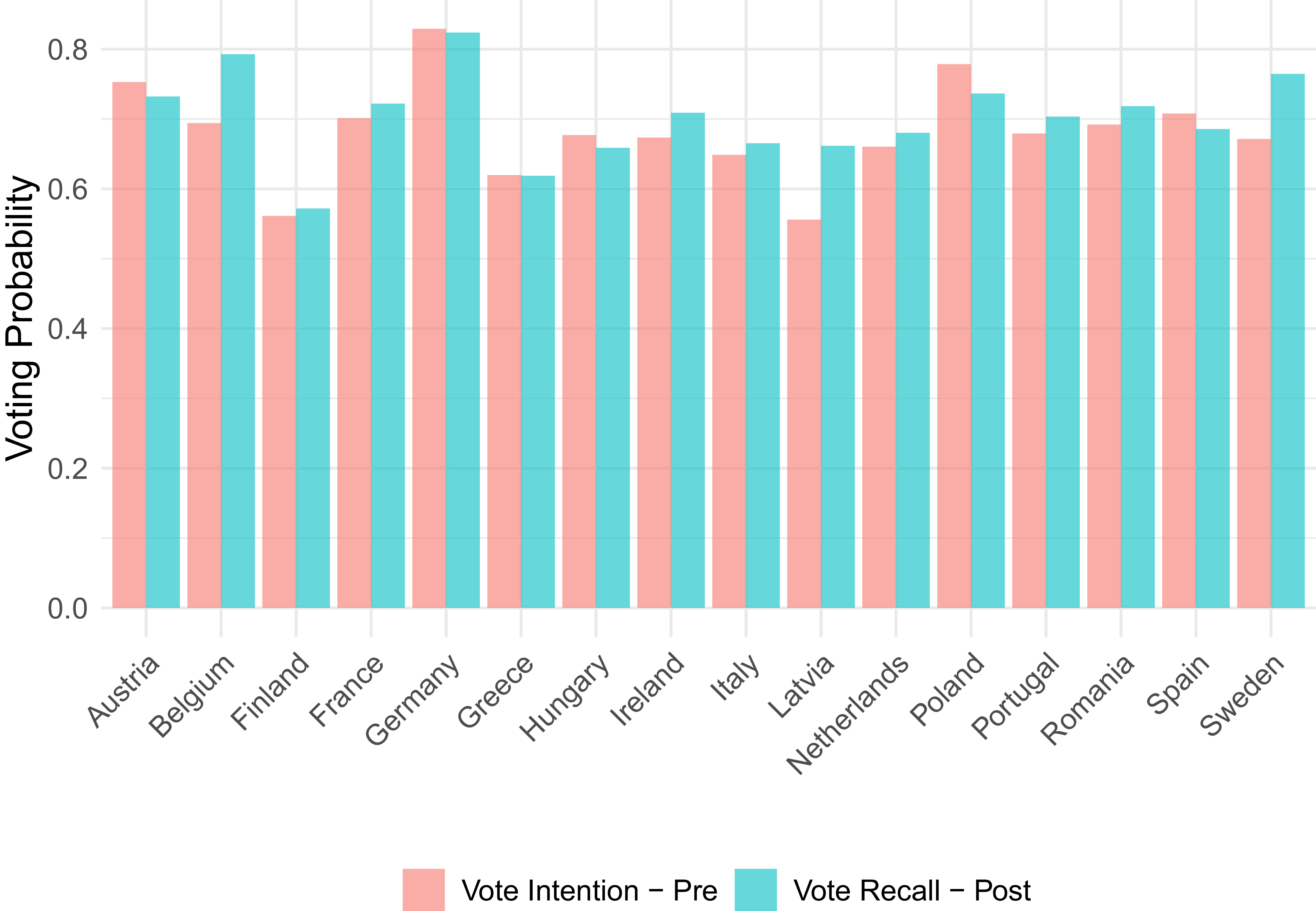
Figure 1 shows the average for each country of the reported likelihood to vote in wave 1 and reported actual vote in wave 2. Both the reported vote and actual vote are considerably higher in my sample compared to the official national turnout.Footnote 5 This is a common issue in empirical research, as respondents over-report their likelihood of voting, possibly due to social desirability bias. This does not affect the internal validity of the study, since all respondents are randomized into treatment and control. Thus, neither category should be over or under-represented by respondents who reported to vote but did not. It remains unclear to what degree external validity is affected, since it may be the case that the “compliers” in the treatment group may disproportionately comprise of those reporting to vote without voting. Nonetheless, most respondents remain consistent in their likelihood and reported vote. Three exceptions are Belgium (which has mandatory voting), Latvia, and Sweden. As robustness, the three countries are omitted from the test of H5, with results remaining identical.
Voting likelihood (wave 1) and actual vote (wave 2) by country.

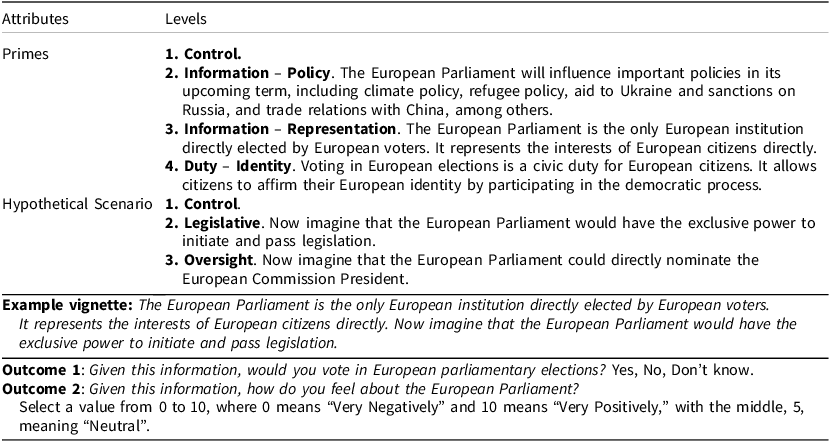
Table 1 shows the experimental design. All respondents received a preamble explaining how the European Parliament functions in the status quo. Doing so was necessary to make sure that respondents understood the hypothetical power increases of the EP. Second, informing all respondents pre-treatment was necessary to untangle the effects of knowledge and increases of powers.Footnote 6 The cost of this decision was that all respondents were partly pre-treated with information on how the EP functions. This means that any effects from the information prime should be conservative, coming on top of any possible effects from the information in the preamble.Footnote 7
Experimental design
Preamble: Please read the statement below carefully before answering the questions which follow. The European parliamentary elections take place every five years to elect members of the European Parliament. Currently, legislation is initiated by the Commission and passed jointly by the European Parliament and the Council. The European Council nominates the Commission President, which the Parliament needs to approve.

Table 1. Long description
The table is divided into three main sections: Attributes, Levels, and Hypothetical Scenario. The Attributes section lists Primes and Hypothetical Scenario. The Levels section under Primes includes Control, Information - Policy, Information - Representation, Duty - Identity. The Hypothetical Scenario section lists Control, Legislative, and Oversight. The table also includes an Example vignette and two Outcomes with specific questions. Row 1: Primes, Levels. Row 2: 1. Control, 2. Information - Policy. The European Parliament will influence important policies in its upcoming term, including climate policy, refugee policy, aid to Ukraine and sanctions on Russia, and trade relations with China, among others. Row 3: 3. Information - Representation. The European Parliament is the only European institution directly elected by European voters. It represents the interests of European citizens directly. Row 4: 4. Duty - Identity. Voting in European elections is a civic duty for European citizens. It allows citizens to affirm their European identity by participating in the democratic process. Row 5: Hypothetical Scenario, Levels. Row 6: 1. Control, 2. Legislative. Now imagine that the European Parliament would have the exclusive power to initiate and pass legislation. Row 7: 3. Oversight. Now imagine that the European Parliament could directly nominate the European Commission President. Row 8: Example vignette, The European Parliament is the only European institution directly elected by European voters. It represents the interests of European citizens directly. Now imagine that the European Parliament would have the exclusive power to initiate and pass legislation. Row 9: Outcome 1, Given this information, would you vote in European parliamentary elections? Yes, No, Don’t know. Row 10: Outcome 2, Given this information, how do you feel about the European Parliament? Select a value from 0 to 10, where 0 means Very Negatively and 10 means Very Positively, with the middle, 5, meaning Neutral.
The information primes highlight the impact and role of the EP in the EU. The first, a “policy” prime, highlights the important policies that the EP will be impacting in its upcoming term. The “representation” prime highlights the role of the EP as the only directly elected body in the EU. I also include, as a benchmark, an “identity” prime, highlighting the role of voting in EP elections as a civic duty, similar to national elections, for purposes of comparison.
The hypothetical scenarios were chosen to represented realistic power increases of the EP. In effect, granting the EP exclusive powers over legislation and full oversight would make it similar to national parliaments. Such scenarios are realistic given that the powers of the EP have already been previously increased (Hix and Høyland, Reference Hix and Høyland2013; Rittberger, Reference Rittberger2012). Making the EP more similar to a national parliament should also be intuitive to respondents, therefore increasing the external validity of the design. Increasing legislative powers would change the status quo by taking power away from the Council and Commission, and giving the EP both legislative initiative as well as singular power to pass legislation. Increasing the oversight powers, would take power from the European Council, allowing the EP to directly nominate the Commission President.Footnote 8
I model the main effects with a linear probability model, including treatments and country fixed effects. For robustness, I rerun the models with a logistic model, showing that results do not depend on model choice. I maintain the linear probability models for ease of presenting and interpreting results. Question wording for pre-treatment variables is available in online Appendix C. Table A1 in the online Appendix shows balance tests across treatments.
Results
Main effects
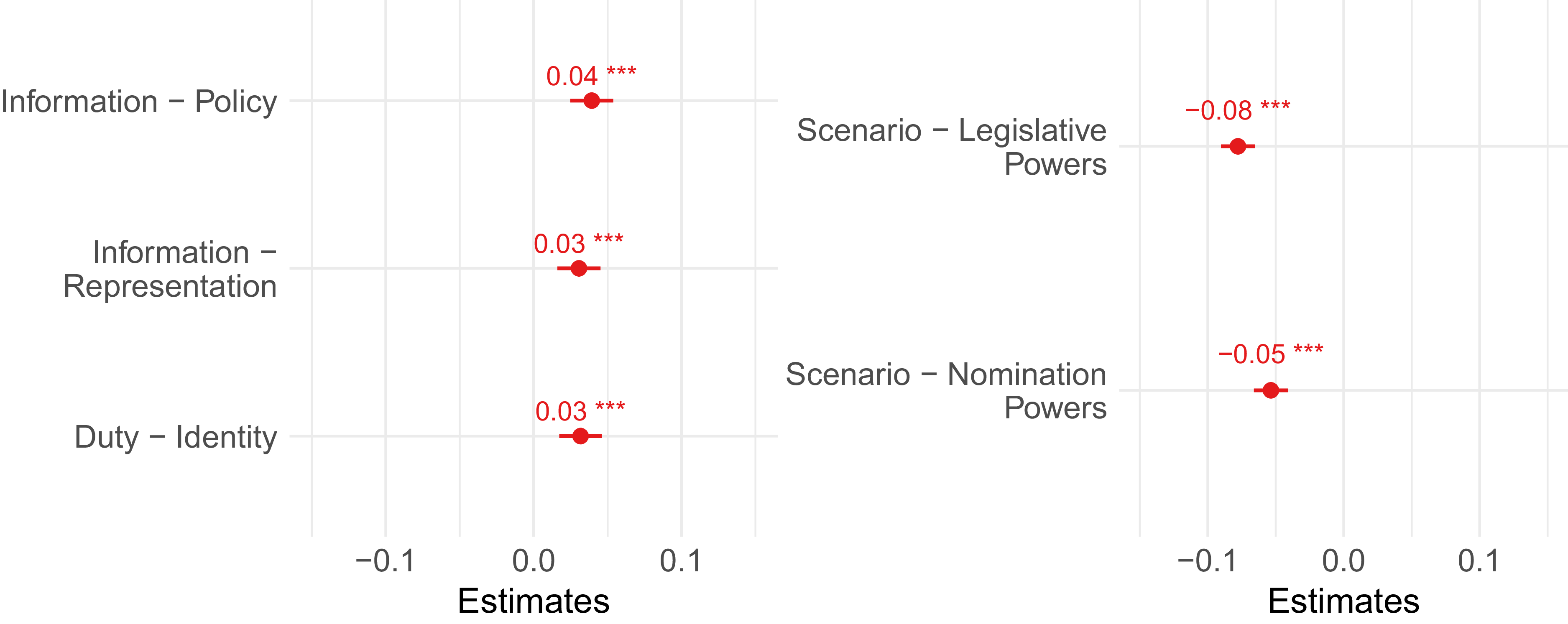
Figure 2 shows the coefficients for the main effects.Footnote 9 The left panel shows the effects of the two information primes, compared to the control group. The third coefficient shows the effect of the prime for voting duty according to identity, the benchmark. I find support for H1, as both information primes increase voting likelihood.Footnote 10 The information primes increase voting likelihood by between 3 and 4 percentage points. This is comparable to the effect of the duty to vote prime (3 percentage points). “Getting-out” the EP vote is therefore not exclusively driven by more information, but can also be activated by increasing respondents’ sense of identity, likely impacting their psychological benefits, D. The magnitude of the effects is slightly larger than the average reported in the GOTV literature, of about 2%.
Main effects, voting likelihood.

The right panel of the figure shows the effects of the hypothetical scenarios increasing the powers of the EP. Contrary to the expectations of H2, both scenarios have strong negative effects, decreasing voting likelihood by between 5 and 8 percentage points. Why would increasing the powers of the EP lead to a backlash in both voting likelihood and views of the EP? One answer is that the backlash effect from Euroskeptic voters, or pro-EU voters who prefer a stronger Commission, is stronger than any positive effects that may be seen from respondents with positive views of the EP. One reason to already suspect this is the stronger effect of the scenario increasing the EP’s legislative powers, arguably the more consequential of the two for EU policy-making, for both outcomes.
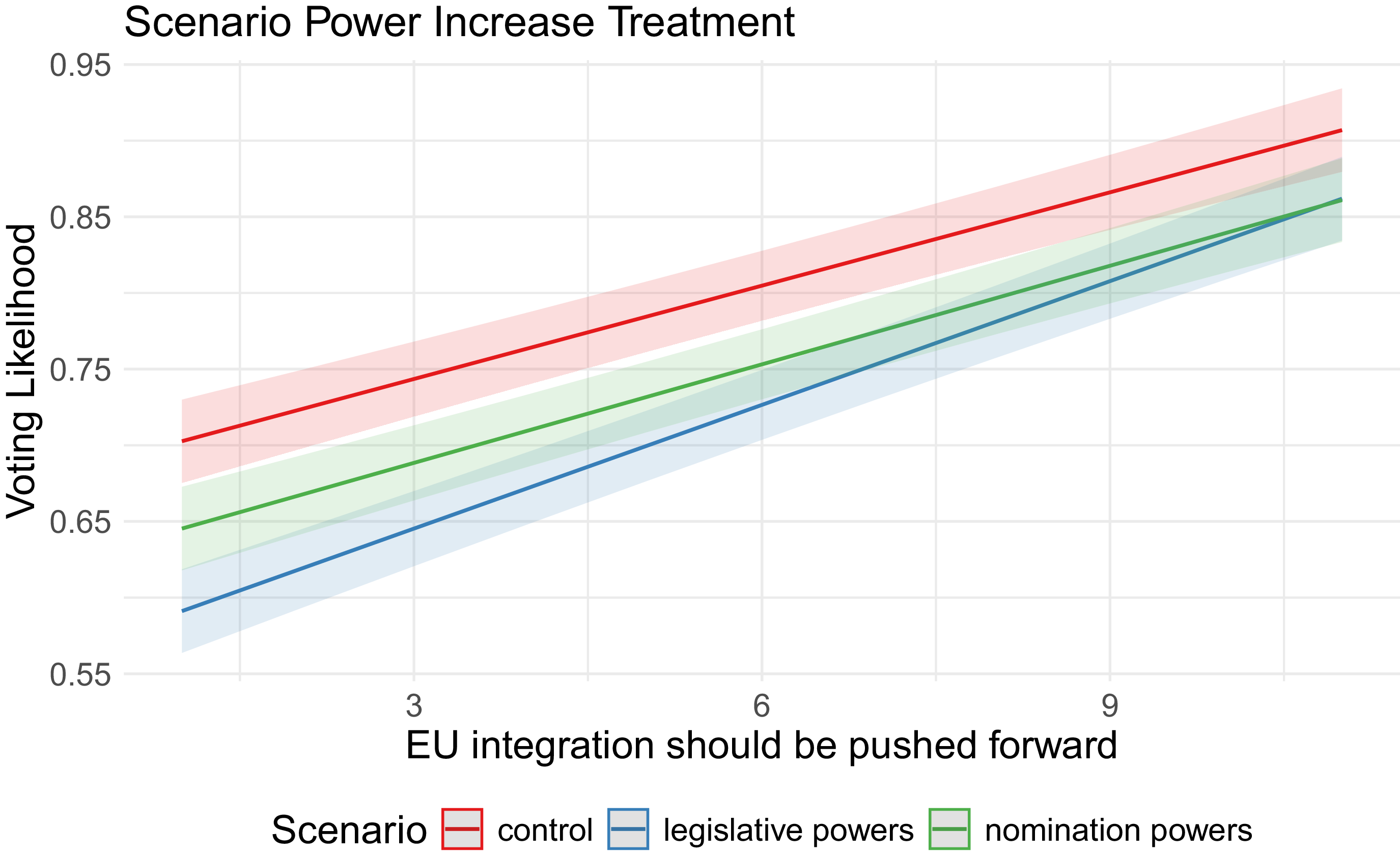
The backlash effect to expanding the powers of the EP is remarkably consistent. Figure A5 shows that the negative effect is substantial in almost all 16 countries and is never positive. Is the backlash effect primarily due to Euroskeptics? Figure 3 (Table A3) shows the effect for both scenarios according to whether individuals think that EU integration should be pushed further (higher values) or has gone too far (lower values). What can be seen is that the negative effect of power increases of the Parliament is concentrated among Euroskeptics. Those who think that EU integration has gone too far are considerably less likely to vote when asked to consider scenarios of increasing EP powers. For those who support EU integration this effect narrows considerably. This provides support for H3. Euroskeptics have a strong backlash to increasing the powers of an institution that they deem as illegitimate. However, even moderately pro-EU voters still show a negative effect, with only the strongest EU supporters showing no backlash.Footnote 11 It may be that other institutional changes to the EU could trigger greater participation. For these specific scenarios, backlash is the norm.
Heterogeneity – EU integration attitudes.

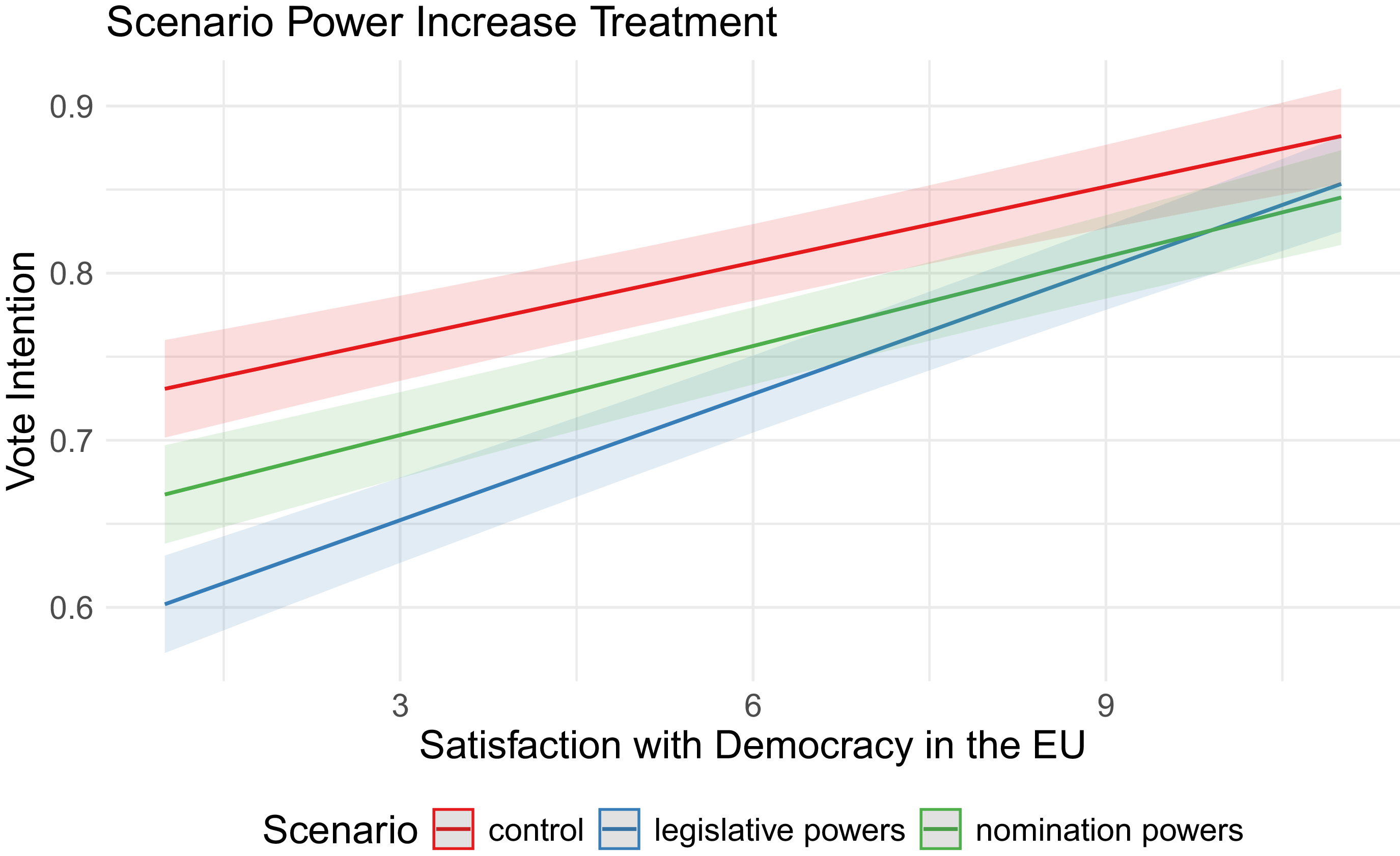
Can increasing the powers of the EP counteract the perceived democratic deficit of the EU? Figure 4 (Table A3) shows the interaction effect between satisfaction with democracy in the EU and the scenario increasing the powers of the EP. What can be seen is the same pattern as before. Those dissatisfied with democracy in the EU have a much stronger negative effect for the “legislative powers” scenario compared to the “nomination powers” one. In other words, those dissatisfied with the EU are even less likely to vote under a scenario of increased legislative powers of the EP. For those most satisfied with democracy in the EU there is no effect. This contradicts the original expectation of H4, which considered increasing the powers of the EP to be a potential solution to the EU’s democratic deficit. Instead, EU citizens seem to treat power increases of the EP as adding fuel to a fire. This suggests that they perceive other inherent democratic problems with the EU and are unwilling to consider power increases of the EP until those are resolved. The relationship between views on the EU’s democratic deficit and the treatment is independent of Euroskepticism, which is controlled for in the model.
Heterogeneity: satisfaction with democracy in the EU.

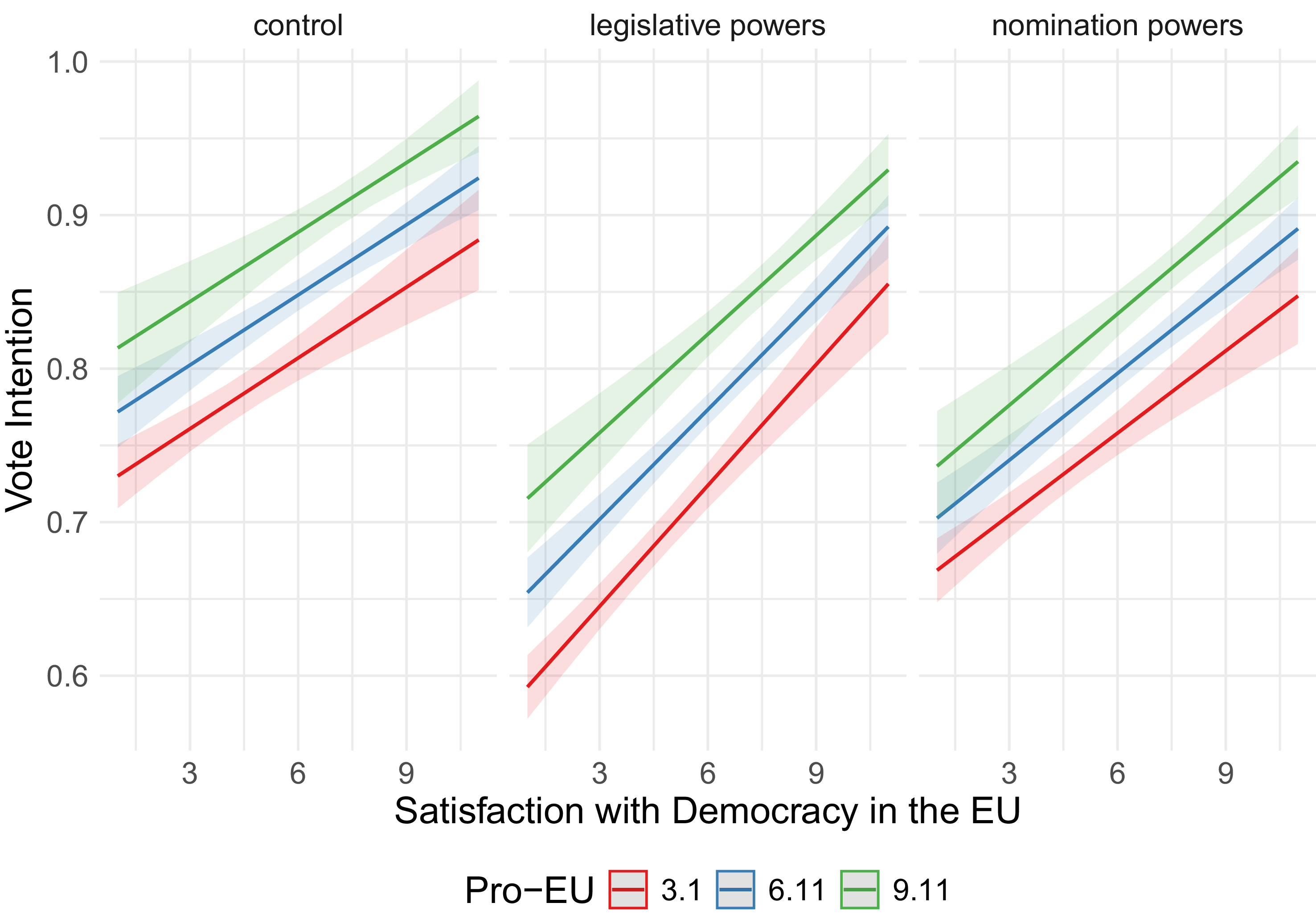
Do views on EU integration and democratic deficit in the EU compound? Figure 5 (Table A4) suggest that they do, to a degree.Footnote 12 Euroskepticism and dissatisfaction with democracy in the EU are distinct, but related attitudes.Footnote 13 The more dissatisfied and against EU integration one is, the more they backlash to power increases, especially legislative powers.Footnote 14 However, even the most satisfied and pro-EU do not show an increased propensity to vote, but rather show stability.Footnote 15
Heterogeneity: satisfaction with democracy and attitudes to EU.

I further explore this backlash effect with three other pre-treatment questions related to EU institutional preferences. Figure A7 in the online Appendix shows heterogeneous effects according to a question asking respondents whether they would want any new EU treaty subject to a national referendum. In the control group there is no difference between those who want a national referendum and those who don’t. However, in the “increasing legislative powers” scenario, those who want any new treaty approved by a referendum show a much stronger backlash, with a lower backlash to the “nomination powers” scenario. Perceptions of democratic deficit compound other sources of Euroskepticism further driving down system legitimacy.
There is further evidence that the particular two scenarios presented to respondents are not seen by them as the way to fix the EU’s democratic deficit or move the EU forward. Figure A9 in the online Appendix shows the heterogeneous effects with a question asking respondents broadly whether the powers of the European Parliament should be increased. As expected, those who disagree completely with increasing the powers of the EP show the strongest backlash, particularly to the “legislative powers” scenario. What is surprising is that even those who agree completely that the powers of the EP should be increased, still show a slight negative effect. How could this be? One answer could be that respondents have other power increases in mind besides legislative and oversight powers. Another answer may be that in answering the pre-treatment question, some respondents were not aware of how the EU operates. Since all respondents received the preamble, which informs them about how the EP currently functions, this may have changed their views on institutional reform. This is, however, unlikely. When subsetting to respondents that are most knowledgeable about the EU or respondents who report to be very interested in politics, the exact same pattern emerges. This also supports the interpretation that respondents do understand the given scenarios.
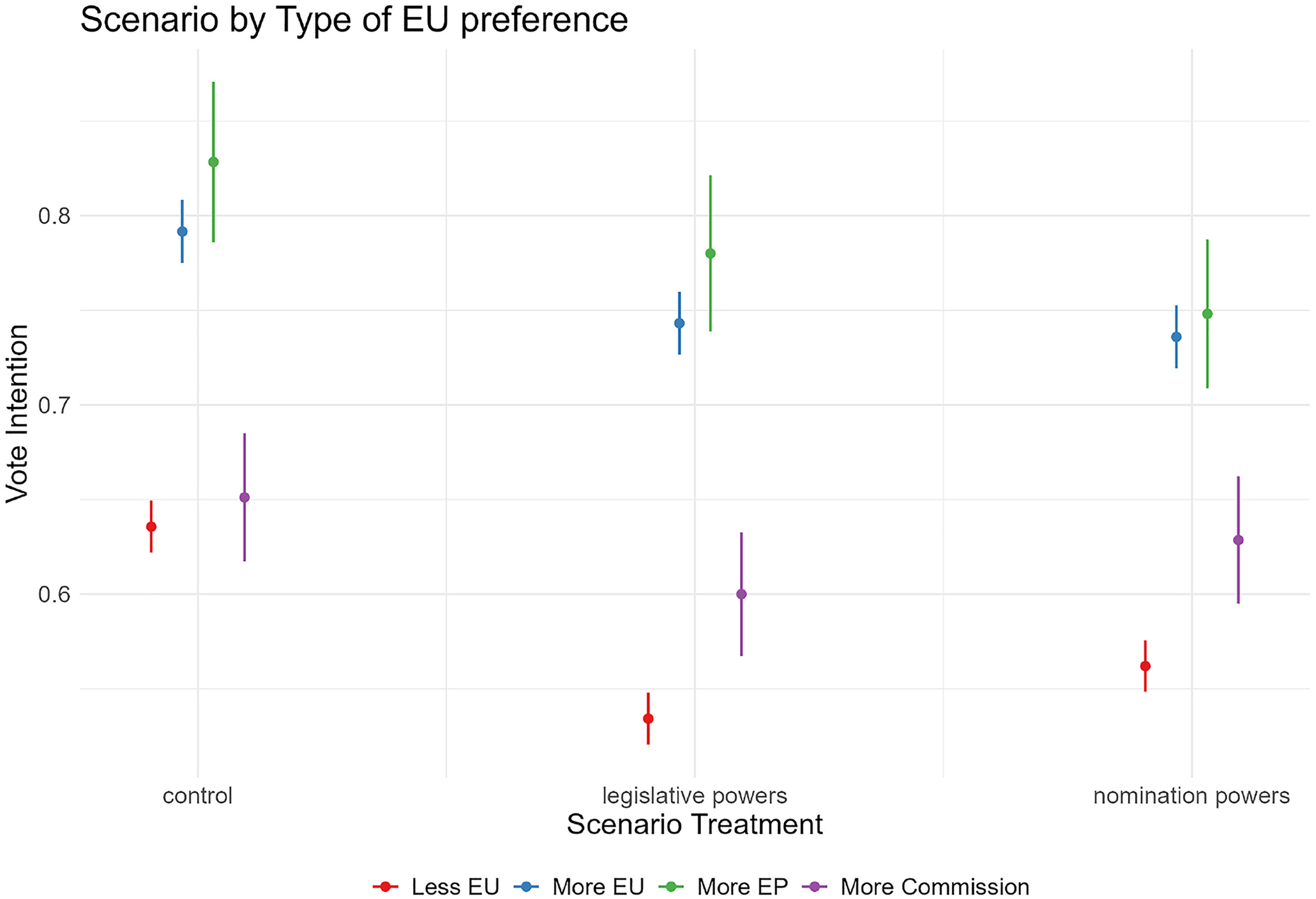
Finally, the effect of the hypothetical scenarios also depends on what type of institutional arrangements respondents prefer in the EU. Figure 6 (Table A5) shows the effect by whether respondents prefer a stronger EP, Commission, both, or neither.Footnote 16 What emerges is that all groups have a negative effect, with the strongest being for the group that does not want either a stronger EP or Commission (the “Less EU” group). Those who want a stronger Commission but not a stronger EP behave similarly to the “Less EU” group, being overall less likely to vote, which further goes down in the treatment condition that takes legislative initiative power from the Commission.
Views EP and commission and EP powers treatment.

Figure 6. Long description
Panel A: A line graph showing vote intention by type of E U preference and scenario treatment. The horizontal axis is labeled Scenario Treatment with categories control, legislative powers, and nomination powers. The vertical axis is labeled Vote Intention with values ranging from 0.6 to 0.8. The graph includes four data lines labeled Less E U, More E U, More E P, and More Commission. The Less E U line shows lower vote intention across all scenario treatments. The More E U and More E P lines show higher vote intention, particularly in the control and legislative powers scenarios. The More Commission line shows moderate vote intention across all scenarios.
Thus, even pro-EU respondents may not want to see specific power increases of the EP, since they may prefer a stronger EU executive. The legitimacy of the EU appears fragile. Increasing the powers of the EP in the specific ways proposed to respondents in this study appear to decrease legitimacy across the board, and more so for Euroskeptic, populist, respondents who are dissatisfied with democracy in the EU, or prefer to see a stronger EU Commission.
Medium-term effect – actual vote recall
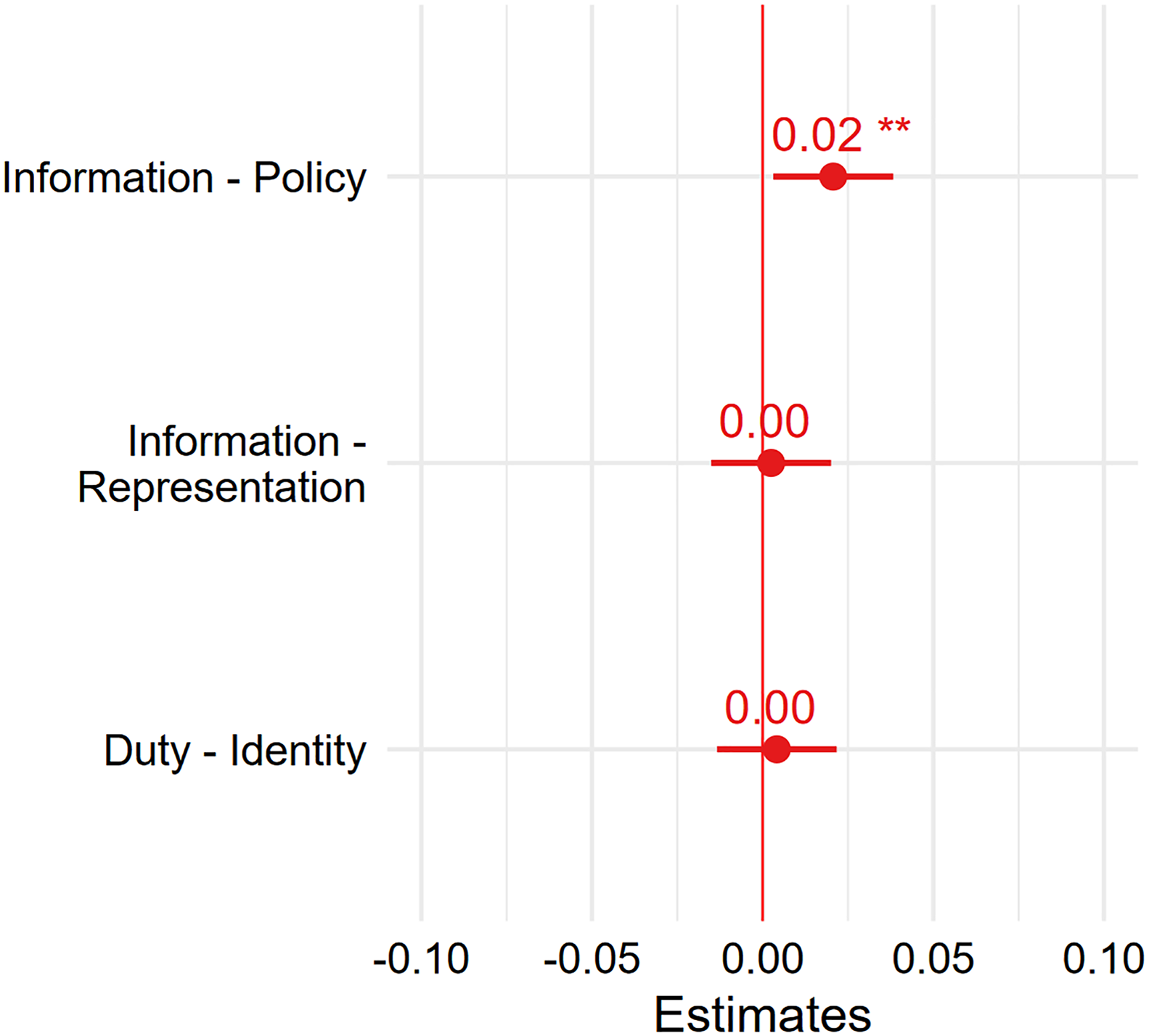
Priming voters with information about the role of the EP increases their reported likelihood to vote. But does this effect last? Does it impact actual propensity to vote? I find robust evidence of a medium-term effect of the policy information treatment, the strongest initial effect, on the actual vote, reported one month after the experiment, in the days just after the EP elections. Figure 7 shows the coefficient plot (Table A6 in the online Appendix).Footnote 17 The strongest treatment effect, the information prime on the policy relevance of the EP, increases actual propensity to vote by 2 percentage points, a still remarkable effect for simple priming vignettes one month prior. One plausible mechanism is that those treated with policy information became more interested in EU issues and followed the political campaign more closely. Table A7 shows that the policy prime has a significant positive effect on the intensity with which respondents followed the campaign, measured after the election. The strong effect of the policy prime, both in the initial experiment and in the follow-up, one month later, show the importance of output legitimacy for voting in EP elections. It supports the argument that increased salience of the issues that the EU handles would lead to greater participation (Moravcsik, Reference Moravcsik2002).
Vote recall after European elections.

I use several strategies to test the robustness of this effect and account for attrition in the panel. First, I run a series of placebo tests showing that the treatment effect does not effect other variables in the second wave of the study, such as ideology, trust in the national government, parliament, or local mayor, satisfaction with democracy, or party choice in the EP election (Table A8). Second, I perform an attrition analysis which shows that respondents were not more likely to remain in the second wave based on their treatment status (Table A9). However, some of the effect modifiers of treatment effects, including views on EU integration, EU identity, knowledge, and views on the role of the EP and Commission, show significant effects, thus creating the potential for selection bias.
I employ three strategies to account for any possible bias. First, I rerun the original effects in the first wave of the survey on the subset of respondents who were retained, which showed near identical effects (Figure A10 in the online Appendix). Second, I create weights to account for all effect modifiers, thus creating balance based on their distributions in the original sample in wave 1. Table A10 in the online Appendix confirms the robustness of the effect. Finally, I utilize the fact that respondents were asked the same vote likelihood question in wave 1, before receiving the treatment effects, and in wave 2, after the election. This allows me to recreate a within-subject design by including the same respondents in both waves with individual fixed effects. Table A11 confirms the role of the information policy prime. The reference category in each case is the control group. The first coefficient captures the difference between wave 1 likelihood (pre-treatment) and the control group in wave 2, showing that the control group was not more likely to vote in wave 2. Those receiving the information policy prime were more likely to vote in wave 2 compared to wave 1, and compared to those who only received the control, after accounting for all between-individual differences.
We need to remain cautious in interpreting this effect as it is still a self-reported measure of the vote. However, it is still a remarkable effect a month after a simple intervention providing information, and on real-world behavior recorded immediately after the election, when recall should be most accurate.
Conclusion
Why do citizens participate less in elections that are perceived as “secondary” to national contests? These elections, including subnational (local and regional) and supranational, suffer from lower salience, thinner informational environments, and more diffuse accountability, conditions that reduce perceived stakes and, in turn, turnout (Dobos & Várnagy, Reference Dobos, Várnagy and Schakel2017; Hix and Marsh, Reference Hix and Marsh2011; Lefevere and Van Aelst, Reference Lefevere and Van Aelst2014). Can participation in such elections be increased by increasing information and raising the institutional stakes?
In this paper, I contribute to this question by examining turnout dynamics in European Parliamentary elections. I look at two reasons for lower turnout. The first is a “don’t know” argument: citizens lack relevant knowledge about what the EP does and what their vote can affect. The second is a “don’t care” argument: even when citizens are informed, they may treat EP elections as low-stakes or view the EP as institutionally inconsequential, limiting the perceived relevance of participation. To assess these mechanisms, I fielded a large-scale survey experiment in sixteen EU member states in the month preceding the 2024 EP elections, with a follow-up wave immediately after the vote. The design presents respondents with informational primes that increase the salience of the EP’s representative role and policy stakes. It also presents hypothetical scenarios that expand EP authority in intuitive and realistic ways.
I find that information is a potent channel for increasing participation in EU elections, likely by increasing the perceived benefits of voting and lowering the costs of information. Informing voters about the role and importance of the EP, in particular its impact on the important policies of the day, increases voting likelihood as well actual voting likelihood a month after the intervention. EP elections are becoming increasingly “first-order.” Giving voters more information can further stimulate their participation. More research can further explore the role of different types of information in more elaborate settings. Moreover, further research can explore whether information also has an impact on D, the duty to vote. It seems plausible that greater knowledge of what the EP does can increase the psychological benefits to participation.
When considering the possibility of enhancing the powers of the EP, the EU needs to be much more cautious, if it has political participation in mind. When presented with scenarios that increased the powers of the EP in intuitive ways, making it more similar to a national parliament, voters across countries and across ideological groups showed intense backlash. Backlash was most intense for those who already perceive the EU as having low legitimacy, thus leading to political apathy. When it comes to increasing the powers of the EP, particularly in relation to the Commission, the EU has much to lose and little to gain, in terms of political participation. Importantly, voters do not see a stronger EP as a solution to the perceived democratic deficit of the EU. On the contrary, those who see the EU as undemocratic are even less likely to vote in a scenario where the EP is strengthened. Further research can test whether other institutional changes are better received.
The findings also speak to competing diagnoses of the EU’s democratic deficit and to different views on how legitimacy should be generated in a supranational polity. A delegation-oriented perspective emphasizes indirect democratic control through member states and the importance of effective policy performance, suggesting that legitimacy may rest more on output and mediated accountability than on supranational electoral contestation (Majone, Reference Majone1998; Moravcsik, Reference Moravcsik2002, Reference Moravcsik2008). By contrast, a more majoritarian view argues that the EU’s legitimacy deficit is fundamentally one of input, and that strengthening visible political contestation and parliamentary linkage should increase engagement (Follesdal and Hix, Reference Follesdal and Hix2006; Hix, Reference Hix2008). While the evidence here is not designed to adjudicate between these models, the pattern of results is consistent with the possibility that mobilization is more readily achieved by increasing the salience of policy stakes than by proposing institutional empowerment per se. At the same time, the observed backlash should be interpreted cautiously. It may reflect the specific content and framing of the reform proposals presented, rather than a general rejection of EP empowerment. It remains plausible that reforms expanding EP authority would be received differently in contexts where concerns over representation are credibly addressed or where output legitimacy is strengthened. Moreover, perceptions of a democratic deficit may deviate from the reality of the EU’s procedural norms, as individuals hold misconceptions (Stoeckel et al., Reference Stoeckel2024). More research is therefore needed to identify which types of institutional change, and which accompanying legitimacy cues, can increase participation without triggering backlash.
Supplementary material
The supplementary material for this article can be found at https://doi.org/10.1017/S1755773926100587.


 Open access

