el-geysh we-l-sha ʿb iyd wahda! (The army and the people are one hand!)
———Chant first heard in Cairo, 28 January 2011At 5:00 p.m. on the afternoon of Friday, 28 January 2011, the Egyptian army was deployed onto the streets following three days of escalating protests. The order to leave barracks coincided with the withdrawal from Alexandria, Cairo, and the Suez of Interior Ministry-controlled Central Security Forces (CSF), the shock troops of President Hosni Mubarak's regime, along with all other branches of Egyptian police, including prison guards and traffic police. Hours earlier, on this day anointed the “Friday of Anger,” columns of protestors from Cairo's different neighborhoods and popular quarters had clashed with CSF units as they struggled to converge at Midan al-Tahrir, the locus of the previous days' protests. A pitched battle was fought on the Kasr el-Nile Bridge as CSF troops blocked protestors advancing from Giza to downtown Cairo and the road to Tahrir. As elsewhere, the battle for Kasr el-Nil lasted most of the afternoon and culminated in the bottom-up defeat of the CSF, but only after protestors endured armored vans plowing indiscriminately into their ranks and seemingly endless volleys of tear gas, water canon, and shotgun pellets. By early evening, increasing numbers, bloodied from the afternoon's fighting, began arriving in the Midan. Approaching Tahrir, many of them, in some cases still pursuing vestiges of the CSF, would encounter newly arriving armored units of the Egyptian army.
How protestors came to terms with the army's deployment amidst unprecedented mobilizations against Mubarak's seemingly entrenched dictatorship has hitherto received little to no attention in either Arabic or English-language journalistic accounts, or in the emerging academic literature on the 25th January Revolution.Footnote 1 I address this lacuna by drawing on informant testimonies,Footnote 2 Arabic and English-language newspapers and blogs,Footnote 3 and analysis of photographs and video footageFootnote 4 to recount fragmentary micro-histories of these encounters, from the first rush to surround newly arriving Egyptian army armored personnel carriers (APCs) to sustained protestor-soldier interactions over the course of the fifteen days from the army's initial deployment to Hosni Mubarak's resignation. Drawing on these largely occluded interactions, I address a question that recurs, both in histories of political struggle and in the ongoing Arab revolts: how do protestors attempt to co-opt or neutralize the threat posed by security forces assumed to be loyal to a regime that is determined to end protest?
With that puzzle in mind, I develop a social interactionist approach to explain the prevalence of protestors chanting in the name of the army, graffiting and climbing aboard military vehicles, sleeping in tank tracks, and physically embracing and posing for photographs with soldiers, in and around Midan al-Tahrir. I bring these together by excavating a category of action common to histories and handbooks of social protest: fraternization. Fraternization is an intuitively familiar idiom of contentious street politics that dates back to at least the eighteenth century. Then, insurgent Europeans would mount barricades and call out to those regime forces sent to put down their insurrection, entreating them to listen to their demands, hoping that, “face-to-face contact and a frank sharing of perspectives would forge an indissoluble bond capable of overcoming any initial antagonism” (Traugott Reference Traugott2010: 209). The effects of fraternization on army discipline during the 1848 French Revolution were so disastrous that army officers would later order that any approaching fraternizer be shot, lest their soldiers succumb (ibid.: 211).
Leon Trotsky (Reference Trotsky2003 [1932]: 136–44) became perhaps the most famous proponent of fraternization, when, in his history of the Russian Revolution, he encouraged future revolutionaries to get physically close so that they might provoke that “psychological moment” when soldiers could contemplate to which side they belonged.Footnote 5 Such was the association between fraternization and revolutionary socialism that it was first formally studied by an English aristocrat, Katherine Chorley, who, in her bid to combat the “Militant Left,” warned military officers of its dangers: “An important method for tampering with the morale of troops … used where the soldiers are dispersed in relatively small numbers in such a way that there can be personal contact between them and the insurgent population … [fraternization] implies any method of winning sympathy, from direct argument and persuasion to the generation by one means or another of that subtle emotional sense of an underlying community of sentiment and interests between troops and people” (Reference Chorley1973 [1943]: 158–59). Fraternization continues to be prescribed by such luminaries of protest as Gene Sharp (Reference Sharp1980: 250; Reference Sharp2005 [1973]: 146–47), doyen of non-violent direct action and compiler of “how-to” protest manuals, as a tactic to usurp the grip of an occupying military power
In this paper, I build on new theoretical directions and empirical priorities in the study of contentious politics (McAdam, Tarrow, and Tilly Reference McAdam, Tarrow and Tilly2001; Tilly Reference Tilly2006a; Reference Tilly2008), and literatures on the micro-interactional aspects of ritual (Goffman Reference Goffman1971; Reference Goffman1972; Collins Reference Collins2004) and violence (Collins Reference Collins2008), to pose fraternization as a repertoire of contentious performances that make immediate, situational claims on the loyalty of regime security forces. During the 25th January Revolution, fraternization performances initially emerged as improvised techniques of micro-conflict avoidance. This occurred first with CSF troops during protests on 28 January, and continued later in and around Midan al-Tahrir after protestors attacked newly arriving tanks and APCs. During other episodes, fraternizing protestors made claims on army units to guarantee their security, especially when threatened by other pro-Mubarak forces. Thanks to these and other performances, protestors and soldiers developed a polyvalent repertoire that came to ritualistically structure protestor-soldier interactions by producing visceral, if often contingent feelings and symbols of protestor-soldier solidarity. Here, I explore fraternizing and the “generative power of the practices of protest” (Dzenovska and Arenas Reference Dzenovska and Arenas2012: 675) in constructing a precarious “internal frontier” (Laclau Reference Laclau2007), which balanced protestors' desires for security with their demands to bifurcate Mubarak's governmental apparatus from what would become a re-aggregated claim to sovereignty in the name of the army and the people.Footnote 6
The social interactionist lens through which I marshal instances of fraternization in Tahrir can be traced back to Doug McAdam, Sidney Tarrow, and Charles Tilly's Dynamics of Contention (Reference McAdam, Tarrow and Tilly2001). That work set out to de-compartmentalize the study of riots, strikes, revolutions, social movements, and other transgressive modes of politics, and view them instead under the common rubric of contentious politics, defined as “episodic, public, collective interaction among makers of claims and their objects when (a) at least one government is a claimant, an object of claims, or a party to the claims and (b) the claims would, if realized, affect the interests of at least one of the claimants” (ibid.: 5).Footnote 7 My mode and manner of analysis, following Tilly and his “recovering structuralist” (Tarrow Reference Tarrow2006) collaborators, is agentic and relational, and treats “social interaction, social ties, communication and conversation not merely as expressions of structure, rationality, consciousness, or culture but as active sites of creation and change” (McAdam, Tarrow, and Tilly Reference McAdam, Tarrow and Tilly2001: 22).
“People” Tilly noted, “make claims with words such as condemn, oppose, resist, demand, beseech, support, and reward. They also make claims with actions such as attacking, expelling, defacing, cursing, cheering, throwing flowers, singing songs, and carrying heroes on their shoulders” (2008: 6). In this, Tilly would observe that political contention often resembles, “loosely scripted theatre” (Reference Tilly2006a: 41). By way of two appropriately theatrical metaphors, he suggested that “presenting a petition, taking a hostage, or mounting a demonstration constitutes a performance linking at least two actors, a claimant and an object of claims … [and] performances clump into repertoires of claim-making routines” (ibid.: 35). Ultimately, Tilly sets out to show how repertoires of contention delimit the possibilities of popular politics, and how this process is shaped by, and in turn shapes political regimes; especially a regime's degree of democratic participation and its capacity to police dissent. I depart from Tilly to travel in the opposite direction, toward the micro-interactional dimensions of contentious claim-making and the formativeness of contentious performances in shaping situational outcomes.Footnote 8 In making this move, I take inspiration from Randall Collins (Reference Collins2010) in asking how a contentious performance makes claims on regime agents through stimulating feelings of solidarity, and comes to figure as an interaction ritual—“a mechanism of mutually focused emotion and attention producing a momentarily shared reality, which thereby generates solidarity and symbols of group membership” (Collins Reference Collins2004: 7).Footnote 9
HOW TO PROTEST SMARTLY
During the 25th January Revolution, fraternization performances were not limited to coping with the army's unexpected arrival. Protestors also fraternized with black-uniformed CSF troops, although this occurred only sporadically and involved a much narrower range of performances. Spectacular video footage exists, for example, of protestors fraternizing with a CSF unit in Alexandria on 28 January.Footnote 10 As protestors approached a line of truncheon and shield-wielding CSF, there was no clash: rather, protestors moved to kiss, hug, and embrace individual soldiers, all the while disrupting their formation. While individual troopers attempted to maintain their distance, others were physically encircled, remonstrated, and pleaded with. In the video, the effects of these interactions are profound: both protestors and soldiers visibly moved to tears.
In and around Tahrir, it is important to note, women were often in the vanguard of would-be fraternizers; this suggests that fraternization as contentious performance belies the masculine, exclusivist solidarity implied by the word's etymology.Footnote 11 In Cairo on the same day, for instance, the image of a woman kissing the cheek of a CSF trooper featured in both local and international news coverage (see Image 1). In that photograph, the trooper continues to stare straight ahead, seemingly unaffected by the kiss; a clue to his emotional detachment? The riot helmets of his colleagues are visible over his shoulder, perhaps suggesting a unit whose internal discipline and solidarity remains intact. Later that afternoon, near the famous Groppi restaurant in downtown Cairo, further incidents of fraternization occurred when advancing protestors isolated twenty CSF troopers. That unit had exhausted its ammunition and found itself cut off from the main CSF lines barring protestors' advance to Midan al-Tahrir. Surrounded, protestors moved to embrace them, chanting, “These are poor men following orders.” They then formed a cordon around the riot police and escorted them to safety, while the protestors were soon subjected to fresh attacks from CSF units stationed further down the road who fired tear gas at them (el-Refai Reference el-Refai2011).
A woman kisses a member of the CSF, Cairo, 28 January 2011 (Lefteris Pitarakis/AP/Press Association Images).

These instances of fraternizing with the CSF were exceptional, and most CSF interactions with protestors were characterized by violence. Informants frequently attributed this to an irreconcilable hatred for the CSF, who are frequently brutal in their policing of street politics, although as the examples above indicate this does not rule out fraternization entirely. Alternatively, we might observe that the CSF were trained in crowd control and equipped with ranged weapons including water cannon, shotguns, rubber bullets, and tear gas. The tactics they employed leading up to the army's deployment made liberal use of these weapons, the emphasis being on controlling space and maintaining distance between the two sides, which made fraternization impossible in most cases. Even when protestors encountered units of riot police in non-conflict situations, the CSF engaged in techniques of intimidation. One observer during the prelude to the march on Kasr el-Nile recalled, “When the first protestors appeared … the policemen closed ranks. They began to stamp the heels of their boots rhythmically on the tarmac, and to let out low, guttural sounds. It was meant to be a scary warning. And it worked” (Trombetta, Reference Trombetta2013: 142).
This question of distance remains key in many respects. The relative absence of fraternization with ranged-weapon wielding CSF troops is broadly consistent with micro-sociological studies (Collins Reference Collins2008), which suggest that the frequency and intensity of violence is situationally affected by distance and shared emotional moods.Footnote 12 By intimidating protestors, maintaining distance, and attacking with ranged weapons, the CSF increased both the fear of further confrontations and the situational tension experienced by CSF troops and protestors alike, all the while negating the possibility of interactional solidarity and making further violence more likely.Footnote 13 As the examples above suggest, and as we will encounter later, fraternization performances were initially used by protestors to transform these emotional moods, to try to inculcate feelings of solidarity between fraternizer and fraternized in ways that limited the opportunities for violence to break out.
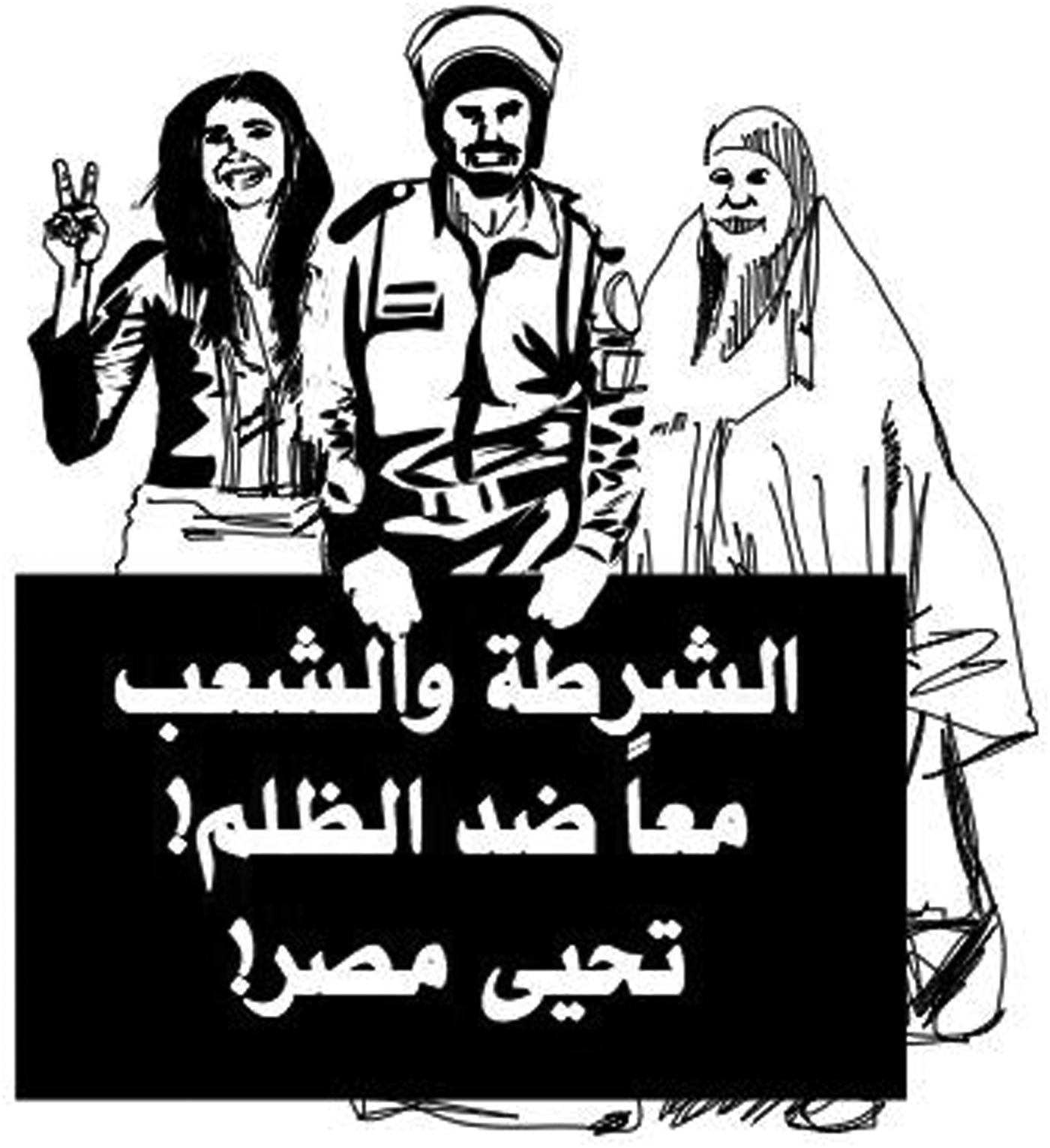
Fraternizing with the CSF and later the army has been claimed as a tactic by the “April 6” Movement, a prominent youth activist group that conducted activist training focused on protest tactics prior to 25 January. They taught chants and embodied actions similar to those that I will identify in the fraternization repertoire.Footnote 14 Similarly, an anonymously authored Arabic-language protest handbook entitled, “How to protest smartly” and illustrated by women physically embracing and posing for photographs with CSF soldiers (see Image 2), circulated in Cairo days before 28 January, urging activists to, “try to bring individual policemen and soldiers to the side of the people” (Kayfa Tathur bi-Hadaʾa 2011: 3). I largely discount the relevance of both of these sources due to my repeated inability to locate graduates of protest workshops, or readers of such manuals, during the formative moments when protestors began to fraternize. Instead, fraternization appears to have emerged, not under the direction of trained activists, or from learned maneuvers outlined in handbooks, but rather in a manner akin to what James C. Scott (Reference Scott1979) has called, “the revolution in the revolution.” In other words, there appears to have been a strong element of improvisation and innovation in these actions quite independent of any orchestrating hand or radical leadership.Footnote 15 Protestors arriving to Midan al-Tahrir responded to the introduction of a new force in Egyptian street politics by improvising claim-making performances that sought to establish the “norms of co-mingling” (Goffman Reference Goffman1971: xi) between protestors and soldiers, ineluctably drawing those army units to the revolution's side.
“The police and the people together against oppression. Long live Egypt!” (Kayfa Tathur bi-Hadaʾa: Maʿlumat wa Taktikat Hamma 2011: 22).
FRATERNIZING THE EGYPTIAN ARMY
At the end of a busy news day, international news media on 28 January showed nighttime Cairo, army vehicles passing through the streets. That evening's Associated Press (2011) package was typical of the coverage: it showed footage of protestors ostensibly welcoming tanks and APCs, before reporting that the headquarters of Mubarak's NDP party were ablaze, Egyptian Internet service providers had cut access, and mobile phone coverage had been similarly disrupted, and then concluding with scenes from the monumental battle for the Kasr el-Nil bridge.
In and around Midan al-Tahrir the situation was manifestly more complicated. As far as I have been able to establish, the first documented encounter between protestors and soldiers occurred around 5:20 p.m.: tanks and APCs were reported entering downtown Cairo and heading for the state radio and television stations at Maspero, not far from the National Museum's entrance to Midan al-Tahrir.Footnote 16 The arrival of a lone, Soviet-era, Egyptian Army APC near the 6 October bridge was captured by Al-Jazeera English Live.Footnote 17 In this footage, daylight is giving way to dusk as the 5:30 p.m. maghrib (sunset) prayer approaches. A crowd of some thirty protestors sights the vehicle and immediately surrounds it, gesticulating, beckoning others to join. Young men quickly begin to haul themselves aboard. The crowd around the APC increases to eighty or a hundred as more protestors arrive. The soldiers atop are largely left undisturbed. Within a few seconds, the APC begins to reverse away. Those who had successfully climbed aboard the APC jump free. A small number give chase as the vehicle backs away.
Al Jazeera Arabic Live caught that same, lone APC on camera shortly afterward, only a few hundred meters from where the first, fleeting interaction took place.Footnote 18 Dusk has not yet arrived, suggesting that little time has passed. The APC has broken down and is being pushed by soldiers. In a 50-second clip, seven pedestrians walk past the vehicle, paying it no attention. Two young men sit on the Nile's bank looking out away from the stricken APC. Traffic continues to move around it.Footnote 19 The camera pans out to the 6th October Bridge above. Protestors cross the bridge from the Giza side, heading toward Maspero and Tahrir, passing abandoned cars, the remnants of the afternoon's traffic.
It is here we begin to see the incipient contours of the fraternization repertoire.Footnote 20 From that first rush to surround the soon-to-be-broken-down APC, we find a fraternization performance that amounts to a ritualized trespassing. The juxtaposition above is particularly useful in delineating the emergence of trespassing as a contentious performance belonging to the fraternization repertoire. This dynamic is rendered all the clearer by understanding the ubiquity of the military and its boundaries in Egypt. Any Egyptian taxi driver picking up fares in Cairo or one of Egypt's other cities, either prior to or after the 25th January Revolution, would as a matter of routine encounter the army in everyday life. Traveling from the outskirts to the center of Cairo, our imaginary taxi driver will drive by numerous barracks, administrative buildings, army hotels, and officers' clubs, army-specific bank branches, pharmacies, and sports clubs, and other elements of a literal military-industrial complex, which as a percentage of the national economy is “too vast and dispersed to estimate with any confidence” (Marshall and Stacher Reference Marshall and Stacher2012: 12). Around sensitive military installations or presidential buildings, or when crossing into a different governorate or approaching the Suez Canal, our driver must pass through manned military checkpoints.
In this partial cityscape, military space is well organized and respected, with clearly defined borders.Footnote 21 Military installations often have high walls and watchtowers, and it is common to see signs around them written in Arabic and English announcing that photography is forbidden. As I discovered while researching this paper, photographing army vehicles, be the photographer a northern European male or his Egyptian brother-in-law, is only possible if done surreptitiously. People passing through military checkpoints tend to go to extraordinary lengths to observe the boundary markers soldiers place around their territory. On my daily walk from Dokki in Giza, I passed through two military checkpoints to access a shortcut via the Pakistani and Yemeni embassies and arrive at the metro station. Soldiers stationed there had placed crowd-control barriers on the corners of both entrances, partially blocking the pavement. Pedestrians, I observed, would seldom sidestep the barrier, manned by a soldier who was frequently bored; they preferred instead to step down into the road, continue there for 20 meters until they passed the second checkpoint, cross another small road, and remount the pavement. The pavement on my shortcut had effectively become military territory.
During the fifteen days between the army's initial deployment and Mubarak's resignation, there emerged a set of performances which through their emulation and recursion challenged this “right of separateness” (Goffman Reference Goffman1972: 69) enjoyed by the army, and came to figure as interaction rituals. The response by protestors at first sighting army vehicles was to trespass, first by surrounding the vehicle and then by hauling themselves aboard. Pedestrians passing the stricken APC otherwise respected the established boundaries of military space. In shaping micro-interactions, the mounting of Egyptian army vehicles asserted a right to physical co-presence that allowed for other kinds of fraternization later. One cannot overstate the importance of trespassing and the demand to share military space in literally setting the stage for other fraternization performances. Goffman explains, “It is apparent that a precondition for the performance of … rituals is that the giver and the receiver be in contact, whether face-to-face or mediated. No contact, no interpersonal ritual” (Reference Goffman1971: 71). One of my key arguments here is that as physical distance between protestors and security forces decreases, we should find an attending increase in ritualized interaction and a decrease in sociological distance; that is to say, the embodied representation that “the army and the people are one hand” is a plausible performance. If fraternization requires physical co-presence, it is equally apparent that accessing police, soldiers, or other arms of a state's apparatus of violence is often difficult: security forces jealously guard the boundaries of their territories and their right to organize that space.
Egyptian soldiers did not simply surrender their vehicles in this regard. In the first encounter with protestors, the APC reversed away when it seemed about to be enveloped by the crowd. As protestors continued along the Nile Corniche, still clashing with the rearguard of retreating CSF units, they encountered further APCs on the road to Maspero.Footnote 22 Initially, when approaching the first such army vehicle, protestors took shelter behind it from CSF tear gas and rubber bullets. Many more stood off the vehicle's sheltering flank to arc stones at the CSF; the APC marked the new frontline of the protestors' offensive. After the CSF troops retreated, numbers remained with the APC. No longer gathered on just one side, they corralled the vehicle with their bodies, the most enterprising pulling themselves on board. Informants reported soldiers manning the vehicles initially trying to stop this, often demanding that the crowd open up so as to allow the vehicle free movement. Indeed, this was a common scene in footage from 28 January and into the next morning, as soldiers attempted to assert control over their vehicles.Footnote 23 As will become apparent, though, protestors could not be deterred in their trespassing, and they made continual claims to access military vehicles and their personnel, all indicative of a crowd that accepted no boundaries aside from those of its own making, especially boundaries that might allow soldiers to remain neutral bystanders in the struggle against Mubarak.
THE ARMY AND THE PEOPLE ARE ONE HAND!
As night fell, protestors gathered outside Maspero, near the National Museum entrance to Midan al-Tahrir. The situation was in flux, and running battles between CSF units and protestors on the road leading to Maspero had been replaced by an uneasy calm. Newly arrived Egyptian army units in APCs and battle tanks, some identifiable by their claret and blue insignia as belonging to the Republican Guard, had taken position outside Maspero. Armed soldiers wearing gas masks—necessary given the volume of tear gas fired by the recently departed CSF—manned the windows and entrances to the large, convex building.
In video recorded by the Egyptian newspaper Al-Masry Al-Youm, protestors can be seen climbing atop stationed army vehicles, many waving flags and cheering on their comrades.Footnote 24 It is outside Maspero that we hear for the first time protestors chanting, “The people and the army are one hand.”Footnote 25 The footage continues with a Republican Guard officer using his signal flag to hit a protestor trying to board an APC. In informant testimony, the interactions with the army have been described as a negotiation, in which a shared emotional mood of victory after having defeated the hated CSF was tempered by fear of the Guards attacking.Footnote 26 One informant, Khalid, told me that ad hoc meetings were held between protestors and army officers to try and establish what the army's role was to be in the unfolding events. From his own ethnographic data, Atef Said speaks of the army's presence as a “black box”—an unknown element that provoked “anxiety and uncertainty” (2012: 408). While elated by the unprecedented defeat of the CSF, nobody was sure what would happen next.
The army had only twice before been deployed onto Egyptian streets: once in 1977 during the Bread Uprising (Intifadat al-Khubz; alternatively Thawrat al-Haramiyya, “the Thieves' Revolution”), and again in 1986 to put down a revolt by CSF officers. On the evening of 28 January, these previous interventions were referenced to highlight the potential threat of soldiers attacking protestors. One activist who arrived in Midan al-Tahrir after setting off on a march from a populous district in eastern Cairo recounted:
Rumours ran in Tahrir that Mubarak ordered the army to descend in the streets. How did the protesters feel towards the army? On several occasions since I joined the march in Nasr City, and till we reached Tahrir, some protesters were calling on the army to intervene and “protect them from the police” like what happened in Tunisia. And when tanks showed up in Tahrir speeding towards Garden City to protect the U.S. and U.K. embassies, many protesters cheered their arrival. But at the same time, I also witnessed several occasions where the protesters intervened with anger against those who were chanting for the army, shouting: “Well, hasn't the army been ruling now since 1952? Aren't they responsible for the Egypt we have today? Didn't they kill protesters in 1977? Who gave them the orders to intervene, Mubarak, right?” All those were questions and arguments that broke out on several occasions (el-Hamalawy Reference el-Hamalawy2011).
There is no sense that such historical episodes provided any interaction rituals or repertoire of contention for protestors to draw on when dealing with the army; these had to be improvised. Outside of Maspero, nobody, least of all the newly deployed soldiers, seemed to know what part the army was to play in events. In response to the ambiguity of the situation, the crowd began to chant anew, demanding that Mubarak issue a statement.
At 10:50 p.m., a column of battle tanks and APCs departed from Maspero and approached Tahrir. Meanwhile, some remaining units of the CSF continued to fire tear gas and live ammunition into Tahrir from roads leading to the Interior Ministry. A rumor quickly spread that the army were coming to reinforce the CSF. As the column of army vehicles entered the Midan in single file, protestors chanted, “Are you with us, or are you with them?” Hazem, a veteran of the pitched battles fought that day on Kasr el-Nil bridge, describes the protestors' reaction to the army's arrival: “In general, as the army came into the square that night there was a very mixed mood—not just between protesters, but within them. It was a mix of fear and joy—as in ‘Yay, the army is here boys,’ to ‘shit, they're sending the army to attack us.’ I myself felt a lot like this. Rumors were erupting constantly. On the one hand, there was an initial belief that the army was here to take on the remaining police units guarding the Ministry of Interior. Then there was the rumor that they came to join forces with the police and would begin to attack us once they took hold of the square.” To expand briefly on the content of the rumors: earlier in the afternoon during the battle for Kasr el-Nil, military police jeeps were reported seen re-supplying CSF units with tear gas and live ammunition as a military helicopter hovered over Tahrir. After the protestors had broken through CSF lines, a lone APC entered the Midan at speed, heading for the remnants of the CSF near the Interior Ministry. Protestors threw stones at it with little effect before it sped off.
Whether the rumors of the military rearming the CSF were true is not as important as that they sowed fear of further confrontations and situational tension in Tahrir when the army arrived. About 30 minutes after the column of army vehicles began to enter Tahrir a tank sat isolated in front of the Egyptian National Museum, some 400 meters from the center of Tahrir, its path blocked by protestors.Footnote 27 The remaining vehicles continued on. A crowd of about a hundred people surrounded the tank and five young men climbed onto the turret to douse the tank with petrol before setting it alight. Stones were thrown at the vehicle, their ricochets audible in the video footage recorded by protestors. When the petrol proved ineffective, the young men poured it on rags, set them alight, and posted them in the tank's vents. The vehicle “smoked-out,” the soldiers scrambled free, only to be attacked by members of the crowd.
Closer to the epicenter of Tahrir, more army vehicles were being attacked. One dramatic video captured on a mobile phone shows an APC entering the Midan and skirting the western edge of Tahrir.Footnote 28 Approximately twenty protestors run towards the APC, throwing stones. A second APC approaches, roof ablaze. The protestors who had been throwing stones stop and watch the vehicle. The second APC then wheels towards the protestors, mounting the pavement and scattering the stone throwers. The APC stops. Stone throwing reaches a new intensity as protestors surge towards the army vehicle chanting, “God is Great!” The number of protestors swells to about fifty. The fire on top of the APC goes out. Since the first APC's appearance, less than a minute has elapsed: the second APC sits motionless. A voice (the cameraman?) shouts, “Set it on fire, set it on fire!” and the crowd takes up this chant. The stone throwing intensifies, and another voice shouts, “Stop, stop!” and now this chant is taken up, seemingly by the same voice previously calling for the fire. The crowd swells further. A man shouts, “Stop hitting them.” An element of the crowd begins to chant for the soldiers to surrender and this continues and develops in intensity as more voices join. A small group of protestors climbs on top of the APC, a fire is lit at the back of the vehicle. Somebody, possibly one of the fire lighters, exclaims, “There's somebody inside, get him out!” The crowd around the burning APC thins out, and the protestors come to resemble spectators.Footnote 29
Aside from some surviving photographs (see Image 3), this episode of protestors attacking army units in Tahrir is completely absent from any journalistic account of the 25th January Revolution.Footnote 30 While I will not sustain this detailed narrative to cover the full period for which soldiers and protestors shared Tahrir, these few hours on the night of 28 January seem especially important. Here, the action appears “eventful” (Sewell Reference Sewell2005) rather than following any structural, cultural, or ideological logics linked to the historical position of the Egyptian army in society, or to the fact that, its being a conscript army, most households have a male relative completing or having completed military service.Footnote 31 Informants like Khalid, who had completed military service and, outside of the situation at hand, held a positive view of the Egyptian military, told me they felt threatened by the army's presence during this and many of the other episodes I will discuss here. This is not to overstate or stylize the argument—several informants were equally insistent that Egyptian soldiers were irrevocably on the side of protestors, and celebrated their arrival. Here, an understanding rooted in the situational dynamics in which soldiers and protestors found themselves interacting explains these contradictory positions.
An Egyptian army APC burns in Midan al-Tahrir, 28 January 2011 (Goran Tomasevic/Reuters).
While the available chronology of events is partial, what we do know happened before, during, and after the attack maps well onto Randall Collins's ideal-type of a “forward panic”:
A forward panic starts with tension and fear in a conflict situation. This is the normal condition of violent conflict, but here the tension is prolonged and built up; it has a dramatic shape of increasing tension, striving towards a climax.… There is a shift from relatively passive—waiting, holding back until one is in a position to bring a conflict to a head—to be fully active. When the opportunity finally arrives, the tension/fear comes out in an emotional rush…. Running forward or backward, in either case they are in an overpowering emotional rhythm, carrying them on to actions that they would normally not approve of in calm, reflective moments (2008: 85).
Upon the army's arrival in Midan al-Tahrir a similar emotional release is observed, and then swiftly reined in. In the second attack, a voice is heard encouraging protestors to set the APC on fire, which is then echoed by other protestors who rush to attack the vehicle. Almost immediately the same voice calls for restraint. These contradictions, or reassessments, Collins argues, accompany the building up and release of emotional energy. In this sequence of events, what appears formative are the features of the situation—the buildup of tension, the existing situation of violence and continued presence of the CSF, the role played by rumors, and the point at which tension spilled over into a forward panic. For my discussion, what is key are the next moves that protestors make after exiting the emotional tunnel of attack.
Returning to the Midan, a military truck had followed the column of tanks and APCs and was similarly surrounded by protestors. The soldiers in the cab were pulled out and attacked, and informants reported ransacking of the truck's cargo and the discovery of food rations. Soldiers manning nearby tanks then moved to intervene, and a protestor was pushed to the ground. While this drama unfolded, protestors commandeered the smoked-out tank, and even managed to pilot it forward a few meters (Shalaby Reference Shalaby2011). A search of the tank discovered boxes of ammunition, tear gas canisters and grenades and, like the food, these were distributed to protestors in the Midan. Other army vehicles and soldiers were likewise attacked with two smoldering military jeeps littering Tahrir the next morning. One had been stopped and commandeered earlier in the evening as it entered Tahrir and found to contain live ammunition before being set ablaze (el-Hamalawy Reference el-Hamalawy2011).
When it appeared the situation would deteriorate further, informants recall, a group of protestors crowded round the remaining parked tanks chanting, “The army and the people are one hand.” In an act of micro-conflict avoidance, I would suggest, protestors chanted for the army as a means to dissipate fear of further confrontations and bring under control the situational anxiety felt by both sides.Footnote 32 Fraternization techniques superseded any prolonging of attacks on soldiers, despite protestors being armed with weapons seized from the army, weapons many suspected had been intended for the CSF. That protestors did not, in effect, militarize the revolution, speaks to the constraints of the broader 25th January repertoire of contention, which cautioned against militarization through the chanting of silmiyya (peaceful) protest.
Significantly, it is here and elsewhere that we find the nascent formation of a new frontier in the struggle against Mubarak through the articulation of the collective subject of “the people.” Particularly cogent is Ernesto Laclau's (Reference Laclau2007) argument that the emergence of “the people” as a collective actor exists not as an a priori category, but proceeds instead through the formation of an antagonistic internal frontier, differentiating “the people” from power via the naming of demands. One chant from the broader 25th January repertoire that we will encounter below illustrates this well: al-shaʿb yurid isqat al-nizam (the people want the overthrow of the regime). In chanting “The army and the people are one hand” protestors would extend this frontier to include newly deployed soldiers, with the Mubarak regime present as the silent Other: the army and the people were one hand in their struggle to overthrow the regime.
To grasp how a political frontier forms we must, as Dzenovska and Arenas (Reference Dzenovska and Arenas2012: 645) have insisted, account for the concrete political practices that made it possible. One protestor, Alia, describes the chant's emergence thusly: “‘The army and people are one hand’ was certainly a strategy for non-violence in the beginning—it wasn't a statement—we weren't welcoming the army. For some it was more like ‘You, we have nothing against’ [or] ‘You we won't attack,’ and for others it was ‘Let's be one hand,’ [but] it certainly wasn't an announcement of the status.” Accordingly, this was, then, a precarious and incomplete solidarity, an act of micro-conflict avoidance, rather than the formation of a new collective actor.
When explaining the de-escalation, informants also attest to a protracted lull in fighting with the CSF on the eastern side of Tahrir, which contributed to a temporary abatement of the shared mood of impending violence. Protestors, for their part, immediately sought to establish face-to-face contact with soldiers. One informant spoke of protestors—who had minutes before been throwing stones—embracing soldiers whose tanks were by then parked in the Midan. Protestors posed for photographs with soldiers; others hugged them, shook their hands and kissed their cheeks.
Recounts Hazem, “Eventually … once the tanks had all parked, protesters began to join them on top of the tanks and talk to them…. Conversation and laughter soon broke out and protestors began taking pictures with their phones standing next to military personnel and their tank. Food was shared between protester and soldier.” Above all, in the wider context of the army's deployment, this episode provides an important backdrop to explaining the confrontational fear and tension that surrounded the army's presence and the mechanisms that protestors adopted to avoid the outbreak of further violence.
While some protestors attacked newly arriving army vehicles, others set about establishing their own system of markers on them. Graffiti on tanks and APCs represented a new way to contest the army's claim to organize its own territory. The graffiti tended to draw on chants and slogans from the larger 25th January repertoire: often variations on a theme of “The people want the overthrow of the regime” and “Leave Mubarak.” What Mona el-Ghobashy (Reference el-Ghobashy2011: 13) has described as the “branding of public goods” is illustrative of how fraternizing protestors could enact a symbolic trespassing that broke down the distinction between a military space and a public space claimed by the protestors. Army vehicles became canvases, encoded with the protestors' contestation announcing the protestors' shared focus of occupying Tahrir until Mubarak was deposed.
The graffiti itself was almost completely anti-Mubarak in content. From my review of photographs, I found no explicitly pro-army slogans graffitied on vehicles. When graffiti did mention the army it tended to highlight its ties to the Mubarak regime, while drawing it into the wider symbolic field of protestors' contention. The graffiti on one APC read, “This is Egypt's army, not Mubarak's army.”Footnote 33 Another piece of graffiti from the same vehicle proclaimed: “We were betting on the Egyptian army, that it would not sell its children; but we found out the truth, that it had sold the Egyptian people for its president.” As a fraternization performance, graffiting tanks and APCs further challenged the army's claims to ownership of that space, in turn placing those vehicles on the side of the protestors. Protestors arriving in the Midan over the following days would report feeling reassured by the graffiti, emboldening them to approach the vehicles, a logic related by one informant, Ahmad, as, “If the army has let us [the protestors] do this, they must be on our side.”
ONE, TWO, WHERE IS THE EGYPTIAN ARMY?
I have suggested that the chant, “The army and the people are one hand” was a contentious performance that protestors employed situationally when they felt threatened by the army units in their midst, or when trying to de-escalate protestor-soldier violence. This was almost always face-to-face action, which through its recursion became an interaction ritual invoked, if not always successfully, in situations when protestor-soldier coexistence was threatened. Even in response to threatening actions by military units some distance away (including episodes of fighter jets over-flying the Midan, unsettling protestors with their sonic booms), or the presence of a military helicopter hovering overhead, protestors directed their chants at army units closer at hand.Footnote 34
A second use of chanting occurred when protestors were, while in the presence of army units, either threatened or under attack by remnants of the CSF or pro-regime loyalists. The first instance of this that I have been able to identify comes on the morning of 29 January. Video shows three APCs maneuvering their vehicles between protestors and shotgun-wielding CSF units on a road leading to the Interior Ministry.Footnote 35 The intervention is not totally on the side of the protestors. As protestors threw stones at CSF troops, individual soldiers tried to restrain them, and minor scuffling broke out. Nevertheless, the protestors persisted. A gunshot then rang out, fired from the CSF side. The crowd started to chant, “One, two, where is the Egyptian army?” The footage cuts to the APCs aligned on the street, offering maximum shielding to the protestors who continue their skirmish with the CSF.
Another example is that of Captain Maged Boules, or the “Lion of Tahrir.” Boules became a hero to those occupying Tahrir after he confronted pro-regime baltagiyya (approximately, thugs) approaching the Midan from the Talaat Harb entrance on 2 February (Al-Shorouk 2011: 5; Al-Ahram, 6 Oct. 2011). In video footage, we see Boules confronting the approaching thugs before retreating towards his APC at the entrance to Tahrir.Footnote 36 Brandishing his pistol, Boules repeatedly fires in the air. As the column continues to advance, more soldiers appear, heading to collect their weapons from the hatch of the APC. As one soldier kneels to load his rifle, protestors begin to chant, “The people and the army are one hand.” The chant quickly spreads. The footage ends with protestors jumping up and down, the column of advancing thugs halted, protestors and soldiers buzzing with the emotional energy of averting attack. A weeping Boules is then embraced by protestors after mounting the APC to be cheered by the crowd and proclaimed with further chants of, “The people and the army are one hand” (see Image 4).
A protestor embraces Maged Boules after he confronts a column of approaching regime thugs, Midan al-Tahrir, 2 February 2011 (Lefteris Pitarakis/AP/Press Association Images).
Chanting at the army took on particular significance during the Battle of the Camel on 2 February, so-called after pro-regime elements, thugs, and plainclothes police attacked Tahrir, many riding horses or camels. For a full day and night, the two sides exchanged stones and Molotov cocktails. During lulls in the fighting, protestors approached army units, entreating them to intervene, chanting, “Where is the Egyptian army?” During one episode when a tank at the National Museum entrance did intervene, with soldiers firing guns above the heads of regime thugs and driving their vehicle forwards, protestors chanted, “The army and the people are one hand.” Meanwhile, according to one informant, Ahmad, those in the center of the Midan misunderstood the situational context and panicked, thinking the army had opened fire on protestors.
The Battle of the Camel was doubly important not only as the last serious attempt by the Mubarak regime to displace the occupation of Tahrir, but also for reminding protestors of the ambiguous position of the army. This is borne out through the situational analyses protestors themselves developed through their interactions with soldiers. Informants frequently identified army units positioned at both the Kasr el-Nil and National Museum entrances to Tahrir as actively collaborating with the Mubarak regime. It was at Kasr el-Nil that regime elements successfully entered the Midan and it was outside the National Museum that the fiercest fighting continued into the next day. Informants explicitly accused those soldiers of being complicit in the attack or of not intervening to protect the protestors when asked.Footnote 37 When implored to intercede to stop the advance of regime supporters after fighting initially broke out in front of the National Museum, soldiers refused, insisting their duty was simply to secure the area (Al-Masry Al-Youm, 3 Feb. 2011: 5). Later, as regime thugs broke onto the roofs of buildings opposite the National Museum to rain Molotov cocktails down onto protestors sheltering behind impromptu barricades below, the army again ignored calls to step in (Egypt Gazette 2011b: 2). As the battle raged, one eyewitness described how “Egyptian soldiers looked on, lined up motionless in their armored vehicles in the middle of the two opposing sides” (Trombetta Reference Trombetta2013: 143).
After the Battle of the Camel a series of confrontations broke out between units of the Egyptian army and protestors. These centered on burnt-out trucks improvised into barricades outside the National Museum. The following morning tanks attempted to tow these away and protestors, fearing the loss of their fortifications, immediately moved to block the army, physically surrounding their vehicles. In several instances scuffles broke out between protestors and soldiers only to be defused, with protestors physically restraining their comrades and chanting pro-army slogans. In this and other instances, we find small numbers of violent protestors brought under control by members of their own side via fraternization performances. These confrontations, informants feared, were provoked by regime agents provocateurs whose goal was to draw the army into attacking the protestors. Fraternizing was thus utilized on two fronts: first, to constrain the behavior of the violent minority by setting an alternative mode of interaction with soldiers, and second, to signal to army units a pacific intent by returning to now familiar interaction rituals signaling protestor-soldier solidarity. The barricades were otherwise left untouched.
A further point of contention arose from the handing over to the army of tens of thugs and undercover policemen detained by protestors after the attack. These detention practices continued until Mubarak's resignation, with suspected agents provocateurs kept in the “people's prison”—the stairway to the closed Sadat metro station that services the Midan (Al-Shorouk 2011: 5; Al-Masry Al-Youm, 7 Feb. 2011: 5). Many believed that, once handed over, these pro-regime elements were simply set free by the army so they could again terrorize the protestors.
Despite their sharing the Midan for nearly a week, the actions of the army remained for many a constant source of distrust and suspected malfeasance. The army would declare on 31 January, three days after their initial deployment, that they would not use force to put down the mobilizations, but not until 3 February, after the Battle of the Camel had been lost by the regime, did the military offer to guarantee the security of protestors in the Midan, and it was all the while calling on them to demobilize and vacate Tahrir (Al-Masry Al-Youm, 3 Feb. 2011: 7). This commitment soon took the form of stop and search checkpoints at the Midan's entrances (Al-Masry Al-Youm, 5 Feb. 2011: 6). Informants, however, complained of soldiers stopping the flow of food and medicine, and protestors continued to maintain their own cordon around the Midan, checking identity cards and searching newcomers. When explaining this duplication to me, ʿAlaa, who had manned a checkpoint, insisted the protestors' cordon was there both to assert their control of the Midan and because, “We didn't trust the army.”
WHAT IS THE LOVE STORY WITH THE TANKS?
What is the love story with the tanks? So reads the title of an Al-Masry Al-Youm article of 2 February 2011 (p. 12), seemingly one of the few Egyptian journalistic accounts published during the revolution that focused specifically on protestor-soldier interactions. The title echoed a question posed by an Egyptian army officer stationed in Tahrir whose tank was surrounded by men and women taking photographs of their friends atop the vehicle. In Tahrir, the article noted, tanks had been transformed into sites for taking photographs. Those being pictured often made victory signs and waved Egyptian flags. Soldiers had tried to stop the climbing on the tanks, but were overrun by the large number of photograph hunters. “Please cooperate with us and stay away,” the army officer implores, “and make our job easier.”
Posing for photographs was one of a set of fraternization performances that involved trespassing upon army vehicles in non-violent situations, performances we first encountered on the night of 28 January and which quickly became an emergent symbol of army-protestor solidarity, to be emulated as long as protestors and soldiers were physically co-present.Footnote 38 I have already catalogued how, in fighting the CSF, protestors used newly deployed APCs as physical cover. In other instances, tanks at the Kasr el-Nile entrance to Midan al-Tahrir were literally incorporated into protestors' barricades. All these performances made immediate claims on the soldiers manning those vehicles to give security to the protestors, or to neutralize any future threat those units posed. Posing for photographs underlines a further dimension to the fraternizing of soldiers in Midan al-Tahrir comparable to what Dzenovska and Arenas (Reference Dzenovska and Arenas2012) have called a, “barricade sociality.” In this, posing for photographs was one of many embodied fraternization performances that both reflected and made possible a protestor-soldier solidarity. These interpersonal rituals, designated by Goffman (Reference Goffman1971: 194–99) “tie-signs”—hugging, kissing, shaking hands, a protestor's arms around the shoulders of a soldier, a soldier hoisted on the shoulders of a protestor—all enacted a political frontier: the army and the people together in occupied Tahrir in the face of regime oppression. These tie-signs took on a particular consequentiality, for instance with the “Lion of Tahrir,” after soldiers committed to intervene on behalf of protestors, or when protestors attempted to diminish the risk of protestor-soldier violence as occurred on the night of 28 January, and, indeed, on the few occasions protestors fraternized with the CSF.
Tie-signs were crucial to sustaining this frontier: they communicated information regarding intentions and the nature of relationships, both to those interacting and to wider audiences. If everyday tie-signs inform third parties as to the nature of the relationship, these tend to map to degrees of familiarity. Fraternization tie-signs are in this sense exceptional, since the usual rules of embodied action are suspended. In a successful fraternization performance protestors and security forces, people almost always unconnected outside of the situation at hand, sign highly-intimate relations that collapse everyday social heterogeneity, such as gender, class, or other group membership.
The ritualistic mounting of army vehicles was not exclusively the domain of protestors. Army officers used tanks and APCs as platforms from which to address those occupying the Midan. Upon the army's deployment on 28 January, officers commanding army units in the Midan delivering such speeches would be interrupted and interrogated, with questions shouted at them demanding to know whether they were with or against Mubarak.Footnote 39 Speeches took a somewhat different form after 4 February when senior military officers, surrounded by bodyguards, began to take tours of Tahrir. These included Field Marshall Tantawi, Mubarak's then minister of defence and head of the Supreme Council of the Armed Forces (SCAF), who visited the Midan to be greeted by chants of, “O Field Marshall, O Field Marshall, we are your children in Tahrir” (Al-Masry Al-Youm, 5 Feb. 2011: 5). These addresses were received with a greater degree of reverence, and when assurances were offered as to the army's loyalty to the protestors' cause, rewarded with chants of, “The army and the people are one hand.” Still, despite the invoked paternalism of protestors' chants and the frequency of these speeches, informants who were present later reported officers who walked through the Midan being accosted by protestors demanding to know if the army would attack them.
This was symptomatic of the lingering uncertainty and anxiety many retained concerning the army's presence, a point well illustrated by a further addition to the fraternization repertoire: sleeping in the tracks of tanks and APCs. The first instance of this was reported on 5 February after tanks stationed in Tahrir started their engines (Egyptian Gazette 2011a: 1).Footnote 40 Just as in the earlier, 28 January episode in which protestors attacked newly arriving army units, a rumor preceded this action, this time suggesting the tanks planned to withdraw from the Midan in anticipation of a renewed attack by regime loyalists. Records of the rumor are unclear as to whether the army was supposed to be participating in the attack, or else complicit in coordinating it.Footnote 41 In response to the tanks' engines starting, protestors quickly surrounded tanks and APCs in Tahrir. The logic of this performance was seemingly that, following the corporeal surrounding of army vehicles individual units could be isolated and made responsible for the protestors' security. If graffiti made military vehicles in Tahrir symbolically compromised, the sleeping in vehicle tracks made them operationally so. Physically encircled and unable to move, the Egyptian army had effectively lost these vehicles and their crews by 6 February, along with any semblance of a military order organizing a contiguous territory. Protestors would remain encamped there until Mubarak's resignation on 11 February, as physical and symbolic forms of defense against the predations of the Mubarak regime.
CONCLUSIONS
To mark the first anniversary of the 25th January Revolution, a convoy of Egyptian army APCs drove through central Cairo. Each vehicle flew a national flag and had emblazoned on its side, “The army and the people are one hand.” Commercial billboards on Cairo's main thoroughfares were rented, proclaiming, “The 25th January Revolution—the army protected it. The army and the people … are one hand,” accompanied by images of children posing for photographs on tanks stationed in Midan al-Tahrir. Similar posters appeared outside the many army barracks and military administration buildings located in and around the city (see Image 5).
“The army and the people are one hand.” Poster outside Egyptian military checkpoint on Suez Road, February 2012 (author's photo).
In post-Mubarak Egypt, the Supreme Council of the Armed Forces have used the residual symbols of fraternization performances as a source of political capital, employed to legitimate their assuming executive control at Mubarak's departure. Those symbols of fraternization, the storage vessels for the ephemeral feelings of protestor-soldier solidarity, have been detached from the wider symbolic universe of revolutionary Tahrir and put to work elsewhere.Footnote 42 In SCAF's narrative, the army's role during those fifteen days is to be fêted as one intended to safeguard peaceful protest against the Mubarak regime.Footnote 43 That the SCAF was able to plausibly draw on these symbols of fraternization speaks to the deep re-imagination of politics that fraternizing protestors and their contentious performances made possible in re-aggregating a claim to sovereignty in the name of “the people” in opposition to the increasingly desperate and violent actions undertaken by the Mubarak regime. This bifurcation of governance from sovereignty was not missed by the regime, as epitomized by its announcement on 7 February, and later relayed via a Greater Cairo-wide SMS message, that the police force would be returning to the streets under its pre-Mubarak motto, “The police are in the service of the people” (Al-Dostor 2011b: 6; Al-Masry Al-Youm, 10 Feb. 2011: 3).Footnote 44 This was followed, shortly after Mubarak's resignation, with posters plastered around the city declaring, “For Egypt: The army, the police and the people are one hand,” dubiously signed-off by the “Youth of Egypt” (see Image 6).
“For Egypt: The army, the police and the people are one hand”. Poster on wall in downtown Cairo, May 2011 (author's photo).
As this paper has argued, and contrary to SCAF's posturing, it is wrong to assume that protestors singularly embraced the army's new role in street politics, or that protestor-solider solidarity was unequivocal. I have suggested instead that protestors surrounding and hauling themselves aboard army vehicles, chanting for the army, graffiting tanks and APCs, and tie-signing with soldiers, constituted instances of claim-making. These protestor-soldier interactions were in themselves sites of action, sites at which protestors and soldiers forged a new political frontier through their performances. Theoretically, this has involved a conception of contentious performance that captures ritualistic claim-making at the micro-interactive level. Exploring the micro-interactive dimensions to one episode of contention reveals a good degree of improvisation and innovation on scripted performances in response to situational dynamics. Key here is taking seriously the capacity for claims made on the agents of regime power to decide situational outcomes, primarily by affecting emotional moods and stimulating feelings of solidarity. In Tahrir, that solidarity was at once fragile and contingent, having constantly to be remade as protestors fraternized with army units stationed in their midst in an attempt to both neutralize any potential threat they posed and sway their loyalty by forging common bonds and a shared political horizon. This dissonance and an attending polyvalence in performances was acknowledged by protestors themselves, one of whom described a “mix of feelings/actions toward the army … on the one hand we have chanted the people and the army are one hand, and on the other, protestors decided to sleep under tanks and block them from encroaching on the square or dispersing the Tahrir sit-in” (quoted in Said Reference Said2012: 409). As a political frontier borne of the practices of street politics, this frontier was for many protestors only ever actualized situationally, by what became ritualized fraternization performances, and by interventions by brave soldiers such as Maged Boules, or the sixteen army officers who reportedly came to the Midan to declare solidarity with the protestors (Reuters 2011). Many of them were later prosecuted in military courts for this.Footnote 45
Preliminary comparative studies of the 2011 Arab revolts have tended to reproduce SCAF's narrative, taking as their point of departure the decision by Egypt's generals not to intervene as having decided the course of the 25th January Revolution (see Barany Reference Barany2011). This even though the military leadership only cut Mubarak loose on 10 February, which triggered his resignation the following day. In the absence of reliable accounts from Egypt's military command concerning the fifteen days the army were deployed, we can only speculate on the formativeness of fraternization in shaping the trajectory of the revolution. The question remains whether an order for the army to attack protestors was ever issued. The SCAF themselves have released a series of contradictory statements, claiming they refused an order to fire on protestors in Tahrir, only to later retract the claim (Egypt Independent 2011). The trial of Mubarak and others implicated in the killing of protestors has otherwise failed to resolve this question with testimony given by Field Marshall Tantawi and Sami Anan (then army chief of staff), heard in camera.Footnote 46
There is a counterfactual argument to be made that hangs on the reliability of army units in Tahrir to follow orders, as perceived by their officers. In Tahrir at least, there was a breakdown of all semblance of a separate military discipline and authority structure standing apart from protestors' claims to control the Midan. In response, red-bereted military police were later drafted into Tahrir in an attempt to bolster the discipline of the army units stationed there. In issuing any order to attack those occupying the Midan, senior army officers would have been forced to question the reliability of troops in Tahrir and their solidarity with those who had for days been embracing them, posing for photographs atop their vehicles, and chanting in their name.Footnote 47
If fraternization succeeded in separating the army units in Tahrir from military command and control structures, the Egyptian military soon developed countermeasures. On 9 March 2011, during one of the army's periodic “clearings” of Tahrir, protestors hastily linked arms and chanted to a column of approaching soldiers, “The people and the army are one hand.”Footnote 48 Others attempted to tie-sign with soldiers, all the while imploring them not to destroy the protestors' encampment. Faced with overwhelming odds and the threat of violence, these protestors fell back on a fraternization repertoire that communicated their solidarity with the army. But here their performances fell flat—the column, marshaled at a distance by military police and kept in tight discipline at a running pace, followed orders. The tents in the Midan were dismantled and protestors beaten by gangs of thugs.
After this and other episodes of contentious street politics, new performances quickly supplanted fraternizing when interacting with the army. Peaceful protestors were killed by soldiers at Maspero in October 2011, and then on Muhammad Mahmud Street in late November 2011 and outside the Defence Ministry in Abbasiyya in May 2012. These events occurred alongside allegations of torture, forced virginity testing, and the army's repressive policing of street politics and labor agitation. By the revolution's first anniversary, new chants had innovated on the old: “The people and the people are one hand!” and “The army and the police are one dirty hand!”