“My Dear Mrs. L.,” wrote Reverend Willard Parsons in a flurry of excitement after his Sunday sermon, “The ball is set in motion.” In early 1877, Parsons had moved from New York City to Sherman, Pennsylvania. He relished life in his new rural home but could not shake the feeling that the poor children he had ministered to in New York deserved to experience this beautiful countryside. So he asked his parishioners to consider hosting city children for country visits. “I took for my text this morning, ‘Inasmuch as ye have done it unto one of the least of these, ye have done it unto me,’” he recounted to his friend Elizabeth Lovett, “and made the practical bearing of my words the bringing out into our homes some of the waifs and outcasts from the city.”Footnote 2
With a list of willing hosts in hand, Reverend Parsons contacted workers from Brooklyn's Plymouth Church Mayflower Mission, and they selected sixty poor tenement children for two-week country stays. The Brooklyn missionaries chose the children they believed were most in need of a vacation, especially those who seemed overworked or underfed or who suffered from the respiratory problems so common among New York's poor children. Parsons escorted each party to and from the homes of the Pennsylvania hosts, and he delighted in the children's enthusiasm and wonder as they returned from their trips. “I do believe they all have a corner in my bachelor-heart,” he wrote to a friend that summer. “It has been taken by storm.”Footnote 3 Declaring the summer of 1877 a success, Parsons officially founded his Fresh Air Fund the following year. After its first makeshift summer, the fund quickly ballooned; by 1888, it was sending over 10,000 New York City children per year to host families in hundreds of towns across the Northeast.
Compared to its peer child-welfare organizations of the late nineteenth and early twentieth centuries, the Fresh Air Fund carried out a modest agenda. The fund typically whisked children away for just two weeks before reuniting them with their families, so it raised few serious objections. Two weeks in the country did not create fears of lasting emotional damage the way that a permanent relocation or institutional home might. Even Parsons acknowledged that the trips succeeded in part because they were so brief. When describing that first summer's guests, he said that the country homes “seemed to bring out the very best that was in them, and before the novelty had worn off they had gone back.”Footnote 4
The modesty of this project helps explain why the Fresh Air Fund has gone largely unexamined by historians during its long life.Footnote 5 Radically interventionist organizations and groundbreaking efforts in child welfare tend to attract the most historical attention, in part because they often changed national debates over children's care and children's rights and in part because historians are fascinated by ideas (such as orphan trains) that once garnered widespread support but that seem bizarre or disastrous to modern eyes.Footnote 6 By contrast, the Fresh Air Fund seemed like a good idea to many volunteers and participants in 1877, and it continued to enjoy broad support throughout the twentieth century. At the dawn of the twenty-first century, country trips still appealed to urban children and their families, and donors still gladly sent checks to sponsor children's few weeks of vacationing in the countryside.
A historical study of the popular and long-lived Fresh Air Fund, though, offers several perspectives on the history of child welfare that go missing in the histories of more extreme or innovative organizations. Examining the Fresh Air Fund's seemingly mild, unobjectionable agenda over its first fifty years, from 1877 to 1926, uncovers a cluster of embedded popular assumptions about class, ethnicity, health, and citizenship. A study of the fund demonstrates that even moderate welfare projects that perform an obvious good have also carried reformers' cultural biases. This study further shows how changing philosophies of child welfare and reform translated into practical action. Fresh Air Fund directors altered their practices—how they selected children, where they sent them, how they instructed families and counselors to teach them—as they changed their minds about what, exactly, poor children needed. By tracing these changes in the fund's practices, and correlating them with policy shifts tracked by social-welfare historians, we can see how theories and currents among reformers in child welfare actually affected the tens of thousands of children cycling through this program every summer.
A history of the Fresh Air Fund reveals participants and volunteers investing a single project with a variety of meanings over time. In the beginning, Willard Parsons and other fund volunteers saw the trips as a means of redeeming spiritually innocent and physically feeble children. By the 1890s, directors carried out their mission as part of a broader, civic-minded progressive agenda. In the decade after World War I, directors used country trips to acculturate children to the nation's growing middle class. Each vision of the Fresh Air Fund mission acted as a balm for problems that worried Americans at that moment. Tracking the evolving meanings that supporters assigned to Fresh Air vacations, we discover how child-welfare work reflected and attempted to ameliorate Americans' anxieties about their nation's future.
Lastly, the Fresh Air Fund's history highlights enduring attitudes toward childhood that many Americans held during this turn-of-the-century era and beyond. No matter what new meanings fund directors attached to children's country vacations, they always returned to a few basic themes. The fund posited that the countryside offered a physically and spiritually healing environment for children, that every childhood ought to include carefree play, and that all children deserved a chance at a more fulfilling and prosperous life than New York's poor tenement districts offered them. Because the Fresh Air Fund constantly balanced these enduring beliefs about childhood with the changing landscape of child-welfare policy, it offers an illuminating chapter in the history of child welfare.
The Fresh Air Fund's Abiding Structure and Strategies
Through all the shifts of its first fifty years, the Fresh Air Fund enlisted volunteers, donors, and children to carry out the same fundamental project. I will here outline the lasting tenets of the Fresh Air Fund mission and describe the different groups that ran, volunteered with, donated to, and vacationed with the Fresh Air Fund throughout its early history. All of these participants would invest the core project with various meanings over time.
Willard Parsons designed his program to serve the children of New York because that was where he knew social workers and missionaries willing to send him children. New York City proved especially fertile ground for the Fresh Air movement for several reasons. Living in the nation's largest city and its most crowded neighborhoods, New York City children seemed most thirsty for the respite of rural life. Because New York was the chief gateway for European immigrants, its population seemed to most need the “Americanizing” process of a country stay. Moreover, because of a series of events and extremes over the course of the nineteenth century—a cholera epidemic, riots over labor disputes and over the Civil War draft, machine politics, overcrowded tenement neighborhoods—New York City became a focus of Americans' fears about the dangers of urban life. In explaining why every American ought to support Fresh Air work, a fund director declared, “New York is not New York to itself alone. New York is the national metropolis, the front door to America. Its enormous foreign population, its congested districts, its problems of poverty exist because national interest are centered in it. There is not a man or woman in the United States without a certain moral obligation for the welfare of New York and its people, especially its poor people.”Footnote 7
Parsons's Fresh Air Fund (known after 1882 as the Tribune Fresh Air Fund, for its newspaper sponsor) was the largest in a constellation of New York charities engaging in what they called “Fresh Air work.” Dozens of other religious and secular programs offered vacations for children. The city's Charity Organization Society acted as an umbrella organization to help to distribute children among them.Footnote 8 While enthusiastic donors and volunteers turned New York City into the world leader in Fresh Air work, the idea clearly applied to other cities and gained ground elsewhere on a smaller scale. A handful of reformers initiated programs in 1870s Copenhagen and Boston.Footnote 9 Many U.S. cities had some similar charity by the early twentieth century, and the idea eventually spread (sometimes via articles about the Tribune Fresh Air Fund) to England, Scotland, and France.Footnote 10 Fresh Air organizations in New York and other cities organized day trips as well as longer vacations. A number of private benefactors gave money expressly for daylong excursions, so programs chartered ferries to shuttle city children and their parents up the Hudson for a picnic and games in a peaceful park. Fresh Air programs invested most of their hopes, however, in longer country stays. Charity directors took the trouble to do extensive fundraising and publicity for these vacations because of their belief that extended trips were far more meaningful and effective for children's welfare work.
Fund directors never wavered in their commitment to children. They always sought to use the children's vacations to give participants an experience of childhood, as mainstream American culture currently defined that term. Nineteenth-century evangelical Protestants like Parsons (unlike earlier generations of Calvinist Protestants) believed that children were born pure and innocent, rather than tainted with original sin. As evangelical Protestantism gained ground, these ideas about childhood worked their way into mainstream American culture. Parents, believing that this innocent stage of life merited special treatment, kept sons and daughters out of the workforce longer and attempted to shelter them from the harsher realities of life.Footnote 11 Poorer parents, though, often had to rely on their children to bring in extra income or to care for younger siblings. Willard Parsons and other child-saving reformers wanted to grant these poor and working-class children the same sheltered experience as their middle-class peers.Footnote 12 Escorting his first group to the country in 1877, Parsons wrote, “Their faces must be less care-worn when they come back. I hope to teach them how to laugh.”Footnote 13 Two weeks later, he declared success: “They went out men and women. They have come back little children.”Footnote 14 The fund initially accepted children ages three to twelve, but out of concern for overworked child laborers and “little mothers,” later extended its programs to girls ages twelve to sixteen.Footnote 15
The fund also maintained, throughout its first fifty years, that children were the most deserving of all the needy. Children did not control the circumstances they were born into. “Pitiful little unfortunates, they have not earned nor deserved the heritage of shocking deprivation and unwholesome environment amid which the innocent days of their childhood are squandered,” explained a 1912 brochure.Footnote 16 The fund found it more difficult to take a stance on charity for poor parents than for unequivocally “deserving” poor children. Its social workers sometimes sympathetically described ill or overburdened mothers, often widows, and even sent some of these mothers to the country with their children.Footnote 17 However, just as often, the fund deemed parents ignorant and intemperate, unworthy of charitable support. “The grown-ups of his family are not always, nor in all respects, objects for pity,” stated the 1912 brochure. “Ambition and energy would carry most of them far from the scenes of squalor which they seem almost to enjoy.”Footnote 18 The fund limited its scope to children to be sure that it served only the truly needy. “Philanthropy frequently finds it wise in dealing with adults to distinguish between the deserving and the undeserving poor,” commented the 1911 annual report. “But the Tribune Fund recognizes no such problem as far as its beneficiaries are concerned, for children are the victims, not the masters, of circumstances.”Footnote 19
Fund directors always carefully selected a subset of New York City's needy that they considered to be both manageable and redeemable. On the one hand, directors urged participating social workers to make sure each child they sent was unable to afford a vacation otherwise, and newspaper articles reassured readers and donors that the fund only served those who truly needed its help.Footnote 20 On the other hand, fund directors excluded New York City's most destitute, who would have required, in their minds, more drastic methods. The fund “does not select its beneficiaries from the gamins, ‘gutter snipes’ and other unfortunate youngsters who have no home but the streets,” explained one article. “Every child sent to the country through its agency has a home and is cared for by parents or relatives.”Footnote 21 Fund leaders believed that children who lived within a family structure were more likely to maintain the health benefits of the country and to hold onto the lessons they had learned.Footnote 22 Fund workers also reasoned that children with parents were more likely to show up on the day of departure and to comply with the requirements for a trip.Footnote 23 By excluding homeless and beggar children, the fund helped ensure that hosts would not have to deal with guests who stole, lied, or otherwise grossly misbehaved. These precautions were not foolproof, for hosts still reported visitors who played pranks or who stole trinkets from their hosts' homes.Footnote 24 Fresh Air Fund reformers sought out children who fit their definition of the worthy poor, though, to carve out what they saw as a realistic and sustainable aid project.
The directors and donors, the country hosts, and the participating children all came from different strata of U.S. society and participated in the process for different reasons. The directors and volunteers who constructed the Fresh Air Fund mission came from New York's urban middle and upper classes. Willard Parsons was perhaps typical of the city's middle-class reformers; he attended Union Theological Seminary in Manhattan and ministered to the poor in Brooklyn before his move to a Congregational parish in Pennsylvania. His successors, John Bancroft Devins and Leslie Marsland Conly, were religious middle-class professionals as well.Footnote 25 These directors collaborated with mission workers and social workers—usually women of middle- to upper-middle-class backgrounds. Some of New York's wealthiest and most influential men, such as Cornelius Vanderbilt, Whitelaw Reid, and William E. Dodge, served on the fund's board of directors.
The fund drummed up financial support from other members of the city's middle and upper class through constant publicity in the New York Tribune. The paper established a paid position for Parsons to write about and run the Tribune Fresh Air Fund in 1882.Footnote 26 Though the Tribune claimed a relatively small proportion of New York's newspaper readers in the late nineteenth century, it attracted a prosperous readership, with especially heavy circulation in the wealthy suburbs of Westchester County.Footnote 27 The paper's Fresh Air Fund articles brought in tens of thousands of dollars in donations from these readers every year.Footnote 28 The Tribune's editor, Whitelaw Reid, had sensed that this cause would appeal to his readers and knew that sponsoring the charity could cast the paper as a benevolent city institution.Footnote 29 The Fresh Air idea may have seemed an especially relevant cause to newspaper readers because many bought copies from working children, the city's newsboys.Footnote 30
Tribune articles played up different features of the program over time while continuously reporting on a few issues that they knew mattered to readers. Articles reported exactly how much it cost to send a child to the country—which ranged from a low of $2.54 per vacation in 1881 to a high of $9.41 in 1926—to show that even a small amount of money could make a big change in a child's life.Footnote 31 The Tribune also assured readers that the fund used all donations efficiently. “It is a well-organized system productive of immediate and large results without involving waste of resources,” an 1890 article explained. “There are neither salary lists, office expenses, nor waste of any kind connected with its operations.”Footnote 32 Because the fund paid its management expenses through large specific donations, it could tell Tribune readers that “it has been its modest boast through all the years—for the comfort of those who wished to feel that their contributions were actually bringing joy and relieving suffering—that all the money given by the public was used, during the season in which it was contributed, to pay the immediate expenses of outings for children.”Footnote 33 The 1899 Tribune called a Fresh Air donation “a good business opening to which their attention is called, and the like of which in dividends they shall not often meet.”Footnote 34
Tribune articles also fostered a sense of participation and community around the cause. The paper printed a record of every single donation that readers sent. The printed lists of donors highlighted not only the fund's gratitude and the collective power of small donations but drew readers into a kind of community. “All sorts of people were helping,” narrated a 1922 report:
A millionaire sent his check for $1,000. . . . Three Flatbush lads gave a show and sold “Grape Ola lemonade” to their playmates so that they might raise five dollars to help the good cause along. . . . Here someone gave a bridge party, the proceeds for the Fund. There, boys or girls whose fathers were rich enough to pay for summers in beautiful mountain and lake camps, clubbed together to make similar vacations possible for the children of the tenements. John Doe, planning his own vacation, bethought himself of the “Fresh Airs” and wrote his check for ten, twenty-five, a hundred dollars.Footnote 35
Readers would likely want to join this caring group by making their own donations. The Tribune continued to sponsor the fund, and to solicit donations using similar tactics, until 1966. In that year the New York Herald Tribune shut down and the New York Times took over as sponsor. The Times remained the program's sponsor into the twenty-first century.
As Tribune articles made their appeals to New York City donors, networks of volunteers publicized the cause among country people. Parsons spoke to many country parishes himself and then entrusted a church leader or a prominent townsperson to carry on the work. Under the guidance of the fund's central office, these local coordinators recruited and screened volunteers with a certain ideal host in mind. They looked for responsible and trustworthy townspeople who would bring children into fairly observant Protestant households. Coordinators also looked for host families that could offer children outdoor space, even if they did not live on a working farm. A stay in an apartment on the town's main street, they reasoned, was not different enough from a child's tenement experience to qualify as a vacation. Though the fund paid hosts a small sum to cover the costs of children's board, its local coordinators excluded hosts who wanted to take in children to earn extra income.Footnote 36
Because they accepted only families who lived in single-family homes and who did not need the Fresh Air Fund's money, coordinators essentially screened out the rural poor, so that participating children journeyed not only from city to country, but from poor to middle-class surroundings. Coordinators had material reasons for doing this, but culture fed in too. Fund workers likely feared that poor hosts would reinforce children's class behaviors and class identities. Workers recruited middle-class host families partly in hopes that the families would teach children new behaviors and recruit them to a middle-class way of life.
Though the quotations and stories that appear in the Tribune represent only the smallest fraction of hosts, they show a country population that found great and varied satisfaction in the charity work.Footnote 37 “The farm is a happier place because of them,” testified one host, “and it does us old folks as much good as it does the children to have them around and see that we can do a little good to somebody.”Footnote 38 Another imagined a deprived and dangerous childhood for city children that her superior parenting could help to remedy: “Lots of these children are not actually sick. There is often nothing organically wrong with them. They are undernourished, allowed to run over the hot, dirty city pavements, of course, seeing that there is no where else for them to play; they don't have any regularity in their lives. They miss the bathing, hygienic care given so devotedly to our own youngsters, the regular, early hours for bed and the consequent long restful hours of sound sleep.”Footnote 39 Small-town supporters may also have found it fascinating to see and talk with such foreign-seeming city dwellers. Townspeople sometimes gathered at the train station to greet guests and to get a look at them, turning the Fresh Air groups' arrival into a spectacle.Footnote 40
Children and their parents decided to take up the fund's offer of a vacation for a range of reasons. Children seemed to delight in the novel routines of the countryside and reveled in the open space and abundant food. “They have got a bird and a pig,” wrote one girl of her host family in Blockville, New York, “so that I am not lonely at all. . . . I have apples, potatoes, corn and beans growing, and the daisies out here are thick as flies in New York.”Footnote 41 Another reported to his father, “We have lots of fun and lots to eat, and so much to eat that we could not tell you how much we get to eat.”Footnote 42 The fund reprinted letters from parents who praised the work of the charity and described how much fatter and livelier their children seemed upon return. Other parents and children participated for different reasons, which did not necessarily align with fund workers' expectations. Some parents were as grateful for the free childcare as for the supposed benefits of the countryside. “I am a widow, with three children—two boys, aged ten and six, and a girl, aged eight,” wrote one mother. “Would be very thankful to you if you could send them away for me for a couple of weeks, as I have to go out to work every day.”Footnote 43
A few participants found that vacations fell short of their expectations and the fund's promises. Parents and children sometimes complained to directors about neglectful hosts or inadequate facilities, and certainly others never made formal complaints but decided not to enlist for another summer. Still, the fund usually received more requests for vacations than it could accommodate and often had more host volunteers than it needed. It fell short of pairing all these eager vacationers and willing hosts only for lack of funds to cover management and transportation costs.Footnote 44
Between 1877 and 1926, the Fresh Air Fund sent New York City children to the countryside each summer, believing the trip would benefit them. Various elements of this recipe changed over time, though. Social workers sought out a broader and more diverse population of children. Participants' experience in the country varied as the fund sent them to different kinds of host families and summer camps. Fund leaders pinned different hopes upon the country visits as their ideas about child welfare changed. Country vacations proved flexible vehicles for reformers' intentions and for participants' needs.
A Redemptive Countryside, 1877 to 1890
In the 1870s and 1880s, Willard Parsons and his followers believed poor children to be prisoners in miserable urban neighborhoods. “They are from that class of poor people who live amid the squalor, misery and vice of the overcrowded tenement houses,” explained an 1882 article of the fund's beneficiaries, “and whose lives are never-ending struggles not only to obtain bread, but to ward off from their children the blighting influences to soul and body that surround them.”Footnote 45 Parsons and his followers associated urban life with disease, vice, and conflict and believed that rural life offered the opposite: good health, Christian virtue, and harmonious relationships. They believed that by separating a child from his tainted urban environment and exposing him to a rural way of life, they could literally save the child, body and soul.
The children selected for Fresh Air Fund trips did not make up a representative sample of New York's tenement population. In its early years, the fund sent just a handful of Catholic and foreign-born children to country homes; it sent no Jewish or black children. Fund workers of the Gilded Age regarded these children as difficult or impossible to assimilate to middle-class families and to set on the path to spiritual redemption. Parsons's recruiting and selection strategies instead targeted mostly white, Protestant families. In the 1870s and 80s, Parsons enlisted children solely through Christian missions in tenement districts, which served only those families willing to accept aid from Christian workers. Parsons also tried to choose participants whom he imagined would make pleasing houseguests for Protestant country families. This left non-Christian, non-white children outside of the scope of the fund's mission.
Although Parsons envisioned the Fresh Air Fund as a nondenominational charity, he hoped that the fund would turn children into better Christians. “In order to get to the country,” Parsons explained, “the children have to come in touch with the missions. Thus, like the Sunday school picnic and the Christmas tree, the outing serves as a motive for attending church and Sunday school, and hence much indirect good is done.”Footnote 46 Parsons believed that the selected rural families generally observed Christian rituals more closely than the urban poor. He hoped that children would pick up structured Protestant routines—such as church attendance, Sunday school, and daily prayers—from both city missions and country families.Footnote 47 Parsons and his volunteers believed their charity might ultimately affect children's fate in the hereafter. “Must not two weeks in this pure mountain air,” Parsons asked his parish, “be felt by them in the after life?”Footnote 48 Fund workers set about their mission with a sense of moral urgency because they were not simply doing a good deed; they were laboring for the souls of tenement children and for their own souls in turn.Footnote 49
Fund staff and supporters also expected rural families to instill a work ethic in visiting children. “A great gain has been made, if you can only succeed in making the tenement-house child thoroughly discontented with his lot,” wrote Parsons. “There is some hope then of his getting out of it and rising to a higher plane.”Footnote 50 After seeing the more comfortable lives of country families, children would return home newly eager to work their way into that kind of life. Host families could also help build the confidence and character children needed to work their way up. The fund proudly reprinted the testimony of one former Fresh Air child who grew up to become a law clerk: “I literally came up out of the very lowest slums,” he said, “and my present prosperous condition is due to the interest that family in the country has always taken in me.”Footnote 51 In an era when many New Yorkers feared that the city's poor would react to their dire situation either with violence or lifelong dependence on charity, fund workers turned to the country as a means to teach the poor to work their way from rags to respectability.Footnote 52
By bringing his charges into rural communities, Parsons aimed to introduce children to a socially healthier alternative to the city. Parsons had witnessed the effects of New York's extremes of wealth and hardship. Stratified neighborhoods allowed wealthy New Yorkers to live apart from the abject poverty in the city and left poor New Yorkers with no better-off friends or neighbors to help in times of need.Footnote 53 The depression that began in 1873 brought urban poverty to crisis levels, and working-class desperation boiled over in strikes and riots. Parsons believed that the country could provide a respite from this polarized environment. The country visits could essentially erase the markings of urban class, explained Parsons. “The new life he sees in the country, the contact with good people, not at arm's length, but in their homes,” Parsons wrote, “not at the dinner, feast, or entertainment given to him while the giver stands by and looks down to see how he enjoys it, and remarks on his forlorn appearance; but brought into the family and given a seat at the table . . . has resulted in the complete transformation of many a child.”Footnote 54 Parsons's attempt to put children on equal footing with hosts was hardly radical. His charity did not address the causes of class division and made no attempt to redistribute wealth or resources to the poor. However, he hoped to give children personal experience with more prosperous households that they never would have entered in the city. The project could give children a sense of social worth, he believed, and ease tensions between New York's rich and poor over time.
The fund claimed its greatest victories when New York children shed the traits of the urban working class and became good country people. Every year a handful of country families offered to adopt their visitors, and fund materials rejoiced in adopted children's transformations. One formerly sickly and stunted boy, adopted by a farmer, grew strong and tall in his new home. “He has his plot of ground which he cultivates, selling the proceeds and investing the money in a bank ‘to help mother and grandmother bye-and-bye.’”Footnote 55 In some other cases, children persuaded their families to move to the country, and host families sponsored the moves.Footnote 56 By 1904, a few resettled Fresh Air children had grown up and offered to host guests themselves.Footnote 57 Fund leaders never pushed hosts to adopt or participants to relocate, and these arrangements only went through with the parents' consent, but fund leaders were nevertheless overjoyed when children permanently relocated to the countryside. They even fantasized that by facilitating these moves, the fund could reverse the flow of migrants from country to city. “If five, ten, fifteen years hence one hundred or one thousand of these same urchins pack their meagre wordly [sic] belongings and turn their backs upon the tenement districts of the metropolis to take up life on the farm,” they speculated, “probably it will be because, through all those years, they have been keeping green the memories of last summer's country visit.”Footnote 58
The great majority of Fresh Air children returned to New York after their trip and grew up as urban workers. However, much good came of the children's return, argued the fund. “[The child] has gone back to its wretchedness, to be sure,” explained Parsons, “but in hundreds of instances about which I have personally known it has returned with head and heart full of new ways, new ideas of decent living, and has successfully taught the shiftless parents the better way.”Footnote 59 Fund workers celebrated cases when children brought newly learned hymns back to their families, spread the particular table manners of their host families, and insisted on keeping themselves as clean as their hosts had kept them. “Some of the little ones who went out last year persuaded their parents to say grace before every meal, when they came back,” explained one missionary worker to a Tribune reporter. “The good influences of their short country life are felt in a thousand ways in the poor homes they return to.”Footnote 60 Many hosts developed long-term relationships with their guests, inviting them to return every summer and exchanging letters over the course of the year. “These letters have continued, in all these years as the children have grown up,” explained Parsons, “and have rescued hundreds and thousands of the children and put them into self-sustaining and self-supporting positions in life.”Footnote 61
Separating children from their families, neighborhoods, and urban environments opened up an opportunity for them to absorb the spiritual and social ways of the countryside. It also gave them, according to fund leaders, a chance to physically recover from the deprivation and disease of their urban environment. Parsons and Fresh Air Fund workers rightly observed that children's health suffered in poor tenement neighborhoods. Malnourishment hindered poor children's growth and left them more susceptible to illness. Tuberculosis, smallpox, and scarlet fever ravaged urban populations; children's diseases like whooping cough and measles spread in the city's close quarters. At the turn of the century, New York City's child mortality rate was 24 percent higher than the national average; about one in five children died before reaching his or her fifth birthday.Footnote 62
Had health workers of this era separated out the variables influencing children's physical health, they might have seen that it varied as well according to nutrition, sanitation, and immune response. However, progressive reformers often firmly believed that the city itself was poisoning these children. Parsons worried at first that in bringing city children to the country “the danger of contamination to other children would be great.”Footnote 63 Behind this fear of urban “contamination” lay a mix of common preferences and biases. Parsons and many other reformers looked with distaste on the habits of immigrant and working-class households and feared the industrial urban future that seemed to lie ahead. These feelings fed their belief that their charges suffered not simply from malnourishment or exhaustion, but more broadly from urban life.Footnote 64 Fortunately, Parsons explained, “to find themselves transported from the cruel conditions of the tenement-houses in the city into surroundings so wholesome and new, seemed to bring out the very best that was in them.”Footnote 65 Nostalgia for a rural past led Parsons to assume that a dose of country ways could cure children's physical and moral ills.
Fund leaders cited copious evidence that their treatment worked. They noted how the young city guests delighted in the country meals and devoured staggering quantities of oatmeal, milk, and buttered bread. Fund volunteers weighed each child before and after a visit and celebrated each pound gained as a sign of renewed health. When one doctor examined the first summer's children, he found that “appetites improved, coughs ceased to be troublesome, ulcers healed, growing deformities were arrested, cheeks filled out and grew ruddy, spirits became buoyant, the step elastic and childlike, while the sickly smile gave way to the hearty laugh of childhood.”Footnote 66 Parsons believed that two weeks in the country could mean the difference between life and death. “Some good angel whisper it in the ear of a little one!” he wrote to a friend after planning the first summer's work. “Tell a tired mother there is life for her child in this fresh country air!”Footnote 67
Unfortunately, a rural setting, especially a temporary one, was not the panacea for health Parsons hoped it to be. Clean surroundings could not vanquish the bacillus that caused tuberculosis, fresh air alone could not cure asthma, and two weeks of healthy meals could not counteract a lifetime of malnourishment. The fund did not maintain health records for its charges, but it seems that health improvements overall did not measure up to reporters' shining examples. One physician noted that about half the children under his care showed no long-term gain from the vacations, either because of chronic disease or chronic hunger.Footnote 68
The Fresh Air Fund's reports of miraculous recoveries do show, however, how firmly fund leaders believed rural and small-town life to be intrinsically righteous and healthy. The fund operated on a bundled set of assumptions about the countryside widely held by the urban middle class—that it was healthier, more virtuous, and more harmonious than the city. In the climate of urban crises and conflicts of the 1870s and 1880s, it is not surprising that many Americans believed rural life to be closer to God's intended path. As early fund leaders saw it, there was no end to what a country visit might achieve by simply sending children “out into the exhilarating air and scenery of the country, where they can shake off the taint that inevitably fastens to their young lives in the city, and come back bringing something of the green fields and blue mountains into their dark, comfortless homes.”Footnote 69
Systematically Serving Children, 1891 to World War I
Countryside trips appealed to poor families and motivated fund volunteers as strongly as ever as the nineteenth century drew to a close, and demand for vacations remained high. The meanings that fund leaders assigned to those vacations began to shift, however, with the era's new ideas about child welfare and charity. In the Progressive Era, the fund moved away from its evangelical roots and toward a model of public service. As a new generation of fund workers came to view the city as an interconnected, interdependent unit, they believed that a problem in some portion of the city—disease, crime, poverty, decaying infrastructure—would eventually affect the population as a whole. With this outlook, reformers saw serving the needy as not only moral and righteous, but also a matter of public duty.Footnote 70 The fund more systematically selected and instructed New York's tenement children both to serve those children and to improve the entire city.
Fresh Air Fund leaders took pains to turn their charity into a more scientific operation, in tune with the social-welfare trends of the era. Fund workers overhauled their previous recruiting system, in which they simply accepted the children that a few Christian missions brought to them. Instead, the fund mapped out and evaluated the city's needy population. New York's Fresh Air organizations held a conference to discuss the city's underserved populations and how to better reach them.Footnote 71 In an effort to serve a broader swath of New York's poor, including the Jewish and African American children that it had previously ignored, the fund enlisted over a hundred synagogues, health clinics, settlement houses, and public schools as well as Christian missions to select children for placement.Footnote 72 Brochures and articles encouraged New Yorkers to personally recommend children to the fund, which publicized its acceptance criteria widely:
No Discrimination as to Race, Religion, or Sex. Children are sent from day nurseries, hospitals, dispensaries, settlements, kindergartens, churches, missions and the streets. Three conditions only:
1- Manifest need
2- Freedom from communicable disease
3- Cleanliness.Footnote 73
However, the homestay system did not easily lend itself to scientific charity methods. When the fund decided to serve a broader swath of New York's poor children, it ran into trouble finding rural homes for them all. Parsons expanded his country recruiting system to try to address this problem. He enlisted not just small-town ministers but editors of local papers and leaders of many local groups, and he worked harder to find African American country hosts.Footnote 74 Given the very different demographics of rural towns and New York tenement neighborhoods, though, the fund found it impossible to match all children with hosts of the same race, ethnicity, and religion. The fund urged its network of rural volunteers, who were mostly white Protestants, to open their homes to the neediest children, no matter their background.Footnote 75 However, the fund did not want to subject children to hostile family settings, so it allowed hosts to specify what kinds of children they wanted, even as it encouraged hosts to keep an open mind. Fund administrators received a disproportionate number of requests for white children, for Protestants, and for girls.Footnote 76
Along with its homestay program, the Progressive Era fund ran summer camps for what they called “classes of children whom it is not wise to place with private hosts.”Footnote 77 The fund set up camps for crippled children, black children, boys (because they were less desired as houseguests), and older girls (who carried the highest risk of sexual abuse in the hosting household).Footnote 78 Though children in camps had quite a different experience from those involved in the customary homestay system, summer camps helped the fund accommodate a larger and more diverse set of participants. They also had the added appeal of allowing for greater control over children's country visits.
Supporters donated country estates to the fund in the early 1890s, and volunteers converted them into summer camps that housed anywhere from thirty to 250 children at a time. Townspeople donated their time to help with cooking, laundry, and maintenance, while paid counselors supervised the young visitors. Camps did not actually give children the same quality of experience as in a homestay, fund leaders acknowledged; contact with counselors could not replace personal friendships between guests and hosts. However, with camps, the fund was able to serve a more diverse pool of children while guaranteeing their safety and avoiding the awkward issue of hosts' intolerance or bad behavior. The portion of children going to camps rather than homes grew rapidly. By 1913, over half of the fund's participants (5,515 children) spent their vacations in one of ten camps in New Jersey, Connecticut, and New York state.Footnote 79
Unlike homestays, Fresh Air camps seemed an effective tool to shape a new generation of children using progressive methods. As experts publicized their research on childhood development and education, many reformers began to think of children as moldable, teachable young citizens. Environmental factors such as family, neighborhood, home design, diet, exercise, and education all shaped young bodies and minds.Footnote 80 The Fresh Air Fund showered readers with anecdotes illustrating how quickly a child, placed in the right environment, might change his or her ways. “To think that when that girl went away she was one of the worst mannered children I ever saw,” remarked a mission worker in a Tribune article. “I didn't think so much could be done in two weeks.”Footnote 81
To accomplish these dramatic transformations of behavior, the fund put children in the hands of trained instructors. They labored alongside the Progressive Era's other experts—economists, social workers, city planners—to act as efficient and professional problem solvers.Footnote 82 “The main secret of success,” fund leaders explained, “lies in the personnel of the superintendents and caretakers. They are, in every instance, women and men of refinement, liberal education and experience in the work of managing children.”Footnote 83 The fund proudly announced counselors' educational credentials (from schools such as Columbia, Johns Hopkins, Yale, Wellesley, and Cornell) to identify them as members of a rising professional class.Footnote 84 The fund also stressed camps' constant supervision: “Every child,” noted one report, “was placed specifically in charge of a clean-minded young man or young woman of culture and clean habits.”Footnote 85 Publicity now highlighted chaperoned activities rather than unstructured play, picturing calisthenic exercises, orderly field trips, and refereed sports games.Footnote 86
Fund leaders also tried to use an ordered physical environment to promote discipline. As much as Parsons had praised rural life, farms could be dirty, noisy, and chaotic. Camps offered greater control. “As Happy Land was built especially for Fresh Air work,” reported the Tribune on a New Jersey camp, “everything is admirably arranged for the care of the children and for their delight—broad verandas, wide halls, light rooms, metal bedsteads, tasteful pictures on the walls. A large meadow and a dense grove of trees furnish a playground.”Footnote 87 The camps were designed to teach children to work within routines: to make their beds neatly, groom themselves, and sit quietly in orderly dining halls.
Progressive Era fund workers no longer ascribed to such vague beliefs about a healthier countryside as their 1870s and 1880s counterparts. Epidemiologists now argued that dirty hands, spit, coughing, and communal cups could spread lethal diseases to unsuspecting victims. The poor ventilation, inadequate plumbing, and close quarters of poor neighborhoods, warned the era's germ theorists, provided breeding grounds for diseases like cholera, tuberculosis, and polio. Once scientists had pinpointed the causes of urban ill health, reformers recognized that rural life was not intrinsically restorative.Footnote 88
Instead of viewing country vacations as spiritual and physical panaceas, fund leaders now looked on the trips as an opportunity to remove children from their infected urban surroundings and to instill habits that would improve their health prospects both during and after their trips. Fresh Air Fund leaders enforced cleanliness with new vigilance from the selection process onwards and hoped the experience would instill lifelong hygienic habits. Earlier, Fresh Air Fund workers had made sure to clean children before sending them to their country hosts, but only to spare them the ordeal of a lice or bedbug infestation.Footnote 89 Now, volunteers investigated the children's homes, checked Board of Health records, and granted no child a vacation if a family member had been ill in the last four weeks.Footnote 90 Beginning in 1890, the fund put each child through two physical examinations. These processes eliminated anywhere from 50 to 85 percent of hopeful participants. If hosts still found their guests too dirty upon arrival, they could hire a nurse to clean them at the fund's expense or put them back on the train. The prize of a country vacation might induce a child to keep cleaner than usual; the humiliation of rejection might do the same. Parsons explained, “As they have to begin the cleaning process three or four weeks beforehand and keep it up during the two weeks in the country, a habit begins to be formed.”Footnote 91 He believed that as the child spread such practices to other members of the family, the effects of fund vacations would ripple outward, eventually slowing the spread of disease in New York tenements.
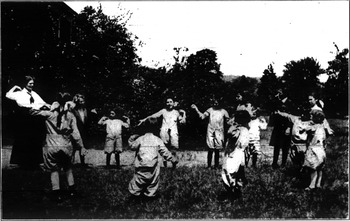
“Romper Girls at North Shore Holiday House.” From Tribune Fresh Air Fund Annual Report, 1914.

“The Physician's Examination.” From Tribune Fresh Air Fund Annual Report, 1905.

Progressive-style campaigns against germs sprang from real fears: one sick child could be the death of an entire host family if the fund was not careful. However, such campaigns also melded medical and cultural reform. The fund's inspections pathologized children's habits and conveyed to them that their parents' and their communities' standards were inadequate. In such a setting, “dirty” became the ultimate insult, hurled from one immigrant child to another.Footnote 92 The inspections also blamed and punished individual families for conditions, such as crowded housing and a lack of plumbing, that were not their fault. With germ theory as their rationale, middle-class groups imposed many changes in habits and practices on immigrants and the poor.Footnote 93
The Fresh Air Fund sent immigrant children messages through its hygiene campaign. The fund also used its camps as vehicles of ethnic assimilation. Nativist sentiment may have run lower at the turn of the century than it had during the 1870s; still, many citizens worried that the United States's cultural coherence would break down in the face of record numbers of immigrants. The threat seemed especially acute in New York, where fully 80 percent of residents were of foreign parentage.Footnote 94 Assimilationist-minded refomers seized on a number of methods—from public schooling to home economics lessons—to spread middle-class, Anglo-American norms to immigrants and their children. Nearly all of these reformers believed they were acting in immigrants' best interests, and they often greatly improved immigrants' quality of life. However, their prescriptive ideas about how to live also sought to keep the era's working class and immigrant groups in check.
During the Progressive Era, fund staff used American rituals to assimilate immigrant children, in keeping with their overall systematized, professionalized approach. In fund camps, children competed in baseball tournaments and raised the flag in morning ceremonies.Footnote 95 The boys at Shepherd Knapp farm began the day with a military drill during World War I, and others planted vegetable gardens to aid the war effort. Fund workers believed that diet, more than any other ritual or practice, would help turn immigrant children into Americans. Counselors reported on the backwards notions children held when they first arrived: “Many do not know the meals by name, as ‘breakfast’ and ‘supper,’” said one.Footnote 96 The Tribune ridiculed immigrant mothers who good-naturedly served their children foods that middle-class Americans deemed unacceptable for children, such as coffee, stews, and organ meats.Footnote 97 The fund also did not accommodate children who required a kosher diet, though organizers did not specify whether this was because a separate kosher diet was too difficult to provide or because it seemed un-American.Footnote 98Tribune articles showcased camp menus full of standard American foods for children: jelly sandwiches, baked beans, beef stew, hot cocoa, and ginger snaps.Footnote 99 Articles voiced satisfaction in winning immigrant children over to American cuisine: “The offspring of the crowded city often utterly refuse to drink the milk, or eat the country delicacies . . . A day or two, however, generally straightens things out.”Footnote 100 Fund volunteers and supporters believed this American food to be healthier than that of other cultures, but they also thought of meals—alongside sports, work, and patriotic exercises—as means to ingrain mainstream American habits and perhaps even beliefs in immigrant charges.
Protestantism still infused the fund's activities in these years but simply as one more means of creating an ordered setting for children and perhaps assimilating them into mainstream culture. Willard Parsons kept traveling to city and country churches to promote the work, and he no doubt still felt a religious duty, as a Christian, to aid urban children. Fund materials continued to quote the Gospels, and directors still trumpeted the uplifting power of Christian households and role models. “It is your privilege,” director John Devins wrote to volunteers, “to take some little lad who never got a right start in life and give him an understanding of Right and Truth.”Footnote 101 Counselors also used religious songs and readings to help order campers' daily routines. At one camp, “when the children troop in to dinner they do not hurry into the seats, but, to the accompaniment of a piano, sing [a] simple grace.”Footnote 102 For children from New York's Catholic and Jewish neighborhoods, these camps may have been the first places where they had to adjust to Protestant culture. Counselors did not expect to convert these children but rather to teach good behavior and to assimilate them in part through Protestant ritual.
The Fresh Air Fund ably adapted itself to Progressive Era reform ideas. In the shift, however, the experience of a fund vacation became more prescriptive and perhaps less appealing to participating children and their parents. For while fund volunteers showed themselves newly committed to the life and health of American cities, they no longer tried to redeem children through contact with the countryside, to integrate them into a larger community, or even to help settle them in a more comfortable, prosperous life. The project, on a grand scale, tried to organize and instruct an urban working class that, left alone, might threaten American mainstream culture and public health. However, it could overlook the individual well-being of immigrants and the poor in its focus on broader civic improvements that mostly benefited the middle and upper classes.Footnote 103 A more orderly world appealed to the middle-class activists themselves, but it may have held less promise for the tenement children whom they tried to reform.
Creating Middle-Class Consumers, World War I to 1926
By the late 1910s, the Fresh Air Fund's progressive model started to seem overly rigid. A new middle-class vision of childhood was changing ideas about child welfare. Children, experts now argued, were born with distinct personalities of their own and were not the moldable, malleable beings whom progressives had imagined. Psychologists popularized the idea of children as complex, strong-willed individuals. Whereas there had been little room for children's individualistic expression in interdependent small towns and rural families, a more capitalist and more urban society started to value personal ambition over obligations to family and community. Middle-class couples tended to have fewer children in these decades, so they had the time and income to notice and encourage children's interests. Consumer culture offered an array of goods to satisfy the unique child. As adults' lives became urban and seemingly more regimented, these adults romanticized the spontaneity and fantasy of childhood.Footnote 104
Fresh Air Fund leaders now described their country vacations, whether in homes or camps, as a means to extend this middle-class model of childhood to New York's poor and working classes. City life, they wrote, was physically, emotionally, and even spiritually limiting. Tenement life boxed children in, fettered them with responsibilities and limits, stunted their lives, limited their dreams. They were “deprived of childhood's birthright, a place and an opportunity for play.”Footnote 105 However, “hearts that squalor and ugliness constrict,” they said, could expand and thrive in the countryside.Footnote 106 “Will you help to put them,” a brochure asked, “where their stunted natures may expand and be unrestrainedly happy for a little while? You will be saving lives, awakening souls, shedding sunlight in gloomy places.”Footnote 107 Vacations allowed children to escape the hardships of their poor families and also escape the anonymity they felt in large public schools and welfare organizations. “When the children pass their vacations as guests in private families,” fund writers explained, “the life of the family circle replaces that of the institution and, for a time, each child attains to the dignity of respected individuality.”Footnote 108 One of the delights of taking in a child, argued the Fresh Air Fund, lay in watching that child's true self emerge in the safety and space of a middle-class home. Fund literature extended the element of childhood fantasy to Fresh Air children, too. Brochures in the 1910s and 20s promised to whisk “little visionaries” away on magic carpets and to help them along a “rainbow bridge” to pots of gold.Footnote 109 In all of these ways, fund spokesmen advocated for poor children's right to playful, carefree, imaginative childhoods.
The best vehicles for giving poor children a taste of this middle-class childhood, insisted the fund's new director, Leslie Marsland Conly, were summer homestays—not camps. Conly evaluated each method in his first year, 1913, and determined that homestays, with their “intimate touch and the good influence of the home circle,” served children best.Footnote 110 The fund's collaborating charity workers confirmed this: There was “a constant and increasing demand from these workers that more and more of their children be given outings with private hosts—because, as they say, ‘such outings mean so much more to the children.’”Footnote 111 Homestays also cost the Fresh Air Fund less than camps, for the space and care for children came from volunteering families rather than from hired staff. Conly decided that the fund would ultimately help more children on its current budget if it expanded the homestay program.Footnote 112
“Food for Thought.” From Tribune Fresh Air Fund Annual Report, 1916.

The fund kept trying to use trips to assimilate immigrant children in the years after World War I, but the rationale and approaches changed. The war and the 1919 Red Scare had thrown suspicion on “hyphenated Americans” who might corrupt American minds with subversive politics or harbor dual loyalties. Integrating immigrants and their children into the American mainstream seemed crucial to keeping the country's political system intact. The fund publicized their country vacations as one means to this end. “A few years,” one fund spokesman reminded readers, “and they will be American voters. Nothing will do so much to Americanize them as the privilege of spending a fortnight in real American homes in the country.”Footnote 113
Even though the Fresh Air Fund's assimilation efforts sprang partly from fear of immigrant culture and politics, the 1920s attitude seemed more generous and optimistic than it had been in the Progressive Era. Because most of the immigrants already present in the United States expected to stay in the country, especially with Europe ravaged after the war, many reformers understood the need to open opportunities to these immigrants and to integrate them into society at large. Because immigrants were no longer arriving in such overwhelming numbers after Congress passed the 1921 and 1924 immigration acts, the assimilation project suddenly seemed more feasible.Footnote 114 The booming, consumer-driven economy of the 1920s spread prosperity through several layers of the American population, and the Northeast's urban economies opened room for both ethnic and class integration. In the 1910s and 20s, too, first- and second-generation immigrants made more visible contributions to American culture than ever before. Movie stars, songwriters, artists, and authors bore eastern- and southern-European surnames and sometimes incorporated influences from their ethnic backgrounds into their work. Native-born Americans adopted elements of immigrant life that had spread through mass culture, from eating spaghetti to listening to klezmer-inflected jazz. A melting-pot version of assimilation seemed less dangerous and more desirable in this era, when immigrants were integrating into, and invigorating, mainstream culture itself.
With their slightly more open attitude toward immigrant cultures, fund leaders tried to integrate poor children through contact with a native-born middle class. The fund changed some of its camps so that children mixed with locals instead of just learning the routines from a few counselors. In one camp where “Fresh-Airs” of many nationalities mixed with New Hampshire boys, a visitor reported, “I could not have believed it possible, had I not seen, that the ‘Melting Pot’ could have done such effective work in so short a time. There was no evidence of any distinction of class, race, financial condition, or anything else.”Footnote 115 It was the simple mixture into native social circles, camp leaders thought, that would most speedily integrate this second immigrant generation.
Fund leaders also positioned Fresh Air vacations as a kind of marketing program for mainstream American life and a way to get poor children to buy into a future for themselves in the broader nation. The fund praised hosts who “proved to the children—a thing that needed to be proved to many of them—that America is not wholly a place of dingy tenement streets.”Footnote 116 “It begins now to dawn upon them, through their Fresh Air travels and their association with their Fresh Air hosts,” narrated another report, “as an American America instead of a foreign quarter in New York vastly spread out.”Footnote 117 These travels would help children recognize the exceptional nature of their own tenement experience and to sell them on the more abundant, bucolic lifestyle that many other Americans enjoyed.
Much of this effort to sell children on a mainstream version of American culture involved seducing them with consumer products found in middle-class homes. In the post-World War I era, fund spokesmen still aimed to teach children a work ethic and good character, but they emphasized material comfort, not character alone, as the ultimate Fresh Air goal. Fund publicity used vague terms like “better ways of living,” “widening of vision,” and “nobler possibilities” to explain this process, but also frankly reported more tangible cases of consumerism. The fund reprinted children's reactions to their hosts' elegant homes. “Oh, you just oughta see the lovely house they had and all the beautiful furniture,” said one participant of her host couple. “Would you believe it, they had a sun porch and a marble bathroom and a lovely kitchen, all white. . . . Oh, I hope my honeymoon'll be in a house like that!”Footnote 118 The girl's excitement over the kitchen and the sun porch, fund writers argued, would translate into higher aspirations and eventual success. “Who will deny that her hope may have something to do with determining the kind of honeymoon hers is to be some years from now?”Footnote 119 A fund vacation, wrote Conly, meant the child “has in his own memory a picture of what may be in his own home when he comes to build one for himself.”Footnote 120 Seeing the things of a middle-class existence gave children a template for their future urban or suburban lives. With such a template in mind, one little girl convinced her mother to whitewash their tenement kitchen as soon as she came back. “We have to do this,” explained the mother to a visiting missionary, “because Yetta's lady in the country has such a nice white kitchen, and nothing satisfies Yetta until we make ours nice and white too.”Footnote 121
Fresh Air Fund leaders declared victory when vacations instilled children with the drive to work their way into the middle class. Beautiful possessions, enviable peers, or an encouraging host might all spark such a drive. The local campers at a New Hampshire Rotary Club caused one Fresh Air child to reflect (as paraphrased by a fund reporter): “They were awful nice fellers, not rough like us, and they don't talk like us. They had awful nice manners. Gee, I'm gonna be like those fellers.”Footnote 122 Another former Fresh Air guest later wrote of her host mother: “I have never once forgotten her doctrine of faith and ambition. . . . Something kept reminding me of what [she] had said, ‘I will—I can.’”Footnote 123 Her rural hosts' words inspired her to become, claimed fund writers, one of the ten highest-paid women executives in 1910s New York. This small taste of a different life, the fund argued, was often all it took to transform a poor child into a middle-class adult.
As this focus on material success and comfort makes clear, the 1920s fund tended to feature fairly well-off families in country towns rather than families running working farms. This shift in emphasis reflected the changing population and wealth of the post-World War I United States. Even if many Americans still valued agrarian traditions, the countryside could no longer claim to be the heart of American cultural or economic life. Between 1880 and 1920, rural areas lost almost two-thirds of their population, and agriculture, employing half the work force in 1880, accounted for less than one-third by 1910.Footnote 124 Though farm incomes rose in the 1920s, they did not keep pace with urban incomes.Footnote 125 In the Northeast especially, it had become more difficult to eke out a living on farming alone, and northeastern towns began to style themselves as bastions of quaint traditions, sponsoring “Old Home Weeks” for city-dwellers with roots in their towns and promoting tourism to their picturesque farms.Footnote 126 Although this demographic shift had been underway since the late nineteenth century, the 1920 census forced the issue into national consciousness, for it confirmed that the majority of Americans now lived in towns or cities, not on farms.
At the same time, urban life looked more livable and more attractive. Technological innovations such as electric lighting, underground sewer systems, elevators, and electric streetcars now served millions of urban residents. Newly affordable middle-class and working-class suburbs eased the crowding of city neighborhoods and made metropolitan life more palatable for families. Jobs in finance, services, and sales seemed to promise easier and more prosperous lives than farms had. Popular culture now often cast life in the city as exciting, energizing, and desirable rather than something to simply endure.Footnote 127
With these new attitudes toward city and country life spreading, the Fresh Air Fund revamped its publicity. It now cast the countryside as neither a redemptive way of life nor a mere setting for instruction, but as a vacation destination. Even though many host families lived in the same small towns as the hosts of previous eras, fund writers of the 1910s and 20s highlighted the natural splendor, not the rural qualities, of children's country surroundings. Now a fund vacation brought “first-hand knowledge of things worth knowing about—knowledge of trees and animals, birds and flowers, stars and wide blue skies.”Footnote 128 Whether children headed to homes or to camps, fund publicity described the trips as transcendent journeys to picturesque vacation spots. “Think of the thousands of others picked up out of the East Side, the West Side, East Harlem, the Gas House District, Red Hook,” fund reporters wrote, “alighting in the land of the sun-silvered Finger Lakes, on the hills that roll their waters down in to the valleys of the Chemung, the Susquehanna, the Hudson, the Connecticut . . . settling gently down to rest and play and live for a fortnight somewhere where there's not a tenement nor a crowd in sight as far as the eye can reach, where the air is fresh and sweet and nothing clouds the glory of the stars at night.”Footnote 129
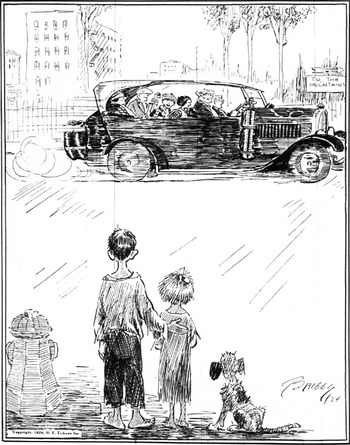
The Fresh Air Fund framed its trips as a way to give poor children exactly the kind of nature experiences that middle-class readers themselves sought and craved. Middle-class vacationers in the 1910s and 20s headed to the wilderness to transcend their everyday lives and discover their true selves. The tourism industry marketed national parks and wildlife reserves as places of escape and fulfillment for urban and suburban travelers.Footnote 130Tribune cartoons for the fund now portrayed poor children who watched as rich folks drove off to their country home or who stared longingly at billboards advertising wilderness vacations. [See Figure 4.]
“Can't you hear Johnnie saying: ‘Gee, never mind, Susie, I betcha the Fresh Air ‘ll take us, too!’” Illustration by Clare Briggs. From Tribune Fresh Air Fund Annual Report, 1924.

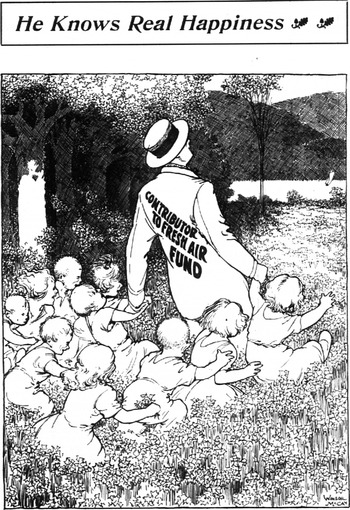
In an era when consumer products and popular entertainments lured Americans to pursue individual fulfillment rather than answer to public duty or a religious calling, the Fresh Air Fund did a remarkable job of keeping its mission current and appealing. It did this by highlighting the benefits and pleasures of charity work for both hosts and donors. Fund writers suggested that visiting children might help hosts recognize blessings they usually took for granted. The Tribune quoted many hosts who exclaimed how delightful their young guests had been—polite, entertaining, filled with wonder. Several said they felt as if their visitors were like their very own children and thanked their guests' parents for loaning them such a treat.Footnote 131 The fund even implied that newspaper readers in New York might find joy and fulfillment by simply donating to the cause. In one drawing a man, labeled as a contributor to the Fresh Air Fund, led children into an idyllic country field. “He Knows Real Happiness,” the title explained. [See Figure 5.] Helping children get to the countryside was not just the right thing to do for God or for community; it was fun.
“He knows real happiness. YOU may know real happiness too.” Illustration by Windsor McKay. From Tribune Fresh Air Fund Annual Report, 1925.

The fund versed New York's charity workers in strict selection and placement criteria designed to ensure the best possible experience for country hosts. Workers did not accept physically or mentally handicapped children because of the undue burden they might cause a host. They never put siblings in different households of the same town, for separated siblings tended to run away to the others' home, and this upset children's hosts. The fund reminded social workers of what country families liked and expected: “The deeper the poverty of the child, the better pleased the average host will be to entertain it.”Footnote 132 Afterwards, fund organizers strongly encouraged families to express their gratitude in thank-you letters to hosts.Footnote 133
The emphasis on the hosts' experience rather than the children's experience may seem odd, but these rules managed to cultivate a strong base of volunteers in an era not especially known for its interest in charity. In the 1870s and 80s, the fund had joined a large coalition of evangelical “child-savers,” and in the Progressive Era it capitalized on notions of public service as a central tenet of middle-class life. In contrast, social reform seemed to taper off in the 1920s.Footnote 134 However, the fund changed with the times: In a consumer-oriented era, it packaged charity as a consumer product by highlighting the benefits it brought to supporters and volunteers.Footnote 135 “Consider that a host who receives a child who meets her specifications, who evidently needs help and who behaves with propriety will be so pleased that she will entertain ‘Fresh Airs’ in succeeding years,” explained a bulletin for social workers selecting children. “The opposite will, of course, be true of the host whose specifications are disregarded, whose guest shows no deep need nor any trace of gratitude in his behavior.”Footnote 136 By creating the best possible experience for hosts and making donors feel good about their contributions, the fund ensured a constant volunteer and donor base in an era less interested in duty or morality and more interested in individual pleasure. The Fresh Air Fund continued to use a similar model to recruit hosts and enlist donors through the twentieth century.
The Fresh Air Fund extended more generous benefits to children in the 1920s than in any previous era. The new child-focused culture prompted volunteers to be genuinely curious about their young guests as individuals. The consumer values that many hosts held and passed on to their guests taught that everyone could aspire to a life of individual fulfillment, material comfort, and upward mobility. The 1920s fund no longer urged poor children to relocate to the countryside, nor did it seek to train them as efficient urban workers. Instead, the group invited poor children to join the class and culture that the volunteers and donors themselves belonged to. In this sense, fund workers spread newly inclusive and even democratic attitudes toward class. Still, even as they adopted more generous attitudes toward participating children, fund directors kept their mission modest. They did not strive to reform the economic and social system that had created child poverty. They simply tried to teach children the ways of middle-class culture, which would help them succeed within the economic and social status quo.
In 1926, the fund's fiftieth anniversary year, the directors articulated one of the program's greatest strengths. “During the years in which the Fund's activities have been increasing in magnitude, the scope of the possibilities inherent in Fresh Air vacations has been unfolding, almost at the same pace,” they explained. “Hardly a year passes which does not add to the list of Fresh Air possibilities its suggestion of something new and valuable.”Footnote 137 The Fresh Air Fund thrived through three different eras of reform (and continued to thrive for over a century) because its mission could accommodate so many hopes and expectations. In its Gilded Age incarnation, the fund offered a way for New Yorkers to sponsor urban children's exposure to a rural community model that to them seemed more harmonious, healthy, and morally sound than city life. In the Progressive Era, it instead aimed to prepare children as well-behaved citizens and workers. By World War I, the fund was attempting to induct children into a newly cohesive urban middle class.
This history of the Fresh Air Fund and its changing agenda reveals how even the seemingly mild project of one child-welfare organization contained an attempt at some serious and even drastic transformations. The fund oriented children away from their immigrant ways, it versed Catholics and Jews in Protestant culture, and it tried to remove stains of vice and sin from children living too long in a city. It removed children from what supporters believed to be the bad influence of their own parents. The sunny messages of the fund inadvertently reveal some of its supporters' social fears and also their prejudices. Viewed through this critical lens, the Fresh Air Fund resembles child welfare efforts that did not last so long, such as orphan trains, settlement houses, and missionary schools. The fund outlasted them all, though, because its mission adapted more easily to each new set of ideas about what was good for children.
The fund's focus on ameliorating—not solving—urban poverty also helps to explain its longevity. Any project that addressed causes of urban poverty would have upset members of New York's middle and upper classes, many of whom rented tenement properties to the poor, employed them at low wages, or bought goods that their cheap labor made possible. Countryside vacations for poor children, though, struck nearly everyone as a humane and worthy cause. In no way did these vacations threaten the economic and political interests of New York's well-to-do.
The Fresh Air Fund's mission appealed to deep-seated beliefs in children's potential, the restorative power of the outdoors, and a child's right to play. This fundamental appeal remained consistent throughout its entire history. Historians of child welfare have amply documented changing trends in reformers' strategies and organizations, whereas synthesis histories of childhood tend to trace continuities in historical attitudes toward children.Footnote 138 The history of the Fresh Air Fund reveals these currents of continuity and change in a constant dialogue. For even as it enacted different welfare programs, the Fresh Air Fund relied on more consensual, enduring notions about what constitutes a happy and healthy childhood.