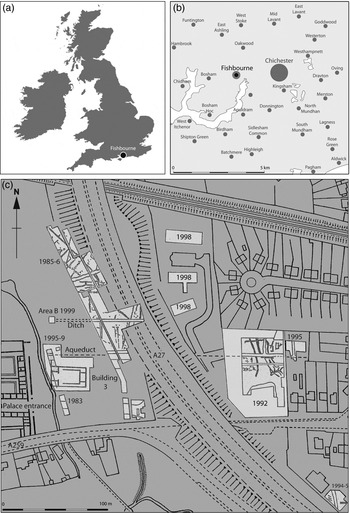
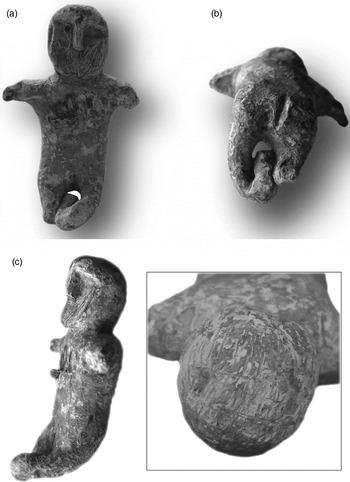
A lead figurine was found in 1992 during work about 200 m to the east of Fishbourne Roman Palace (built during the first century a.d.) on a site excavated by Chichester District Archaeological Unit ahead of housing development ( fig. 4).Footnote 25 The figurine is about 43 mm in height. Except for some limited modern damage to the chest it appears to retain its original form and all four limbs and head are present. However, the end of the right leg, the forearms and hands are missing. The left leg is longer than the right and bent under the body at the knee ( fig. 5a). The forehead is prominent and details of the hair and eyes can be seen, but there is no mouth. There are no indications as to the gender of the figurine, but details on the face could suggest a beard. Its crude appearance suggests that it was roughly made, but a tool with a very thin tip was used to create the detail on the face and the head ( fig. 5c). A broader tool was perhaps used to separate the buttocks ( fig. 5b).
(a) Location of Fishbourne; (b) Location of the Fishbourne Roman Palace; (c) Plan of the excavation of Fishbourne Roman Palace. (a and b drawn by M. Bailliot; c after Manley and Rudkin Reference Manley and Rudkin 2005b , fig. 3)

Lead figurine from Fishbourne Roman Palace: (a) front, (b) back and (c) left side and details of the head. Scale 2:1. (Photos: M. Bailliot; © Fishbourne Roman Palace Museum, Sussex Archaeological Society)

The find is unstratified, having been recovered from the excavation's spoil heap. There can, however, be little doubt that the object is Roman in date. Activity on the site appears to have been overwhelmingly Roman and a published note on the figurine confirms that this was the opinion of the excavators.Footnote 26 Analogy with similar objects found elsewhere only adds weight to this assertion.
While the site is yet to be published in full, KennyFootnote 27 describes the Roman layers as indicating a late second-century area of industrial activity. It is suggested that metalworking on the site would have supplied the nearby Palace with decorative and functional items. During the late second century, the Palace was undergoing a period of major renovation and much of this industrial activity was probably linked to building work at the Palace. The area, located between the nearby city of Noviomagus (Chichester) and Fishbourne Roman Palace, would doubtless have attracted a great deal of traffic, with large numbers of people passing through on the way to conduct business. This is certainly the picture painted by Manley and Rudkin,Footnote 28 who excavated this area in the late 1990s and 2002.
RELIGIOUS ACTIVITIES AT FISHBOURNE PALACE?
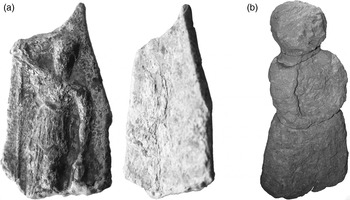
Moreover, Manley and Rudkin go on to suggest that elements of the site may have become centres for ritual activities.Footnote 29 Thus Building 3 ( fig. 4c) has been identified as either a military principia or a religious location.Footnote 30 Cults are well represented in Roman Sussex, not least by discoveries from Chichester and Hayling Island.Footnote 31 There is relatively strong evidence for the presence of rural religious buildings in the area,Footnote 32 and other sites might also support a religious interpretation.Footnote 33 In addition, shrines and ritual pits have been identified.Footnote 34 Some evidence, e.g. shrines and possible lararia, suggests domestic religious practices in a number of villas.Footnote 35 Fishbourne itself has also produced a variety of artefacts with potential religious or ritual interpretations.Footnote 36 They include two phallic amulets (one made from a piece of bone and another in copper alloy); several decorated tintinnabula (bells); a pottery mural crown;Footnote 37 a miniature lead axe;Footnote 38 a thin sheet of folded gold (35 mm wide) recovered in 1999 from the area to the east of the Palace;Footnote 39 remains of stone pine (Pinus pinea) cones from the silting of the Roman canal bed and from a burnt deposit in the Palace itself;Footnote 40 a lead plaque (29 mm high) with a figure of a goddess (24 mm high) holding a patera and maybe a spear or a sceptre,Footnote 41 which could represent Juno or Diana ( fig. 6a).Footnote 42 Further afield, but still within the environs of the Palace, are two other discoveries that suggest ritual practice: a limestone statue of a Celtic mother goddess from Willow Court ( fig. 6b);Footnote 43 and a pipe-clay Venus.Footnote 44
(a) Lead plaque depicting a goddess from Fishbourne Roman Palace; (b) Limestone statue of a Celtic mother goddess from Willow Court. No scale. (Photos: R. Symmons; © Fishbourne Roman Palace Museum, Sussex Archaeological Society)

IDENTIFICATION OF THE FIGURINE: COMPARISONS WITH RITUAL FINDS
Given its form and its archaeological context, it is necessary to consider whether the lead figurine ( fig. 5) was associated with religious activities at Fishbourne Palace. In short, was the figurine a ritual item? Its form certainly suggests a ritual function. At first glance it resembles the small crude dolls (of lead, clay or wax) used for the magic ritual of defixio, which was practised all over the Graeco-Roman world, including Roman Britain. Known as καταδε~ιν (katadein) in Greek and defigere in Latin, it was practised between the fifth century b.c. and the fourth century a.d.Footnote 45 Evidence for this magic ritual appears as binding spells, mainly inscribed on lead sheets which were rolled, folded or sometimes pierced by one or more nails.Footnote 46 Lead tablets have been found with the remains of sacrifices (animal bones, lamps, etc.), see below. They were often placed in a grave, a chamber of an amphitheatre, a sanctuary, a sacred spring or a well (in short in a locus which enabled contact with chthonic deities such as Hermes and Persephone or with the soul of a dead person in order to accomplish an evil deedFootnote 47 ). They can also be found in domestic contexts as at Kempten (south-west Bavaria), where the foundations of a Roman house yielded a second-century a.d. defixio sent to the goddess Muta Tacita,Footnote 48 and in the north-east quarter of Roman Leicester, where two second-century a.d. curses were buried in the courtyard of a Roman town-house.Footnote 49
The ritual of defixio was private and generally performed to ensure victory in a competition (especially races) or in a legal dispute, or to gain another's affections, or to separate lovers.Footnote 50 While magical handbooks (papyri) discovered in Egypt have provided a considerable amount of significant information,Footnote 51 Britain has yielded around 300 lead tablets. About 130 of these come from the temple of Sulis-Minerva at Aquae Sulis (Bath, Somerset),Footnote 52 and a further 80 or so from the temple of Mercury at Uley (Glos.).Footnote 53 Most of the ‘curses’ written on these relate to thefts (clothes, tools, etc.) and are called ‘prayers for justice’. This distinguishes them from defixiones which have a purely evil aim, and are sometimes buried with ‘voodoo dolls’ depicting the victims of the ritual.Footnote 54 It has been suggested that the large number of ‘lead tablets for justice’ from Britain suggests that the Graeco-Roman cursing tradition was adopted by the native population, but in a way that reflected their style of worship of local deities.Footnote 55
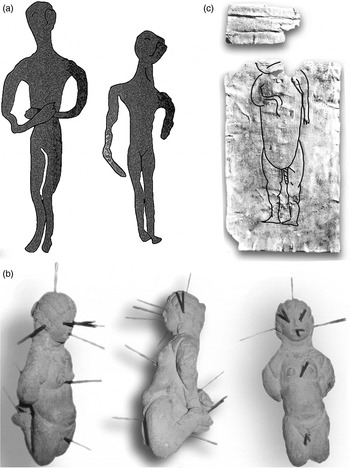
The ritual concerning defixiones included sacrifices and invocations to the deities, and parallels between the artefacts and the texts are sometimes apparent. The piercing of the sheets for example corresponds to defigo, which means in English ‘I nail down’.Footnote 56 The defixio ritual was essentially performative.Footnote 57 Moreover, most of the time the victims of the curses had to suffer and were symbolically sent to hell by the principle of similia similibus as described by Audollent. A fourth-century b.c. Attic defixio illustrates this: ‘Let Pherenikos be bound before Hermes Chthonios and Hekate Chthonia … just as this lead is worthless and cold.’Footnote 58 A third-century a.d. defixio from Carthage written against a charioteer and his horses also provides a good example: ‘… Just as this rooster has been bound by its feet, hands and head, so bind the legs and hands and heart of Victoricus the charioteer of the blue team, for tomorrow; and also bind the horses which he is about to race …’Footnote 59 There are also parallels between ritual dolls and the symbolic injuries mentioned in the texts. As Faraone showed, dolls were sometimes placed in a clay pot or a lead box which evokes a coffin and the Underworld. The body was generally pierced by nails or pins (defigere) or covered with inscriptions.Footnote 60 The arms and the legs could also be bound or twisted behind the back (following the verb καταδέω/katadeo: ‘I bind’) as seen in a Hellenistic bronze figurine from Delos (Greece),Footnote 61 and two Roman lead dolls from Volubilis (Morocco).Footnote 62 Here, the legs are twisted and in one example the hands are crossed over the belly ( fig. 7a).Footnote 63 These figurines often present more than one single morphological criterion.Footnote 64 Some of them were bound and nailed or covered by an inscription and express the ‘hybridization’ between Greek and Latin traditions. One of the most famous parallels that combines a spell with a doll comes from Antinoopolis (Egypt), where a fourth-century a.d. clay female figurine (90 mm tall) ( fig. 7b) was found enclosed in a clay pot with a folded curse tablet.Footnote 65 The doll is shown in a kneeling position, with its hands bound behind its back. It is pierced with 12 bronze nails through the ears, the mouth, the top of the head, the eyes, the hand, the feet, the solar plexus, the anus and the vagina. The correspondence between this doll and a magical papyrus held in the care of the Bibliothèque Nationale de Paris is noteworthy (see Appendix 1).
(a) Two lead magical dolls from Volubilis (Moulay Idriss Zerhoun, Morocco) in the collections of the Archaeological Museum of Rabat. (b) Clay figurine from Antinoopolis (Sheikh Ibada, Egypt). (c) Defixio from Hadrumentum (Sousse, Tunisia) depicting a victim of the spell with a bound arm. No scale. (a. Drawn by M. Bailliot; after Souville Reference Souville 1957 , 180; b. Photo: M. Bailliot; © Louvre Museum; c. After Grenier Reference Grenier 1905 , no. 1)

These magical artefacts are not specific to Greece or Egypt. In 1999/2000, three second-century a.d. ‘voodoo dolls’, shaped from clay, pierced and partially fired, were recovered from the sanctuary of Magna Mater in Mainz, with defixiones (see note 55) which constitute the earliest Latin curse tablets.Footnote 66 Other magical finds — dolls shaped from wax or flour enclosed in lead canisters, lead curse tablets and clay lamps — dating to the third or fourth century a.d. come from the cistern of the temple of Anna Perenna in the Piazza Euclid in Rome.Footnote 67 With the lead tablets they show evidence of a typical eastern style of defixio, such as the use of magical symbols (characteres),Footnote 68 and suggest the existence of professional magicians in the temple who perhaps worked with a magical handbook. Also worthy of note is a third- or fourth-century a.d. clay figurine recovered from the cellar of a Roman building in Reims (Marne, Champagne-Ardennes), with the remains of sacrifices (animal bones and charcoal) and two other similar deposits. It had been pierced and enclosed in a box made from two samian bowls. The upper bowl was covered by seven small flattened balls of a dark paste (or wax), which almost certainly had a ritual function.Footnote 69 Even though the figurine was recovered without any defixio, the bones and the paste indicate ritual activity. The curse may have been written on a biodegradable material (a piece of papyrus or a wax tablet for example), which has not survived. Other such discoveries are known, and the lack of any defixio has sometimes been explained by the loss of biodegradable materials from the archaeological record.Footnote 70
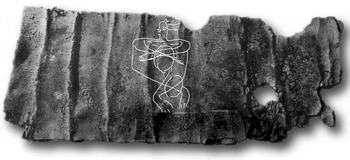
The Fishbourne figurine, being made from lead, is analogous to the dolls from Volubilis ( fig. 7a ). Its elongated and twisted leg is reminiscent of other dolls, as well as the image of a victim with a bound arm engraved on a defixio (aimed against a charioteer) from Hadrumetum (Sousse, Tunisia) ( fig. 7c).Footnote 71 We know that bound and injured victims engraved on defixiones had the same function as tortured figurines.Footnote 72 The defixus (the victim of the spell) on a defixio from Carthage resembles the doll from Delos (mentioned above), with his legs and hands tied ( fig. 8).Footnote 73
Defixio from Carthage (Tunisia) depicting the victim of the spell with his legs and hands tied. No Scale. (Photo: M. Bailliot; © Musée paléochrétien de Carthage)

CONCLUSION
The morphology of the Fishbourne figurine is certainly compatible with it having been used in a religious context. It might be argued, however, that the absence of a religious building or a defixio associated with the artefact undermines such an interpretation. Even though Fishbourne Palace does not provide strong evidence for any religious building devoted to the performance of rites in the presence of a community, some finds suggest at least the occurrence of domestic activities linked to religious beliefs.Footnote 74 Moreover, the movement of goods and ideas through the area would have exposed the local population to Mediterranean religious influences. Some finds recovered from the Palace may indicate a cult devoted to Cybele and Attis.Footnote 75 As discussed above, lead tablets can sometimes be found in domestic buildings and need not necessarily be associated with religious buildings stricto sensu. Footnote 76 As noted above, the absence of defixiones at Fishbourne need not be viewed as necessarily problematic, since these can be made from biodegradable materials. It seems, therefore, that on morphological grounds alone the Fishbourne figurine could be connected to Graeco-Roman magical practices.
APPENDIX 1
Translation of the magical papyrus kept in the Bibliothèque Nationale de Paris:
Wondrous spell for binding a lover: take wax (or clay) from a potter's wheel and make two figures, a male and a female. Make the male in the form of Ares fully armed, holding a sword in his left hand and threatening to plunge it into the right side of her neck. And make her with her arms behind her back and down on her knees. And you are to fasten the magical material on her head or neck. Write on the figure of the woman being attracted as follows: on the head: ‘ISEÊ IAÔ ITHI OUNE BRIDÔ LÔTHION NEBOUTOSOUALÊTH’; on the right ear: ‘OUER MÊCHAN’; on the left ear: ‘LIBABA ÔIMATHOTHO’; on the face: ‘AMOUNABREÔ’; on the right eye: ‘ÔRORMOTHIO AÊTH’; on the other: ‘CHOBOUE’; on the right shoulder: ‘ADETA MEROU’; on the right arm: ‘ENE PSA ENESGAPH’; on the other: ‘MELCHIOU MELCHIEDA’; on the hands: ‘MELCHAMELCHOU AÊL’; on the breast: the name, on her mother's side, of the woman being attracted; on the heart: ‘BALAMIN THÔOUTH’; and below the lower belly: ‘AOBÊS AÔBAR’; on the pudenda: ‘BLICHIANEOI OUÔIA; on the buttocks: ‘PISSADARA’; on the sole of the right foot: ‘ELÔ’; on the sole of the other one: ‘ELÔAIAOE’. And take 13 copper needles and stick 1 in the brain while saying, ‘I'm piercing your brain, NN’; and stick 2 in the ears and 2 in the eyes and 1 in the mouth and 2 in the midriff and 1 in the hands and 2 in the pudenda and 2 in the soles, saying each time, ‘I'm piercing such and such a member of her, NN, so that she may remember no one but me, NN, alone’. And take a lead tablet and write the same spell and recite it. And tie the lead leaf to the figures with thread from the loom after making 365 knots while saying as you have learned, ‘ABRASAX, hold her fast!’ You place it, as the sun is setting, beside the grave of one who died untimely or violently, placing beside it also the seasonal flowers …
(Papyri Graecae Magicae IV, 296–466, trans. Betz 1986, 44–7)
This charm can also be compared with many defixiones which were supposed to silence the tongue of the enemy during a court dispute. For example : ‘… I bind his tongue, his soul and the speech he is practising … I bind, I hide, I bury, I nail down …’ (defixio from the late fourth or third century b.c.Footnote 77 ).