

1. INTRODUCTION
Faroese (FA) and Danish (DA) are closely related languages. They are both part of the group of Scandinavian (or North Germanic) languages (see e.g. Haugen Reference Haugen1976; Harbert Reference Harbert2007). Syntactically, some minor differences exist between FA and DA. Faroese is most often classified as an Insular Scandinavian language (ISc) while Danish is classified as Mainland Scandinavian (MSc), although it might be better to group FA on its own as a ‘Mid-Scandinavian’ language, as it shows both ISc and MSc syntactic properties (Barnes & Weyhe Reference Barnes, Weyhe, König and van der Auwera1994), the latter due to language contact. The term Mid-Scandinavian is meant to indicate that FA is situated geographically as well as linguistically between Icelandic and the Mainland Scandinavian languages.
The purpose of this article is to look into what happens in the syntax of asymmetrical bilinguals when the two languages are closely related. The study is based on FA and DA language contact data from the FADAC database in Hamburg (see Section 2 below). I will use van Coetsem's (Reference van Coetsem2000) notion of Recipient and Source Language agentivity, as it is useful when looking at the current language situation on the Faroe Islands.
According to Hagström (Reference Hagström1984:240), the Faroe Islands today is one of the countries with the most consistent bilingualism, as adults master two official languages, FA and DA, to an extensive degree as both a spoken and a written medium. Faroe Islanders have a high proficiency in DA, but they are asymmetrical bilinguals, with FA being the dominant language. Dominance will be addressed later in this section with reference to Weinreich (Reference Weinreich1953).
The influence of DA on FA is described in Orðafar, which is the newsletter published by the Faroese Language Secretary. Here, they say that:
In spoken Faroese – and also in written Faroese by some – there are a lot of Danish words and idioms which are more or less adapted to Faroese. These are treacherous forms of language corruption, and it is sometimes difficult to watch out for them, as Danish is so firmly established by speakers of Faroese. (Orðafar, No. 2, February 1987)
As the topic of this article is convergence as a general phenomenon in Recipient Language agentivity (here: borrowing from Danish to Faroese) and in Source Language agentivity (here: imposition from Faroese onto Faro-Danish), a few words are needed on these terms, also on agentivity and the agent speaker and the term Faro-Danish (FAR-DAN). By the agent speaker is meant that the same Faroese agent speaker may perform a pull-chain when speaking FA and borrow linguistic material from DA. When the same agent speaker speaks FAR-DAN, which is the special variant of DA used on the Faroe Islands as an L2, s/he performs a push-chain, and imposes linguistic material from FA onto FAR-DAN.
With regard to FAR-DAN it should be noted that it is not standard DA, but rather DA as it is spoken on the Faroe Islands as the most dominant foreign language. The Frame Language is DA, meaning that speakers generally use Danish morphology, the lexicon of Danish, and Danish syntax. Then there are cases, although not many, in which the Faroese speakers use e.g. Faroese morphemes like plural and infinitive, Faroese gender and mixed compounds such as idrætskúlin = [idræt [skúlin]] lit.: ‘sport-school’ = ‘sports school’. In this particular case, the head: -skúlin is Faroese, and idræt- ‘sport’ is Danish (Petersen Reference Petersen2009, Reference Petersen2010). Another characteristic of FAR-DAN is that the agent speakers seem to use an intermediate pronunciation of the mid-vowels, as shown in Petersen & Rakow (Reference Petersen and Rakow2010).
Recipient Language agentivity consists of the borrowing/imitation of DA linguistic material into FA, where DA is the Source Language and FA is the Recipient Language in addition to being the dominant language. Dominance is understood as:
[A] bilingual speaker's relative proficiency in two languages is easily measured . . .one of the languages can hence be designated as dominant by virtue of the speaker's greater proficiency in it. (Weinreich Reference Weinreich1953:75)
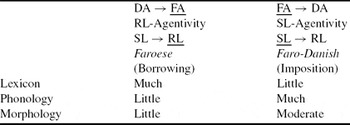
Recipient Language agentivity is formalized as SL → RL (van Coetsem Reference van Coetsem2000:49ff.) and Source Language agentivity is formalized as SL → RL; the underline is used to show which language is dominant.
In Recipient Language agentivity, speakers borrow mainly open-class lexical material, but also modal and discourse particles. We see the adaptation of Danish syntactic constructions to pre-existing structures in Faroese and replication meaning that new constructions do not show an excact copying of the source language constructions (Petersen Reference Petersen2010:165; Reference Petersen2011:110–117). In contrast, very little phonology or morphology is borrowed (Petersen Reference Petersen2010).
In Source Language agentivity (FA → FAR-DAN), the speakers of the Source Language, in our case FA, impose especially their articulatory habits onto FAR-DAN, as well as some morphological endings, but very rarely any FA lexemes. When this is in fact the case, the lexemes are in the form of nonce-borrowings, fulfilling mainly the need to describe culture-specific phenomena such as the nonce–borrowing ræstfisk ‘fish which has developed a typical sharp and pungent taste’, as is described in the Faroese–English dictionary (Skála & Mikkelsen Reference íSkála and Mikkelsen2007). Another way of fulfilling such needs in FAR-DAN (Source Language agentivity) is by code switching, as in hjall ‘storehouse’. Then there are cases of code switching where need is not the driving force, but rather cognates and homophonous diamorphs such as FAR-DAN forsetti ‘continued’ (< DA fortsatte ~ FA. forsetti ‘continued’). Code switching is here understood as in Myers-Scotton (Reference Myers-Scotton2006), where she says (p. 261) that classic code switching contains mainly singly occurring words and embedded islands.
In Recipient Language agentivity (DA → FA), the unstable parts of grammar are transferred, as opposed to the stable parts of grammar, which are transferred in Source Language agentivity (FA → FAR-DAN). The transfer of linguistic material in Recipient Language agentivity and Source Language agentivity is complementary (see Table 1). In the case of syntax, transfer occurs from DA to FA and from FA to FAR-DAN. With regard to syntactic borrowing as such, there are those who believe that syntax might be borrowed between languages (Harris & Campbell Reference Harris and Campbell1995:120ff.). I will not address the question regarding syntactic borrowings specifically, only note that I find cases of syntactic transfer without word order change in my material and also reanalysis or replication. This means that when speakers use e.g. the borrowed de-venitive construction in FA, kemur at + infinitive of main verb = lit.: ‘comes.fut.3sg to.inf-marker’ = ‘is going to’ ~ (DA kommer til at + infinitive of main verb lit.: ‘comes.fut.3sg to.part to.inf-marker’), then this is a case of adaptation (without word order change) to a pre-existing structure in Faroese: fer at + infinitive of main verb lit.: ‘comes.fut.3sg to.inf-marker’ + infinitive of main verb. Note that the DA construction is not borrowed in full, as the particle til ‘to’ is deleted.
Recipient Language (RL) and Source Language (SL) agentivity.

2. METHOD
The data I present come from different sources. Some data come from the FADAC database on Faroese–Danish bilingualism, as part of a project that is presently is in its final phase at the University of Hamburg, and some data come from correspondence with different speakers and searches on the Internet. The C in the abbreviation FADAC stands for ‘corpus’.
The FADAC database consists of interviews in FA and FAR-DAN. There are 30 interviews in FA, which I (native Faroese speaker) conducted in 2005. The informants were equally distributed between the sexes, and came from Vágar (West-Faroese), Tórshavn (the Capital, Mid-Faroese), Eysturoy/Norðoyggjar (East- and North-Faroese), and Suðuroy (South- Faroese). There were 15 informants between the ages of 16–20 years and 15 older than 70 years. The interviews were conducted in informal conversations in which the informants spoke about different things such as the Second World War (the oldest generation), books they had read, children's games, daily matters and so forth.
The FAR-DAN data currently consist of recordings of 24 informants who spoke FAR-DAN with a native Dane, Tine Stensbjerg, in 2006. As she did not understand any FA, the informants had to speak DA to her. The informants came from different parts of the Faroe Islands, men and women between the ages of 16–20 years and older than 70 years. Many of the informants included in the Faroese interviews also participated in the Danish part, but not all, as we were unable to reestablish communication with all of them. Some had left for Denmark to study, others were on holiday and so forth. We also have interviews with the middle generation (age 40–50 years) in FA and FAR-DAN, but as these are still under preparation, I have not included them in this article. I have listened to the recordings, and can only say that the general picture I present in this article will not be altered by the data from the mid-generation; rather, these confirm the findings presented here.
I will make references to Icelandic (IC) as a kind of a ‘control’ language. This means that if a construction is spreading in FA and cannot be found in IC, but is relatively common in DA, I take this to be the result of an external change, especially if it did not exist in the FA prior to the spread.
3. CONVERGENCE TO THE RECEIVING LANGUAGE IN RECIPIENT AND SOURCE LANGUAGE AGENTIVITY
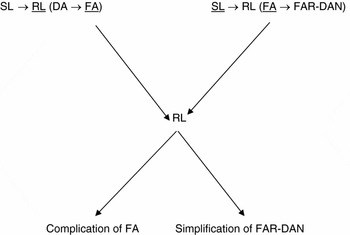
Convergence is always the transfer of linguistic material to a Recipient Language, which is FA in Recipient Language agentivity, and FAR-DAN in Source Language agentivity (see Figure 1).
The outcome of convergence in Recipient Language (RL) and Source Language (SL) agentivity. Underlining shows which language is the dominant language. FA is always the dominant language.

I define convergence as follows, where I stress the process as well as the outcome:
Convergence
The transfer process of the agent speakers’ use of constructions from the Source Language and the surface forms of the receiving language. The result is complication in RL agentivity and reduction/simplification in SL agentivity.
The following examples demonstrate convergence in FA (Recipient Language agentivity) and FAR-DAN (Source Language agentivity).
(1)


The circumposition frá. . .af ‘from. . .off’ in (1a) is borrowed from DA (see (1b)) by Faroese speakers and adapted to FA. Av ‘off’ in (1a) is optional. But as the borrowing of the circumpositions enriches the FA system, so to speak, with a circumposition in addition to prepositions, the result is a complication of FA. Circumpositions are not found in IC, at least they are not mentioned in Thráinsson (Reference Thráinsson2007), nor are they found in Old Norse (ON; Faarlund Reference Faarlund2004). FA is in this specific case more complex than IC and ON, where complexity is understood simply as a system that needs a longer description (Dahl Reference Dahl, Braunmüller and House2009:42). In (1c), a case of Source Language agentivity, the agent speaker makes his communication easier, as s/he simplifies his/her DA by using FA syntax. In this case, the speaker uses a partitive PP af is ‘of ice’, which is ungrammatical in DA, in addition to the absence of an expletive subject, which is marginally acceptable in standard DA, see the standard DA sentence in (1d).
3.1 Deontic and epistemic modality
Deontic and dynamic modality refer to events that have not been realized, events that have not yet taken place but are merely possible, and may therefore be described as ‘event modality’ in terms of Palmer (Reference Palmer2001:70). In FA, deontic modality is expressed with the modal verb at kunna ‘may’; in DA with måtte ‘may’ (Thráinsson & Vikner Reference Thráinsson and Vikner1995, Thráinsson et al. Reference Thráinsson, Páll Petersen, Jacobsen and Hansen2004:306).
With epistemic modality, speakers express their judgments about the factual status of the proposition (Palmer Reference Palmer2001:8). An epistemic modality denoting possibility is expressed in FA with the modal verb at kunna ‘can’ and in DA with at kunne ‘can’ (Thráinsson & Vikner Reference Thráinsson and Vikner1995:55; Thráinsson et al. Reference Thráinsson, Páll Petersen, Jacobsen and Hansen2004:306ff.), but note the difference between the two languages shown in Table 2. That is, in FA kunna is used to express deontic modality ‘may’, and epistemic modality ‘can’, whereas DA has two verbs: matte ‘may’, which is used to express deontic modality, and kunne ‘can’, which is used to express epistemic modality.
The difference between the use of ‘may’ and ‘can’ in FA and DA.

In the example in (2a), the speaker mentions a good-looking woman. The event the speaker refers to has not yet taken place; an event that is merely potential; that is, we are dealing with deontic modality, which is expressed with kunna ‘may’ in FA, with the past tense kundi ‘might’ (as in (2c)). The corresponding DA sentence in (2b) clearly shows that the speaker uses the DA modal system in his FA.
(2)
(2a) is in fact a reanalysis, as the deontic modality can now be expressed both with kunna ‘may’ and mega ‘may’ in FA.
3.2 V-to-I in embedded clauses
V-to-I movement is illustrated in (3). The assumption in the generative literature is that negation marks the left edge of the VP. If the verb follows the AdvP (which includes the negation marker ikki ‘not’), it has not moved out of the VP. It is said that the verb remains in situ. If it is situated in front of the AdvP, it has moved to the head of the IP to check tense and agreement features. In DA, (3b), the verb has not moved out of the VP, while (3c) shows the verb's intermediate position in FA, but with preference for the ‘DA’ structure (Petersen Reference Petersen2000; Thráinsson Reference Thráinsson, Snædal and Sigurðardóttir2000; Heycock, Sorace & Hansen Reference Heycock, Sorace and Hansen2010).
(3)
Heycock et al. (Reference Heycock, Sorace and Hansen2010:17) show that V-to-I follows the DA pattern when the adverb is ikki ‘not’. V-to-I is more readily accepted, however, when the adverb is a high adverb like kanska ‘perhaps’ or ofta ‘often’. The loss of V-to-I is close to completion, they argue, and this corresponds with the findings in Petersen (Reference Petersen2000) and Thráinsson (Reference Thráinsson, Snædal and Sigurðardóttir2000) that V-to-I is ‘in general not preferred by the younger speakers of Faroese’.
The conclusion that Heycock et al. (Reference Heycock, Sorace and Hansen2010:4) reach is that
Faroese is indeed at a very late stage in the process of losing V-to-I, but that there is some evidence for an intermediate system allowing a type of ‘short’ verb movement.
The change is almost complete, but it should be noted that V-to-I is allowed in FA, as the following sentences from FAR-DAN show. In (4), the verb is placed in front of the negation. This is totally ungrammatical in standard DA. The speaker is a member of the younger generation (age 16 years) and he is from Vágar (West Faroese).
(4)
Another FAR-DAN example is in (5), where a young girl speaks about some youngsters she trains in gymnastics; she uses the string verb + adverb, in contrast to DA where the word order is adverb + verb.
(5)
The FAR-DAN data show that V-to-I is not totally lost in FA, but this nearly completed change is accelerated by language contact.
3.3 Future time reference
Future tenses or future time references (FTRs) are a much debated area, as ‘their theoretical status has been the object of considerable controversy’ (Dahl Reference Dahl2000a:309). I will not go into any discussion about future time references here and will only show examples of the borrowing of these constructions into FA, where especially the de-venitive construction is well integrated. A de-venitive construction is where the future is expressed with the verb at koma ‘to come’, e.g. hann kemur at siga tað í morgin lit.: ‘he.n comes to say.inf it tomorrow’ = ‘he is going to say it tomorrow’.
I will follow Dahl (Reference Dahl2000a) in using the term future time references and show which of these have been borrowed by the Faroese speakers. The future time references are all cases of convergence, where linguistic material from DA is adapted to a pre-existing structure in FA, that is to the existing future time reference, which is expressed with fara at lit.: ‘go.fut to.inf-marker’ + infinitive of main verb, see (6) below. In the case of de-andative and de-volitive, there is also adaptation to pre-existing structures, that is skula ‘shall’ + infinitive and vilja ‘will’ + infinitive. De-andative is a case where the future is expressed with the verb skula ‘shall’, and the-volitive is a case where the future is expressed with the verb vilja ‘will’. I will give examples below.
FA usually has the telic verb of movement fara ‘to go, to move’ to express future (Andreasen & Dahl Reference Andreasen and Dahl1997:116). In using a telic verb of movement, FA is similar to most other Germanic languages (Dahl Reference Dahl2000a:351).
(6)
As noted, intentions relating the future are usually expressed in FA with the motion verb fara ‘to go, to move’ + infinitive of the main verb, e.g. Eg fari at keypa bilin lit.: ‘I.n go.ftr to buy.inf car.def.a’ = ‘I am going to buy the car’; see for example Henriksen (Reference Henriksen2000:41) and Thráinsson et al. (Reference Thráinsson, Páll Petersen, Jacobsen and Hansen2004:73); see also (7).
(7)
Prediction-based future time references can be seen in the sentences in (8). Note that (8c–f) can be exchanged with the usual prediction future time reference verb at fara ‘to go, to move’ + infinitive, which shows that we are dealing with FTRs. I will deal more extensively with these constructions in the individual subsections.
(8)
It will be shown below (in Section 3.3.2) that the de-venitive construction is accepted in FA, so that at koma ‘to come’ is grammaticalized and has lost its lexical meaning in this specific construction. The de-andative and de-volitive constructions are more dubious.
3.3.1 De-andative
In the case of de-andative, the future is expressed with the modal verb skula ‘shall’, see (9a) below, where the speaker expresses that s/he is going to Denmark to study for some time. (9a) is interchangeable with (9c), which is the usual way of expressing the future. The sentence in (9a) could be translated with ‘be going to’ in English, and this is labelled as a de-andative construction in Dahl (Reference Dahl2000a:319); note, however, that (9a) can also be translated with ‘will’, expressing volition. That is, the sentence in (9a) can express an event that has not yet taken place, an event that is merely possible. The sentence in (9a) is thus ambiguously located between a pure FA construction expressing dynamic volition (Thráinsson et al. Reference Thráinsson, Páll Petersen, Jacobsen and Hansen2004:306) and a future-reading which builds on DA. Note the DA model sentence (9b) and the IC sentence in (9d). J. G. Jónsson informs me (p.c.) that it is not possible to use skal ‘shall’ in IC in the same way as in FA, that is with a future time reference. Instead, IC uses the simple present tense without an auxiliary or with the auxiliary munu ‘may’.
(9)
In (10), one must imagine that the speaker asks the hearer where s/he is going after seeing him or her coming out of a travel agency. The sentence has an intentional meaning, and would normally be expressed with fara ‘to go, to move’ in FA. The sentence in (10a) is an imitation of the DA sentence in (10b); note the standard FA sentence in (10c).
(10)
In DA, it is possible to have a prediction-based reading as in (11b), but according to my consultants, this is very unlikely in FA. Only two of the consultants said that they thought that the FA sentence in (11a) is grammatical, but added that they would not use it themselves; one said, however, that he thought that ‘the sentence is somehow okay’, while the other added that he preferred fer at regna ‘is going to rain’, where the future is expressed with the usual verb of movement at fara ‘to go, to move’. One informant said that he was in doubt. Skal is totally ruled out as a possibility in IC as shown in (11c).
(11)
Some of my informants said that if the context was altered a little, it would be possible to use skula ‘shall’ to express the future.
(12)
The future time readings show a first step towards a change in the system with regard to how future might be expressed in FA. It is possible that the verb at fara ‘to go, to move’, which is used to express the future, might be replaced by the above-mentioned constructions (de-andative and de-volitive), or the fara- and the skula-constructions will exist side by side for generations.
3.3.2 De-venitive
According to Dahl (Reference Dahl2000a:320), a de-venitive construction provides a way of expressing the future by means of the verb ‘come’.
In Europe, this construction is found in the Mainland Scandinavian languages and in Romansh dialects, and has developed independently in these languages/dialects. Of the Scandinavian languages, de-venitive exists in Danish, Norwegian and Swedish (Dahl Reference Dahl2000b:320). The original construction was as is presented in (13).
(13)
Agent speakers of FA have borrowed the de-venitive construction and adapted it to FA.
The sentences in (14) are taken from the FADAC database. In (14a) the informant speaks about a football player who has been injured, and doubts if this player is ever going to play again. In (14b) the writer tells us what he is going to write on his blog in the future. (14c) is in FAR-DAN. The woman tells about her daughter, who was injured and paralyzed, and that the daughter thought that she would be able to walk again.
(14)
The de-venitive constructions are clearly part of Faroese. The sentences in (14) express future events that are non-controllable (Hilpert Reference Hilpert2008:54), and show that the verb has lost some of its lexical meaning and now functions as an auxiliary, a construction that is grammaticalized in FA.
3.3.3 De-volitive
According to Dahl (Reference Dahl2000a:322), ‘will’ is used as a future time reference marker in English (will), in Danish, in Norwegian Bokmål (vil), Faroese (vil), Frisian (wal) and Yiddish (vel). Note that the verb vilja ‘will’ can only be used in an intention-based reading in FA.
According to Henriksen (Reference Henriksen2000:47), a sentence like (15a) is impossible with a future tense reading. The only possible sentence is (15b), according to Henriksen (ibid.).This is largely confirmed by my five native FA-speaking consultants.
(15)
The most detailed answer to Tað vil regna í morgin? ‘It is going to rain tomorrow?’ came from a woman of around 50 years of age. She said that the sentence is a ‘liberal one with Danish characteristics, where vil is used instead of fer at “going to” to denote the future’. She did not regard the sentence as ungrammatical in this context.
Epistemic modality can be expressed with the modal verb vilja ‘to want’, as in Knøini vildu fara undan henni lit.: ‘knee.the.n wanted go.inf from under her.d’ = ‘The knees tended to give’. Dynamic modality, expressing volition, is also expressed with vilja ‘want’ (Thráinsson et al. Reference Thráinsson, Páll Petersen, Jacobsen and Hansen2004:306). Dynamic modality refers to an event that has not yet occurred; an event that has not yet taken place and that is located outside of the person indicated as the subject (Palmer Reference Palmer2001:70). This is exemplified with the following sentence from the Internet, in which someone talks about not wanting to go to her parents to ask for money. She has not yet put this plan into action, hence it is a case of dynamic modality.
(16)
The following example can have a prediction-based future time reading or it can express epistemic probability, where the speaker presents his judgment of the factual status of the proposition, namely that it is probable that the potted plant will die if it is not watered. But as the sentence is interchangeable with the typical FTRs verb of movement fara + infinitive ‘to go, to move’, (17b), the translation ‘is going to die’, a FTR is also possible. The sentence in (17a) is ambiguous. It can express probability or a future time reference, though not all of the five speakers I consulted could accept (17a) with a future time reading. This only shows that a change is under way in FA as a result of the imitation of a DA structure. Again, we note that IC has simple present tense, something that is possible in FA as well.
(17)
The verb at vilja ‘to want’ has an intention-based reading as in Eg vil doyggja av látri lit.: ‘I.n will die.inf of laughter.d’ = ‘I am going to die of laughter’, while a prediction-based reading, as in Tað vil regna klokkan 12 í morgin lit.: ‘it.n will.ftr rain tomorrow’ = ‘It will/is going to rain tomorrow’ is impossible according to most informants that I consulted, as the sentence ‘does not make any sense’, as one says. Another says that ‘it sounds like a Dane trying to speak Faroese, or a Faroe Islander who has been living in Denmark for a long time’. But one speaker accepts the sentence. He adds, however, that he would not use the sentence himself. He points out that according to older usage, the sentence would not be acceptable in Faroese; however, and this is interesting for our investigation, such a construction is not uncommon in the modern language, probably because of foreign influence.
I also sent out e-mail queries concerning: Útvarpið sigur, at tað vil regna í morgin klokkan 12.00, lit.: ‘radio.the.n says that it.n will.ftr rain in tomorrow.a clock 12.00’ = ‘The radio says that it will rain tomorrow at 12 o'clock’. The reactions were the same as with Tað vil regna . . . etc. ‘It will rain . . .’. One participant said, however, that he was in doubt as to whether the sentence is ungrammatical, but that he would prefer the verb of movement fer at regna ‘will rain’. Another informant says that he thinks that the sentence is grammatical, but that he would not use it himself.
3.3.4 Summarizing future time references in Faroese
In structural terms, there is nothing new in having a verb + infinitive marker + infinitive of main verb construction in FA. DA de-venitive constructions can therefore be easily included into and adapted to FA syntax, with or without the particle til ‘to’. This is a new way of expressing the future and as such, we are dealing with the result of convergence. I have also shown how a construction without the particle is imposed onto FAR-DAN. With regard to the de-andative and de-volitive constructions, speakers are very reluctant to accept prediction-based readings; still, some do not find them to be totally ungrammatical, and I suspect that a grammaticalization process is taking place in precisely these constructions.
3.3.5 Possessive constructions
There are two possibilities in FA with regard to the string possessive + head and head + possessive in e.g. iPodur mín and mín iPodur ‘my iPod’. Note that possessive + head is the most common construction in spoken FA, as illustrated in (18), from colloquial FA.
(18)
Dahl (Reference Dahl1908:105) says that the genitive follows the noun, a view that is reiterated in Hammershaimb (1854:315) and Lockwood (Reference Lockwood1977:116); the latter says that ‘the normal position of the possessive adjective is after the noun it qualifies: skúli mín “my school”’. Lockwood's view is repeated in Barnes & Weyhe (Reference Barnes, Weyhe, König and van der Auwera1994:208). The topic is more carefully investigated in Barnes (Reference Barnes, Johansen, Hansen, Jacobsen and Marnersdóttir2002:65), and his conclusion is that both word orders are allowed; he refers to Hamre (Reference Hamre1961:244–245), who performed a corpus-based study on the matter for a selection of twentieth-century prose texts and showed that ‘the possessive preceded the noun in 62% of cases where the possessive was the sole modifier (the type mín skúli “my school”), in 92% where the noun otherwise was modified (the type sínar seinastu dagar “their last days”)’ Barnes Reference Barnes, Johansen, Hansen, Jacobsen and Marnersdóttir2002:59). Hamre (Reference Hamre1961:244–245) further states that ‘the high percentage of preceding possessives, . . . 62%, clearly indicates that this position is preferred in the written language, no doubt as a result of DA influence’; this means that (19a) is ‘Danish’, while (19b) is ‘Faroese’ (see also Barnes Reference Barnes, Johansen, Hansen, Jacobsen and Marnersdóttir2002:60).
(19)
Previous corpus-based studies on the word order of such constructions have been done for written FA, most often for prose texts. These, however, do not provide an accurate picture of the situation in colloquial language due to the often strong revision of written texts as a result of the purist movement's language cleansing.
I will illustrate the word order in possessive constructions using data from FADAC. This gives us a picture of the distribution different from that of previous studies, with my data strongly reflecting colloquial speech, as is also the case in the sentence in (19a).
Typical examples of possessive constructions in spoken FA are given in (20), in which the possessive follows the kinship noun (20a); (20b) is a case of a possessive pronoun tín ‘your’ and the clitic -sa, which expresses possession. The typical word order in spoken FA with animate and inanimate nouns is given in (20c–e), where the possessive pronoun precedes the noun. I have also included (20f), as this sentence, from the FADAC database, nicely illustrates the distribution in modern FA of kinship term + possessive; elsewhere, the order is possessive + noun, which is the unmarked word order. Another way of expressing the possessive is with the preposition hjá ‘with’, as in (20g–i); see also (Lockwood Reference Lockwood1977:105–105; Barnes Reference Barnes, Johansen, Hansen, Jacobsen and Marnersdóttir2002:60; Thráinsson et al. Reference Thráinsson, Páll Petersen, Jacobsen and Hansen2004:118; Petersen & Adams Reference Petersen and Adams2009:262).
(20)
Written FA has a preference for possessive + head, according to Hamre (Reference Hamre1961), or a fifty–fifty distribution of possessive + head or head + possessive, according to Barnes (Reference Barnes, Johansen, Hansen, Jacobsen and Marnersdóttir2002), where he says that the word order noun + possessive is the rule for kinship nouns: here pápi mín ‘my father’.
Harris & Campbell (Reference Harris and Campbell1995:328) point out that there are two conflicting forces in all language changes:
[T]he new general pattern is a force towards a change; the conventional form is a force towards the status quo. While the former is stronger in most contexts and generally wins out, the latter is strong in the syntax governed by frequently occurring words or expressions, in kinship terms and sacred terms, and in fixed expressions.
Kinship terms may fail to undergo a regular change and therefore constitute an exception. They are conventional forms and encourage the use of the older constructions. This explains why kinship noun + possessive pronoun as in pápi mín ‘my father’ is the rule in FA. For the sake of curiosity, I can mention the change Harris & Campbell (Reference Harris and Campbell1995:329) refer to between Old and Modern Georgian, where the latter has the possessor preceding the possessed in unmarked order, while in Old Georgian possessors regularly follow the possessed noun: Old Georgian moc'ape-ni mis-ni lit.: ‘disciples.n.pl his.n.pl’, Old Georgian mam-sa šen-sa lit.: ‘father-d your-d’ = ‘your father’, and Mod. Georgian misi t'anisamosi ‘his clothing’, but with the old word order in a few kinship terms, such as mama-čemi lit.: ‘father-my’ = ‘my father’.
This is exactly the situation in modern spoken FA, where the unmarked word order is now possessive + head, as I will show later.
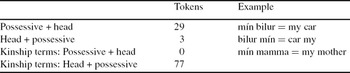
I counted all of the cases of possessive pronouns produced by the oldest and the youngest generation in the FADAC database as well as the hjá constructions. I counted only the cases where possessive + noun or noun + possessive were interchangeable (see Table 3).
The distribution of the head + modifier and modifier + head in the FADAC database.

The results speak for themselves. Spoken FA has the word order possessive + head with some relics of the older word order head + possessive. When the head noun is a kinship term, the word order is head + possessive, as expected. When I say ‘as expected’, this is because according to Harris & Campbell (Reference Harris and Campbell1995:328), kinship terms often preserve older word order patterns.
What is, then, the origin of the possessive + head construction? Hamre (Reference Hamre1961) points to the DA influence, which is a good candidate, but this is questioned in Barnes (Reference Barnes, Johansen, Hansen, Jacobsen and Marnersdóttir2002), who writes:
[W]hile increasing use of possessive + noun may reflect Danish influence, it is worth remembering that this order is not an exclusively Danish phenomenon. It goes back to at least Old Scandinavian, and occurs commonly enough in Faroese ballads. If it could become the norm in Danish, why should not the same happen independently in Faroese? (Barnes2002:62)
Given the long time that bilingualism has existed on the Faroe Islands, the relatively positive attitude towards Danish, the huge corpus of written Danish texts used on the islands simply in order to manage daily life (for details see e.g. Petersen Reference Petersen2010: 35ff.), the relatively weak purist tradition, and the fact that the Faroese speech community is a relatively open society when it comes to borrowing linguistic material, I do not think that it is possible to rule out Danish influence in the possessive construction. One cannot completely exclude DA influence only because the phenomenon modifier + head construction was present in Old Scandinavian. It is not historically realistic to assume that a contact-induced change is not potentially responsible for these changes, even though there is a pre-existing structure in the language.
3.3.6 Circumpositions
Circumpositions were not originally found in FA, and they are said to be ‘un-Faroese’, meaning ‘bad FA’ (Orðafar, No. 8, December 1987). They are not included in the grammars of FA, except for that of Petersen & Adams (Reference Petersen2009:211–212), which mentions examples like (21a) (compare the DA model sentence in (21b)). An example from the FADAC database (21c) is also included here. All in all, I found six types and tokens with circumpositions in the FADAC database.
(21)
Circumpositions are not found in IC; at least they are not mentioned in Thráinsson (Reference Thráinsson2007), with the same holding for ON (Faarlund Reference Faarlund2004). It is argued that circumpositions exist in English, as seen in Decisions were communicated from the top down, in Dutch in De fles begon haar reis onder de brug door ‘The bottle started its trip under the bridge through’ (Rooryck Reference Rooryck and Thráinsson1996:243), and German in unterder Brücke durch ‘under the bridge through’ (Rooryck Reference Rooryck and Thráinsson1996:228). It is possible, even reasonable, to assume that they are borrowed from German into Danish, and they are definitely borrowed from Danish into Faroese.
In the transfer of linguistic material, it is not always the case that speakers copy the Source Language material, as illustrated with (21a). The sentence does not make any sense semantically, meaning ‘go from hell to’. The agent speakers have identified the DA construction ad. . .til and have chosen a FA preposition that is close to DA ad in pronunciation, this being the preposition av ‘from’. The speaker has avoided using the cognate FA preposition at ‘to’, which is found in e.g. leggja at landi (lit.: ‘lay at land’ = ‘to put a ship in’), as direction is generally expressed with móti ‘to; against’ in the colloquial language. This móti ‘to; against’ is gradually replacing at ‘to’ due to contact with DA, mod ‘to; against’. Thus, speakers would not usually say Kom ikki at málingini! lit.: ‘come not at painting.def.d’ = ‘Do not touch the painting!’ in colloquial or informal speech, as is indicated in the Faroese dictionary (Poulsen et al. Reference Poulsen, Johansen, Hansen, Jacobsen and Simonsen1998), but rather Kom ikki móti málingini! lit.: ‘come not against painting.def.d’.
In order to avoid the preposition at ‘to’ in the borrowed circumposition, the speaker has imitated DA ad ‘to’ with the phonetically closest preposition, av ‘from’, and borrowed the whole chunk ad. . .til and replaced it with av. . .til, even though it does not make sense. As the DA construction makes sense, however, and people are bilingual with simultaneous online access, the phrase functions and fulfills the communicative needs of the speakers.Footnote 1 As such, it is a clear illustration of replication (Heine & Kuteva Reference Heine and Tania2005:92), which can also be seen in the following FAR-DAN example from a woman of the youngest generation, who says:
(22)
It is the English from scratch that underlies fra skrot. The standard DA sentence is fra begyndelsen ‘from the beginning’, and skrot ‘scrap’ cannot be used in DA in an expression such as that in (22). English scratch is transferred to the almost homophonous DA word skrot, and the borrowed circumposition frá . . . av ‘from . . . of’ is then imposed onto FAR-DAN, yielding (22).
3.3.7 More examples from SL agentivity
In the preceding section, the main focus has been on FA, although I have also shown parallel examples in FAR-DAN, like that involving the use of the circumposition just mentioned in (22). In this section, I present the reader with more examples of convergence from FAR-DAN, all of which show how the Faroeses agent speaker simplifies his L2 by using Faroese constructions.
The first example is of a long-distance anaphora. In the FAR-DAN sentence (23a) the reflexive pronoun at the end of the sentence refers back to the subject of the main clause mennesker ‘people’, something that is possible in FA, see (23b) and IC, but not in the MSc languages, see (23c). For more on reflexives in FA, see Barnes (Reference Barnes1986).
(23)
Faroese, Norwegian and Swedish dialects in Jämtland exhibit supine attraction or supine spreading, in which an infinitive changes to a supine as the result of the supine in the preceding main verb (Sandøy Reference Sandøy1991). I have only two examples with supine-attraction in the FADAC database, of which one is presented below.
(24)
The final example is more complex, so to speak. Here, the agent speaker uses two FA verbal frames, verb + particle koma fyri lit.: ‘come fore’ = ‘occur, happen’; and henda seg lit.: ‘happen SELF’ = ‘occur, happen’. This again illustrates nicely how the Faroese agent speaker simplifies his FAR-DAN by combining two into one:
(25)
The FAR-DAN construction kommer for sig ‘It happens’ requires more space than the proper FA examples and the DA example; still, we have simplification in the sense that the speaker conflates two verbal frames into one, thus making her online processing easier.
4. CONCLUSION
The processes discussed in this article are (i) borrowing in Recipient Language agentivity and (ii) imposition in SL agentivity, meaning that the same Faroese speaker borrows linguistic material from DA, while imposing FA linguistic material onto his/her variant of DA, which I call FAR-DAN here.
When looking at convergence, the result is twofold, as the data show. In Recipient Language agentivity, constructions are adapted to pre-existing structures in FA where possible, resulting in the feature [+native]. In the cases under discussion, the result of the borrowing process is a complication of the Faroese syntactic system, where ‘complex’ simply means that it takes longer to describe something. When the same Faroese agent speaker speaks FAR-DAN, s/he simplifies his/her syntactic possessing and uses Faroese syntax, as when the verb is placed in front of the negation. Simplification is then to be understood from the point of view of the same agent speaker. Note that this does not mean that FAR-DAN in general is a simplified form of DA or anything similar. It is only in these specific cases of convergence that simplification occurs.
ACKNOWLEDGEMENTS
I would like to thank three anonymous reviewers and Sten Vikner for comments on earlier version of this article, as well as Audrey MacDougall for proofreading my English and the informants for their participation in the study.