The Late Mesolithic is a period of considerable interest, incorporating the transition from a hunting and gathering to a farming way of life. Human remains dating to the period as a whole are very rare in Britain, and, contrary to what might be expected, this is particularly the case for the Late Mesolithic.Footnote 1 The latest known directly dated human remains are those from Oronsay on the west coast of Scotland, spanning the centuries around 4000 cal bc that mark the transition between the Mesolithic and the Neolithic.Footnote 2 Although over a millennium earlier, the next are isolated human elements recovered from Paviland Cave and Foxhole Cave, both on the Gower peninsula, south Wales,Footnote 3 indeed the sites are within a few hundred metres of one another. Other Mesolithic human remains on Gower – again scattered and fragmentary – come from Worm's Head and Mewslade, but these belong to the earlier Mesolithic.Footnote 4
While such partial and out-of-context finds do not provide anywhere near the information that can be gained from a complete skeleton, especially one recovered from a funerary context, the potential of even fragmentary remains is considerable. Once directly dated, they can offer important palaeodietary insights through the application of stable carbon (δ13C) and nitrogen (δ15N) isotope analysis, relating not only to the Mesolithic–Neolithic transition, but also to the investigation of spatial and temporal variation within the diets of both Mesolithic and Neolithic populations. When teeth are present, as they are at Foxhole, their enamel can provide the reliable strontium and oxygen isotope values that are increasingly being employed to address questions of human mobility relevant to both hunter-gatherer and early farmer contexts.Footnote 5 Finally, advances in the field of ancient DNA studies are providing new analytical possibilities for the investigation of population histories at the genetic level.Footnote 6 While further research at Foxhole is planned to take advantage of these last two developments, the present study focuses on AMS 14C dating and δ13C and δ15N analysis.
The previously published δ13C and δ15N results on Mesolithic human remains from Paviland and Foxhole are surprising in that they suggest little use of marine protein,Footnote 7 an unusual finding for communities living near the coast in this period.Footnote 8 Results on earlier Mesolithic human remains from Worm's Head and Mewslade similarly indicate minimal use of marine resources,Footnote 9 but this is less unexpected, as the sea would have been a greater distance away at the time, making these essentially inland sites.Footnote 10 This is in stark contrast to Caldey Island, Pembrokeshire, where a series of human remains with dates intermediate between those from Worm's Head/Mewslade and those from Foxhole/Paviland has been identified.Footnote 11 The associated stable isotope measurements show that the humans from Caldey had a diet in which marine foods played a prominent role, while thus far the Gower humans – including the two directly dated to the Late Mesolithic (when the coast would be near its present position) – indicate a diet with minimal input from marine foods.Footnote 12
As Caldey Island and Gower are only some 30km apart, the suggestion that people buried there seem to have had quite distinct diets was rather surprising. It is important to emphasise at this juncture that stable isotope measurements on bone collagen reflect long-term, averaged diets (albeit biased towards sources of dietary protein),Footnote 13 so that the observed difference implies the presence of two separate human groups rather than, for example, the same group using the sites in different seasons. The investigation of this intriguing difference was one of the major goals of the current project, aimed at recovering more Late Mesolithic human remains from Foxhole Cave. Furthermore, it was hoped that additional earlier Neolithic human remains might also be found, in order to further our understanding of subsistence change across the Mesolithic–Neolithic transition. While the nature of the transition is still debated,Footnote 14 on present evidence it appears to have been relatively sudden and more or less complete,Footnote 15 though Late Mesolithic Gower seems again to provide a notable exception to the otherwise consistent pattern of coastal sites showing significant use of marine dietary resources.
Another factor that makes Foxhole, along with other cave sites in south Wales, of particular interest is that the earlier Neolithic human remains from cave contexts (identified entirely through AMS 14C dating, as there are no reliable artefactual or other contextual associations) provide a counterpoint to those from chambered tombs, in this case specifically the Cotswold–Severn example at Parc le Breos Cwm, Gower.Footnote 16 This allows an exploration of the question of whether or not those buried in caves in the earlier Neolithic had isotopically similar diets to those buried in monuments. Preliminary indications are that there may indeed be a subtle difference between the two burial contexts, though this requires further investigation and confirmation.Footnote 17 Related to this is the question of whether or not caves saw any continuity in their use for burial between the Late Mesolithic and Early Neolithic.
Thus new excavations at Foxhole, in conjunction with a wider ongoing investigation of other sites across south Wales, have the potential to inform us on a number of key issues in the mid-Holocene prehistory of Britain.
The site
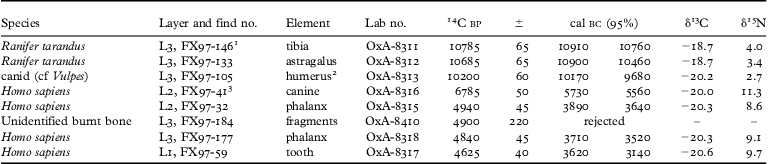
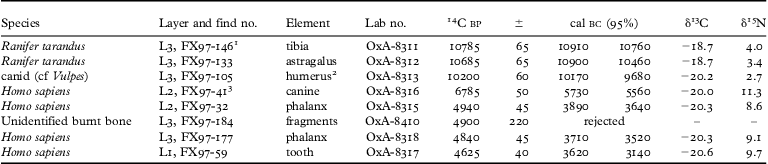
Foxhole Cave is located on the south coast of Gower, south Wales (Figs 1 and 2), at c 40m OD on the side of a dry valley leading down to Paviland, famous for the Middle Upper Palaeolithic male burial known as the ‘Red Lady’.Footnote 18 The cave has two parts: an outer and an inner. The former measures some 6m across and 3m high at the entrance – its widest and highest points – and some 4m deep. The inner cave is a long, narrow, tunnel-like extension at floor level at the rear of the outer cave, c 1.2m wide and 0.8m high, and mapped for some 20m during an earlier survey.Footnote 19 The site was first described in the literature by Melvyn Davies in his 1993 archaeological assessment of the caves of the south Gower coast.Footnote 20 Davies, who knew the area well, could find no record of previous excavations, and commented on the site's archaeological potential. Taking this lead, a small test excavation was undertaken by Stephen Aldhouse-Green in 1997 as part of his Paviland project.Footnote 21 The results of this initial investigation confirmed the potential of Foxhole Cave: while limited in quantity, the small number of finds included Early Mesolithic ‘broad blade’ microlith fragments,Footnote 22 Late Glacial fauna and a small quantity of human remains. Direct AMS 14C dating of the latter indicated the presence of Late Mesolithic and earlier Neolithic humans (Table 1), and it is this that makes the site of some importance in the context of Britain and, indeed, of north-west Europe.
Map of south Wales showing sites mentioned in the text. Drawing: R Schulting

View to west towards Foxhole Cave. The headland to the left is the location of Goat's Hole, Paviland. Photograph: R Schulting
AMS 14C dates and stable isotope values previously reported on human and animal bone collagen from 1997 excavations at Foxhole Cave (data from Pettitt Reference Pettitt2000 and Richards 2000; recalibrated using CALIB 5.0)
Notes
1‘97’ has been added to the ‘FX’ designation originally reported in order to distinguish these finds from those in subsequent seasons (ie, FX08 and FX10).
2The originally published identification of FX97-105 as an arctic hare (Lepus arcticus) radius is clearly in error, presumably due to a mix-up in labels. The specimen with this number – which does exhibit a fresh cut surface suggesting it was dated – has been re-identified by Richard Madgwick as a canid humerus. However, its δ15N value would be unusually low for a dog or fox, and it may be that another bone (ie, an arctic hare radius) was actually submitted for dating. Given the mix-up in finds numbers this is not possible to confirm. This and other issues with the 1997 archive (see note to Table 2) are being investigated.
3As discussed further below (see Fig 8), the results for this specimen are problematic.
The excavations
In 1997, a single trench (2.5 × 1.5m) was placed across the middle of the entrance by Stephen Aldhouse-Green, bisecting the outer cave's dripline,Footnote 23 and was taken to a maximum depth of 0.85m without reaching bedrock. A major aim – successfully achieved – of our 2008 season (TT1 and 2) was to locate and re-excavate the 1997 trench in order to take that unit deeper, and to use its known stratigraphy as the basis from which to extend the trench. In 2010, excavation was taken further into the front of the narrow opening of the inner cave (TT3 and 4) (Fig 3).
The deposits were found to be heavily disturbed for the first metre or more, with abundant modern fauna (rabbit, sheep) and rubbish (nails, glass, plastics). Beneath this no definite modern material was identified, though the deposits were often still heavily disturbed, primarily by a large, ancient badger set running alongside the north wall of the cave, also encountered in the 1997 excavations. The nature of the sediments – heavy clay strewn with many boulders resulting from rock fall from the roof of the outer cave – made excavation very difficult (Fig 4). Nevertheless, by the end of the 2010 season the depth of 0.85m in the original 1997 excavation had been extended to a maximum depth of c 2m in parts of the trench without reaching bedrock, while the trench itself was extended to the mouth of the inner cave (Figs 3 and 5). This makes it clear that, prior to the rockfall and other infill currently blocking access to the inner cave, Foxhole would have presented a much larger and roomier cave than is apparent at present.
Plan of test trenches at the end of the 2008 and 2010 seasons at Foxhole Cave. The large boulder extending across much of the base of TT4 is not bedrock. Drawing: R McLaughlin
The north-west section of TT4 at the end of the 2010 excavations. Note the change in colour just below the line of boulders on which the trowel (pointing north) rests, marking the apparent division between the disturbed upper Holocene levels and the lower, less disturbed, Early Holocene/Late Pleistocene levels. The hole to the right is an old badger set. Photograph: R Schulting
The north-west section of TT4 at the end of the 2010 excavations. The column sample ‘C’ was taken for soil micromorphological analysis. The locations of two optically stimulated luminescence (OSL) samples are also shown. Circled numbers refer to samples taken for the recovery of microfauna. Drawing: R McLaughlin
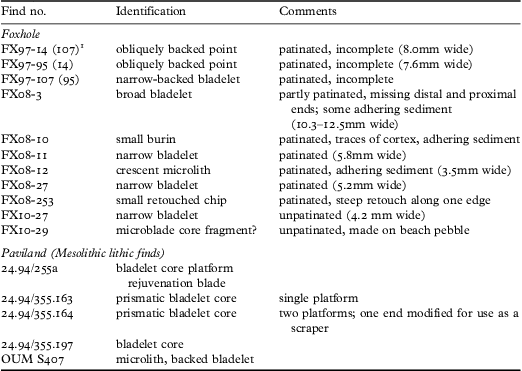
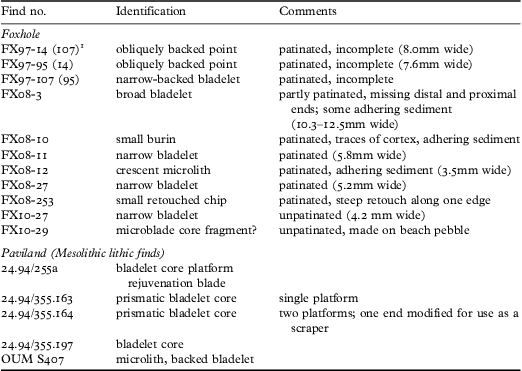
As was the case with the 1997 investigation, the 2008 and 2010 excavations yielded only a small number of artefacts, comprising a total of sixteen pieces of struck flint, all from the disturbed upper levels of the site (Fig 6). For diagnostic purposes, the most important of these are a small Late Mesolithic crescent microlith (FX08-12) and two narrow bladelets (FX08-11 and FX10-27), as well as a longer, broader bladelet (FX08-3) that may add to the Early Mesolithic presence suggested by the 1997 excavation. A small flint fragment bearing steep retouch, a small burin (FX08-10) and a possible small microblade core fragment (FX10-29) were the only other retouched pieces (Table 2). The 1997 excavation produced sixteen struck flints, again of a Mesolithic character. Two (FX97-14 and FX97-95) are fragments of obliquely backed points. Measuring 8mm and 7.6mm wide respectively, they straddle the 8mm divisionFootnote 24 between broad- and narrow-blade microliths. Although usually taken to be diagnostic of the Early Mesolithic, obliquely backed points themselves are present in both the Early and Late Mesolithic in Wales.Footnote 25 FX97-107 is a fragment of a narrow backed bladelet, and would be more in keeping with the Late Mesolithic. Thus the evidence for an Early Mesolithic component in the small lithic assemblage, while certainly possible, is somewhat ambiguous, while a Late Mesolithic element is more clearly seen. The small number of Mesolithic flints reported from nearby Goat's Hole, Paviland,Footnote 26 have been re-examined for this paper and are also of Late Mesolithic character.
Selection of struck flints recovered from Foxhole: FX08-10, burin; FX08-11, bladelet; FX08-12, crescent microlith. Photograph: I Cartwright
Foxhole and Paviland lithics (retouched and diagnostic pieces only; all are of flint)
Note
1These are the current finds numbers for these lithics, which differ in their order from those published in Aldhouse-Green (2000b, fig 1.18), given in brackets, again highlighting problems in the archive.
The small number of lithics and the high proportion of blades and retouched pieces relative to debitage are similar to the assemblage from Worm's Head Cave.Footnote 27 In the latter case, however, this could be explained by the loss of nearly all of the sediments at the cave entrance as a result of scouring by wind and sea and by antiquarian excavations, which were unlikely to recover evidence of a microlithic industry. Neither of these considerations apply at Foxhole, which suggests that the site was never used for long-term occupation. Its size and location may be more commensurate with periodic use as a short-term camp, perhaps for shelter during trips to the more exposed nearby coastal plain and to the coast itself. A concentrated area of burnt limestone suggests a possible hearth, though subsequent disturbance and rock fall make its form uncertainFootnote 28 and it lacks dating evidence. Alternatively, given the number of humans represented by the bone, albeit each by only a very few fragments, the site's primary focus may have been for burial in both the Late Mesolithic and the earlier Neolithic. Notably, no pre-modern pottery has been recovered, despite the presence of earlier Neolithic, Romano-British and medieval human remains identified in the AMS dating programme. It is interesting that the much larger Goat's Hole, Paviland, just a few hundred metres away, again provided only a very small number of flints attributable to the Mesolithic,Footnote 29 in addition to a human humerus directly dated to this period. This suggests that size was not necessarily the only factor in the limited use of Foxhole for occupation.
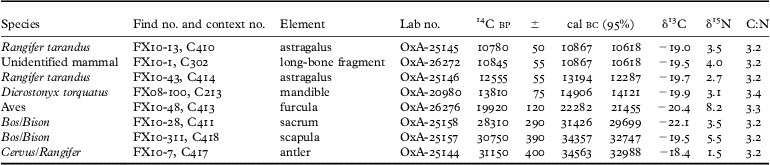
The faunal assemblage at Foxhole is dominated by modern sheep and rabbit, with fox and badger also present, probably including both modern and ancient material. Finds from the deeper levels of the 2010 season include red deer (Cervus elaphus) and reindeer (Rangifer tarandus; also noted in the 1997 excavation) and aurochs or bison (Bos/Bison). There is a considerable amount of microfauna, but given the disturbed nature of the Holocene sediments the detailed analysis of this material is unlikely to be worthwhile. The exceptions to this are the remains from the small samples taken from a wedge of well-consolidated Late Glacial sediments identified in 2008 and from the lowermost deposits of the 2010 season. Analysis of the microfauna from the former yielded an assemblage comprising c 850 rodent teeth and jaw fragments (as well as numerous but less diagnostic limb bones and fragments), including those of the collared lemming (Dicrostonyx torquatus), a mandible of which provided an AMS determination of 13,810 ± 75 bp (OxA-20980, 14,900–14,120 cal bc). Analysis of the larger microfaunal assemblage from the lower deposits of the 2010 season – again including collared lemming – suggests glacial conditions, which is contradicted neither by the large mammal remains nor by the radiocarbon dating programme discussed below. Furthermore, soil micromorphology of a column sample (marked ‘C’ on Fig 5) taken from a pocket of laminated silts from the lowermost levels shows features consistent with ice lensing.
The human remains
The limited number of human remains is not unusual considering that only a small area was excavated. What is surprising is the fact that they represent such a large number of individuals relative to the number of skeletal elements recovered. The three molars found belong to three separate individuals, as they exhibit very different stages of wear, with an unworn first molar representing a child of approximately six years of age, a moderately worn third molar representing a middle-aged adult and a highly worn second molar representing an older adult (this is confirmed by direct dating, discussed below). In addition to the molars, two adult vertebrae, an adult metatarsal fragment, an adult cranial fragment, two cuboids (ankle bones) and the unfused proximal epiphysis of a child's tibia were found. All exhibit reasonably well-preserved surfaces, with no signs of subaerial weathering or animal gnawing. The metatarsal and cranial fragments are particularly interesting as they exhibit a dark staining of geochemical origin (ie, manganese oxides) that may be an indication of greater age (see below). Given the range of cranial and postcranial elements represented, there is no indication of any special cultural selection of particular bones (such as crania or long bones) for deposition in the cave. Indeed, it is noteworthy that all the bones found are either small, or are fragments of larger elements, suggesting that at least some could derive (through animal burrowing) from more intact burials yet to be discovered, perhaps further into the cave. Alternatively, it is possible that scavengers brought some of the human remains to the cave, though, as noted above, there is no evidence for carnivore gnawing and the element selection would be odd.
AMS dating and stable isotope results
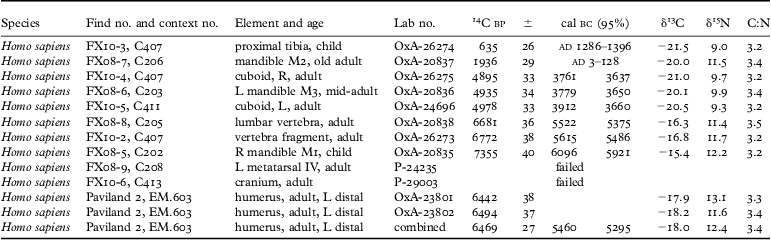
Ten human bone/dentine samples from the 2008 and 2010 excavations at Foxhole Cave were submitted to the Research Laboratory for Archaeology and the History of Art (RLAHA), University of Oxford, for AMS 14C dating, of which two failed to yield sufficient collagen. The remaining eight determinations range from 6096–5921 cal bc to cal ad 1286–1396 (at 95.4% probability), though the latter and another late result (cal ad 3–128) are very much outliers, with the other six all falling within the Late Mesolithic and earlier Neolithic (Table 3). The three Mesolithic human bone dates have been corrected for a marine reservoir effect, based on their significantly elevated stable carbon isotope (δ13C) values, ranging between −16.8‰ and −15.4‰. Assuming marine and terrestrial δ13C endpoints of −12‰ and −20.5‰, respectively,Footnote 30 the contribution of marine protein to the diets of these individuals can be estimated to have been in the order of 45–60%. These values are then used to ‘correct’ the calibrated ages of the samples by using mixed terrestrial and marine calibration curves in OxCal 4.1, proportional to the estimated contribution of marine foods. The current reservoir age of the northern hemisphere oceans is ∼400 years, but there are local departures (ΔR) from this global value,Footnote 31 with the average offset for five datapoints nearest south Wales being −15 ± 25 years.Footnote 32 This value is used in Table 3, and acts to increase the uncertainty in the estimates slightly. Significantly, and consistent with previous British Neolithic isotopic results,Footnote 33 no such correction is required for any of the three AMS determinations falling within that period.
Results of AMS 14C and stable isotope analyses on human bone/tooth collagen. OxA-20835, 20838, 23801/2 and 26273 have been corrected for a proportional marine reservoir effect using a local ΔR offset of −15 ± 25 years
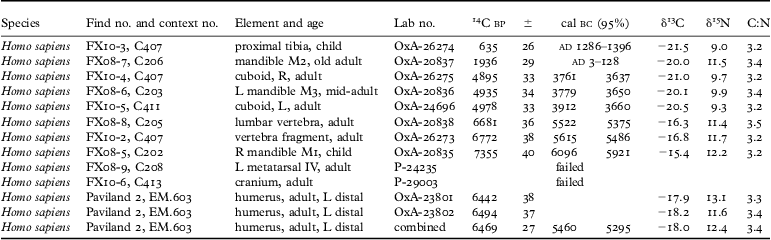
In addition to the newly excavated human remains from Foxhole, the ‘Paviland 2’ humerus,Footnote 34 previously dated to 6290–5790 cal bc (OxA-681, 7190 ± 80 bp), was resampled as part of the present project, given the advances in sample preparation and AMS radiocarbon dating itself since it was first measured in the 1980s.Footnote 35 In fact, the sample was analysed in duplicate as part of RLAHA's internal quality control procedures. The two results are consistent with one another, and can be combined to 5230–5055 cal bc (χ2, df = 1, T = 1.0(5% 3.8)), taking into account a small marine reservoir correction, indicated by the associated δ13C value of −18.0‰. This is more recent than the original date by more than 500 years, demonstrating the importance of continually revisiting earlier analyses to improve upon their accuracy.Footnote 36 The new δ13C result of −18.0‰ is in broad agreement with that of −18.5‰ previously published,Footnote 37 though this is not surprising as that measurement was made much more recently than the original AMS determination. Thus this individual still shows a low contribution of dietary marine protein relative to that seen in individuals from Foxhole and Caldey Island.
Eight faunal samples from the new 2008 and 2010 excavations at Foxhole were also submitted for dating, all of which provided acceptable results (as judged by collagen yields and C:N values). A small long-bone fragment was initially thought potentially to be a part of a human femur (FX10-1), but its low δ15N value of 4.0‰ excludes this possibility, and identifies it instead as a herbivore (perhaps red deer or reindeer). As no faunal remains were selected for dating from the disturbed upper levels of the site, it is not surprising that the results all show considerable antiquity, ranging from 10,870–10,620 cal bc to 34,360–32,750 cal bc (Table 4).
Results of AMS 14C and stable isotope analyses on animal bone collagen
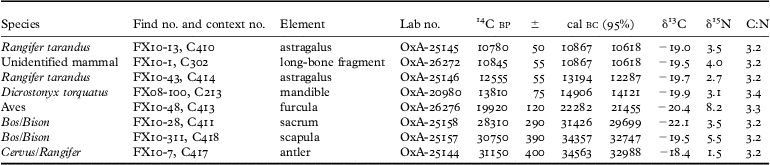
The species represented are typical of Pleistocene and early Holocene fauna, and indeed appear to fall within notably cold periods. None of the fauna exhibit cut marks or other clear indications of human modification: their selection was intended to date the lower levels of the trench, and so they need not be related to human activity in the cave. Indeed, carnivore tooth puncture marks on a number of large mammal bones suggest another possible mechanism for their accumulation. Small amounts of microscopic charcoal, however, were identified in the soil micromorphology column. This aspect of the site requires further investigation, particularly given the small assemblage currently available from the limited excavation area of the deeper levels.
The two failed human bone samples warrant further discussion. Both exhibit a dark, manganese oxide mineral staining that is not the product of burning.Footnote 38 The first, a metatarsal fragment, derived from the lower part of the disturbed upper metre of deposits. The second, a blackened cranial fragment (Fig 7), derived from a level well below the modern disturbance, in light-coloured, compacted sediments typical of the pre-Holocene. After the failure of this sample to yield collagen, a blackened faunal element (a bird furcula) from the same context was submitted, producing a determination of 22,280–21,460 cal bc. While it cannot be assumed that the two are even broadly contemporary given the nature of the deposits at this cave, this does present an intriguing possibility. Unfortunately no other human remains were recovered from this depth, nor, as mentioned above, was there any artefactual evidence or cut-marked faunal remains from the lower levels. It is worth noting that similarly blackened bones were found in small-scale test excavations at Worm's Head Cave; of the three submitted for dating, two also failed to yield sufficient collagen, while the third, an unidentified large mammal long-bone fragment, provided a result of 11,660–11,360 cal bc (UB-6814, 11,600 ± 54 bpFootnote 39). Taken together, this information may indicate that non-burnt, ‘blackened’ (actually very dark brown/black) bone from Gower caves is a potential indicator of Pleistocene or early Holocene age.Footnote 40
Blackened human cranial fragment FX10-6, internal view. Photograph: R Schulting
The stable carbon and nitrogen isotope values presented in Table 3 are the averages of measurements made in triplicate, run separately from the AMS radiocarbon dating process. Collagen yields and C:N ratios are in the range appropriate for well-preserved collagen.Footnote 41 The δ13C results have already been alluded to in the context of the need for a marine reservoir correction. As noted above, there is a variable but clear marine protein contribution in the three Late Mesolithic samples from Foxhole (averaging −16.2 ± 0.7‰), while that from Paviland shows significantly less marine influence (−18.0‰). The sampled elements from Foxhole must derive from at least two different individuals, since both a child and an adult are represented; in addition, the child's first molar is significantly earlier than the two adult vertebrae, which could, on the basis of their similar dates and stable isotope values, belong to the same individual. The δ15N values for all four samples (averaging 11.9 ± 0.5‰) are relatively high, though not as high as might be expected given the elevated δ13C values. This suggests that the majority of the marine contribution to the diet probably came from shellfish and relatively low trophic-level fish, rather than top piscivores or marine mammals. Contemporary faunal remains would be needed to refine this aspect further, but unfortunately these have not as yet been identified for the region/period.
The three earlier Neolithic results, as is typical for that period,Footnote 42 are significantly lower than the Late Mesolithic humans in terms of both δ13C (−20.5 ± 0.4‰) and δ15N (9.6 ± 0.3‰) (Fig 8). These must represent at least two different individuals, as the two cuboids dated are of substantially different sizes. The dated molar overlaps with the larger left cuboid, and could belong to the same individual.
δ13C and δ15N values on human bone and dentine collagen from Mesolithic and Neolithic samples from Foxhole and Paviland. Note the anomalous position of one sample from Foxhole (FX97-41), currently being investigated. This exception aside, there is a clear difference between the Mesolithic and Neolithic results for both isotopes
Between the osteological analysis and the radiocarbon-dating programme, it is apparent that at least six individuals are represented by the small number of human remains recovered in the 2008 and 2010 excavations. These include two individuals attributed to the Late Mesolithic, two to the earlier Neolithic and one each to the Romano-British and medieval periods. With one exception, the Mesolithic and Neolithic dates overlap with those obtained from the 1997 excavations, the exception being a Neolithic individual dating somewhat later than any of the others. This brings the site total to a minimum of seven individuals, albeit each represented by only one or two elements – in itself a rather remarkable situation.
Discussion
The new information provided by the small-scale excavations at Foxhole Cave has challenged earlier findings from the site, and by extension the wider region. This derives first and foremost from the AMS 14C dating of the small number of human remains recovered. While human remains dated to the Late Mesolithic and earlier Neolithic had been previously recovered by Aldhouse-Green, it seems clear, based on age-at-death, dating and stable isotope results, that the material from the 2008 and 2010 seasons includes an additional two Late Mesolithic individuals: an adult and a child. Moreover, the identification of a strong marine isotopic signal in these individuals, comprising approximately one-half of their dietary protein, considerably changes previous interpretations both of the site and of subsistence adaptations along coastal south Wales as a whole. It was previously suggested, based in part on the earlier results from Foxhole and Paviland, that Mesolithic communities on Gower made far less use of marine resources than those on what is now Caldey Island.Footnote 43 It seems that this position may no longer be tenable, or at least will need to be subjected to further investigation. While it remains the case that individuals from Worm's Head and Mewslade show only a minimal marine influence, their comparison with Caldey Island is complicated by their earlier Holocene date, when lower sea levels would have placed the coastline at some distance from their current locations,Footnote 44 effectively making them inland sites.
In many ways the new stable isotope results are much more in line with our expectations for coastal Mesolithic communities, and in particular with the results from Caldey Island (Fig 9).Footnote 45 It is the Late Mesolithic specimen from Paviland, and more particularly that from the 1997 excavation at Foxhole, that are now looking increasingly anomalous. It may be, as was previously suggested,Footnote 46 that the Foxhole individual represented by the tooth dated in 1997 spent his or her early years further inland (with an entirely terrestrial diet) and moved to the coast only in later life. This is possible because measurements on dentine collagen reflect the time the tooth was forming, unlike those on bone collagen, which experience slow but continual turnover.Footnote 47 However, there appears to be an issue with the reported value itself that is being currently investigated. Briefly, because of what was seen as the unusual δ13C result of −20.0‰, remaining collagen from the original 1997 sample submitted to RLAHA – in a clearly labelled bag with the find number FX-41 – was reanalysed for both 14C and stable isotopes. The resulting determination of 4596 ± 30 bp (OxA-24746, 3501–3129 cal bc) places the sample not in the Mesolithic, but in the Middle Neolithic: in this context, the new δ13C and δ15N values of −21.0‰ and 10.3‰, respectively, are not at all out of place. There has obviously been a mix-up in the samples, but exactly what has happened is not yet clear. Another unspecified human tooth (FX-59) from the 1997 excavations provided a similar date (OxA-8317, 4625 ± 40 bp, 3618–3143 cal bc) and isotopic values (−20.6‰ and 9.7‰ for δ13C and δ15N, respectively). If, as seems likely, the confusion was between these two samples, it will unfortunately not be possible to resolve, as there is nothing remaining of sample FX-59 for reanalysis, either in the laboratory or in the National Museum of Wales, Cardiff, where the 1997 finds have been deposited.
Median of cal bc dates and δ13C values on human bone/dentine collagen from Foxhole, Paviland, Caldey Island (Mesolithic) and Parc le Breos chambered tomb (Neolithic) (Whittle and Wysocki Reference Whittle and Wysocki1998; Pettitt Reference Pettitt2000; Richards Reference Richards2000; Schulting and Richards 2002). Note the anomalous position of one sample from Foxhole (FX97-41), currently being investigated
The terrestrial stable isotope values for the earlier Neolithic individuals are comparable to those previously presented for Foxhole,Footnote 48 and indeed are typical for the period in general, though a small contribution (in the order of 5–10% at most) from marine protein cannot be ruled out (though even that appears increasingly unlikely given the broader results from coastal and inland Britain as a whole).Footnote 49 Given the overlap in their calibrated date ranges, it is possible that some of the AMS 14C determinations refer to the same individuals. Nevertheless, at least three earlier Neolithic individuals must be represented, taking into account both osteological and dating information.
A comparison of directly dated Mesolithic and Neolithic individuals from Foxhole and Paviland with those of Caldey Island and Parc le Breos chambered tomb illustrates their clear separation in δ13C values (again with the single and now problematic exception of FX97-41) (Fig 9). However, unlike the west coast of Scotland,Footnote 50 there remains a gap of more than a millennium between the latest Mesolithic and the first Neolithic individuals. This gap has been noted in the literature,Footnote 51 though its explanation remains elusive (Fig 10). Recently, Hellewelle and Milner have questioned its reality,Footnote 52 proposing a degree of continuity in the use of caves for burial in Britain and drawing particular attention to two early dates on human remains from another Fox Hole Cave, in Derbyshire. The dates (OxA-9805, 5185 ± 60 bp, 4228–3803 cal bc; OxA-9929, 5485 ± 75 bp, 4492–4073 cal bc) are certainly very late if seen as Mesolithic, or very early if accepted as Neolithic, as favoured by the excavator.Footnote 53 But – aside from the fact that even if accepted, they provide the only two exceptions in the entire fifth millennium – they fall within a series of samples now known to have been contaminated by old carbon, deriving from the ultrafilters newly introduced at the Oxford dating laboratory at that time.Footnote 54 These samples, as with the others affected, require reanalysis before they can be accepted:Footnote 55 previous experience has indicated that they are very likely to be too early by some centuries.Footnote 56 Later dates would be much more in keeping with the Peterborough ware sherds found in the cave, if these are assumed to be in association. In any case, it clear that on Gower there is, thus far, no indication of any continuity in the use of caves for burial across the transition. A similar gap between dated Mesolithic and Neolithic humans has been noted on Caldey Island.Footnote 57
Median of cal bc dates on human bone collagen from caves (n = 158) falling between 9000 and 2000 cal bc placed into 1,000-year bins, with marine reservoir corrections applied where appropriate. Two determinations from Fox Hole Cave, Derbyshire, which would fall in the 5000–4000 cal bc bin, have been omitted (see text)
One suggestion that has been made for the very marked increase in the use of caves for burial in the earlier Neolithic is that they were perceived as being in some way similar to chambered tombs.Footnote 58 This could not be said of large cave openings such as that presented by Goat's Hole, and it is interesting to note that no Neolithic human remains have been identified there. On Gower specifically, it is apparent that the Neolithic samples from Foxhole and those from Parc le Breos chambered tomb overlap both in time and in stable carbon isotope values (Fig 9), suggesting similar minimal (if any) use of marine foods in both burial contexts, despite their locations less than a kilometre from the sea.
The fact that at least seven individuals are represented by such a small number of elements is intriguing, and strongly suggests the presence of considerably more skeletal material – for these individuals at least – in the immediate area. The elements recovered in 2008 and 2010 are not weathered or gnawed, and so must have been buried relatively quickly. If this is correct, it raises the question of where the rest of these skeletons are located. The two most probable options would appear to be the sides of the outer cave, or deeper into the inner cave. The remains found in the outer cave may, then, have been moved there by burrowing animals, for which there is strong evidence. Planned future excavations will, it is hoped, resolve this question, and could potentially recover more complete skeletons of Late Mesolithic and earlier Neolithic individuals. The former would be particularly significant, given the paucity of human remains dating to this period in Britain.Footnote 59 Further work is also required to provide a wider context for the unexpected Romano-British and medieval human elements, though it can be noted here that Foxhole lies below Paviland Camp (Yellow Top) promontory fort. Promontory forts are common along the Welsh coast and are thought to have their origins in the Iron Age, though they may show later use.Footnote 60 Excavation at a nearby promontory fort, at Horse Cliff, revealed pottery dating from between the first century bc and the first century ad.Footnote 61 There is further evidence for Roman settlement elsewhere on Gower,Footnote 62 and just to the north west lies the Roman auxiliary fort of Leucarum, founded c AD 75 (see Fig 1).Footnote 63
Aside from the clear importance of the human remains, a number of other noteworthy results were obtained from the new excavations. The first of these is the identification of what appears to be relatively substantial and intact Pleistocene deposits with some palaeoenvironmental potential. The directly dated fauna extend back to c 33,500 cal bc, and the floor of the cave has not yet been reached. The opening of a larger trench, to a greater depth, has also clarified some points raised by the 1997 excavation. Foremost among these is that the deposits down to 0.85m depth (reached in 1997), and indeed in some areas down to c 1.5m depth, are all disturbed Holocene sediments. The larger sections available also show that there is no evidence for solifluction,Footnote 64 as was previously suggested on the basis of more limited excavation.Footnote 65 While there is as yet no definite evidence for pre-Holocene human activity at Foxhole, the presence of bone-bearing deposits of a similar age to those from nearby Goat's Hole, Paviland, highlights the potential of Foxhole Cave to address not only those issues surrounding mid-Holocene hunter-fisher-gatherers and the transition to farming, but also those from considerably earlier periods.
Acknowledgements
The team at various times consisted of Rick Schulting, Cate Frieman, Daniela Hofmann, Linda Fibiger, Rowan McLaughlin and Emily Murray. Nick Barton and Simon Collcutt visited the excavations and their observations are much appreciated. The Countryside Council of Wales and the landowner, Christopher Beynon, kindly gave their permission for the work to proceed. Thanks go to Peter Ditchfield for mass spectrometry, to Fiona Brock and Christophe Snoeck for their efforts on investigating the blackened bones, to Brian Gilmour for X-ray fluorescence (XRF) analysis, to Ian Cartwright for his professional finds photography, to Richard Madgwick for checking a faunal identification and to Robert Kruszsynki and the Natural History Museum for allowing the sampling of the Paviland 2 humerus. Thanks are also due to the two anonymous reviewers for their comments, which much improved the clarity of the paper. Funding for the project was provided through grants from the Society of Antiquaries of London and the Meyerstein Fund of the School of Archaeology, University of Oxford. Additional funding for AMS dating was provided by the Natural Environment Research Council (NERC) through its Oxford Radiocarbon Accelerator Dating Service (ORADS) programme.