1. Introduction
When the present economic crisis began to build up, numerous economistsReference De Grauwe1 warned of structural shortcomings in the design of the euro zone, comprising as it did countries with widely differing fabrics of production and levels of competitiveness that did not constitute an optimum monetary area.Reference Toribio2 To prevent asymmetric shocks in this context required if not greater common political power (a European government with sufficient powers of taxation and spending, i.e. equipped with a compensating budget like the federal government of the USA, which for instance was able to intervene in the Nevada real estate bubble crisis) then at least greater coordination in other areas of economic policy. The rationale behind this requirement was clear: the countries of the euro zone currently lack the conventional tools available to national economies to deal with asymmetric crises (e.g. exchange rate and interest rate adjustments and the intervention of central banks as a last resortReference De Grauwe3), nor can they expect any substantial transfers from the common budget.
The current economic crisis in Europe has initially followed a pattern similar to an asymmetric shock, since it is basically a symmetrical shock with asymmetric implications (to paraphrase the DG for Economic and Financial Affairs of the European Commission4). Some authors continue to hold that the historical roots of the current euro crisis must be sought in the construction of the EMU, based on the Maastricht Treaty.Reference Busch5
Indeed, given the restrictions entailed by the principle of subsidiarity, a number of mechanisms and instruments were designed to mitigate the institutional shortcomings of the euro zone, so as to permit the multilateral coordination and supervision of microeconomic, fiscal and financial regulatory and supervisory policies, which remained in the hands of national governments.Reference Caballero, García and Gordo6 But those mechanisms have failed, and have not enabled a clear exit strategy to be designed or sufficient measures to be drawn up to palliate the problems that have arisen. Nor, evidently, have they served to encourage Member States to exercise solidarity over and above the basic rules of the game in the EU. It is true that the recent Report by the President of the European Council envisages the possibility of several ‘options for the shock absorption function of the euro area fiscal capacity’Reference Van Rompuy7 to be adopted in a Stage 3 of the road map for the achievement of a genuine Economic and Monetary Union. But the December 2012 European Council did not get very far with this aspiration and completing this decision will not be easy.
This paper seeks to take a brief look at the concept of governance, with the current conditioning factors that stem from increasingly globalised economies, and to describe the features that characterise governance in the complicated context of Europe. It then goes on to highlight the limitations of the economic governance architecture design in the EU, which is made to look very poor in the light of its improvised responses to the crisis since 2007. The idea is to compare the rationales that underlie the two exit strategies that have been built up over time practically as polar opposites, reflecting not only the different vested interests in dispute but also disagreements in terms of theoretical reference points. This paper seeks, in conclusion, to draw up desirable guidelines for reforming the current framework of European economic governance.
2. Governance and New Global Conditioning Factors for the Formulation of Public-sector Policies at National Level
The modern concept of governance stems from the ‘good governance’ practices advocated by the World Bank in the 1990s, which consisted of suggestions concerning economic, financial, political and social behaviour aimed at countries that were borrowing for development purposes. The concept has subsequently developed strongly, and has mainly been interpreted in terms of a willingness to consolidate democracy, accountability, openness, equity, the promotion of the rule of law and political and administrative decentralisation.Reference Kagancigil8 Thus, some authors, such as Celedón and Orellana,Reference Celedón and Orellana9 endow ‘governance’ with the potential for drawing up rules of the game that include demands for and access to information, transparency of processes, accountability, and assessment and monitoring by citizens of public policies.
But within this diversity of meanings and usages of the term, all parties agree that ‘governance’ suggests collective decision-making based on the inclusion of broad groups of stakeholders. So if a single definition of ‘governance’ had to be given, it could be described as a set of institutional arrangements by which public decisions are made and implemented in a given social environment. It therefore refers to structures, processes, actors and the relationships between them, formal rules, measures for coercion, control and accountability, incentives, informal rules and, in general, all the elements that affect decision-making in the public domain.Reference Longo10
In this regard, Borrás and RadaelliReference Borrás and Radaelli11 stress that the architecture of governance should consist of two main parts:
∙ an ideological component, which should include policy paradigms and value discourses, i.e. theoretical reference points; and
∙ an organisational component, which should be based on the formal institutional structures and instruments available.
In its White Paper on European Governance, the European Commission12 defined governance as ‘the rules, processes and behaviour that affect the way in which powers are exercised at European level, particularly as regards openness, participation, accountability, effectiveness and coherence’. The same White Paper establishes the elements that characterise good governance:
1. The participation of citizens in decision-making.
2. Openness and free circulation of information, essential for the subsequent accountability of public powers.
3. The sensitivity of institutions and processes to the actors involved in them, which endows decision-making processes with legitimacy.
4. Consensus between different interests, enabling a conciliation to be reached that constitutes the general interest.
5. Efficacy and efficiency on the part of institutions, calling for a high degree of adaptability to needs and fast decision-making.
6. The accountability of politicians.
7. Leaders must have a strategic vision of human development as a basis for their leadership.
3. Limits on European Economic Governance: Institutional Architecture and Response Mechanisms
On a purely doctrinal level, economic governance in the European Union was certainly required from the outset to have institutional mechanisms in place to enable it to respond in a timely, flexible manner to the needs of the internal market and the single currency.Reference Conde13 But the actual configuration that has emerged at Community level in the economic and financial sphere is one that was defined as early as 199314 as ‘multi-level governance’.Reference Marks15 As a result, some policies are now defined by supranational bodies (e.g. the ECB draws up European monetary and exchange policies) while others are designed and implemented at national level, in line with the principle of subsidiarity, but with varying degrees of coordination and common restrictions on States, in a framework that has proved highly ineffective. This ‘asymmetrical construction’ of economic governance (under which monetary policy is Europeanised and other areas of economic authority are left in the hands of each Member State) was not tempered by any significant provisioning of the European budget or by providing immediate assistance mechanisms to cater for urgent financial needs on the part of Member States. The key decisions in core areas of economic policy (taxation, public spending, supply-side policies and regulation of the labour market and social protection) remain in the hands of national governments.
The design and subsequent implementation of the EMU heightened the need for coordination, and gave rise to further agreements and resources such as the following.
∙ The Stability and Growth Pact (SGP), initially approved by the Council of Europe in Amsterdam in June 1997 and subsequently amended in 2005 (Commission Regulations 1055/2005 and 1056/2005) to incorporate a procedure for preventive notice and rapid assessment. The remit of the SGP is to set the quantitative criteria required to ensure the maintenance of sound public finances in Member States and provide for procedures to monitor compliance. The current version envisages substantial sanctions for non-compliance and a new procedure for excessive deficits.
∙ To reinforce their earlier commitments, on 2 March 2012, 25 of the 27 EU Member States signed the Treaty on Stability, Coordination and Governance in the Economic and Monetary Union (TSCG), which contains a number of so-called ‘golden rules’ (chief among which are commitment to maintaining structural deficit levels below 0.5% of GDP, or 1% if the country has a debt level below 60% of GDP, and an obligation binding on countries with public debt levels higher than 60% of GDP to reduce them below that figure within 20 years, at a rate equal to one 20th of the spread in each one year period). These rules become binding once they are ratified by 12 countries. This latest version of the SGP allows for some small measure of play in automatic stabilisers and, more significantly for matters of governance, introduces the rule of ‘inverse majority’. This means that from now on a majority ‘no’ vote is required for corrective or sanctioning mechanisms proposed by the European Commission to be rejected, whereas in the previous version a majority ‘yes’ vote was required for such proposals to be approved.
∙ The multilateral surveillance procedure for national stability, convergence and reform programmes. This surveillance, envisaged under Article 121 of the Treating on the Functioning of the European Union (TFEU) and in the SGP itself, has recently been reformulated (EU Regulation 1175/2011). It is initially intended to prevent the appearance of excessive public administration deficits and promote the coordination of economic policies. The Council examines national programmes at the commencement of each year and issues a ruling on each one, based on the assessment of the Commission and the Economic and Financial Committee (EFC). 2012 has also seen the commencement of work to develop a further surveillance procedure for preventing and correcting macroeconomic imbalances.16
∙ The Broad Economic Policy Guidelines (BEPGs), first drawn up at the European Council in Lisbon (2000), lay down guidelines for economic policy in Member States.
∙ The Open Method of Coordination (OMC), also set up at the Council in Lisbon (2000), is an instrument for coordinating the policies of Member States in areas where the EU does not have the authority to legislate, such as social protection and social inclusion. This method is based on the sharing of good practices and the drawing up of assessments and recommendations. It was classed by the Commission in 2008 as an ‘innovative instrument in European governance’.
∙ The increased political and decision-making significance of the Euro-group, currently chaired by Jeroen Dijsselbloem as successor to long-time chairman Jean-Claude Juncker. This group began to meet informally in 1997, but with the onset of the current crisis its meetings have taken on an increasingly decisive nature. Ministers from the Member States that have adopted the euro as their currency hold meetings at which they examine issues concerned with specific shared responsibilities in regard to the single currency. They have agreed, for instance, to set up and provision bail-out mechanisms such as the ESM.
Some authors hold that this framework is underpinned by an orthodox, liberal view of economic policy focused primarily on the control of inflation by the ECB, on the compulsory adoption of severe fiscal policies and on the need for structural reforms.Reference Watt17
An examination of the gradual establishment of multi-level governance in Europe, and more specifically of the design of the euro zone, leads to the conclusion that there are structural shortcomings in both the ideological aspects and the governance architecture that have limited its ability first to prevent and second to cut short the current crisis.
Taking as a theoretical reference point the elements that should characterise good economic governance in the EU (as set out in the White Paper), the main problems to which those structural shortcomings have led are the following:
1. A lack of clear leadership in defining an exit strategy for the crisis. The overwhelming predominance of intergovernmentalism in the decision-making processes of the EU means that there is a need to forge a single political will out of the interests, theoretical reference points, strategies and electoral calendars of the 27 Member States resulting from the successive enlargement processes, because procedurally the applicable treaties require unanimity, or a highly qualified majority of Member States for decisions to be made on economic matters.
2. Moreover, as a result of the euro there are two decision-making areas (the EU as a whole and the euro zone), so some decisions are made by 17 countries and others by 27.
3. The problems of effectiveness and efficiency associated on the one hand with a tendency to revise earlier decisions18 and on the other hand with how long it takes for measures to be implemented given the slowness of the procedures involved, the need for ratification at national level and other conditioning factors (for instance, over a year went by from the time when it was agreed to set up the ESM – March 2011 – to the time when it was actually set up – 8 October 2012 – and it is still not known for certain when it will be able to begin operating effectively). These problems have a negative effect on the requirements for adaptability to needs and rapid decision-making called for under good governance.
4. Relations between Community decision-makers and their national counterparts are defined in a way that fails to ensure conciliation focused on general interest: coordination mechanisms constitute a sort of ‘soft government’ for facilitating the gradual configuration of the economic policies still in the hands of individual Member States.
5. There has been no correction of the structural shortcomings of a model for constructing a monetary union between countries which did not previously make up an optimum monetary area because:
∙ production structures and levels of competitiveness continue to vary widely from one country to another;
∙ the resources of the common budget have not only not been increased, but have actually been cut back (as an effective percentage of Community GDP), so that it continues to lack the power to offset asymmetrical shocks;
∙ there has been no significant progress towards fiscal or financial integration;
∙ obstacles to perfect mobility of the labour factor between Member States continue to exist, in the form of language, social and cultural barriers.
6. There are still problems of legitimacy and citizen participation in Community decision-making, and problems of openness (which is an obstacle to accountability on the part of political leaders).
In short, to paraphrase Conde,Reference Conde13 the major outstanding challenge facing economic governance in the EU continues to be the determination of how to achieve greater effectiveness and a higher standard of democratic content. By way of an excuse it is true that to understand the nature of the fragilities of economic governance that have emerged, one needs to start by considering the evolutionary concept of European integration on which the EMU project was based. The creation of a single currency was seen as a stage-by-stage process, and there was no intention to establish a final design from the outset that would articulate all the elements involved in the complex relationship between common monetary policy and other economic policies, which remained in the hands of national governments.
4. Factors that Explain the Sovereign Debt Crisis: Could Extreme Market Pressure have been Avoided?
I believe that the seriousness of the current euro crisis can be explained in terms of three interlinked factors.
(1) The European countries that are under most pressure from the financial markets suffer from intrinsic problems such as:
(a)the low tax collection capacity of their taxation systems (especially during times of recession);
(b)uncompetitive fabrics of production (reflected in poorly-performing ULCs and a chronic deficit in their economic relations with the rest of the world);
(c)high levels of leverage and dependence on external savings (with the consequent effects in terms of negative net international investment positions);
(d)Financial systems that are vulnerable due to bank balance-sheet problems concerned with the accumulation of sovereign debt subject to write-down (Greece and Cyprus) or to the over-valuation of real-estate assets (Spain and Ireland).
Some illustrations of these intrinsic problems follow.
(a)The Insufficiency of Taxation Systems in the Periphery Countries
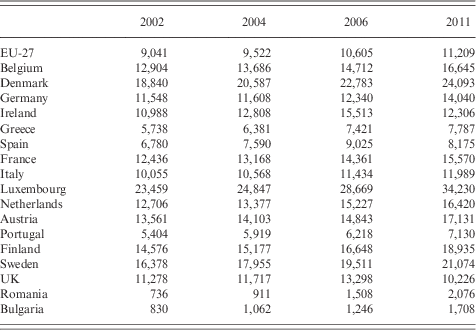
As shown by Table 1, in 2011 the revenues of the EU’s Member States from all items (taxes, social welfare contributions, property rent, transfers, and so on) averaged €11,209 per annum per head of population. However, the range of revenues varied enormously, with, for example, €34,230 per capita in Luxembourg and €7130 (almost exactly four times less) in Portugal. By comparison, the data for Bulgaria and Romania (€1708 and €2076 respectively) seem almost ridiculous, and serve to give an idea of the level of public service provision that the citizens of those countries can expect to enjoy.
A look at the figures for the periphery countries reveals that they all have revenues that are markedly lower than the EU average (Portugal €7130; Greece €7787; Spain €8175; Ireland €12,360), and as much as two or three times lower than the average revenues per capita in the central and northern Member States.
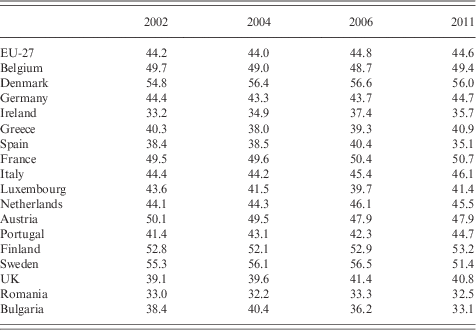
It might be assumed that the spread can be explained by the income effect, i.e. the periphery countries have lower revenues per head of population simply because the per capita incomes, and therefore the taxpaying capacity, of their citizens are lower. However, Table 2 reveals that this factor patently fails to explain the full diversity of revenues: if public revenues are relativised according to the GDP of each country, much of the spread observed continues to exist. It can therefore only be explained in terms of fiscal effort being lower in the periphery countries.
Historically, the performance in general of the periphery countries is clearly below the European average (around 44% of GDP over the past decade) in terms of fiscal effort. With the exception of Luxembourg, where the high level of public revenues can indeed be explained by the extremely high per capita income, all the other countries with the highest levels obtain their revenues through a greater fiscal effort (over 50% of GDP in Denmark, France, Finland and Sweden in 2011).
(b)External Imbalances Stemming from Widening Competitiveness Gaps
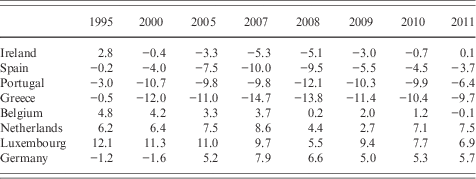
A negative trend in relative competitiveness among the periphery countries (with bigger increases in unit labour costs19 and other factorial income; a tendency to specialise in conventional activities) has resulted in persistent balance of trade and current account deficits that it has not been possible to offset artificially through currency devaluations because of their membership of the euro zone. Table 3 illustrates the differences in performance between the countries that are under pressure from the markets (the first four rows, which have widespread foreign trade imbalances), and those EU Member States where the risk premium is lowest.
(c)Increased Dependency on External Savings, with Record Levels of Public and Private Borrowing
In the periphery countries the historical build-up of large annual current-account deficits (in excess of €100 billion in some recent financial years in the case of Spain), weak domestic savings, domestic firms that find it difficult to issue bonds on international markets, the granting of bank loans in excess of the funds available to domestic lendersReference Díez20 and, in some cases, an urgent need for funding in the public sector have led to highly substantial levels of foreign borrowing and leverage.
Table 4 again compares the situation in the periphery countries with those of Member States that are not under pressure from the markets: the former all have negative net international investment positions, with relative values in excess of 90% of their GDP, while the latter enjoy positions that are clearly positive.
Just as serious as the sheer volume of foreign borrowing among the peripheral economies (Spain, for instance, has close to €1 trillion in net liabilities, incurred mainly by banks) is the scant economic return on the loans secured. In many cases they have been used ultimately to finance home buying in the midst of a real estate bubble (home loans currently account for around 75% of household borrowing). Third generation models used to study financial crises warn that if indebted countries fail to use the resources that they borrow to fund projects that can provide sustained returns they will find it extremely difficult to repay the loan capital.
(d)Financial Systems that are Vulnerable due to Bank Balance-sheet Problems Concerned with the Accumulation of Sovereign Debt subject to Write-down (Greece and Cyprus) or to the Overvaluation of Real-estate Assets (Spain and Ireland)
The vulnerability of financial systems in terms of bank balance sheets is due in some cases (e.g. Greece and Cyprus) to the accumulation of sovereign debt affected by write-downs when the Greek bail-out was negotiated, and in others (e.g. Ireland and Spain) to the growth and subsequent bursting of real-estate bubbles.
In Spain and Ireland the progressive overvaluation of real-estate assets created obvious bubbles, brought about by easy loans, by the climate of euphoria prevailing among economic actors and by the tax breaks granted to the sector. The economic downturn imposed by worldwide restrictions on credit led to the bursting of these bubbles, with dire economic consequences:
∙Serious job losses: it is estimated, for instance, that close to 2 million jobs in construction and connected activities have been lost in Spain since 2008.
∙A significant drop in tax revenues.
∙Negative effects on bank balance sheets: a highly substantial part of total credit investment was sunk into real estate, in operations with both developers and households.
∙Reduction in aggregate spending levels due to the destruction of employment mentioned above and to the income effect caused among economic agents and credit restrictions.
(2) The economic effects of the crisis have been exacerbated in the periphery countries by the shortcomings of EMU in terms of economic governance, by its deficient institutional architecture, by the loss of credibility of the internal rules of the EU Court, for instance, by repeated breaches of the SGP,21 by the complexity of the decision-making process and, above all, by the failure to take decisive action in defence of the euro and in support of countries in difficulty. This apparently categorical assertion can be checked out by comparing the pressure exerted by financial markets on the UK and on Spain. As pointed out by De Grauwe,Reference De Grauwe22 public borrowing levels in the UK are far higher than in Spain (85% of GDP as compared with 65% in early 2011), the British economy had already fallen into recession and its foreign deficit and budget deficit levels are similar, but in spite of this it has not been subjected to anything like the same market pressure and has not experienced the same serious difficulties as Spain in securing funding.
While the markets demanded premiums of between 300 and 500 basis points for Spanish bonds in 2011, the UK was being asked for an average of just 30 basis points (with a minimum of –10 on 29 November and a maximum of +64 on 22 September). The fact that the British government and the Bank of England are willing to resort swiftly and strongly to any measures available to them in defence of their economy and their currency (as shown by successive quantitative easing procedures to bail out the financial system) is seen in a positive light by the financial markets, which continue to show confidence in bonds issued in Sterling even though the UK suffers from many of the same unsatisfactory underlying economic conditions as Spain.
(3) The hesitant, changing intervention strategy followed by the EU in its management of the crisis is the result of internal divergences and of the prevalence (attenuated only slightly since June 2012) of the German approach, which is characterised by trust in the efficient operation of markets, commitment to the eluding of ‘moral risk’ (especially in connection with the Greek crisis) and the maintenance of orthodoxy in the handling of monetary policy (on the grounds that the letter of the treaties requires that the ECB be subordinate to inflation targets).
In the author’s opinion a prompt, forceful intervention in support of the euro when the first sovereign debt problems emerged (in Greece in 2010) would very probably, and with relatively low levels of transfers or loans,Reference Díez23 have forestalled the ensuing spiral of speculation that has hit financing conditions in many Eurozone countries so hard that much larger bailouts have become necessary, for the moment in Greece, Portugal and Ireland.
Indeed, a simulation under the Integrated Global Monetary and Fiscal Model drawn up this autumn by the IMF estimates that around 200 basis points out of the total Spanish risk premium can be attributed to the financial stresses associated with a potential break-up of monetary union:
In the scenario in which policy is able to alleviate the stress (blue bars), credit in the euro area expands relative to the baseline and sovereign spreads decline. In the periphery countries, credit expands by roughly €225 billion relative to the baselines, and sovereign spreads decline by roughly 200 basis points in 2013.24
Total public revenues per capita in the EU, 2002–2011 (current euros)

Source: EUROSTAT (2012) Government Finance Statistics (Luxembourg: Publications Office of the European Union).
Total public revenues in the EU as a percentage of GDP, 2002–2011
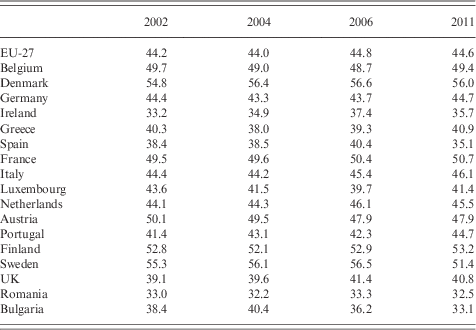
Source: EUROSTAT (2012) Government Finance Statistics (Luxembourg: Publications Office of the European Union).
Trend in current account balances in some euro-zone countries, 1995–2011 (percentage of GDP)
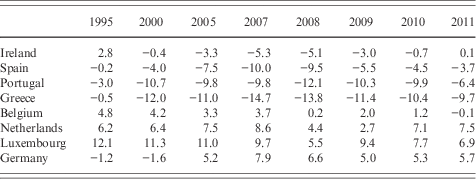
Note: The first four countries listed are under pressure from financial markets, the other four are not. Source: own work based on data from EUROSTAT (2011) Balance of Payments. Main Tables (Luxembourg: Publications Office of the European Union), and IMF (2012) World Economic Outlook. Growth Resuming, Dangers Remain. April 2012 (Washington: IMF) for 2011.
Net international investment position in some euro-zone countries, 2010 (% of GDP)

Source: European Commission (Ref. 16, p. 4).
5. Contradictions and Rationalisations Inherent in Exit Strategies: Austerity versus Boldness
After the years that have elapsed, two basic positions in regard to exit strategies for the crisis continue to coexist in opposition to each other on a political level in the European Union:
(a) On the one hand there is the more orthodox strategy, centred politically on Germany (and supported unconditionally by countries such as Finland and Holland), which is associated with demands for severe austerity programmes in the periphery countries. The rationale behind this strategy is based on the following points:
(1)Absolute confidence in market mechanisms, the signals from which (as manifested, for instance, through the interest rates demanded on debt markets with the addition of the risk premium) are seen as determining the need to undertake a succession of cutbacks and other initiatives until the equilibrium levels that correspond to the circumstances and potential of the respective economies are recovered.Reference Donges25
(2)Particular care to avoid ‘moral risk’, exacerbated in the Greek crisis, so as not to encourage some states in the euro zone to try to elude the economic consequences of their successive decisions or failures by passing them on to taxpayers in other states. The periphery countries have no incentive to correct imbalances voluntarily so long as the market continues to finance them.
(3)The maintenance of orthodoxy in the handling of monetary policy, based on the letter of the treaties that establish the subordination of the ECB to inflation targets. Behind this lies Germany’s fear of inflationary processes, as evidenced by these words spoken recently by Jens Weidmann, President of the Bundesbank:
If central banks can potentially create an unlimited amount of money out of thin air, how can we ensure that money remains sufficiently scarce to preserve its value? Does this ability to create money more or less at will not create the temptation to take advantage of this instrument to create additional leeway short term, even at the risk of highly probable long-term damage?Reference Weidmann26
He therefore insists on regarding as illegal any measure that might entail the ECB providing direct funding to governments, on the grounds that this is expressly prohibited under Community regulations and could compromise the essential purposes of the bank.
(4) Finally, the high levels of public debt in numerous Member States are seen as primarily responsible for the euro crisis into which the international crisis has turned. This underlying diagnosis is supplemented by belief in the so-called Ricardian equivalence theorem, from which a loss of potential effectiveness of expansive fiscal policies in the long term can be deduced.
The latest and most widely disseminated version of this argument against excessive budgetary debts and deficits is that of Reinhart and Rogoff, who reach the following conclusion in their renowned paper (which German Finance Minister Wolfgang Schäuble has cited in several of his speeches): ‘main result is that whereas the link between growth and debt seems relatively weak at “normal” debt levels, median growth rates for countries with public debt over roughly 90 percent of GDP are about one percent lower than otherwise; (mean) growth rates are several percent lower’.Reference Reinhart and Rogoff27
Under this approach, any action by the ECB (to acquire government bonds on secondary markets or facilitate increased liquidity levels) or by any other Community organisation that might potentially dilute those market signals is considered as merely putting off the adoption of necessary measures (by applying a sort of ‘anaesthetic’ to gain time) and enabling periphery countries momentarily to elude their responsibilities. Moreover such actions would be incompatible with the treaty provisions that prohibit public deficits from being financed with the help of the ECB or national central banks (TFEU, Art. 123), prohibit the public sector from obtaining privileged access to financial institutions (TFEU, Art. 124) and prohibit the Community from being answerable for the financial obligations of Member States, i.e. the famous ‘no-bailout clause’ (TFEU, Art. 125).
However, the recent paper by Herdnon, Ash and PollinReference Herdnon, Ash and Pollin28 reveals that the said study by Reinhart and Rogoff (RR):
has made significant errors in reaching the conclusion that countries facing public debt to GDP ratios above 90 percent will experience a major decline in GDP growth. The key identified errors in RR, including spreadsheet errors, omission of available data, weighting, and transcription, reduced the measured average GDP growth of countries in the high public debt category. The full extent of those errors transforms the reality of modestly diminished average GDP growth rates for countries carrying high levels of public debt into a false image that high public debt ratios inevitably entail sharp declines in GDP growth. Moreover, as we show, there is a wide range of GDP growth performances at every level of public debt among the 20 advanced economies that RR survey. […] Specifically, RR's findings have served as an intellectual bulwark in support of austerity politics. The fact that RR’s findings are wrong should therefore lead us to reassess the austerity agenda itself in both Europe and the United States. (Ref. Reference Herdnon, Ash and Pollin28, pp. 14–15; emphasis added)
It must also be realised that the current fragmentation of financial markets in the EU benefits those countries that support this exit strategy, because they are obtaining financing on the markets at historically low interest rates (German bonds at 10 years have been traded at around 1.5%, and several EU countries have issued zero-coupon short-term debt with negative nominal rates of return).
(b) On the other hand there is a more open, proactive strategy that is sensitive to the demand side and at the same time prepared to use all the tools available in the framework of European economic governance, just as other developed countries not belonging to EMU do. This approach is defended by major Community authorities, by the Southern Member States and has even been recommended by leading figures in the OECD and the IMF. The strategy is based on the following economic rationale:
(1)A warning is issued that the severe adjustment plans undertaken may have dramatic consequences for the economies of the periphery (and, through the foreign sector, for the EU as a whole), because they may reduce their aggregate demands and drive them into a dangerous situation of recession (or deflation). These tough adjustment plans (tax increases and cutbacks in public spending) also compromise the very objectives of fiscal consolidation, as they reduce taxable bases. This strategy therefore argues that demands for fulfilment of targets as regards deficits should be relaxed (by giving more time for budget consolidation efforts to take effect) and that the ECB should maintain an active role, even if that means accepting some level of inflation in return.
(2)Particular emphasis is placed on providing the most powerful financial firewalls, and on firm intervention by the ECB to discourage the speculation on the debt markets that is pushing up risk premiums to excessive levels that are related not to the characteristics of the economies under attack (where risk has been fiercely re-evaluated) but rather to the vulnerabilities of the euro zone as a whole. The self-imposed limitations of the ECB in comparison with the speed and firmness with which the Federal Reserve and the Bank of England act have further encouraged speculation. The existence of inverted yield curves is an imperfection of the market that justifies the intervention by the ECB whose legality is denied by the other approach.
An example of the potential effectiveness of such actions can be found in last September’s announcement of an intervention in the markets by the ECB, which inverted the trend and resulted in a significant improvement in financing conditions for periphery states, with marked reductions in their risk premiums and in the interest rates paid on new debt issues (on the very day of the announcement, 6 September, the marginal interest rate on three-year Spanish treasury bonds dropped to 3.774%, a full point lower than the 4.774% paid by Spain in the previous auction on 7 August). Subsequent bond issues in November have confirmed the downward trend in interest rates.
(3)Along with the foregoing, there is a call for the adoption of Eurobonds or other forms of ‘mutualising’ European debt, to encourage stability on financial markets and prevent the draining of resources from periphery countries, which cannot make progress towards fiscal consolidation so long as they are forced to earmark increasing percentages of their budgets for servicing their debts. The latest idea put forward in EU circles is the issuing of a certificate of partial sovereign risk protection (ECCL+ in EU nomenclature), a sort of guarantee or insurance certificate under which investors will be covered by the bail-out fund for partial remissions of 20% or 30% of the value of the sovereign debt issued under the scheme. The advantage of this formula is that it would reduce the cost of financing for Spain and other periphery countries with no effective outlay on the part of the bail-out fund, and at the same time it would open the gate for debt purchases on the secondary market by the European Central Bank (ECB).
(4)Urgent improvements need to be made in the economic governance of the EU to reduce how long it takes to apply the measures adopted, speed up decision-making in crisis management (by reducing the scope for minority blocking) and assign a specific body focused on the general interest over and above national interests with authority to promote exit strategies.
(5)Stricter financial surveillance is called for, centred on a new surveillance perimeter (affecting ‘shadow banking’) and the re-regulation of financial activity in the EU with the aim of increasing the levels of capital held by financial institutions and drawing up tougher definitions, in line with the deterioration of their balance sheets (based on sovereign debt or real estate assets). Indeed, the achieving of banking surveillance for the EU as a whole, validated by the EBA or the IMF, was one of the undertakings that emerged from the summit in June 2012. At the same time, some ‘understanding’ could be shown towards certain national protectionist measures such as bans on short positions in stocks29 to reduce volatility and pressure on trading, plus actions to increase the transparency of the markets.30
The author would venture to suggest that those who hold the German position frequently forget that there are certain potential externalities that operate dynamically and prevent the crisis exit strategy from being considered as a zero sum game in which any gain by the Southern EU Member States is achieved at the expense of the northern States, and vice versa. Thus, a firmer strategy that favours the recovery of confidence in the euro (and its irreversibility, thanks to unlimited support from the ECB and from the EU has a whole) would relieve the burden of debt on the budgets of those countries bailed out or placed under control by the markets, favouring their fiscal consolidation and enabling them to return to less restrictive public accounts that can positively impact activity levels and employment throughout the EU.
The austerity-based option could have too many side effects: progress towards fiscal consolidation is not possible if the economies of the periphery are in recession due to adjustment plans (their taxable bases shrink), and are forced to devote ever greater amounts of public resources to servicing their debts. The IMF itself24 has warned of uncertainties in regard to the impact that bailout programmes may have on some European countries due to the conditions imposed on those countries, which could slow growth even further and worsen their deficits.
6. Conclusions
The author believes that the architecture of economic governance in the EU contains serious shortcomings in terms of ideological issues (design of a coherent exit strategy) and institutional issues (procedures, irreversibility and the implementation times of decisions adopted). As a result, the measures adopted by the EU in response to the crisis have been taken late, hesitantly and sometimes with insufficient intensity. Moreover, contradictory measures have been taken over the course of the management of the crisis, as evidenced in the changing exit strategies pointed out above.
The intrinsic problems of some Member States (substantial budgetary and foreign trade imbalances, vulnerable financial systems and economic stagnation) may therefore have been worsened by the lack of confidence shown by the markets in the workings of the euro and in Community institutions as a whole. Along with these shortcomings in economic governance (in a supranational environment where there is still broad scope for sovereign decisions in economic, and especially fiscal affairs) there have also been internal discrepancies due to the prevalence in some core Member States (with Germany at their head) of highly orthodox approaches to monetary and supply-side issues and over-cautiousness in regard to ‘moral risk’, as opposed to the actions defended by the EU's southern Member States. This has prevented the reaching of a truly common diagnosis of the most pressing problems, and the articulation of effective solutions. Moreover, some of the self-imposed limitations applied by institutions such as the ECB, derived from the prevailing economic rationale, have encouraged speculation on the debt markets.
I believe that exit strategies grounded on the control of public finance and on inaction by the ECB need to be reconsidered. At the very least, the current architecture of economic governance in the EU is patently improvable and, in my opinion, modifications in the following directions are urgently needed.
∙ To favour clearer leadership of crisis management, strengthening the role and the degrees of freedom attributed to Community bodies (especially the Commission, the ECB, the president of the Euro-group, and Community financial instruments) in diagnosing problems and administering ‘emergency first aid’ in line with the best interests of the EU as a whole. There is indeed some tension between achieving greater effectiveness and safeguarding democratic legitimacy (which the said bodies do not enjoy to the same degree as national governments), but without such express delegation of competences it will not be possible to achieve sufficient crisis prevention and early response capabilities at European level, and the distrust shown by the markets will continue. One possible compromise between effectiveness and legitimacy could be to submit the measures adopted by these bodies to the European Parliament for urgent approval.
∙ To speed up decision-making processes in the management of the economic crisis, to limit the scope for minority blocking and to reduce the implementation times for the measures adopted, introducing a law under which they may not be reviewed until after they have been initially implemented. All this would help to improve the effectiveness and adaptability of actions.
∙ To improve the credibility of the current mechanisms for co-ordinating economic policies, so as to prevent any recurrence of flagrant breaches (as in the case of the SGP). Even the provision of short-term flexibility margins in some directives would be preferable to outright breaches of excessively strict rules.
∙ Seeking on the one hand more symmetry between Member States in their capacity to influence decision-making and on the other hand more balance between concessions of sovereignty (e.g. the recently approved ‘Two-Pack’ grants new powers to the European Commission in regard to economic supervision in the Eurozone, and even permits EU authorities to request amendments to national budgets before they are passed into law) and a willingness to make progress in the mutualising of sovereign debt or to transfer resources to countries in trouble on the basis of solidarity.
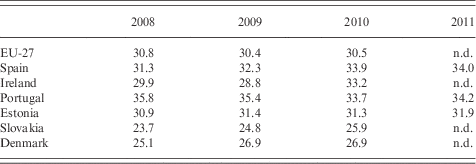
∙ Make progress towards fiscal harmonisation, at least to the extent of preventing ‘escape routes’ in regard to national regulations, fiscal competences and the continued existence of tax havens in the EU or in related areas. If major taxpayers in the periphery countries fail to meet their obligations it will be extremely difficult to balance public accounts and at the same time safeguard the European social model. Governments need to be aware of the redistribution implications of cutbacks in spending and increases in taxation, to prevent any significant loss of fairness in personal income distribution, as is happening in Spain and elsewhere (Table 5).
∙ To improve financial surveillance, working towards a greater degree of banking integration that can incorporate some elements of shared risk (guarantee funds). Anything that helps increase the security of savers and institutions will also facilitate the circulation of credit and help activate investment.
Trend in the Gini index in selected EU-27 countries, 2008–2011
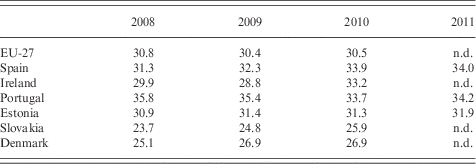
Source: EUROSTAT (2012) Statistics on Income and Living Conditions (Luxembourg: Publications Office of the European Union).
In this regard I fully agree with the thesis put forward by Klaus Busch:
Analysis shows that only measures that go beyond Maastricht – such as a new growth strategy, Eurobonds, abolishing the market states approach, reforming the financial markets and supranational European economic government – can provide a lasting solution to the crisis. (Ref. Reference Busch5, p. 3)
Javier Bilbao-Ubillos graduated in Economics and Law, and obtained his Doctorate in 1990. He is now a Senior Lecturer in the Department of Applied Economics I of the University of the Basque Country (Spain). He is the author (or co-author) of 20 books and 45 articles in journals such as European Urban and Regional Studies, Administration & Society, Economic & Political Weekly, Transportation Research Part A: Policy and Practice, International Journal of Social Welfare, Journal of Economic Policy Reform, Sustainable Development, Public Money & Management, Social Indicators Research, and Economic Development Quarterly. His research interests include Regional Economics, Economic Policy, Development Studies.