Introduction
Offspring of patients with schizophrenia more often have social and cognitive disadvantages than offspring of non-schizophrenic parents, including lower IQ (David et al. Reference David, Malmberg, Brandt, Allebeck and Lewis1997; Kremen et al. Reference Kremen, Buka, Seidman, Goldstein, Koren and Tsuang1998; Davidson et al. Reference Davidson, Reichenberg, Rabinowitz, Weiser, Kaplan and Mark1999), greater attention deficits (Lifshitz et al. Reference Lifshitz, Kugelmass and Karov1985; Sohlberg, Reference Sohlberg1985; Erlenmeyer-Kimling & Cornblatt, Reference Erlenmeyer-Kimling and Cornblatt1992), higher incidence of speech impairment (DeLisi et al. Reference DeLisi, Boccio, Riordan, Hoff, Dorfman, McClelland, Kushner, Van Eyl and Oden1991; Jones et al. Reference Jones, Rodgers, Murray and Marmot1994), difficulties with social adjustment (Walker et al. Reference Walker, Grimes, Davis and Smith1993; Bearden et al. Reference Bearden, Rosso, Hollister, Sanchez, Hadley and Cannon2000) and higher risk of schizophrenia (McDonald & Murphy, Reference McDonald and Murphy2003). Several studies also suggest that children with parents suffering from schizophrenia have lower school competence as rated by peers and teachers (Fisher et al. Reference Fisher, Kokes, Harder and Jones1980), lower motivation and more behavior problems (Janes et al. Reference Janes, Weeks and Worland1983), and poorer mathematical reasoning (Ayalon & Merom, Reference Ayalon and Merom1985). Researchers have used children of twin studies to investigate the mechanisms for the higher incidence of schizophrenia disorder among offspring of patients with schizophrenia (Gottesman & Bertelsen, Reference Gottesman and Bertelsen1989). However, these studies were seldom done to specifically investigate the mechanism behind the association between parental schizophrenia and offspring behavior.
One possible causal mechanism underlying the observed association could be adverse family environment. School performance is associated with multiple family environmental factors, including parents' educational level (Kim, Reference Kim2004). Schizophrenia is associated with cognitive impairments, social withdrawal and low socio-economic status (Goldberg & Morrison, Reference Goldberg and Morrison1963; Tandon et al. Reference Tandon, Nasrallah and Keshavan2009). Illness-related characteristics and behavior might affect family interpersonal relationships and make children more worried and inattentive in school. Therefore, schizophrenia-associated family environment impairments could worsen offspring school performance.
In contrast, genetic factors shared by parents and offspring might also affect the children's academic performance. A twin study from the UK found that 60% of the variation in school performance was explained by genetic influences (Haworth et al. Reference Haworth, Dale and Plomin2008). Thus, offspring's poorer school performance could be due to genetically influenced traits such as cognitive ability that are shared by parents with schizophrenia and their children. In fact, numerous studies have tried to identify pre-morbid markers for schizophrenia (e.g. IQ, attention deficit or school performance) by studying offspring of individuals with schizophrenia (Niemi et al. Reference Niemi, Suvisaari, Tuulio-Henriksson and Lönnqvist2003). An often implicit assumption in these studies is that the pre-morbid markers are genetically determined and that the association is due to shared genetic liability (Jaffee & Price, Reference Jaffee and Price2007).
In parent–offspring studies, however, researchers cannot disentangle whether the cause of an association is environmental or genetic. Traditionally, the children-of-twin study design has been used to examine the effect from genetic components (Gottesman & Bertelsen, Reference Gottesman and Bertelsen1989; D'Onofrio et al. Reference D'Onofrio, Turkheimer, Eaves, Corey, Berg, Solaas and Emery2003). In this design, healthy co-twins of affected twins are studied, and the rates of the disorder in offspring among monozygotic (MZ) co-twins and dizygotic (DZ) co-twins are compared. If genetic influences are negligible, the rate of disorder among offspring of unaffected MZ co-twins should be the same as the rate of disorder among offspring of unaffected DZ co-twins. Conversely, if genetic influences are important, the rate of disorder among offspring of unaffected MZ co-twins should be higher than the rate of disorder among offspring of unaffected DZ co-twins. This is because the only difference between MZ and DZ twins is the genetic relatedness. Recently, the children-of-sibling design has been developed based on the same principle (Rutter et al. Reference Rutter, Pickles, Murray and Eaves2001; Harden et al. Reference Harden, Lynch, Turkheimer, Emery, D'Onofrio, Slutske, Waldron, Statham and Martin2007; D'Onofrio et al. Reference D'Onofrio, Goodnight, Van Hulle, Rodgers, Rathouz, Waldman and Lahey2009a, Reference D'Onofrio, Goodnight, Van Hulle, Rodgers, Rathouz, Waldman and Laheyb). The intergenerational (parent to offspring) association strength was compared among discordant sibling pairs with decreasing genetic relatedness (full siblings, half-siblings, full cousins, half-cousins and unrelated individuals). An increasing trend of association strengths would suggest some role of genetic factors in affecting offspring disorder.
It is well known that offspring of schizophrenic individuals have poorer school performance than offspring of non-schizophrenic parents. However, it is not known whether the poor offspring school performance is due to genetic transmission or environmental factors in families with parental schizophrenia. The aim of the current study was to confirm the association between schizophrenia in parents and offspring school performance and explore the underlying mechanisms behind this association. We linked multiple Swedish longitudinal registers and investigated the mechanism by stratifying the analysis according to genetic and environmental relatedness.
Method
Study population and register linkage
This national cohort study was based on linkage of multiple Swedish longitudinal population-based registers, using the unique national identification number given to all Swedish citizens at birth and to immigrants upon arrival to the country. The registers used were:
(1) The National School Register: Education in Sweden is free of charge and compulsory between the ages of 7 and 16 years (i.e. for 9 years). The Swedish National School Register includes grades for all students in each subject from the final year of compulsory school (class 9) since 1988 (Lambe et al. Reference Lambe, Hultman, Torrång, Maccabe and Cnattingius2006). The register comprises 1 439 215 individuals with grades from 1988 to 2006.
(2) The Multi-Generation Register: This register includes the identity of biological parents of each individual born in Sweden since 1932 or who immigrated to Sweden together with one or both parents before the age of 18 years. We identified family structures based on this information (Statistics Sweden, 2003).
(3) The Hospital Discharge Register: This Register supplied details of all individual episodes of psychiatric hospitalization in Sweden since 1973 (including data from the few private providers of in-patient care) (Swedish Hospital Discharge Register, 2005).
(4) Other national registers: The Education Register holds information about the highest level of education obtained by each individual since 1990 (Statistics Sweden, 1993). The Total Population Register includes the gender and date of birth of each individual since 1961 (Persson & Andersson, Reference Persson and Andersson2010).
Using the Multi-Generation Register, individuals were connected to their siblings and cousins via their parents and grandparents. The entire dataset includes 1 439 215 offspring in 810 968 nuclear families nested in 640 035 extended families.
Exposure
Parents were classified to suffer from schizophrenia based on two or more separate hospitalization episodes with a discharge diagnosis of schizophrenia [International Classification of Diseases (ICD)-8/9: 295, ICD-10: F20, excluding latent schizophrenia (ICD-9: 295.5 and ICD-10: 295F)]. Two or more in-patient admissions were chosen as the cut-off to increase diagnostic specificity (Lichtenstein et al. Reference Lichtenstein, Björk, Hultman, Scolnick, Sklar and Sullivan2006). Offspring were considered to be exposed if at least one biological parent fulfilled the criteria above.
Outcome
Grades between 1988 and 1997 were given according to a relative five-step grade (1–5) in each subject by teachers. A summary grade was calculated as the mean of all grades. From 1998 onwards, each subject was given an absolute mark, and the summary grade was computed based on the 16 best subject grades. The children get their grades when completing the 9th grade; hence usually at the age of 15 years. To use data for the entire period, summary grades were standardized and normalized for each period using Blom transformation [scorei=Φ−1(ranki – 3/8)/(n+1/4)] (Van den Oord et al. Reference Van den Oord, Simonoff, Eaves, Pickles, Silberg and Maes2000). The normalized score used in analyses represents overall performance of each child.
Covariates
The highest educational level of the parents was obtained from the Education Registry in 2004. Family educational levels were defined as the highest educational level of father and mother. If educational level information was missing for one parent, we used the information from the parent with available data. If information was missing for both parents, family educational level was consequently coded as missing. Offspring gender was obtained from the Total Population Register.
Statistical analysis
To investigate the association between parental schizophrenic disorder and offspring school performance, we used linear regression on unrelated offspring to avoid clustering of data. Parental education and offspring gender were controlled as covariates in the regression.
To estimate mechanisms behind the association, we also investigated within-family effects of having a schizophrenic parent on offspring school performance. Thus, school grades among offspring of parents with schizophrenia were compared with, for example, their cousins (i.e. offspring of the healthy sibling of a patient with schizophrenia). These analyses were thus done in extended families, and we used hierarchical linear modeling (HLM) to adjust for the clustering of data and covariates (Raudenbush & Bry, Reference Raudenbush and Bry2002; Littell et al. Reference Littell, Milliken, Stroup, Wolfinger and Schnabenberger2006; Harden et al. Reference Harden, Lynch, Turkheimer, Emery, D'Onofrio, Slutske, Waldron, Statham and Martin2007). HLM models provide an effect estimate (β coefficient), which measures the effect of parental schizophrenia on offspring school performance in extended families, thus comparing discordant affected offspring (offspring of schizophrenic parents v. offspring of non-schizophrenic parents) within the same extended family.
Parents with schizophrenia could affect offspring school performance by passing on genetic risks to their offspring and/or contribute to environmental risks (Plomin et al. Reference Plomin, DeFries and Loehlin1977). To determine if genetic or environmental factors affected offspring school performance, we compared the within-family intergenerational association (β coefficient) across different family types with different offspring kinship distances. The family types used in this study are displayed in Fig. 1. Genetic relatedness is indicated by the average percentage of co-segregating genes for each class of relatives. Paternal (or maternal) half-cousin data included half-cousins who shared the same grandfather (grandmother) but different grandmother (grandfather) in each extended family (Fig. 1 a, b). Full-cousin data included full cousins who shared the same grandfather and grandmother in each extended family (Fig. 1 c). Paternal (or maternal) half-sibling data included paternal (or maternal) half siblings in each extended family who shared the same father (mother) but different mother (father) (Fig. 1 d, e) (since full siblings had the same mother and father, we could not examine the influence of exposure to a parent with schizophrenia in full sibling pairs. Extended family was indexed by the grandmother (paternal half-cousin data were indexed by the grandfather), and nuclear families were indexed by the offspring of grandfather and grandmother.
Datasets used when comparing school performance in offspring of parents with schizophrenia with that in relatives at varying genetic distance. (◆), Schizophrenic male or female parent; (◊), non-schizophrenic male or female parent.

To investigate the role of genetic mechanisms, we explored how the variability in offspring genetic relatedness within extended families moderated the association strength. If genetic effects are responsible for an observed association, we would expect the within-family effect (β coefficient) to be smaller the closer the genetic relatedness between the compared individuals (offspring of a schizophrenic parent v. offspring of non-schizophrenic parents in the same extended family). Since extended families were indexed by the grandmother, the relationship of offspring in one extended family could be maternal half-cousins, full cousins or half siblings. We therefore compared the within-family effect of exposure to parental schizophrenia on offspring school performance (β coefficient) across maternal half-cousins, full cousins and half-siblings (including both paternal and maternal half-siblings) (Fig. 1).
One way to test the importance of the environment in families with schizophrenia patients is to compare the school performance of offspring who are exposed to different loads of a schizophrenia-associated family environment. As a result, we compared the mean school performance between unrelated offspring of schizophrenic mothers and of schizophrenic fathers, respectively. The assumption is that since the mother has traditionally been the primary caregiver in Sweden (Kate, Reference Kate1991), the family environment would be more detrimental if the mother (as compared with the father) had a diagnosis of schizophrenia. Therefore, if family environments play an important role in determining offspring school performance, offspring of a schizophrenic mother would perform worse than offspring of a schizophrenic father. Another way to test the importance of a family environment is to compare relatives who differ in environmental relatedness. If family environments are important, we would expect the difference between exposed offspring and their unexposed relatives in school performance to change if the environment relatedness of the relatives changes. We therefore contrasted the association strength between paternal and maternal half-sibling pairs and between paternal and maternal half-cousin pairs, respectively (Fig. 1 – symbolized with ‘stratification’). This was because both paternal and maternal half-siblings (half-cousins) share 25% (6.25%) genetics, but the family environmental similarity is lower between paternal half-siblings (half-cousins) than between maternal half-siblings (half-cousins). The rationale is that a vast majority (91%) of children in Sweden continue to live with their mother after parental divorce or separation (Statistics Sweden, 1994). Therefore, although the genetic relatedness of paternal half-sibling pairs is the same as genetic relatedness of maternal half-sibling pairs (25%), the family environment would be more similar between maternal half-sibling pairs (as compared with paternal half-sibling pairs) since they most often stayed with the same mother, while paternal half-siblings were brought up by different mothers. We assumed that maternal half-sibling pairs were more similar in behavior and characteristics as compared with paternal half-sibling pairs since they were brought up by the same mother. As a result, compared with offspring of paternal half-sibling pairs (i.e. paternal half-cousins), offspring of maternal half-sibling pairs (i.e. maternal half-cousins) would be exposed to a more similar family environment, even though the genetic relatedness is the same for both maternal half-cousin pairs and paternal half-cousin pairs. If environment plays an important role in the association, we would expect variability in environment similarity to moderate association strength. In other words, the within-family intergenerational association (β coefficient) should be different between paternal half-siblings (paternal half-cousins) and maternal half-siblings (maternal half-cousins) if family environment plays an important role.
Results
Demographic sample characteristics are shown in Table 1. The proportion of all offspring with final grades from compulsory school who had one or more parents with schizophrenia was 0.25%. The effect size of the influence of parental schizophrenia on offspring school performance was –0.31 (p<0.0001) before controlling for covariates and −0.18 (p<0.0001) after controlling for covariates (Appendix Table A1), suggesting that offspring of schizophrenic parents had a mean overall grade 0.31 standard deviations (s.d.) lower than those of non-schizophrenic parents. In agreement with previous studies (Claudia et al. Reference Claudia, Thomas and Anne2008), our results showed that men performed poorer academically than women (average grades) at school (Appendix Table A1).
Characteristics of offspring of parents with and without schizophrenia in Sweden

Data are given as number of offspring (percentage).
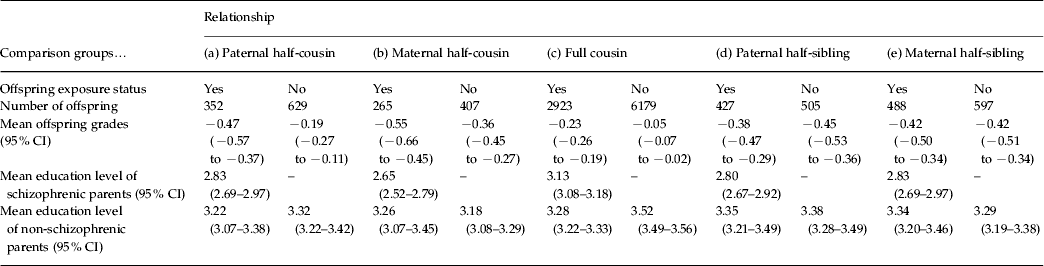
Descriptive statistics of offspring in each of the comparison group (Fig. 1) are shown in Table 2. As can be seen, all offspring has a mean grade that is negative, indicating that offspring from extended families with a schizophrenic member generally performed poorer than other offspring. Also, the mean school performances of unexposed offspring were not exactly the same, indicating that the baseline school performances in different family types were different. More specifically, children from extended families with only full cousins had considerably higher mean values of their grades compared with the other family groups. The education levels of the spouses of schizophrenic patients were similar across comparison groups.
Descriptive statistics of patients with schizophrenia, their relatives, and offspring in each comparison group

CI, Confidence interval.
To investigate the effect of genetic factors in mediating the observed effect on offspring school performance, we stratified the analysis by genetic relatedness. HLM was used to adjust for covariates and the clustering of data so that the average effect of parental schizophrenia to offspring school performance (i.e. the within-family β coefficient) could be examined. These details of the results are showed in Appendix Table A2, and summarized in Fig. 2. Within extended families, the association between parental schizophrenia and offspring school performance was strongest when comparing differentially exposed half-cousins (β=−0.23, p=0.01, n=65 126), followed by full cousins (β=−0.13, p<0.0001, n=917 678) and vanished when comparing half-siblings (β=0.04, p=0.31, n=203 506), indicating that offspring school performance became more similar as the genetic relatedness of offspring increased. Thus, the results suggest that change in genetic relatedness within extended families greatly moderates the association between parental schizophrenia and offspring school performance. A similar trend was also observed when offspring gender and/or parental education were not included as covariates (Appendix Table A3).
Associations between parental schizophrenic disorder and offspring school performance: effect size within extended family. Comparison of half-cousins, full cousins and half-siblings. The estimates denote fixed effect sizes. Values are β coefficients, with standard errors represented by vertical bars. * p<0.05, *** p<0.0001.

Next, we examined the effect of family environment on offspring school performance in two ways. (1) We compared the mean school performance between offspring with a schizophrenic father and those with a schizophrenic mother. If environment played an important role, the offspring with a schizophrenic mother would have worse school performance than offspring with a schizophrenic father. We found no significant difference in their school performance (mean difference=0.015 s.d., p=0.70, n=2739) (Appendix Table A4). (2) We stratified the association analysis according to offspring environmental similarity while controlling for genetic relatedness. It was achieved by comparing the strength of the associations (β coefficient) between paternal half-sibling and maternal half-sibling pairs and by comparing the association between paternal half-cousin and maternal half-cousin pairs (see Methods, statistical analysis). As showed in Fig. 3, there was no significant association between schizophrenia in parents and school performance in offspring neither within differentially exposed paternal half-sibling (β=0.01, p=0.83, n=98 166) nor within differentially exposed maternal half-sibling pairs (β=0.06, p=0.27, n=105 340) (Appendix Table A5). The strength of the association was also commensurate for paternal half-cousins (β=−0.21, p=0.01, n=68 371) and maternal half-cousins (β=−0.23, p=0.01, n=65 126) (Fig. 3; Appendix Table A6). Thus, in all the comparisons where we investigated the effect of the family environment, the results suggested that variability in offspring environmental similarity did not affect the association strength when the genetic relatedness was held constant. Altogether, we found no evidence that family environment substantially affected offspring school performance, lending little support to the hypothesis that the family environment played an important role for the association.
Association between parental schizophrenic disorder and offspring school performance. Comparison of paternal and maternal half-siblings and half-cousins. The estimates denote fixed effect sizes. Values are β coefficients, with standard errors represented by vertical bars. * p<0.05.

Discussion
In agreement with previous studies, we found that offspring of patients with schizophrenia exhibited poorer school performance compared with offspring of parents with no diagnosis (Fisher et al. Reference Fisher, Kokes, Harder and Jones1980; Janes et al. Reference Janes, Weeks and Worland1983; Ayalon & Merom, Reference Ayalon and Merom1985). Importantly, we also studied the putative mechanisms for this association; our data suggest that the association between parental schizophrenia and poorer offspring academic performance is primarily due to genetic factors.
Parents could affect offspring behavior through environmental or genetic mechanisms. To disentangle the effects of genetic and environmental influences, we stratified the association analyses according to genetic and environmental relatedness. Genetic factors greatly moderated the association; the effect size of exposure to a schizophrenic parent on offspring school performance dropped from −0.23 to −0.13 when genetic relatedness increased from 6.25% in half-cousins to 12.5% in full cousins, and the effect disappeared when genetic relatedness reached 25% in half-siblings (Fig. 2). Thus, there was strong evidence for genetic contributions to the association. However, environmental similarity between exposed offspring and unexposed offspring might increase together with genetic relatedness due to gene–environment correlation (Plomin et al. Reference Plomin, DeFries and Loehlin1977). As a result, based on these results alone, we cannot exclude the possibility that the observed genetic effects were mediated by environmental effects.
To test if family environments were important, we stratified the analysis according to environmental relatedness while holding genetic relatedness constant. We found no significant effect neither in paternal half-siblings nor in maternal half-siblings, and the association strength was only marginally different between paternal half-cousins and maternal half-cousins. In addition, we found no significant difference in mean school performance between offspring of schizophrenic mothers and offspring of schizophrenic fathers, even though the offspring of schizophrenic mothers were exposed to a more detrimental family environment. Altogether, these results gave little evidence for family environmental influences on the association, and supported the interpretation that the intergenerational association between parental schizophrenia and offspring academic performance was mainly mediated by genetic effects. An unexpected result was that the school performances in offspring of schizophrenia-discordant half-siblings were basically the same (β=0.04, p=0.31), when we would have expected poorer school performance among the offspring of the affected sibling. Even though the confidence intervals around these estimates are relatively wide and congruent with a true effect, the lack of effect was probably influenced by the low performance in offspring of half-siblings compared with other types of offspring (Table 2). Assortative mating, known to exist among patients with schizophrenia (Parnas, Reference Parnas1988; Lichtenstein et al. Reference Lichtenstein, Björk, Hultman, Scolnick, Sklar and Sullivan2006), could also possibly influence the association. Thus, possible genetic effects could have been masked by assortative mating and the strong selection effects among half-siblings.
School performance is a complex trait determined by multiple environmental and genetic factors (Lemelin et al. Reference Lemelin, Boivin, Forget-Dubois, Dionne, Séguin, Brendgen, Vitaro, Tremblay and Pérusse2007). It has previously been studied as a pre-morbid marker for later development of schizophrenia with inconsistent results. A Dutch twin study suggested that underperformance at school was one of the first prodromal signs of schizophrenia (Van Oel et al. Reference Van Oel, Sitskoorn, Cremer and Kahn2002), and a Swedish study reported that poor school performance was strongly associated with risk of schizophrenia (MacCabe et al. Reference MacCabe, Lambe, Cnattingius, Torrång, Björk, Sham, David, Murray and Hultman2008). In contrast, two Finnish studies found no association between poor school performance and schizophrenia development (Isohanni et al. Reference Isohanni, Järvelin, Nieminen, Jones, Rantakallio, Jokelainen and Isohanni1998; Cannon et al. Reference Cannon, Jones, Huttunen, Tanskanen, Huttunen, Rabe-Hesketh and Murray1999). Our results suggest that academic underperformance of offspring of parents with schizophrenia, who are at higher risk of developing schizophrenia, is due primarily to genetic factors. Thus, poor school performance is one of the initial signs in the development of schizophrenia, and could possibly be considered an endophenotype in this process (Allen et al. Reference Allen, Griss, Folley, Hawkins and Pearlson2009).
Our study had several strengths. Particularly, we employed a population-based design to reduce potential selection bias. We also used stratification within a quasi-experimental study design framework to pull apart presumably co-occurring genetic and environmental risks associated with poor offspring school performance. Our study also has some potential limitations. The prevalence of offspring with at least one parent with schizophrenia was only 0.25% in our study; lower than the 1% schizophrenia prevalence usually reported (Tandon et al. Reference Tandon, Keshavan and Nasrallah2008). One possibility is that the fertility of schizophrenia patients is lower than for non-schizophrenic individuals (Nanko & Moridaira, Reference Nanko and Moridaira1993), and our use of a strict criterion for schizophrenia classification, requiring at least two separate in-patient episodes involving a schizophrenia diagnosis (Lichtenstein et al. Reference Lichtenstein, Björk, Hultman, Scolnick, Sklar and Sullivan2006). In our study, we found decreasing associations with increasing genetic relatedness within extended families, suggesting genetic influences of the intergenerational association between parental schizophrenia and offspring school performance. However, it is not known whether the genetic effect was driven by those offspring that later would develop schizophrenia or could be attributed to the majority of the offspring. A long-term follow-up study would be necessary to elucidate this relationship. It has been observed that assortative mating exists among schizophrenia patients (Parnas, Reference Parnas1988; Lichtenstein et al. Reference Lichtenstein, Björk, Hultman, Scolnick, Sklar and Sullivan2006). Assortative mating could overestimate the intergeneration association since the offspring might in that case be exposed to more environment and/or genetic exposure, even though it would not have changed the pattern of results. Our study design cannot prove that family environment has no effect on offspring school performance. Since we found little support to the hypothesis that environmental effects were important for the intergenerational transmission, however, the most probable interpretation was that the environment did not play a substantial role for poorer school performance in offspring of parents with schizophrenia. We used offspring graduating from compulsory school during two time periods (1988–1997 and 1998–2006) with different grade systems. We standardized school grades for each period with Blom transformation and assumed no major temporal trends. We tested if the association was similar in the two time periods, and found neither an effect of the time period nor an interaction effect between time period and parental schizophrenia status on offspring school performance (p=0.20 for time period, p=0.40 for period and exposure status interaction; Appendix Table A7), thus validating our approach. Finally, offspring of schizophrenic parents did not represent all families with a schizophrenic individual in Sweden, because fewer schizophrenic compared with non-schizophrenic individuals have children. However, since parents with more severe symptoms (and likely stronger impact on offspring performance) are even less likely to have children, our estimate of the association between parental schizophrenia and offspring school performance was probably conservative.
Although most children of schizophrenic parents do not develop clinically significant cognitive problems, our results support genetically determined early deficits or impaired development of cognitive functioning in these children (Reichenberg et al. Reference Reichenberg, Caspi, Harrington, Houts, Keefe, Murray, Poulton and Moffitt2010). This could have practical implications for school, mental health and social services. A substantiated decrease in cognitive performance during adolescence among children with a severely mentally ill parent or other family member might motivate assessment and monitoring also of other prodromal signs (Salokangas & McGlashan, Reference Salokangas and McGlashan2008). Early detection of prodromal signs and impaired functioning followed by appropriate interventions could, for instance, include collaboration between child and adult psychiatric services, educational assistance in school and family support from the social services.
Acknowledgements
This work was supported by National Institutes of Health (NIH) grant no. 061817-01A1, quasi-experimental studies of early risk factors for severe psychopathology. The authors wish to acknowledge the Swedish Research Council, Swedish Council for Working Life and Social Research. The authors are grateful to Dr Chia Kee Seng for his helpful comments and suggestions on the manuscript.
Declaration of Interest
None.
Appendix
Regression analysis of the effect of parental schizophrenia on offspring school performance

a Based on the sample including 631 358 unrelated offspring.
Hierarchical linear modeling of the effect of parental schizophrenia on offspring school performance in half-cousin, full-cousin and half-sibling datasets

a Based on the sample including 65 126 offspring.
b Based on the sample including 917 678 offspring.
c Based on the sample including 203 506 offspring.
Hierarchical linear modeling of the effect of parental schizophrenia on offspring school performance in half-cousin, full-cousin and half-sibling datasets using different combinations of covariates

a The model adjusted for offspring gender, parental education level and an interaction term with offspring gender and exposure status.
Comparison of school performance between offspring with a schizophrenic mother and offspring with a schizophrenic father, respectively

a By t test.
b Adjusted for offspring gender and parental education in linear regression.
Hierarchical linear modeling of the effect of parental schizophrenia on offspring school performance in paternal and maternal half-sibling datasets

a Based on the sample including 98 166 offspring.
b Based on the sample including 105 340 offspring.
Hierarchical linear modeling of the effect of parental schizophrenia on offspring school performance in paternal and maternal half-cousin datasets

a Based on the sample including 68 371 offspring.
b Based on the sample including 65 126 offspring.
Test of interaction effect between period and parental schizophrenia status on offspring school performance