

In 2014, the Flemish Parliament approved a parliamentary act on measures for pupils with specific educational needs (M-Decree) with the aim to make all educational levels (primary, secondary, and postsecondary education) more inclusive. The act contains measures that allow pupils with disabilities to participate fully, effectively, and on equal terms in regular education. The M-Decree follows the principle of ‘regular education if possible, special education if necessary’ (Ministry of Education, 2014).
Inclusive education indicates an educational practice in which all pupils can participate, taking into account their strengths and talents and paying special attention to neutralising the barriers caused by their disability. The first step towards educational change and innovation was taken by this legislative basis (M-Decree), but the realisation of inclusion in the entire educational field will require more than just a legal change so that teachers are prepared for teaching pupils with diverse needs (Vandenbussche & Schauwer, Reference Vandenbussche and Schauwer2018).
In order to move forward in the process towards inclusive education we need to recognise that both the teacher and the teacher-training program play a crucial role within educational change (Donnelly & Watkins, Reference Donnelly and Watkins2011). Several authors have emphasised the importance of preservice teachers developing positive attitudes towards pupils with disabilities and inclusion while enrolled in the teacher-training program (Sharma & Sokal, Reference Sharma and Sokal2015). An attitude is considered a multidimensional concept, consisting of three components — an affective, a cognitive, and a behavioural component (Triandis, Reference Triandis1971) — that are interpreted together as a person’s degree of favourableness or unfavourableness with respect to a psychological object or person (Triandis, Reference Triandis1971). De Fever and Flament (Reference De Fever, Flament, Grietens, Vanderfaeillie and Hellinckx2005) state that the teacher’s attitude towards pupils with disabilities is seen as a precondition for creating qualitative, inclusive education, which stands for education suited for all pupils, regardless of whether they have a disability or not. A positive attitude of a (preservice) teacher is an attitude where the teacher has a positive feeling (affective component) towards a pupil with a disability, where the teacher knows what this disability means in terms of school skills and wellbeing (cognitive component), and that he or she knows how to behave in an inclusive way with special attention for the inclusion of this pupil (behavioural component). Positive teacher attitudes towards pupils with disabilities are seen to contribute to more effective teaching strategies, such as using different instructional formats, the development of a behaviour management plan, and improved learning environments, which adhere to the principles of universal design for learning in which it becomes possible for every pupil to learn (Sharma, Forlin, & Loreman, Reference Sharma, Forlin and Loreman2008; Winzer & Mazurek, Reference Winzer and Mazurek2011).
The factors that influence the attitudes of teachers can be divided into pupil, teacher, and environmentally related variables. Child-related variables mainly focus on the type or severity of the pupil’s disability (Hassanein, Reference Hassanein2015). The nature or severity of the disability of the pupil has an effect on how teachers will see the pupil (Avramidis, Bayliss, & Burden, Reference Avramidis, Bayliss and Burden2000). Preservice teachers have more favourable attitudes towards inclusion of young pupils with mild disabilities than those with severe disabilities and emotional–behavioural disorders (Subban & Sharma, Reference Subban and Sharma2006).
In terms of teacher-related variables, several studies show that women exhibit more positive attitudes towards the inclusion of pupils with disabilities than men (Avramidis & Norwich, Reference Avramidis and Norwich2002). Research suggests that younger teachers have more positive attitudes in comparison with their older colleagues (Hwang & Evans, Reference Hwang and Evans2011). Teachers who have more experience with pupils with disabilities exhibit more positive attitudes than teachers without, as also stated by the contact hypothesis (Avramidis & Norwich, Reference Avramidis and Norwich2002; de Boer, Pijl, Post, & Minnaert, Reference de Boer, Pijl, Post and Minnaert2012).
Examples of environmental variables are the type of school, the school’s ethos, or the subjective norm (in the teacher-training program). This article focuses on the subjective norm, as described by the theory of planned behaviour (TPB). The subjective norm is the prevailing standard, mostly produced by a role model (e.g., teacher educator), containing values and moral implications, in that specific situation. In other words, the subjective norm is about the expectation someone has that actually determines how you should behave in that situation according to that same person. For example, if you have a group of friends who prefer a certain football team, then you are expected to behave at least neutrally but not against this football team in the company of these friends.
When translated to the situation at hand, then the subjective norm in the teacher-training program influences the attitudes of the preservice teacher, because the teacher educators are role models (Lambe, Reference Lambe2011). These attitudes, in turn, influence the way the preservice teacher behaves. Bandura (Reference Bandura and Goslin1969) demonstrated this a long time ago with his psychological research that human behaviour is constructed by observing others, and this theory still stands today. As a result, the observed behaviour of the teacher educators forms a guideline or the subjective norm for future actions of the preservice teacher (Bandura, Reference Bandura and Goslin1969; Klaassen & Wessels, Reference Klaassen and Wessels2010; Lambe, Reference Lambe2011). Yet research on this topic is scarce, especially when it comes to pupils with disabilities.
The link between the subjective norm, attitudes, and behaviour is explained by TPB (Ajzen, Reference Ajzen, Kuhl and Beckmann1985). TPB is often used in the social sciences and states that the intention to behave in a certain way can be predicted by that person’s attitudes, the applicable subjective norm, as well as perceived behavioural control. Intention in turn predicts the way one will behave. Attitudes are described above, the subjective norm is described below but perceived behavioural control deserves a word of clarification as attitudes, subjective norm, and perceived behavioural control together have an influence on the intention of a person. Perceived behavioural control is the idea a person has about the degree of control they have over the behaviour they will adopt. In educational research this has often been operationalised as self-efficacy, which implies a belief in one’s own teaching abilities (Eagly & Chaiken, Reference Eagly and Chaiken1993). Together, these factors are very important in a teacher’s behaviour (Ajzen, Reference Ajzen, Kuhl and Beckmann1985; Ajzen & Fishbein, Reference Ajzen and Fishbein1977). Even though all factors in the TPB model are important, this study takes a deeper look into only two elements from the TPB, namely attitudes and subjective norm, because research on this link is scarce and this is a possible starting point in understanding the inclusive behaviour of teachers in general.
Teacher educators in the teacher-training program are therefore of importance because they are the influencing role models for preservice teachers. The attitude and behaviour of the teacher educator, with regard to pupils with disabilities, can influence how the preservice teacher will behave within an inclusive setting (Klaassen & Wessels, Reference Klaassen and Wessels2010; Lambe, Reference Lambe2011). Like teachers in primary and secondary education, the teacher educators’ actions in the teacher-training program are based on a normative framework, as a result of which he or she continually transmits value-oriented and moral messages during the lessons or lectures (Klaassen & Wessels, Reference Klaassen and Wessels2010). One way in which the normative framework of the teacher educator in the teacher-training program can influence preservice teachers is through communication. It is not only about understanding the spoken content but also about deriving the implicit message (Walsh, Reference Walsh2013). This is summarised in the concept of discourse. Discourse is defined as the whole of reasoning with which a subject is put in a certain perspective, and in this way it forms the subjective norm with regard to a certain concept. Within a discourse, it is determined who or what is perceived as typical or atypical.
The first central theory within this study is the theory of persuasive communication. Persuasive communication influences attitudes and ultimately causes behavioural change (Campbell, Reference Campbell2006; Rillotta & Nettelbeck, Reference Rillotta and Nettelbeck2007; Stiff & Mongeau, Reference Stiff and Mongeau2016). Triandis (Reference Triandis1971) argues that more change in attitudes will be observed if the source is competent, familiar, and attractive, and radiates authority. Campbell (Reference Campbell2006) categorises these characteristics into three factors: (a) credibility (reliability, expertise); (b) likability (similar, attractiveness); and (c) power (status, authority).
Morton and Campbell (Reference Morton and Campbell2008) demonstrated the importance of perceived credibility. They found that children had more positive attitudes when a professional transferred the message (information about an unfamiliar child with a disability) instead of the mother of a child with a disability, while both roles were interpreted by the same person (Morton & Campbell, Reference Morton and Campbell2008). Likability was demonstrated by Corrigan et al. (Reference Corrigan, River, Lundin, Penn, Uphoff-Wasowski, Campion and Kubiak2001), where pupils showed more change when the educational intervention was given by a source that was perceived as likeable. The influence of power has been repeatedly confirmed by studies on the influence of teachers (Barker & Graham, Reference Barker and Graham1987).
Yet attitude change cannot be fully explained by using a reliable, sympathetic, or expert source. There is another important factor that has not been taken into account, namely the content of the message itself. The cognitive dissonance theory plays an important role when looking at the content of the message and explains what happens when the discourse of the persuasive communication is in conflict with the attitudes of the recipient. Festinger (Reference Festinger1957) states that people experience cognitive dissonance when they behave inconsistently with their original attitudes. To reduce this inconvenience, people often replace their original attitude to make it consistent with their behaviour (Festinger, Reference Festinger1957). If the discourse of the teacher educator conflicts with the attitudes of the preservice teacher, it can lead to cognitive dissonance. The study by Gawronski and Strack (Reference Gawronski and Strack2004) clarifies this with an example of what cognitive dissonance is and how it is linked to attitude and behavioural change. They did two experiments in which the participants were asked to write an essay that was inconsistent with their attitudes. The results showed that there were changes in participants’ attitudes due to the behaviour they had to set — in this case, writing an essay that was not in line with their own beliefs. Cognitive dissonance can therefore cause change in attitudes (Gawronski & Strack, Reference Gawronski and Strack2004).
In conclusion, the attitudes of the teacher educators are extremely important according to TPB because they are a good predictor of behaviour, and according to the theory of persuasive communication and cognitive dissonance, the subjective norm in the teacher-training program will influence the attitudes of the preservice teachers. However, little research has been done on influencing the attitudes of preservice teachers via the subjective norm. It is necessary to examine the sources of influence among teacher educators in order to expand knowledge about the origin of (negative) attitudes. This study will investigate whether the subjective norm in terms of discourse in the teacher-training program can have an influence on the attitudes of preservice teachers. This leads to the following two research questions:
-
Does the subjective norm, installed by teacher educators, have an influence on the attitudes of preservice teachers?
-
Is a process of cognitive dissonance triggered due to the subjective norm?
Methods
Experimental design
An experimental design was used with two conditions and two measurement moments: a pre-measurement 6 weeks before the intervention and a post-measurement immediately after the intervention. By manipulating certain variables within this intervention, an attempt was made to install a certain subjective norm. Two studies were carried out with preservice teachers who were in their third year.
Participants
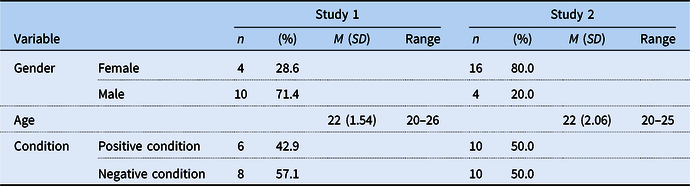
In total, there were 24 preservice teachers in the first study, as depicted in Table 1. Only 14 preservice teachers had fully completed the survey in both the pre- and post-test (response: 58.3%). Of the 14 preservice teachers, the majority were men (n = 10, 71.4%) and they had an average age of 22 (SD = 1.54).
Characteristics of the Preservice Teachers

In the second study, there were 34 preservice teachers, of which 20 preservice teachers had completed the survey in both the pre- and post-test (response: 58.8%). Of the 20 preservice teachers in the second study, the majority were women (n = 16, 80.0%), and they had an average age of 22 years (SD = 2.06).
This sample was randomly subdivided into a positive and negative condition; in the first study, eight preservice teachers (57.1%) were taught in the negative discourse, while 10 preservice teachers (50%) were taught in the negative discourse in the second study.
Procedure
The experiment was announced as a guest lecture in both groups through the online learning portal Toledo of the preservice teachers with the complete design of the study and the clear message that the researchers have no connection whatsoever with the teacher-training program in terms of evaluation or grades. The preservice teachers were randomly split into a positive and negative condition. During both guest lectures, an extra researcher was present. This additional researcher had the task of observing, ensuring that the research complied with standardisation and that there was adequate implementation. The data of the pre-measurement were collected using an electronic questionnaire in Qualtrics on the online learning portal Toledo. The data from the post-measurement were collected on paper immediately after the guest lecture. This post-measurement questionnaire also contained a section on privacy of personal data and the informed consent for the study. Afterwards, the preservice teachers were debriefed orally. KU Leuven’s ethics committee judged that the procedures in this study were in line with the applicable ethical rules for research.
By manipulating certain variables within this course, an attempt was made to install a certain subjective norm. The independent variable, the subjective norm in terms of discourse (i.e., the message), was manipulated within the experiment. The lecturer (i.e., source of influence) was kept constant in both conditions.
Source of influence
In both the positive and negative condition, aspects of the source of influence, which, according to research, have an effect on attitudes, were kept as constant as possible. As a result, changes in attitudes can be attributed to the difference in subjective norm (discourse). According to Campbell (Reference Campbell2006), the effect of the source itself on attitudinal influence can be increased by responding to three factors: (a) credibility, (b) likability, and (c) power. The source of influence in this research was the guest lecturer. The credibility of the guest lecturer was emphasised by adding an extra slide in the PowerPoint presented in the guest lecture. This slide contained information about the guest lecturer that emphasised her expertise on inclusive education. To increase the reliability of this guest lecturer, the design of the PowerPoint was based on the PowerPoint format of a well-known university. Because of the presence of the university logo, the guest lecturer was associated with this eminent university and the preservice teachers saw her as a reliable expert. To let the preservice teachers experience the guest lecturer as likable, the guest lecturer smiled and made the same two jokes every time during the guest lecture. Finally, authority was emphasised by adopting a certain attitude in the classroom and by consistently responding to noise. The two different conditions each received the same content about reasonable accommodations and inclusive education, but the discourse of the guest lecturer differed between the two conditions.
The message
The subjective norm was operationalised as the prevailing standard, produced by a teacher educator (guest lecturer), containing values and moral implications, in that specific situation. As a function of values, the correct or incorrect term for a person with a disability was used. To manipulate the moral implications, negative examples were used as well as a dated or inappropriate medical model to look at disability. To manipulate the subjective norm, the message was adjusted, and this concrete operationalisation is described as follows for the two conditions.
Negative condition
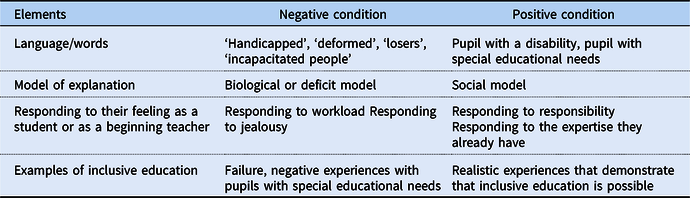
To install a negative subjective norm, the guest lecturer emphasised the negative discourse using various elements: language (e.g., ‘deformed people’, ‘disabled losers’, …), use of the biological or deficit model, and negative examples of inclusive education (e.g., the statement ‘of course you are overworked, those children with disabilities ask for one adjustment after the other, which makes you run out of time’). A comparison of elements between the negative and positive conditions can be found in Table 2. The language use of a teacher is a central aspect of the discourse and can convey an implicit message to preservice teachers.
A Comparison of Elements in Both Conditions

Positive condition
To install a positive subjective norm, the same elements were used in a more positive tone: language, use of the social model, and citing positive examples of inclusive education. The use of language in the positive discourse focused on the terms ‘specific educational need’ and the correct use of the term ‘disability’. We followed the human rights guidelines about how we should communicate about this group (Schulze, Reference Schulze2010).
Instruments
In this study we used the Chedoke-McMaster Attitudes Towards Children With Disabilities (CATCH) Scale (Rosenbaum, Armstrong, & King, Reference Rosenbaum, Armstrong and King1986), which is an instrument used to measure the attitudes of pupils to their peers with a disability. This was originally designed for pupils between 9 and 13 years, but had been used for an older population (Bossaert, Colpin, Pijl, & Petry, Reference Bossaert, Colpin, Pijl and Petry2011). This questionnaire was translated into Dutch by three certified English-Dutch translators and had been used in a study in Belgium (Bossaert et al., Reference Bossaert, Colpin, Pijl and Petry2011). This questionnaire consists of 36 items that participants must answer using a 5-point Likert scale (0 = completely disagree, 4 = complete agreement). These items include statements that evaluate preservice teachers’ attitudes towards pupils with disabilities. In this research, we examined the attitudes of preservice teachers with regard to pupils with disabilities in general, which is in consonance with the approach of the CATCH.
The 36 items are further subdivided into three parts with 12 items each, based on the three components (affect, cognition, and behaviour) of attitudes proposed by Triandis (Reference Triandis1971). Each component comprises as many positive as negative statements, with the positive and negative alternating. The negative items must then be positively coded. After computing the scores, the items are between 0 and 40, with a higher score representing attitudes that are more positive. A score between 0 and 15 is seen as a less positive attitude, around 20 as a rather neutral attitude, and over 25 a positive attitude.
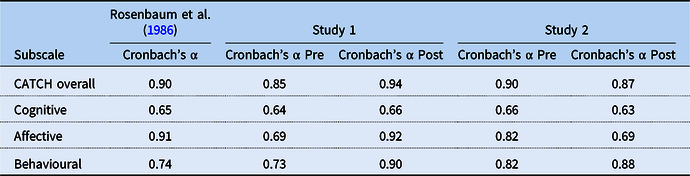
Rosenbaum et al. (Reference Rosenbaum, Armstrong and King1986) showed that the internal consistency for the English version of the CATCH was 0.90. The reliability of the measuring instrument for attitudes (CATCH) in light of the original psychometric properties by Rosenbaum et al. (Reference Rosenbaum, Armstrong and King1986) is shown in Table 3, which illustrates that the psychometric properties are generally good and close to the original properties, except for the affective component in the pre-measurement of Study 1 (0.69) and in the post-measurement of Study 2 (0.69).
Psychometric Properties of the Chedoke-McMaster Attitudes Towards Children With Disabilities (CATCH) Scale

Analysis
Descriptive statistics were used to represent the mean values for attitudes in the different conditions. In order to test differences in conditions according to the presupposed hypothesis, an ANOVA for repeated measurements was used. For the ANOVA, it was examined whether the dataset met the assumption of normality. This condition was met for both Study 1 and Study 2.
Results
Does the Subjective Norm, Installed by Teacher Educators, Have an Influence on the Attitudes of Preservice Teachers?
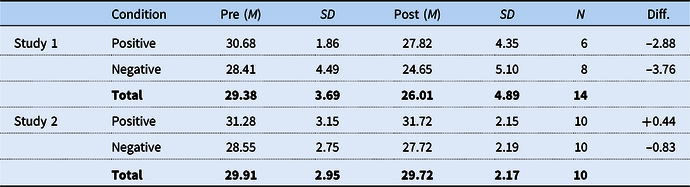
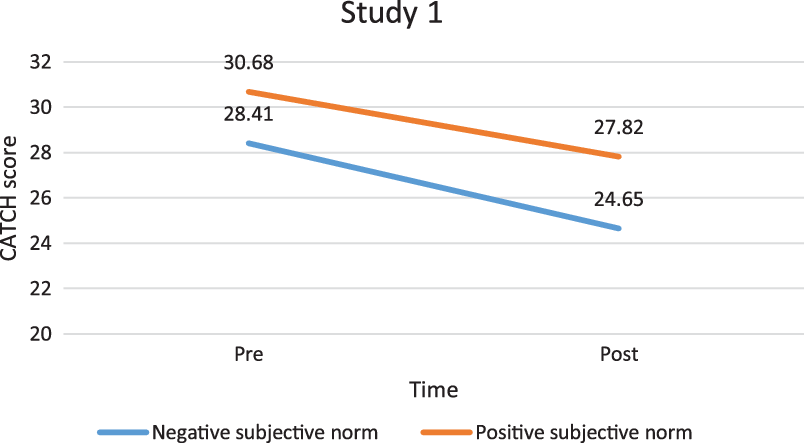
Table 4 depicts the average total score on the CATCH of the preservice teachers for Study 1 and 2. In the first study, the group in the positive condition during the pre-measurement had a CATCH score of 30.68 (SD = 1.86) and during the post-test, 27.82 (SD = 4.35). The average total score on the CATCH of the preservice teachers in the negative condition during the pre-measurement was 28.41 (SD = 4.49) and during the post-test, 24.65 (SD = 5.10). Given the scores of the first study, we can conclude that the positive attitudes in the positive condition remain positive, but that in the negative condition there arises a range of neutral to positive attitudes.
Descriptive Statistics Study 1 and 2

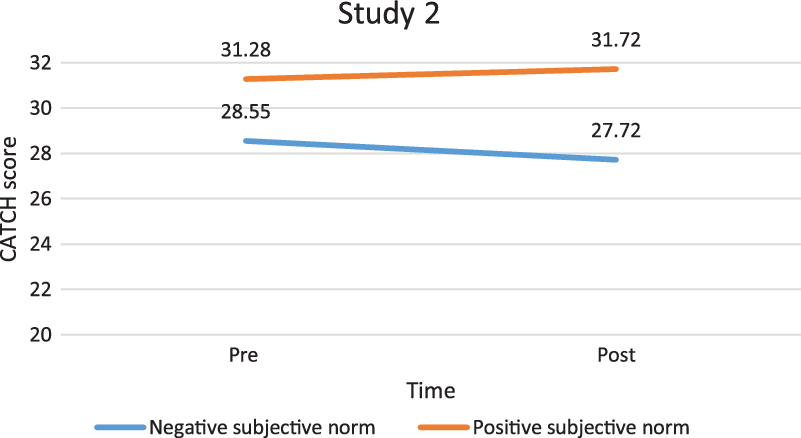
In the second study, the group in the positive condition during the pre-measurement had a score of 31.28 (SD = 3.15) and during the post-test, 31.72 (SD = 2.15). The average total score on the CATCH of the preservice teachers in the negative condition during the pre-measurement was 28.55 (SD = 2.75) and during the post-test, 27.72 (SD = 2.19). Given the scores in Study 2, we can state that there are positive attitudes in both conditions but there is a decrease in attitudes in the negative condition.
We investigated the hypothesis that for the group in the positive condition the attitudes would remain stable and in the negative condition, the attitudes would change. In Study 1, both the positive and negative condition groups’ attitudes showed a decrease in attitudes, as shown in Figure 1. In Study 2, the group in the positive condition showed an improvement of attitudes and the group in the negative condition showed a decrease in attitudes, as shown in Figure 2. The effect of measurement moment (pre-measurement and post-test) and condition was investigated using an ANOVA for repeated measurements. In Study 1, a significant main effect of measurement moment was found on the attitudes of preservice teachers, F(1, 12) = 5.54, p = .037, partial η2 = 0.32. No significant interaction effect was found. In Study 2, no significant main or interaction effect of measurement moment was found on the attitudes of preservice teachers, F(1, 18) = 0.109, p = .745, partial η² = 0.006.
Study 1 Chedoke-McMaster Attitudes Towards Children With Disabilities (CATCH) Scale Pre-Post.

Study 2 Chedoke-McMaster Attitudes Towards Children With Disabilities (CATCH) Scale Pre-Post.

Looking at the subscales of the CATCH in Study 1, no significant main effect of measurement moment or interaction was found on the cognitive component, F(1, 12) = 1.61, p = .228, partial η² = 0.12, F(1, 12) = 0.63, p = .442, partial η² = 0.05. No significant main effect of measurement moment or interaction effect was found on the affective component, F(1, 12) = 1.38, p = .262, partial η² = 0.10, F(1, 12) = 0.063, p = .806, partial η² = 0.103. A significant main effect of measurement moment was found on the behavioural component, F(1, 12) = 9.62, p = .009, partial η² = 0.45, but no significant interaction effect, F(1, 12) = 0.27, p = .612, partial η² = 0.02.
Looking at the subscales of the CATCH in Study 2, no significant main effect of measurement and interaction effect was found on the cognitive component, F(1, 18) = 1.31, p = .267, partial η² = 0.07, F(1, 18) = 0.07, p = .795, partial η² = 0.004. No significant main effect of measurement moment or interaction effect was found on the affective component, F(1, 18) = 2.01, p = .173, partial η² = 0.10, F(1, 18) = 0.00, p = 1, partial η² = 0.101. No significant main effect of the measurement moment or interaction effect was found on the behavioural component, F(1, 18) = 0.002, p = .963, partial η² = 0.00, F(1, 18) = 4.05, p = .59, partial η² = 0.184.
Is a Process of Cognitive Dissonance Triggered Due to the Subjective Norm?
To determine whether cognitive dissonance occurred, we merged the sample of the two studies and divided the preservice teachers into two groups based on their attitudes. Preservice teachers who scored below the general average were divided into the group with a less positive attitude, while those who scored higher than the group average were classified in the group with a more positive attitude.
First, we investigated the hypothesis that for the group in the positive condition the attitudes would remain stable and that there would be an improvement based on cognitive dissonance in the group of preservice teachers with a less positive attitude.
Second, we tested the hypothesis that for the group of teachers with a less positive attitude in the negative condition the attitudes would remain the same. In addition, for the group of teachers with a rather positive attitude, their attitudes would decrease.
In Table 5, we show the average scores for the CATCH. A significant cognitive dissonance effect can be seen in the negative condition, where the more positive group of preservice teachers dropped an average of almost 3 points with regard to the post- measurement. In the group of preservice teachers in the positive condition, we see a nonsignificant improvement for preservice teachers with less positive attitudes.
Cognitive Dissonance Effect

Note. N = 34 (positive attitudes, n = 17; less positive attitudes, n = 17).
* Significant at α < 0.05.
Based on a t-test for paired samples, the differences in means between the pre- and post-test of both conditions were checked, as depicted in Table 5.
Discussion
This study is based on the idea that attitudes are influenced by the subjective norm as stated by the TPB. Research on this topic is scarce. Therefore the link between attitudes and the subjective norm is explored by operationalising it through persuasive communication and the resulting possibility of cognitive dissonance, which also states that a certain form of communication in the environment (i.e., the subjective norm) can have an influence on a teacher’s attitudes. In this study, we used a quantitative design with a pre- and post-measurement in which we manipulated the subjective norm during the intervention. The following hypothesis was investigated: Does the subjective norm, installed by the teacher educators, have an influence on the attitudes of preservice teachers? According to the theory of persuasive communication and the TPB, the subjective norm in the teacher-training program will influence the attitudes of the preservice teachers.
In Study 1, the preservice teachers’ attitudes in the positive conditions as well as the group in the negative condition showed a decrease in attitudes, and a significant main effect of measurement moment was found on the attitudes of preservice teachers. These first results are not in agreement with the proposed hypothesis, in which we assumed that the attitudes in the positive condition would stay the same or improve. The second result confirms the assumption that the negative condition might have a negative effect on attitudes.
In Study 2, the group in the positive condition showed an improvement of attitudes and the group in the negative condition showed a decrease in attitudes, but no significant main effect of measurement moment was found on the attitudes of preservice teachers. The results from the second study are in concordance with what we would expect based on the proposed hypothesis.
The results of the first research question are in line with previous research (see, for e.g., Nowicki and Sandieson, Reference Nowicki and Sandieson2002), where it became clear that teachers could influence pupils’ attitudes towards other pupils with disabilities. This study focuses on teacher educators and their students, which is not such a big leap as they fulfil the same kind of role model function, except for the short time aspect, which will be considered further in the discussion of this study (Nowicki & Sandieson, Reference Nowicki and Sandieson2002). The first research question was based on the persuasive communication theory that is about (explicit or implicit) messages to change attitudes and behaviour. The objective of this theory is contained in the word itself, as it is about seducing or persuading the hearts and thoughts of the audience that hears the message. In this case, it concerned preservice teachers who received a positive or negative message about pupils with disabilities. We can therefore cautiously assume that this finding therefore also applies to preservice teachers in the teacher-training program, where the subjective norm, installed by teacher educators, persuaded the attitudes of the preservice teachers.
Second, in this study we investigated whether there is a process of cognitive dissonance triggered due to the subjective norm. The hypothesis was that preservice teachers experience cognitive dissonance when they hear statements or see behaviour that is inconsistent with their original attitudes. To reduce this inconvenience, preservice teachers could replace their original attitude to make it consistent with the subjective norm (Stiff & Mongeau, Reference Stiff and Mongeau2016).
We saw cognitive dissonance in the negative condition where the more positive group dropped an average of almost 3 points, a significant difference with regard to the post-measurement. The group with the previously less positive attitudes improved in the negative condition, but no significant effect was found here. Only the first result corresponds to the hypothesis that a negative subjective norm might cause a negative attitude change.
In the positive condition, we see a decrease in attitudes in the more positive group, which we did not expect, based on our hypothesis. We saw an improvement in the less positive group, which we anticipated, based on our hypothesis.
Based on these findings, which partially support our hypothesis, we can carefully assume that cognitive dissonance took place in which the previously positive attitudes were replaced by more negative ones during the experiment.
We see a decrease in the positive group in the positive condition, but we would at least expect stability there or an improvement. We see an improvement in attitudes of the less positive group in the negative condition. This is not in complete agreement with the outcome we anticipated. These conflicting results may be due to the strength of the attitudes of the preservice teachers. The attitudes were not extremely positive or negative and are therefore less susceptible to cognitive dissonance (Brannon, Tagler, & Eagly, Reference Brannon, Tagler and Eagly2007; Festinger, Reference Festinger1957). Research shows that the stronger the original attitude is, the more pronounced the cognitive dissonance will be (Brannon et al., Reference Brannon, Tagler and Eagly2007). People experience more cognitive dissonance when there is something at stake. Cognitive dissonance appears to be more pronounced in situations in which one’s decision or behaviour is irreversible or in situations involving preliminary decisions (Jonas, Schulz-Hardt, Frey, & Thelen, Reference Jonas, Schulz-Hardt, Frey and Thelen2001). In this study, there were no consequences attached to this guest lecture in terms of grades or evaluation. This could have made preservice teachers less motivated to sharpen their attitudes or to defend them mentally.
On the other hand, based on the two results that are in alignment with the hypotheses, we can state that it is extremely important that teacher educators are aware of their role in teacher training because of their influence on teachers’ attitudes towards pupils with disabilities. When we therefore know that positive attitudes are a clear condition (De Fever & Flament, Reference De Fever, Flament, Grietens, Vanderfaeillie and Hellinckx2005) for inclusion and that an important influencing environmental factor is the subjective norm (Klaassen & Wessels, Reference Klaassen and Wessels2010) that the teacher educator installs as a role model for the preservice teacher, it seems essential that teacher-training programs should devote a great deal of attention to the installation of a positive subjective norm. This means that they should not only focus on shaping the curriculum for an inclusive practice but also devote sufficient attention to the inclusive mindset of teacher educators. We agree with Conderman and Johnston-Rodriguez (Reference Conderman and Johnston-Rodriguez2009) that there is a lot of research on teacher-training programs that concerns the teachers’ readiness to include pupils with disabilities assessing feelings of competence, but there is not a lot of research on the subjective norm in the teacher-training program or on the teacher educators for that matter.
Limitations
This study was subject to a number of methodological limitations. First, a small sample was used, which makes it difficult to generalise the findings. Nevertheless, the results of this study are an indication for follow-up research, as already stated by Shevlin and Miles in Reference Shevlin and Miles1998. They stated that there is nothing wrong with conducting well-designed small studies. Small studies just need to be interpreted carefully. Although small studies can provide results quickly, they do not yield reliable or precise estimates. Therefore, data from such studies should be used to design larger confirmatory studies (Shevlin & Miles, Reference Shevlin and Miles1998). We therefore propose to take a closer look at the teacher-training program and to conduct further research into the subjective norm in these programs using larger samples. This way, positive subjective norm can be actively deployed to strengthen the attitudes of preservice teachers, and by extension their behaviour (Ajzen, Reference Ajzen1991).
Second, there is an underrepresentation of women in Study 1 and an underrepresentation of men in Study 2, which may again question the applicability and generalisation of the results. It is possible that these differences within the samples led to underestimating or overestimating the effect of the intervention, but this cannot be demonstrated with certainty because there is no consensus about the influence of gender (e.g., de Boer, Pijl, Post, & Minnaert, Reference de Boer, Pijl, Post and Minnaert2012; Tamm & Prellwitz, Reference Tamm and Prellwitz2001).
Third, social desirability plays a major role in self-reporting questionnaires such as the CATCH. This means that preservice teachers will respond in a way that they think the researchers will want them to answer rather than what they really think. This could explain the positive scores within the study in the pre- and post-test. Furthermore, online and paper survey modes do not necessarily produce comparable results (Yetter & Capaccioli, Reference Yetter and Capaccioli2010). Using off- or online surveys can be an influencing factor if the participants experience a large discrepancy between their analogue and digital skills (e.g., with smaller children, older people). The participants in our study are students, where it does not seem to be a real barrier. Alternatively, in the future we could offer a choice between online and paper-and-pencil survey formats or just stick to one format only.
Fourth, in this study, the long-term effect was not included due to the small scale of this project. Future research, however, can investigate the effect of one or more lessons in the long term, so it might be possible to focus on the persistency of these influences. By examining the effect of different lectures with the same discourse, knowledge about the origin of attitudes among teachers can be extended. We agree with MacFarlane and Woolfson (Reference MacFarlane and Woolfson2013) that future research should continue to take into account the complex nature of attitudes, the role of other teaching staff in promoting inclusion, and the degree of complexity with regard to variables that may influence attitudes and behaviour such as the length of time to which teachers are exposed (Lambe, Reference Lambe2011). In this study, there was only one guest lecture, but intensive and prolonged exposure to a pro-inclusive subjective norm should be further considered in future research.
Future Research
Our results are not entirely in alignment with the hypotheses we projected, so it would be interesting to take a closer look at the cognitive dissonance theory and the TPB with a larger sample of teacher educators and in different teacher-training programs. The basic idea for this research is that the attitude and behaviour of teacher educators have an important influence on the attitudes of preservice teachers. However, research on the role models or subjective norm that influence the attitudes of preservice teachers is scarce. Further elaborating on this concept of the subjective norm is important for teacher education. Teachers with positive attitudes put more emphasis on education that ensures that all pupils can learn (and therefore those with disabilities). Teacher training should therefore be a cradle for positive attitudes, and the role of teacher educators is crucial in this respect. It is important that follow-up research tries to unravel the influence of the subjective norm in the teacher-training program.
If teacher educators have an impact on the attitudes of the preservice teacher, the next step may be to examine what attitudes teacher educators have within the Flemish teacher-training programs and how we can train them to install positive subjective norms in the education programs. However, knowing that the TPB is more than attitudes and subjective norm, future studies should include all factors from the TPB in order to create a holistic picture. This first step, by linking two variables to the theory of persuasive communication and the cognitive dissonance theory, is already a step forward. Based on these findings, professionalisation can then be developed to make teacher educators aware of their influence.
Conclusion
This study has shown that preservice teachers have relatively positive attitudes towards pupils with disabilities. Literature has already shown that positive attitudes for teachers are essential for inclusion to succeed, and other studies show that the subjective norm in teacher education is very important in influencing preservice teachers’ attitudes, which our study also showed. From the results of this research it can be noted with caution that one guest lecture in a negative discourse is sufficient to influence the attitudes of preservice teachers. The conclusion is therefore a plea for teacher education programs to not only focus on strong inclusive curricula but also pay sufficient attention to the inclusive mindset of teacher educators as role models for preservice teachers.
Acknowledgements
I would like to thank all students who participated in this study and the university college to allow this experiment in their teacher-training program. Many thanks to master thesis student Hannelore Behaegel who contributed to this study. Also a special thank you to English teacher Esther Plessers who read and improved this article.