1. Introduction
Calc-alkaline granitoids are commonly composed of spacious granodiorite and tonalite with Na2O > K2O. They may also contain abundant mafic microgranular enclaves (MMEs) and are temporally-spatially associated with small-scale intermediate to basic intrusions. Three classical mechanisms have been generally proposed to interpret the generation of calc-alkaline granitoids: (1) crustal assimilation and fractional crystallization of basaltic magmas (Bigazzi, Del Moro & Macera, Reference Bigazzi, Del Moro and Macera1986; López, Castro & García-Casco, Reference López, Castro and García-Casco2005; De Souza et al. Reference De Souza, Martin, Peucat, De Sá and Macedo2007), (2) partial melting of mafic lower crust (Michard-Vitrac et al. Reference Michard-Vitrac, Albarède, Dupuy and Taylor1980; Tepper, Nelson & Bergantz, Reference Tepper, Nelson and Bergantz1993; Jung et al. Reference Jung, Masberg, Mihm and Hoernes2009), and (3) mixing of mafic and felsic melts (Vernon, Reference Vernon1990; Bateman, Reference Bateman1995; Janoušek et al. Reference Janoušek, Braithwaite, Bowes and Gerdes2004 and others). Recently, based on a detailed and creative review of the genesis of calc-alkaline granitoids, a fourth hypothesis supported by experimental data and thermomechanical models challenged the classical conception that the calc-alkaline granitoids were possibly formed by partial melting of mid-ocean ridge basalt + sediment mélanges (Castro & Gerya, Reference Castro and Gerya2008; Castro et al. Reference Castro, Gerya, Garcia-Casco, Fernandez, Diaz-Alvarado, Moreno-Ventas and Low2010). Regardless of their genesis, calc-alkaline granitoids mainly formed in continental arc (Wetmore et al. Reference Wetmore, Schmidt, Paterson and Herzig2002) or post-collisional settings (Roberts & Clemens, Reference Roberts and Clemens1993). However, it is difficult to distinguish post-collisional calc-alkaline granitoids from their subduction-related equivalents as both may have similar geochemical and isotopic characteristics.
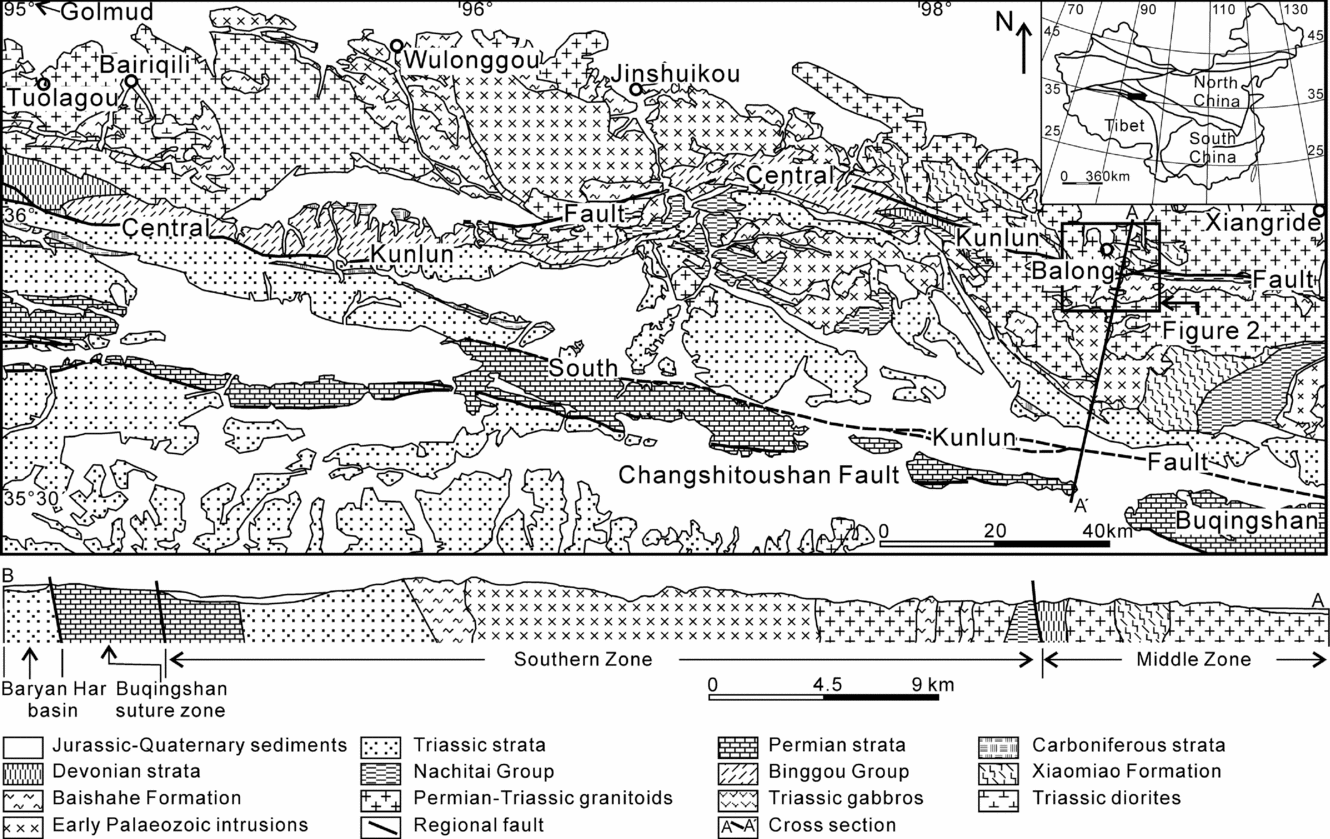
Calc-alkaline granitoid intrusions are widespread in the eastern Kunlun Orogen, providing an excellent opportunity to examine their genesis and tectonic setting. Originally, these intrusions were considered to have a Permian (BGMRQP, 1971, pp. 246–461) or Early Palaeozoic to Late Triassic age (Wang, Jia & Zhu, Reference Wang, Jia and Zhu2003, pp. 99–165). Recent SHRIMP zircon U–Pb dating suggests that granitoid intrusions near the Xiangride area (Fig. 1) were emplaced during Middle Triassic (242–239 Ma, Liu et al. Reference Liu, Mo, Luo, Yu, Chen, Li and Zhao2004) or end Permian (255–253 Ma, Sun et al. Reference Sun, Pei, Ding, Li, Feng, Zhang, Li, Chen, Zhang and Chen2009) times. The genesis and tectonic setting of these intrusions are poorly understood. Roger, Jolivet & Malavieille (Reference Roger, Jolivet and Malavieille2008) proposed that they were genetically related to the N-directed subduction of the Anyemaqen ocean lithosphere, whereas others ascribed their formation to magma mixing in a post-collisional environment due to slab break-off (e.g. Chen et al. Reference Chen, Luo, Mo, Liu and Ke2005). In this paper, we present geological, geochemical and geochronological data from granitoid intrusions in the Balong region, eastern Kunlun Orogen, and discuss their petrogenesis and tectonic significance.
Geological map of the eastern Kunlun Orogen. Inset is tectonic outline of China showing the location of the eastern Kunlun Orogen. A–A′ shows a generalized cross-section across the Balong region.

2. Geological setting and geology of the plutons
The eastern Kunlun Orogen, connected with the western Kunlun Orogen to the west and the western Qinling Orogen to the east, is bounded by the Tibetan Plateau in the south and by the Qaidam Basin in the north (insert of Fig. 1). It underwent Early Palaeozoic and Early Mesozoic subduction and collision processes, during which time the Nuomuhong–Qingshuiquan and the Anyemaqen–Buqingshan suture zones were formed successively (Yang et al. Reference Yang, Robinson, Jiang and Xu1996; Bian et al. Reference Bian, Li, Pospelov, Yin, Li, Zhao, Chang, Luo, Gao, Astrakhantsev and Chamov2004; Zhu et al. Reference Zhu, Lin, Jia and Wang2006). The eastern Kunlun Orogen consists traditionally of three tectonic units, the Northern, Middle and Southern Zones, separated by the North and Central Kunlun faults, respectively (Jiang et al. Reference Jiang, Yang, Feng, Zhu, Zhao, Chai, Shi, Wang and Hu1992). The Anyemaqen–Buqingshan suture zone is divided from the Southern Zone by the Southern Kunlun Fault and linked to the Baryan Har sedimentary basin to the south.
The Middle Zone, the Nuomuhong suture zone, the Southern Zone, the Buqingshan suture zone and the Baryan Har sedimentary basin were exposed in the eastern part of the eastern Kunlun Orogen from north to south (Fig. 1). The Middle Zone consists mainly of the Baishahe Formation, the Xiaomiao Formation and the Binggou Group with widespread Palaeozoic to Mesozoic intrusions and minor Devonian and Carboniferous sedimentary rocks. Comparatively, the Southern Zone is lithologically similar to the Middle Zone, although the latter contains more abundant Triassic volcanic-sedimentary rocks and lesser amounts of Palaeozoic to Mesozoic intrusions (Liu et al. Reference Liu, Genser, Neubauer, Jin, Ge, Handler and Takasu2005). The Baishahe Formation consists of gneisses and marbles, with minor amounts of amphibolites, migmatites and schists. Their protoliths include greywackes, limestones and intermediate to basic volcanic rocks. An early geochronological study yielded an amphibolite Sm–Nd isochron age of 1927 Ma and a gneiss U–Pb age of 1850 Ma (C. S. Zhao, unpub. Ph.D. thesis, Univ. Jilin, Jinlin, 2004). The Xiaomiao Formation consists of granulitites, schists and subordinate marbles. Their protoliths were likely a suite of volcanic-sedimentary rocks deposited as neritic facies and underwent low amphibolite-facies metamorphism. The depositional age of the Xiaomiao Formation was constrained to Mesoproterozoic time (1683–1554 Ma) by detrital zircon ages (Chen et al. Reference Chen, Pei, Li, Liu, Li, Zhang, Chen, Liu, Ding and Guo2011). The Baishahe and Xiaomiao formations constitute the Jinshuikou Group. The Binggou Group consists of marbles, slates and meta-sandstones. They were formed during Neoproterozoic time based on fossil evidence (Sun, Reference Sun1997, pp. 20–57). The Nachitai Group, near the south of the Central Kunlun Fault, comprises basalts, ultramafic rocks, metasedimentary rocks and carbonate rocks. It constitutes an important component of the Early Palaeozoic Nuomuhong suture zone (Wang, Jia & Zhu, Reference Wang, Jia and Zhu2003, pp. 1–98; Zhu et al. Reference Zhu, Lin, Jia and Wang2006). The Devonian sedimentary rocks are typical molasse deposits and include conglomerates, sandstones, mudstones and rarely volcanic rocks. Zircon U–Pb dating indicates that these rocks were deposited in the interval of 400–423 Ma (Lu et al. Reference Lu, Wu, Hu, Barosh, Hao and Zhou2010). The Carboniferous sedimentary rocks are mainly composed of sandstones, siltstones and limestones with minor mudstones and tuffs and deposited as littoral facies. The Buqingshan suture zone, the western extent of the Anyemaqen suture zone, contains ophiolites, chert and red abyssal clay, flysch, bioclastic limestone and Permian limestone, and minor conglomerates, sandstones and mudstones (Bian et al. Reference Bian, Li, Pospelov, Yin, Li, Zhao, Chang, Luo, Gao, Astrakhantsev and Chamov2004). The Baryan Har sedimentary basin is mainly filled by sandstones and slates. It is a tremendous Triassic flysch basin (Y. T. Zhu, unpub. Ph.D. thesis, Chengdu Univ. Tech., Chengdu, 2006), and the flysch has an island arc property and is derived from the eastern Kunlun Orogen to the north (She et al. Reference She, Ma, Mason, Li, Wang and Lei2006).
Early Palaeozoic intrusions include quartz diorites, monzogranites and syenogranites with emplacement ages of 515–391 Ma (Long et al. Reference Long, Jin, Ge and Yu2006; Zhang et al. Reference Zhang, Pei, Ding, Li, Feng, Sun, Li and Chen2010; Ma et al. unpub. data). A large number of the intrusions are Late Permian to Triassic in age. They are mainly composed of granodiorites, monzogranites and syenogranites with minor diorites and gabbros (Fig. 1). Late Triassic andesites, dacites and rhyolites occur in Triassic strata within the Southern Zone and were explained as continental volcanic rocks formed in a post-collisional setting (Yang et al. Reference Yang, Shi, Wu, Wang and Robinson2009).
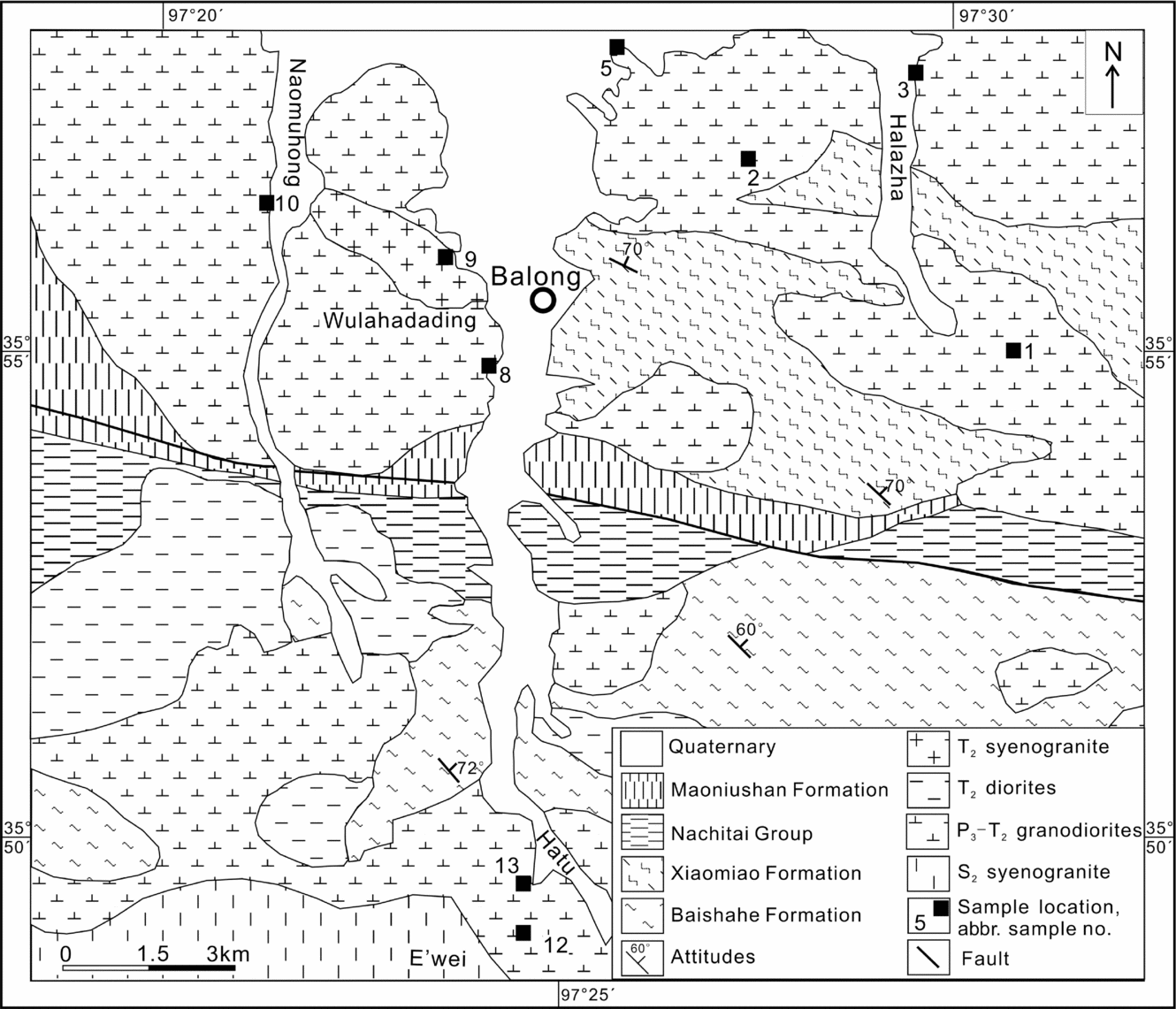
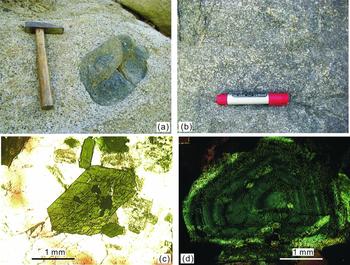
The study area is located in the transition between the Middle and Southern zones, close to the town of Balong (Fig. 1). Stratigraphically, the area is composed of the Baishahe and Xiaomiao Formations, the Nachitai Groups and Devonian sedimentary rocks (Wang, Jia & Zhu, Reference Wang, Jia and Zhu2003, pp. 1–98) (Fig. 2). Granitoid intrusions in the Balong area occur as stocks, ranging in surface exposure from 1.5 to 60 km2. Zircon U–Pb dating suggests that they were formed mainly in Early Palaeozoic and Late Permian–Middle Triassic times (Ma et al. unpub. data). The Early Palaeozoic E'wei stock, located in the southwest of the region, is dominated by coarse-grained syenogranite that was emplaced at 423 Ma. The Late Permian–Middle Triassic Halazha, Naomuhong and Hatu stocks consist of granodiorite, diorite and syenogranite and were emplaced into the Proterozoic to Lower Palaeozoic rocks. Fine-grained MMEs (Fig. 3a), rounded or elliptical in shape, are abundant in the granodiorite and generally contain K-feldspar xenocrysts, similar to K-feldspar phenocrysts from their host. Their size is rather varied (1 × 1 to 10 × 10 cm2) and commonly ranges from 5 × 3 cm2 to 10 × 7 cm2. The contacts between the MMEs and the host granodiorite are exclusively sharp. Crystallized segregations are also observed in the Halazha stock. They occur as enclaves with rather irregular shapes. Their size (e.g. 3 × 4 m2) is obviously larger than the MMEs and their quantity is apparently lesser than the MMEs. Euhedral hornblende with a long columnar shape commonly occurs in the segregations. They are texturally heterogeneous and the content of hornblende in the segregations increases generally towards their centres (Fig. 3b). The contacts between the segregations and the host granodiorite are transitional. A number of small quartz diorite stocks, individually < 0.05 km2 in surface area, occur in the Halazha stock. A few small diorite and syenogranite intrusions were emplaced near the Hatu and Wulahadading stocks.
Simplified geological map of the Balong region.

(a) Mafic microgranular enclave in granodiorite near Halazha. (b) Close-up image from the central part of a heterogeneous crystallized segregation with euhedral hornblende, near Halazha. (c) Photomicrographs of euhedral hornblende and (d) complex zoned plagioclase in granodiorite, near Hatu.

3. Petrography
The granodiorite investigated is medium- to coarse-grained and locally porphyritic. It consists of plagioclase (45–50%, estimated by volume), K-feldspar (10–15%), quartz (18%), biotite (5%) and hornblende (5%), together with accessory apatite, zircon, titanite and magnetite. Plagioclase may have a complex zoned texture (Fig. 3d). Hornblende is commonly subhedral, whereas hornblende from the Hatu granodiorite is usually euhedral (Fig. 3c). The MMEs have highly variable mineral contents and consist of plagioclase (45–60%), biotite (2–16%), hornblende (15–32%), quartz (8–19%), K-feldspar (0–2%) and accessory minerals including zircon, titanite and acicular apatite. The central part of individual crystallized segregation is composed of hornblende (20–30%), biotite (10–20%), plagioclase (35%), K-feldspar (10%) and quartz (13%). Hornblende is euhedral, 3–5 mm long and 0.5 mm wide. The fine-grained diorite is composed of hornblende (30%), biotite (10%), plagioclase (50%), K-feldspar (5%) and quartz (3%). The quartz diorite is medium-grained and contains more biotite and less hornblende compared to the diorite. The syenogranite is medium- to fine-grained and consists of plagioclase (18%), K-feldspar (50%), quartz (30%) and biotite (1%), with accessory zircon and apatite.
4. Analytical methods
4.a. Whole-rock major and trace element analysis
Fresh whole-rock samples were crushed in a steel crusher and powdered to 200-mesh size using an agate mill. Major elements were measured at the Hubei Institute of Experimental Geology, Wuhan. H2O+ and CO2 were determined by gravimetry and volumetry, respectively, whereas other major elements were analysed by X-ray fluorescence (XRF). Relative standard derivations (RSDs) for major elements are better than 5%. Trace and rare earth elements (REEs) were analysed at the State Key Laboratory of Geological Processes and Mineral Resources (GPMR), China University of Geosciences, Wuhan, using an Agilent 7500a inductively coupled plasma-mass spectrometer (ICP-MS). Methods of sample preparation and digestion are the same as in Liu et al. (Reference Liu, Zong, Kelemen and Gao2008). RSDs estimated from repeated analyses of three standard reference samples G-2, AGV-1 and GSR-3 are better than 5% for REEs and 5–12% for other trace elements.
4.b. Whole-rock Rb–Sr and Sm–Nd isotope analysis
Whole-rock Sr–Nd isotope compositions were obtained using a Finnigan Triton thermo-ion mass spectrometer at GPMC, following the methods of Zhang et al. (Reference Zhang, Harris, Parrish, Kelley, Zhang, Rogers, Argles and King2004). Reported 87Sr/86Sr and 143Nd/144Nd ratios were normalized to 86Sr/88Sr = 0.1194 and 146Nd/144Nd = 0.7219, respectively. Total analytical blanks are 5 × 10⁻¹¹ g for Sm and Nd and (2–5) × 10−10 g for Rb and Sr.
4.c. Zircon U–Pb dating
Zircon crystals were hand picked under a binocular microscope after conventional liquid and magnetic separation. Representative grains were mounted in epoxy resin discs, and the discs were polished and cleaned. Before U–Pb isotope analyses, all grains were photographed under transmitted- and reflected-light, and then imaged by the cathodoluminescence (CL) technique using a JEOL JXA-8900RL microprobe at the Chinese Academy of Geological Sciences (Beijing). The photomicrographs and CL images of the zircons were used as a guide to determine appropriate areas for subsequent isotope analyses. U–Pb dating was performed using a laser ablation-inductively coupled plasma-mass spectrometer (LA-ICP-MS) at GPMR. Laser sampling was performed using a GeoLas 2005, and an Agilent 7500a ICP-MS instrument was used to acquire ion-signal intensities. The details of the analytical method have been fully described by Liu et al. (Reference Liu, Gao, Hu, Gao, Zong and Wang2010). Data reduction was made using the Glitter online software, which provides for selection of stable intervals in each time-resolved analysis. Subsequent data processing was carried out using the ISOPLOT program (Ludwig, Reference Ludwig2003). Errors are quoted at the 1σ level for individual analyses, whereas the error for weighted mean ages is quoted at the 2σ (95% confidence) level.
5. Results
5.a. Zircon U–Pb ages
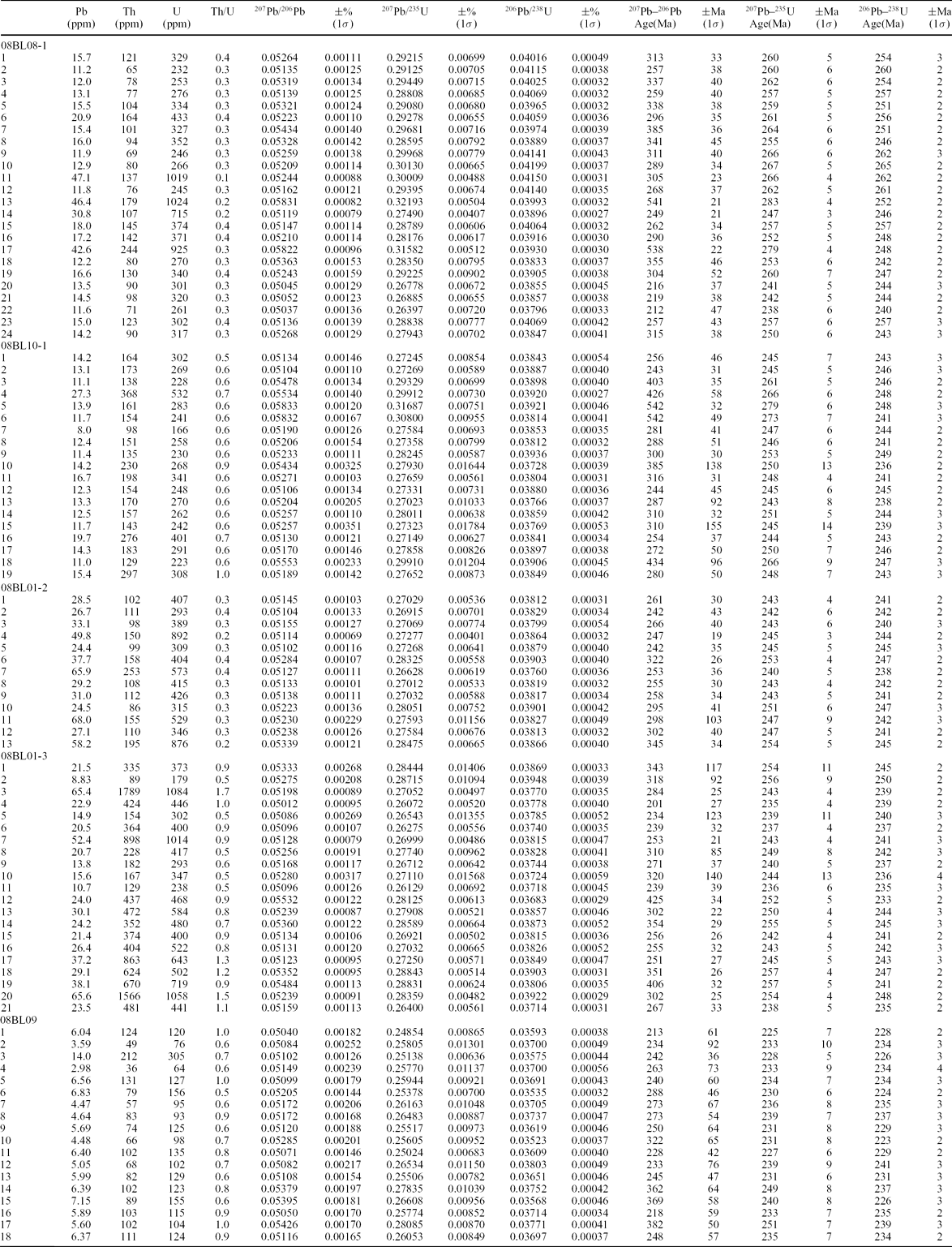
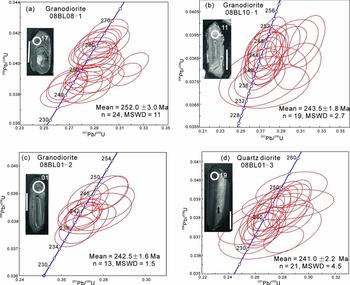
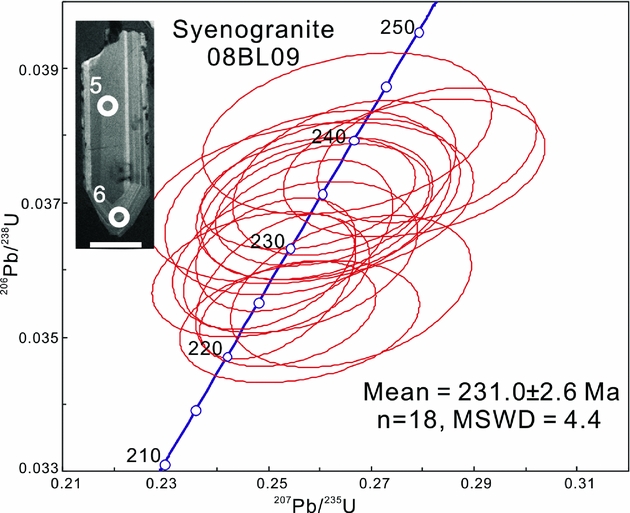
Three samples from the Naomuhong stock (08BL08-1, 08BL09 and 08BL10-1) and two from the Halazha stock (08BL01-2 and 08BL01-3) were dated. The U–Pb isotope data are summarized in Table 1 and graphically illustrated in Figures 4 and 5.
Zircon U–Pb dating results for the granites from the Balong region

LA-ICP-MS zircon U–Pb concordia diagrams of the granodiorite and quartz diorite near the Balong region. Scale bar is 100 μm.

LA-ICP-MS zircon U–Pb concordia diagram of the syenogranite near the Balong region. Scale bar is 100 μm.

Zircon grains from sample 08BL08-1 are colourless. The crystals range in size from 150 to 300 μm, and their elongation ratios are mostly 3:1 to 2:1. CL images show an obvious oscillatory zoning texture. Zircon grains contain 232–1024 ppm U and 65–244 ppm Th, with Th/U ratios of 0.1 to 0.4. Twenty-four spot analyses yield 206Pb–238U ages ranging from 240 to 265 Ma. All analyses form a coherent group on the concordant line, with a weighted mean 206Pb–238U age of 252.0 ± 3.0 Ma (Fig. 4a).
Zircon crystals from sample 08BL10-1 are colourless, transparent and prismatic. The grains are 100 to 350 μm long with elongation ratios of 4:1 to 2:1. CL images reveal excellent oscillatory zoning. Their Th/U ratios (0.5–1.0) are high. Nineteen spot analyses provide 206Pb–238U ages of 238–249 Ma. All analyses plot on the concordant line and give a weighted mean 206Pb–238U age of 243.5 ± 1.8 Ma (MSWD = 2.7) (Fig. 4b).
Zircon crystals from sample 08BL01-2 are colourless and transparent, ranging in size from 50 to 300 μm. Some grains have excellent prismatic faces. All grains display well-developed oscillatory zoning in CL images. Th/U ratios are variable from 0.2 to 0.4. Thirteen spot analyses produce 206Pb–238U ages of 238–247 Ma. All analyses plot on the concordant line with a weighted mean 206Pb–238U age of 242.5 ± 1.6 Ma (MSWD = 1.5) (Fig. 4c).
Zircon crystals from sample 08BL01-3 are colourless and transparent, ranging in size from 100 to 350 μm. Most of them are fragmented and show narrow CL bands, whereas the remaining euhedral crystals have oscillatory zoning in CL images. Their Th/U ratios (0.5–1.7) are high. Twenty-one spot analyses, with 206Pb–238U ages of 233–250 Ma, plot on the concordant line and yield a weighted mean 206Pb–238U age of 241.0 ± 2.2 Ma (MSWD = 4.5) (Fig. 4d).
Zircon crystals from sample 08BL09 are colourless, transparent and have prismatic crystal faces. They are commonly 100–300 μm long and exhibit oscillatory zoned textures in CL images. Their Th/U ratios (0.5–1.0) are high. Eighteen spot analyses, with 206Pb–238U ages of 224–241 Ma, plot on the concordant line and produce a weighted mean 206Pb–238U age of 231.0 ± 2.6 Ma (MSWD = 4.4) (Fig. 5).
5.b. Whole-rock geochemistry
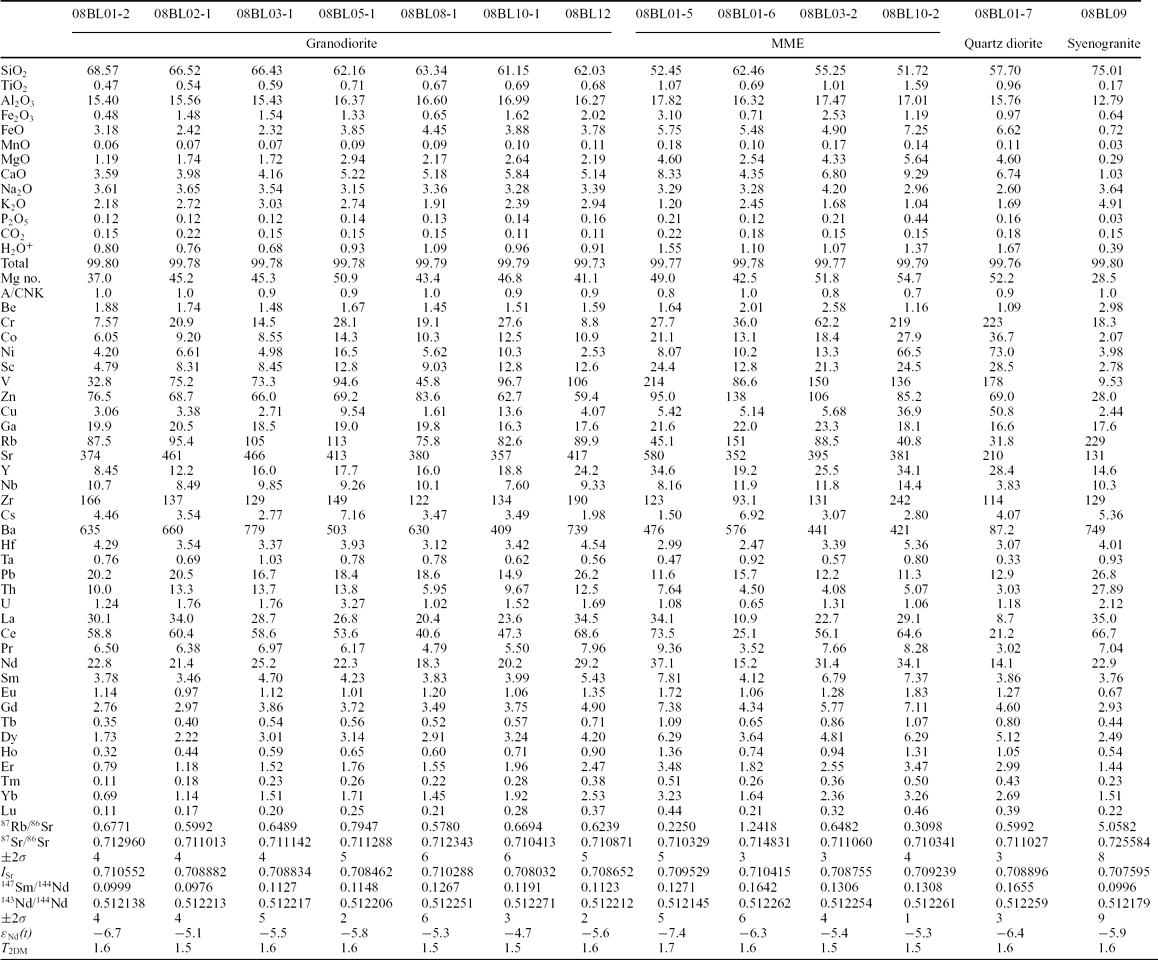
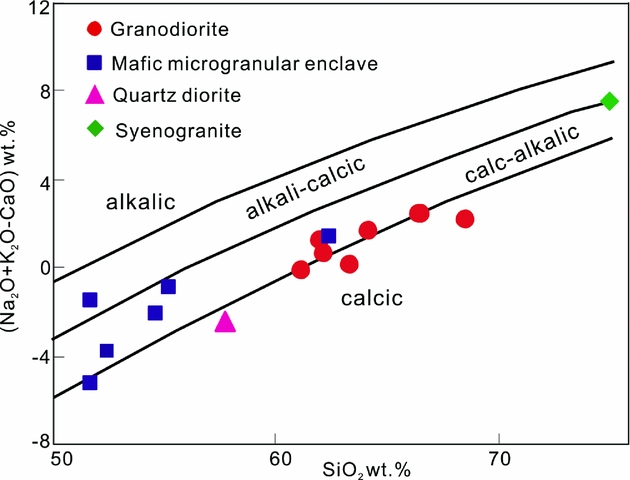
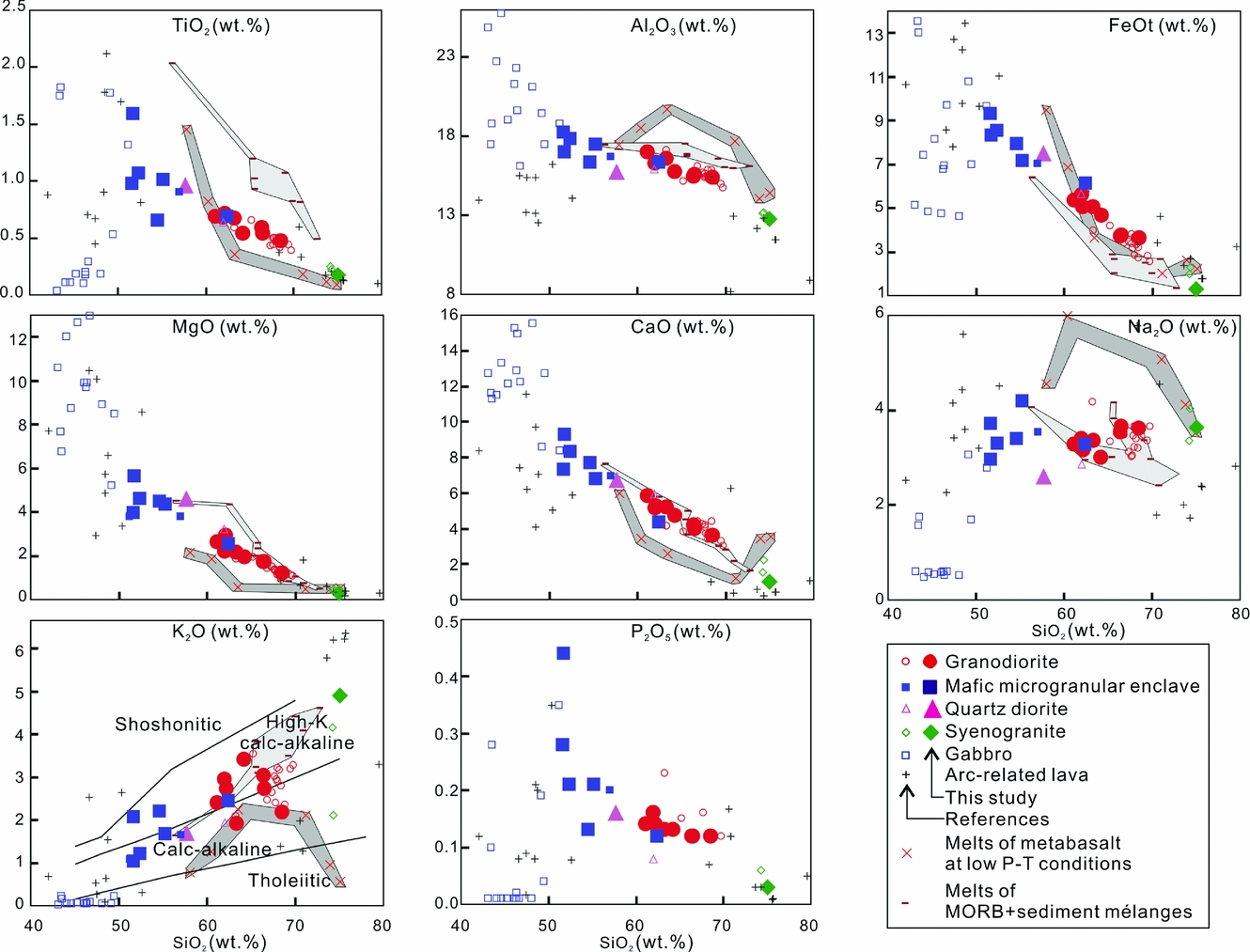
Major and trace element contents are presented in Table 2 and illustrated in Figures 6–8. The granodiorite from the Halazha, Naomuhong and Hatu stocks contains 61.15–68.57 wt% SiO2, 2.32–4.45 wt% FeO and 3.59–5.84 wt% CaO. The samples have Al2O3 between 15.40 and 16.99 wt% and total alkalis of 5.27–6.57 wt% with K2O/Na2O ratios of 0.57–0.87. They show metaluminous characteristics with A/CNK values (molar Al2O3/(CaO + Na2O + K2O)) of 0.90–1.04. All samples plotted in the calc-alkalic field in the SiO2 v. (Na2O + K2O − CaO) diagram (Fig. 6) (Frost et al. Reference Frost, Barnes, Collins, Arculus, Ellis and Frost2001). The MMEs have lower SiO2 (51.72–62.46 wt%) and variable CaO contents. When all granodiorite and MME samples are plotted in the Harker diagrams, there is a negative linear trend between SiO2 and TiO2, Al2O3, FeOt (total FeO), MgO, CaO and P2O5, and a positive linear trend between SiO2 and K2O (Fig. 7). The quartz diorite has major-oxide contents intermediate between the granodiorite and MMEs. Compared to the granodiorite, the syenogranite contains more abundant SiO2 (75.01 wt%) and K2O (4.91 wt%) but lower Al2O3, MgO, CaO, FeO, TiO2 and P2O5.
Elemental, Sm–Nd and Rb–Sr isotopic compositions of selected samples from the Balong region

SiO2 v. (Na2O + K2O − CaO) diagram of the granodiorite, MMEs, quartz diorite and syenogranite from the Balong region.

Major element Harker plots of the granodiorite, MMEs, quartz diorite and syenogranite from the Balong region. References include Chen et al. (Reference Chen, Luo, Mo, Liu and Ke2005, Reference Chen, Wang, Zhang, Sun, Li and Chen2007) and X. Z. Pei (unpub. Ph.D. thesis, Northwest Univ., Xi'an, 2001). Melts of metabasalt at low P–T conditions from Rapp & Watson (Reference Rapp and Watson1995). Melts of MORB + sediment mélanges from Castro et al. (Reference Castro, Gerya, Garcia-Casco, Fernandez, Diaz-Alvarado, Moreno-Ventas and Low2010).

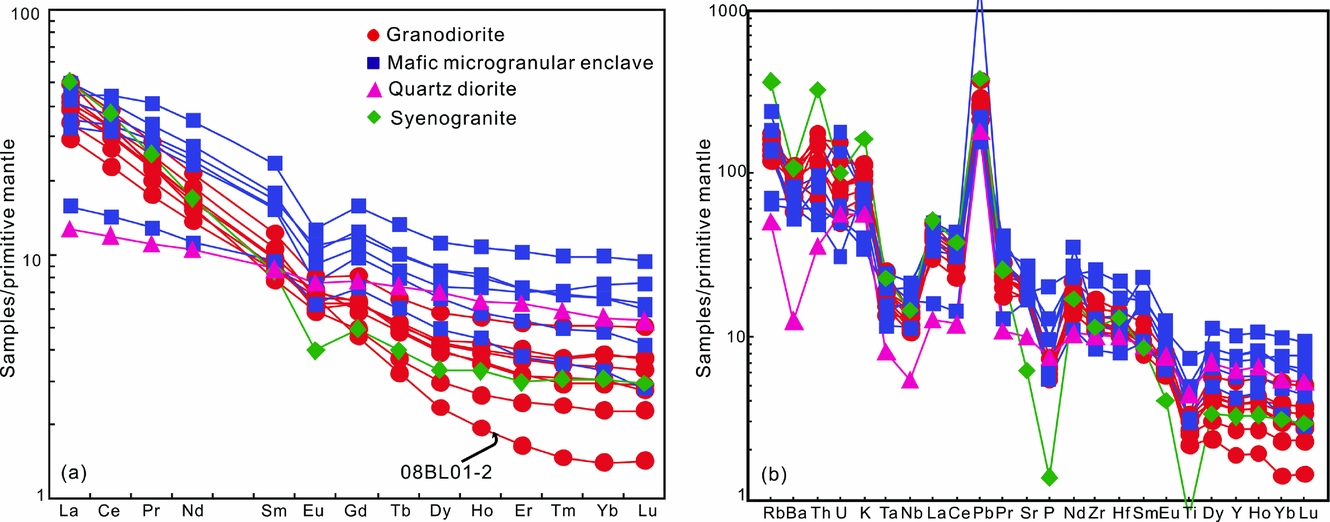
Primitive mantle-normalized REE patterns (a) and spidergrams (b) of the granodiorite, MMEs, quartz diorite and syenogranite from the Balong region. Normalized data from Wood et al. (Reference Wood, Joron, Treuil, Norry and Tarney1979) and Wood, Tarney & Weaver (1980).

The total REE contents of the granodiorite are 100–163 ppm. Their Eu/Eu* (the value of the Eu anomaly) and (La/Yb)N (N – normalized to primitive mantle; normalized data from Wood et al. Reference Wood, Joron, Treuil, Norry and Tarney1979 and Wood, Tarney & Weaver, 1980) range from 0.78 to 1.08 and 8.80 to 31.3, respectively. Europium of sample 08BL01-2 has no anomaly, with a (La/Yb)N ratio of 31.3. The MMEs have a wide range of total REEs (73.1–212 ppm) and moderate negative Eu anomalies (Eu/Eu* = 0.65–0.77). One quartz diorite sample has the lowest total REE content (70.3 ppm) and displays a flat REE pattern without a Eu anomaly (Eu/Eu* = 1.01) (Fig. 8a). One syenogranite sample also has a strongly fractionated REE pattern with a moderate negative Eu anomaly (Eu/Eu* = 0.62). The quartz diorite and syenogranite are broadly consistent with the granodiorite and MMEs in the spider diagrams, marked by high Rb, Ba, Th, U and Pb, and low Ta, Nb, P and Ti (Fig. 8b). The contents of Rb and Th from the syenogranite and V, Y, Cr and heavy REEs (HREEs) from the MMEs and quartz diorite are obviously higher than the granodiorite (Fig. 8b).
5.c. Sr–Nd isotope compositions
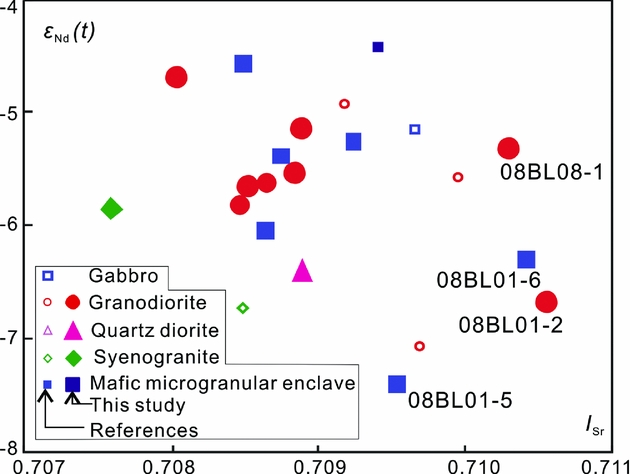
The Rb–Sr and Sm–Nd isotope data are presented in Table 2 and illustrated in Figure 9. Initial 87Sr/86Sr (I Sr) and epsilon Nd values (ε Nd(t)) were calculated using the age of 240 Ma. Because some samples have 147Sm/144Nd ratios higher than the average value of the Earth's crust (0.12), the Nd model ages were calculated using a two-stage evolutionary model (T 2DM) (Li, Reference Li1996). The granodiorite samples have an I Sr between 0.7080 and 0.7106, ε Nd(t) values from −6.7 to −4.7, and T 2DM of 1.5–1.6 Ga, which are indistinguishable from those of the MMEs (0.7088–0.7104, −7.4 to −5.3, and 1.5–1.7 Ga, respectively). I Sr and ε Nd(t) of the quartz diorite sample are 0.7089 and −6.4, while these values for the syenogranite sample are 0.7076 and −5.9. It is obvious that the granodiorite and the MMEs therein, the quartz diorite and the syenogranite have similar Sr–Nd isotopic compositions (Fig. 9). T DM values of samples 08BL01-7 and 08BL01-6 are abnormal owing to their high 147Sm/144Nd ratios.
I Sr v. ε Nd(t) diagram for the granodiorite, MMEs, quartz diorite and syenogranite from the Balong region. References include Chen et al. (Reference Chen, Luo, Mo, Liu and Ke2005, Reference Chen, Wang, Zhang, Sun, Li and Chen2007).

6. Discussion
6.a. Emplacement age of granitoid intrusions
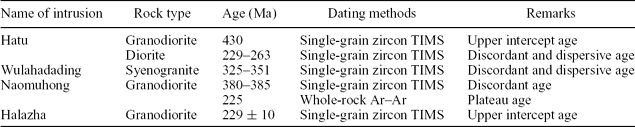
The granitoid intrusions in the Balong area were initially thought to be produced during Permian time (BGMRQP, 1971, pp. 246–461). Recent whole-rock Ar–Ar and single-grain zircon U–Pb dating suggests that they formed over a longer magmatic history spanning from Early Silurian to Late Triassic times (Table 3, Wang, Jia & Zhu, Reference Wang, Jia and Zhu2003, pp. 99–165). However, previous U–Pb ages were obtained by conventional chemical methods, and the majority of the data are discordant, and thus their quality and geological reliability are highly questionable.
Previous ages of the granitoid intrusions in the Balong area (Wang, Jia & Zhu, Reference Wang, Jia and Zhu2003)

LA-ICP-MS zircon U–Pb dating suggests that the granodiorite in the Halazha and Naomuhong stocks, the Wulahadading syenogranite and small quartz diorite stocks were emplaced during Early to Middle Triassic times (Figs 4, 5). Recently, Xiong et al. (Reference Xiong, Ma, Zhang and Liu2011) obtained Late Permian ages (263–262 Ma) for granodiorite and MMEs from the Hatu stock.
The granitoids in the Balong area are mainly composed of medium- to coarse-grained granodiorite that contains the quartz diorite stocks and MMEs. The diorite and syenogranite are subordinate. All rocks have similar mineralogy consisting of quartz, plagioclase, K-feldspar, biotite and hornblende. The rock assemblages are comparable to the Middle Triassic granitoids from the Xiangride area (Liu et al. Reference Liu, Mo, Luo, Yu, Chen, Li and Zhao2004; Chen et al. Reference Chen, Luo, Mo, Liu and Ke2005) and are distinct from Early Palaeozoic granites in the Jinshuikou region (Long et al. Reference Long, Jin, Ge and Yu2006) and in the Kekesha region (Zhang et al. Reference Zhang, Pei, Ding, Li, Feng, Sun, Li and Chen2010). Therefore, it is concluded that extensive magmatism near the Balong region was active during the Late Permian–Middle Triassic interval (263–231 Ma). Zircon U–Pb ages also indicate the following intrusive succession: (1) the granodiorite and MMEs from the Hatu stock, (2) the granodiorite, quartz diorite and MMEs from the Halazha and Naomuhong stocks, and (3) the Wulahadading syenogranite. The magmatism in the Balong region is about 10 Ma earlier than in the Xiangride area (242–239 Ma, Liu et al. Reference Liu, Mo, Luo, Yu, Chen, Li and Zhao2004; 255–253 Ma, Sun et al. Reference Sun, Pei, Ding, Li, Feng, Zhang, Li, Chen, Zhang and Chen2009).
6.b. Petrogenesis
The widespread granodiorites in the Balong region are calc-alkaline and show metaluminous and Na-rich characteristics, with slightly enriched, relatively homogeneous Sr–Nd isotope compositions. As summarized in Section 1, four mechanisms have been proposed to interpret the generation of such calc-alkaline granodiorites: (1) crustal assimilation and fractional crystallization of basaltic magmas (Bigazzi, Del Moro & Macera, Reference Bigazzi, Del Moro and Macera1986; López, Castro & García-Casco, Reference López, Castro and García-Casco2005; De Souza et al. Reference De Souza, Martin, Peucat, De Sá and Macedo2007), (2) partial melting of mafic lower crust (Michard-Vitrac et al. Reference Michard-Vitrac, Albarède, Dupuy and Taylor1980; Tepper, Nelson & Bergantz, Reference Tepper, Nelson and Bergantz1993; Jung et al. Reference Jung, Masberg, Mihm and Hoernes2009), (3) mixing of mafic and felsic melts (Vernon, Reference Vernon1990; Bateman, Reference Bateman1995; Janoušek et al. Reference Janoušek, Braithwaite, Bowes and Gerdes2004 and others), and (4) partial melting of mid-ocean ridge basalt + sediment mélanges (Castro & Gerya, Reference Castro and Gerya2008; Castro et al. Reference Castro, Gerya, Garcia-Casco, Fernandez, Diaz-Alvarado, Moreno-Ventas and Low2010).
Crustal assimilation of basaltic magmas may lead to variable Sr–Nd isotope compositions (Bigazzi, Del Moro & Macera, Reference Bigazzi, Del Moro and Macera1986; Skjerlie, Reference Skjerlie1992; Schaltegger et al. Reference Schaltegger, Brack, Ovtcharova, Peytcheva, Schoene, Stracke, Marocchi and Bargossi2009) and the formation of a linear array in the I Sr v. 1/Sr, I Sr v. SiO2 and ε Nd(t) v. SiO2 diagrams (Roberts et al. Reference Roberts, Pin, Clemens and Paquette2000; Jung et al. Reference Jung, Masberg, Mihm and Hoernes2009). The granodiorite samples of this study have relatively homogeneous Sr–Nd isotope compositions, and there is no obvious correlation between the isotopic ratios and incompatible trace element concentrations. This suggests that crustal assimilation was not significant in the formation of the granodiorite; a view partly confirmed by the absence of xenoliths in the rocks and inherited components in zircon crystals (Figs 4, 5). Compared with the granodiorite in the Balong region (Table 2), granodioritic melts generated by assimilation experiments that simulate the reaction between basaltic magmas and metamorphosed pelites in the continental crust (Castro, Reference Castro2001) have low FeO contents and high K2O/Na2O ratios. Moreover, hydrous mafic magma interacting with tonalitic crust will produce granodioritic melts with low MgO contents (López, Castro & García-Casco, Reference López, Castro and García-Casco2005). Taken together, we suggest that crustal assimilation has played an insignificant role in the formation of the granodiorites in the Balong region. Such an assumption is confident but usually difficult to quantify since the inferred upper mantle-derived melt and crustal contaminants are often not exposed in the eastern Kunlun Orogen and obtained from related references. Fractional crystallization, however, cannot be ruled out. The crystallized segregations have transitional contacts with their host granodiorite and higher euhedral hornblende contents within their centres, indicating congregation of hornblende from granodioritic melts. The negative correlation between SiO2 and other major oxides including TiO2, CaO and MgO (Fig. 7) indicates fractionation of hornblende. Separation of hornblende is also evidenced by the high (La/Yb)N ratio noticed in sample 08BL01-2.
The rounded or elliptical shape of the MMEs represents the quenching effect imposed by the felsic magma (Sparks & Marshall, Reference Sparks and Marshall1986). Felsic minerals in the MMEs are highly variable, and likely reflective of the degree of magma mixing (e.g. Barbarin & Didier, Reference Barbarin and Didier1992). Abundant acicular apatite crystals in the MMEs reflect quenching of the mafic melt when injected in the felsic magma. The MMEs have incompatible elements (e.g. Rb, Sr, Ba, La, Th, U, Zr, Hf, Nb and Ta) and Sr–Nd isotopes indistinguishable from the host granodiorite, but they possess different concentrations of compatible elements (e.g. Ni, Cr, V and HREEs). This indicates that incompatible elements and Sr–Nd isotopes tend to attain local equilibrium rapidly during magma mixing (Allen, Reference Allen1991) and this process is similar to the second stage of the magma mixing model provided by Barbarin (Reference Barbarin2005). Thus, it is concluded that magma mixing has exerted an influence on the formation of the MMEs and granodiorite around the MMEs to some extent.
As for the partial melting of mid-ocean ridge basalt + sediment mélanges, although major element contents of the melts from the mélanges are comparable with the granodiorite in the study area (Fig. 7), half of them are peraluminous (A/CNK = 1.1–1.3) and the other half have high Mg no. ratios (55–67). It is an unsuitable model for the metaluminous and low-MgO granodiorite of this study. More importantly, the granodioritic magmas of the Balong region seemed to coexist with amphibole in their sources owing to the flat HREE patterns and low (La/Yb)N ratios, whereas the melts of the mélanges are buffered by garnet and have fractionated REE patterns and high (La/Yb)N ratios. The sediments from a subducted slab commonly have a wide range of Sr–Nd isotope compositions (Hironao, Reference Hironao1997; Gertisser & Keller, Reference Gertisser and Keller2003), which will be inherited by melts of the subducted sediments. The granodiorite of the region with its homogeneous Sr–Nd isotope composition is strongly against that.
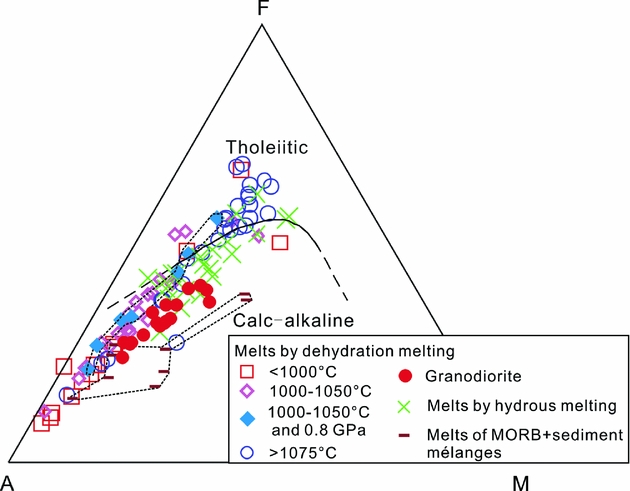
The geochemical features of the granodiorite in the Balong region preclude partial melting of metasedimentary or felsic meta-igneous rocks as a vital mechanism in their formation (Altherr et al. Reference Altherr, Holl, Hegner, Langer and Kreuzer2000). Instead, partial melting of mafic rocks in the lower crust may explain the observed major and trace element features. Experimental studies have been conducted to constrain the origin of intermediate-acidic melts using basic-intermediate rocks as starting materials, and the results suggest that melting conditions (fluid, pressure, temperature, etc.) strongly influence the composition of melts and residues (Rushmer, Reference Rushmer1991; Sen & Dunn, Reference Sen and Dunn1994; Rapp & Watson, Reference Rapp and Watson1995; Nakajima & Arima, Reference Nakajima and Arima1998). The presence of fluid could make partial melting happen under low pressure–temperature (P–T) conditions. Dehydration melting is a more likely mechanism of anatexis in the lower continental crust relative to H2O-saturated melting (Wolf & Wyllie, Reference Wolf and Wyllie1994). With increasing pressure, the restites tend to be plagioclase-absent but garnet-bearing amphibolite, granulite or eclogite. Partial melts produced at high pressure should have low Y and HREE concentrations, but high Sr concentrations and Sr/Y ratios (Rapp & Watson, Reference Rapp and Watson1995). The major element compositions of melts are more readily affected by temperature than pressure and the high temperature melts tend to belong to the tholeiite series and are more mafic (Rapp & Watson, Reference Rapp and Watson1995) (Fig. 10).
AFM diagram for melts of hydrous (Nakajima & Arima, Reference Nakajima and Arima1998) and dehydration (Rushmer, Reference Rushmer1991; Sen & Dunn, Reference Sen and Dunn1994; Rapp & Watson, Reference Rapp and Watson1995) melting of mafic rocks and the granodiorites in the Balong (this study) and Xiangride (Chen et al. Reference Chen, Luo, Mo, Liu and Ke2005, Reference Chen, Wang, Zhang, Sun, Li and Chen2007) regions. Melts of MORB + sediment mélanges from Castro et al. (Reference Castro, Gerya, Garcia-Casco, Fernandez, Diaz-Alvarado, Moreno-Ventas and Low2010).

The granodiorites in the Balong region are consistent with partial melts produced by dehydration melting of mafic rocks at temperatures of 1000–1050°C and 0.8 GPa both in major element compositions and their ratios like A/CNK and Mg no. (Figs 7, 10). Products of hydrous melting plot in the tonalite field in the classification diagram for granitic rocks (fig. 4 in Nakajima & Arima, Reference Nakajima and Arima1998). Moreover, pore fluids are normally absent in the lower crust. Therefore, it is unlikely that the granodiorite was produced by hydrous melting although some granodiorite samples have geochemical compositions overlapping acidic melts produced by hydrous melting (Fig. 10). The granodiorites investigated have no obvious HREE and Y depletion, Sr enrichment and high Sr/Y ratios, indicating that the residues are predominantly amphibolite, corresponding to a pressure of about 1.0 GPa. Considering its enriched Sr–Nd isotope composition, we propose that the granodiorite in the Balong region was most likely derived from dehydration partial melting of mafic rocks in the lower continental crust at about 1.0 GPa and 1000–1050°C.
The quartz diorite within the Halazha stock has high Mg no., V, Ni and Cr values relative to the granodiorite, and displays a flat REE pattern similar to continental lower crust. Its Sr–Nd isotope compositions, however, are consistent with the granodiorite. This suggests that the quartz diorite was most likely originated from partial melting of mafic lower continental crust, because diorite evolved from a mantle-derived magma would have a higher Mg no. value and compatible element concentrations (Roberts et al. Reference Roberts, Pin, Clemens and Paquette2000). Considering its low Rb/Sr ratio, the syenogranite in the Wulahadading stock is unlikely to form by fractionation of granodioritic magmas. Its high K, Rb, Th and Sr contents suggest increasing upper continental crustal materials in the source region. This in turn indicates that the source region of the syenogranite is located at a higher crustal level compared to the granodiorite.
6.c. Geological significance
The Buqingshan–Anyemaqen suture zone along the southern margin of the eastern Kunlun Orogen was formed by closure of the palaeo-Tethys; however, the closure time remains unresolved. Some authors suggested that the palaeo-Tethys closed at the beginning of the Late Permian period, based on Upper Permian basal conglomerates unconformably overlying the Anyemaqen ophiolite suite (Wang, Jia & Zhu, Reference Wang, Jia and Zhu2003, p. 52) and Triassic post-collisional granitoids in the Xiangride region (Chen et al. Reference Chen, Luo, Mo, Liu and Ke2005); however, other studies indicated that the N-directed subduction of the Anyemaqen ocean lithosphere started at about 260 Ma and the collision ended at 230 Ma (Y. T. Zhu, unpub. Ph.D. thesis, Chengdu Univ. Tech., Chengdu, 2006; Yang et al. Reference Yang, Shi, Wu, Wang and Robinson2009). Yang et al. (Reference Yang, Shi, Wu, Wang and Robinson2009) recognized mid-ocean ridge basalts (308 Ma), island arc volcanic rocks (260 Ma) and post-collisional volcanic rocks (200–230 Ma) along the Anyemaqen suture zone and its northern region, which were taken by the authors as evidence for the initiation of N-directed subduction at 260 Ma and the end of collision at 230 Ma. The presence of Upper Triassic molasse, unconformably overlying Middle Triassic marine rocks, also indicates the closure time of the palaeo-Tethys is at about 230 Ma (Y. T. Zhu, unpub. Ph.D. thesis, Chengdu Univ. Tech., Chengdu, 2006).
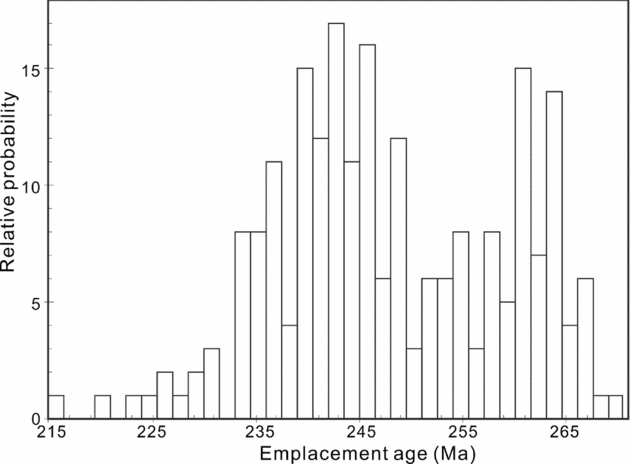
The granitoids near the Balong and Xiangride regions are located in the north of the Buqingshan–Anyemaqen suture zone. The granitoids near the Balong region formed during Late Permian–Middle Triassic times, with two magmatic peaks at 262 Ma and 244 Ma, respectively (Fig. 11). These calc-alkaline granites show subduction-related signatures (e.g. enrichments in large-ion lithophile elements and depletions in high-field-strength elements). Though such signatures may also be found in granites formed in crust that contains ancient subduction components, the following evidence obviously supports their subduction-related origin.
Age probability diagram for the Late Permian–Middle Triassic granites in the Balong and Xiangrede regions. n = 220, including data from Liu et al. (Reference Liu, Mo, Luo, Yu, Chen, Li and Zhao2004) and Sun et al. (Reference Sun, Pei, Ding, Li, Feng, Zhang, Li, Chen, Zhang and Chen2009).

Firstly, the major element compositions of these calc-alkaline granites, together with small-scale diorites and gabbros in the eastern Kunlun Orogen, roughly overlap with island arc basalt–andesite–rhyolite assemblages in the region (Fig. 7) and are completely different from post-collisional andesite–dacite–rhyolite assemblages. An area percentage for the granodiorites and monzogranites is about 93% and only almost 7% for diorites and gabbros in the eastern Kunlun Orogen. The estimated proportions are similar to Mesozoic–Cenozoic intrusions from continental margin on the east coast of the Pacific Ocean (Castro et al. Reference Castro, Gerya, Garcia-Casco, Fernandez, Diaz-Alvarado, Moreno-Ventas and Low2010).
Secondly, the presence of Upper Permian to Middle Triassic marine carbonate and clastic rocks in the eastern Kunlun Orogen (Cai, Wang & Li, Reference Cai, Wang and Li2004; Cai et al. Reference Cai, Luo, Liu and Yuan2008) provides compelling evidence that the Buqingshan–Anyemaqen ocean did not close until Late Permian to Middle Triassic times. Additionally, we noticed that, except for oceanic closure and subsequent collision, some subduction-related processes could also cause a regional unconformity, such as a subducted plate changing its subduction style (angle and/or speed) (Nieto-Samaniego, Alaniz-Álvarez & Camprubí, Reference Nieto-Samaniego, Alaniz-Álvarez, Camprubí, Alaniz-Álvarez and Nieto-Samaniego2007), ridge subduction (White, Bradley & Friedman, Reference White, Bradley and Friedman2006), and essential volcano-tectonic events in the subduction zone (Branney & Soper, Reference Branney and Soper1988), one of which might be responsible for the regional unconformity between Upper and Middle Permian rocks in the region.
Therefore, a subduction setting is favoured during Late Permian to Middle Triassic times and the granodiorite and quartz diorite (263–241 Ma) are likely related to the N-directed subduction of the Anyemaqen ocean lithosphere, while the 231 Ma syenogranite was probably produced during syn-collisional processes. This model is compatible with all geological, geochronological and geochemical data in the eastern Kunlun Orogen. However, it is still unclear which type of process in the subduction zone is responsible for the two magmatic peaks and regional unconformity between the Upper and Middle Permian.
7. Conclusions
-
(1) The Late Permian to Middle Triassic granitoids near the Balong region consist of granodiorite, diorite and syenogranite. The granodiorites were emplaced between 263 and 241 Ma and usually contain abundant MMEs, small quartz diorite stocks and crystallized segregations. The syenogranite was produced at 231 Ma.
-
(2) The widespread granodiorite and quartz diorite show calc-alkaline, metaluminous and Na-rich characteristics, with slightly enriched, relatively homogeneous Sr–Nd isotope compositions. The syenogranite has a low Rb/Sr ratio and high K, Rb, Th and Sr contents relative to the granodiorite.
-
(3) The genesis of the granodiorite and quartz diorite was interpreted as dehydration melting of mafic lower crustal rocks during the Late Permian–Middle Triassic N-directed subduction of the Anyemaqen ocean lithosphere. After that, a relatively shallow level partial melting event happened and formed the syenogranite in a syn-collisional setting.
Acknowledgements
This study was financially supported by the China Geological Survey (no. 1212010918002), the Natural Science Foundation of China (no. 40903017), the Fundamental Research Funds for the Central Universities (no. CUG090102) and the MOST special fund from the State Key Laboratory of Geological Processes and Mineral Resources (no. MSFGPMR201005). Prof. Jian-Wei Li provided constructive comments on the paper and numerous modifications to the language, which significantly improved the presentation of the paper.