Introduction
Based on the view that competitive contracting can increase efficiency and innovation, British policy makers have, since the 1980s, transformed the delivery of welfare services by using business solutions to address social problems (Farnsworth, Reference Farnsworth2006). In practice, this involves instituting market-based mechanisms, such as quasi-markets, in the delivery of public services. Reflecting on the underpinning rational choice theories of such governance arrangements, social policy scholars question whether these reforms will: bring greater efficiency or increase inequality (Le Grand, Reference Le Grand1991; Rees et al., Reference Rees, Whitworth and Carter2014), present issues of trust in market relationships (Taylor-Gooby, Reference Taylor-Gooby1999), lead to the commodification of service users (Grover, Reference Grover2009), or benefit corporate organisations (Farnsworth, Reference Farnsworth2006; Reference Farnsworth2013). Drawing on transaction cost theory this article adds to these debates by critically examining the delivery of British employment services through a ‘welfare-to-work’ quasi-market and the associated claims that it a) is a more efficient way to deliver employment support services, and b) offers more varied and innovative services from a range of different actors.
This article is structured as follows. Starting with a brief description of the British welfare-to-work quasi-market, it is demonstrated that social policy scholars’ attention to the content of individual welfare-to-work programmes dwarfs our knowledge on the collective procurement processes involved in creating and shaping the quasi-market, including the evolving role of different types of independent providers. It is argued that ignoring the longitudinal dynamics of the implementation structure limits our understanding of welfare-to-work policies and the use of quasi-markets in social policy. Correspondingly, the subsequent section outlines transaction cost theory to draw our attention to the contractual relationships between the state and independent providers, and the policy choices which underpin the nature of quasi-market evolution. The subsequent sections use a transaction cost theory lens to analyse relevant policy documents and identify how changes to the quasi-market since 2008 can be linked to efforts to reduce transaction costs. By drawing on a case study of a third sector organisation (TSO) involved in welfare-to-work contracting between 1997 and 2010 it is argued that, primarily due to the increase in debt-financing and payment-by-results, these procurement changes disadvantage TSOs. Reflecting on the empirical research, the concluding sections draw our attention to the nature of the evolution of the welfare-to-work quasi-market, the dominance of particular types of independent organisations, and the shift in welfare state financing.
The British welfare-to-work quasi-market
The Labour Government's (1997–2010) efforts to modernise the delivery of employment support centred on the introduction of ‘welfare-to-work’ programmes; supply-side labour market interventions targeting individuals in receipt of out of work benefits. Starting with numerous ‘New Deal’ programmes in 1997 up to the current ‘Work Programme’, such programmes target various groups of unemployed citizens (long-term unemployed, young people, lone parents) using predominately (but not limited to) job search and job brokering services based on a ‘work-first’ perspective (Lindsay et al., Reference Lindsay, McQuaid and Dutton2007). Over the past 18 years consecutive governments have also introduced or removed welfare-to-work programmes that target depressed labour market localities (such as the Employment Zone), those furthest from the labour market due to health barriers (such as Pathways to Work), and more recently mandatory work placement schemes. The active labour market elements of these programmes, especially the rise of conditionality, are well-covered social policy topics (Bredgaard and Larsen, Reference Bredgaard and Larsen2008; Finn, Reference Finn2009; Van Berkel, Reference Van Berkel2009; Wright, 2012). Rather than retelling the content of individual welfare-to-work programmes, this article focuses on the introduction and evolution of the service delivery model (a quasi-market) in order to demonstrate the influential role contracts and independent organisations play in policy design and implementation.
Echoing a similar approach introduced in Australia in 1996 (Finn, Reference Finn2009), the Labour Government opted to deliver welfare-to-work programmes by introducing a new quasi-market system. The initial stages of constructing the quasi-market involved creating the Department for Work and Pensions (DWP) in 2001; a central government department responsible for administering welfare-to-work programmes and managing the newly reformed Jobcentre Plus (an agency combining the former employment office and benefits agency). Excluding Jobcentre Plus, which currently remains within the public sector, DWP policy makers procure welfare-to-work services from non-state actors on behalf of out of work citizens. Since their inception, all British welfare-to-work programmes have, to differing extents, involved a contractual arrangement between the state and various types of independent providers (Bennett, Reference Bennett2013). Unlike much of the Labour Government's social programmes and administrative designs, this competitive contracting approach has continued to garner political support from the subsequent Conservative-led coalition government (2010–2015), and current Conservative majority government (2015–present).
Due to the proliferation of contracts since 1997, the DWP has encouraged the creation or growth of a large range of ‘independent’ providers, including both commercial companies and TSOs, who compete for contracts lasting two to five years. When promoting the quasi-market, the DWP claims that the growing use of both private and third sector providers is based upon their ‘superior client knowledge’ and ‘innovative delivery methods’ claiming that ‘these organisations can bring a distinctive approach to service delivery, based on their specialist knowledge, experience and skills’ (DWP, 2006: 74). The DWP states that ‘they [independent providers] can also offer more scope for innovation, developing new and creative ways of working with customers’ (DWP, 2006: 7) and ‘the contracting process will ensure quality provision, competition to drive value, outcome-based contracts with the flexibility to drive value’ (DWP, 2006: 60). To encourage competition, the DWP ranks providers based on job outcomes (DWP, 2012a).
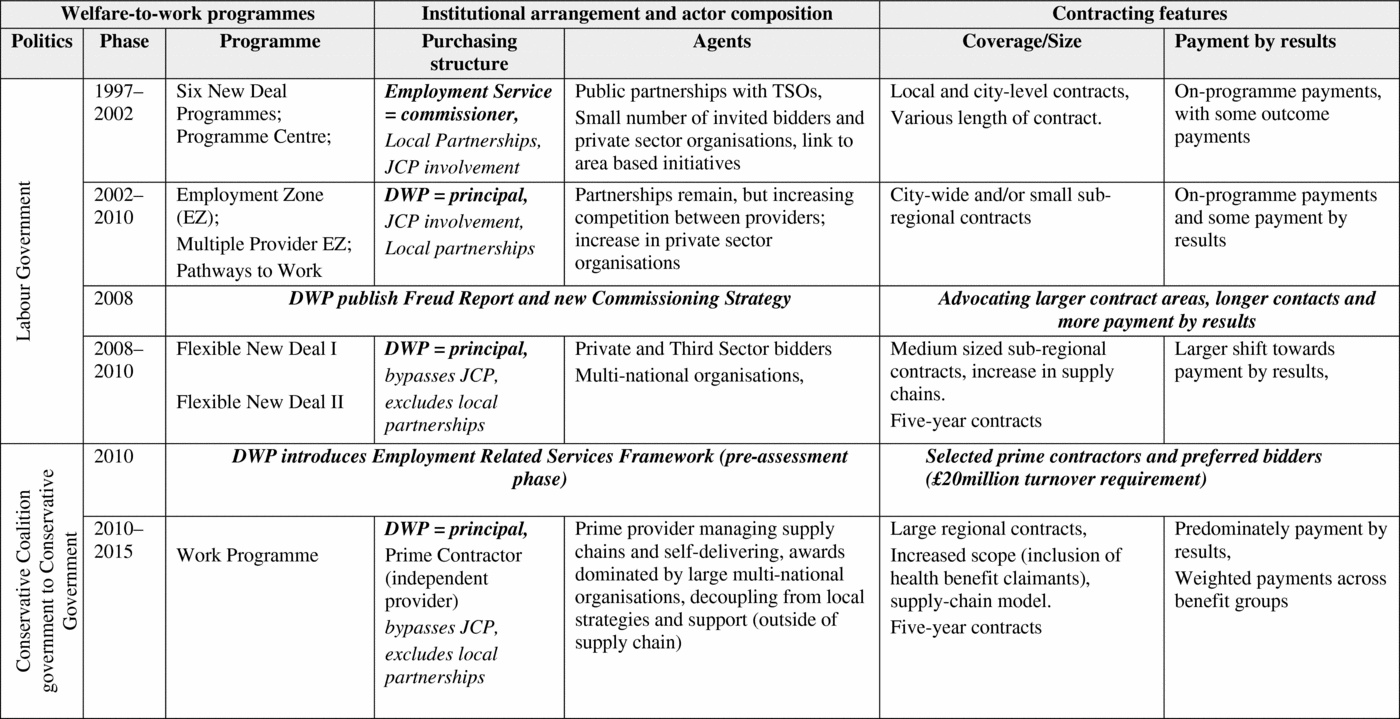
Superficially, the welfare-to-work quasi-market resembles Le Grand and Bartlett's (Reference Le Grand and Bartlett1993) definition that a quasi-market is differentiated from a pure market by three characteristics. First, competition need not necessarily be driven by the profit motive, because non-profit and public organisations may also be competing. Second, a quasi-market is based on public funds which are made available by the government. Third, the purchasing power does not lie with individuals, but with an organisation that acts as a client on behalf of service users (the DWP). By focusing on the policy implementation structure we can expand our scope beyond individual welfare-to-work programmes to include independent actors, commissioning organisations, policy-makers, and contract design in our understanding of welfare-to-work policies. Figure 1 outlines the largest programmes, changing procurement processes, and shifting role of independent providers between 1997 and 2015.
The creation and evolution of the British welfare-to-work quasi-market 1997–2015

Despite the evident ‘process of evolution’ (Ferlie, 1992: 94), existing research on policy implementation in this context is limited to three main issues. First, and by far the most prevalent, studies outline policy implementation design and largely centre on comparative descriptions of institutional reforms or systemic changes but overlook implementation processes in practice (cf. Considine, Reference Considine2001; Struyven and Steurs, Reference Struyven and Steurs2005; Finn, Reference Finn2009; Van Berkel, Reference Van Berkel2009). Second, studies effectively critique a single programme's contract design (such as The Work Programme), albeit in isolation of preceding arrangements and provider relations (e.g. Carter and Whitworth, Reference Carter and Whitworth2015). Finally, literature on provider behaviour focuses on one dominant idea: financial incentives inherent in quasi-markets induce ‘gaming behaviour’ whereby providers (which are rarely conceptualised or defined) target those closest to the labour market to meet contract outcomes (cf. Sol and Westerveld, Reference Sol and Westerveld2005; Bredgaard and Larsen, Reference Bredgaard and Larsen2008; Rees et al., Reference Rees, Whitworth and Carter2014). This body of existing research successfully presents some aspects of market regimes and governance arrangements. However, such discussions appear to frame the quasi-market as a somewhat static or shallow entity comprised of a fixed set of delivery organisations with generalizable market behaviour. As a consequence, there is often little understanding of the dynamics of the quasi-market, limited differentiation between types of organisations, and no consideration of how contractual relationships are constructed and change over time.
This empirical blind spot requires greater attention. By focusing solely on snapshots of the ‘official reform story’, (Van Berkel, Reference Van Berkel2009: 19) we overlook the activities of organisations involved in mediating the quasi-market and how the business-like transformation of the welfare state is encouraged and enacted through a range of influential organisations (see Farnsworth, Reference Farnsworth2006; Farnsworth and Holden, Reference Farnsworth and Holden2006). Similarly, burgeoning research on the role of debt-driven financing and commercial organisations (backed by global financial investments) draws our attention to the ways that particular types of organisations capture public service markets or dominate and legitimise out-sourcing agendas (Crouch, Reference Crouch2011; Sayer, Reference Sayer2014; Streek, Reference Streek2014). Such debates suggest that detailed research into the evolution and dynamics of specific quasi-markets would enable greater understanding of market-based policy implementation approaches and future policy making boundaries. To add to this empirical gap the following section turns to transaction cost theory to frame our understanding of the procurement processes and policy choices that shape the composition of the quasi-market.
Transaction Cost Theory
Drawing on transaction cost theory (TCT) the article draws attention to the contracting process between the state and independent organisations. Transaction costs are essentially the management cost (in this case inclusive of risk and up-front capital) associated with either internally producing the service or buying it through contracting the ‘comparative costs of planning, adapting, and monitoring task completion under alternative governing structures’ (Williamson, Reference Williamson1981: 552–553). By using a TCT perspective we can conceive the welfare-to-work quasi-market as a governance system that regulates the economic exchanges between the DWP (the principal) and numerous delivery organisations (the agent/s). Fundamentally, TCT suggests that the principal chooses to contract out the ‘product’ (employment support) but is faced with a decision as to whether this is financially beneficial if the cost of regulating the service outweighs the cost of delivering it internally.
In the principal-agent relationship the DWP wants delivery organisations to complete the terms of the contract to advance the policy goals. There are three key features of transactions cost theory which may affect this relationship (Williamson, Reference Williamson1975; 1981). First, the extent to which the resources required to complete a transaction are transferable to other uses without reducing their productive value (asset specificity), i.e., would DWP expenditure on contracting processes produce a better outcome if allocated to other activation measures. Second, if there is incomplete information the principal may experience an increase in transaction costs as they cannot fully predict all possible future scenarios and cannot fully specify contracts (uncertainty). Third, agents may consider the likelihood that a transaction will reoccur when considering expenditure on costly but necessary mechanisms to deliver the contract (frequency). Two behavioural assumptions (opportunism and bounded rationality) are also central to this discussion. Opportunism or ‘self-interest seeking with guile’ (Williamson, Reference Williamson1975) refers to the tendency of individuals to engage in opportunistic practices contrary to the knowledge of others in the exchange relationship. Acknowledging these characteristics brings attention to the limitations of trust and self-enforcement. Bounded rationality implies that people's rationality is limited due to various constraints, such as time, human capacity to process and store information, or the ability to foresee possible contingencies.
If monitoring the exchange is costly or not prioritised there is potential for a ‘moral hazard’ problem; a situation where the agent and principal have differing objectives or the principal cannot easily determine whether the agent's actions are taken in pursuit of the principal's goals or are self-interested. To mitigate against this issue the principal may need to increase the resources devoted to monitoring or increase incentive contracts balancing risk-bearing against the benefits of improved performance (Milgrom and Roberts, 1992). Contracting out employment services will thus create transaction costs related to pre-contract preparation, negotiations, and post-contract oversight (required to mitigate opportunism). As the ‘product’ here is a public service there may be added considerations (such as equal access) and it is possible to identify three scenarios if the cost of monitoring external providers increases: bringing the service in house, continuing to contract out but with less oversight (although this may mean less control of the information required to make future contracting decisions), or to continue to out-source and increase oversight costs.
A purely financial analysis does not provide insight into the dynamics between actors and enable us to reflect on government assumptions of the efficiency of marketised welfare services. Comparing annual contract fees or departmental expenditure is not only inadequate but also impossible (the cost of administering welfare-to-work programmes is not publically available from the DWP or providers). Instead the analysis here uses transaction cost theory to shape our understanding of the major policy and contracting changes (specifically those that seek to reduce transaction costs or gain information on provider organisations) and frame our exploration of an agent (such as the processes of acquiring a contract and fulfilling oversight requirements). This approach allows us to consider the relationship between the quasi-market and ideas of efficiency. We can also reflect on the impact of using a transaction cost lens for understanding the evolution of the quasi-market and the role of different types of independent providers.
Methodology
This article draws on extensive qualitative data exploring independent providers and contracting processes in the welfare-to-work quasi-market. The following section, which explores the role of the principal, draws on an analysis of policy and tender documents, and publically available DWP contract award data. The next section, which explores the experience of an agent, draws on a case study research strategy of an anonymised TSO (referred to as Provider A). Due to the diverse and complex nature of all organisations, but particularly TSOs (Heins and Bennett, Reference Heins and Bennett2016), the case study is not intended to offer generalizable experiences for all TSOs or treated as typical of providers in the quasi-market. Instead, drawing on Stake (Reference Stake1995), it is presented as an instrumental case study that enables us to better understand provider behaviour. The case itself may be of secondary interest to many readers but it helps us to better understand the major themes associated with contractualism. Data collection (between 2007 and 2011) involved conducting 20 semi-structured interviews with past and present senior employees, the analysis of 150 documents (covering both internal and external publications), and the analysis of annual company accounts (covering the period 1986–2010). Data was also collected during a 6-month ethnographic period within Provider A during The Work Programme tendering phase (2010–2011). For confidentiality purposes all respondents are anonymised.
An Economic and Social Research Council (ESRC) funding arrangement enabled access for data collection. Studies employing a similar data collection approach are scarce due to issues of commercial confidentiality, gatekeeping, and limited access to longitudinal data from providers. Similarly, the DWP does not share tendering details, differentiate programme expenditure between contract management and front-line service spending in publically available departmental data, or require independent providers to partake in social research. These data collection issues create problematic empirical gaps that limit our knowledge of the economic and social value of outsourcing as an implementation approach. It also affects our understanding of how organisations legitimate and maintain their role in public service markets (see Sayer, Reference Sayer2014). Consequently, the methodological approach employed in this article makes an important contribution to the existing literature on the use of quasi-markets in social policy.
Reducing the principal's costs
Contracting welfare-to-work programmes is resource intensive. The principal incurs large costs through writing specifications and contracts, publicising and evaluating tenders, providing information and responding to enquiries from bidders, and negotiating contract awards. In response to early concerns regarding fraud and performance measurement (DWP, 2008a; WPC, 2012), there are also on-going compliance costs including the creation of audit and regulatory functions. For example, the DWP introduced ‘Merlin standards teams’ to monitor provider relationships, and ‘provider assurance teams’ to interrogate behaviour during contract delivery (DWP, 2012b; NAO, 2012b). These regulatory teams monitor supply change management principles and seek to reduce opportunistic behaviour. Data is not available regarding the transaction costs associated with the welfare-to-work programmes prior to 2010 but the National Audit Office estimates that performance monitoring for the Work Programme will cost the DWP at least £8.6million (NAO, 2012a).
DWP procurement reforms seek to reduce the transaction costs of commissioning and monitoring numerous contracts (NAO, 2011; NAO, 2012b). In 2007, the Labour Government hired investment banker David Freud to produce the influential report, ‘Reducing Dependency, Increasing Opportunity: Options for the Future of Welfare-to-Work’ (DWP, 2007), which outlined amendments to the design, financing, and procurement of welfare-to-work programmes. Instead of funding programmes from the DWP budget (the Department Expenditure Limit), Freud claimed that welfare-to-work programmes should be financed through the treasury budget (called Annually Managed Expenditure). In this ‘invest to save’ approach, the treasury determine budget parameters for employment support to ensure social security savings outweigh payments to contractors. Correspondingly, Freud recommended an increase in payment-by-results financing and that the DWP should only contract with a top tier of prime providers who would then be responsible for supply chains in their contract area. To further reduce the DWP's transaction costs Freud recommended larger contracts (both in length and geographical coverage) and proposed amalgamating most benefit recipient groups (such as health benefit claimants, lone parents and ex-offenders) under one contract. Instead of delivering DWP prescribed service provision and minimal guarantees, providers would now design their own service model as part of a ‘black box’ approach. While the government claims that this approach reflects the need for the best placed organisations to design services based on their knowledge of job seekers, from a TCT perspective reducing prescription is also a means to decrease oversight responsibilities and subsequently the DWP's transaction costs.
Accepting the majority of Freud's recommendations, the DWP published a ‘Commissioning Strategy’ (2008) to rationalise existing welfare-to-work contracts. Notably, the then Secretary of State for Employment claimed that the Government was ‘creating a market for the long term’ that would ‘free’ providers ‘from central control and allow them to innovate’ (Purnell, Reference Purnell2008). For successful providers these performance-based contracts represented ‘a major milestone in [the] welfare reform programme,’ where ‘the rewards will be high, with longer contracts and a growing market’ (ibid). The Labour Government implemented some of Freud's recommendations in the procurement process for the Flexible New Deal (FND) programme and instructed the DWP to introduce prime-contractors, large contract regions and emphasise job outcome payments. At this time, Armstrong et al. (Reference Armstrong, Byrne, Cummings and Gallen2010) estimated that close to 556 to 677 organisations were involved in delivering services (two-thirds had a turnover of revenue up to £5 million, with over one-third generating revenue of up to £1 million). The design of the multi-billion pound FND contracts encouraged larger commercial and third sector organisations to borrow finance in advance to invest in service provision. Despite a prolonged and expensive tendering process, the FND programme (in its second phase) was short-lived; the 2010 general election led to a change in government and the Labour government was replaced by the Conservative led coalition. The new government retained the welfare-to-work quasi-market (unsurprisingly as Freud is now a Conservative Party politician), albeit with important alterations to procurement processes as outlined below.
Shortly after the 2010 election the DWP introduced a new pre-qualification stage to produce a pre-vetted short-list of providers with exclusive tendering access to the new government's welfare-to-work programme (The Work Programme). Known as the ‘Preferred Suppliers Framework,’ it reduces the DWP's transaction costs associated with managing numerous contractual relationships and generating information on agents. Reflecting the new responsibilities for delivery organisations, the Framework emphasises the importance of financial capacity and prescribes a minimum turnover threshold for competing bidders of £20 million per annum (DWP, 2010b). The DWP selected potential providers using financial ratios designed to assess debt structures and a company's ability to pay liabilities (DWP, 2011b). The assessment and scoring mechanisms rewarded organisations with access to large resources, supply chain management experience, and contract performance knowledge (Bennett, Reference Bennett2013). The government stated that only DWP ‘Preferred Suppliers’ would be able to access future contract competitions for welfare-to-work programmes and potentially alternative public service markets in the future (DWP, 2010a). The DWP's approach immediately altered the arrangement of providers in the quasi-market, suggesting that efforts to reduce transaction costs outweighed the previous claim that out-sourcing can offer organisational diversity and specialist expertise. According to Bennett (2011), of the 128 organisations selected onto the Framework across the UK, only 23 were non-private sector organisations (17 per cent), despite over 30 per cent of applications being from non-private sector organisations. Most Preferred Suppliers were large, commercial organisations.
Only Preferred Suppliers could bid to be a Work Programme ‘prime provider’ in each lot. Prime providers are responsible for creating and managing supply chains with other independent organisations in their delivery area (DWP, 2010b). Currently the DWP has 40 contracts with 18 prime providers who may sub-contract some or all of the support they are responsible for (HOC, 2014b: 1). For those organisations that wanted to compete as a prime provider (or sub-contractor within the supply chains) the Work Programme contracts presented an increased risk-based funding model. Building on the reforms in the FND programme the new government's claim was that The Work Programme ‘represents a massive expansion of the payments by results principle, removing flat rate service fees and ensuring that we move to 100 per cent outcome based contracts as soon as possible. For the first time, we will also be paying providers using the benefits savings that they help to generate, building value for money into these programmes in a way that hasn't been possible in the past’ (Grayling, Reference Grayling2011). To reduce the transaction costs associated with managing numerous contracts, the DWP's design for The Work Programme incorporated all previous welfare-to-work contracts and went further than the market revisions realised in the FND programme by: increasing contract sizes, creating larger geographical contract ‘lots’ (equivalent to a UK region), increasing the proportion of finance based on payment by results, and incorporating formally separated specialist groups into the one mainstream programme (DWP, 2011a). To increase competition either two or three prime contractors operate in 18 different geographic areas across England, Scotland, and Wales (HOC, 2014a). Such contracts are big business; between June 2011 and March 2016, the DWP expects to refer 2.1 million people to the Work Programme and forecasts total payments to prime contractors of £2.8 billion (HOC, 2014b).
While the Work Programme offered longer contracts than previous programmes it was also debt driven involving a pricing structure comprised of four payment points: an attachment fee, a job outcome payment, sustainment outcome payments and incentive payments (aimed at ensuring providers do not park ‘harder to help’ jobseekers). Most of these payment instruments are time limited, require substantial up-front funding, and the largest (the job outcome) payment was expected to be discounted in the bids (Rees et al., Reference Rees, Whitworth and Carter2014; Bennett, Reference Bennett2013). Discounting outcome payments increased the financial score and raised outcome targets, thus affecting the attractiveness of the associated tender. This act is a crucial aspect of quasi-market competition which ‘exists only at the point of contract negotiation’ (Crouch, Reference Crouch2011: 87). Those organisations able to discount their bids and offer the lowest tender had a distinct advantage over competitors. As such, procurement reforms which sought to reduce the principal's transaction costs created a system contingent on the availability of delivery agents with access to extensive up-front financial resources.
When we analyse the composition of delivery organisations it is evident that the new procurement approach favours particular types of independent providers. A survey of DWP providers (conducted during the beginning of the FND and before the Work Programme) found that 44 per cent were from the third sector, compared to 25 per cent from the private sector and 31 per cent from the public sector (Armstrong et al., Reference Armstrong, Byrne, Cummings and Gallen2010: 22). However, in the Work Programme contract awards, approximately 72 per cent of prime and subcontracting arrangements were awarded to the private sector, with the third sector acquiring only 19.4 per cent (despite many of the bidding TSOs possessing considerable welfare-to-work experience). In fact, private sector organisations secured 35 out of 40 available prime contracts (Bennett, 2011; DWP, 2011c). Based on DWP volume predictions TSOs were awarded only seven per cent of the market share in prime contracting. Conversely, one private provider won seven contracts through substantial discounting which the DWP equated to offering better value for money. The winning bidder (Ingeus Deloitte) was a joint venture between an established public service provider (with revenues of over £73 million in 2010) and a multinational consultancy FTSE 100 firm. As a result, the DWP shifts resources within the quasi-market away from (some) of the previously successful employment support specialists to large, well-financed, contract management organisations.
Procurement changes also affected the range of organisations engaged in the quasi-market supply-chains. Although the Minister for Employment stated that ‘nearly 300 third sector organisations are involved in delivery of the Work Programme as sub-contractors, and two as prime contractors’ (Grayling, Reference Grayling2011) an examination of the contracting awards reveals only two private sector prime providers involved TSOs in 50 per cent or more of their delivery strategy. In fact, of the 37 contracts awarded to private providers, 30 bids involve TSOs in less than a third of sub-contracting arrangements and 16 of these involve the third sector in 10 per cent or less (Bennett, 2011). In comparison to the higher level of involvement of TSOs in earlier phases on welfare-to-work contracting, the unequal distribution of Work Programme contracts outlines a shift of resources towards the private sector. Furthermore, the data on market-share suggests that when TSOs’ bids were unsuccessful they were not replaced by new entrants, but by expanding commercial providers. Such shifts in market-share raise concerns regarding the future competitiveness of the quasi-market and the dominance of large commercial organisations. To better understand this shift the following section presents a case study of a TSO.
Increasing the Agent's costs: Case study of Provider A
Provider A (a TSO) was founded in 1983 and, until the late 1990s, its main activities involved delivering local employment programmes for the long-term unemployed. Whilst Provider A has continued to deliver a range of similar programmes, an analysis of the annual accounts demonstrates that its main income from 1999 to 2010 derived from the delivery of contracted welfare-to-work programmes, leading to an increase from £8.5 million in 1996 to £32.1 million by 2010 (figures adjusted for inflation). Provider A consecutively secured a range of welfare-to-work contracts between 1998 and 2010, was a prime provider for the FND programme, was selected onto the aforementioned Preferred Suppliers Framework for Scotland and NE England, but was unsuccessful in The Work Programme competition in 2010. Consequently, Provider A ceased delivering the FND contract in 2011 and, although it was not involved in the delivery of The Work Programme (in 2011), by 2014 it was acting as a sub-contractor with a small market share for a large commercial prime provider (Bennett, Reference Bennett2013).
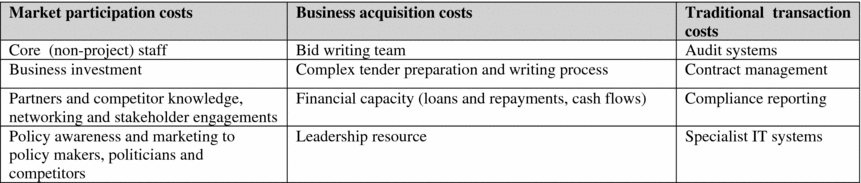
Using the data collected it appears that the DWP's effort to reduce its own transaction costs increased a range of costs and weakened the competitive position of organisations such as Provider A. First, under the post-Freud arrangement, the agent's market participation costs increase. Market participation costs are considered here to be the activities and resources required for an organisation to gather knowledge about the quasi-market (including commissioning bodies, competitors, and other players) and also essential lobbying and influencing activities (Crouch, Reference Crouch2011). During data collection it was evident that there are major costs associated with keeping informed of the work of others in the market including arranging meetings, attending conferences, and joining official networks such as the Employment Related Services Association. Of course, some market participation costs existed prior to the Freud reforms. However, under the prime contractor model, such costs increase as providers expend resources to develop supply-chains which involves gathering competitor information and publicising their role in the quasi-market to other actors (both competitors and potential partners). Despite the high expenditure of resources, cost recovery is not guaranteed. Specific market participation costs for Provider A include investment in HR, finance, IT, and marketing. Alongside the increase in the number of employees with duties dominated by the welfare-to-work quasi-market, DWP contracts involved ‘much employee time dedicated to keeping an eye on the environment’ (Respondent 1). The organisation expanded its core staff numbers and employed more staff on permanent contracts doing organisational work rather than direct project or service delivery. In 2009 senior managers also invested extensively in IT systems to comply with the DWP's contract management requirements, such as £1 million of computer software to manage sub-contractors.
Second, all potential delivery organisations had to satisfy a number of DWP tendering requirements leading to expenditure on business acquisition costs. These costs can be substantial because tendering processes for the largest contracts involve numerous interactions with competitors and possible partners for up to 12 months. To acquire business in the quasi-market the DWP requires potential contractors to demonstrate advanced internal financial processes (see DWP, 2008b; DWP, 2010b). Prior to the FND programme the DWP required each organisation to demonstrate solvency. However, they were not required to go into any great detail and, as such, one respondent described earlier financial requirements as simple ‘tick box processes’ (Respondent 2). Over time the DWP increased its emphasis on financial valuation and the FND required a more ‘rigorous financial assessment’ (Respondent 3) including current year forecast, future budgets, and annual accounts (DWP, 2008b). The DWP's financial assessment involved benchmarking organisations against pre-agreed standards to ensure provider viability, and providing contractors with a ‘growth limit’ – a maximum amount that each contractor could apply for. To match these requirements Provider A expended resources on recruiting new employees (limited to individuals with bid-writing success in similar competitive quasi-markets), and investing in financial planning (including consultancy fees, financial project managers, and accountants).
Finally, once a bidding organisation is awarded a contract it must expend resources on traditional transaction costs including the cost of contract management (including post-tender negotiations), service delivery (through arrangements with sub-contractors), finance, claims and compliance, reporting to DWP teams, internal audit and monitoring, personnel and payroll functions, staff employment and recruitment policies, and the health and safety of staff and clients (DWP, 2008a; DWP, 2010a; DWP, 2010b). Contractors also design and implement management arrangements with sub-contractors which, in Provider A's case, often involved service-level agreements containing quality performance standards and reporting expectations. The audit and compliance costs also include collecting information from service users and overhauling internal audit processes to mirror DWP processes. The exact financial data is not available. However, attention to audit was ‘pretty small, but it started growing dramatically’ (Respondent 2) with the onset of larger welfare-to-work contracts. To mitigate against fraudulent behaviour, delivery organisations must separate the teams that achieve an outcome and those reporting it (NAO, 2012b). For Provider A this rule resulted in ‘quadrupling the audit and compliance team’ (Respondent 3) responsible for keeping informed of changes in the DWP who they claim were, ‘continually reorganising themselves and changing their regions and contract managers’ (Respondent 4). Provider A expended resources on revising internal processes and adhering to legitimating indicators, such as the European Foundation for Quality Management (EFQM) Business Excellence Framework, Scottish Quality Management Systems, Membership of Quality Scotland and Investors in People, a DWP approved Information Security Plan, and ensuring staff qualify as ‘certified assessors’ (Respondent 5). Such traditional transaction costs can (to an extent) be recovered from the income of the contract. However, the contract income must also pay for the previously expended market participation and business acquisition costs, suggesting that much welfare-to-work financing is absorbed in the contracting process at some stage. While there is clearly a need for delivery organisations to be able to comply to audit standards, it is also evident that a large financial investment in contract management is necessary to secure contracts. As the quasi-market developed, and particularly post-2008, new entrants needed substantial up-front financing to cover market participation and business acquisition costs.
Figure 2 summarises the three types of costs identified in the section above.
A summary of three types of contract related costs (for the agent post-2008)

The impact of DWP procurement choices on TSOs is important because previous contract awards impact on future contracting outcomes and quasi-market configurations. Providers with contracts are able to generate a competitive advantage in future welfare-to-work tendering rounds for two reasons. First, organisations with existing contracts produce profits and reinvest in organisational change. In order to continue to compete in the quasi-market during its evolution, much of Provider A's organisational change and expenditure was in line with the requirements of the DWP and activities of competitors (see Bennett, Reference Bennett2013). Those organisations without contracts may not be able to afford to do this and therefore may not meet DWP criteria (particularly TSOs who cannot borrow from financial investors). Without an income stream during the bidding phases of each welfare-to-work contract, Provider A would also have been unable to afford the market participation and business acquisition costs required to compete for the next tender. Provider A's financial participation was based on surpluses from previous welfare-to-work contracts (such as the Employment Zone), and income from locally funded programmes.
Second, compared to new or returning market entrants, organisations with contracts develop an exchange relationship with the DWP and are at an advantage during competitive tendering. For example, Provider A's previous experience with welfare-to-work contracts gave it some competitive and informational advantage from having experienced new audit reforms, being consulted on programme changes, attendance at provider events, or having an increased profile to attract supply-chain partners. Equally, reflecting the concept of frequency, at each tendering stage the decision to leave the quasi-market became more difficult as they were unlikely to relinquish the costs expended on investing in DWP requirements. Such decision-making suggests that contracting through quasi-markets is not a series of independent transactions, but involves complex organisational strategizing to cover previous expenditure and maintain and potentially influence future resource allocation.
Discussion
Using TCT to explore the exchange relationships which structure the British welfare-to-work quasi-market demonstrates how policy makers since 2008 have sought to reduce transaction costs involved in commissioning and overseeing numerous contracts. It is evident that ideas of cost reduction in contract management dominate the policy choices and procurement design for service delivery. By using a prime provider approach the DWP has attempted to reduce its transaction costs and ‘tip the balance’ towards contracting out service delivery. In the new system, the DWP would not only have fewer contracts to manage but it would only pay for targets achieved and not for services rendered, thus reducing the costs of monitoring opportunistic behaviour. The narrative of the evolution of the quasi-market reflects the efforts to reduce transaction costs and the preference for less monitoring and oversight and greater incentive and risk frameworks.
The DWP's approach has, however, increased contracting costs for organisations within the quasi-market as providers must expend resources on market participation and business acquisition costs without any guarantee that contracts can be secured. Increasing the financial risks associated with welfare-to-work contracting in this way creates an increasingly uneven playing field as commercial companies can raise funds and capital through borrowing mechanisms and shareholders. Conversely, TSOs may find it increasingly difficult to raise large funds in short time periods and the increased financial risk may conflict with mission statements and organisational commitments (see Rees et al., Reference Rees, Taylor and Damm2013). Even previously successful TSOs, such as Provider A, who adapt in-line with procurement demands, possess informational advantage and some surpluses from previous contract awards, struggle to win contracts in a system dependent on extensive discounting and large up-front resources. In this way narrow ideas of efficiency and cost reduction on the part of the DWP take preference over the desire for diversity and the need for delivery organisations to possess extensive employment support experience.
The welfare-to-work quasi-market has evolved from a collection of diverse organisations contracted through a mix of funding mechanisms to a narrow field managed through a predominately payment-by-results framework incorporating delayed outcome payments. As this requires delivery organisations to access extensive up-front funding, often secured through investors and financial markets, the British welfare-to-work quasi-market appears to sit in contrast to Le Grand and Bartlett's (1993) description that a quasi-market does not focus on profit generation. In fact, producing surpluses is fundamental to quasi-market involvement and success in two ways. First, surpluses from one programme offer much needed funds to allow organisations to engage in subsequent tendering competitions (particularly for TSOs). Second, the possibility to generate profits is essential for those organisations that seek to attract capital for the necessary up-front investment required to win a payment-by-results contract, start delivery, and repay investors.
Understanding the evolving role and nature of independent organisations is important as these organisations are responsible for designing employment services and are able to influence future active labour market policy. High entry barriers and business acquisition costs create what Crouch (Reference Crouch2011: 77) describes as ‘insider firms’ – a privileged group of organisations that are securely within the market and able to gain advantages by influencing forthcoming market reforms. In cases where the principal has consolidated a market place ‘the risk has emerged that they become dominated by a few large firms, who become so important to the continued provision of services that they cannot be allowed to fail’ (HOC, 2014a: 13). The Public Accounts Committee criticise the underperforming Work Programme contractors and call for greater government action to tackle poor performance, increase transparency, and identify gaming behaviour (HOC, 2014b). However, such monitoring and information symmetries will create costs (for both principal and agent). If the DWP improves over-sight in the quasi-market it will increase its associated transaction costs suggesting that (exclusive of political motivation or interference) the DWP may be faced with a decision regarding the value of contracting out services at all.
In regards to future social policy debates there are two key issues to raise. The first is that the UK government seeks advice from existing delivery organisations (who are positioned as experts) regarding the services they provide to citizens and the contracting processes. This raises questions about the quality and validity of feedback that is derived from such a homogenous group of delivery organisations. Can a handful of increasingly similar, profit-oriented, contract management organisations provide diverse feedback and innovations regarding service provision? Is there not an opportunity for these organisations to generate informational advantage or influence procurement and regulation further in their favour? Access to information to shape future policy making is fraught with new challenges and, as previously mentioned, commercial confidentiality makes third party access to information increasingly difficult.
The second issue relates to the visible shift towards, and increasing centrality of, a debt-driven system where debt financing pays for the delivery of services addressing present day policy issues (Sayer, Reference Sayer2014; Streek, Reference Streek2014; Krippner, Reference Krippner2012). In this case, rather than the state, private organisations and shareholders accept the initial responsibility for the debt; their borrowing is connected to market expectations that investing in public service markets and commercial delivery organisations will provide returns. However, these returns are recouped from successful contract awards demonstrating that government budgets for employment support cannot be spent on front-line service support. The dominance of commercial organisations, the shift of transaction costs from principal to agents, and the dependency on debt-driven financing suggests that decisions about contracting out go further than existing social policy and welfare-to-work debates may acknowledge. While more research needs to be undertaken on the evolution of quasi-markets in other policy contexts, the findings here suggest that scholars may need to start to focus attention on the extent to which financial markets underpin and sustain commercial organisations, and the policy choices which create systems where these organisations become essential to the design and delivery of social programmes.
Conclusion
Drawing on key concepts from transaction cost theory, this article provides a critical insight into contractual processes and procurement preferences that underpin the British welfare-to-work quasi-market. By doing so it contributes to debates about the relationship between independent organisations, quasi-markets, and the delivery of social policies. From the data presented it is evident that in recent years the DWP has prioritised cost reduction and a procurement system that relies on up-front financing and contract management expertise. This shift appears to be based on a need to reduce the DWP's transaction costs in order to continue to use a market-based system to deliver welfare services. However, it is demonstrated that due to policy choices and the nature of contracting reforms, TSOs have suffered in terms of market control and market share in recent contract awards. In their place large commercial organisations have gained success. Insight from empirical research suggests that this is partly because there are encumbering costs associated with operating in the welfare-to-work quasi-market that many organisations may be unable to shoulder without large financial resources during the tendering stage and early phase of service delivery.
The findings of this research also suggest that future quasi-market reforms need to take into account the wider impact on those organisations delivering welfare services and whether the value of outsourcing lies in simply the transfer of financial risk or, as was stated during the conception and development of the welfare-to-work market, the innovations and experience of non-public sector organisations. Diversity may not be possible unless governments adopt approaches that reprioritise and reward a range of organisational characteristics. Such matters are issues of policy making and procurement choices, particularly where quasi-market systems are dealing with public goods. For social policy scholars interested in the nature of welfare state transformation, it is essential that researchers are able to access the necessary data to continue to critically assess the realities of such public service markets, including the impact of procurement reforms on service delivery and the basis for using market mechanisms which may not offer choice, innovation, or competition.
Acknowledgements
I am very grateful to both referees for their helpful comments and to the JSP team who guided the manuscript through the review process. I would like to thank colleagues in the Social Policy department at The University of Edinburgh for their feedback on earlier versions and many employees of Provider A for their access, time, and support. The research was funded via an ESRC-CASE studentship (Grant Number: ES/F032021/1).