1 Introduction
This article investigates uses of the adverb again in Early Modern English (EModE). We have conducted a corpus study of letters written between the fifteenth and seventeenth centuries on the basis of the Parsed Corpus of Early English Correspondence (PCEEC; Taylor et al. Reference Taylor, Nurmi, Warner, Pintzuk and Nevalainen2006). The study collects occurrences of again and analyses their interpretation. It reveals interesting differences between EModE again and uses of again in later stages of English (Late Modern English (LModE) and Present-day English (PDE)).
PDE again gives rise to a well-known ambiguity illustrated by (1). (1) can be used if the event described by the sentence has occurred before, as in (1′a) (paraphrase and example context provided) – a repetitive reading. (1) can also be used if the opposite has happened before and only the result of the event described is repeated, as in (1′b) (with once more paraphrase and example context) – a so-called restitutive or counterdirectional reading.
(1) Leo jumped up again.
- (1′)
(a) Leo jumped up, and he had done that before. (repetitive)
The bell rang, and Leo jumped up. [. . .]
A knock came on the door, and he jumped up again.
(b) Leo jumped up, and he had been up before. (restitutive/counterdirectional)
Leo slowly sat down in his favourite armchair.
A knock came on the door, and he jumped up again.
Competing theories exist for the analysis of the restitutive/counterdirectional interpretation. Some scholars (e.g. Fabricius-Hansen Reference Fabricius-Hansen, Fery and Sternefeld2001; Jäger & Blutner Reference Jäger, Blutner and Wyner2000) analyse the ambiguity as lexical and hence propose in addition to repetitive again an again that has a counterdirectional meaning. Others (e.g. von Stechow Reference Stechow1996; Beck Reference Beck2005) argue in favour of an analysis that keeps the meaning of again repetitive and analyses the second reading in terms of a different structure. We call them respectively the lexical and the structural analysis of the repetitive–restitutive/counterdirectional ambiguity.
Beck, Berezovskaya & Pflugfelder (Reference Beck, Berezovskaya and Pflugfelder2009) found that the phenomenon is subject to diachronic change. In a nutshell, restitutive/counterdirectional again was more common in the nineteenth century than it is today, and it occurred with a greater variety of predicates. They argue that their findings speak in favour of the structural analysis. In (2) below, we give the overall frequency of restitutive/counterdirectional again according to this study in LModE and PDE, respectively, and exemplify the key difference with predicates that can be easily found on such readings in LModE but are only accepted by some speakers in PDE.
(2)

In order to gather their evidence, Beck et al. put together two letter corpora, one of letters written in the nineteenth century, and the other one of written utterances (letters, emails, blogs, interviews conducted in writing) written no earlier than 1990. They then searched the corpora for occurrences of again and identified their interpretation as either repetitive or restitutive/counterdirectional.
This article uses the same methodology but shifts the focus further into the past. We have utilized a selection of correspondence from the Parsed Corpus of Early English Correspondence (PCEEC; Taylor et al. Reference Taylor, Nurmi, Warner, Pintzuk and Nevalainen2006). The letters were written between the fifteenth and seventeenth centuries. Like Beck et al., we searched the corpus for occurrences of again and identified their interpretation. Our basic finding is summarized in (3): restitutive/counterdirectional again was even more common in EModE than in LModE; moreover, it crucially occurred with predicates that will not permit such an interpretation today, and did not do so in the nineteenth century.
(3)

We argue that the unexpected uses of again in EModE speak in favour of the lexical analysis of again. This has the interesting consequence that in the course of the development of this adverb, both the lexical and the structural analysis are required. The result is unexpected in that the two analyses of again are normally seen as competitors. We will see that they are related through the diachronic development and have to be reconciled over time.
The structure of the article is as follows: section 2 sets the scene by introducing the two semantic analyses of again, and by summarizing the Beck et al. study. In section 3 we present our EModE data and our interpretation of our results. Section 4 concludes.
2 Background
2.1 Again's semantics
We briefly introduce first the lexical analysis of restitutive/counterdirectional again, and then the structural analysis (sections 2.1.1 and 2.1.2). A particular type of argument has been put forward in favour of the structural analysis, visibility, which is important for Beck et al. and is reported in section 2.1.3.
2.1.1 The lexical ambiguity theory
Let us take a closer look at our example (1). Its two interpretations according to the lexical ambiguity theory are paraphrased in (1″).
(1) Leo jumped up again.
- (1″)
(a) (1) presupposes that Leo had jumped up before.
If that is the case, (1) asserts that Leo jumped up. (repetitive)
(b) (1) presupposes that Leo had sat down before.
If that is the case, (1) asserts that Leo jumped up. (counterdirectional)
The derivation of the first reading, the repetitive interpretation, is essentially uncontroversial. The adverb again indicates that an event of the kind described by the sentence has happened before, as shown in (4) (interpretations are presented in the style of Heim & Kratzer (Reference Heim and Kratzer1998); ‘e′<e’ stands for ‘e′ occurred before e’). The analysis of the repetitive reading of (1) is sketched in (5) (we ignore tense and the functional layer of the clause for simplicity).
(4) [[againrep]] = λP.λe:∃e′[e′<e & P(e′)].P(e)
‘This has happened before.’
- (5)
(a) [VP [VP Leo jump up] againrep]
(b) [[[VP Leo jump up]]] = λe.jump_up(e)(L)
(c) [[[VP [VP Leo jump up] againrep]]] =
λe:∃e′[e′<e & jump_up(e′)(L)]. jump_up(e)(L)
The lexical ambiguity analysis claims that the adverb again itself is responsible for the ambiguity of (1). In addition to a repetitive interpretation, the adverb has the interpretation in (6) – the so-called counterdirectional reading. The analysis of the counterdirectional reading of (1) is sketched in (7).
(6) [[againctrdir]] = λP.λe:∃e′[e′<e & Pc(e′)].P(e)
‘The reverse has happened before.’
- (7)
(a) [VP [VP Leo jump up] againctrdir]
(b) [[[VP Leo jump up]]] = λe.jump_up(e)(L)
(c) [[[VP [VP Leo jump up] againctrdir]]] =
λe:∃e′[e′<e & sit_down(e′)(L)]. jump_up(e)(L)
The analysis assumes that, given a sentence with predicate P and the word again, we can identify the counterdirectional predicate Pc. For example, sitting down would be the reverse (i.e. a counterdirectional event type) of jumping up, and similarly for the pairs rise/fall, open/close, pick up/put down and so on.Footnote 1
2.1.2 The structural ambiguity theory
The structural analysis of the ambiguity illustrated by (1) denies that the adverb again is ambiguous. Again, according to this analysis, only ever expresses repetition. The two readings of (1) are to be distinguished purely in terms of what is repeated, namely the entire event or its result state. Accomplishment and achievement predicates have a result state that can be restored, hence the ambiguity should exist with those predicates. Activities and states do not have result states and should give rise to repetitive readings only. Corresponding paraphrases of our example (1) are offered below.
(1) Leo jumped up again.
- (1″′)
(a) (1) presupposes that Leo had jumped up before.
If that is the case, (1) asserts that Leo jumped up. (repetitive)
(b) (1) presupposes that Leo had been up before.
If that is the case, (1) asserts that Leo jumped up. (restitutive)
The idea behind this analysis is that the result state of the event described by the sentence is restored. This can be understood as repetition, provided that we can identify a constituent that denotes the result state that againrep can modify. This is done by understanding the predicate to be internally complex. In our example, its composition could be as sketched in (8). The VP consists of a constituent that denotes an activity, here jump, and a constituent that denotes the result state, here indicated by the particle up (von Stechow Reference Stechow, Egli, Pause, Schwarze, von Stechow and Wienhold1995; Beck Reference Beck2005). (We use the label XP because the particular name of the label will not matter for the purposes of interpretation; and there are several types of phrases that can express the result state, as discussed in more detail in section 2.1.3.)
(8) [VP Leo jump [XP PROLeo up]]
‘Leo's jumping causes Leo to come to be up.’
The derivation of the repetitive reading attaches again to the VP, as shown in (9a), while the derivation of the restitutive reading attaches again to the constituent denoting the result state, as indicated in (9b). This analysis requires that there be a result-state-denoting constituent for again to modify, or else there cannot be a restitutive reading.
- (9)
(a) [VP [VP Leo jump [XP PROLeo up]] againrep] (repetitive)
‘Once more, Leo's jumping causes Leo to come to be up.’
(b) [VP Leo jump [XP [XP PROLeo up] againrep]] (restitutive)
‘Leo's jumping causes Leo to once more be up.’
Notice that the terms ‘restitutive’ and ‘counterdirectional’ for the reading in question anticipate the two analyses, in that the former is typically used in the structural analysis and the latter in the lexical analysis. In order not to prejudge the issue, we talk – somewhat clunkily – about the restitutive/counterdirectional reading.
2.1.3 Visibility
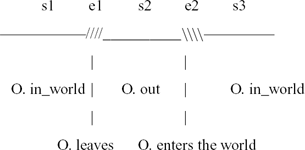
The truth conditions that the two competing analyses ascribe to the restitutive/counterdirectional reading are virtually indistinguishable; under both analyses, the situation described by our example (1) on the restitutive/counterdirectional reading can be visualized as in (10).
(10)

Hence the two analyses are more easily evaluated in terms of the predictions they make with respect to when a restitutive/counterdirectional reading should be available. For the lexical analysis, the prerequisites are conceptual: there should be a reversal of direction. Then there can be a counterdirectional predicate. For the structural analysis, the prerequisites are structural: there should be a result-state-denoting constituent. Then this constituent can potentially be targeted by the adverb. Thus, data showing that there are structural prerequisites for the availability of restitutive/counterdirectional again support the structural analysis.
Data reflecting so-called visibility (Rapp & von Stechow Reference Rapp and von Stechow1999) are of this nature. Beck (Reference Beck2005) distinguishes three degrees of visibility that are relevant for modification by adverbs:
(11)
To illustrate: in (12a) both VPs are independent syntactic phrases and should generally be modifiable by adverbs. In (12b), while the VP is an independent syntactic phrase, the category we call XP is part of a complex predicate (a verb–particle construction) and not an independent syntactic phrase; see Snyder (Reference Snyder2001) and Beck (Reference Beck2005) for our use of the term complex predicate.Footnote 2 Examples of complex predicate constructions are given in (13). Only adverbs with at least setting (ii) should be able to modify the XP constituents indicated there (in bold). Finally, (12c) contrasts with (12b) in that the result state of the predicate is not overtly expressed at all. Such predicates are analysed in terms of decomposition in von Stechow (Reference Stechow1996) and Rapp & von Stechow (Reference Rapp and von Stechow1999) (among many others). Taking the result state in such cases to be an AP, as in (12c), the AP should be visible only to adverbs with setting (iii), which can be called decomposition adverbs. Decomposition is involved in lexical accomplishment predicates like rise, open, return (e.g. Dowty Reference Dowty1979,Footnote 3 von Stechow Reference Stechow, Egli, Pause, Schwarze, von Stechow and Wienhold1995, Reference Stechow1996 and Beck Reference Beck2005; see Ramchand Reference Ramchand2008 for recent discussion relying on an articulate syntactic structure).
- (12)
(a) Leo [VP started to [VP sing the Marseillaise]]
(b) Leo jumped up.
Leo [VP jumped [XP _ up]]
(c) Leo rose.
Leo [VP ØV [AP _ risen]]
(13)
To give an example of the relevance of visibility, consider English almost vs German fast (‘almost’) (from Rapp & von Stechow Reference Rapp and von Stechow1999). The example in (14) shows that almost is an adverb with setting (iii), because the result-state-modifying reading of almost is available for decomposition structures (close). German fast on the other hand has setting (ii): a result-state-modifying reading is possible with complex predicates, as in (15a), but not with decomposition structures, as in (15b). Rapp & von Stechow argue that German erneut (‘again’) shows a behaviour indicative of setting (i), while German wieder (‘again’) has setting (iii). The fact that the syntactic status of the result-state-denoting expression matters speaks in favour of a structural analysis. Since the prerequisites of the lexical analysis are purely conceptual, we would expect no such effects.
(14)
(15)

We have left out English again in our discussion of visibility although it is regarded as a prototypical decomposition adverb, because again's behaviour is precisely the topic of the diachronic study that we turn to next.
2.2 Beck, Berezovskaya & Pflugfelder (Reference Beck, Berezovskaya and Pflugfelder2009)
Beck et al. (Reference Beck, Berezovskaya and Pflugfelder2009) investigate the restitutive/counterdirectional interpretation of again in LModE vs PDE. They find evidence of diachronic change in between the two stages of the language and argue that the nature of the change supports the structural analysis of again.
2.2.1 Method
The study assembled two corpora. The first one consists of letters written in the nineteenth century. The letters were taken from the Gutenberg Archive and the Corpus of Late Modern English Prose. This corpus contains letters written by fifteen speakers of English. The second corpus consists of written utterances from no earlier than 1990. It puts together written utterances by fifteen English speakers as well. From these corpora, Beck et al. collected: (i) the overall number of uses of again; (ii) the plausibly restitutive/counterdirectional uses of again; and (iii) the predicates with which restitutive/counterdirectional again was used.
An occurrence of again is classified as plausibly restitutive/counterdirectional in this study if one of two circumstances applies to it: either the event presupposed on the restitutive/counterdirectional reading is maximally salient, or it is clear from the context that the repetitive presupposition is not true. (16a) illustrates the first case and (16b) the second.
- (16)
(a) . . . a gleam of affectionate pleasure lighted it up for an instant, and
straight it sunk again. (Edgeworth)
= > ‘sink again’ refers back to the immediately preceding lighting up.
(b) The first time of going over I shall mark the passages which puzzle me,
and then return to them again. (Macaulay)
= > since the speaker goes over the passages for the first time, repetition of
‘return to them’ is impossible.
(16a, b) are good examples because the local sentence context establishes the criterion for classifying those occurrences of again as restitutive/counterdirectional. The same criteria were applied throughout, taking into account the surrounding text where appropriate.
2.2.2 Results
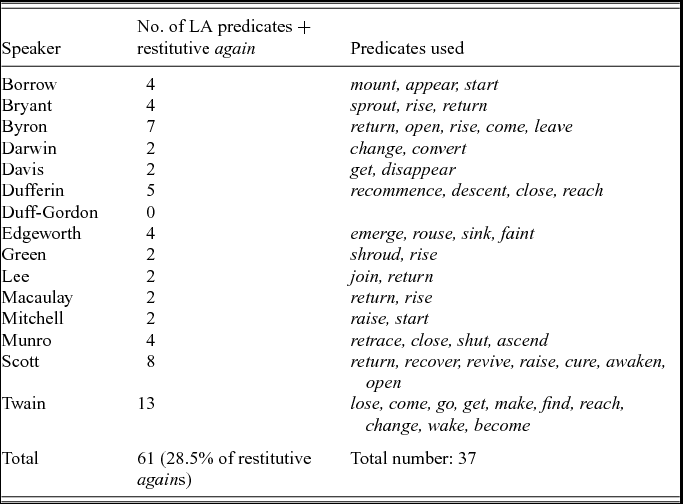
Tables 1–3 summarize Beck et al.'s results for the nineteenth-century speakers. Table 2 lists the number of restitutive/counterdirectional agains used with lexical accomplishment (i.e. decomposition) predicates and the particular predicates that occur per speaker. In Table 3 we give a list of the lexical decomposition predicates that occur with restitutive/counterdirectional again in the nineteenth-century corpus altogether. (The notation in the tables contains the label ‘restitutive’ rather than ‘restitutive/counterdirectional’ for brevity.)
Nineteenth-century agains

Lexical accomplishment (LA) predicate + restitutive again

LA predicates used with restitutive again

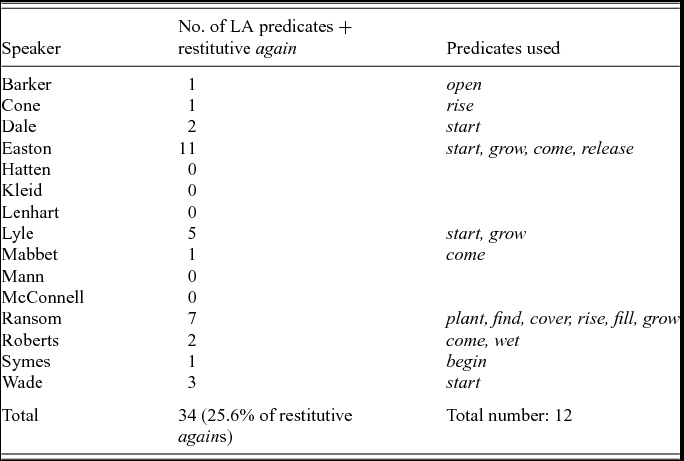
Tables 4–6 present parallel results for the PDE speakers.
Modern agains

LA predicate + restitutive again
LA predicates used with restitutive again

Beck et al. observe both a quantitative and a qualitative difference between the two corpora. In terms of numbers, restitutive/counterdirectional again used to be more common (average 21.1%) than it is now (average 12.6%). The result is significant: the probability was calculated by a χ2-test, p<.01. The second difference concerns uses of restitutive/counterdirectional again with lexical decomposition predicates. There is a relatively small difference in overall numbers: in PDE, 25.6 per cent of the restitutive agains occur with such predicates, while it is 28.5 per cent in the nineteenth-century corpus. The difference becomes clearer when we look at individual speakers: a tendency to lose restitutive again with LA predicates emerges for particular speakers in that 14 out of 15 historical, but only 10 out of 15 modern speakers use again with LA predicates. It can also be seen quite clearly when we consider the predicates involved: 37 different predicates occur in the historical corpus vs 12 now; three predicates (start, grow, come) account for 24 out of 34 modern LA restitutive agains. The small number of predicates is potentially very significant. It is possible for a combination of predicate plus again to become more or less idiomatic and even lexicalized. An example that occurs in the modern corpus is (17).
(17) salads of the ‘cut-and-come-again’ variety
A speaker who uses this term may not be applying a decomposition analysis at all, but simply have learned this term as the name for a type of salad. A reasonable criterion for taking a speaker to have restitutive/counterdirectional again with decomposition structures would be that the speaker use restitutive again with at least two different LA predicates. Only 4 modern speakers would meet this criterion, while 14 out of 15 historical speakers do.Footnote 4 Beck et al.'s interpretation is that this is a visibility phenomenon; specifically, that the facts can be analysed in terms of the visibility parameter given in (11) above. They argue that setting (iii) of the Visibility Parameter is available only to a subgroup of the modern speakers, while LModE speakers generally had this setting. This interpretation matches the results of an informal questionnaire study which reveals differences between predicates like return vs come back (18) or connect vs put together (19) in PDE:
- (18)
(a) % return again (restitutive)
(b) come back again (restitutive)
- (19)
(a) % connect the parts again (restitutive)
(b) put the parts together again (restitutive)
The findings in (18) and (19) indicate that the restitutive/counterdirectional interpretation of again is uniformly accepted with the latter but not the former type of predicate. The difference between the two virtually synonymous predicates is that return involves decomposition and would require setting (iii) for restitutive/counterdirectional again to be possible, while come back is a complex predicate, with back overtly marking the result state, and needs only setting (ii) for restitutive/counterdirectional again.
Note that decomposition as such is still available in PDE. Both (20a) and (20b) have result-state-modifying readings. The observed change concerns again, specifically.
- (20)
(a) I almost reached the summit.
ok: ‘I got to a point where I was almost at the summit.’
(b) Can we open the window for a few minutes?
ok: ‘Can we bring it about that the window is open for a few minutes?’
Hence Beck et al. conclude that restitutive/counterdirectional use of again is beginning to require a visible result state, i.e. again in PDE is changing from setting (iii) to setting (ii). Visibility of the result state matters only under the structural analysis. Beck et al. therefore also conclude that their findings support the structural analysis.
3 Early Modern English again
Beck et al. (Reference Beck, Berezovskaya and Pflugfelder2009) provide the model for our own empirical investigation. Since again has undergone change in the recent past, we ask whether earlier stages of the language may reveal further development. The study reported in this section looks at again in EModE. We first describe the database we put together on the basis of the PCEEC corpus. Section 3.1 below contains details concerning our source and selection of data. The findings extracted from that corpus are reported in section 3.2. We will see that they do indicate differences to nineteenth-century and PDE again, which are analysed in section 3.3.
3.1 Method
For the sake of comparability, we tried to proceed in as parallel a way as possible to the Beck et al. study, beginning with the type of utterance. The data for our investigation have been extracted from the Parsed Corpus of Early English Correspondence (PCEEC), available through the Oxford Text Archives (see Taylor et al. Reference Taylor, Nurmi, Warner, Pintzuk and Nevalainen2006). The PCEEC contains a total of 84 files with each file containing letters from an edited collection (in a few cases more than a single collection; see Taylor et al. Reference Taylor, Nurmi, Warner, Pintzuk and Nevalainen2006 for further philological as well as corpus-related background details). With respect to our current purposes, recall that the study of Beck et al. (Reference Beck, Berezovskaya and Pflugfelder2009) was conducted on the basis of individual speakers, or writers. Therefore we proceeded as follows also with the EModE data of the PCEEC. Rather than just taking the collections of letters (in each of which several corresponding authors are included), filtering according to individual letter writers was necessary to ensure the largest possible degree of compatibility with the later Modern English study.
We chose letters written between the fifteenth and seventeenth centuries, i.e. the largely EModE span of the corpus. We then extracted all tokens containing relevant forms of the adverb again in correspondence written by the fifteen most productive writers. The choice of speakers also followed closely the strategy of Beck et al. in focusing on productive speakers: those speakers were picked who had the largest number of uses of again. Even so, we ended up with a smaller overall number of agains than in Beck et al. This was unavoidable if we were to follow the same basic set-up for the study. The historically earliest speaker in our corpus, John Paston II, provides data in his letters from the fifteenth century, so not strictly speaking EModE but still Middle English (ME), more specifically the last subperiod, M4. This gives us a small window into ME, which will prove interesting below. For simplicity, we still refer to the corpus we assembled as the EModE corpus.
We extracted and categorized data in a fashion parallel to the Beck et al. study, using the same criteria: number of agains, plausibly restitutive/counterdirectional uses, the predicates that occur and so on. All the different spellings of the adverb (again, againe, ageyn, ageyne, etc.) were counted, but not prepositions, which are not distinguishable in general by spelling at that time; see the example in (21a), in which the second occurrence is a preposition (i.e. ‘against’). Example (21b) illustrates the well-known fact that spelling is not a reliable indicator (the adverb has the same spelling as the preposition in (21a) and the two passages stem from the same writer).
(21)
3.2 Findings
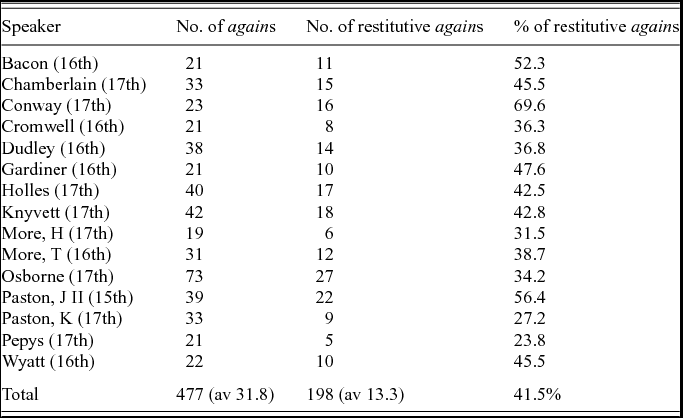
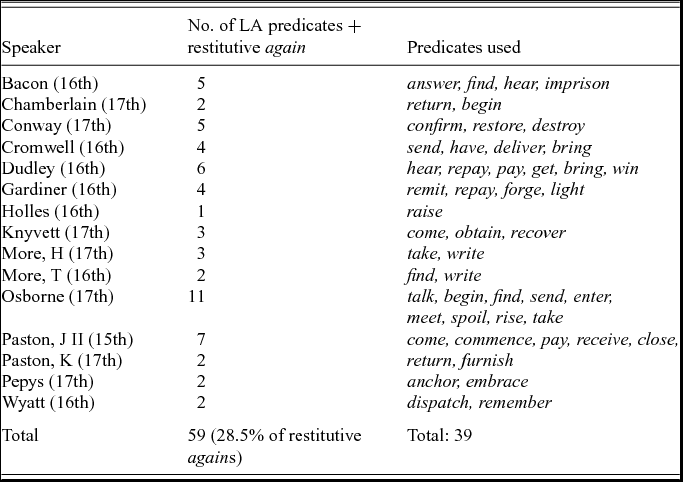
Table 7 reports the number of agains, number and percentage of restitutive/counterdirectional agains per speaker; table 8 reports lexical predicates with restitutive/counterdirectional again per speaker; and table 9 provides a list of such predicates that showed up overall.
EModE agains
LA predicate + restitutive again
LA predicates used with restitutive/counterdirectional again

In table 9 there are some predicates whose occurrence is unexpected in the light of the interpretive options of again today. Those include in particular answer, hear, write, talk. We give some of the relevant examples from the EModE corpus below:
(22) therfore I am reddy in your particular to answere your love with myne back againe [. . .]
(John Holles, 17th c., PCEEC-HOLLES,II,203.059.1409)
= ‘to return your love’
(23) and doe looke every oure to hear from him again.
(Robert Dudley, 16th c., PCEEC-LEYCEST,34.010.261)
= ‘to hear back from him’
(24) that lyke as the French King byfore wrote and bosted vn to his mother that he had of his awne mynd passed in to Italy, so is it lykly that she shall haue shortly cause to wryte agayn to hym that it had to be mych bettre and more wisedome for hym to abide at home [. . .]
(Thomas More, 16th c., PCEEC-MORE,313.020.266)
= ‘to write back to him’
(25) Tis like people that talk in theire sleep,
nothing interupts them but talking to them again [. . .]
(Dorothy Osborne, 17th c., PCEEC-OSBORNE,37.017.774)
= ‘to reply to them’
It is clear from the context that these agains are not repetitive. Their use is more similar to restitutive/counterdirectional again. The paraphrases indicated make sense especially in terms of counterdirectionality (e.g. he writes to her/she writes to him). But it would not be possible to use again in this way in PDE; see e.g. (26). Also, no such predicates occur in the lists in tables 3 and 6 of lexical predicates used with restitutive/counterdirectional again in LModE and in PDE.
(26) Please leave a message after the tone. We will call you back/#again.
Once more we have both a quantitative difference and a qualitative difference between this corpus and the later ones. First, the overall number of restitutive/counterdirectional agains is proportionally very high: on average 41.5 vs average 21.1 per cent in the nineteenth-century corpus. On the basis of the chi-squared test, the difference between our EModE data and the LModE data is statistically highly significant (χ2 [1] = 66.7, p< 0.001). Furthermore, when testing for the trend in proportions for the three major periods under discussion (i.e. EModE, LModE and PDE), the result obtained is also highly significant (χ2 [1] = 136.5, p< 0.001). Second, the predicates that occur with restitutive/counterdirectional again in EModE include some that do not permit such a use later. We take these findings to be indicative of a diachronic change between EModE and LModE.
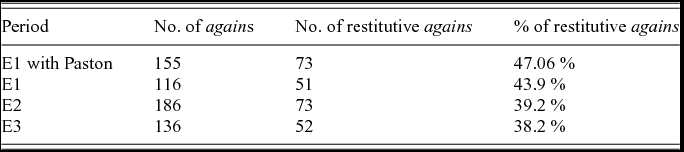
Since our current corpus contains instances of again spread over more than two centuries, it is legitimate to ask whether there is any internal development within this period. Using the standard Helsinki threefold subdivision of the Early Modern English period, we give the results for our material in table 10. The speakers are usually within one period (we counted Thomas Knyvett as belonging to E2 since most of his letters are situated in this subperiod). For the first subdivision, we give the figures both with and without John Paston II (who belongs to the late Middle English period M4 and not to E1).
EModE agains
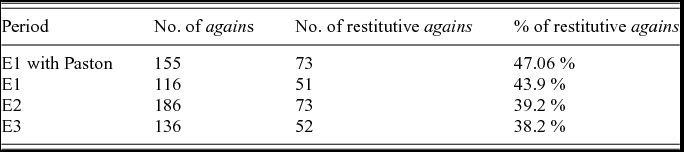
A decreasing tendency can be observed descriptively in the figures presented in table 10 within the span of the EModE correspondence data, but the numbers here are clearly a lot more stable than compared to Late Modern English (see Beck et al. Reference Beck, Berezovskaya and Pflugfelder2009 and section 3.3 below). The tendency, internal to the EModE period, is not statistically significant, according to the chi-squared test (p = 0.5). Applying the test for the trend in proportions also yields a non-significant result (p = 0.3). To summarize so far, there is a significant difference between the incidence of counterdirectional/restitutive again in EModE and LModE, on which the main claim of this article is based, while the EModE period itself does not show a statistically significant internal development. An analysis of the developments is given in section 3.3.
3.3 Discussion
3.3.1 EModE: the presence of counterdirectional again
We propose that the uses of again in (27a–d) are plausibly seen as counterdirectional rather than as restitutive.
(27) Uses of again suggestive of counterdirectional semantics:
(a) to talk to them again = to reply to them
(b) to write again to him = to write back to him
(c) to answer your love with mine back again = to return your love
(d) to hear from him again = to hear back from him
A first point to note is that some predicates used with again in EModE, like talk, are most plausibly seen as activities. The results of applying the usual criteria (see Dowty Reference Dowty1972; Verkuyl Reference Verkuyl1972) are given in (28b, c). It is hard to see these predicates as introducing a result state. But if there is no result state, such a state cannot be restored – ruling out a restitutive analysis of again. On the other hand, we can intuitively easily see the activity described as directed (29).
(28) No change of state:
(a) Lizzy talked to Darcy.
(b) Lizzy talked to Darcy for an hour / #in an hour.
(c) Lizzy was talking to Darcy. = > Lizzy talked to Darcy.
(29) Counterdirectionality:
x talk to y / y talk to x
Other predicates can reasonably be described in terms of a decomposition into an activity and a result state, like write and answer. However, a plausible decomposition introduces a result state that does not really capture the intuitive interpretation of the uses of again in (30a, b). The intuitive interpretations do indicate a reversal of direction.
(30) Change of state, but plausible result state not helpful:
(a) Darcy wrote to Lizzy.
= Darcy's writing caused a message to Lizzy to come into existence.
She wrote to him again. ≠
Her writing caused a message to him to once more come into existence.
(b) I answer your love with mine.
possible result: I love you (you have my love).
I answer your love with mine back again. ≠ I once more love you.
Pending a clearer understanding of and a more precise semantics for counterdirectionality, we assume that the intuition of a reversal of direction can be formalized, i.e. that such a semantics can be developed. We conclude that the data in (27) can be captured by a counterdirectional analysis of again, but not by a structural analysis. It is interesting that there are, after all, predicates that reveal an interpretive difference between the lexical and the structural analysis and that it took diachronic data to identify them. We conclude that EModE has counterdirectional again.
3.3.2 The change from counterdirectional to restitutive again
How do we reconcile counterdirectional EModE again with the structural analysis of again that Beck et al. (Reference Beck, Berezovskaya and Pflugfelder2009) argued for? (41) summarizes what we know from the two correspondence studies.
- (31)
(a) EModE has counterdirectional again.
(b) LModE does not have counterdirectional again.
=> counterdirectional again is lost between the seventeenth and nineteenth centuries.
Let us consider the restitutive/counterdirectional reading of an example like (32):
(32) nothing can ever perswade mee to enter the worlde againe [. . .]
(Dorothy Osborne, 17th c., PCEEC-OSBORNE,123.052.2815)
The example is from a letter written by Dorothy Osborne to William Temple. Although Osborne and Temple later married, the relationship was facing difficulties at the time of this piece of correspondence. Preceding the letter, Osborne had decided to end their secret engagement and Temple had in turn reproached her; see Harding (Reference Harding1976: 144), who regards the letter from which (32) is taken as ‘written in great depression’. Osborne breaks the linear narrative style here and she writes about distancing herself from the world in the passage. We ignore the embedding material contained in the original example (the matrix clause with the negative quantifier and the verb ‘persuade’) and concentrate on the subordinate clause with enter the world againe.
We claim that in such examples in the history of the English language, two different analyses ought to be considered, one in terms of counterdirectionality and the other in terms of restitution, shown in (33) and (34). On both readings, Osborne enters the world in the event e. The fact that this happens ‘again’, i.e. there was a previous relevant event is captured through the presupposition (cf. the notation ∃e′.e′<e, i.e. there is an event e′ preceding e). The two analyses yield truth conditions that for this type of example are indistinguishable. They both describe situations with the properties sketched in (35) (as noted above for the parallel example (1)).
(33) Counterdirectional analysis:
(a) [[PROOsborne [enter the world]] againctrdir]
(b) λe: ∃e′[e′<e & O. leave_the_world(e′)]. O. enter_the_world(e)]
(34) Structural analysis:
(a) [[PROOsborne [ØV [[SC PROOsborne in the world] againrep]]
(b) λe: ∃e′[e′<e & O. in_the_world(e′)].
O. does something that causes her to come to be in_the_world (e)
(35)
When do these respective analyses apply? We have evidence that counterdirectional again is older than repetitive again. It comes from the steady decrease in the percentage of agains used restitutively/counterdirectionally, and the corresponding rise in repetitive again. Between the EModE and LModE corpora, restitutive/counterdirectional again drops from 41.5 to 21.1 per cent. Within the EModE corpus, we observe that John Paston II, our earliest speaker historically, uses mostly restitutive/counterdirectional agains, namely at a rate of 56.4 per cent.
Since we know that LModE no longer has counterdirectional again, a process of language change needs to be posited that will get us from the counterdirectional analysis in (33) to the restitutive analysis in (34). The restitutive analysis in (34) has two prerequisites: on the one hand, a speaker has to have repetitive again, and on the other, s/he has to have access to decomposition structures.
We can confirm that the latter has to be the case in EModE. There are other adverbials that are decomposition adverbials (almost, for an hour etc.), hence decomposition is a process that plays a role in the grammar of the language. We give some relevant examples below involving temporal adverbs and almost in conjunction with the perfect of result.
(36) Vppon thys I was commaunded to go forth for a whyle
(Thomas More, 16th c., PCEEC-MORE,553.042.796)
(37) Sir, my lord of Hunsdon hath sent his comandment, uppon his sonn Hobbyes informacion, for a bayly of Hersam, who had a book concerning ther own lybertyes and myne also, delyvered them by a stuard of myne only for a tyme to pleasure them [. . .]
(Robert Dudley, 16th c., PCEEC-LEYCEST,11.005.86)
(38) Indeed, sweet hart, this busines hath almost broake my hart.
(Thomas Knyvett, 16th /17th c., PCEEC-KNYVETT,161.042.1784)
While the example in (36) wears the event interpretation on its sleeves, i.e. overtly via the particle forth, the one in (37) interestingly requires decomposition at the level of interpretation, as does (38). In the latter, Thomas Knyvett is not quite entirely demolished given that, as he puts it in the very next sentence, ‘I am gladd to reade some comfort in thy letters’. At the same time, the sentence is not counterfactual (so that, say, he in fact managed to escape the inconvenient situation entirely) – we are told in the same token: ‘yet when I looke backe vpon my owne condition, I am struck blancke againe, seeing my selfe inviron’d with eyes & eares that seek's my vtter ruine’. Hence we clearly have a result-state-modifying reading of almost with a lexical accomplishment predicate (‘this business has caused my heart to come to be almost broken’).
We can also confirm that English must have a repetitive use of again during the ME period. Below is a pair of examples from John Paston II (a late representative of the ME period), the first of which is a counterdirectional use of again and the second of which must be repetitive (since be in London is purely a state). Roughly 40 per cent of John Paston II's agains are repetitive.
(39) John Paston II (15th c.):
counterdirectional: tyll that the Kyng goo in-to Walys an kome ageyn [. . .]
(PCEEC-PASTON,I,391.126.3877)
repetitive: I woll not fayle to be there at London ageyn wyth-in thys vj dayes
(PCEEC-PASTON,I,443.137.4269)
Thus an EModE speaker has all the grammatical knowledge required to employ the restitutive analysis in (34). We speculate that at some point speakers reanalysed (33) to (34). Note that this is a plausible step to take because the resulting interpretations describe the same situations, a point discussed in terms of ‘constant entailments’ in Beck (Reference Beck2012); see also the discussion in section 4 below.
In sum, EModE enter the world again is likely to be vacuously ambiguous, reflecting both the older counterdirectional source and the modern decompositional use of repetitive again. By contrast, a predicate like enter the world again in LModE is restitutive: it has repetitive again and decomposition. By the nineteenth century, the restitutive analysis (34) is the only option.
3.3.3 Further issues
The trajectory that we have sketched for again opens some interesting questions for further research. Again must have gone through a series of changes. These begin with the change from preposition to counterdirectional adverb in early ME. The counterdirectional adverb then acquires a repetitive reading in addition during the ME period. Repetitive again has setting (iii). Counterdirectional again is lost, before LModE. The setting of repetitive again switches to setting (ii) in PDE. On this view, the change of again is not a monolithic one, but rather a sequence of changes that are rather distinct in nature. The numerical developments we have noted give some support to this view.
The developmental trajectory which is observed in the corpora consisting of individual speakers cannot be one and the same change from the Middle English period to PDE. A uniform change from Middle English to PDE (say, with a possible death of restitutive readings in the future in the completion of an idealized curve of change) would face two problems: (i) semantic implausibility (no plausible result state for many counterdirectional predicates preceding LModE; see above); (ii) a falsified prediction if we assumed that it were a purely structural change following the S-shaped curve in its progress (see Kroch Reference Kroch1989). Under the latter assumption, at the centred span of the change, we would expect the most dynamic development. The curve would only be expected to be slow in the rate of change at its endpoints. But the EModE period is not at the beginning or the end of the development between Early Middle English and PDE. Consequently, the observed stability in the rate of restitutive readings during the EModE period, which is not at an extremity of the assumed single development, would not be expected on the simplest assumptions.
4 Conclusion and questions for further research
The main claim in this article has been that both a counterdirectional analysis and a restitutive analysis of again are required in order to track its historical development. While the structural analysis could capture the transition from LModE to PDE, the counterdirectional analysis is required for earlier English.
We end the article with some questions for further research. The overall picture calls for an analysis of the individual steps involved in the changes that again went through:
Q1: The adverb again can be traced back to a preposition meaning against.
How does counterdirectional adverbial again develop from the preposition?
Q2: The repetitive use of again develops from the counterdirectional use. How are they related? Does the development happen via the reanalysis of lexical decomposition structures with counterdirectional again?
- Q3:
a. How is counterdirectional again lost?
b: How and why does PDE lose setting (iii) for again?
We see that a more comprehensive survey of the behaviour of again will be needed, as well as a detailed semantic investigation of its various stages. A detailed semantic analysis should build on the path-related preposition against (Cresswell Reference Cresswell1978; Krifka Reference Krifka and Rothstein1998). Its connection to counterdirectional again will give us more evidence on the nature of counterdirectionality. There is also a more general theoretical issue alluded to above:
Q4: Is the concept of constant entailments a useful guideline for meaning change?
Following Beck (Reference Beck2012), constant entailments are defined as follows:
(50) Variability in the meaning of an expression α between interpretations α′ and α″ is promoted by the existence of contexts ϕ in which an occurrence of α under both interpretations α′ and α″ leads to the same proposition ϕ′.
Crucially, different analyses can lead to identity in the overall sentence meanings. Supposing that we can take constant entailment as a guideline for the possibility of change, we can pin down the rise of repetitive again in the way envisioned above. The notion of constant entailment is distinct from that of bridging contexts in the sense of Evans & Wilkins (Reference Evans and Wilkins2000) or Heine (Reference Heine2002).Footnote 5 While we do not deny the role of implicatures turning into core meanings (see also Eckardt's (Reference Eckardt2006, Reference Eckardt, von Heusinger, Maienborn and Portner2012) Avoid Pragmatic Overload principle in order to motivate change in the framework of compositional semantics), the change we have described in this article is of a different type (see Beck Reference Beck2012). It is not in any obvious way primarily rooted in the conventionalization of implicatures. What is rather the case is that sentences containing again that are truth-conditionally indistinguishable at some point, i.e. between the counterdirectional and the restitutive reading, lose one of the two potential representations along the path of change. We hope to address some of the issues presented here with the tools of a formalized system in future work.