





Introduction
A multiword sequence (MWS; Christiansen & Arnon, Reference Christiansen and Arnon2017), also referred to as formulaic language (Carrol & Conklin, Reference Carrol and Conklin2020) or a multiword expression (Kallens & Christiansen, Reference Kallens and Christiansen2022, Sag et al., Reference Sag, Baldwin, Bond, Copestake and Flickinger2002) is a highly familiar frequently occurring word combination that serves as fundamental building blocks of language (Arnon et al., Reference Arnon, McCauley and Christiansen2017; Arnon & Snider, Reference Arnon and Snider2010). MWSs encompass different linguistic forms, such as idioms (shoot the breeze), collocations (fatal mistake), binomials (bride and groom), lexical bundles (on the other hand), and other expressions (see Wray, Reference Wray2002). MWSs are highly pervasive in both spoken and written language; for example, Erman and Warren (Reference Erman and Warren2000) estimated that about 55% of a text contains formulaic expressions of some sort.
MWSs are generally associated with a processing advantage, being processed more quickly than word sequences that do not frequently co-occur (e.g., Li et al., Reference Li, Bassetti and Frisson2025). This processing advantage challenges the traditional “words-and-rules” view (Pinker, Reference Pinker1999) of language use and processing (for discussion, see Kallens & Christiansen, Reference Kallens and Christiansen2022). Rather than solely relying on the incremental combination of individual words within a syntactic frame, MWSs appear to benefit from language users’ sensitivity to recurrent occurring patterns, giving rise to a degree of unit-like representation and processing.
Historically, most research of MWSs was confined to the processing of idioms (Siyanova-Chanturia & Martinez, Reference Siyanova-Chanturia and Martinez2015). While MWSs research nowadays also includes different types of expressions, direct comparisons between different types are scarce and further complicated by MWSs varying in several important aspects, such as the degree of conventionalization (i.e., the extent to which the form configuration or meaning is static), semantic decomposability/transparency (i.e., the extent to which individual components of a MWS independently contribute to the overall meaning), and meaning dominance (i.e., the extent that MWSs are used in their derived or compositional meaning). The present study directly compares two common types of MWS: collocations (e.g., vast area) and ambiguous idioms (i.e., word sequences that can have both a literal and figurative interpretation, e.g., gray area). Moreover, MWSs are important in second language acquisition; being able to competently use the right MWS in the right context is indicative of L2 proficiency (Pawley & Syder, Reference Pawley, Syder, Richards and Schmidt1983). Given that different types of MWS pose different challenges for L2 users (Yi & Zhong, Reference Yi and Zhong2024), we will compare the processing of both types in both L1 and L2 (Chinese-English) language users.
To our knowledge, only one study has investigated to what extent distributional properties, such as frequency and contextual predictability, affect different MWSs. Carrol and Conklin (Reference Carrol and Conklin2020) recorded eye movements while participants read sentences containing idioms (spill the beans), collocations (abject poverty), binomials (king and queen), or matched novel phrases (drop the beans; total poverty; prince and queen). They examined whether the processing advantage typically observed for MWSs over novel phrases was consistent across different MWS types, and how far this advantage could be explained by general (e.g., frequency) and/or type-specific (e.g., degree of decomposability) properties. They found a consistent advantage for MWSs over novel phrases and argued that this effect was mainly driven by frequency and predictability, i.e., by general properties. They concluded that the processing advantage for MWS is largely driven by “aspects of conventionalization (frequency […] and predictability […] based on co-occurrence probabilities)” (p. 116).
The present study expands Carrol and Conklin’s (Reference Carrol and Conklin2020) research in several important ways. First, the different MWSs, due to their different configurations, could not be compared directly, which our design did allow. Second, in our study, distributional variables such as frequency, familiarity and predictability, were carefully controlled between all MWSs. Third, we included idioms in both literal and figurative contexts, enabling us to exploit their inherent ambiguity to investigate their processing. Fourth, while Carrol and Conklin only tested native participants, we tested both L1 and L2 participants and compared the processing profiles between the two groups, providing a broader perspective on how MWSs are processed across language backgrounds.
Collocation processing in the first and second language
Previous studies suggest that collocations (e.g., provide information, fatal mistake) are processed more quickly than novel word combinations that infrequently co-occur (e.g., compare information, extreme mistake) by both L1 and L2 speakers. This processing advantage has been demonstrated using different paradigms, including priming tasks (Durrant & Doherty, Reference Durrant and Doherty2010; Vilkaitė-Lozdienė & Conklin, Reference Vilkaitė-Lozdienė and Conklin2021), phrasal judgment tasks (e.g., Siyanova & Schmitt, Reference Siyanova and Schmitt2008; Wolter & Gyllstad, Reference Wolter and Gyllstad2011, Reference Wolter and Gyllstad2013; Wolter & Yamashita, Reference Wolter and Yamashita2015, Reference Wolter and Yamashita2018), and eye-tracking during reading (Li et al., Reference Li, Warrington, Pagán, Paterson and Wang2021; Li et al., Reference Li, Bassetti and Frisson2025; Sonbul, Reference Sonbul2015; Vilkaitė & Schmitt, Reference Vilkaitė and Schmitt2019; Vilkaitė, Reference Vilkaitė2016).
Furthermore, both L1 and L2 speakers are sensitive not only to the frequency of individual words within collocations but also to the frequency of the collocation as a whole (Öksüz et al., Reference Öksüz, Brezina and Rebuschat2021, Reference Öksüz, Brezina, Monaghan and Rebuschat2024). Using an acceptability judgment task, Öksüz et al. (Reference Öksüz, Brezina and Rebuschat2021) found that both noun frequency and collocational frequency were associated with faster responses in both L1 and L2 speakers. Öksüz et al. (Reference Öksüz, Brezina and Rebuschat2021) also found that higher collocational frequency reduced reliance on word frequency, indicating a shift toward holistic processing for frequent collocations. This suggests that frequent collocations become more entrenched and lexicalized in memory, consistent with usage-based language models (Bybee, Reference Bybee, Gruber, Higgins, Olson and Wysocki1998; Goldberg, Reference Goldberg2006; Tomasello, Reference Tomasello2003). However, given that both groups of speakers remained sensitive to word-level frequency, even in frequent collocations, lexicalization does not mean collocations are processed solely as chunks without compositional analysis.
Studies reporting a collocation advantage (Carrol & Conklin, Reference Carrol and Conklin2020; Durrant & Doherty, Reference Durrant and Doherty2010; Li et al., Reference Li, Warrington, Pagán, Paterson and Wang2021; Li et al., Reference Li, Bassetti and Frisson2025; Öksüz et al., Reference Öksüz, Brezina and Rebuschat2021; Siyanova & Schmitt, Reference Siyanova and Schmitt2008; Sonbul, Reference Sonbul2015; Vilkaitė, Reference Vilkaitė2016) typically adopted a frequency-based approach (Sinclair, Reference Sinclair1991) to define collocations. Collocations can be defined using two distinct approaches: the corpus-based frequency method (Sinclair, Reference Sinclair1991) and the phraseology-based method (e.g., Howarth, Reference Howarth1998). The frequency method defines collocations as frequently co-occurring word combinations and includes semantically transparent and literal collocations (Carrol & Conklin, Reference Carrol and Conklin2020). In contrast, the phraseology-based method emphasizes semantic restrictions, where one component may not be used literally or lacks semantic transparency (e.g., heavy rain), as described in Howarth’s Continuum Model (Reference Howarth1998). For the current study, we employed the corpus-based frequency method and selected only transparent and literal collocations. Full details are provided in the materials section.
Idiom superiority effects in the first language
Idioms are characterized as a string of words for which the figurative meaning cannot be derived by computing the individual components literally (Swinney & Cutler, Reference Swinney and Cutler1979). Unlike collocations, idioms are perceived as fixed, semantically opaque, and having a conventionalized figurative meaning. A considerable body of literature demonstrates idioms’ superiority effect in L1 processing, i.e., faster processing of idioms compared to novel literal word combinations, with evidence coming from lexical decision tasks (e.g., Ortony et al., Reference Ortony, Schallert, Reynolds and Antos1978; Swinney & Culter, Reference Swinney and Cutler1979; Tabossi et al., Reference Tabossi, Fanari and Wolf2009), self-paced reading tasks (e.g., Conklin & Schmitt, Reference Conklin and Schmitt2008; Gibbs, Reference Gibbs1980), and eye-tracking studies (Carrol & Conklin, Reference Carrol and Conklin2017, Reference Carrol and Conklin2020; Siyanova-Chanturia et al., Reference Siyanova-Chanturia, Conklin and Schmitt2011; Underwood et al., Reference Underwood, Schmitt, Galpin and Schmitt2004).
The well-documented idiom superiority effect in L1 speakers was initially taken as evidence that idioms are represented as non-decomposable strings and retrieved directly from the mental lexicon (e.g., Bobrow & Bell, Reference Bobrow and Bell1973; Swinney & Culter, Reference Swinney and Cutler1979). However, subsequent research showed that this effect is primarily driven by the high familiarity among L1 speakers, facilitating faster processing than novel word combinations (e.g., Carrol & Conklin, Reference Carrol and Conklin2017, Reference Carrol and Conklin2020; Tabossi et al., Reference Tabossi, Fanari and Wolf2009). Furthermore, studies showed that idiom processing involves both literal computation, which is considered obligatory, and figurative retrieval (e.g., Cacciari & Corradini, Reference Cacciari and Corradini2015; Cacciari & Tabossi, Reference Cacciari and Tabossi1988; Cutting & Bock, Reference Cutting and Bock1997; Titone et al., Reference Titone, Lovseth, Kasparian and Tiv2019). Hence, idioms are characterized as simultaneously compositional and non-decomposable (Kuiper et al., Reference Kuiper, van Egmond, Kempen and Sprenger2007), exhibiting features of both words and complex syntactic structures. Like words, idioms may have unitary representations. At the same time, they resemble syntactic structures that undergo compositional analysis (Cutting & Bock, Reference Cutting and Bock1997; Sprenger et al., Reference Sprenger, Levelt and Kempen2006).
As discussed above, there appears to be little inherent to idioms that explains their processing superiority. Like collocations, the processing difference between idioms and novel word combinations can largely be due to idioms being more familiar and better known to language users. However, idioms do not entirely fit in the usage-based approach, as individual idioms are relatively infrequent in language, particularly in corpora (Moon, Reference Moon1998). This discrepancy leads us to question whether idioms still demonstrate the superiority effect compared to other word combinations when distributional information is controlled for.
The present study therefore separates two constructs. Conventionality refers to how strongly an expression is established in the language community. An expression can be conventionalized as a preferred configuration, as an established meaning, or both. Idioms are treated as strongly semantically conventionalized because they not only have a fixed form but also an established figurative meaning. Although corpus-defined collocations involve preferred co-occurrence patterns, they are generally less fixed in form than idioms, and their meanings are usually literal. The second construct, semantic decomposability/transparency, refers to how easily the phrase-level meaning can be understood from the meanings of the individual words. In this study, this dimension was measured only for idioms, because the collocations were selected to be literal, and, hence, transparent. For example, the idiom break the ice has the conventionalized figurative meaning “to make people feel more relaxed in a social situation”. However, this meaning cannot be fully understood from the literal meanings of break and ice, making the expression relatively non-decomposable. The present study therefore asks whether higher semantic conventionality facilitates MWS processing beyond frequency, familiarity, and predictability, and whether differences in semantic decomposability affect idiom processing. These constructs are distinct from frequency and subjective familiarity, which reflect how often an expression is encountered rather than how its meaning is represented.
Some evidence suggests that semantic meaningfulness can facilitate MWS processing over and above frequency. Using a phrasal decision task, Jolsvai et al. (Reference Jolsvai, McCauley and Christiansen2020) showed that expressions judged as more meaningful (e.g., play the field) were recognized faster than those judged less meaningful (e.g., because it lets). In addition, Shi et al. (Reference Shi, Peng and Li2023) used self-paced reading and reported a trend for faster reading of figurative MWSs with a figuratively used component (e.g., build a career) relative to matched literal collocations (e.g., build a house) in L1 speakers. Together, these findings are consistent with hybrid accounts of idiom and MWS processing (Kuiper et al., Reference Kuiper, van Egmond, Kempen and Sprenger2007; Sprenger et al., Reference Sprenger, Levelt and Kempen2006), in which MWSs with more conventionalised form—meaning mappings are more likely to engage direct access to a unitary meaning representation, reducing reliance on fully literal, word-by-word compositional analysis. However, this has not yet been directly tested and whether conventionality facilitates MWS processing over and above distributional information remains unknown.
Moreover, semantic decomposability (i.e., the extent to which an idiom’s components directly relate to the idiomatic meaning) has been suggested to affect idiom processing, as in the Idiom Decomposition Hypothesis (Gibbs et al., Reference Gibbs, Nayak and Cutting1989; Gibbs & Nayak, Reference Gibbs and Nayak1989). Specifically, it influences the bottom-up incremental parsing or compositional analysis. However, its role remains unclear. Some studies reported a facilitatory effect with decomposable idioms being processed faster than non-decomposable ones (Caillies & Butcher, Reference Caillies and Butcher2007; Carrol & Segaert, Reference Carrol and Segaert2024; Gibbs & Nayak, Reference Gibbs and Nayak1989; Hamblin & Gibbs, Reference Hamblin and Gibbs1999; Libben & Titone, Reference Libben and Titone2008; Milburn et al., Reference Milburn, Vulchanova and Vulchanov2021; Titone et al., Reference Titone, Lovseth, Kasparian and Tiv2019). In contrast, other studies found no difference (Carrol & Conklin, Reference Carrol and Conklin2014; Kyriaco et al., Reference Kyriacou, Conklin and Thompson2020; Tabossi et al., Reference Tabossi, Fanari and Wolf2009) or even the opposite effect (Titone & Libben, Reference Titone and Libben2014), with non-decomposable idioms processed more quickly. In addition, Milburn and Warren (Reference Milburn and Warren2019) showed that semantic decomposability, operationalized as the degree to which an idiom’s literal and figurative meanings overlap, interacts with usage frequency to influence processing. Highly decomposable idioms slow reading when their figurative interpretation is dominant but speed it up when the literal and figurative interpretations of idioms are more balanced. This pattern highlights how facilitatory or inhibitory effects of semantic decomposability depend on which interpretation readers expect.
Idiom processing in the second language
The idiom superiority effect is less consistent in L2 speakers than in L1 speakers, likely due to weaker connections between the idiom’s configuration and its idiomatic interpretation. Although some studies (e.g., Conklin & Schmitt, Reference Conklin and Schmitt2008) show L2 speakers read idioms faster than novel word combinations, others did not find an idiom superiority effect in L2 speakers (e.g., Carrol et al., Reference Carrol, Conklin and Gyllstad2016; Carrol & Conklin, Reference Carrol and Conklin2017; Siyanova-Chanturia et al., Reference Siyanova-Chanturia, Conklin and Schmitt2011). Siyanova-Chanturia et al. (Reference Siyanova-Chanturia, Conklin and Schmitt2011) compared ambiguous idioms to novel word combinations within short discourse contexts. The preceding context sentences were biased toward either a literal or a figurative interpretation of the idiom. L1 speakers read idioms in both literal and figurative interpretations more quickly than novel word combinations. However, L2 speakers did not demonstrate faster processing of the idiomatic interpretations over novel word combinations. Moreover, L2 speakers read the literal interpretations of idioms faster than the figurative ones.
The processing cost that L2 speakers experience with the idiomatic meaning suggests that they rely on a more compositional, bottom-up approach to idiom processing (Beck & Weber, Reference Beck and Weber2016; Cieślicka, Reference Cieślicka2006; Senaldi & Titone, Reference Senaldi and Titone2022). This view aligns with several idiom processing models. According to the Dual Process model (van Lancker Sidtis, Reference Van Lancker Sidtis2012; see also Wray, Reference Wray2002), the direct retrieval route relies on distributional properties such as familiarity and exposure frequency (Titone & Connine, Reference Titone and Connine1994). This route allows users to recognize and access idiomatic forms and meanings directly, especially for familiar idioms. The computation route is required for less familiar idioms, involving a more analytical parsing process. For familiar idioms, both routes interact, with the direct route typically prevailing—a pattern common among L1 speakers. For less familiar idioms, the computational analysis dominates over direct retrieval. Given their limited exposure to L2 idioms, L2 speakers are more likely to rely on the computational route, diminishing the idiom superiority effect. According to the Literal Salience model (Cieślicka, Reference Cieślicka2006), L2 speakers default to a literal analysis of idioms even when they know the figurative meaning and only compute the figurative interpretation if the literal reading fails. This compulsory literal-first strategy then incurs processing costs for idiomatic or abstract meanings.
Taken together, previous research leaves unresolved a key theoretical question: whether the processing advantage for MWS is primarily a consequence of distributional experience, or whether semantic properties of the expression also shape the processing route that speakers use. Usage-based and statistical learning accounts predict that frequent and familiar sequences become entrenched through repeated exposure, leading to faster processing. On this view, if idioms and collocations are matched on phrase-level frequency, familiarity, and contextual predictability, their processing advantage should be comparable. In contrast, hybrid and dual-route accounts of MWS processing suggest that expressions may differ in the relative contribution of direct retrieval and compositional computation. From this perspective, highly conventionalized expressions, such as idioms, may be more likely to engage direct access to a unitary meaning representation, whereas transparent collocations may rely more strongly on compositional processing, even when they are frequent and familiar.
This contrast is also theoretically important for L2 processing. L2 speakers have less experience with many MWSs and may therefore rely more heavily on literal, word-by-word computation than on direct retrieval of phrase-level meaning. Comparing L1 and L2 speakers therefore allows us to examine whether the balance between direct retrieval and compositional processing differs across language backgrounds. By directly comparing idioms and collocations while controlling distributional factors, the present study tests whether MWS processing is best explained by distributional experience alone, or whether semantic conventionality also shapes how different types of MWSs are represented and processed, and how this varies between L1 and L2 speakers.
The present study
While several studies have demonstrated the processing advantages of MWSs over novel word combinations, the processing differences among different types of MWS remain largely unknown. The present study directly contrasts two main types of MWS, collocations and idioms (used either literally or figuratively) and compares their processing to each other and to novel word combinations. L1 and L2 speakers were tested on the same material. We focused specifically on collocations extracted from corpora and idioms because they represent different points on the scale of semantic conventionality: corpus-defined collocations are typically relatively literal in meaning, whereas idioms are more strongly associated with conventionalised idiomatic meanings that cannot always be derived directly from their component words. Although MWSs include many different expression types and vary widely in syntactic structure, focusing on collocations and idioms allowed us to restrict the comparison to adjective–noun constructions, thereby reducing syntactic variation across item types.
A self-paced reading paradigm was implemented in conjunction with a concurrent stop-making-sense paradigm (Boland et al., Reference Boland, Tanenhaus and Garnsey1990; Gibson et al., Reference Gibson, Pearlmutter, Canseco-Gonzalez and Hickok1996), to encourage participants to monitor sentence coherence incrementally during reading. This was important because the experimental materials contained collocations and idioms which, despite being selected to be familiar, may still vary in familiarity and interpretability, especially across L2 speakers. The Stop-Making-Sense task allowed us to identify trials in which participants did not treat the sentence as meaningful during unfolding comprehension. Furthermore, the task discourages superficial, “good-enough” processing (Ferreira & Patson, Reference Ferreira and Patson2007), deriving an acceptable overall interpretation without necessarily fully processing the critical expression.
Our first research question investigates whether semantic conventionality gives idioms a processing advantage over collocations when distributional factors (phrase frequency, familiarity, and contextual predictability) are controlled for. Additionally, it examines whether the processing differences between idioms and collocations vary between L1 and L2 speakers.
We hypothesize that if distributional factors primarily drive the processing advantage of idioms, we should observe no significant differences between idioms and collocations. However, if additional properties of MWS, such as conventionality, play a role in MWS processing, we expect idioms to demonstrate a processing advantage over collocations, particularly among L1 speakers.
The second research question investigates idiom-level variables, i.e., meaning dominance and semantic decomposability, that might influence how L1 and L2 speakers process idioms. As semantic relatedness and decomposability share similarities, we expect an interaction between meaning dominance and semantic decomposability, mirroring Milburn and Warren (Reference Milburn and Warren2019), with a facilitating effect of semantic decomposability when an idiom is more frequently used in its literal interpretation, whereas an inhibitory effect is expected when an idiom is predominantly used figuratively.
Method
Openness and transparency
All study materials, data, and R code required to reproduce the present findings are provided via the Open Science Framework <https://osf.io/fx3mr/>. The present project was not pre-registered.
Participants
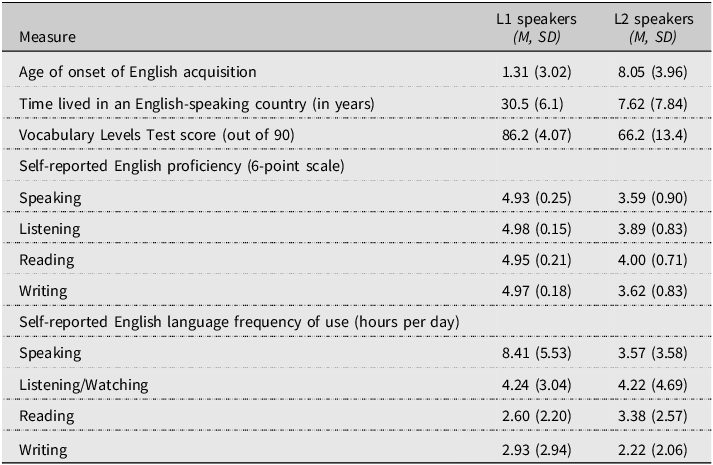
Eighty-seven L1 native English speakers (age: M = 31.90, SD = 5.25) and 117 L1-Chinese speakers of L2-English (age: M = 29.90, SD = 7.62) participated in the experiment. Four L1 and five L2 participants were removed from the analysis, either for judging nearly all implausible filler sentences as sensible and plausible critical sentences as nonsensical or for scoring below 80% on comprehension questions. Participants’ language backgrounds are summarized in Table 1. We conducted a power analysis using simulation-based methods following DeBruine and Barr’s (Reference DeBruine and Barr2021) recommendations. Power was evaluated within a null-hypothesis significance testing the faster reading of idioms or collocations over novel word combinations. Effect sizes for the simulations were informed by using collocation studies (Li et al., Reference Li, Warrington, Pagán, Paterson and Wang2021, Reference Li, Paterson, Warrington and Wang2022) and idiom study (Carrol & Conklin, Reference Carrol and Conklin2020) as benchmarks for plausible magnitudes. We then generated 1,000 synthetic datasets for a range of candidate sample sizes and, for each dataset, fit a linear mixed-effects model using lmer to log-transformed reading times: lmer(log(dv)) ∼ Phrase_type + (Phrase_type | participant) + (1 | item). For each simulation run, we recorded whether the target fixed effects reached statistical significance. The results indicated that a sample of 80 participants, each reading 40 collocations or idioms and 40 novel word combinations, would provide at least 90% power to detect the critical effects for reading time, using an alpha level of .05.
Summary of participants’ language backgrounds

Table 1. Long description
A table comparing language backgrounds of participants. The table has 10 rows and 4 columns. The columns are labeled Measure, L1 speakers (M, SD), and L2 speakers (M, SD). The rows are labeled with different measures such as Age of onset of English acquisition, Time lived in an English-speaking country (in years), Vocabulary Levels Test score (out of 90), Self-reported English proficiency (6-point scale) for Speaking, Listening, Reading, and Writing, and Self-reported English language frequency of use (hours per day) for Speaking, Listening/Watching, Reading, and Writing. Each row provides mean (M) and standard deviation (SD) values for L1 and L2 speakers.
All participants had normal or corrected-to-normal vision and provided written informed consent. The experiment was conducted in accordance with the British Psychological Society ethical guidelines (version 2021) and was approved by the University of Birmingham’s ethics committee (ERN_19-0936).
Additionally, L2 speakers’ proficiency was measured using the Vocabulary Levels Test (Schmitt et al., Reference Schmitt, Schmitt and Clapham2001); the average score was 66.2 out of 90. On average, participants had started learning English at 8.05 years (SD = 3.96) and had spent 7.62 years in English-speaking countries (SD = 7.84). L2 participants completed a multiple-choice test to confirm their knowledge of the target idioms, and any trials with incorrectly interpreted items were excluded from analysis. Previous research normed idiom familiarity on a single L2 cohort and deliberately selected familiar expressions; yet idioms are inherently infrequent (Moon, Reference Moon1998) and individual exposure varies widely (Kuperman & Van Dyke, Reference Kuperman and Van Dyke2013). To address this variability, we not only chose idioms reported as familiar but also removed any unknown items based on each participant’s post-experiment questionnaire, ensuring that every idiom included in the analyses was genuinely known to our L2 sample.
Design
For the first research question, phrase type was a four-level within-participant and between-item variable (figuratively used idioms, literally used idioms), collocations, and novel word combinations. These three types of phrases reflect varying degrees of semantic conventionality, with idioms exhibiting the most conventionalized meanings, collocations falling in between and novel word combinations lacking a conventionalized meaning. For the second research question, predictors included meaning dominance and local and global decomposability of idioms.
The dependent variables were reading time in the critical and spillover regions. The critical region consisted of the MWS, and the spillover region consisted of the two words that followed the critical region. The spillover region was included because the self-paced reading paradigm can delay processing effects, potentially influencing subsequent regions.
Materials
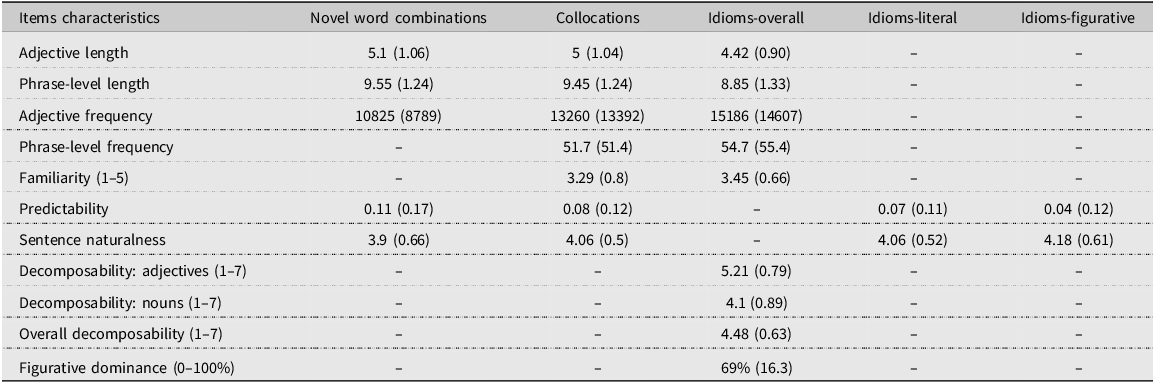
There were 40 sets of adjective-noun quartets, each sharing the same final word. To select these adjective-noun quartets, we used the following steps. First, we identified 72 adjective-noun pairs listed as idioms in either Macis and Schmitt (Reference Macis and Schmitt2017) or the Oxford Dictionary of English Idioms (Ayto, Reference Ayto2009). Each idiom also needed to be ambiguous, allowing for both idiomatic and literal interpretations. Second, we then extracted 72 adjective–noun collocations from the BNC, each with the target noun immediately preceded by an adjective within a one-word window. All collocations had a Mutual Information (MI) score of 3 or higher (Hunston, Reference Hunston2022). Third, we generated novel adjective–noun pairs by pairing each target noun with a literal adjective attested at most once or never in the BNC. Finally, to norm these items, 45 L1-English speakers rated the 72 sets on familiarity using a scale from 1 (Never) to 5 (Extremely frequently), indicating how often they encountered or used each item. Based on these ratings, 40 sets of items were selected. Table 2 reports the item characteristics.
Summary of item characteristics (M, SD)

Table 2. Long description
A table comparing characteristics of novel word combinations, collocations, and idioms. The table has 10 rows and 6 columns. The columns are labeled Items characteristics, Novel word combinations, Collocations, Idioms-overall, Idioms-literal, and Idioms-figurative. The rows are labeled Adjective length, Phrase-level length, Adjective frequency, Phrase-level frequency, Familiarity (1-5), Predictability, Sentence naturalness, Decomposability: adjectives (1-7), Decomposability: nouns (1-7), Overall decomposability (1-7), and Figurative dominance (0-100 percent). Each cell contains numerical values representing the mean and standard deviation of the respective characteristics.
Note: All frequencies were extracted from the 100-million-word BNC and are presented as raw occurrence counts.
Item-related variables were matched as closely as possible across the four items in each set. One-way repeated ANOVA tests indicated that adjective frequency was matched across conditions (F(2, 117) = 1.22, p = .30). However, adjective length differed, resulting in differences in phrase-level length (F(2, 117) = 3.55, p = .032), with idioms being shorter than novel word combinations (β = 0.7, t(117) = 2.46, CI = [0.14, 1.26], p = .046). Note that the difference was less than 1 character on average. Finally, idioms and collocations were matched on phrase-level frequency (t(39) < 1, CI = [−28.71, 22.66]), MI-score (t(39) < 1, CI = [−1.26, 1.11]), and familiarity (t(39) < 1, CI = [−0.51, 0.18]).
Idioms: meaning dominance and decomposability
The meaning dominance and local and global decomposability of idioms were assessed by the same 45 L1-English speakers who provided familiarity ratings. First, they evaluated figurative meaning dominance on a slider, indicating the percentage of times they anticipated the idiom would be understood literally or figuratively, with 0% meaning exclusively literal and 100% meaning exclusively figurative (see Milburn & Warren, Reference Milburn and Warren2019). These ratings demonstrated high reliability (Cronbach’s alpha = 0.912). Their consistency was evidenced by high correlations with estimates from another 20 L1-English speakers (r(38) = 0.7, CI = [0.52, 0.83], p < .001).
Then, the same 45 speakers assessed local decomposability, by rating the contributions of the adjective and the noun to the idiom’s figurative meaning on a scale from 1 (no contribution) to 7 (100% contribution; see Gibbs et al., Reference Gibbs, Nayak and Cutting1989). To assess global decomposability, an additional 15 L1-English speakers rated the literal meaning of the adjective-noun pair to contribute to the idiom’s figurative meaning, using the same scale. These measures are reported in Table 2.
Context sentences
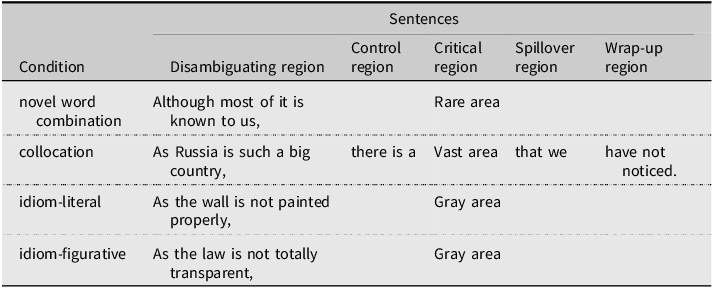
For each adjective-noun quartet, four context sentences were created. Each context sentence consisted of a disambiguating context, a control region, a critical region containing the adjective-noun combination, a spillover region (the two words following the critical region), and a wrap-up region, as shown in Table 3. The control and spillover regions were identical across conditions for each set of items. For idioms, disambiguating contexts were biased toward either the literal or figurative interpretation.
An example of one set of items and context sentences

Table 3. Long description
A table with 4 rows and 5 columns. The columns are labeled Condition, Disambiguating region, Control region, Critical region, Spillover region, and Wrap-up region. The rows are labeled with different conditions: novel word combination, collocation, idiom-literal, and idiom-figurative. Each cell contains a sentence fragment. Row 1: novel word combination, Although most of it is known to us,, Rare area,, . Row 2: collocation, As Russia is such a big country, there is a, Vast area, that we, have not noticed. Row 3: idiom-literal, As the wall is not painted properly,, Gray area,, . Row 4: idiom-figurative, As the law is not totally transparent,, Gray area,, .
To measure contextual predictability, 60 L1 English speakers completed a sentence continuation task, predicting the noun of 40 sentences truncated before the noun of the MWS (counterbalanced over four lists, with an equal number of items per condition). Contextual predictability for the final nouns was matched among literal idioms, figurative idioms, and collocations (F(2, 117) = 1.2, p = .3). To ensure sentence readability, reading times up to the target regions were compared across the three conditions, and no differences were found (χ2(1) = 3.33, p = .35). Second, an additional 20 L1 English speakers rated the naturalness of the sentence frames (up to the spillover regions) on a five-point scale (1 = very unnatural, 5 = very natural), and no differences were found across conditions (F (3, 156) = 1.67, p = .18). To ensure that participants monitored sentence meaning in the stop-making-sense task, 40 semantically incorrect or odd filler sentences were included. These varied in implausibility location and were judged implausible by over 80% of 20 L1-English speakers, who normed them alongside 20 grammatically correct and semantically plausible sentences.
After all pre-tests, four lists of 80 trials were created by counterbalancing the 40 critical sets of items following a Latin square design and including the 40 filler sentences. The software randomized each list for each participant and presented the trials in two 40-trial blocks separated by a self-paced break.
Procedure
Participants were recruited via Prolific and Sona Systems and directed to the web-based reading experiment. The experiment was programmed with PsychoPy (version 2021.2.3) and hosted by Pavlovia. Participants read instructions on the computer screen and then completed eight practice trials. At the start of each trial, the prompt “A new sentence starts” was displayed and disappeared once the participant pressed the space bar. Each sentence was divided into five reading regions, with the critical region always appearing third. Reading regions were presented one at a time in the centre of the screen to ensure the same position across participants’ different screen sizes. Participants initiated reading by pressing the space bar to reveal the first region. To progress through the sentence, they pressed “J” if the text remained plausible, which removed the current region and replaced it with the next region at the same central location. If the sentence became nonsensical for them, they pressed “F,” which terminated the trial and initiated the next one. If the participant read the full sentence and rated it as plausible, a comprehension question was presented to assess understanding. After the reading experiment, all participants completed a language background questionnaire.
Statistical analysis
All analyses were carried out using R version 4.2.1 (R Core Team, 2022) with lm4 (Bates et al., Reference Bates, Mächler, Bolker and Walker2015). Following recommendations (Brysbaert & Stevens, Reference Brysbaert and Stevens2018) for analyzing continuous data, RTs were log-transformed prior to analysis to better approximate a normal distribution. For the first question, the full model included phrase type and language background as fixed effects, and trial number, phrase length, adjective, and noun frequencies as covariates. We treatment-coded phrase type with novel word combinations as 0 and language background with L1 as 0. For the second question, the full model included language background, idiom-level variables (meaning dominance, global decomposability, adjective decomposability, and noun decomposability), and the interactions between idiom-level variables and the same covariates as the first research question. All continuous predictors were cantered before entering them into models. Finally, to test whether L2 proficiency modulates phrase type effect, a separate model was fit to L2 speaker data only, including vocabulary scores, phrase type, and their interaction with the same covariates as the first model.
In all models, the maximal random structure model included the interactions of experimental variables with both participants and items whenever possible (Barr et al., Reference Barr, Levy, Scheepers and Tily2013). If convergence was not achieved, the “bobyqa” or “optimx” optimiser was used to increase the number of iterations. If this failed, the random effect was simplified by removing interactions first, followed by individual terms if necessary, until the model converged.
All full models were subsequently reduced with the drop1() function, which compares the model with a chi-square test. The manipulated variables were always retained in the corresponding reduced models to reflect the experimental design, even if their effects were not significant; covariates were removed if not significant. Based on these tests, reduced models were selected to best fit the data. For all bested-fitted models, the vif() function from the car package was used to check collinearity and variables with a t value of greater than 1.96 were considered significant (Baayen et al., Reference Baayen, Davidson and Bates2008). Finally, when there was a significant interaction, the emmeans function from the emmeans package (Lenth et al., Reference Lenth, Bolker, Buerkner, Giné-Vázquez, Herve, Jung, Love, Miguez, Piaskowski, Riebl and Singmann2024) was used to conduct pairwise comparisons of estimated marginal means using Tukey-adjusted p-values.
Data pre-processing
Following Singh et al. (Reference Singh, Fedorenko, Mahowald and Gibson2016), critical trials that participants thought implausible in English were removed, resulting in 15% L1 and 20% L2 data loss. To ensure that the data removal did not affect the results, we also ran the models with the excluded data points, showing similar results in terms of direction and significance. Trials associated with incorrect responses to comprehension questions (3% of L1 data and 5% of L2 data) were excluded from the analysis. An extra 1.8% of L2 data were removed because the participant failed to identify the idiom’s meaning in the multiple-choice test. RTs above 3000 ms and below 200 ms in the critical region, and those above 2000 ms and below 200 ms in the spillover region were removed (as the spillover region was shorter, the maximum cut-off was lower). Finally, RTs more than 2.5 SDs above or below the mean for each participant and condition were excluded. After data cleaning, 80% of the critical region data (2756 trials) and 80% of the spillover region data (2774 trials) from L1 speakers; 72% of the critical region data (3347 trials), and 72% of the spillover region data (3318 trials) from L2 speakers were included in the analyses.
Results
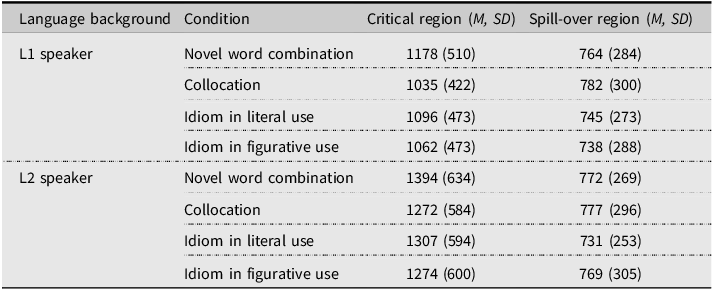
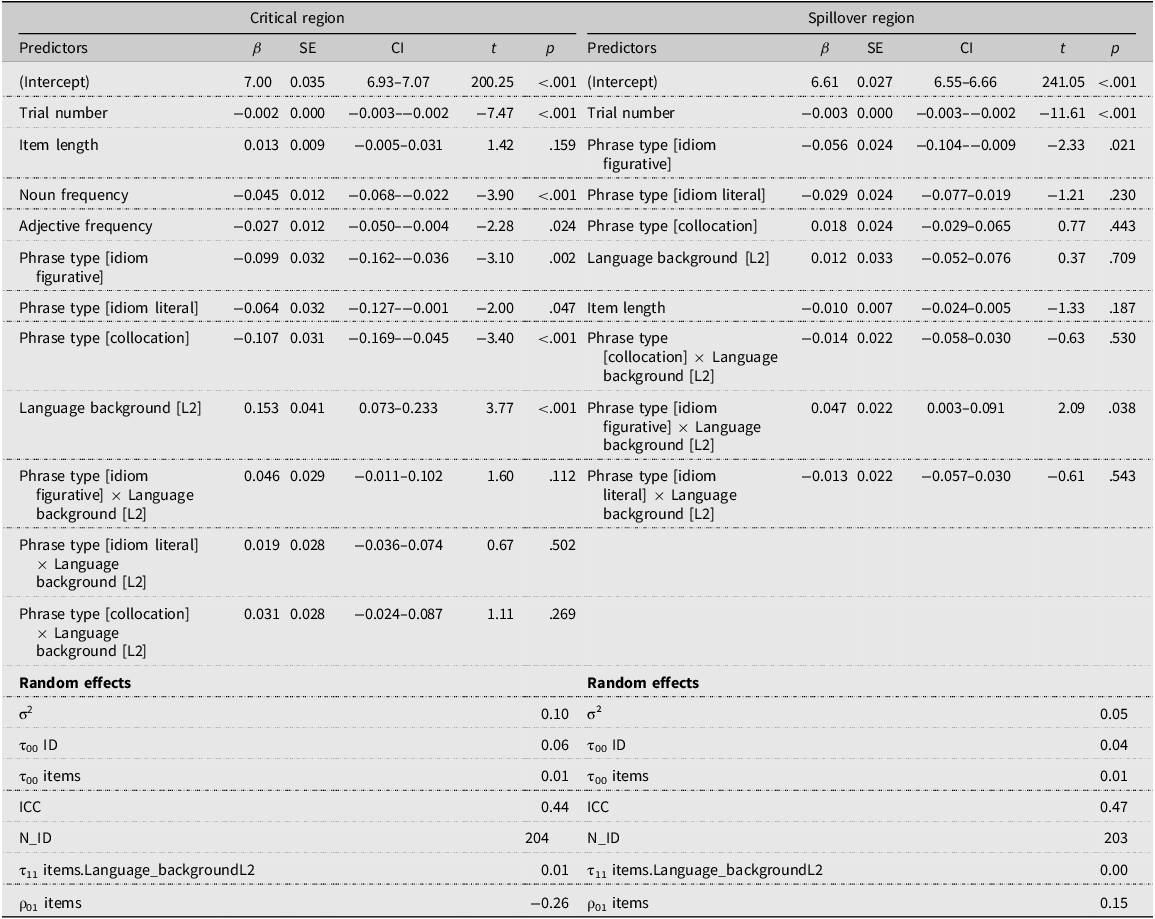
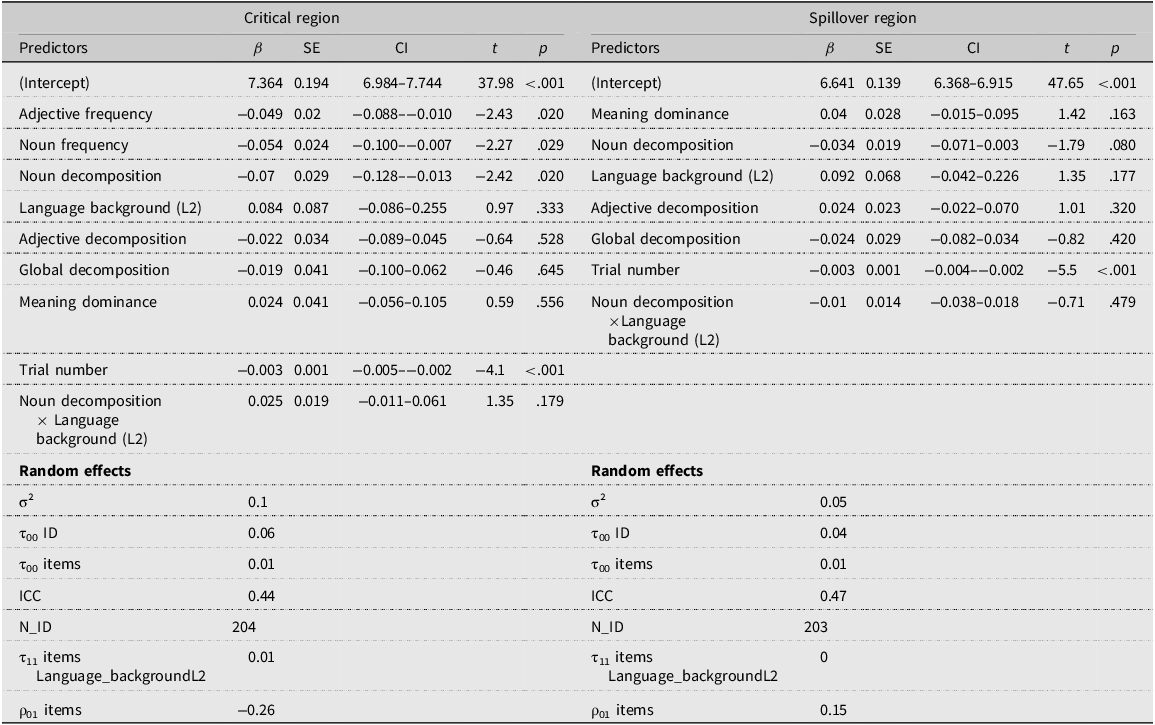
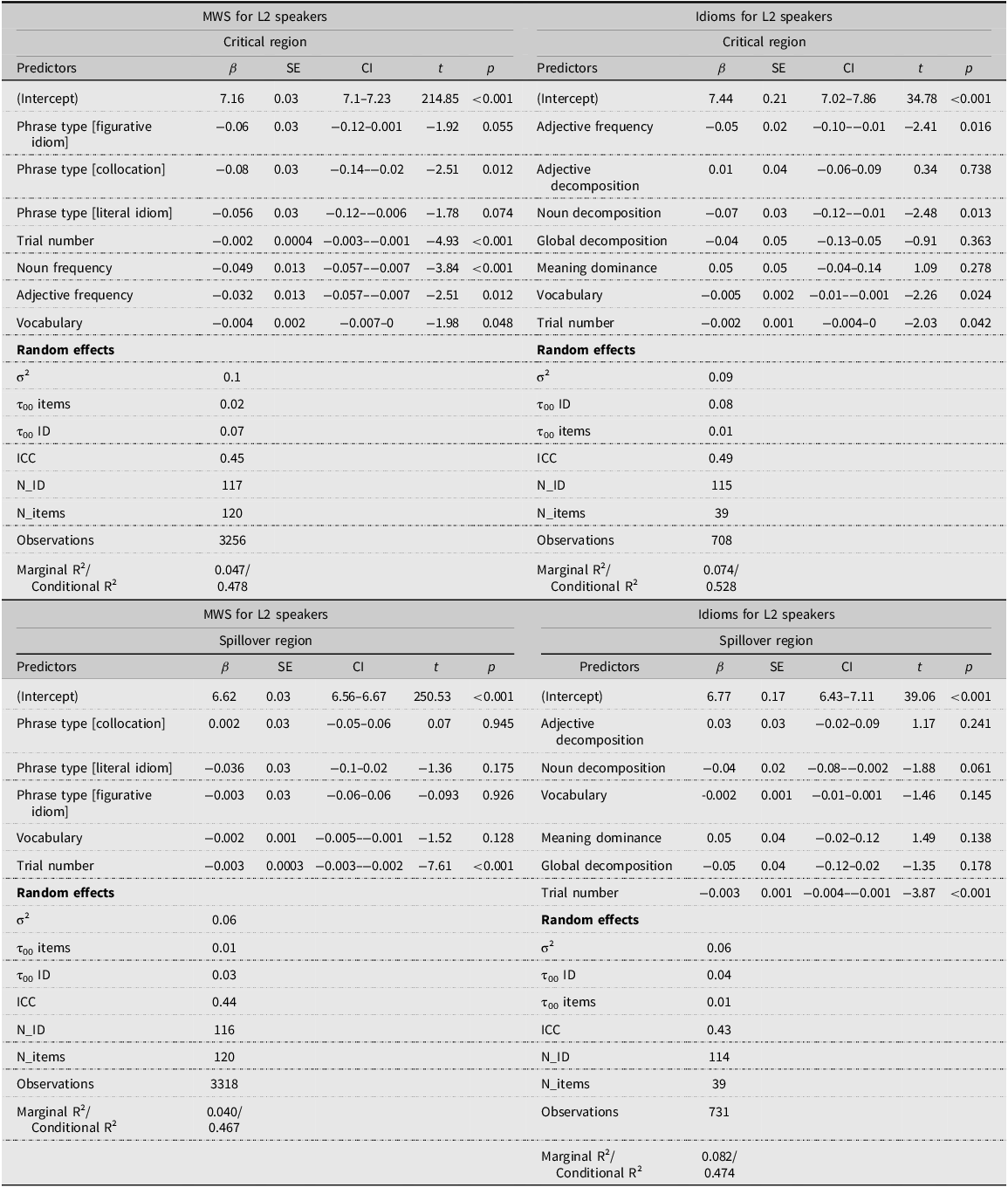
The average reading times in the critical and spillover regions are reported in Table 4. Tables 5 and 6 present the best-fitting models for the different types of MWS and the idiom-only analyses. L2 results are reported in Table 7.
Mean RTs (ms) across four conditions by language background

Table 4. Long description
A table comparing mean reading times in milliseconds across four conditions by language background. The table has 8 rows and 4 columns. Column headers are Language background, Condition, Critical region (M, SD), and Spill-over region (M, SD). Row labels include L1 speaker and L2 speaker, with conditions being Novel word combination, Collocation, Idiom in literal use, and Idiom in figurative use. For L1 speakers, mean reading times in the critical region range from 1035 to 1178 milliseconds, and in the spill-over region from 745 to 782 milliseconds. For L2 speakers, mean reading times in the critical region range from 1274 to 1394 milliseconds, and in the spill-over region from 731 to 772 milliseconds.
Summary of the best-fitting models of MWSs on critical and spill-over regions

Table 5. Long description
A table comparing predictors and random effects for critical and spillover regions. The table has two main sections: Critical region and Spillover region, each with predictors and random effects. Each section lists beta coefficients, standard errors, confidence intervals, t-values, and p-values for various predictors. The Critical region section includes predictors such as Intercept, Trial number, Item length, Noun frequency, Adjective frequency, Phrase type, and Language background. The Spillover region section includes similar predictors with additional interactions. Random effects are listed at the bottom of each section, including variance components and intraclass correlation coefficients. The table provides detailed statistical information for each predictor in both regions.
Summary of the best-fitting models of idioms on critical and spill-over regions

Table 6. Long description
A table comparing predictors for critical and spillover regions. The table has 18 rows and 12 columns. Column headers are Predictors, β, SE, CI, t, p for the critical region, and Predictors, β, SE, CI, t, p for the spillover region. Row labels include (Intercept), Adjective frequency, Noun frequency, Noun decomposition, Language background (L2), Adjective decomposition, Global decomposition, Meaning dominance, Trial number, and Noun decomposition × Language background (L2). The table also includes random effects for both regions with σ², τ00 ID, τ00 items, ICC, N_ID, τ11 items Language_backgroundL2, and ρ01 items. Each row lists values for the predictors, their standard errors, confidence intervals, t-values, and p-values. Notable trends include significant p-values for (Intercept) and Trial number in both regions.
The separate best-fitting models for L2 speakers

Table 7. Long description
A table comparing models for L2 speakers. The table has two main sections: MWS for L2 speakers and Idioms for L2 speakers, each with Critical region and Spillover region subsections. Each subsection lists predictors with corresponding beta values, standard errors, confidence intervals, t-values, and p-values. The table includes random effects and marginal R-squared values. Row 1: MWS for L2 speakers, Critical region, Predictors: (Intercept), Phrase type [collocation], Phrase type [literal idiom], Trial number, Noun frequency, Adjective frequency, Vocabulary. Row 2: MWS for L2 speakers, Critical region, Values: Beta, SE, CI, t, p. Row 3: MWS for L2 speakers, Random effects, Values: sigma squared, tau00 items, tau00 ID, ICC, N_ID, N_items, Observations, Marginal R-squared/Conditional R-squared. Row 4: MWS for L2 speakers, Spillover region, Predictors: (Intercept), Phrase type [collocation], Phrase type [literal idiom], Phrase type [figurative idiom], Vocabulary, Trial number. Row 5: MWS for L2 speakers, Spillover region, Values: Beta, SE, CI, t, p. Row 6: MWS for L2 speakers, Spillover region, Random effects, Values: sigma squared, tau00 items, tau00 ID, ICC, N_ID, N_items, Observations, Marginal R-squared/Conditional R-squared. Row 7: Idioms for L2 speakers, Critical region, Predictors: (Intercept), Adjective frequency, Adjective decomposition, Noun decomposition, Global decomposition, Meaning dominance, Vocabulary, Trial number. Row 8: Idioms for L2 speakers, Critical region, Values: Beta, SE, CI, t, p. Row 9: Idioms for L2 speakers, Random effects, Values: sigma squared, tau00 ID, tau00 items, ICC, N_ID, N_items, Observations, Marginal R-squared/Conditional R-squared. Row 10: Idioms for L2 speakers, Spillover region, Predictors: (Intercept), Adjective decomposition, Noun decomposition, Vocabulary, Meaning dominance, Global decomposition, Trial number. Row 11: Idioms for L2 speakers, Spillover region, Values: Beta, SE, CI, t, p. Row 12: Idioms for L2 speakers, Spillover region, Random effects, Values: sigma squared, tau00 ID, tau00 items, ICC, N_ID, N_items, Observations, Marginal R-squared/Conditional R-squared.
Research question 1.
Our first research question asks whether semantic conventionality gives idioms a processing advantage over collocations after controlling for distributional factors and whether this effect differs between L1 and L2 speakers. In the critical region, we did not observe an interaction between language background and phrase type (χ2(3) = 3.11, p = 0.374). As expected, there was an effect of language background, with L2 speakers showing slower RTs than L1 speakers (β = 0.15, t = 3.77, CI = [0.073, 0.233], p < .001). We also found an effect of phrase type. Specifically, collocations were processed faster than novel word combinations (β = −0.107, t = −3.4, CI = [−0.169, −0.045], p < .001), and idioms in a figurative context were processed faster than novel word combinations (β = −0.099, t = −3.1, CI = [−0.162, −0.036], p = .002).
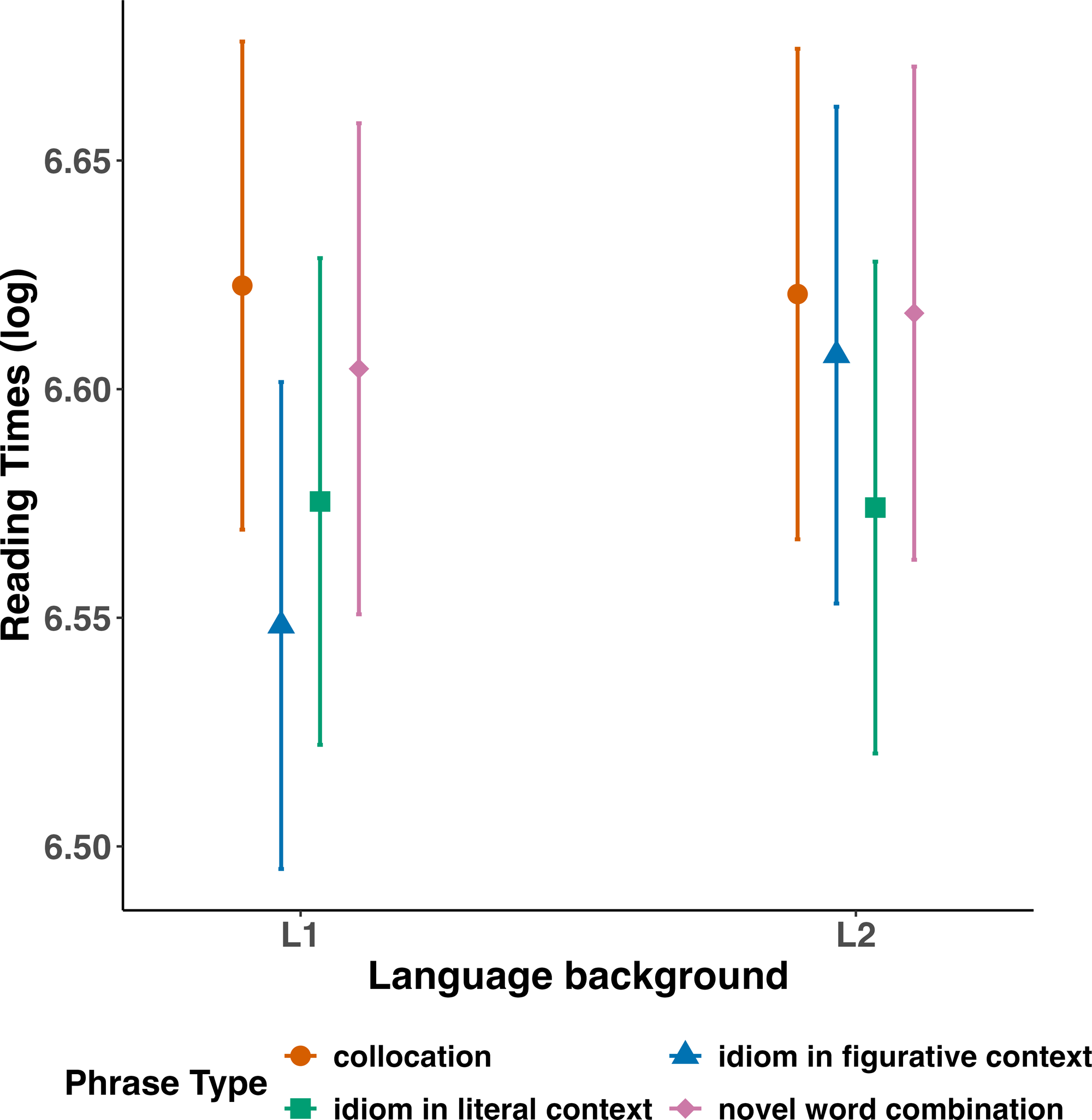
In the spillover region, there was a significant interaction between language background and phrase type (χ2(3) = 6.65, p = 0.036). Phrase type remained significant for L1 speakers but not for L2 speakers (see Figure 1). Further, pairwise comparisons revealed that L1 speakers processed figuratively used idioms faster than collocations (β = −0.07, t = −2.97, p = .008), but L2 speakers processed figuratively used idioms more slowly than literally used idioms (β = 0.03, t = 2.81, p = .02).
The interaction between language background and phrase type.

Finally, to examine the effect of L2 proficiency, we fit a model to the subset of L2 speakers only. In the critical region, L2 speakers exhibited a trend toward faster reading of idioms when presented in figurative contexts (β = −0.06, t = −1.921, p =.057) and demonstrated significantly faster reading times for collocations compared to novel word combinations (β = −0.08, t = −2.51, p = .012). Vocabulary score reached significance, with L2 speakers with higher vocabulary scores showing faster reading times (β = −0.004, t = −1.98, p = .048), but no significant interaction was found between vocabulary score and phrase type (p = 0.296). In the spillover region, an interaction between phrase type and vocabulary score was observed (χ2(3) = 8.35, p = .039). To further explore this interaction, we examined the simple effect of phrase type at high and low vocabulary levels (See Figure 2). The lower-vocabulary group showed significantly longer RTs for figurative than literal idioms (β = 0.05, p = .013).
The interaction between phrase type and vocabulary score.

Figure 2. Long description
A line graph showing the interaction between phrase type and vocabulary score. The horizontal axis represents vocabulary score on a scale from -30 to 20. The vertical axis represents reading times in logarithmic scale from 6.5 to 6.8. Four phrase types are represented by different lines: collocation (orange circles), idiom in figurative context (blue triangles), idiom in literal context (green squares), and novel word combination (pink triangles). The collocation line is relatively flat, indicating little change in reading times across vocabulary scores. The idiom in figurative context and novel word combination lines show a downward trend, indicating that reading times decrease as vocabulary scores increase. The idiom in literal context line also shows a downward trend but starts at a lower reading time compared to the other phrase types. Shaded areas around each line represent confidence intervals.
Research question 2.
The second research question investigates how idiom-level properties influence L1 and L2 idiom processing. Only the semantic decomposability of the noun had an effect (β = −0.07, t = −2.42, p = .02), with higher semantic decomposability speeding up the reading of idioms in the critical region.
Finally, we fitted a separate model to the L2 speaker data. Noun semantic decomposability and vocabulary knowledge were the only predictors of idiom RTs, and only in the critical region, where higher noun decomposability (β = −0.07, t = −2.48, p = .013) and higher vocabulary scores (β = −0.005, t = −2.26, p =.024) were associated with shorter idiom RTs.
General discussion
Previous studies have demonstrated faster processing of idioms and collocations among L1 speakers and faster processing of collocations among L2 speakers. However, differences in the processing of various types of MWSs remain unexplored. The present study aimed to compare the processing of different types of MWSs in L1 and L2 speakers. First, we replicated previous findings that both L1 and L2 speakers read collocations more quickly than novel word combinations. Similarly, L1 speakers processed idioms used figuratively faster than novel word combinations. Importantly, our study revealed that, on the spillover region, only L1 speakers continued to process figurative idioms more quickly than collocations, even when controlling for distributional factors such as phrase-level frequency, familiarity, and contextual predictability. In contrast to L1 speakers, who demonstrated faster processing of figurative idioms compared to literal idioms, lower proficiency L2 speakers exhibited faster processing of literal idioms compared to figurative idioms.
The distributional information effect
Using self-paced reading in conjunction with a concurrent stop-making-sense paradigm (Boland et al., Reference Boland, Tanenhaus and Garnsey1990; Gibson et al., Reference Gibson, Pearlmutter, Canseco-Gonzalez and Hickok1996), we replicated findings from other paradigms showing faster processing of collocations compared to novel word combinations, in both L1 and L2 speakers (e.g., Li et al., Reference Li, Bassetti and Frisson2025; Li et al., Reference Li, Warrington, Pagán, Paterson and Wang2021, Reference Li, Paterson, Warrington and Wang2022; Öksüz et al., Reference Öksüz, Brezina and Rebuschat2021; Sonbul, Reference Sonbul2015; Vilkaitė, Reference Vilkaitė2016; Vilkaitė & Schmitt, Reference Vilkaitė and Schmitt2019). Our study further demonstrated that L1 speakers read figuratively used idioms faster than novel word combinations, consistent with previous findings in L1 idiom processing (e.g., Carrol et al., Reference Carrol, Conklin and Gyllstad2016; Carrol & Conklin, Reference Carrol and Conklin2017; Siyanova-Chanturia et al., Reference Siyanova-Chanturia, Conklin and Schmitt2011; Swinney & Cutler, Reference Swinney and Cutler1979; Tabossi et al., Reference Tabossi, Fanari and Wolf2009). These results suggest that language users exhibit a processing advantage for collocations and idioms, indicating that these word combinations become entrenched in memory over time. Consequently, this advantage primarily arises from the higher phrase-level frequency and greater familiarity of collocations and idioms (Carrol & Conklin, Reference Carrol and Conklin2020), extending the frequency effect beyond single words to multiword sequences. Moreover, these findings align with language models that emphasize the role of experience—specifically, the notion that frequency serves as an index of speakers’ experience with a linguistic construction, which impacts language entrenchment and processing. This perspective is supported by usage-based models of language acquisition (Bybee, Reference Bybee, Gruber, Higgins, Olson and Wysocki1998; Goldberg, Reference Goldberg2006; Tomasello, Reference Tomasello2003), which argue that linguistic knowledge is shaped by repeated exposure and experience. The processing advantage in collocations and idioms over novel word combinations also supports statistical learning theories, which posit that this advantage reflects language users’ sensitivity to word co-occurrence. This is consistent with the view that both L1 and L2 speakers are capable of tracking patterns of word co-occurrence, as demonstrated in the statistical learning of language (Rebuschat & Williams, Reference Rebuschat and Williams2012; Romberg & Saffran, Reference Romberg and Saffran2010; Saffran & Kirkham, Reference Saffran and Kirkham2018; Wang & Saffran, Reference Wang and Saffran2014).
Beyond distributional information
We first examined whether idioms exhibit a processing advantage over collocations once distributional information (i.e., phrase-level frequency, familiarity, and contextual predictability) is controlled for. The spill-over region revealed that L1 speakers read figuratively used idioms faster than collocations, suggesting that the processing advantage of idioms extends beyond distributional information. If MWSs such as collocations and idioms become familiar and predictable through repeated exposure (e.g., Cacciari & Tabossi, Reference Cacciari and Tabossi1988; Libben & Titone, Reference Libben and Titone2008; Tabossi et al., Reference Tabossi, Fanari and Wolf2009) and if distributional information alone drives the processing advantage, then collocations and idioms should not differ in our experiment, given that phrase-level frequency, familiarity, and contextual predictability were controlled for. Hence, the idiom advantage in the spill-over region suggests a processing effect beyond distributional information.
One reason for the advantage of figuratively used idioms over collocations could be that idioms tend to have more conventionalised meanings. Because idiomatic meanings cannot simply be computed by assembling the meanings of their lexical components, idioms are generally less decomposable and more conventionalised. In contrast, collocations are more decomposable and less conventionalised, as their collocational meaning can be computed based on their lexical components (all collocations used in our experiments were semantically transparent and literal).
According to the Hybrid Representation Hypothesis (Kuiper et al., Reference Kuiper, van Egmond, Kempen and Sprenger2007; Sprenger et al., Reference Sprenger, Levelt and Kempen2006), MWSs, e.g., idioms, can be activated both through the analysis of their lexical parts and via direct access to the unitary meaning, and this dual activation can occur interactively and synchronously. Our findings extend this hypothesis by suggesting that the relative contribution of these two routes is not fixed but graded along a continuum determined by the degree of conventionality. Specifically, highly conventionalised MWSs such as figurative idioms are more strongly represented as holistic units and therefore more likely to be processed via direct retrieval of their conventional meaning. Collocations, while frequent, are more semantically transparent and thus more likely to rely on compositional analysis, even though direct access may also be available. Thus, rather than assuming categorical processing differences between idioms and collocations, our results support a graded relationship between the direct retrieval route and the computational route.
We therefore propose that the representation of MWSs and their internal components is redundant, with both holistic and decomposed information co-existing but differing in cognitive prominence. As the degree of conventionality increases, holistic representations become more dominant, and processing shifts toward direct retrieval. As conventionality decreases, processing relies more heavily on sequential compositional computation. This graded account integrates the Hybrid Representation Hypothesis within a broader continuum framework and provides an explanation for why idioms, but not collocations, retain a processing advantage after distributional factors are controlled.
Processing idioms in a second language
Unlike some previous studies on L2 idiom processing (e.g., Carrol et al., Reference Carrol, Conklin and Gyllstad2016; Carrol & Conklin, Reference Carrol and Conklin2017; Siyanova-Chanturia et al., Reference Siyanova-Chanturia, Conklin and Schmitt2011), this study found that L2 speakers exhibited a trend toward faster recognition of figurative idioms compared to novel word combinations. The discrepancy between prior research and the current study may stem from the exclusion of unfamiliar idioms for L2 speakers. While we selected idioms that were rated familiar in prior research, idioms are relatively infrequent in language (Moon, Reference Moon1998) and individual variability is high for less common linguistic constructions (Kuperman & Van Dyke, Reference Kuperman and Van Dyke2013). We therefore excluded idioms that participants reported as unknown in a post-experiment task from analyses. Hence, the L2 reading data were not confounded by participants not knowing idiomatic interpretations.
According to the lexical entrenchment hypothesis (Diependaele et al., Reference Diependaele, Lemhöfer and Brysbaert2013), greater exposure to linguistic structures in the L2 strengthens both representations and the links between them, reducing activation thresholds and facilitating processing of frequent idioms. However, idiom representations in L2 speakers, while entrenched, may remain weaker than those in L1 speakers, especially among speakers with lower vocabulary levels. The interaction between phrase type and vocabulary level in the spill-over region indicated a processing advantage for idioms used in a literal context by weaker L2 speakers but not by more proficient L2 speakers. In contrast, L1 speakers showed a processing advantage for figuratively used idioms.
This asymmetry is theoretically informative. Within the Hybrid Representation Hypothesis (Kuiper et al., Reference Kuiper, van Egmond, Kempen and Sprenger2007; Sprenger et al., Reference Sprenger, Levelt and Kempen2006), both direct retrieval and compositional analysis are available for idiom processing. Our findings suggest that L2 speakers operate within the same dual-route architecture as L1 speakers, but the relative weighting of the two routes differs. Specifically, because holistic idiom representations are less strongly entrenched in L2, the direct retrieval route is less dominant, and compositional analysis plays a more central role.
This interpretation is consistent with previous findings showing stronger competition between idiomatic and literal meanings in L2 processing (Carrol & Conklin, Reference Carrol and Conklin2017; Shi et al., Reference Shi, Peng and Li2023; Siyanova-Chanturia et al., Reference Siyanova-Chanturia, Conklin and Schmitt2011). Furthermore, unlike L1 speakers, L2 speakers did not read figuratively used idioms faster than collocations. Combined with the relative ease of processing literally used idioms, the accumulated evidence indicates that L2 speakers do not strongly activate figurative meanings, even when supported by a biasing figurative context. Instead, L2 speakers appear to prioritize computation of literal meanings, although this tendency becomes less pronounced for more advanced L2 speakers. Indeed, the pattern exhibited by more advanced L2 speakers in our study began to trend toward the L1 pattern, though without fully converging.
Rather than treating this difference as evidence for qualitatively distinct processing mechanisms in L1 and L2, we argue that it reflects a dynamic shift along the graded retrieval–computation continuum proposed above. In L1 speakers, extensive exposure and early acquisition result in strongly entrenched holistic idiom representations. As a result, the direct retrieval route tends to dominate, particularly for highly conventionalized figurative idioms. In contrast, in L2 speakers, especially those with lower proficiency, the weaker entrenchment of idiomatic representations shifts processing toward greater reliance on compositional computation. As exposure and proficiency increase, the balance gradually shifts toward stronger holistic activation, bringing L2 processing closer to the L1 end of the continuum.
This account integrates our findings with the Literal Salience Model (Cieślicka, Reference Cieślicka2006), which proposes that literal meanings are more readily activated in L2 processing. Under our graded framework, literal salience reflects the relative strength of compositional routes when holistic idiom representations are insufficiently entrenched. Thus, literal-first tendencies in L2 are not obligatory or categorical, but probabilistic and experience-dependent. In general, when it comes to known idioms, L1 speakers primarily rely on direct retrieval, with computational analysis playing a less important role. In contrast, compositional analysis serves as the primary route for idiom processing in L2 speakers, while direct retrieval functions as a secondary route. Two key reasons may explain this disparity between L1 and L2 speakers. First, L2 speakers have comparatively less exposure and experience with L2 idioms, especially since individual idioms are relatively uncommon in language. This limited exposure makes it more challenging for them to establish strong form – meaning connections for idioms, thereby reducing their ability to identify idioms immediately (Carrol & Conklin, Reference Carrol and Conklin2017; Senaldi & Titone, Reference Senaldi and Titone2024). Second, L2 speakers generally follow a more compositional approach than L1 speakers (Beck & Weber, Reference Beck and Weber2016; Cieślicka, Reference Cieślicka2006; Senaldi & Titone, Reference Senaldi and Titone2022). Supporting this view, rating tasks (Hubers et al., Reference Hubers, Cucchiarini and Strik2020) show that L2 speakers perceive idioms as more decomposable and transparent than L1 speakers. Consequently, L2 speakers must exert additional effort to inhibit inappropriate literal meanings due to their stronger reliance on compositional analysis.
Crucially, our findings suggest that these L2 characteristics can be understood as reflecting a shift in the relative weighting of processing routes within a shared architecture. Degree of semantic conventionality determines the structural position of an expression along the continuum, while language experience determines where the speaker operates on that continuum. Figurative idioms in L1 speakers occupy the end characterised by dominant direct retrieval; figurative idioms in lower proficiency L2 speakers shift toward greater reliance on computation; and increasing proficiency gradually moves L2 speakers toward the L1-like balance.
Effects of idiom variables
Idiom-level variables, such as meaning dominance and semantic decomposability, had a limited impact on idiom processing. No effect of meaning dominance was observed in this study, indicating that idioms with stronger figurative dominance were not processed faster than those with more balanced meanings, unlike the findings of Milburn and Warren (Reference Milburn and Warren2019). This discrepancy may be due to the narrower range of meaning dominance in our idioms (63.6–73.6) compared to their study (50.17–89.64). The semantic decomposability of the nouns was found to facilitate idiom processing. This suggests that when the idiomatic and literal meanings of the nouns are more closely related, processing is generally easier for both L1 and L2 speakers, aligning with some prior research (Caillies & Butcher, Reference Caillies and Butcher2007; Carrol & Segaert, Reference Carrol and Segaert2024; Gibbs & Nayak, Reference Gibbs and Nayak1989; Hamblin & Gibbs, Reference Hamblin and Gibbs1999; Libben & Titone, Reference Libben and Titone2008; Milburn et al., Reference Milburn, Vulchanova and Vulchanov2021; Titone et al., Reference Titone, Lovseth, Kasparian and Tiv2019). This effect of semantic decomposability likely reflects the role of relational overlap between the literal meanings of the constituents and their idiomatic meaning. When such overlap exists, both L1 and L2 speakers can draw on compositional mechanisms to support idiom processing, in addition to retrieving the idiomatic meaning.
Limitations and future research
There are inevitable limitations to our study. First, although the experiment was designed to control many item-related variables, the length of the idioms was somewhat short than that of novel word combinations (though less than 1 character). To address this, the models included item length as a covariate. Nevertheless, this issue should be more rigorously controlled in future studies. Another limitation involved the online experimental paradigm. While online experiments offer advantages such as greater participant diversity and larger sample sizes, data quality remains a concern. To address this, we used a stop-making-sense task, which is sensitive to sentence processing (Boland et al., Reference Boland, Tanenhaus and Garnsey1990; Gibson et al., Reference Gibson, Pearlmutter, Canseco-Gonzalez and Hickok1996; Singh et al., Reference Singh, Fedorenko, Mahowald and Gibson2016). This approach allowed participants to stop reading when they faced comprehension difficulties, particularly with idioms. However, it led to a higher rate of trial exclusions than standard self-paced reading tasks. We justified excluding these trials for two reasons: pressing “NO” indicated comprehension difficulties, especially for L2 speakers, and switching from “Yes” to “No” required extra time, making their inclusion problematic. Importantly, additional analyses including these excluded trials showed similar results, confirming the robustness of our findings. Finally, the self-paced reading paradigm approximates rather than fully replicates natural reading, as sentences are presented in discrete regions rather than as continuous text. Future research using eye-tracking would allow participants to read more naturally while still providing fine-grained measures of MWS processing.
Both L1 and L2 speakers processed collocations more quickly than literal controls. However, while L1 speakers demonstrated a processing advantage for idioms over collocations, this advantage was not observed in L2 speakers. This suggests that frequency alone may not fully account for the learning and processing difficulties in MWS in L2 speakers. Future research should, therefore, consider the semantic aspects of MWS as well. Previous studies have shown that words and even collocations can be gradually and incidentally learned through repeated encounters in context (Chen & Truscott, Reference Chen and Truscott2010; Webb, Reference Webb2007; Webb et al., Reference Webb, Newton and Chang2013). However, our findings suggest that repeated exposure to idioms may not be sufficient for effective L2 idiom acquisition. Idiomatic meanings may not be learned adequately unless special attention is given to their semantic properties. Thus, acquiring L2 idioms would benefit from explicit focus during learning and teaching. L2 learners should be made aware that some MWS carry idiomatic meanings and be encouraged to interpret and use these meanings without relying heavily on their alternative literal interpretations.
Conclusion
This study investigated the processing of different types of MWSs in both L1 and L2 speakers. The findings confirmed that both L1 and L2 speakers processed collocations more quickly than novel word combinations, supporting the view that phrase-level frequency and familiarity play a crucial role in MWS processing. Additionally, L1 speakers exhibited a processing advantage for figuratively used idioms over collocations, even when distributional factors were controlled. Overall, the present findings suggest that MWS processing is best characterized not as a categorical distinction between idiomatic and compositional processing, nor as a qualitative difference between L1 and L2 systems, but as a graded architecture in which the relative contribution of direct retrieval and compositional computation varies continuously. This gradient is shaped by (a) the degree of semantic conventionality of the expression and (b) the amount of language experience available to the speaker.
Replication package
Replication data and materials for this article can be found at https://osf.io/fx3mr/.
Competing interests
The authors declare no competing interests.


 Open access

