INTRODUCTION
The false killer whale Pseudorca crassidens (Owen, 1846) is found throughout the world's tropical and warm temperate oceans, generally between latitudes of 50°S and 50°N (Stacey et al., Reference Stacey, Leatherwood and Baird1994; Odell & McClune, Reference Odell, McClune, Ridgway and Harrison1999; Taylor et al., Reference Taylor, Baird, Barlow, Dawson, Ford, Mead, Notarbartolo di Sciara, Wade and Pitman2008). Few data are available on the distribution or relative abundance of the false killer whale in most of its worldwide range, and consequently it has been classified as a Data Deficient species by the International Union for Conservation of Nature (IUCN) (Taylor et al., Reference Taylor, Baird, Barlow, Dawson, Ford, Mead, Notarbartolo di Sciara, Wade and Pitman2008).
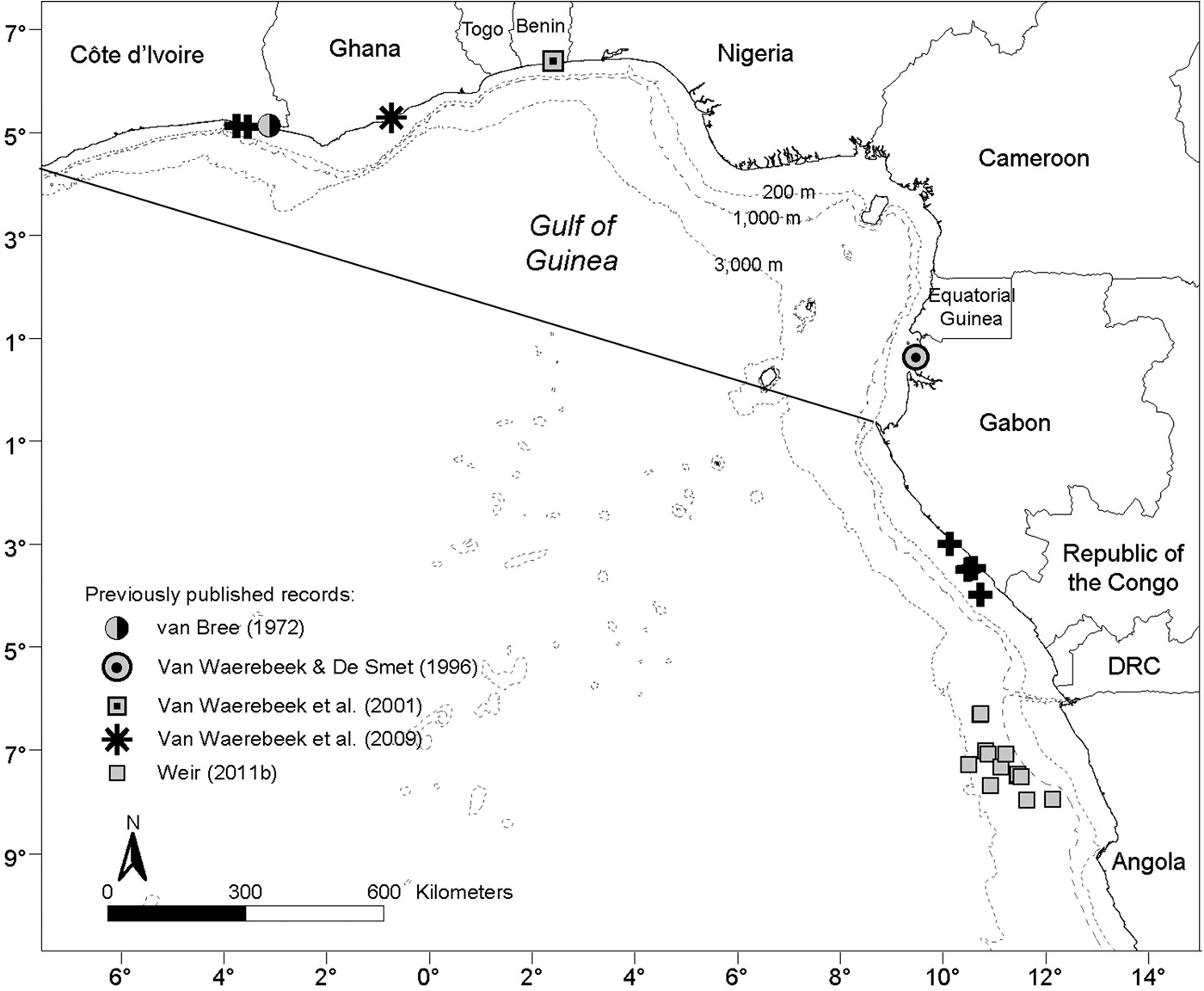
The eastern tropical Atlantic (ETA) extends along the west coast of Africa from Mauritania to Angola (Spalding et al., Reference Spalding, Fox, Allen, Davidson, Fernaña, Finlayson, Halperin, Jorge, Lombana, Lourie, Martin, McManus, Molnar, Recchia and Robertson2007). The occurrence and distribution of delphinid species in the ETA is poorly-documented due to a historical scarcity of cetacean fieldwork in the region (Jefferson et al., Reference Jefferson, Curry, Leatherwood and Powell1997; Weir, Reference Weir2010). To date only six ETA range states have been verified for the false killer whale, and are summarized here (north to south): (1) Cape Verde islands: a mass stranding of 14 animals during the late 1980s or early 1990s, a single stranded animal in July 2007, and a right mandible originating from the 2000s (presumably also from a stranding) (Hazevoet et al., Reference Hazevoet, Monteiro, López, Varo, Torda, Berrow and Gravanita2010); (2) Côte d'Ivoire: a skull found at Assini during March 1970 (van Bree, Reference van Bree1972); (3) Ghana: two by-catch records from Apam during 2003, comprising two adults landed together and a separately-landed juvenile (Van Waerebeek et al., Reference Van Waerebeek, Ofori-Danson and Debrah2009); (4) Benin: a mummified head from an adult specimen (Van Waerebeek et al., Reference Van Waerebeek, Tchibozo, Montcho, Nobime, Sohou, Sohouhoué and Dossou2001); (5) Gabon: a juvenile stranded live at Cap Esterias in July 1992 (Van Waerebeek & De Smet, Reference Van Waerebeek and De Smet1996); and (6) AngolaFootnote 1: verified sightings of the species between 2004 and 2009 off Angola (N = 11) and in an exclusive economic zone belonging to either the Democratic Republic of the Congo (DRC) or Angola (N = 2) (Weir, Reference Weir2011a, Reference Weirb) (Figure 1). Rather surprisingly, no false killer whales were recorded during several deep-water surveys off Gabon in recent years (de Boer, Reference de Boer2010; Weir, Reference Weir2011b). However, this likely reflects a low density of the species in the region rather than no occurrence.
Location of shelf sightings of false killer whales Pseudorca crassidens off Gabon and Côte d'Ivoire (black crosses), and the locations of previously published stranding, by-catch and sighting records in the wider Gulf of Guinea region. The Gulf of Guinea is demarcated according to the IHO (1953) definition as extending from Cape Palmas in Liberia to Cape Lopez in Gabon.

There are some additional unverified records of the species in the ETA. Mörzer Bruyns (Reference Mörzer Bruyns1971) reported sightings off Liberia during September 1961 and off Guinea-Bissau during June 1963. The map in the species review by Odell & McClune (Reference Odell, McClune, Ridgway and Harrison1999) showed only two records in the large area extending from Portugal south to Namibia; one at the Cape Verde Islands and a second in the offshore Gulf of Guinea south of Ghana. However, the origin of those records is unclear. A ‘personal observation’ in Findlay et al. (Reference Findlay, Collins and Rosenbaum2006) referring to an occurrence off Gabon for which no further supporting information was provided, relates to a 2002 sighting that is described in this paper.
Worldwide, false killer whales are usually considered to inhabit offshore, oceanic waters and the waters around island archipelagos (Stacey et al., 1994; Odell & McClune, Reference Odell, McClune, Ridgway and Harrison1999; Baird, Reference Baird, Perrin, Würsig and Thewissen2008; Baird et al., Reference Baird, Gorgone, McSweeney, Webster, Salden, Deakos, Ligon, Schorr, Barlow and Mahaffy2008; Jefferson et al., Reference Jefferson, Webber and Pitman2008; Taylor et al., Reference Taylor, Baird, Barlow, Dawson, Ford, Mead, Notarbartolo di Sciara, Wade and Pitman2008). Within the ETA, at-sea sightings (providing information on habitat, group size and behaviour of the species) have only been documented off Angola (during 5905 hours of primarily deep water (>200 m) survey effort: see Weir Reference Weir2007, Reference Weir2011a, Reference Weirb). Group size in that area ranged from 2 to 50 animals (mean = 18.9, SD = 16.2, median = 17; Weir, Reference Weir2011b), while water depth for the sightings ranged from 1340 to 2683 m (mean = 1842, SD = 399; Weir, Reference Weir2011b). The deep-water occurrence of the Angolan sightings led Weir (Reference Weir2010) to classify the false killer whale as a shelf-edge/oceanic (>200 m water depth) species in the ETA region.
This paper describes six false killer whale sightings from cetacean surveys carried out off Gabon and Côte d'Ivoire between 2002 and 2012. In contrast to previous deep-water sightings in the region, these records were all from shelf (<200 m depth) waters, and consequently provide new information on a neritic occurrence of the species in the ETA.
MATERIALS AND METHODS
Data collection
All sightings occurred during dedicated cetacean surveys, the methods for which have been described fully elsewhere and are therefore only briefly outlined here. Three false killer whale sightings were recorded during small-boat surveys carried out between 2000 and 2006, which focused on the photo-identification and biopsying of humpback whales Megaptera novaeangliae off Port Gentil, Iguela, the Nyanga River and Mayumba in Gabon. The study area, distribution of survey effort and methodology were described in detail by Weir et al. (Reference Weir, Collins, Carvalho and Rosenbaum2010), but, in summary, comprised 2018.3 hours of dedicated survey effort (99% of which occurred in water depths of ≤100 m).
Three false killer whale sightings were recorded during two seismic surveys: (1) from the ‘PGS Apollo' which surveyed Gabonese shelf waters approximately 20–40 km off the Mayumba National Park from 21 October to 17 November 2011 (total of 331.2 hours survey effort; 94% in shelf waters <200 m); and (2) from the ‘Polarcus Nadia' which surveyed an area off Côte d'Ivoire extending 2–40 km from the coast (including shelf and deep water >1000 m) from 14 December 2011 to 13 January 2012 (total of 342.3 hours survey effort; 79% in shelf waters <200 m). The marine mammal survey methods used during both seismic surveys were similar to those described by Weir (Reference Weir2007), including the logging of standardized location (GPS position), environmental (e.g. sea state, swell height and visibility) and cetacean sighting (e.g. species, group size and behaviour) data. However, because the ‘PGS Apollo' was working close to a sensitive marine national park, additional monitoring was implemented. This involved 2–3 observers maintaining a simultaneous visual 360° watch from the bridge during daylight hours, and the use of a passive acoustic monitoring (PAM) towed hydrophone system (supplied by Seiche Measurements Ltd) which was deployed 24 hours a day throughout the survey. The 5 m hydrophone array comprised four hydrophone elements: (1) three broadband elements with a flat response from 2 to 200 kHz; and (2) one low frequency element with a flat response from 75 Hz to 30 kHz. The array was deployed 100 m astern of the vessel and at a depth of approximately 7 m. The hydrophone signals were digitized and sampled at 48 kHz. Real-time analysis was carried out using PAMGuard (http://www.pamguard.org) monitoring software.
Digital photographs were taken during all encounters. Dorsal fins were photographed casually during sightings, with no attempt made to systematically photographically-capture every animal in the group. False killer whale groups were approached to several metres distance during Sightings 1 to 3, for the purpose of opportunistic photo-identification work. No approaches were possible during Sightings 4 to 6, and the closest distance of animals to the vessel during those sightings was 150–600 m.
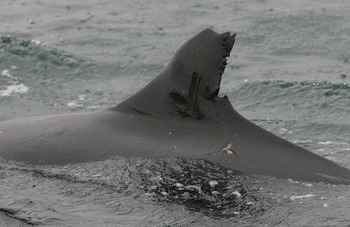
A single researcher (Tim Collins) compared the patterns of nicks and notches along the trailing edge of the dorsal fins in order to identify and catalogue individuals (Würsig & Jefferson, Reference Würsig and Jefferson1990) (Figure 2). Images were assessed and matched using the Discovery (Beta version) Photo-identification Database Management System, with the aim of determining whether any of the same individuals were present in separate sightings. Initial examination indicated that images taken during Sightings 4 to 6 were not suitable for photo-identification purposes, due to the high eye height of seismic survey platforms and the distance of the animals. Photo-identification analyses were therefore limited to images collected from small dedicated research platforms during Sightings 1 to 3. All images were considered, regardless of quality and individual distinctiveness, since the aim of the photo-identification analysis was to gain preliminary information on the minimum number of individuals and indications of site fidelity (see Weir et al., Reference Weir, Canning, Hepworth, Sim and Stockin2008 for further evaluation of opportunistic photo-identification methods).
Dorsal fin of a false killer whale Pseudorca crassidens photographed off Gabon on 18 August 2006, with a trailing edge well-marked with nicks and notches (photograph: Nick Mbadinga).

The approximate distance of each sighting from shore was measured in Google Earth. Water depths for Sightings 4 to 6 were recorded directly from vessel echosounders and are accurate for the vessel position at each sighting. Water depth was not available for Sightings 1 to 3. Consequently, the depths for all sightings were also calculated using GEBCO (General Bathymetric Chart of the Oceans) Digital Atlas 2003 contour data within the Arcview 3.2 Geographic Information System (GIS) (see Weir, Reference Weir2011b). All descriptive statistics were carried out using Minitab statistical software (Minitab Ltd).
Whistle analysis
Four acoustic files comprising 9.8 minutes of recordings were made during one false killer whale encounter (Sighting 4). The files were initially examined as spectrograms in CoolEdit 2000 (Syntrillium) to locate vocalizations. Biological sounds were heavily masked by engine and airgun noise, and consequently a digital high-pass filter (4 kHz) was applied to all files in Matlab (version R2009a; The Mathworks, Inc.) to enhance the signal to noise (S/N) ratio. Whistles were then identified in the filtered files and extracted as short files for analysis. Only 20 whistles were of sufficient S/N ratio to facilitate analysis. Spectrograms were produced within Matlab using a 512-point fast Fourier transform (FFT) (duration 10–11 ms) with a Hanning window. Seven descriptive parameters of the whistles were measured directly from the Matlab spectrogram using crosshairs within purpose written scripts to trace and save the time/frequency coordinates: (1) duration (s); (2) start frequency; (3) end frequency; (4) minimum frequency; (5) maximum frequency; (6) mean frequency; and (7) frequency range (maximum frequency–minimum frequency).
RESULTS
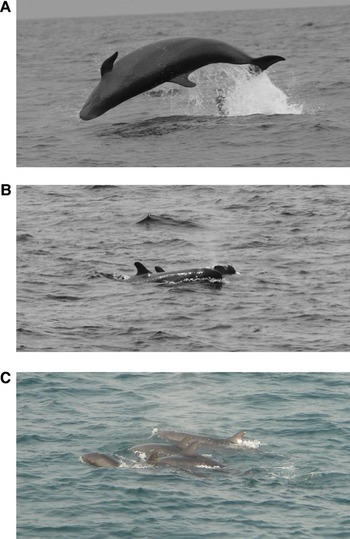
Six false killer whale sightings from ETA shelf waters are reported here (Table 1). During all sightings, the key diagnostic features of this species (Odell & McClune, Reference Odell, McClune, Ridgway and Harrison1999; Jefferson et al., Reference Jefferson, Webber and Pitman2008; Baird, Reference Baird2010) were observed and photographed including: (1) uniform dark body coloration; (2) large body size reaching around 5 m length; (3) slender, elongated body shape; (4) a prominent centrally-placed slender and erect dorsal fin, which appeared small in proportion to the length of the back; and (5) a conical head, lacking a defined beak (Figure 3). A summary of the sightings is provided in Table 1.
Species verification photographs of false killer whales Pseudorca crassidens from the three studies: (A) Gabon, 28 August 2006 (photograph: Simon Elwen); (B) Gabon, 16 November 2011 (photograph: Caroline Weir); (C) Côte d'Ivoire, 8 January 2012 (photograph: Terry Cross).

Summary of false killer whale Pseudorca crassidens sightings in shelf waters off Gabon and Côte d'Ivoire.

Distribution
Four false killer whale sightings were recorded on the Gabonese shelf, and two off Côte d'Ivoire (Figure 1; Table 1), providing the first confirmed at-sea sightings of the species in both countries. The Côte d'Ivoire sightings were located off Assini and Grand-Bassam, to the east of Abidjan. All of the Gabon sightings occurred between Iguela and the border with the Republic of the Congo (Figure 1).
The water depth of the sightings (as determined by GEBCO) ranged from 17 to 103 m with a mean of 54.5 m (SD = 30.2). However, for Sightings 4 to 6 (where depths from vessel echo-sounders were available) GEBCO consistently over-estimated water depth (see Table 1). Consequently, it seems likely that the water depths for Sightings 1 to 3 may also have been shallower than calculated.
The width of the continental shelf (≤200 m depth) in eastern Côte d'Ivoire and southern Gabon is approximately 23–30 and 60–70 km respectively. The six sightings had a relatively nearshore distribution, occurring at distances of 4.8 to 34.2 km (mean = 13.9; SD = 11.1) from the coast. The furthest sighting from shore (Sighting 4) was located midway across the continental shelf, and the other sightings were in the inshore third of the shelf.
Group size and composition
The best estimate of group size ranged from 10 to 100 animals (mean = 34.8; SD = 34.1; median = 23.5). Most groups (N = 5) comprised 10 to 40 animals (Table 1). Group composition was not accurately ascertained during most sightings. However, calves (≤50% adult length) and/or juveniles (50–75% adult length) were confirmed to be present during all sightings except for Sighting 2 (where no age information was noted). At least one calf was observed off Gabon during Sighting 4, while one and 10 juveniles respectively were recorded off Côte d'Ivoire during Sightings 5 and 6.
Photo-identification
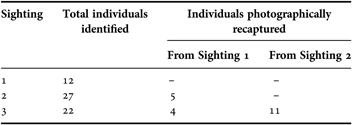
Forty-three individual false killer whales were opportunistically photo-identified during Sightings 1–3, of which most (N = 27) were only photographed once. However, 14 individuals were recorded during two of the sightings, and two individuals were photographed in all three sightings. Half of the individuals photographed during Sighting 3 had also been recorded 10 days earlier during Sighting 2 (Table 2). Additionally, seven individuals were photographically re-captured between 2002 and 2006 (Table 2).
Opportunistic photographic encounters with individual false killer whales Pseudorca crassidens off Gabon on 12 August 2002 (Sighting 1), 18 August 2006 (Sighting 2) and 28 August 2006 (Sighting 3).

Behaviour
During three of the sightings (Sightings 1, 4 and 5; Table 1), animals predominantly exhibited steady directed travel throughout the encounter. Several leaps and changes of direction were noted intermittently during Sighting 4, but it was unclear whether those related to foraging or social behaviour. The three other sightings apparently comprised hunting (Sighting 2) and social (Sightings 3 and 6) behaviour respectively.
During Sighting 2, a false killer whale group was observed for over 2 hours hunting Atlantic sailfish (Istiophorus albicans) (Figure 4). Multiple sailfish were seen at the surface during the day, and this fish aggregation was considered to be unusual by a local sports fisher (Francois Horent, personal communication). The false killer whales dispersed into small sub-groups while chasing and capturing sailfish; injured and dead fish retrieved from the water exhibited tooth rake marks and bites. During the encounter, the false killer whales approached both the research boat (bow-riding) and a pod of six humpback whales with which the research boat was working. No direct physical interactions between false killer whales and humpback whales were observed, although the humpback whales were noted as being ‘agitated’ (as indicated by high surface activity, erratic direction and higher than usual prevalence of fluking) both prior to, and during, the false killer whale encounter.
False killer whale Pseudorca crassidens hunting an Atlantic sailfish on 18 August 2006 (photograph: Nick Mbadinga).

Sighting 3 comprised multiple dispersed false killer whale sub-groups which were observed while the research boat was working with several different groups of humpback whales. The false killer whales were very surface-active, exhibiting social behaviour and with some individuals performing repeated back flip leaps. They were also seen bow-riding surfacing humpback whales, with others leaping around the areas where humpback whales had submerged. As during Sighting 2, the humpback whales encountered on this date appeared ‘agitated’ and spent longer at the surface than typical. However, no direct physical interactions between false killer whales and humpback whales were observed.
During Sighting 6, animals travelled in two compact sub-groups (20 and 12 animals) which appeared to be engaged in subsurface social activity. Individuals surfaced with erratic changes of direction, sometimes upside down and with high levels of physical interaction. Little surface-active behaviour was observed; rather the animals were interacting just below the surface.
Vocalizations
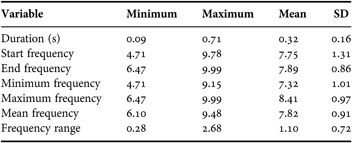
The descriptive parameters of 20 false killer whale whistles recorded during Sighting 4 indicated a mean fundamental frequency of 7.8 kHz (Table 3). The whistles had very similar mean minimum–maximum and start–end frequencies, a mean frequency range of only 1.1 kHz and simple flat or convex structures in the spectrogram (Figure 5). The fundamental energy of most (N = 14) whistles occurred entirely within the 6–9 kHz bandwidth. Only two whistles contained energy at frequencies lower than 6 kHz, and only four whistles extended to frequencies beyond 9 kHz. The whistles had short durations (mean = 0.32 s) (Table 3).
Spectrograms showing filtered (4 kHz digital high-pass filter) false killer whale Pseudorca crassidens sounds recorded off Gabon on 16 November 2011: (A) whistle; (B) whistles, echolocation clicks and burst-pulse sounds.

Descriptive statistics for the fundamental frequency of 20 false killer whale Pseudorca crassidens whistles recorded off Gabon, 16 November 2011. All frequency values are presented in kHz.

DISCUSSION
Spatial and temporal occurrence in ETA shelf waters
Previous records of false killer whales in the ETA region predominantly comprised strandings and by-catches (van Bree, Reference van Bree1972; Van Waerebeek & De Smet, Reference Van Waerebeek and De Smet1996; Van Waerebeek et al., Reference Van Waerebeek, Ofori-Danson and Debrah2009; Hazevoet et al., Reference Hazevoet, Monteiro, López, Varo, Torda, Berrow and Gravanita2010), which do not provide information on habitat. The offshore, deep-water distribution of sightings recorded off Angola (Weir, Reference Weir2007, Reference Weir2011b) had led Weir (Reference Weir2010) to allocate false killer whales to a deep-water ETA cetacean community. Van Waerebeek et al. (Reference Van Waerebeek, Ofori-Danson and Debrah2009) also considered the deep-water sightings off Angola to be ‘in accordance with the species’ usual habitat'. However, the sightings described here indicate an additional use of ETA neritic waters.
Regular nearshore occurrences of false killer whales are usually considered to be restricted to the waters around tropical oceanic islands (Acevedo-Gutiérrez et al., Reference Acevedo-Gutiérrez, Brennan, Rodriguez and Thomas1997; Baird, Reference Baird, Perrin, Würsig and Thewissen2008; Baird et al., Reference Baird, Gorgone, McSweeney, Webster, Salden, Deakos, Ligon, Schorr, Barlow and Mahaffy2008); habitats with relatively narrow shelf and steep associated slope. For example, 18 false killer whale sightings around Hawaii occurred in 38–4331 m depth and at distances of 1.6–50.5 km from shore (Baird et al., Reference Baird, Gorgone, McSweeney, Webster, Salden, Deakos, Ligon, Schorr, Barlow and Mahaffy2008). However, the false killer whale sightings reported off Côte d'Ivoire and Gabon were located in shallow (~17–103 m), nearshore (4.8–34.2 km from the coast) waters adjacent to the African mainland. There are some other records of false killer whales using shelf waters along mainland continents. For example, they are occasionally sighted at Golfo Dulce (an estuarine bay reaching 215 m depth) in Costa Rica, sometimes only 10 m from the shore (Acevedo-Gutiérrez et al., Reference Acevedo-Gutiérrez, Brennan, Rodriguez and Thomas1997). Best & Reeb (Reference Best and Reeb2010) reported that the species is infrequently sighted in nearshore (sometimes ~500 m from the coast) shallow waters off South Africa. The species clearly inhabits (at least occasionally) areas of shallow continental shelf adjacent to mainland, in addition to its more usual deep, offshore habitat and the slope-influenced waters around islands.
The six sightings reported from ETA shelf waters were recorded in January (Côte d'Ivoire), and during August and November (Gabon), and reflected the seasonal timing of the survey work. Consequently, it remains unclear whether false killer whales inhabit the ETA shelf year-round or whether the sightings relate to a population that uses both oceanic and neritic habitat on a seasonal basis.
Photo-identification on the Gabonese shelf
Individual false killer whales in Gabon and Côte d'Ivoire were noted (anecdotally) to be well-marked for photo-identification purposes, for example with multiple, and often very deep, dorsal fin notches or stumped dorsal fin tips. However, only Sightings 1–3 from the Gabonese shelf were suitable for use in photo-identification analysis and are discussed below.
The photo-identification work reported here was of a very opportunistic nature, and the results in terms of re-sightings and associations should therefore be interpreted as minimal occurrence. Two animals were photographed during all three of the sightings, suggesting that at least some individuals exhibit a degree of site fidelity to Gabonese shelf waters. Half of the individuals photographed during Sighting 3 had also been recorded ten days earlier during Sighting 2 (Table 2), suggesting short-term site fidelity of false killer whales to Gabonese shelf waters. Additionally, a further five individuals were photographed in both 2002 and 2006 (Table 2), which is suggestive of repeated use of shelf waters over the longer-term. Individual false killer whales were re-sighted over periods of several years in both Costa Rica (Acevedo-Gutiérrez et al., Reference Acevedo-Gutiérrez, Brennan, Rodriguez and Thomas1997) and Hawaii (Baird et al., Reference Baird, Gorgone, McSweeney, Webster, Salden, Deakos, Ligon, Schorr, Barlow and Mahaffy2008), with the latter study recording a 20 year period between the first and last sighting of one individual.
The evidence for site fidelity raises the question of whether genetically-discrete (though not necessarily completely exclusive in spatial range) populations of false killer whales may occur in shelf (and/or nearshore) and oceanic (and/or offshore) waters within the ETA, as has been suggested for this species in Hawaii (Baird et al., Reference Baird, Gorgone, McSweeney, Webster, Salden, Deakos, Ligon, Schorr, Barlow and Mahaffy2008). Genetic analyses will probably be required in order to elucidate stock structure in the ETA (as in the eastern tropical Pacific: e.g. Chivers et al., Reference Chivers, Baird, McSweeney, Webster, Hedrick and Salinas2007).
The re-sightings of individual false killer whales between the three Gabonese shelf sightings are also indicative of the presence of stable associations between some individuals over time. Repeated associations among individuals have been documented in Costa Rica (Acevedo-Gutiérrez et al., Reference Acevedo-Gutiérrez, Brennan, Rodriguez and Thomas1997) and Hawaii (Baird et al., Reference Baird, Gorgone, McSweeney, Webster, Salden, Deakos, Ligon, Schorr, Barlow and Mahaffy2008), the latter study including some very long-term (15 years) associations.
Group size in ETA shelf waters
With the exception of one large group (best estimate of ~100 individuals) recorded on 28 August 2006, school size in neritic waters fell within the 2–50 animal range recorded by Weir (Reference Weir2011b) offshore Angola. This is also consistent with group size ranges recorded off Costa Rica (5–34 animals: Acevedo-Gutiérrez et al., Reference Acevedo-Gutiérrez, Brennan, Rodriguez and Thomas1997), around Hawaii (1–41 animals: Baird et al., Reference Baird, Gorgone, McSweeney, Webster, Salden, Deakos, Ligon, Schorr, Barlow and Mahaffy2008) and in the Gulf of Mexico (3–70 animals: Maze-Foley & Mullin, Reference Maze-Foley and Mullin2006). Sightings of large groups in Hawaii are thought to represent temporary associations of multiple stable sub-groups (Baird et al., Reference Baird, Gorgone, McSweeney, Webster, Salden, Deakos, Ligon, Schorr, Barlow and Mahaffy2008, Reference Baird, Schorr, Webster, McSweeney, Hanson and Andrews2010). The large group encountered on the Gabonese shelf may potentially represent one such temporary aggregation.
Surface and acoustic behaviour
The observation of false killer whales hunting Atlantic sailfish on the Gabonese shelf is consistent with their documented fish and cephalopod diet worldwide, which includes large prey items such as dolphinfish (Coryphaenidae), wahoo Acanthocybium solandri, billfish (Istiophoridae and Xiphiidae) and yellowfin Thunnus albacares, skipjack Katsuwonus pelamis and albacore T. alalunga tuna (Stacey et al., Reference Stacey, Leatherwood and Baird1994; Odell & McClune, Reference Odell, McClune, Ridgway and Harrison1999; Baird, Reference Baird, Perrin, Würsig and Thewissen2008, Baird et al., Reference Baird, Gorgone, McSweeney, Webster, Salden, Deakos, Ligon, Schorr, Barlow and Mahaffy2008; Jefferson et al., Reference Jefferson, Webber and Pitman2008; Forney et al., Reference Forney, Kobayashi, Johnston, Marchetti and Marsik2011). No other information is available regarding the diet of this species in ETA waters.
In contrast to the regularly reported associations with other odontocete species (e.g. Stacey et al., Reference Stacey, Leatherwood and Baird1994; Maze-Foley & Mullin, Reference Maze-Foley and Mullin2006; Baird, Reference Baird, Perrin, Würsig and Thewissen2008; Baird et al., Reference Baird, Gorgone, McSweeney, Webster, Salden, Deakos, Ligon, Schorr, Barlow and Mahaffy2008), mixed-species associations between false killer whales and baleen whales have not often been reported in the literature. Humpback whales, which were the focus of cetacean studies on the Gabonese shelf, were being followed by researchers during two of the false killer whale encounters reported here. The two species were intermittently mixed together on both occasions, including bow-riding of surfacing humpback whales by false killer whales during Sighting 3. No direct physical interactions were seen between the species, but the humpback whales appeared unusually ‘agitated’ and spent longer at the surface prior to, and during, both false killer whale sightings. Baird et al. (Reference Baird, Gorgone, McSweeney, Webster, Salden, Deakos, Ligon, Schorr, Barlow and Mahaffy2008) noted one encounter between false killer whales and humpback whales off Hawaii; during that encounter the false killer whales travelled past the humpback whales, and the latter appeared ‘agitated’ (indicated by forced blows) (Robin Baird, personal communication). While the exact nature of these interspecies interactions remains unclear, they are more consistent with harassment (actual, or the perceived potential threat of) of humpback whales by false killer whales rather than concerted predation attempts. There is only one published report of apparent predation of a humpback whale by false killer whales: a second-hand account of an attack on a humpback whale calf in Hawaii (Hoyt, Reference Hoyt1983). However, the evidence was inconclusive, and some doubt remains about whether a calf was in fact killed (Robin Baird, personal communication).
Small sample size prohibits any meaningful discussion of the vocalizations produced by false killer whales in the ETA. However, we note that the parameters of the 20 ETA whistles were comparable to 68 whistles recorded in the eastern tropical Pacific by Oswald et al. (Reference Oswald, Barlow and Norris2003), which also had very similar minimum–maximum and start–end frequencies, a small mean frequency range (1.4 kHz), short duration (0.4 s) and simple structure (mean of 0.5 inflection points). However, the mean minimum and maximum frequencies of 4.7 and 6.1 kHz respectively (Oswald et al., Reference Oswald, Barlow and Norris2003) were slightly lower than the 7.31 and 8.41 kHz recorded in the ETA. Using a larger sample of 340 whistles from the eastern tropical Pacific, Oswald et al. (Reference Oswald, Rankin, Barlow and Lammers2007) recorded slightly higher mean minimum and maximum frequencies of 5.28 and 6.95 kHz respectively; still lower than those recorded in the ETA. Kamminga & van Velden (Reference Kamminga and van Velden1987) noted the production of ‘a rather constant whistle of about 8 kHz’ by three captive specimens, which is very similar to the mean fundamental frequency of 7.8 kHz recorded in the ETA. Since whistle parameters may vary according to factors including age, behaviour, group, population and geographical region, more recordings are required to examine the acoustic behaviour of this species in ETA waters.
Conservation status and threats in the ETA
False killer whales are considered to be naturally uncommon throughout their range (Baird, Reference Baird, Perrin, Würsig and Thewissen2008). The scarcity of records in the ETA, even from areas that have been relatively well-surveyed such as offshore waters in Angola and Gabon (de Boer, Reference de Boer2010; Weir, Reference Weir2011b), support a low abundance also in this region. Too few data are available to speculate about the status of the species in the shelf waters of Côte d'Ivoire. At present there are no data to determine whether shelf animals move offshore into deeper waters or to what extent they move through the waters of adjacent countries. One satellite-tagged false killer whale in Hawaii travelled a straight-line distance of 420.1 km in 32 days (Baird et al., Reference Baird, Schorr, Webster, McSweeney, Hanson and Andrews2010), and there is clearly therefore potential for trans-boundary movements in the ETA.
Human impacts on delphinid species in the ETA region are poorly-documented due to the paucity of stranding schemes and of by-catch monitoring in fisheries (Weir & Pierce, Reference Weir and Pierce2012). Stacey & Baird (Reference Stacey and Baird1991) suggested that the ‘offshore habitat of the false killer whale is generally less susceptible to human impact and degradation than are coastal areas’. However, an occurrence in ETA shelf waters increases the potential for overlap with human activities.
Three false killer whales have been confirmed as by-catch in the Ghanaian drift net fishery; all were presumably used for human consumption (Van Waerebeek et al., Reference Van Waerebeek, Ofori-Danson and Debrah2009). A live-stranded animal in Gabon was also slaughtered and used for human consumption (after a failed refloat attempt) (Van Waerebeek & De Smet, Reference Van Waerebeek and De Smet1996). The mandibles from two animals were found at the artisanal fish landing site of Longobondi (4.30908°S 11.51604°E) in the Republic of the Congo during June 2011 (specimens are stored at the Park Base in Conkouati Douli National Park). The animals had apparently been butchered (marks were present on the bones: T. Collins, personal observation); it is unclear whether they originated as directed take or as by-catch.
One false killer whale photographed on the Gabonese shelf during Sighting 2 had a single loop of plastic packing strap entwined around its body, passing dorsally between the blow hole and the dorsal fin; it was unclear to what extent the ventral and posterior portions of the animal were entangled. Examples of plastic marine debris causing cetacean entanglement are relatively rare (Simmonds, Reference Simmonds2012), and this appears to be the first such example for the false killer whale.
Two of the sightings (Sightings 4 and 6) recorded during 3-D seismic surveys involved animals passing at close range (≤300 m) to airguns operating at full production volume (2940 and 3111 in3 respectively), indicating that some false killer whales may not avoid high-amplitude sound sources. It is unclear what individual- or population-level impacts exposure to airgun sound may have on ETA cetaceans (Weir & Pierce, Reference Weir and Pierce2012).
The distribution, abundance, movements, population structure and both natural and human-originating mortality rates of false killer whales in the ETA remain unknown, and require clarification for conservation and management purposes.
ACKNOWLEDGEMENTS
Sightings 1–3: the Gabonese humpback whale project was supported by the Wildlife Conservation Society Ocean Giants Programme. Thanks to The Gabon Ministry of Water and Forests and the Agence National des Parcs Nationaux for their permissions to conduct the work. Data were also collected by: Solange Ngouessono, Francois Horent, Nick Mbadinga, Jacquie Ay-Ling Loo and Megan Wallner. Funding was provided by: The Flora Family Foundation, The Gordon and Betty Moore Foundation, Edith McBean, The Eppley Foundation for Research, Shell Gabon and The Lerner Gray Fund for Marine Research.
Sightings 4–6: seismic survey work was sponsored by VAALCO Gabon (Etame) Inc. and Harvest Natural Resources in Gabon, and Rialto Energy in Côte d'Ivoire. Neil Grosse at Geomotive provided helpful assistance in gaining data permission. Thanks to the crews of the ‘Polarcus Nadia' and the ‘PGS Apollo' for their help and hospitality during the surveys.