Introduction
Western flower thrips (WFT), Frankliniella occidentalis (Pergande 1895), is an introduced pest that was detected in Kenya presumably in 1989 (Kedera and Kuria, Reference Kedera and Kuria2005). WFT has rapidly become an important pest on several crops and ornamentals and is now one of the most important pests of French bean (Phaseolus vulgaris L.) in East Africa (Nderitu et al., Reference Nderitu, Wambua, Olubayo, Kasina and Waturu2007). So far, farmers mostly use synthetic insecticides to control this pest, but due to issues such as stringent regulations on the export market and development of insecticide resistance (Brødsgaard, Reference Brødsgaard1994; Nderitu et al., Reference Nderitu, Kasina, Nyamasyo, Waturu and Aura2008), new control strategies need to be developed. Recent approaches to manage F. occidentalis in Kenya include improved monitoring techniques (Muvea et al., Reference Muvea, Waiganjo, Kutima, Osiemo, Nyasani and Subramanian2014), intercropping (Nyasani et al., Reference Nyasani, Meyhöfer, Subramanian and Poehling2012), integration of Metarhizium-based products with kairomones (Niassy et al., Reference Niassy, Maniania, Subramanian, Gitonga and Ekesi2012a , Reference Niassy, Maniania, Subramanian, Gitonga, Mburu, Masiga and Ekesi2012b ; Mfuti et al., Reference Mfuti, Subramanian, van Tol, Wiegers, de Kogel, Niassy, du Plessis, Ekesi and Maniania2016) and predatory mites (Nyasani et al., Reference Nyasani, Subramanian, Poehling, Maniania, Ekesi and Meyhöfer2015). However, little is known about field ecology and population genetics of F. occidentalis in Kenya, including host preferences, adaptation potential and genetic variation on local and regional scales, thus constraining development and implementation of new control approaches.
In general, not all host plants are equally suitable and attractive for F. occidentalis depending on factors such as plant age, morphology, colour and scent, but also the nutritional value of plants (e.g. Lewis, Reference Lewis and Lewis1997; Pearsall, Reference Pearsall2000; Baez et al., Reference Baez, Reitz, Funderburk and Olson2011; Nyasani et al., Reference Nyasani, Meyhöfer, Subramanian and Poehling2013). WFT, therefore, shows complex selection behaviour and prefers certain host plants (e.g. flowering or fertilized plants) with consequences for its fitness (Lewis, Reference Lewis and Lewis1997; de Kogel et al., Reference de Kogel, Bosco, van der Hoek and Mollema1999; Chau et al., Reference Chau, Heinz and Davies2005). Finally, there are indications for host race development in F. occidentalis suggesting a certain degree of specialization to host plants (Cao et al., Reference Cao, Zhi, Cong and Margolies2014). For plant protection strategies, the impacts of specialization are manifold. For example, it might explain the high variability in thrips population densities on crops, which can depend on the composition of surrounding plant species (e.g. Nault et al., Reference Nault, Kain and Wang2014) and which may affect crop and intercrop selection at farm level. As a result, specific trap crops, intercropping, and other management approaches (entomopathogenic fungi and nematodes, beneficial insects, biological strategies involving pheromones, etc.) to reduce thrips damage, could be developed.
This pilot study is meant as a starting point to investigate if the available microsatellites (Yang et al., Reference Yang, Sun, Xue, Li and Hong2012a ) are suitable to answer more detailed questions regarding WFT population genetics in the French bean agroecosystem in Kenya. Therefore, we focused on the following research questions:
-
(A) Are available microsatellites suitable for Kenyan WFT populations and are they sufficiently polymorphic for studies on WFT population genetics in Kenya?
-
(B) Is there genetic structuring and how strong is gene flow between Kenyan WFT populations?
-
(C) Do allelic frequencies vary in different regions and on different host plant species?
Material and methods
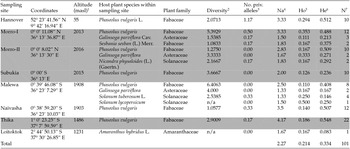
Thrips were collected in August 2011 from several host plant species, including crops, intercrops and weeds growing within and around French bean fields, in seven different field sites located in the Rift Valley and Central regions of Kenya (Table 1). The two regions were chosen, because they are the main French bean production areas of Kenya. Except the farm near Thika of more than 16 ha, all other samples were collected on small-scale farms (0.5–1.0 ha). Sampled farm fields were characterized by fairly structured landscapes and are located in the high-altitude zone (1900–2700 masl), except Loitokitok and Thika, which are located in the mid-altitude zone (1000–1800 masl) of Kenya. The main crop on all farm fields was French bean, which is grown throughout the year in rotation with other vegetables such as sweet pepper (Capsicum annuum L.) or zucchini (Cucurbita pepo L.) or side-by-side with the latter crops and baby corn (Zea mays L.).
Collection sites with coordinates, altitude above sea level, diversity, expected and observed heterozygosity, and host plants of Frankliniella occidentalis samples from Kenyan French bean production areas. While geographical distance between Morro & Subukia as well as between Malewa & Naivasha is less than 2 km, distances between regions (except Hannover) range between 74 and 336 km. (n/a = not applicable)

1asl = above sea level; 2Genetic diversity; 3No. priv. alleles = Number of private alleles; 4Na = Mean number of different alleles; 5Ho = Observed heterozygosity; 6He = Expected heterozygosity; 7N = sample size.
Thrips were collected from different host plants (Table 1) and transferred to 90% ethanol. After determination of morphological identity using a microscope and the key from Moritz et al. (Reference Moritz, Mound, Morris and Goldarazena2004; Reference Moritz, Brandt, Triapistyn and Subramanian2013), specimens were stored at 6 °C in a fridge until transport to Germany and further use. As an out-group for tree building, WFT specimens from a long-term lab reared colony at IPP in Hannover (Lower Saxony, Germany) were used.
DNA of female individuals was extracted using a modified protocol from Sunnucks and Hales (Reference Sunnucks and Hales1996). To test for possible cryptic species of Frankliniella, a diagnostic PCR (Rugman-Jones et al., Reference Rugman-Jones, Hoddle and Stouthamer2010) was performed following the authors’ protocol with minor modifications. To genotype individuals, six microsatellite primers (WFT02, WFT03, WFT04, WFT05, WFT07, WFT08) designed by Yang et al. (Reference Yang, Sun, Xue, Li and Hong2012a ), that proved to be polymorphic and could be scored unambiguously were used with a modified protocol using Bioline Taq polymerase (Bioline GmbH, Berlin, Germany) and tetramethylammonium chloride (Roth GmbH, Karlsruhe, Germany) to increase PCR specificity (Chevet et al., Reference Chevet, Lemaître and Katinka1995). PCR products were then separated on an Origins gel electrophoresis system (Elchrom Scientific AG, Cham, Switzerland) with precast Spreadex® gels and visualized by ethidium bromide staining. Bands were scored using the program Labimage 1 D (Kapelan Bio-Imaging GmbH, Leipzig, Germany) and also checked by eye. Genetic differentiation was analysed at three hierarchical levels using the analysis of molecular variance (AMOVA) supplied by the software Arlequin 3.5.1.3 (Excoffier and Lischer, Reference Excoffier and Lischer2010) and significance was tested using 10100 non-parametric permutations (Excoffier et al., Reference Excoffier, Smouse and Quattro1992). Hierarchical levels included within populations, among populations within groups, and several groupings (e.g. French bean vs. other plant species, grouping according to geographic vicinity). Also, pairwise F ST values and pairwise number of migrants (Nm) were estimated using the Arlequin software.
The program Micro-Checker 2.2.3 (Van Oosterhout et al., Reference Van Oosterhout, Hutchinson, Wills and Shipley2004) was used to search for null alleles, allele dropout and scoring errors (95% confidence interval). Allele frequencies, genetic diversity (mean squared allele size differences among individuals within samples averaged over samples), mean number of different alleles (number of alleles/number of loci), number of private alleles (mean number of alleles unique to a single population), observed heterozygosity and expected heterozygosity (genetic diversity, calculated as 1 minus the sum of the squared gene frequencies) averaged over loci were calculated using Genepop 4.2 (Rousset, Reference Rousset2008) and GenAIEx 6.501 (Peakall and Smouse, Reference Peakall and Smouse2012). To identify first generation migrants of potential source populations, we used the assignment test as implemented in the program GeneClass2 (Piry et al., Reference Piry, Alapetite, Cornuet, Paetkau, Baudouin and Estoup2004) between weed and bean populations and within populations of the same host plant type. Monte Carlo resampling was used by the test procedure to compute the likelihood that a specific genotype originates from other populations (1000 simulated individuals; exclusion threshold = 0.01) (Paetkau et al., Reference Paetkau, Slade, Burden and Estoup2004).
For analysis of isolation by distance, F ST values were transformed into F ST/(1−F ST) and regression calculated with the natural logarithm of geographical distance in kilometres. The correlation between the distance matrices was assessed using a Mantel test with 1000 permutations as implemented in Genepop (Rousset, Reference Rousset2008).
A tree was calculated using Nei's genetic distance D A (Nei et al., Reference Nei, Tajima and Tateno1983) and the Neighbor-Joining algorithm (Saitou and Nei, Reference Saitou and Nei1987) provided with the software Populations 1.2.32 (Langella, Reference Langella1999). For tree building, populations of adjacent locations were pooled (Morro: Morro-I, Morro-II, and Subukia; Malewa: Malewa and Naivasha). Loitokitok was omitted because the sample size was too small.
Results and Discussion
A total of 101 WFT individuals from 15 locations and seven host plant species were collected (Table 1). To exclude effects of possible cryptic Frankliniella species, all specimens were checked with a diagnostic PCR (Rugman-Jones et al., Reference Rugman-Jones, Hoddle and Stouthamer2010) with the result of a ~400 bp band, indicating that all Kenyan and German individuals belonged to the western flower thrips G genotype, which is widespread in Africa and Europe (Rugman-Jones et al., Reference Rugman-Jones, Hoddle and Stouthamer2010).
PCRs of all microsatellite loci gave fragments that could be analysed unambiguously and all loci proved to be polymorphic with an average of 2.27 alleles per locus (Table 1).
All markers showed highly significant deviation from the Hardy–Weinberg Equilibrium (HWE) with a deficiency of heterozygotes (P<0.001; multisample score test; Raymond and Rousset, Reference Raymond and Rousset1995). This result could be attributed to population structuring (e.g. by close association to host plants), but also the effects of small sample size and null alleles cannot be excluded. Micro-checker indicated that three loci may have null alleles (WFT03, WFT04, WFT08) but without large allele dropout or scoring errors (at 95% confidence interval). Correcting for null alleles by using adjusted allele frequencies in the subsequent analyses (as calculated by Micro-Checker) failed to change the results, and therefore, we present uncorrected data.
The overall F ST value of 0.253 is highly significant (Table 2), indicating substantial population differentiation. With an AMOVA, we tested several groupings, but only by grouping weeds and intercrops against French bean, at least 12% of the detected genetic variation between groups could be explained (Table 2), whereas other groupings resulted in much higher explained variation within but not between populations (data not shown). This indicates a considerable population differentiation between thrips populations found on French bean and other plant species.
Analysis of molecular variance (AMOVA) of Frankliniella occidentalis samples from Kenyan French bean production areas (Hannover samples not included). Two groups were defined a priori using all samples from weeds and intercrops as a group and all samples from French beans as a second group

Significance tests (10100 permutations): *P = 0.02653; **P = 0.00030; ***P = 0.00693.
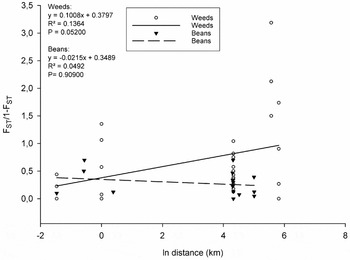
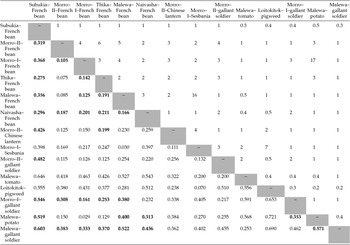
A Mantel test showed that there is a marginal correlation between genetic and geographic distance only between populations from weeds (Fig. 1), indicating negligible isolation by distance effects between more distant populations. Among populations from French bean, no isolation by distance could be detected. This is also supported by the pairwise comparison of the number of migrants per generation (Nm), which indicates little exchange between populations (Table 3).
Scatterplots of pairwise F ST/1–F ST values and pairwise natural logarithms of geographical distance between Kenyan WFT populations on beans (triangles and dashed line) and weeds/intercrops (circles and continuous line). The Hannover population was not included.

Matrix of the number of migrants between sites and crops (Nm; upper triangle) and pairwise F ST values between each Kenyan western flower thrips population (lower triangle) sampled on different plant species. Significant F ST values are displayed in bold (P≤0.05)

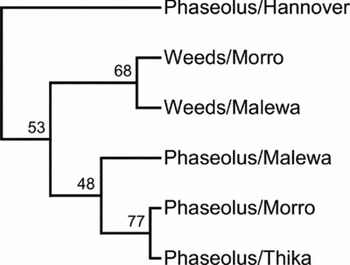
Using a neighbour-joining tree analysis with pooled populations, WFT populations from P. vulgaris plants (except the out-group) were grouped in a distinct branch (Fig. 2) and weeds and intercrops into a second one with moderate support by bootstrap analysis. Within both branches, distinct differences between populations on the same host plant species but not between different regions were found. These results indicate effects of host plants on population differentiation with moderate bootstrap support (Fig. 2).
Neighbour joining tree using Nei's D A genetic distance (Nei et al., Reference Nei, Tajima and Tateno1983) between Kenyan WFT populations, which are pooled by vicinity and host plant (Morro includes Morro-I, Morro- II and Subukia; Malewa includes Naivasha; Loitokitok is omitted). Numbers indicate bootstrap support (1000 bootstrap replicates) for branchings. The Hannover WFT population was used as an out-group.

These results are supported by an assignment test, by which we tried to identify F0 migrants between populations. The assignment revealed no migrants between French bean and weed/intercrop populations, but two migrants within French bean and seven migrants within weed/intercrop populations. Such host associations were also reported in other studies and attributed to preference for different host plant species (e.g. Baez et al., Reference Baez, Reitz, Funderburk and Olson2011; Nyasani et al., Reference Nyasani, Meyhöfer, Subramanian and Poehling2013; Cao et al., Reference Cao, Zhi, Cong and Margolies2014), which is then reflected in differences in genotype distribution, leading to more specialized biotypes (e.g. Brunner et al., Reference Brunner, Chatzivassiliou, Katis and Frey2004; Mirnezhad et al., Reference Mirnezhad, Schidlo, Klinkhamer and Leiss2012; Cao et al., Reference Cao, Zhi, Cong and Margolies2014; Nault et al., Reference Nault, Kain and Wang2014). Doederlein and Sites (Reference Doederlein and Sites1993) found host plant preferences of WFT in onion fields and accompanying weeds changed with phenological stage of the crop and other environmental factors that induce plant stress (e.g. drought). But since dispersal was not recorded and populations were not genotyped, it is uncertain whether individuals of the same or of different sub-populations contributed to the observed preferences.
The genetic diversity in the Kenyan thrips population seems to be rather low compared to other studies on WFT (Brunner and Frey, Reference Brunner and Frey2010; Yang et al., Reference Yang, Sun, Xue, Li and Hong2012a ). This might be an effect of the relatively small sample sizes (low individual numbers correspond with lower diversity).
These preliminary results indicate that the investigated Kenyan WFT populations have little exchange and show a genetic structure that could lead to development of biotypes or host races in the future. Geographical distance seemed to have no or only little effect on population structure. With regard to plant protection strategies, the results suggest that weeds may be rather unimportant as a source for WFT colonizing French bean compared to other crop plants. The tested microsatellites gave promising results even with small sample sizes, making this study and the set of microsatellite markers a good starting point for a more detailed analysis of field dispersal and host plant specialization of F. occidentalis in Kenya with extensive sampling and further microsatellite markers, which are available from Yang et al. (Reference Yang, Sun, Xue, Zhu and Hong2012b ).
Conclusion
WFT is a serious pest of Kenyan French bean production and the strong demand to develop new plant protection strategies requires a sound understanding of WFT population genetics, e.g. in terms of source habitats and population structure. The study revealed for the first time that WFT populations from weeds and intercrops are genetically different to populations on French bean and seem to be unimportant source habitats for WFT. Therefore, IPM strategies based on intercropping need to be reconsidered.
Acknowledgements
We thank Birgit Milde for technical assistance. This study was funded by the BMZ (German Federal Ministry for Economic Cooperation and Development) through GIZ (Deutsche Gesellschaft für Internationale Zusammenarbeit) through a project grant entitled “Implementation of integrated thrips and tospovirus management strategies in small-holder vegetable cropping systems of Eastern Africa” (Project number: 11.7860.7-001.00, Contract number: 81141840) to which we are grateful.