Introduction
Fluorescence in the plant kingdom exhibits a variety of types and colours (Donaldson Reference Donaldson2020, Lang et al. Reference Lang, Stober and Lichtenthaler1991). Primary fluorescence categories include red fluorescence, attributed to chlorophyll, and blue fluorescence, frequently observed in specialised plant structures such as flowers and fruits (Buschmann et al. Reference Buschmann, Langsdorf and Lichtenthaler2000, Donaldson Reference Donaldson2020, Guerrero-Rubio et al. Guerrero-Rubio et al. Reference Guerrero-Rubio, Escribano, García-Carmona and Gandía-Herrero2020, Roshchina et al. Reference Roshchina, Kuchin and Yashin2017). Additionally, the presence of specific compounds or metabolites can lead to yellow-green fluorescence, though this is less common (Bergau et al. Reference Bergau, Bennewitz, Syrowatka, Hause and Tissier2015, Donaldson Reference Donaldson2020, Roshchina et al. Reference Roshchina, Kuchin and Yashin2017, Sutton et al. Reference Sutton, Punja and Hamarneh2023).
The array of fluorescence colours in plants represents a captivating dimension of their biochemistry and ecological adaptations. It has been hypothesised and studied that plants harness glowing colours (in this case, the emitted blue and green fluorescence) as a visual cue to attract animals for essential purposes, including pollination (Mori et al. Reference Mori, Fukui, Oishi, Sakuma, Kawakami, Tsukioka, Goto and Hirai2018), seed dispersal (Guerrero-Rubio et al. Guerrero-Rubio et al. Reference Guerrero-Rubio, Escribano, García-Carmona and Gandía-Herrero2020), and even predation in the case of carnivorous plants (Kurup et al. Reference Kurup, Johnson, Sankar, Hussain, Sathish Kumar and Sabulal2013).
Several anecdotal observations of autofluorescence in Nepenthes species have been shared through online forums and social media in recent years. However, proper scientific documentation in peer-reviewed journals remains scarce. To date, only Kurup et al. (Reference Kurup, Johnson, Sankar, Hussain, Sathish Kumar and Sabulal2013) have explicitly investigated this phenomenon and assessed the role of fluorescence in luring insect prey; nevertheless, the authors described only blue autofluorescence. Herein, we report a natural hybrid of pitcher plant from Peninsular Malaysia, Nepenthes benstonei × rafflesiana, exhibiting distinctive ultraviolet (UV)-induced green fluorescence on its peristome—representing the first documented evidence of green autofluorescence in the genus. This phenomenon is hypothesised to serve an as-yet undetermined ecological role in the taxon’s adaptation and may originate from certain plant-derived compounds or bacterial interactions. Drawing upon published studies from related systems, this article further posits the role that biofluorescence may play in prey luring and assesses potential plant- and microbe-derived fluorophores involved in that process.
The discovery of the green-fluorescent pitcher plant has now become another fascination, adding to our earlier findings on Nepenthes in Peninsular Malaysia (Ghazalli et al. Reference Ghazalli, Tamizi, Nikong, Besi, Mat Esa, Mohd Nordin, Latiff, Zaini and Shakri2020, Tamizi et al. Reference Tamizi, Ghazalli, Nikong, Besi, Mat-Esa, Mohd-Nordin, Latiff and Shakri2020a, Reference Tamizi, Ghazalli, Nikong, Mat Esa, Besi, Latiff, Mohd Nordin and Shakri2020b, Reference Tamizi, Mohamad, Shakri, Mohd-Rusli, Mat-Amin and Mohamad-Jamali2023). Within the Malesian floristic region, Peninsular Malaysia is home to up to 20 species and 17 natural hybrids of Nepenthes, making it the fourth most diverse biogeographic hotspot for tropical pitcher plants, after the Philippines, Borneo, and Sumatra (Tamizi et al. Reference Tamizi, Mohamad, Shakri, Mohd-Rusli, Mat-Amin and Mohamad-Jamali2023).
Materials and method
The study was conducted in eastern Peninsular Malaysia, within the Timur Range. All specimens were examined in situ at multiple locations during daylight and at night, with none removed from their natural habitat. Photographs of the Nepenthes, both with and without UV illumination, were captured using two smartphones: a Samsung Galaxy A8+ (2018) and a Samsung Galaxy S23 FE. Daylight images were captured at a 26 mm focal length, f/1.8 aperture, ISO 20–50, a shutter speed of 1/180 s, and 0.0 EV exposure compensation. Nighttime images used the same focal length, aperture, and exposure compensation. For low-light shots without flash, the settings were 1/25 s shutter speed and ISO 500. With flash, images were taken at 1/100 s and ISO 320. The UV illumination was provided by a handheld UV torch (Alonefire SV38, 5W 365nm; Shenzhen Shiwang Technology Co., Ltd., Guangdong, China) featuring a 5000 mW UV LED emitting a narrow spectrum (peak emission at 365 nm) of true UV-A radiation. The UV torch was held about 60 cm from the specimens to avoid false blue reflections caused by overexposure or glare, which can distort the true autofluorescence signal. Specimens were photographed against a portable black polyethylene backdrop under natural lighting conditions. Post-image processing was limited to background replacement with a uniform black (RGB 0,0,0) to ensure consistent image isolation for morphological analysis, along with basic image cropping.
Results
Green fluorescence in carnivorous plants is a previously undocumented occurrence and piques curiosity. The peristomes of matured pitchers of N. benstonei × rafflesiana displayed a clearly visible UV-induced green fluorescence (Figure 1), whereas newly opened pitchers emitted a subtle blue fluorescence intermixed with green fluorescence patches. Additionally, tiny dots of green fluorescence corresponding to the nectar glands were also observed scattered on the abaxial surface of the lids. Nepenthes rafflesiana also exhibited yellow-green biofluorescence, though it was more sparsely distributed than in the hybrid, with blue fluorescence being more dominant. In contrast, N. benstonei displayed only blue emission under the same UV excitation (Figure 2).
Autofluorescence in Nepenthes benstonei × rafflesiana under visible and ultraviolet (UV) light. (a, b) Pitchers photographed under visible light, showing the peristome and its surface colour patterning. (c, d) The same pitchers under UV light, revealing vivid green autofluorescence on the entire peristome, potentially acting as a visual lure for prey.

Ultraviolet-induced autofluorescence of the peristomes in two Nepenthes species occurring sympatrically with the studied hybrid. (a) A Nepenthes benstonei pitcher under UV light showing blue fluorescence on the peristome and red fluorescence throughout the pitcher body. (b) Nepenthes rafflesiana pitcher under UV illumination, displaying bright blue fluorescence with distinct linear striations and scattered yellow-green irregular speckles along the peristome.

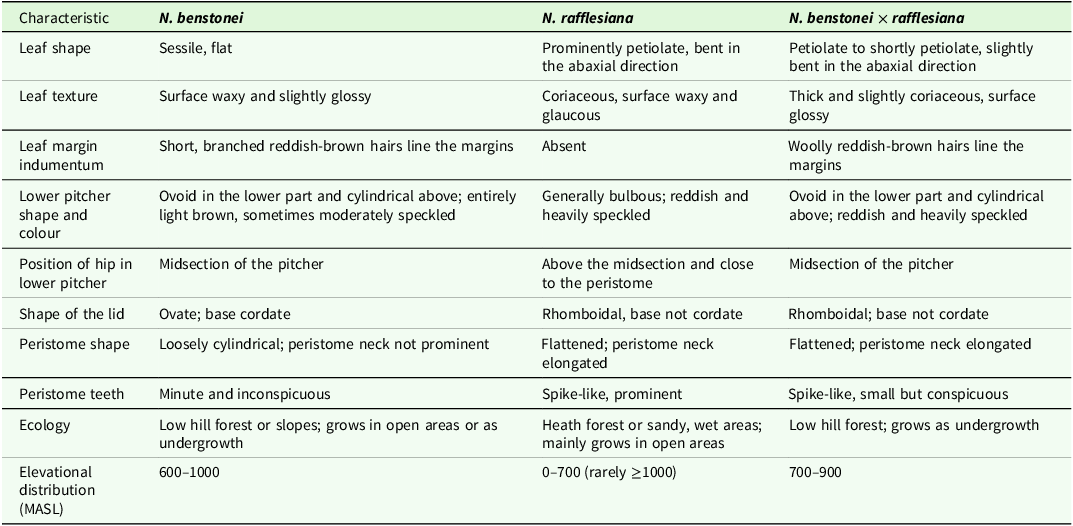
All observed specimens grew terrestrially among leaf litter on humus-rich soil without climbing stems, and their compact stature is due to short internodes (Figure 3a). This growth habit, combined with their glossy brownish-green leaves, rendered the hybrid particularly inconspicuous in its natural habitat (Figure 3b). The hybrid exhibited a distinct blend of traits from its putative parental species, with some characteristics appearing intermediate or diluted (Figure 4). From N. rafflesiana, it inherited sub-petiolate to petiolate, slightly curved leaves, and spine-like peristome teeth; from N. benstonei, it had small pitchers (∼10 cm) and bore brownish indumentum along the leaf margins (Figures 3b and 4c). Interestingly, N. benstonei × rafflesiana featured woolly brown hairs lining the margins, in contrast to the short hairs observed in N. benstonei. Upper pitchers and inflorescences could not be documented, as all observed specimens lacked climbing stems or had not yet begun to produce them; they appeared to be in a juvenile growth stage. This incomplete developmental representation currently limits the full morphological characterisation of this natural hybrid, and future studies should gather additional data. The known characteristics of N. benstonei × rafflesiana and its putative parental species are compared in Table 1.
Habit of N. benstonei × rafflesiana: (a) the plant grows as low undergrowth, with individuals sparsely distributed from one another; (b) a close-up of the plant showing glossy brownish leaves, leaf margins with brown hairs (enlarged inset), and blotched lower pitcher.

Morphological comparison of the Nepenthes hybrid and its putative parental species showing variation in leaf and pitcher characteristics. (a–c) Leaf blades with margin details (insets): (a) Nepenthes benstonei showing brownish hairs; (b) N. rafflesiana with glabrous margin; (c) N. benstonei × rafflesiana exhibiting woolly brownish hairs. (d–f) Pitchers with detailed peristome structures (insets): (d) Nepenthes benstonei having a narrow peristome with minute triangular teeth; (e) N. rafflesiana with a broad peristome lined with spike-like teeth; (f) N. benstonei × rafflesiana showing a slightly broadened and flattened peristome, serrated with fine spike-like teeth.

Main morphological differences between the hybrid N. benstonei × rafflesiana and its putative parental species. These characteristics are based on the individuals occurring at the type locality of the natural hybrid and other locations within the Timur Range

Nepenthes benstonei is an intermediate-highland species occurring east of the Titiwangsa Range and is endemic to Peninsular Malaysia (Figure 5). In contrast, N. rafflesiana is distributed primarily across Peninsular Malaysia’s lowlands, particularly along the east coast, southern region, and west coast (Tamizi et al. Reference Tamizi, Mohamad, Shakri, Mohd-Rusli, Mat-Amin and Mohamad-Jamali2023). Their distinct altitudinal preferences limit natural overlap to just one documented location—the discovery site of the hybrid, N. benstonei × rafflesiana. Given the conservation concern of this hybrid, its precise locality has been withheld in this article. The conservation status of N. benstonei × rafflesiana has been assessed as Data Deficient (DD); nonetheless, we propose an Endangered (EN) status based on the IUCN Red List Categories and Criteria (IUCN, 2012) due to the limited number of individuals (fewer than ten individuals observed) and its highly localised occurrence at 700–900 MASL within the Timur Mountain Range.
Topographic map of Peninsular Malaysia showing the three major mountain ranges: the Bintang Range (northwest), the Titiwangsa Range (central spine), and the Timur Range (east). The enlarged inset highlights the highland areas within the Timur Range, which spans the east coast states of Kelantan, Terengganu, and Pahang. Red circles denote documented occurrences of N. benstonei populations, as recorded during our field surveys across multiple sites in the Timur Range. Map generated using CalTopo (https://caltopo.com) with elevation data from various Digital Elevation Model (DEM) sources, including Kartverket, the National Land Survey of Iceland, and AW3D30 data courtesy of the Japan Aerospace Exploration Agency (JAXA).

Discussion
The phenomenon of UV-induced fluorescence in carnivorous plants—potentially functioning as a biosignalling mechanism to attract prey—has garnered growing interest, yet remains poorly studied. Kurup et al. (Reference Kurup, Johnson, Sankar, Hussain, Sathish Kumar and Sabulal2013) proposed that the blue fluorescence observed in the traps of Nepenthes (tropical pitcher plants), Sarracenia (the North American pitcher plants), and Dionaea (the Venus fly traps) may serve as a visual attractant for insects. This idea, however, was contested by Golos (Reference Golos2020), the researcher who later first discovered blue fluorescence in Heliamphora (sun pitcher plants). The author argued that ‘temporal blue fluorescence’ did not play a role in attracting ants, the primary prey of Heliamphora, a proposition that might also apply to other blue-fluorescing carnivorous plants—including those studied by Kurup et al. (Reference Kurup, Johnson, Sankar, Hussain, Sathish Kumar and Sabulal2013).
To address this disparity in views, reports of autofluorescence and its underlying mechanisms in other plant systems may offer a useful basis for evaluating its potential role in Nepenthes. The following studies highlight the different ecological roles of plant fluorescence across different species and contexts. Peng et al. (Reference Peng, Zhao, Xiang, Li, He, Huang, Bao, Wang, Zhu, Larkin, Luo and Ning2022) engineered tobacco plants to emit green biofluorescence and found that the tobacco cutworm (Spodoptera litura) exhibited a higher feeding preference for biofluorescent leaves, suggesting a potential role in herbivore attraction. In a separate context, Mori et al. (Reference Mori, Fukui, Oishi, Sakuma, Kawakami, Tsukioka, Goto and Hirai2018) examined the compounds responsible for autofluorescence in floral structures and observed that honeybees were attracted to blue fluorescence, indicating its relevance in pollinator behaviour. Meanwhile, Baby et al. (Reference Baby, Johnson, Govindan, Lukose, Gopakumar and Koshy2013) described blue fluorescence in the reproductive structures of grasses as a possible attractant for a broader range of organisms, including pollinators, predators, and pests. In low-light environments such as dusk, moonlight, or shaded habitats, residual UV light persists (Negelspach et al. Reference Negelspach, Kaladchibachi and Fernandez2018), and plant fluorophores can convert these photons into visible green light that enhances signal conspicuity against a dark background. These fluorescence-based cues may be detected by crepuscular and nocturnal insects, as reported for moths (Lepidoptera) and stinkbugs (Verada), which strongly respond to UV and green wavelengths (Endo et al. Reference Endo, Hironaka, Honda and Iwamoto2022; Martín-Gabarrella et al. Reference Martín-Gabarrella, Gemeno and Belušič2023). Collectively, these studies support the idea that plant biofluorescence does play a role in attracting insects for ecological interactions, and a similar function may be inferred for the green biofluorescence observed in N. benstonei × rafflesiana. In the past, Moran (Reference Moran1996) and Moran et al. (Reference Moran, Booth and Charles1999) reported that the peristome of Bornean N. rafflesiana demonstrated pronounced visual contrast with the pitcher body across the UV, blue, and green wavebands. However, the papers did not explicitly document or depict the occurrence of visible blue or green fluorescence as observed in our study.
The specific fluorophores or metabolites responsible for fluorescence in carnivorous plants remain uncharacterised and warrant further investigation. As mentioned earlier, natural fluorescence in terrestrial plants is mostly due to small molecules and pigments (Donaldson Reference Donaldson2020), with no evidence that endogenous proteins contribute to vibrant fluorescence—a notable contrast to marine animals, which predominantly employ fluorescent proteins (FPs) to glow under UV excitation (Poding et al. Reference Poding, Jägers, Herlitze and Huhn2024). A number of well-studied plant compounds, such as alkaloids, anthocyanins, flavonoids, and riboflavin, are known to fluoresce in the blue-green to yellow-green range (500–600 nm) (Donaldson Reference Donaldson2020). It is highly possible that one or more of these cause the green glow seen in the peristomes of N. benstonei × rafflesiana. Dávila-Lara et al. (Reference Dávila-Lara, Reichelt, Wang, Vogel and Mithöfer2021) confirmed that several Nepenthes species specifically accumulate anthocyanin derivatives in their peristomes, which may be linked to the vibrant green fluorescence observed during our field study.
While plant-derived compounds are likely responsible for the observed fluorescence, the possibility of microbial involvement should not be discounted. According to Ganeshan and Manoj Kumar (Reference Ganeshan and Manoj Kumar2005), some epiphytic microorganisms induce metabolic changes in their host plants that could improve or alter the synthesis of fluorophores in plants (Gaube et al., Reference Gaube, Marchenko, Müller, Schweiger, Tenhaken, Keller and Junker2023). Nevertheless, direct in situ evidence linking microbes to visible autofluorescence on plant surfaces is still limited. Visible UV-induced fluorescence has so far only been recorded in lab-grown pure cultures of fluorescent microbes. This includes the Pseudomonas fluorescens species complex—a well-studied group of Gram-negative pseudomonads commonly isolated from rhizosphere, phyllosphere, and endosphere microhabitats (Hanifah et al. Hanifah et al. Reference Hanifah, Ghadamgahi, Ghosh, Ortiz, Whisson, Vetukuri and Kalyandurg2023, Taylor et al. Reference Taylor, Silby and Jackson2025). Instead of influencing phytocompounds, this group of microbes produces an iron-scavenging siderophore called pyoverdine, which fluoresces green under UV light (Meyer Reference Meyer2000, Taylor et al. Reference Taylor, Silby and Jackson2025). In the case of N. benstonei × rafflesiana, it is possible that fluorescent pseudomonads or other microbial species have colonised the peristome (either on or below the surface). Fluorescent pseudomonads, in particular, are known to be associated with nectar (Álvarez-Pérez et al. Reference Álvarez-Pérez, de Vega and Herrera2013) and may benefit from the extrafloral nectar secreted by this trap structure. This, however, raises another question: why does only the hybrid specifically harbour a concentrated amount of green-fluorescent microbes while the other two species do not? This difference is worth investigating.
Hybridisation causes genetic changes that manifest as varying phenotypes, such as novel fluorescence patterns, and this offers another perspective pertaining to the unique trait of N. benstonei × rafflesiana. A transgressive trait is one of the phenotypic outcomes in hybrid offspring (the other two being incomplete dominance and codominance). Such a trait falls outside the phenotypic range of the parental species and can be either more advantageous or less favourable than those of the parents (Koide et al. Reference Koide, Sakaguchi, Uchiyama, Ota, Tezuka, Nagano, Ishiguro, Takamure and Kishima2019) and may contribute to the emergence of evolutionary novelty and early speciation (Dittrich-Reed and Fitzpatrick Reference Dittrich-Reed and Fitzpatrick2013). It is interesting to note that hybridisation between compatible species is relatively common across the kingdoms of life, including members of the genus Nepenthes, and has played a key role in enhancing the adaptability of hybrid offspring to changing environments (Armarego-Marriott Reference Armarego-Marriott2024, Peñalba et al. Reference Peñalba, Runemark, Meier, Singh, Wogan, Sánchez-Guillén, Mallet, Rometsch, Menon, Seehausen and Kulmuni2024, Scharmann et al. Reference Scharmann, Wistuba and Widmer2021, Stelkens and Seehausen Reference Stelkens and Seehausen2009). Multiple underlying mechanisms, including sequence recombination, epigenetic modifications, gene positional effects, transposable element activity, and novel interactions between regulatory elements and non-coding genomic regions, contribute to the dynamic regulation of gene expression that shapes transgressive traits (Peñalba et al. Reference Peñalba, Runemark, Meier, Singh, Wogan, Sánchez-Guillén, Mallet, Rometsch, Menon, Seehausen and Kulmuni2024). The intense green fluorescence observed in N. benstonei × rafflesiana (Figure 1) may represent a case of transgressive phytochemical phenotype, as it markedly exceeds the fluorescence characteristics of its putative parents. While both parental species exhibited uniform blue fluorescence, N. rafflesiana additionally showed faint and scattered yellow-green streaks along its peristome (Figure 2), suggesting that the hybrid’s vivid green emission could result from novel interactions between the inherited traits from both parent species at the genetic level. To date, transgressive fluorescence in terrestrial plant hybrids has not been documented; however, its occurrence cannot be entirely ruled out. This is especially plausible since transgressive pigmentation patterns have been observed in interspecific hybrids of Nicotiana (tobacco plants), Ruellia (wild petunias), and Mimulus (monkeyflowers), which exhibit visually distinct floral traits absent from both parents (McCarthy et al. Reference McCarthy, Arnold, Chittka, Le Comber, Verity, Dodsworth, Knapp, Kelly, Chase, Baldwin and Kovařík2015, Simmons et al. Reference Simmons, Cooley, Puzey and ConradiSmith2023, Zhuang and Tripp Reference Zhuang and Tripp2017). These cases demonstrate how hybridisation may activate or amplify previously unexpressed visual traits or other unbeknownst characteristics that could enhance the colonisation of fluorescent microflora as proposed earlier.
Further studies are needed to fully characterise N. benstonei × rafflesiana, as the upper stems and floral structures have not been confirmed. All individuals observed in the wild appeared to be juveniles, and the observations were limited to populations near accessible trails; future studies may uncover more mature individuals in less disturbed areas. It is known that certain species (such as N. attenboroughii and N. rajah) preferentially produce non-climbing stems that trail on the ground or scramble over low vegetation (Robinson et al. Reference Robinson, Fleischmann, Mcpherson, Heinrich, Gironella and Peña2009). Since this growth habit might have been overlooked during the last field survey, it should be taken into consideration when interpreting the form of N. benstonei × rafflesiana.
Most montane Nepenthes species (including intermediate–highland taxa) have highly restricted distributions, with several being ultra-endemic to isolated montane ecosystems, as they rely on cooler high-elevation climates to thrive (Mohd Zubir et al. Reference Mohd Zubir, Joseph, Makbul and Godoong2024, Tamizi et al. Reference Tamizi, Mohamad, Shakri, Mohd-Rusli, Mat-Amin and Mohamad-Jamali2023). These environmental constraints restrict their range and reduce the likelihood of natural overlap with species from lower elevations. The green fluorescent hybrid is a result of a rare interaction between a primarily lowland species (N. rafflesiana) and an intermediate–highland species (N. benstonei), each belonging to distinct phylogenetic clusters (Tamizi et al. Reference Tamizi, Ghazalli, Nikong, Besi, Mat-Esa, Mohd-Nordin, Latiff and Shakri2020). It remains unclear whether the occurrence of N. benstonei × rafflesiana is due to direct human disturbance or part of natural processes—such as altered pollinator behaviour, shifting climate conditions, or gradual range expansion and collision (Chase et al. Reference Chase, Paun and Fay2010, Song and Zhou Reference Song and Zhou2025). The studied hybrid is a cross between species from different elevational niches, which may confer enhanced fitness that could buffer against climate warming or potentially facilitate new lineage formation (Scharmann et al. Reference Scharmann, Wistuba and Widmer2021). However, its ability to reproduce sexually via seeds and its potential to persist and displace local parental species remain uncertain and require further investigation, as hybrid fertility is often variable. Although the population occurs within a protected forest reserve with minimal anthropogenic pressure, future threats such as drastic habitat alteration and climate change could still affect both the hybrid and its parental species. Its rarity and uniqueness therefore warrant continued monitoring and targeted conservation efforts. Recent efforts by local universities and government agencies have renewed interest in Nepenthes, making them one of the key subjects of exploration and targeted conservation (Rawi and Shahrudin Reference Rawi and Shahrudin2021, Tamizi et al. Reference Tamizi, Mohamad, Rahman, Mustafa, Hamdin and Zakaria2025, Yahya et al. Reference Yahya, Hassan, Abdullah, Wahid, Khalid, Ramuddin and Abdullah2021). Several species, including N. benstonei, have already been included in the Malaysia Red List: Plants of Peninsular Malaysia (Yong et al. Reference Yong, Khairi, Cheah, Yao, Chew, Siti-Munirah, Julius, Phoon, Sam, Nadiah, Ong, Sarah-Nabila, Suhaida, Muhammad-Alif Azyraf, Siti-Eryani, Yap, Jutta, Syazwani, Norzielawati, Kiew, Chung, Chua and Lau2021), and we call for the assessment and potential inclusion of more montane species and natural hybrids.
In view of this hybrid’s restricted distribution, incomplete fertility data, and ecological distinctiveness, an ex situ conservation measure should be considered to support its survival. Vegetative propagation is regarded as a practical and useful technique to create clones for conservation purposes since only a few individuals were discovered. In a recent study, a shoot-based propagation method was developed for N. mirabilis × rafflesiana (Tamizi et al. Reference Tamizi, Mohamad, Rahman, Mustafa, Hamdin and Zakaria2025), and the same approach is intended to be applied to N. benstonei × rafflesiana. Additionally, DNA barcoding and sequence analysis can be used to determine its genetic affinity and infer its phylogenetic position among Peninsular Malaysian taxa, providing further support for its taxonomic classification.
Conclusion
In summary, this preliminary documentation of the green-fluorescent Nepenthes and its classification as a previously undescribed taxon represents novel contributions to scientific knowledge, particularly within the realm of carnivorous plants. The discovery emphasises the natural richness of the Peninsular Malaysian rainforest and the urgent need to preserve its vital ecosystems, which harbour understudied and fascinating biodiversity. Although the use of fluorescence as a cue in ecological interactions has been studied in various animals and several plants, the precise molecular mechanisms, biochemical reactions, and the specific role of green biofluorescence in carnivorous plants remain largely unresolved. This study opens new avenues for investigating the fluorophores responsible for the vibrant green autofluorescence at both genetic and metabolic levels, elucidating the roles of biofluorescence (particularly in prey attraction and behaviour), and evaluating its taxonomic implications for Nepenthes identification.
Acknowledgements
This paper is part of a decade-long study on Nepenthes in Peninsular Malaysia, conducted by the Biotechnology and Nanotechnology Research Centre, MARDI, that includes visits to protected forest reserves. These reserves were accessed under the following non-exhaustive list of permits (or reference numbers): JH100/Jld.34(74), PHN.KN.130/1/9J10(38), PHN.Kn.66/3/72. J7(04), PHD.KK.600/03/12JLD.13(243,244), PHNT.100/58/2/33(25), PHDTU.1/3/175BHG.16, PHDTU.1/3/175BHG.18, 22EWTR0500197, and 22EYTR0500254. We would like to express our gratitude to the Forestry Department of Peninsular Malaysia (FDPM), the Johor State Forestry Department, the Kelantan State Forestry Department, and the Terengganu State Forestry Department for their guidance and approval in the issuance of the permits.
Financial support
This work was supported by the Pemacu Pertanian 2025 Research Grant [Grant number K-RBNA1-1001-KSR999 (02)].
Competing interests
The authors declare that they have no competing interests.
Declaration of an AI-assisted technology utilisation
During the preparation of this manuscript, ChatGPT (a language model by OpenAI) was utilised exclusively to refine the language and enhance readability. The authors conducted a thorough review and made necessary revisions, assuming full responsibility for the final content.