The World Health Organization defines health and well-being as “a state of complete physical, mental and social well-being and not merely the absence of disease or infirmity”.1 The mandate of the World Health Organization is to develop the science of primary prevention and primary health care. Some individuals in the western world continue to speak of the burden of disease, and use the presence or absence of disease as a marker of the health and well-being of nation states.2 If health and well-being is to be defined as more than the absence of disease, then psychological, social, and spiritual well-being must also be included in the indices of health.
Health and well-being, according to the definition of the World Health Organization, is not only a biophysical concept. It is also a philosophical concept that includes the mind, the body, and their interconnectedness. It is a dynamic process that changes over time. It is about an individual, and how that individual engages in living, physically, intellectually, psychologically, socially, and spiritually.
The mandate of the team organising the clinics for adults with congenitally malformed hearts at the Peter Lougheed Hospital, Calgary, Alberta, Canada, is to assess and intervene on biophysical, intellectual, psychological, social and spiritual complications of their disease in order to promote health and well-being. The team consists of three cardiologists who specialize in congenital cardiac disease, one full-time nurse, one part-time nurse, and a social worker. The team has formal links to specific resources within the Calgary Health Region. In the population served, health and well-being can be achieved and maintained despite living with the constant uncertainty of a chronic disease superimposed on the issues of everyday life. Patients ask many questions related to their health and well-being such as whether they will have complications after reparative or palliative surgery, whether the results of surgical procedures will last 3 years or 10 years, and whether they will have to undergo repeated surgical procedures. It is difficult to answer these questions with any degree of certainty.
Other questions that are frequently asked about issues of life affecting adults include whether they can have children, what will happen if they decide to become pregnant, what are the risks of pregnancy, what are the chances of having a baby with a cardiac defect, and will they live a normal life span. They ask how they will be able to support their family if they get sick, and require time off work for repeated surgery. In order to assist adults with congenitally malformed hearts to achieve and maintain health, the health professionals at the Adult Congenital Heart Clinic attempt to address all concerns expressed by the patients, whether they fall in the biophysical, intellectual, psychological, social, or spiritual realm.
Historically, investigators conducting research in adults with congenital heart disease have used instruments that measure psychological dysfunction, such as depression, anxiety, behavioural problems, and poor psychosocial functioning.Reference Horner, Liberthson and Jellinek3–Reference Utens, Versluis-Den Bieman, Verhulst, Meijboom, Erdman and Hess7 Psychological well-being, if commented on, has been viewed as being inversely proportional to psychological dysfunction. With the development of Ryff’s psychological well-being scale, there is now an opportunity to evaluate psychological well-being by measuring each of six dimensions of psychological well-being, rather than measuring psychological dysfunction, or using the absence of psychological dysfunction as a measure of psychological well-being.Reference Ryff8–Reference Ryff and Singer10 Understanding the relationship between psychological well-being and the complexity of congenital cardiac disease will assist the team in developing clinical interventions to promote health and well-being in the psychological domain.
Methods
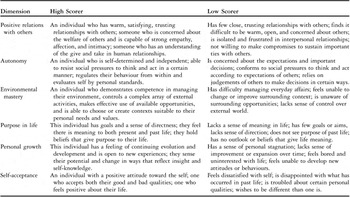
We used the survey method to examine the six dimensions of psychological well-being in two groups of adults with congenital heart disease, those with simple and those with complex malformations. The questionnaire used in the survey has 96 items in total, and was subdivided into 2 sections. The first section consisted of 12 socio-demographic items, which were developed from the literature, discussion with colleagues in the Adult Congenital Heart Clinic, and the clinical experience of one of the investigators (YB). A review of face and content validity was completed by two of the investigators with expertise in designing questionnaires (JR & KT). The second section of the questionnaire consisted of Ryff’s scale of psychological well-being.Reference Ryff8 The tool has six subscales, each with 14 items, giving a total of 84 items. The six subscales measure the following dimensions: positive relations with others, autonomy, environmental mastery, personal growth, purpose in life, and self-acceptanceReference Ryff8 (see Table 1). Responses to each item are made on a 6-point scale, where 1 equals strongly disagree and 6 equals strongly agree, with 40 items being reverse scored. The range in scores possible for one dimension of psychological well-being is from 14 to 84. Correlations of the psychological well-being scale developed by Ryff with prior measures of positive functioning, such as happiness, life satisfaction, affect, self-esteem, internal control, and morale, showed positive and significant (p less than 0.001) coefficients ranging from 0.25 to 0.73. Correlations with prior measures of negative functioning showed negative and significant (p less than 0.001) coefficients ranging from −0.30 to −0.60.Reference Ryff8
The six dimensions of psychological well-being based on Ryff’s scale.

If a patient had not responded to an item in one dimension of psychological well-being, the questionnaire of that patient was excluded from the mean group score for that dimension of psychological well-being. For example, if a patient had completed all the items relative to the dimension of autonomy but not self-acceptance, that questionnaire would be used to compute the mean group score for autonomy, but not the mean group score of self-acceptance. The complexity of structural heart disease was determined by using the classication proposed following the 32nd Bethesda Conference.Reference Warnes, Liberthson and Danielson11
Recruitment and size of sample
Patients were recruited from the adults with documented congenital cardiac disease registered on the database of the clinic. In order to ensure the most variability between the two groups, we chose patients with simple and complex congenital cardiac disease as defined following the 32nd Bethesda Conference.Reference Warnes, Liberthson and Danielson11 All patients who participated in the study were recruited by postal mail-out.
A systematic search of Academic Search Premier, CINAHL, EMBASE, Medline, HealthSTAR, PsychINFO yielded no prior study in the literature that measured psychological well-being in two groups of patients upon which to base a calculation of required size for the samples. It was decided to recruit as many patients as possible that fit the criteria from the database. At the time of the study, we were following 553 such patients fitting the classification for simple disease,Reference Warnes, Liberthson and Danielson11 from which we selected a random sample. Since there were only 175 listed patients with complex disease, all were given the opportunity to participate in the study. A total of 85 patients with simple disease, and 78 with complex disease, returned completed questionnaires. Patients who were developmentally challenged and unable to complete the questionnaire were excluded from the study.
Ethical approval
Permission to approach the patients, and access to the database, was received from the directors of the Adult Congenital Heart Clinic. In addition, permission was obtained through the appropriate committees of the University of Calgary and the Calgary Health Region, Calgary, Alberta, Canada.
Results
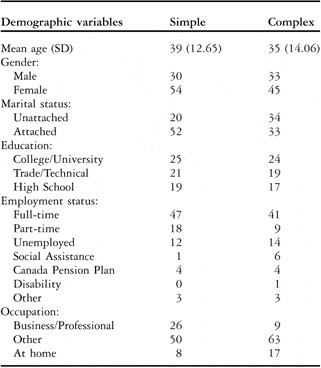
A total of 85 out of 205 patients with simple disease, and 78 of 175 patients with complex disease, returned completed questionnaires, giving responses of 41%, and 45%, respectively (Table 2).
Characteristics of groups.

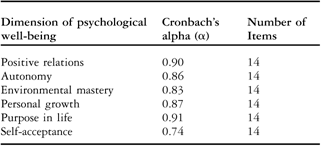
The patients ranged in age from 18 to 87 years. The mean age for all patients was 37 years, with a standard deviation of 13.4. The mean ages for those with simple and complex diseases were 39, and 35, years respectively. Reliability coefficients for the sample were acceptable, and ranged from 0.74 to 0.91 (Table 3).
Cronbach’s alpha.

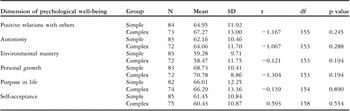
As may be seen from Table 4, there was no statistically significant difference in the mean scores of each of the six dimensions of psychological well-being between those patients with simple and complex disease.
Mean dimension score by simple/complex group.

Socio-demographic variables
Two-way Analysis of Variance and Univariate Analysis of Variance found significant differences in mean dimension scores when factoring in demographic variables.
Age
The original validation study compared young adults aged from 18 to 29 years, adults in midlife from 30 to 65 years, and senior adults aged 65 years and over, showing that the older the respondent, the higher the score for environmental mastery and autonomy, and the younger the respondent, the higher the score for purpose in life and personal growth.Reference Ryff8 In order to make comparison to the age groups used in the original validation study, we used the same three age groups in this study. We failed to find any significant effect of age, complexity, or age by group interaction effect on the mean scores for any of the dimensions. Although the range in age for this study was 18 to 87 years, three-quarters of our patients were between the ages of 26 and 46 years. This may have contributed to the absence of age-related changes. A replication study comparing patients with simple and complex disease to a healthy age-matched peer group would help to clarify the reason for the absence of an age effect in our study.
Gender
As had been found in the original validation study, we showed that there was a significant gender effect on the mean score for the dimension of positive relations with others, with females scoring significantly higher than males (F (1,152) = 9.41, p = 0.003).Reference Ryff8 There was no significant gender effect on the mean score for the other dimensions. Multivariate analysis to control for three age groups found that the p value was very close to statistical significance for gender effect (Wilk’s Lambda λ = 0.911, F (6,133) = 2.159, p = 0.051). There was no significant effect of complexity (Wilk’s Lambda λ = 0.949, F (6,133) = 1.87, p = 0.317), and no significant interaction effect between gender and complexity (Wilk’s Lambda λ = 0.930, F (6,133) = 1.673, p = 0.132).
Marital state
Of the 161 patients who responded to this question, 85 (53%) were married or living together in common law. There were more patients with simple (62%) than complex (43%) disease who were married or living together in common law. For purpose of analysis, relationships were divided into two categories: attached and unattached. Those patients who were attached had significantly higher mean dimension scores for the dimensions of environmental mastery (F (1,149) = 7.009, p = 0.009), purpose in life (F (1,150) = 5.179, p = 0.024), and self-acceptance (F (1,154) = 4.536, p = 0.035) for all patients with congenital cardiac disease.
Education
Of the 78 patients with complex disease, 24% had a trade/technical diploma and 31% had a university degree, compared to the 85 patients with simple disease of whom 25% had a trade/technical diploma and 33% had a university degree. Both groups of patients who had gone on to attain a technical diploma or university degree had significantly higher mean scores on four of the six dimensions than those who had completed high school only (positive relations with others [F (2,148) = 3.219, p = 0.043], personal growth [F (2,148) = 8.846, p < 0.001], purpose in life [F (2,147) = 4.925, p = 0.009] and self-acceptance [F (2,151) = 5.335, p = 0.006]. The mean scores for the other two dimensions, autonomy and environmental mastery, did not meet statistical significance.
The total number of patients with simple and complex disease who had completed either a technical diploma or university degree was 46 compared to 43. There was no significant difference found in mean scores of psychological well-being and level of education attained between these patients.
In order to measure the impact of age and level of education attained on the mean dimension scores of psychological well-being, we divided the patients into the three age groups. Multivariate analysis showed a significant group effect (Wilk’s Lambda λ = 0.802, F (12,258) = 2.506, p = 0.004), but no effect of complexity or interaction effect among these variables.
Employment
For the purposes of analysis, patients were considered to be employed, not employed, or to have other sources of income. Of the 115 patients responding to this question, the majority were working either full-time or part-time (70%). Of those working full-time, 52% had simple, and 48% had complex disease. Of those working part-time, 15% had simple and 85% had complex disease. A total of 9 patients with simple disease, and 12 with complex disease, were on some form of guaranteed income supplement or disability insurance.
For those patients who were employed, the mean dimension scores were significantly higher for environmental mastery [F (2,150) = 4.597, p = 0.012], personal growth [F (2,150) = 5.859, p = 0.004], purpose in life [F (2,149) = 9.998, p < 0.001], and self-acceptance [F (2,154) = 4.660, p = 0.011]. There was no significant difference in mean dimension scores of psychological well-being and employment between those having simple or complex disease. While controlling for the three age groups, multivariate analysis found no significant group effect of any variable.
Health rating
The majority of patients (90%) rated their health as excellent to good. Of the 48 patients with simple disease who responded to question, 57% rated their health as excellent, 33% rated their health as good, and 10% rated their health as fair to poor. Of the 78 patients with complex disease who responded, 50% rated their health as excellent, 39% rated their health as good, and 11% rated their health as fair to poor. For statistical analysis, we collapsed the health ratings into excellent, good, and fair to poor. There was a significant effect on the mean dimension scores for environmental mastery [F (2,149) = 10.660, p < 0.001], personal growth [F (2,149) = 5.892, p = 0.003], purpose in life [F (2,148) = 13.077, p < 0.001], and self-acceptance [F (2,153) = 7.491, p = 0.001] between patients who rated their health as excellent as compared to those patients who rated their health as fair to poor.
Spirituality
There was a significant difference in the mean environmental mastery score between those patients who believed spirituality to be an important part of their lives and those who did not [F (1,142) = 13.250, p < 0.001]. Those with complex disease had a significantly higher mean self-acceptance score [F (1,146) = 16.042, p < 0.001] if they believed spirituality was an important part of their life. There was also a significant interaction effect on the mean autonomy score [F (1142) = 8.643, p = 0.004] between spirituality and those patients with simple and complex disease. We anticipated a significant difference in the mean purpose in life score between those with simple as opposed to complex disease, but this was not found.
Discussion
It is anticipated that 85% of children born with congenitally malformed hearts will survive to adulthood. Much of the medical management of this population, therefore, is now focused on promoting health and well-being.Reference Warnes, Liberthson and Danielson11 It is the connection between the dimensions of psychological well-being and the lens through which patients view their life that combine to inform the individual differences in response to the challenges of lives.12 The results of our study indicate that adults living with congenitally malformed hearts are responding to the challenges of life, and enjoying a high level of psychological well-being. Factors other than the complexity of structural congenital heart disease will affect psychological well-being. Quality relationships with others affect individual happiness and well-being.Reference Popelová, Slavik and Škovránek5, Reference Utens, Versluis-Den Bieman, Verhulst, Meijboom, Erdman and Hess7, Reference Ryff8, Reference Wray and Sensky13 Our study shows that quality relationships are important to psychological well-being. Financial security is an important determinant of health.Reference Stephens, Dulberg and Joubert14, 15 Education and employment contribute to financial security, and we suggest this may significantly influence psychological well-being.
Studies conducted previously on children with congenitally malformed hearts found that complexity predisposed such persons to poor success at school, and that complexity continues to affect cognitive and academic performance even after surgery.Reference Kokkonen and Paavilainen16–Reference Wernovsky, Stiles and Gauvreau18 Our findings in adults with congenital cardiac disease would suggest that, by adulthood, there is no difference between those with simple and complex disease with respect to level of education attained.
The process of preparing for further education and a particular career or profession begins well before 18 years of age. It is the responsibility of both paediatric and adult clinicians to collaborate with parents, educators, and community partners to ensure the young adult with a congenitally malformed heart makes appropriate choices regarding education and careers in anticipation of future health concerns. Our results highlight the importance of education and employment on psychological well-being. This underscores the need for the team to be sensitive to requests for coordinated medical tests and visits to minimize disruptions to school or work schedules.
Spiritual well-being may be an important internal resource for persons forced to adjust to the uncertainty of a chronic illness.Reference Landis19 Our results showed that those patients with complex disease who believed spirituality to be an important part of their life were more accepting of themselves and their life challenges.
It will be recalled that a total of 85 out of 205 patients with simple disease, and 78 out of 175 patients with complex disease, returned completed questionnaires. Of the 383 patients mailed questionnaires, 56 did not receive the questionnaire due to changes of address or, unfortunately in a few cases, the patients had died.
Another difficulty that was encountered during collection of data was that many of the patients with patency of the oval foramen were told on assessment at the clinic that their anatomy was a variant of normal. It had been detected because of the sensitivity of new technology but was not now, nor likely would it ever cause them any specific problems. They should consider themselves normal and live a full and active life with no restrictions. Telephone calls were received from these patients to say they were told they were “normal” and therefore they felt they should not participate in the study. It is reassuring to know that these patients are getting the appropriate message from the clinic. These patients, however, are under-represented in this study. According to the criteria of the 32nd Bethesda Conference, patency of the oval foramen falls into the classification of a simple disease, and as such these patients need to be included in research.Reference Warnes, Liberthson and Danielson11
The second section of the questionnaire was Ryff’s psychological well-being scale, which is an instrument used to measure psychological well-being.Reference Ryff8 The reliability and validity of this instrument has been tested in adults of various ages.Reference Ryff8 We used the same age groups as the original validation study. As the number of adults with complex disease living to 65 years or over is limited, it is difficult to obtain an appropriate sample in this category in order to conduct meaningful statistical analysis.
Psychological research in adults with congenital cardiac disease has only recently begun to appear in the literature. These studies have used instruments to measure psychological pathology and quality of life and equated the absence of psychopathology and/or quality of life as a measure of psychosocial well-being.Reference Horner, Liberthson and Jellinek3–Reference Utens, Versluis-Den Bieman, Verhulst, Meijboom, Erdman and Hess7, Reference Simko and McGinnis20–Reference Rose, Köhler, Köhler, Sawitzky, Fliege and Burghard23 In our study, we used an established instrument to measure psychological well-being. The research on psychological well-being in chronic illness suggests that high scores in the six dimensions of psychological well-being may reduce the incidence of psychological dysfunction in chronic illness. Congenital cardiac disease is a chronic illness. It is therefore incumbent upon those working with patients having such disease to examine ways of assessing and intervening on dimensions of psychological well-being in order to prevent psychological dysfunction over the entire trajectory of the illness.
In previous quality of life studies in patients with congenital cardiac disease, the Functional Classification of the New York Heart Association, or the Ability Index, have been used to classify patients according to complexity.24, Reference Somerville25 The Functional Classification is reliable and valid, albeit designed for use in patients with ischaemic heart disease and congestive heart failure. The Ability Index was developed for use in those with congenital cardiac disease, but to date, there is no evidence to support its reliability and validity.
The classification of congenital cardiac disease proposed at the 32nd Bethesda Conference, and used in our study, is the universal classification system developed specifically for use in these patients. It is well published and well recognized around the world.Reference Ryff and Keyes9 Assigning patients to groups according to structural complexity based on a recognized system allows for consistency in comparison with future research findings.
Recommendations for future research include a national study on psychological well-being to be conducted at multiple congenital cardiac disease clinics, a replication study to compare patients with simple and complex disease to a healthy peer group, and a pilot study on psychological well-being in other chronic diseases to look for similarities and differences among such patients. If similarities are found, it may provide the incentive to create new programmes and possibly even share multidisciplinary resources.
Limitations
Our sample is larger that those used previously.Reference Horner, Liberthson and Jellinek3–Reference Spurkland, Bjornstad, Lindberg and Seem6, Reference Simko and McGinnis20–Reference Cox, Lewis, Stuart and Murphy22 The generalizability of our results, nonetheless, is somewhat limited in that it was conducted at one clinic. One way to increase the sample, and strengthen the results, would be to replicate the study in multiple centres, either nationally or internationally.
One difficulty that arose from conducting this study was that our current data base was not always up to date with respect to addresses and current state of health. In addition, it is difficult to maintain a current data base when dealing with a young, mobile, population of adults, where there are frequent relocations. While it may be difficult to control for every eventuality with respect to changes in the data base, such as mortality, certain actions could be taken, such as, ensuring that the documentation is current with the information on the data base, for example with change of address.
Anecdotal clinical evidence would indicate that many of the patients are “working poor”. Although 70% of our patients reported they are employed either full or part-time, this does not necessarily mean that they are able to make ends meet, or that they can support themselves should they be hospitalized with complications. In retrospect it would have been helpful to have included an item on financial income in the demographic section of the questionnaire. This may have provided a clearer picture of the issues surrounding education and employment.
Conclusion
Traditional medicine continues to be very effective in developing surgical therapies to prolong and improve the life of those born with congenitally malformed hearts. Therapies that focus on improving physical outcomes alone, however, do not necessarily improve psychological well-being. We have found that psychological well-being in those with congenitally malformed hearts is much more dependent on those very factors that provide meaning and purpose in life. We recommend that clinicians who manage young adults with congenital cardiac disease be aware of these factors, and consider the World Health Organization definition of health and well-being in clinical decision making and planning of health services to meet the needs of this patient population.1 Given the excellent results of new surgical procedures for children born with congenitally malformed hearts, their care should be viewed within the context of a long and productive life. Clinical decision making and planning of health services should be guided by a continuum of transitional care.
Acknowledgements
This project was funded in part by the Canadian Council of Cardiovascular Nurses of Alberta, NWT & Nunavut. We thank Dr. Carol Ryff, University of Wisconsin, Institute of Aging, Madison, Wisconsin, USA for use of the scale of psychological well-being. We are especially grateful to those patients who participated in the study.