1. Introduction
Does the language used at the time of experiencing an event shape speakers’ and hearers’ mental representation of that event in that moment? Much work has demonstrated that the words used to describe events that people witness can influence their mental representations of those events. Loftus and Palmer (Reference Loftus and Palmer1974) showed that people who witness the same car accident have different memories about how fast the cars were going before the accident depending on the verbs used during interrogation (e.g., smashed, collided, bumped, hit, contacted). Billman and Krych (Reference Billman and Krych1998) and Billman, Swilley and Krych (Reference Billman, Swilley and Krych2000) showed that people who viewed films depicting the same motion events but heard or produced different verbs (e.g., enter or skip) exhibited sensitivity to the description-specific event aspect (trajectory of entering, or manner of skipping) in a subsequent memory recognition test. In addition to the impact of language on memory in adults, Dessalegn and Landau (Reference Dessalegn and Landau2008) showed that four-year-olds who viewed stimuli with combinations of different features (e.g., red/green, horizontal/vertical) remembered the features associated with the stimuli when the viewing was accompanied by language (left/right/top/bottom), but not when the viewing was accompanied by non-linguistic attention getters (e.g., flashing). These effects clearly indicate the impact of language on encoding, retrieving, and maintaining mental representations, at least temporarily, within a language. They also raise the question as to whether speakers of different languages might think differently as a consequence of variation in how events are encoded across languages.
The issue of whether cross-linguistic differences can lead to differences in how language users mentally represent the world has been intensely researched in the realm of linguistic relativity research. While linguistic relativity in its strong sense, i.e., that language determines thought, has received little support, the notion that language influences thought has been demonstrated in several studies (Boroditsky, Reference Boroditsky2001; Davidoff, Davies & Roberson, Reference Davidoff, Davies and Roberson1999; Levinson, Reference Levinson, Gumperz and Levinson1996; but see Li & Gleitman, Reference Li and Gleitman2002). These studies showed that people think in language-specific ways, even when they are not actively using language. Other, more processing-oriented, research focuses on how thinking is shaped by language during language use. The most influential proposal regarding this particular relation of language to thought is found in Slobin (Reference Slobin, Gumperz and Levinson1996), who argues that “there is a special kind of thinking intimately tied to language, namely, the thinking that is carried out, on-line, in the process of speaking” (Slobin, Reference Slobin, Gumperz and Levinson1996, p. 75). During the formulation of an utterance, speakers need to fit their thinking to a language-particular mold so that it is readily encodable for speaking. Slobin's proposal is different from the linguistic relativity claim in that Slobin specifies how thought allows itself to be shaped by language-specific patterns during online language processing, whereas the linguistic relativity proposal allows thought to be invariably influenced by language, whether one is speaking or not.
Another related processing-oriented account suggests that language is used temporarily as a strategy in mental processes (Finkbeiner, Nicol, Greth & Nakamura, Reference Finkbeiner, Nicol, Greth and Nakamura2002; Gennari, Sloman, Malt & Fitch, Reference Gennari, Sloman, Malt and Fitch2002; Papafragou, Reference Papafragou, Lefebvre and Cohen2005). The “language as a strategy” account proposes that if the task at hand does not have a standard or objective answer, people seek strategies available in the task environment for formulating their answers. Language is a good candidate for such a strategy. For example, when people are given three things and need to judge which two are more similar among the three, there is no standard answer if the three objects are equally similar (by some metric of similarity). For instance, a blue square is similar to a blue circle in color, but is similar to a green square in shape. In this case, people may use the verbal description of the object (i.e., verbal encoding) as a basis to make the necessary decision (Gennari et al., Reference Gennari, Sloman, Malt and Fitch2002). In the case of a simple task where there is a salient objective answer, no strategy is needed. For instance, a blue square has the same color as a blue circle, but it has no feature in common with a yellow rectangle (other than that they are both geometric shapes). The “language as a strategy” proposal is consistent with “thinking-for-speaking” in suggesting that the decisions people make in ambiguous situations may differ depending on the language in use, because different languages may highlight different aspects of a situation during verbal encoding.
The fact that language can influence thought in these different ways raises a number of intriguing questions regarding people who speak more than one language. Do bilingual or multilingual speakers of typologically different languages have multiple, perhaps conflicting, modes of thought, each corresponding to a particular language? Or does one dominant way of thinking prevail irrespective of the number of languages one speaks? Do bilingual speakers speak and think like the monolingual speakers of each of their languages? Does the age at which a second language is acquired predict the extent to which it will shape thought? The current study examines these questions by investigating “thinking-for-speaking” effects in speakers of two languages. In particular, we investigated the effects of immediate language use on the classification of motion events in Spanish–English bilinguals. We focused on the domain of motion and Spanish–English bilinguals because considerable prior research has demonstrated that motion events are described differently in Spanish and English (discussed in more detail in Section 2.1 below). Such a clear linguistic distinction provides a good testing ground for bilinguals’ mental representation of motion. In what follows, we will first review some literature regarding how motion is described in English and Spanish, and how motion events might be represented in the minds of monolinguals and bilinguals.
2. Background
2.1 Monolinguals: Motion language influences event representation during speaking
How do monolingual speakers of Spanish and English talk about motion? Talmy (Reference Talmy1991, Reference Talmy2000) classified the world's languages into two types in terms of how complex motion events can be described. In verb-framed languages (V-languages) like Spanish, the trajectory of motion (“path” henceforth) is typically encoded in the main verb, and the manner, if needed, can be expressed in a gerundial phrase, e.g., la botella entró a la cueva flotando “the bottle entered the cave floating”. In satellite-framed languages (S-languages) like English, the manner of motion is typically encoded in the main verb whereas the path is encoded outside the main verb – a “satellite” (e.g., as verb particles which might themselves take a prepositional phrase in English, a verb complement in Mandarin, a polysynthetic affix in Atsugewi, etc). For example, in the bottle floated out of the cave, the manner “float” is expressed in the main verb and the path “out of the cave” in the prepositional phrase. Manner-salient languages usually have many manner verbs, and these manner verbs can be further divided into high-manner and low-manner verbs (Slobin, Reference Slobin, Hickman and Robert2006). High-manner verbs, such as “roll”, are more expressive, and low-manner verbs, such as “walk”, involve everyday motion. There are, of course, exceptions. In English, it is certainly acceptable to leave out the manner expression by using path verbs such as exit, enter, ascend, descend, etc. Likewise, in Spanish, speakers can use manner verbs to describe an agent's state, e.g., ella está corriendo “she is running”. Spanish speakers can also combine manner verbs with path phrases in certain situations (see Aske, Reference Aske1989; Slobin & Hoiting, Reference Slobin and Hoiting1994). But probabilistically speaking, the key difference between the S-languages and the V-languages remains, as demonstrated in spontaneous speech (e.g., Choi & Bowerman, Reference Choi and Bowerman1991), narratives elicited by a children's storybook (e.g., Berman & Slobin, Reference Berman and Slobin1994), production data elicited by films of motion events (e.g., Naigles, Eisenberg, Kako, Highter & McGraw, Reference Naigles, Eisenberg, Kako, Highter and McGraw1998), and translations of novels (e.g., Slobin, Reference Slobin, Ravid and Shyldkrot2005).
Several studies have investigated whether the difference in the salience of manner in motion event descriptions between S-languages and V-languages influences how those speakers mentally represent motion events (Bohnemeyer, Eisenbeiss & Narasimhan, Reference Bohnemeyer, Eisenbeiss, Narasimhan, Levinson and Enfield2001; Filipović, Reference Filipović2011; Finkbeiner et al., Reference Finkbeiner, Nicol, Greth and Nakamura2002; Gennari et al., Reference Gennari, Sloman, Malt and Fitch2002; Kersten, Meissner, Lechuga, Schwartz, Albrechtsen & Iglesias Reference Kersten, Meissner, Lechuga, Schwartz, Albrechtsen and Iglesias2010; Papafragou, Hulbert & Truswell, Reference Papafragou, Hulbert and Trueswell2008; Papafragou, Massey & Gleitman, Reference Papafragou, Massey and Gleitman2002). In these studies, monolingual speakers of an S-language or a V-language watched some film clips of motion events and then performed cognitive tasks involving perception, memory recognition, and/or similarity judgment. These studies found that the cross-linguistic difference of manner does not influence speakers’ non-linguistic representation of motion events (Papafragou et al., Reference Papafragou, Massey and Gleitman2002, on English and Greek), at least not in the way predicted by Talmy's dichotomy (Bohnemeyer et al., Reference Bohnemeyer, Eisenbeiss, Narasimhan, Levinson and Enfield2001, on 17 genetically, areally, or typologically different languages). The effect was found, though, in cases where participants were required to memorize events (Filipović, Reference Filipović2011; Finkbeiner et al., Reference Finkbeiner, Nicol, Greth and Nakamura2002, on English and Spanish), or when participants were required to verbally describe the events prior to or during the cognitive tasks (Gennari et al., Reference Gennari, Sloman, Malt and Fitch2002; Papafragou et al., Reference Papafragou, Hulbert and Trueswell2008). Both of these cases can be viewed as an online language effect, because in the former case, covert verbal encoding might be in use for memorization. In the latter case, overt verbal encoding was obviously in use. However, a recent study by Kersten et al. (Reference Kersten, Meissner, Lechuga, Schwartz, Albrechtsen and Iglesias2010) suggests otherwise. In one of their experiments, the monolinguals watched novel motion events carried out by creatures with bug-like parts moving around in different ways, and were asked to classify them in novel categories without overt verbal encoding. They found that the English monolinguals were faster than the Spanish monolinguals in noticing that manner was diagnostic of the novel categories. In contrast to past research, the finding in Kersten et al. (Reference Kersten, Meissner, Lechuga, Schwartz, Albrechtsen and Iglesias2010) suggests that language has a long-term effect on one's mental representations.
2.2 Bilinguals: Motion language and event representation during speaking
How do bilinguals talk about motion? In a study by Hohenstein, Eisenberg and Naigles (Reference Hohenstein, Eisenberg and Naigles2006), English–Spanish bilinguals watched film clips of motion events and described the events, first in one of their languages, and a week later, in the other language. They found that while the bilinguals used more manner verbs than path verbs to describe motion events in both language sessions, their manner preference was modulated by the test language. In addition, the age at which the bilinguals acquired a second language mattered. Consistent with the overall manner preference, the bilinguals who acquired both languages early (i.e., learned English before or beginning at the age of 5) used more manner verbs than path verbs when speaking both languages. The bilinguals who acquired one of the languages (English) late produced descriptions in English (L2) that were influenced by Spanish and descriptions in Spanish (L1) that were also influenced by their English (L2). This bidirectional influence has found corroborative evidence in some studies (Brown & Gullberg, Reference Brown and Gullberg2010; Reference Brown and Gullberg2011; Lai & Boroditsky, Reference Lai and Boroditsky2013), but not in others (Cadierno & Ruiz, Reference Cadierno and Ruiz2006; Navarro & Nicoladis, Reference Navarro, Nicoladis and Eddington2005).
How do English–Spanish bilinguals mentally represent motion events during speaking? Only a handful of studies examined this issue. In a subset of the experiments reported in Kersten et al. (Reference Kersten, Meissner, Lechuga, Schwartz, Albrechtsen and Iglesias2010), Spanish–English bilinguals participating in the novel categorization task were tested in either Spanish or English. They found that the early bilinguals (i.e., participants who were exposed to English at or before 5 years of age) performed as well as the English monolinguals, regardless of the test language. The late bilinguals performed better in discriminating novel manners when tested in English than when tested in Spanish, showing a test-language modulation. The authors suggested that early bilinguals have learned to attend to manner of motion, existing or novel manners, owing to their earlier, and longer, exposure to English. Late bilinguals, who have developed attention toward path at birth and later noticed the usefulness of manner whenever English is in use, have learned to attend to manner when the contextual cue of the English language is present. Another study by Filipović (Reference Filipović2011) examined early bilinguals of English and Spanish using a memory recognition test. Their Spanish–English bilinguals can be viewed as early bilinguals because some of them were bilingual from birth and some from schooling age (5–7 years old). In this study, the bilinguals and the monolinguals watched film clips of motion, in one case with verbal encoding, and in the other, without verbal encoding. The bilinguals were then asked to perform a memory recognition test in which they had to identify the clips they previously saw. The recognition error data showed no effect of verbal encoding, which is inconsistent with all the past findings. Based on the null difference, the author then collapsed the groups with and without verbal encoding, and compared the overall recognition performance between the monolinguals and the bilinguals. The analyses showed that the bilinguals patterned with the Spanish monolinguals: both made more errors in manner recognition than English monolinguals did. The author concluded that bilinguals “adhere to a single lexicalization pattern that is acceptable in both languages, which is the Spanish one (path prominent)”. Summarizing, in early bilinguals, the mental representation of motion events was found to be English-like in a novel manner task (Kersten et al., Reference Kersten, Meissner, Lechuga, Schwartz, Albrechtsen and Iglesias2010) but Spanish-like in a memory recognition task (Filipović, Reference Filipović2011), irrespective of whether there was verbal encoding in the task or which language was in use. As for late bilinguals, their mental representation of motion events varied depending on the language in use (Kersten et al., Reference Kersten, Meissner, Lechuga, Schwartz, Albrechtsen and Iglesias2010).Footnote 1
There are several puzzles here. First, since both Filipović (Reference Filipović2011) and Kersten et al. (Reference Kersten, Meissner, Lechuga, Schwartz, Albrechtsen and Iglesias2010) examined early bilinguals who were exposed to both languages before schooling age, it is not clear why these early bilinguals differed in the language pattern they settled on. Second, the findings differed in terms of the comparison between the bilinguals and the monolinguals. Kersten et al. (Reference Kersten, Meissner, Lechuga, Schwartz, Albrechtsen and Iglesias2010) demonstrated a linguistic relativity effect (see Section 2.1 above): one that has not been found in prior research with monolingual speakers in the domain of motion. The Filipović study demonstrated that verbal encoding does not influence bilinguals’ performance in a non-linguistic task: an influence that has been repeatedly reported in several studies using verbal encoding with monolingual speakers. The latter finding is also intriguing in light of the findings from Kersten et al. (Reference Kersten, Meissner, Lechuga, Schwartz, Albrechtsen and Iglesias2010). If speakers attend to aspects of their experience in language-specific ways in the absence of language use, one would surely expect similar effects when a specific language is actively in use. Perhaps the task demand differences can explain the inconsistent findings. The novel categorization task in Kersten et al. (Reference Kersten, Meissner, Lechuga, Schwartz, Albrechtsen and Iglesias2010) might have accentuated the manner aspect of the motion events, and the memory recognition task in Filipović (Reference Filipović2011) might have promoted the path aspect of the motion events. Further, the specific type of manner (e.g., “rolling” vs. “sliding”) or path (e.g., rightward vs. leftward direction) can also influence the construal of motion events in language-specific ways (see Bohnemeyer, Eisenbeiss & Narasimhan, Reference Bohnemeyer, Eisenbeiss and Narasimhan2006), and may have played a role in the conflicting findings.
3. The present study
The present study investigated the effects of language use on the classification of motion events in early and late bilinguals of English and Spanish. We manipulated bilinguals’ immediate language use with the test language by having them verbally describe the motion events in the test language prior to classifying motion events. During the experiment, a native Spanish or English experimenter chatted with the participants in the test language prior to the experimental task (Brown & Gullberg, Reference Brown and Gullberg2011; Lai & Narasimhan, Reference Lai and Narasimhan2008) in order to put the bilingual participants in a “monolingual mode” (Grosjean, Reference Grosjean and Nicol2001, p. 5). Then, participants performed a similarity judgment task with verbal encoding. We used a similarity judgment task because prior research in monolinguals (see Gennari et al., Reference Gennari, Sloman, Malt and Fitch2002) suggests that a similarity judgment task with verbal encoding is more likely to reveal a language effect on event classification performance as compared to a memory recognition task with verbal encoding. In each trial, participants were first presented with a video clip of a motion event with its pre-designed event description (comprehension) and were asked to repeat the description (production). Then, they were presented with two variants of the video clips at the same time, with one manner-consistent and the other path-consistent. Participants’ task was to indicate which variant was more like the first one. We used sentence repetition because first, we wanted to constrain the syntactic and lexical variation that would be found in natural description. Second, we wanted to make sure that they were really thinking for the purpose of “speaking” (production). We also controlled for the sources and the goals occurring in the motion events. Finally, in order to investigate the effects of bilingualism per se on thinking, we compared the patterns of responses provided by bilinguals tested in English and Spanish with those provided by monolingual speakers of English and Spanish. Although bilinguals may not vary in their non-linguistic task performance as a function of the test language, they may nevertheless differ from monolinguals because they speak two languages. That is, speaking more than one language would result in a way of thinking that differs from that of monolinguals of either language.
We could foresee at least three possible outcomes. First, bilinguals’ event classification preference might vary as a function of the language in use. This would suggest that bilinguals attend to the event dimensions made salient by the language overtly used in the environment, and flexibly base their similarity judgments on these dimensions, even if their other language might be covertly in use due to some shared semantic representation between their two languages. Such language-specific effects would be compatible with both “thinking-for-speaking” and “language as a strategy” accounts. A second possible outcome is that there would be no difference in bilinguals’ classification preference as a function of the language in use. That is, bilinguals would classify motion events in the same way irrespective of the test language. This outcome would suggest that bilinguals have a way of thinking that is resistant to shifting by the language use in the current environment. This way of thinking could be dominated by one of their languages or constitute a mode of thinking that is “in between” their two languages. Regardless of whether bilinguals would be influenced by the test language, they may nevertheless construe motion events in ways that differ from those of monolinguals. This is why we would also investigate the classification preferences of monolingual speakers performing the same task as the bilinguals. A third possible outcome is that bilinguals would just make their judgments randomly.
4. Method
4.1 Participants
Eighty-three participants in the US, Mexico, and the Netherlands took part in the study with informed consent. All bilingual participants were of Hispanic heritage who were exposed to Spanish since birth, had been using both languages on a daily basis, and were currently native-like in both languages. The monolingual participants were “minimally bilingual”, i.e., people who primarily use one language but had minimal exposure to foreign languages (Brown & Gullberg, Reference Brown and Gullberg2011). Language proficiency was assessed based on the combination of the Language History Questionnaire (Gullberg & Indefrey, Reference Gullberg and Indefrey2003), the interaction with the experimenters, and self-reports. Following these criteria, 10 participants were excluded: self-proclaimed bilinguals who signed up for the experiment but turned out to have low proficiency in one of the languages as verified by our native speaker experimenters; trilingual participants who spoke a third language well in addition to English and Spanish; participants who were tested in noisy environments; monolinguals who spoke a second language too well and rated the second language as equal or greater than 1.5 on a 1–5 scale; participants whose age of L2 acquisition information was missing.
After exclusion, 73 participants remained in the final analyses: (i) 27 bilinguals tested in Spanish (mean age 29.85 years, age range 19–50 years; 18 females; English proficiency: 4.68; Spanish proficiency: 5.00) in the US, Mexico, and the Netherlands; (ii) 16 bilinguals tested in English (mean age 27.69, age range 20–47; 7 females; English proficiency: 4.53; Spanish proficiency: 5.00) in the US and the Netherlands; (iii) 16 monolinguals tested in Spanish (mean age 42, age range 20–60; 11 females; Spanish proficiency: 5.00) in Mexico; and (iv) 14 monolinguals tested in English (mean age 21.23, age range 18–31; 7 females; English proficiency: 5.00) in the US.
In addition, the age of English acquisition in bilinguals varied: 23 bilinguals started learning English before the age of 6 (age range 0–5 years), and 20 bilinguals started learning English at or after the age of 6 (age range 6–15 years).
4.2 Materials
The materials consisted of 16 animations depicting motion events with a “tomato man” moving in various manners and directions, and between various locations (see Allen, Ozyurek, Kita, Brown, Furman, Ishizuka & Fujii, Reference Allen, Ozyurek, Kita, Brown, Furman, Ishizuka and Fujii2007; Bohnemeyer et al., Reference Bohnemeyer, Eisenbeiss, Narasimhan, Levinson and Enfield2001). In our study the animations that were employed systematically varied four manners of motion (TWIRL, ROLL, JUMP, and SLIDE), two directed paths (leftward and rightward), and two locations that served as a source or goal (a tree and a rock, and a hut and a cave).
Forty-eight triads were created based on these 16 animations. Each triad consisted of three animations. At the beginning of a triad, one of the animations (i.e., target) was displayed in the center of the screen for four seconds, depicting a motion event (e.g., a tomato man rolling rightward). Then, two animations (i.e., variants) appeared side by side on a split-screen simultaneously, also for four seconds, with one animation depicting a motion event that had the same directed path as in the target but with a different manner (e.g., a tomato man jumping rightward), and the other depicting a motion event that had the same manner of motion as in the target but with a different trajectory (e.g., a tomato man rolling leftward). The background of the animations depicted green lawn and blue sky, with the ground objects (e.g., a tree and a rock). See Figure 1 for an example. The 48 triads were distributed into six lists using a Latin-square rotation, resulting in eight triads per list. The order of the triad presentation was first randomized, and was presented in one order (forward) as one version of the list, and then reversed (back) as the other version of the list, resulting in 12 lists.
An example of the experimental triad.

Sixteen filler triads were inserted in each list pseudo-randomly, to prevent participants from settling into a fixed response pattern. The filler animations consisted of two tomato men interacting with each other in four actions. The actions were two events of change of possession (GIVE and THROW an instrument of a hammer or a stick) and two events of change of state (BREAK and HIT with an instrument of a hammer). The background of the filler animations was held the same as in the experimental trials. For example, in one of the target animations, one tomato man threw a stick to the other tomato man. In its variants, the same-instrument variant depicted a tomato man hitting the other with a stick, and the same-action variant depicted a tomato man throwing a hammer to the other tomato man. The combination of the tomato men, their actions, and the instruments were counterbalanced.
Three practice triads were used, to familiarize the participants with the task. The practice triads consisted of two geometric shapes, i.e., a red circle and a blue square, interacting with each other. For example, in one of the target animations, a red circle in a container moved outside of the container. In its variants, one variant depicted the red circle moving inside into the container, and the other variant depicted a blue square moving back and forth inside the container.
The descriptions of the motion events were created by a native Spanish speaker and a native English speaker with reference to the most typical framing patterns for each language reported in the literatures (e.g., Slobin, Reference Slobin, Gumperz and Levinson1996; Talmy, Reference Talmy and Schopen1985, Reference Talmy1991). For example, in Figure 1 above, the animation at the top was El señor Rojo se fue rodando hacia la piedra “The Mister Red went rolling toward the rock” in Spanish and Mr. Red rolled toward the rock in English. If the animation at the bottom left was employed as a target event in another trial, it would have been described as El señor Rojo se fue saltando hacia la piedra “The Mister Red went jumping toward the rock” in Spanish and Mr. Red jumped to the rock in English. If the animation at the bottom right was employed as a target event in a different trial, it would have been described as El señor Rojo se fue rodando hacia el árbol “The Mister Red went rolling toward the tree” in Spanish and Mr. Red rolled toward the tree in English.
4.3 Procedure
The participants gave their informed consent and interacted with their experimenter in the session language. English monolinguals and approximately half of the bilinguals were tested in English. Spanish monolinguals and approximately half of the bilinguals were tested in Spanish. The experimenters were native English or native Spanish speakers. In order to put a given participant in the session language “mode”, the experimenter conversed with the participant in that language for about five to ten minutes. The topics of conversation included the participant's interactions with family members, their daily activities, their hobbies, performance in school, etc.
After the conversation session, each of the participants was assigned to one of the 12 lists. For each triad, they first heard the description of the motion in the target animation by the experimenter. Then, they watched the target animation while listening to the experimenter's description of the motion again. After the target animation, the experimenter paused the video with a mouse-click. At this pause, the participant was asked to verbally repeat the experimenter's description of the motion. The experimenter then continued and showed the participant the two variant animations. The participant had to wait until the variant animations were finished playing, to point to one of the variant animations that to them was more like the previous target animation. The participant was previously told that there was no standard answer to their similarity judgments. Lastly, the experimenter wrote down the participant's response before moving on to the next triad. A practice session was given at the beginning of the session. The session took approximately 15–20 minutes. After the session, the participants filled out the Language History Questionnaire.
5. Results
When repeating the event descriptions, a few Spanish monolinguals tested in Mexico made two kinds of mistakes during the filler triads. First, the experimenter used quebró for “break” and the participants used rompió for “break”. Second, the experimenter used tiró for “throw” and the participants used lanzó for “throw”. In both cases, the participants said that it was more natural to use quebro/tiró than to use rompió/lanzó in these filler triads. No mistakes were made during the experimental triads in Mexico or the experimental and filler triads in other test locations. In terms of data coding, the manner preference was calculated by dividing the number of manner consistent responses by the overall number of responses per participant.
5.1 Language effects in monolinguals and bilinguals
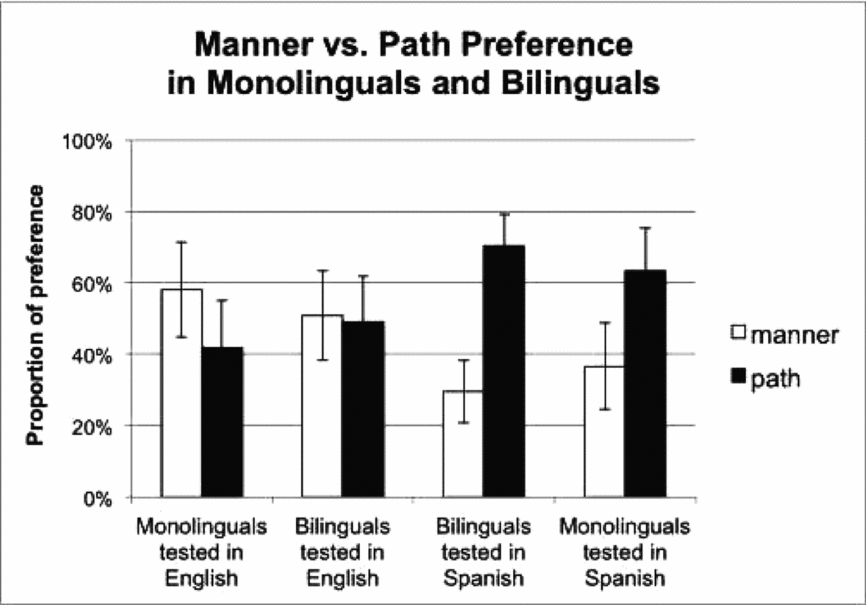
The results are summarized in Figure 2. The manner preference were 58.0% (SE = 13.2%) for the English monolinguals, 50.8% (SE = 12.5%) for the bilinguals tested in English, 29.6% (SE = 8.8%) for the bilinguals tested in Spanish, and 36.7% (SE = 12.7%) for the monolinguals tested in Spanish.
Manner versus path preference in monolinguals and bilinguals.
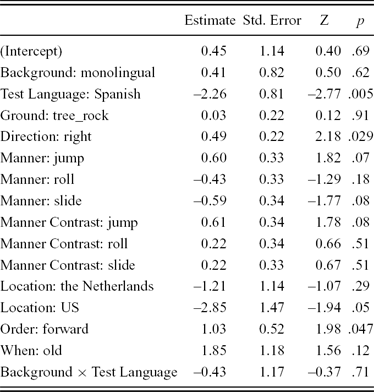
To analyze the data, we carried out mixed-effects logistic regression analyses (Baayen, Reference Baayen2008). Our first question was whether the language of test (Spanish, English) and/or the language background (monolingual, bilingual) could predict bilinguals’ judgment preference (same path, same manner) while controlling for the random variables of subject and item, and the experimentally controlled variables: type of ground (hut–cave, tree–rock), direction of motion (left, right), manner of motion in the target clip (twirl, jump, slide, roll), type of manner contrast shown in the target clip and the variant clip (twirl–roll, twirl–jump, twirl–slide, jump–slide, jump–roll, slide–roll), order of clips (forward, back), locations (US, Mexico, the Netherlands), and the time when data collection was carried out (old, new).Footnote 2
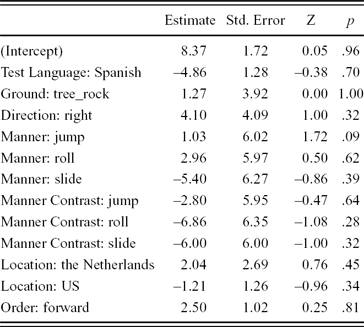
The results are summarized in Table 1. The test language mattered (β = –2.26, Z = –2.77, p = .006). Participants tested in Spanish were more likely to choose the path-consistent clips than the participants tested in English. There was no main effect of background (monolingual vs. bilingual) (β = 0.41, Z = 0.50, p = .62) or interaction of background and language (β = 0.43, Z = 0.67, p = .72). There was also a significant effect of the control variable, direction. Participants viewing the left-to-right (rightward) motion were more likely to choose the manner-consistent than the path-consistent clips (β = 0.49, Z = 2.18, p = .029). In addition, the order in which the clips were presented was marginally significant (β = 1.03, Z = 1.98, p = .047). The other variables included in the model were not significant.
The overall model for whether background (monolingual, bilingual) and test language (English, Spanish) predict classification preference (same manner, same path) in monolinguals and bilinguals in English and Spanish.
Next, although participants’ background did not interact with the test language to influence classification preference in the overall model (Table 1), we were interested in comparing bilinguals with monolinguals separately for each language. By holding the language constant, we could avoid translation-induced differences between the descriptions in English and in Spanish, if there was any. This comparison also allowed us to understand if any of the controlling variables influenced event classification in addition to test language and background.
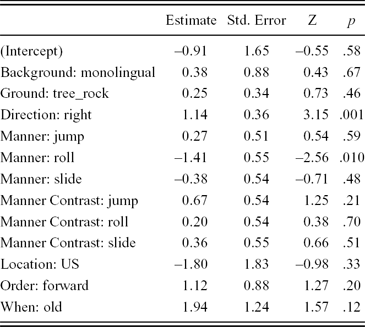
The results within the monolinguals and bilinguals tested in English are summarized in Table 2. Background did not matter, replicating the overall model, as expected. The direction of motion (β = 1.14, Z = 3.15, p = .002) and the “roll” manner (β = –1.41, Z = –2.56, p = .002) predicted classification preference. Within the English language, participants were more likely to choose the manner-consistent than the path-consistent clips when the trajectory of the motion was rightward. Participants were also less likely to choose the manner-consistent versus the path-consistent clips when the “roll” manner appeared (as opposed to “flip”, “jump”, or “slide”).
The model for whether background (monolingual, bilingual) predicts classification preference (same manner, same path) within participants tested in English.
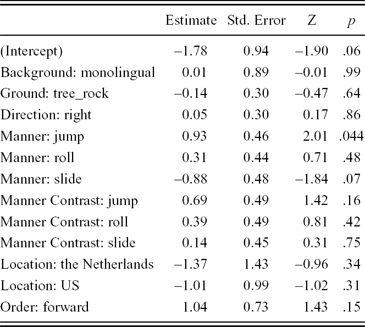
The regression results within the monolinguals and bilinguals tested in Spanish are summarized in Table 3. Again, monolinguals and bilinguals did not differ, replicating the overall model, as expected. But the “jump” manner marginally predicted classification preference (β = 0.93, Z = 2.01, p = .04). Within the Spanish language, people might have a tendency to choose the manner-consistent over the path-consistent clips when the “jump” manner appeared (as opposed to “flip”, “roll”, or “slide”).
The model for whether background (monolingual, bilingual) predicts classification preference (same manner, same path) within participants tested in Spanish.
The analyses so far demonstrate “thinking-for-speaking” effects in Spanish–English bilinguals in a similarity judgment task. The overall model showed that people were more likely to classify motion events on the basis of the path of motion when using Spanish to encode motion events and less likely to do so when using English. Thus, the habitual patterns of event encoding in the two languages influence the event representations in bilinguals. In addition, two subsets of analyses within a given test language showed that people tested in English had a preference for path when the “roll” manner appeared in the target clips, and that people tested in Spanish had a preference for manner when the “jump” manner appeared. Finally, we saw the lack of effect of the controlling variable “type of ground” (sources and goals) in all the analyses, as expected.
5.2 Age of acquisition effects in bilinguals
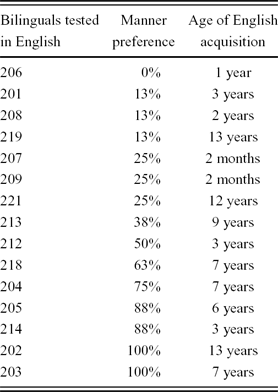
As can be seen in the analyses in Section 5.1 and Figure 2 above, there is an equal split in “same-manner” vs. “same-path” preference in bilinguals tested in English. There are two possible interpretations: (i) each participant responded randomly; (ii) there is a bimodal response pattern such that some participants have a manner preference, and others have a path preference. To distinguish between the two possibilities, we examined the responses from each bilingual (Table 4). It appears that interpretation (ii) holds because approximately half of the participants consistently pointed to the same-manner clips (highlighted in bold) whereas the other half consistently preferred the same-path clips. The question now becomes what factor is driving this either–or pattern.
Percentage of “same-manner” choices in each bilingual tested in English and their age of English acquisition.
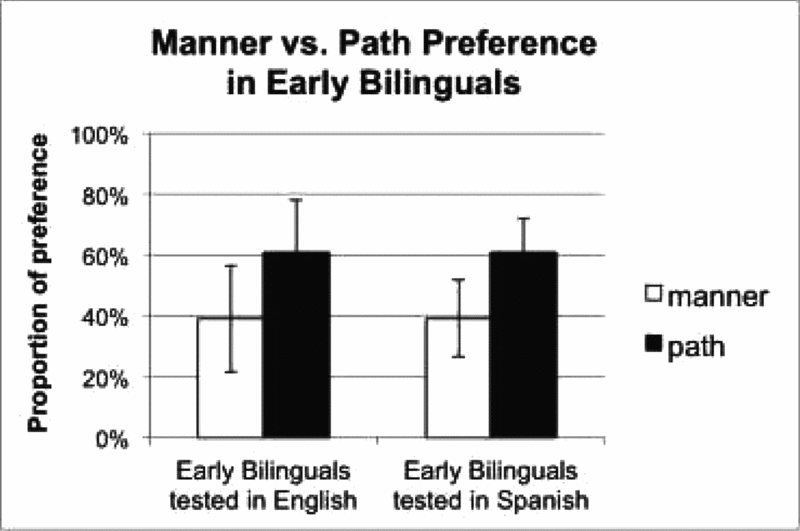
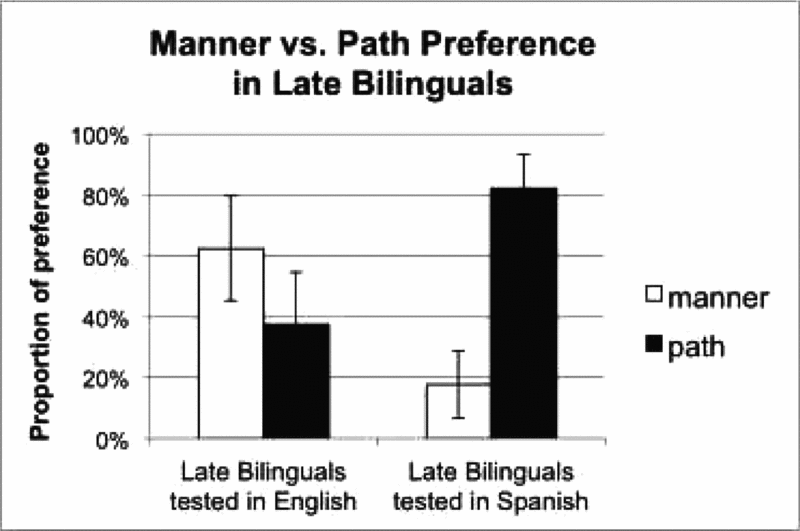
Based on prior research (discussed in Section 2.2 above) and the descriptive data of the age of English acquisition as reported in participants’ Language Questionnaires, we hypothesized that the two patterns of responses in the bilinguals were linked to their age of acquisition of English. We investigated whether the age of acquisition of English influenced the effects of test language observed within the bilingual groups.Footnote 3 With reference to the past literature (Hohenstein et al., Reference Hohenstein, Eisenberg and Naigles2006; Kersten et al., Reference Kersten, Meissner, Lechuga, Schwartz, Albrechtsen and Iglesias2010) and data inspection (Table 4), we operationally defined early bilinguals as bilinguals who started learning both languages before the age of 6, and late bilinguals as bilinguals who started learning English at and after six years of age.Footnote 4 Based on these criteria, 23 participants were classified as early bilinguals (15 participants tested in Spanish and 8 tested in English) and 20 participants were classified as late bilinguals (12 participants tested in Spanish and 8 tested in English). The results are summarized in Figure 3 and Figure 4. Descriptively, the same-manner choices were 39.1% (SE = 17%) for early bilinguals tested in English, 39.2% (SE = 13%) for early bilinguals tested in Spanish, 62.5% (SE = 17%) for late bilinguals tested in English, and 17.7% (SE = 11%) for late bilinguals tested in Spanish.
Manner and path preference in early bilinguals.
Manner and path preference in late bilinguals.
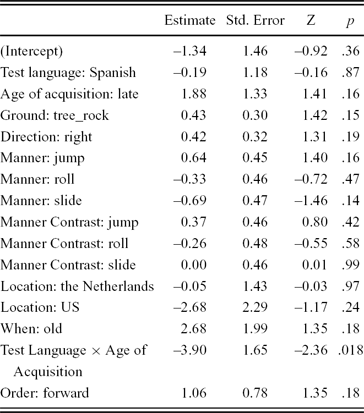
To analyze the age of acquisition effect in the two bilingual groups, we entered the factor of age of acquisition (early, late) along with all the variables reported previously in a regression model. As visual inspection of the graphs in Figure 3 and Figure 4 suggested an interaction between the language in which the bilinguals were tested and the age of acquisition, we explored the interaction between these variables. The results are summarized in Table 5.
The model for whether Age of Acquisition (early, late) and test language (English, Spanish) predict classification preference (same manner, same path) within bilinguals.
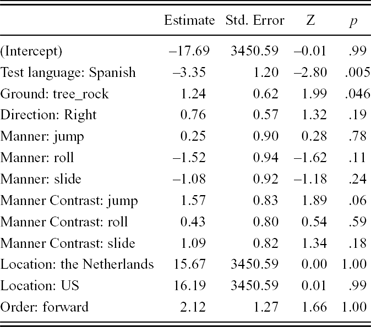
Age of acquisition interacted with the language in which the bilinguals were tested (β = –3.896, Z = –2.36, p = .018). We further broke down the interaction by examining the effect of test language in early bilinguals and in late bilinguals. The results are summarized in Table 6 and Table 7. We found that test language mattered for late bilinguals (β = –3.352, Z = –2.796, p = .005), but not for early bilinguals (p = .704). Lastly, we found that the early bilinguals tested in Spanish did not differ from monolinguals tested in Spanish (β = –0.57, Z = –0.68, p = .50), and that the early bilinguals tested in English did not differ from monolinguals tested in English (β = 1.80, Z = 1.70, p = .09).
The model for whether test language (English, Spanish) predict classification preference (same manner, same path) within early bilinguals.
The model for whether test language (English, Spanish) predicts classification preference (same manner, same path) within late bilinguals.
Summarizing, the Spanish–English bilinguals who acquired English late, i.e., at/after the age of 6, tended to flexibly change their patterns of responses in judging the similarity between events as a function of the language use. In contrast, the bilinguals who acquired English earlier in life, i.e., before the age of 6, appeared to have settled on a single classification preference for path irrespective of the language in use.
6. General discussion
The present study tested whether the language bilinguals used at the time of speaking could influence their mental representation. We tested bilinguals of English and Spanish in either English or in Spanish, and examined whether the language in use influenced their motion event classification behavior. We employed a forced-choice similarity judgment task with verbal encoding. We also tested a group of English monolinguals and a group of Spanish monolinguals for comparison.
Our primary finding was that the language used to verbally encode the motion event influenced participants’ subsequent event classification preference: a “thinking-for-speaking” effect. The bilinguals tested in Spanish classified motion events based on the path of motion more often than the bilinguals tested in English. Comparing with the monolingual controls, the bilinguals did not differ from the monolinguals in their patterns of classification. That is, the bilinguals tested in English behaved like the English monolinguals, and the bilinguals tested in Spanish behaved like the Spanish monolinguals. Our secondary finding was an age of acquisition effect within the bilingual groups. Early bilinguals, operationally defined as bilinguals who have been exposed to both languages before the age of 6 years, had a path preference irrespective of the language in use. The late bilinguals, operationally defined as those who started learning their L2 of English at or after 6 years of age, exhibited a path preference when using Spanish and a manner preference when using English.
When using one of their languages, late bilinguals temporarily represent motion events in a way that is specific to that language during a similarity judgment task with overt verbal encoding. This finding is consistent with the majority of the past findings in monolinguals (Billman & Krych, Reference Billman and Krych1998; Finkbeiner et al., Reference Finkbeiner, Nicol, Greth and Nakamura2002; Gennari et al., Reference Gennari, Sloman, Malt and Fitch2002; Papafragou et al., Reference Papafragou, Hulbert and Trueswell2008) and in late bilinguals (Kersten et al., Reference Kersten, Meissner, Lechuga, Schwartz, Albrechtsen and Iglesias2010). These studies employed various verbal encoding methods but all found a language effect. In Billman and Krych (Reference Billman and Krych1998), participants viewed motion events accompanied by event descriptions before doing a memory recognition task. Such comprehension without production can be seen as a weak imprint of motion verb difference onto speakers’ mind during task. In Gennari et al. (Reference Gennari, Sloman, Malt and Fitch2002), participants used a short phrase with a single verb instead of several verbs that encoded different sub-events of the target motion event. A language effect in the similarity judgment task was found. In Papafragou et al. (Reference Papafragou, Hulbert and Trueswell2008), participants freely inspected and described events in an eye-tracking task and fixated on the event component that was needed for the description task. Such a verbal encoding method is natural and ecologically valid, but may, however, be less controlled because different descriptions may give rise to different theoretical reasons why such an effect exists. In the present study, the pre-designed event descriptions ensured that the verbal encoding was linguistically matched across participants, which means that the frequency and the types of manner verbs (occurring as main verbs or gerunds) were matched across participants. That all four studies found the effect of verbal encoding demonstrates the profound impact of language encoding.
We are aware though that not all studies found such language effects (e.g., Filipović, Reference Filipović2011; Malt, Sloman & Gennari, Reference Malt, Sloman, Gennari, Gentner and Goldin-Meadow2003). In particular, Filipović (Reference Filipović, Marotta, Lenci, Meini and Rovai2010) suggested that the language effect depends on the task and the cognitive load that the task introduces. The effect is more likely to appear in a categorization task than in a memory task, because categorization tasks may be more language-driven whereas memory of events is less restricted by language. Filipović further argued that the language effect is mostly likely to appear in a forced choice similarity task, which is exactly why what we selected this task to test bilinguals as a starting point to explore how bilinguals represent motion events. However, the effect of language was also found in studies using memory tasks (Billman & Krych, Reference Billman and Krych1998; Finkbeiner et al., Reference Finkbeiner, Nicol, Greth and Nakamura2002). Thus, further studies are needed to clarify the task dependency of the language effect in monolinguals and bilinguals.
To provide a more mechanistic explanation for where the effect of verbal encoding might come from, we can combine an attention theory (Smith & Samuelson, Reference Smith and Samuelson2006) and a memory maintenance theory to interpret our findings. Based on the attention account, language directs speaker/hearer attention to specific aspects of the event. Using English orients speakers/hearers toward manner whereas using Spanish orients speakers/hearers toward path. Based on the memory maintenance account, verbal encoding may help the mind hold on to the event information. Here verbal encoding functions like the phonological loop (Baddeley & Hitch, Reference Baddeley, Hitch and Bower1974). By providing an articulatory rehearsal, memory traces that decay rapidly can be slowed down or even revived. Depending on how those motion events are linguistically packaged, some components (e.g., manner in English and path in Spanish) are made more prominent and therefore are decayed slower. Those prominent aspects could then be used and influence the similarity judgment task. Attention and memory must work together to show this effect, as the components of a motion event must capture a language user's attention first before the captured components decay as time goes by.
In the bilingual results, the language effect was only found in the late bilinguals, not in the early bilinguals. Further, the early bilinguals had an overall path preference, rather than a manner preference. Why would this be? We suggest that it may be efficient to rely on one pattern that is compatible in both languages and generalizable/reliable in a broad range of language use situations. According to Talmy (Reference Talmy1991), the path of motion constitutes the ‘core schema’ for motion event encoding in both S-framed and V-framed languages, irrespective of differences in how the manner of motion is encoded. And indeed, the path component is regularly expressed in motion event descriptions in the verb and/or in non-verbal path expressions, depending on the typology of the language. In contrast, the manner component of motion is frequently omitted from motion event descriptions in V-framed languages (Slobin, Reference Slobin, Ravid and Shyldkrot2005). So, early bilinguals home in on a salient regularity that characterizes both types of languages in their environment. This may be a result of a strategic use of a linguistic pattern, namely the pattern that works in both languages, i.e., the core schema of path. In addition, this account is plausible in light of first language acquisition research showing that 10–12-month-old infants exposed to English have an early sensitivity to path of motion versus manner of motion (Roseberry, Göksun, Hirsh-Pasek, Shallcross & Golinkoff, Reference Roseberry, Göksun, Hirsh-Pasek, Shallcross and Golinkoff2008).
Following this reasoning, when our early bilinguals performed the similarity judgment, they continued to rely on the path of motion as the basis for judging which events were alike. This suggests that “the kind of thinking carried out online in the process of speaking” is not exclusive to the language used in the immediate environment, but takes into consideration a whole lifetime of experience “thinking-for-speaking” both languages in early bilinguals. This explanation is consistent with the discussion in Filipović (Reference Filipović2011) who also found a path preference for (early) bilinguals in a memory recognition test. That is, early bilinguals memorize events based on the reliable cue of path instead of the cue of the test language. However, such a preference may be relatively malleable. For instance, the manner preference in the early bilinguals in Kersten et al. (Reference Kersten, Meissner, Lechuga, Schwartz, Albrechtsen and Iglesias2010), discussed previously, may arise due to the nature of the manner categorization task employed in the study in which manner captured participants’ attention due to the creatures’ novel ways of moving, overriding early bilinguals’ usual reliance on path for purposes of classification.
Why, then, do the late bilinguals in our study shift their preference for manner versus path depending on the language in use? It is possible that when late bilinguals are exposed to an L2 at or after the age of 6, they have already developed an L1-like system to deal with the various motion event components. When faced with the new pattern in L2, they need to develop a strategy to cope with the situation. They can first identify which language is in use, and then either remain with the old system if L1 is in use or switch to a new pattern if L2 is in use. The late bilinguals in our study may have adopted just this latter strategy. Thus, compared to early bilinguals, late bilinguals are more sensitive to the external language environment.Footnote 5 Our finding is consistent with the language data in Brown and Gullberg (Reference Brown and Gullberg2011) and Hohenstein et al. (Reference Hohenstein, Eisenberg and Naigles2006), and the non-linguistic data in Kersten et al. (Reference Kersten, Meissner, Lechuga, Schwartz, Albrechtsen and Iglesias2010), suggesting that bilinguals can access multiple ways of representing motion events, at least for the purpose of speaking.Footnote 6 One of those ways can be rendered temporarily salient by the language use, consistent with both “thinking-for-speaking” and “language as a strategy” theories.
Finally, we had two peripheral findings. One of the findings was that rightward (left-to-right) direction predicts a manner preference. This preference came from participants tested in English (Table 2), not from participants tested in Spanish (Table 3). We suggest that this may be due to cultural habits relating to a left-to-right axis, perhaps more often found in English-speaking culture than Spanish-speaking culture. We are not the first to observe this kind of language-independent preference. In a study in Bohnemeyer et al. (Reference Bohnemeyer, Eisenbeiss and Narasimhan2006), there was a scene depicting motion up or down a ramp. It was found that, across speakers of 17 genetically and typologically different languages, people had a path preference when the motion involves moving up or down the ramp. They suggested that a single vertical ground (the ramp) may make it easier to diagnose path than the two grounds (e.g., tree, rock) in the other scenes. Our interpretations are somewhat post-hoc; future studies are needed to investigate the direction of motion and types of manner.
The other peripheral finding was the path preference for the “roll” manner when tested in English and the manner preference for the “jump” manner when tested in Spanish. As discussed in Section 1, Slobin (Reference Slobin, Hickman and Robert2006) has suggested that some manners of motion are “high-manner” (e.g., “roll”) and others are “low-manner” (e.g., “walk”). In the case of jump, we suggest that “jump” is high-manner and may act as an attention getter for our participants tested in Spanish, and therefore produced a manner preference. However, the same interpretation cannot account for why the high-manner “roll” prompted English participants to choose the path-consistent clips. Perhaps “rolling” entails turning the face and the eyes of the tomato man upside down, which in turn drew attention to path. Further studies are needed to verify these conjectures.
One potential caveat is that we employed a between-subject design since the danger of practice effects might jeopardize the main effect. But a within-subject design might be more useful to assess whether bilinguals, especially the late bilinguals, flexibly change their conceptualization based on language in use. Future studies should test the validity of the inclusion of independent groups of bilinguals as opposed to the use of a within-subject design.
In conclusion, we find two concurrent modes of “thinking-for-speaking” in bilinguals, dependent on the language used for verbal encoding. This language effect is modulated by the age at which the bilinguals acquired their second language. Early bilinguals rely on the pattern that works in both languages while the late bilinguals rely on the pattern in use at the moment of communication. These data provide an exciting prospect of two mechanisms in place, whereby early bilinguals have a strongly forged mechanism of habitually coping with the two languages more efficiently than the late bilinguals who need to switch to one or the other, showing more contextual variation.Footnote 7