Introduction
In India, a considerable body of research has documented information about child health, including nutritional status and childhood immunization (Basu, Reference Basu1985; Arnold et al., Reference Arnold, Choe and Roy1998; Arokiasamy, Reference Arokiasamy2004; Pande, Reference Pande2003; Pande & Yazbeck, Reference Pande and Yazbeck2003; Mishra et al., Reference Mishra, Roy and Retherford2004; Kumar & Mohanty, Reference Kumar and Mohanty2011a, Reference Kumar and Mohantyb). These studies have identified a number of factors to be associated with child health in the country, such as sex discrimination, urban/rural differentials, maternal characteristics and socioeconomic status. However, there has been very little research on the association of family structure and the presence of siblings with child nutritional status and health care utilization. Family and household structure is an important determinant of child well-being (Blake, Reference Blake1981; Amato, Reference Amato1987; Thomson et al., 1994; Schiller, 1996; Wu, 1996; Mayer, Reference Mayer1997). However, most of these studies have been conducted in the United States during the era of rapid growth in single-parent or female-headed households (Gage, Reference Gage1997).
This study addresses the gap in the literature by examining the extent to which family structure influences child nutritional status (underweight) and immunization in India. In particular, it focuses on the influence of family structure and the presence of siblings on child health status as indicated by nutritional status and immunization coverage. Accordingly, the study has two objectives: (1) to examine the impact of family structure and number of siblings on child health status in India; (2) to examine the direct and indirect effects of family structure and number of siblings on child health after adjusting for key socioeconomic and demographic characteristics. The importance of this study is twofold. First, it will provide information about how child well-being is shaped by their living arrangements. Second, from a policy point of view, it will be helpful in identifying the vulnerable characteristics of households associated with poor child health status.
Conceptual framework
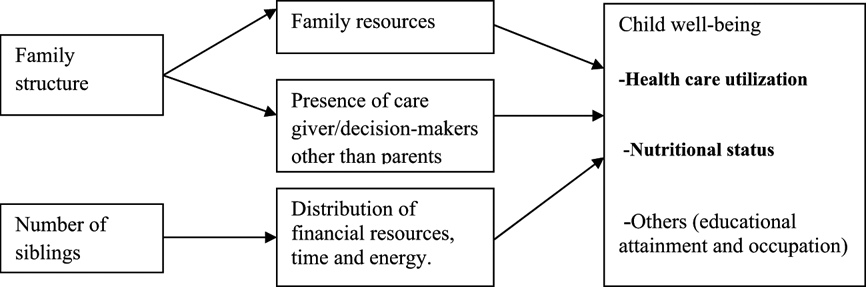
Based on previous studies on the linkage between family structures and child well-being, a framework is proposed to understand the relationship between family structure and child health (Fig. 1). The framework is a modification of the earlier work of Albrecht et al. (Reference Albrecht, Miller and Clarke1994). According to Thomson et al. (1996), a family provides two important resources to a child: money and time/care. These are the two mediators through which a household provides possible support for a child's well-being. Here, money is defined in terms of socioeconomic status and financial resources of a household. The financial resources of the family determine the living conditions of the children and their food pattern, exposure to infectious diseases and treatment-seeking behaviour. Similarly, time is defined as the presence of other family members that serve as caregivers to a child. The presence of other family members may increases the chance of health care utilization for a child, particularly when a mother has limited autonomy to visit health care services or if she is engaged in her domestic duties.
Conceptual framework explaining the relationship between family structure, number of siblings and child well-being.
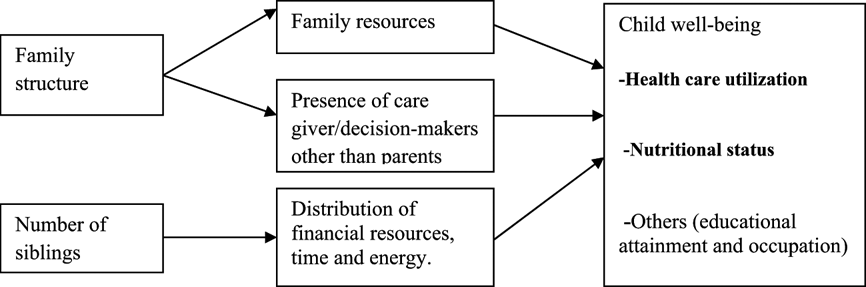
The ‘presence of siblings’ is also placed in the framework. Previous studies show that the presence of many siblings in a family curtails the resource distribution among the siblings (Blake, Reference Blake1981, Reference Blake1989; Heer, Reference Heer1985). Thus it works in a similar way to the family financial resource influence on child well-being. A combination of all these factors therefore influences overall child well-being, including health. This paper only assesses the relationship between family structure and child nutritional status/treatment-seeking behaviour (given in bold in Fig. 1).
Background
Nuclear family and child health
Much of the existing literature has shown that family structure has mixed effects on child well-being depending on the context in which the issue is addressed. In developed countries, a single-parent household (irrespective of the sex of the head of household) is adversely associated with child well-being in comparison with the presence of both parents. For example, a single-parent household headed by either a female or a male is negatively associated with child well-being due to constraints of time, poor financial condition and lack of interpersonal communication, which are basic requirements for child well-being (Amato, Reference Amato1987; McLanahan & Booth, Reference McLanahan and Booth1989; Dawson, Reference Dawson1991; Schiller, 1996). In developed countries, the presence of a partner provides sufficient time for child care as well as supporting family financial resources. Therefore, two parents provide a better environment for child rearing and care for child well-being (Amato, Reference Amato1987; McLanahan & Sandefur, Reference McLanahan and Sandefur1994; Hogan & Lichter, Reference Hogan, Lichter and Farley1995). In contrast, evidence from developing countries has shown that female-headed families (either single-parent or nuclear) can have positive influences on child nutritional status and well-being. The argument is that the female/mother is more concerned about child care than male heads might be, which influences the well-being of children despite the financial and time constraints associated with female-headed households (Horten & Miller, 1989). Moreover, the female-headed family is likely to maximize their resources to fulfil the needs of children (Dwyer & Bruce, Reference Dwyer and Bruce1988). Evidence shows that female-headed families consume foods of higher nutritional quality and spend much of their earnings on child requirements rather than other consumption (Horton & Miller, Reference Horton and Miller1989; Louat et al., Reference Louat, Grosh and van der Gagg1993). However, evidence is mixed and some studies in developing countries show similar findings to developed countries, with children of single-parent households being more likely to be stunted in developing countries, possibly because the children are not being given the proper nutrients, time and health care (Bronte-Tinkew & DeJong, Reference Bronte-Tinkew and DeJong2004). In developing countries, the presence of both parents has been shown to support better economic conditions and a higher level of per capita consumption in the family, which favours child well-being (Lloyd & Gage-Brandon, Reference Lloyd and Gage-Brandon1993).
Extended family and child health
Parents in a nuclear family have a strong hold on decision-making about the health of their children in relation to proper care, nutritious food and access to health services because they do not have to consult other adult household members to make such decisions. However, the extended family has the potential to offer better social care and is more likely to provide the necessary resources to seek health treatment for dependants (Chekki, Reference Chekki and Kurian1974; Murthy et al., Reference Murthy, Ramnath, Vijayaraghavan and Rao1985; Caldwell et al., Reference Caldwell, Reddy and Caldwell1996). The extended family has the ability to provide financial and social resources to family members, including children (Desai, Reference Desai1992; Gage, Reference Gage1997; Gage et al., Reference Gage, Sommerfelt and Piani1997). The presence of other adults in an extended family serves to provide extra caregivers for a child when the mother is engaged in her domestic responsibilities, or if she is restricted in visiting health facilities. Moreover, adult caregivers are more likely to care adequately for infants and young children than older siblings (Griffiths et al., Reference Griffiths, Matthews and Hinde2002). For example, previous research in Africa and India has shown that children of extended households are more likely to be immunized and less likely to be stunted (Gage, Reference Gage1997; Gage et al., Reference Gage, Sommerfelt and Piani1997; Pande, Reference Pande2003). Thus extended family households are better off than nuclear families (either single-parent or two-parent) in terms of health care utilization.
However, evidence on the protective effects of extended families on child health in South Asia is mixed, perhaps because of the low level of female autonomy of young mothers in these families. The inter-familial power of the index mother is associated with the distribution of resources and food within the family, as well as household decision-making on child-related issues, particularly schooling and treatment seeking. For example, Murthy et al. (Reference Murthy, Ramnath, Vijayaraghavan and Rao1985) found that, in rural Andhra Pradesh, there were no significant differences between body weight outcomes according to family type. Similar results have been found in other regions of India (Griffiths et al., Reference Griffiths, Matthews and Hinde2002).
Siblings and child health
The number of siblings in a family has been shown to influence child well-being. This is probably because with increasing number of siblings, each child enjoys a smaller proportion of the family financial resources. Similarly, parents' devotion (time and energy) to their children is weakened in a larger family. For example, there is evidence that a larger number of siblings lessens the educational attainment within a family (Li & Taylor Reference Li and Taylor1993; Anh et al., Reference Anh, Knodel, Lam and Friedman1998; Elounden-Enyegue & Williams, Reference Eloundou-Enyegue and Williams2006).
Similarly, number of siblings may influence child health, particularly nutritional status. The existing literature shows a clear relationship between number of siblings and child nutritional status. A study conducted by Sereebutra et al. (2006) in rural Guatemala found that children living in a household with four or more siblings were more likely to be stunted than children living in a less crowded family. A similar result was observed in another study in Mali (Lalou & Mbacke, Reference Lalou, Mbacke and Lloyd1992). There is little evidence on the association between number of siblings and childhood immunization, although Pande (Reference Pande2003) found that the sex composition and order of siblings is associated with immunization coverage in India.
Evidence from India
In India, the family is particularly important in the study of child health and health-seeking behaviour as it is the fundamental social unit ensuring the survival, growth, security and well-being to its members. The presence of other family members in the Indian family may have considerable influence on the health and health care utilization of a child. Moreover, the prevailing ‘Low Autonomy’ and ‘Purdha System’ (Dyson & Moore, Reference Dyson and Moore1983; Doan & Bisharat, Reference Doan and Bisharat1990) have placed a strong restriction on women's movements within and outside of the community. This may mitigate a woman's awareness and knowledge about child health and negatively influence treatment-seeking behaviour.
The existing literature has shown that household structure has an influence on the utilization of maternal health care services in India. For instance, the family has a major role in decisions on access to health care services (Mosley & Chen, Reference Mosley and Chen1984; Das Gupta, Reference Das Gupta1987; Chatterjee, Reference Chatterjee, Krishnaraj and Karuna1989; Basu, Reference Basu1992). Such decisions are influenced by the familial power structure or relationship between the decision-maker and the index women (Khan et al., Reference Khan, Anker, Dastidar, Gosh, Bairathi, Caldwell and Santow1989). A study conducted by Saikia & Singh (2009) found that women living in non-nuclear families are less likely to use contraception and utilize prenatal and natal care services than those women living in a nuclear family. This may be because women in non-nuclear households tend to be less involved in deciding about the utilization of maternal health services. Moreover, in non-nuclear households the chances of discussion between spouses on such issues may be lower than in nuclear households.
In the case of child health and nutritional status family resources are important. Mortality and morbidity among children are linked with family resources in India (Beenstock & Sturdy, Reference Beenstock and Sturdy1990). Family resources determine the capability of the family to purchase health goods, services and food for children (Chatterjee, Reference Chatterjee, Krishnaraj and Karuna1989; Doan & Bisharat, Reference Doan and Bisharat1990; Berman et al., Reference Berman, Kendall and Bhattacharya1994; Behrman, Reference Behrman, Pinstrup-Andersen, Pelletier and Alderman1995, Reference Behrman1998). Moreover, the perceived future contribution of children in the family also determines treatment patterns in children (Gittelsohn, Reference Gittelsohn1991).
Few plausible mechanisms through which family structure influences child health in India have been suggested. Even though family structure has been identified as a prime determinant of children's economic and social well-being (Louat et al., Reference Louat, Grosh and van der Gagg1993; Lloyd & Blanc, Reference Lloyd and Blanc1996), surprisingly little is known about the link between family structure and child health status in India. The sole study, conducted by Griffiths et al. (Reference Griffiths, Matthews and Hinde2002), found no association between family structure and child nutritional status. The authors found no research on the relationship between family structure and immunization in India. Moreover, the sibling effect on nutritional status is also under-explored.
Reduction in child undernutrition and improvement in child immunization are important challenges facing India today. The high level of child undernutrition is a major barrier to achieving the Millennium Development Goals in India (World Bank, 2004). Among children under five years of age, more than two-fifths (43%) were found to be underweight and about half (48%) stunted during 2005–06 (IIPS & Macro International, 2007). Moreover, the prevalence of undernutrition has been found to vary greatly by socioeconomic status and region (Subramanyam et al., 2010; Pathak & Singh, Reference Pathak and Singh2011). The country is also lagging behind in childhood immunization. Despite its longstanding commitment to universal immunization, basic immunization coverage in India had never reached the majority of children. For instance, among children aged 12–23 months, only 43% have received all recommended doses of vaccines, with stark differentials by household economic status (24% among the lowest wealth quintile compared with 71% among the richest wealth quintile) and state (IIPS & Macro International, 2007; Kumar & Mohanty, Reference Kumar and Mohanty2011a).
Based on evidence from developing countries and the observed low autonomy among women in India it is hypothesized that the children from extended families in India will be more prone to be undernourished. The argument is supported by previous studies that found that in cases where a mother-in-law was present in a family and the young wife had little decision-making power, children's weight-for-age was significantly lower than in a family where the mother was the head or co-head of the family (Doan & Bisharat, Reference Doan and Bisharat1990). But the same family type may affect child health care utilization, such as immunization, in the opposite way. This argument is backed by Griffiths et al. (Reference Griffiths, Matthews and Hinde2002), who argued that the presence of other family members results in additional available caregivers other than the parents/mother. These additional caregivers may facilitate bringing the child to a health facility when the mother has less mobility or if she is engaged in other work. Moreover, in other settings, the evidence shows that the extended family is associated with an environment where childhood immunization services are utilized more effectively (Gage et al., Reference Gage, Sommerfelt and Piani1997). Based on the evidence presented on the relationship between family structure and child health outcomes, the following four hypotheses have been formulated and will be tested using data from the third round of the National Family Health Survey in India:
1. Children living in non-nuclear families are more likely to be underweight.
2. Children living with many siblings are more likely to be underweight.
3. Children living in non-nuclear families are more likely to be immunized.
4. Children living with many siblings are less likely to be immunized.
Methods
Data
The study used data from the third wave of the Indian National Family Health Survey (NFHS-3) conducted in 2005–06. The NFHS is a nationally representative, multi-round large-scale survey and comparable to the Demographic and Health Surveys of other Asian countries. The third round of the survey was conducted through a collaborative effort between various international and national organizations. The International Institute for Population Sciences (IIPS), Mumbai, India, was the key agency for facilitation of the survey. Data collection procedures were approved by the ORC Macro institutional review board. A formal written consent was obtained and ethical issues were taken care of before interviewing the respondent and ethical approval was provided by the IIPS. Moreover, the study is based on an anonymous public use data set with no identifiable information on the survey participants.
The survey followed a two-stage sampling design in most of the rural areas and a three-stage sampling design in most of the urban areas, and covers more than 99% of the country's population. The NFHS-3 provides comprehensive information on fertility, infant and child mortality, nutritional status of children, maternal and child health care, knowledge and prevalence of HIV/AIDS, women's empowerment and domestic violence. It collected information from 109,041 households and 124,385 women (aged 15–49) from 29 states. A separate ‘Kids File’ is generated from the women's file which provides information on 51,555 children aged less than 59 months in the five years preceding the survey. Details of the sampling procedures and sample size are given in national and state reports (IIPS & Macro International, 2007).
Outcome variables
The two prime indicators of child health used in the study were underweight and full immunization. Children aged 0–59 months whose weight-for-age Z-score is minus two standard deviations below the median of the reference population are defined as underweight. It is estimated based on an international reference population recommended by the World Health Organization (WHO Multicenter Growth Reference Study Group, 2006) and accepted by the Government of India. This WHO standard adopted a prospective approach describing how healthy children should grow. Weight-for-age (underweight) was used as an indicator to measure child nutritional status. The use of weight-for-age is supported by previous studies, which suggest that underweight is the summary measure reflecting the chronic as well as acute nutritional status of the child (Deaton & Dreze, Reference Deaton and Dreze2009).
Full immunization
is considered as surviving children who have received one dose of BCG, three doses of DPT, three doses of Polio, and one dose of Measles. The immunization status of children is divided into three categories: no immunization (not taken any vaccine), any immunization (taken at least one vaccine but not all) and full immunization (taken all doses of vaccines). Immunization is estimated for children aged 12–23 months only, as per the WHO schedule of immunizations.
Key explanatory variables
Family structure is the key explanatory variable in the study. Two indicators were used to capture family structure: (1) type of family (nuclear/non-nuclear), (2) number of live siblings (no sibling/1–2 siblings/3 and more siblings). In the NFHS-3 a nuclear family is defined as a household comprising a married couple, a man, or a women living alone or with unmarried children (biological, adopted or fostered), with or without unrelated individuals (IIPS & Macro International, 2007). The remaining households were defined as non-nuclear families/households. This general categorization of family structure has been used in previous studies (Steptoe & Cropley, 2000; Ferrer & Burge, Reference Ferrer and Burge2005), and reflects the family structure of India.
Beside family structure, the other socioeconomic and demographic confounders empirically associated with child health used in the study are: sex of the child (male/female), age of child in months (0–11, 12–23, 24–35, 36–47, 48–59), place of residence (urban/rural), age of mother (15–24/25–34/35 and above), mother's education (uneducated/1–5 years of schooling/6–10 years of schooling/more than 10 years of schooling), exposure to media (not exposed/exposed), current working status (not working/working), father's education (uneducated/1–5 years of schooling/6–10 years of schooling/more than 10 years of schooling), wealth index (poorest/poorer/middle/richer/richest), religion (Hindu/Muslims/Others), caste (scheduled castes and scheduled tribes (SCs/STs)/Other Backward Castes (OBC)/Other). Region of residence is also included among the confounders as family type varies greatly across regions. India is divided into six regions (North/East/West/North-East/Central/South). Regions are divided following the NFHS-3 regionalization scheme (IIPS & Macro International, 2007). All of these variables are adjusted in order to establish the relationship between family structure and child health outcomes.
Female autonomy is also an important determinant of child and women's health. Moreover, women's autonomy may differ by type of family and thus may have a different role in shaping child health and well-being in different families. Previous studies have measured women's autonomy based on indicators of women's mobility (freedom to visit places unescorted) and decision-making authority (Jejeebhoy, Reference Jejeebhoy1995; Saikia & Singh, 2009). The NFHS-3 provides sufficient information on all these indicators to compute a women's autonomy index. Five decision-making indicators are used: (i) decision on own health care, (ii) decision on large household purchases, (iii) decision on purchase of daily household needs, (iv) decision on visits to family and relatives, (v) decision on spending husband's earnings. Three mobility indicators are used: (i) allowed to go to market, (ii) allowed to go to a health facility, and (iii) allowed to go outside the village. Based on these indicators a composite index is computed using Principal Component Analysis termed as women's/mother's (used interchangeably) autonomy and divided into three categories: relatively low, medium and high autonomy. Women's autonomy was included as a confounder in the relationship with family type, thus a single women's autonomy index was computed incorporating the two aspects of women's autonomy that are likely to be most relevant to family type and child health (decision-making and permission components) rather than a dimension-specific index that incorporates all of the dimensions of autonomy available in the NFHS.
Analysis
Descriptive statistics are used to understand the distribution of the sample across socioeconomic context. Bivariate analysis is used to understand the differentials in selected child health indicators across family structure and selected socioeconomic characteristics. Besides family structure, the health status of a child may be affected by a number of other socioeconomic and demographic characteristics. Accordingly, multivariate analysis is used to examine the association between family structure and selected child health indicators after adjusting for other confounders. Two separate regression analyses are deployed (binary and multinomial logistic regression) depending on the nature of the outcome variables. Binary logistic regression is used for underweight as it is defined as whether a child is underweight or not (0=otherwise, 1=underweight). Multinomial/polytomous logistic regression is used for immunization coverage (it is divided into three categories: no immunization, partial/any immunization and full immunization) because it allows the effects of the independent variables to differ for each outcome, and handles the non-independence of the categories of dependent variable by simultaneous estimation of the models for all outcomes, except that one outcome is omitted to serve as the base category.
Five separate models are run for both of the outcomes to understand the influence of family structure in different contexts. For example, Model I is used to understand the direct relationship between family structure (including number of siblings) and outcome variables without taking into account either child or maternal and socioeconomic characteristics. In Model II adjustment is made for child characteristics, while Model III is adjusted for child as well as maternal characteristics. In Model IV child, maternal and socioeconomic characteristics are adjusted for. Finally, in Model V all selected covariates – child level, maternal characteristics, socioeconomic status of household and regions of the country – are adjusted for. A two-way interaction effect of autonomy and family type (women autonomy×type of family) is also examined. This is useful to understand how the decision-making and power of the indexed mother affect child health in different family structures, as the health and nutritional status of children is influenced by resources as well as family decision-making (Griffiths et al., Reference Griffiths, Matthews and Hinde2002). Analysis is performed using STATA 8.2 software.
Results
Sample characteristics
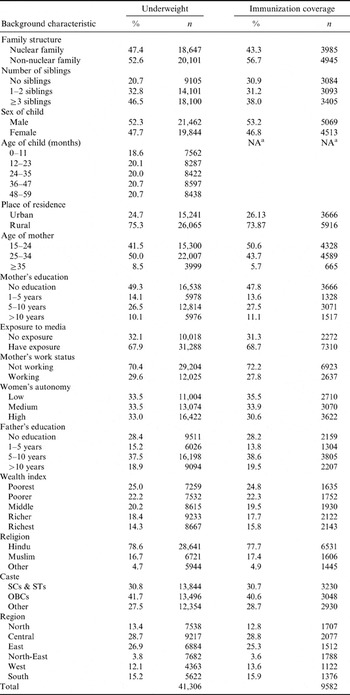
Table 1 presents the descriptive statistics of the sample characteristics of children considered in the study. The sample differs slightly by family structure and sibling composition between the selected outcomes. In the case of the underweight sample, 47% of children belong to a nuclear family and 53% belong to a non-nuclear family. For the immunization sample, 43% of the children belong to a nuclear family compared with 57% from a non-nuclear family. Similar differences are observed by number of siblings in the family. For instance, among the underweight sample, 21% of children are living without a sibling, 33% are living with one to two siblings, and 47% are living with three or more siblings. In the case of immunization, 31% are living with no sibling, a similar proportion (31%) are living one to two siblings and 38% are living with three or more siblings. The sample distribution for the two outcomes is similar for most of the background characteristics, meaning that the socio-demographic profiles of the sample children for underweight and immunization are similar. For instance, the sex composition of children remained similar for underweight and for immunization. A similar pattern is observed in the distribution of children by mother's age, religion and region. More than two-thirds of children live in rural areas, and a similar percentage (70%) have a non-working mother. The majority of the children belong to an uneducated mother from a poor household.
Percentage distribution of the sample for underweight (children aged 0–59 months) and immunization coverage (children aged 12–23 months) during the five years preceding the survey, by selected background characteristics, India, 2005–06

a NA, age of child is not applicable for immunization sample as this included children aged 12–23 months.
All n values are unweighted. The sum of n values is not equal to the total values because of missing cases in that category.
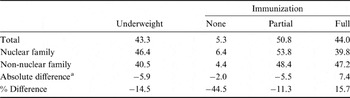
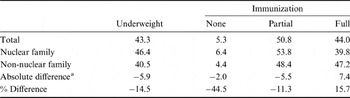
The descriptive statistics show the poor health status – either for underweight or for immunization coverage – of the sample children at the time of the survey (Table 2). More than two-fifths of children aged 0–59 months were underweight at the time of survey. Similarly, only 44% of children aged 12–23 months were fully immunized, indicating that the majority of children had not received the complete dose of immunization at the time of the survey.
Percentage of underweight and immunized children by type of family, India, 2005–06
a Difference between non-nuclear and nuclear families.
There is evidence of differentials in child health status by family structures (Table 2). The proportion of underweight children is slightly higher in nuclear (46%) compared with non-nuclear families (41%), indicating that the proportion of underweight children is 14% higher among nuclear families than for non-nuclear families. Full immunization coverage is lower in nuclear (40%) compared with non-nuclear families (47%). Moreover the inter-familial gap is higher in the case of full immunization compared with underweight.
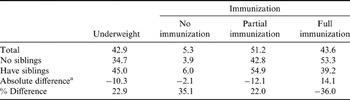
Child health status also varied with the presence of siblings. The proportion of underweight children is higher in those families where a child resides with siblings. For instance, among children living without a sibling, 35% were underweight compared with 45% among those who reside with siblings (Table 3). Similarly, full immunization coverage varied with the presence of siblings in the family. Full immunization was 53% among the children with no siblings, compared with 39% among those who reside with siblings. Again, the difference is larger for full immunization coverage.
Percentage of underweight and immunized children by surviving siblings, India, 2005–06

a Difference between non-nuclear and nuclear families.
Multivariate analysis
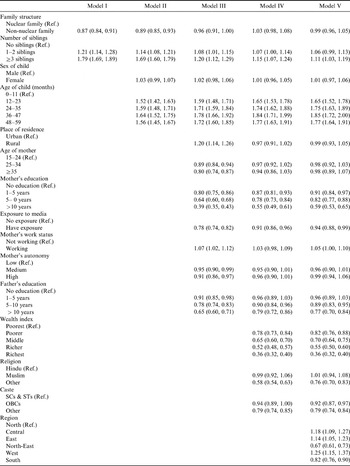
Binary logistic regression is used for underweight and the results are presented in Table 4 in the form of odds ratios and 95% confidence intervals. The simplest model (Model I) shows a significant relationship between family structure and underweight. For instance, children who belong to a non-nuclear family are less likely (0.87, p<0.01) to be underweight. A similar result is observed in Model II, after including child-level variables in the analysis, and the significance of the odds ratio remained similar (0.89, p<0.01). Even after adding child and maternal characteristics, children of non-nuclear families are less likely to be underweight (Model III). However, the odds ratio tends toward 1 and the level of significance has changed (0.96, p<0.05). Family structure is not a significant determinant of underweight after including socioeconomic variables along with child and maternal characteristics (Model IV). However, the odds of being underweight are less, but not significantly so, among children of non-nuclear families compared with those of nuclear families (Model V).
Odds ratios (95% confidence intervals) based on logistic regression showing the effect of family structure and selected socioeconomic and demographic characteristics on underweight children, India, 2005–06

Ref.: reference category.
The presence of siblings in the household also appeared to be a significant determinant of underweight in children. In Model I, children living with a sibling were more likely to be underweight than children living without siblings. Moreover, the values of odds ratio increased as the number of siblings increased. For instance, the odds of being underweight for children living with one to two siblings and more than two siblings are 1.21 (p<0.01) and 1.79 (p<0.01), respectively. The significance of the effect of siblings on underweight remained similar after adding child, maternal, socioeconomic and region variables in subsequent models, although the odds ratio decreased.
Other results in Models III and IV show that child's age, parent's educational attainment, mother's exposure to media, current work status and wealth index of the household are significantly associated with risk of being underweight for children. For instance, older children are more likely to be underweight than younger children and the effect of age remains significant even after inclusion of maternal, socioeconomic and region variables (Model III, Model IV and Model V, respectively). Women's autonomy has a significant effect on underweight when adjusted for maternal and child characteristics. For instance, children of medium and highly empowered women are significantly less likely to be underweight (Model III). Though significant, the effect of women's autonomy disappeared after adjusting maternal characteristics with socioeconomic characteristics (Model IV). The effect of women's autonomy remained the same after including region (Model V). Children of an educated mother or father (more years of schooling) are less likely to be underweight. Children in the richest wealth quintiles are less likely (0.36, p<0.01) to be underweight. Regional differentials show that children who belong to the Central and West region are more likely to be underweight. However, the sex of children and place of residence do not appear to be significant determinants of underweight after controlling for socioeconomic status and region in Model V.
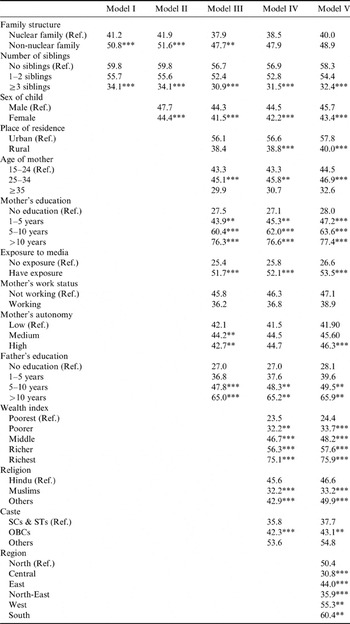
Multinomial regression is used in the case of immunization as it has more than two categories, i.e. no immunization, partial immunization and full immunization. In order to avoid the complexity of interpretation, the results obtained from the multinomial logit regression are presented in terms of adjusted percentages using a multiple classification application (MCA). Results are presented for full immunization only to keep the context precise and focused (Table 5). In Model I, full immunization coverage is significantly higher among children of non-nuclear families compared with nuclear families: 51% vs 41%. Similarly, in Model II, full immunization coverage is higher among children of non-nuclear (52%) than those of nuclear families (42%). In Model III (after the inclusion of child and maternal characteristics) the results remained similar with 38% immunized among nuclear families compared with 48% among non-nuclear families. But after inclusion of household socioeconomic status (Model IV), family structure does not appear to be a significant determinant of full immunization coverage. A similar pattern is observed in the final model (Model V). However, the result, although not significant, remained in a similar direction to the previous models.
Adjusted percentages based on multinomial logistic regression models showing the effect of family structure and selected socioeconomic and demographic characteristics on full immunization coverage, India, 2005–06

Ref.: reference category.
***p<0.01; **p<0.05; *p<0.1.
Odds ratios for underweight and adjusted percentages for full immunization, based on multivariate analysis showing the interaction effect of women's autonomy index and type of family on child health indicators, India, 2005–06

Ref.: reference category.
***p<0.01; **p<0.05; *p<0.1.
Regressions analysis adjusted for sex of the child, place of residence, age of child, age of mother, educational status of mother, mother's working status, exposure to media, father's education, wealth index, religion, caste and region.
The presence of a sibling has a significant influence on immunization coverage. Immunization coverage is significantly lower among children living with many siblings: 60% among those living without a sibling compared with 34% among those living with more than two siblings. In all of the models full immunization coverage decreased as the number of siblings increased, but only a child living with more than two siblings compared with no siblings was significantly less likely to be immunized. Also, full immunization coverage is significantly higher among children with educated parents, from wealthier households or who have empowered mothers. However, it is lower for a girl child, and children from rural areas. As for regional variation, immunization coverage is significantly higher in the south and west regions, and lower in the Central, East and the North-East regions of the country.
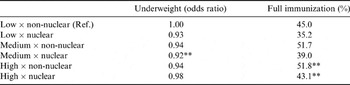
The results of the interaction effect (women's autonomy×type of family) show that women with a medium level of autonomy from nuclear families are less likely to have a child who is underweight compared with a woman with low autonomy from a non-nuclear family. In the case of immunization, children of women with high autonomy from a non-nuclear family are more likely to be fully immunized.
Discussion and Conclusions
This study made an attempt to understand the relationship of family structure and number of siblings with child health status (underweight and full immunization) in the Indian context using the data from the third round of the National Family Health Survey, conducted during 2005–06. Differences in child health status (nutritional status and immunization coverage) were found between non-nuclear and nuclear families. The children of non-nuclear families were found to be at an advantage for both outcomes, with better nutritional status (lower proportion underweight) and higher full immunization coverage. The difference is comparatively greater for full immunization. In contrast, the presence of siblings in a household increased the risk of poor nutritional status and low level of immunization coverage.
The multivariate results show, for the first hypothesis, that there is a significant and positive association between non-nuclear families and probability of underweight in children, i.e. non-nuclear families are less likely to house children who are underweight. Even after inclusion of maternal characteristics such as age and education, the non-nuclear family is positively associated with the nutritional status of children (Table 4, Model III). Such a relationship may be because the non-nuclear family offers better social care for its members and therefore is more likely to provide necessary resources, such as food and health care, as is observed in the case of immunization coverage (Table 5). Thus, better health care by protecting a child from infectious diseases may be positively associated with child nutritional status, as has been supported by previous studies (Murthy et al., Reference Murthy, Ramnath, Vijayaraghavan and Rao1985; Caldwell et al., Reference Caldwell, Reddy and Caldwell1996). Similarly, the presence of extended household members could compensate for income deficits by providing material assistance such as transport and child care, which may affect the nutrition status of children (Moss & Carver, Reference Moss and Carver1992). But when the economic status of the household is taken into account, the picture is less clear. The results suggest the importance of economic status, which affects undernutrition through type of family. For instance, the majority of the poorest households (63%) are nuclear in type, while most of the richest households are non-nuclear families (68%). Moreover, there are a number of recent studies which suggest that economic status is the prime determinant of child malnutrition in India (Mazumdar, Reference Mazumdar2010; Pathak & Singh, Reference Pathak and Singh2011; Subramanyam et al., 2010). Thus it may be that the economic status of the household may mitigate the effect of family structure on child undernutrition. Moreover, the family system of India varies across its regions, and thus the effect of family type on child health may be different in different regions. To examine this, the multivariate analysis was extended separately for the North and South regions of the country using the classification of Dyson & Moore (Reference Dyson and Moore1983). The North region includes the states of Gujarat, Rajasthan Uttar Pradesh, Madhya Pradesh, Punjab and Haryana, while the South region includes the states of Kerala, Tamil Nadu, Andhra Pradesh, Karnataka and Maharashtra. Different results were found for the two regions (data not shown). For instance, in north India the children of non-nuclear families are less likely to be underweight after adjusting for child, maternal and socioeconomic characteristics. However, the relationship was not significant. In south India, the children of non-nuclear families are significantly more likely to be underweight after adjusting for all the characteristics. These findings provide supporting evidence for the fact that different family structures might have different support systems in different contexts (Desai, Reference Desai1992). Overall, family structure, after controlling for economic circumstances, has little influence on child underweight in India, and this finding is in line with previous studies in India (Murthy et al., Reference Murthy, Ramnath, Vijayaraghavan and Rao1985; Griffiths et al., Reference Griffiths, Matthews and Hinde2002). Although our findings did not show a direct association between family type and childhood nutritional status, the relationship could be indirect, as in India the nuclear family is more vulnerable to poverty than the non-nuclear family. This better economic status of the non-nuclear family may have an advantageous effect on childhood nutritional status.
The results of this study support the second hypothesis showing that living with siblings is an important determinant of childhood nutritional status after adjusting for child, maternal and socioeconomic characteristics. The presence of siblings in a family has a significant and negative impact on the rate of child underweight. This result is supported by previous studies, where living with many siblings has been shown to be associated with the nutritional status of children (Lalou & Mbacke, Reference Lalou, Mbacke and Lloyd1992; Sereebutra et al., 2006). The possible mechanism for such a relationship may be understood through the ‘dilution effect’: as the number of children increases, family resources available to an individual child decrease (Heer, Reference Heer1985; Beenstock & Sturdy, Reference Beenstock and Sturdy1990; Bronte-Tinkew & DeJong, Reference Bronte-Tinkew and DeJong2004). The family resources may be either financial resources, which determine the purchase of health goods, services and food (Doan & Bisharat, Reference Doan and Bisharat1990; Berman et al., Reference Berman, Kendall and Bhattacharya1994; Behrman, Reference Behrman, Pinstrup-Andersen, Pelletier and Alderman1995, Reference Behrman1998), or it may be availability of time to care for a child (Blake, Reference Blake1981; Horton, Reference Horton1988).
Non-nuclear families also appeared to be a significant determinant of full immunization coverage after controlling for child and maternal characteristics. Children of non-nuclear families are more likely to be immunized in certain contexts. This result is similar to that of other studies, where extended families have been shown to be positively associated with immunization coverage (Gage, Reference Gage1997; Gage et al., Reference Gage, Sommerfelt and Piani1997; Pande, Reference Pande2003; Bronte-Tinkew & DeJong, Reference Bronte-Tinkew and DeJong2004). In the extended family many adult caregivers are available for a child when the mother is engaged in domestic duties or if the parents are engaged in economic activity. Moreover, these adult caregivers are more likely to care for the infants and younger children (Griffiths et al., Reference Griffiths, Matthews and Hinde2002). However, our findings do not provide significant evidence of an association between family structure and childhood immunization after inclusion of socioeconomic status in the analysis. To explain such a finding it is again argued, as with nutritional status, that the economic status of the household is a significant determinant of childhood immunization. Thus the economic status of the households knocks out the significant effect of family structure when included in the model. These findings are in a similar direction to those of previous studies that have shown significant effects of household economic status on childhood immunization (Pande & Yazebeck, Reference Pande and Yazbeck2003; Kumar & Mohanty, Reference Kumar and Mohanty2011a).
The findings clearly support the fourth hypothesis. The presence of many siblings in a family is found to be associated with a lower chance of immunization. These findings are similar to those of previous studies, which observed that children living with more siblings are less likely to be immunized (Li & Taylor, Reference Li and Taylor1993; Torun & Bakırci, 2006). The interaction effect of women's autonomy and family type show the mixed effects of women's autonomy by family type, with no consistent pattern emerging.
The study has certain limitations. First, it used a simple and prevailing composition of family structure (nuclear and non-nuclear family) in the Indian context rather than the complex composition (single parents, two parents, two parents cohabiting and extended), which has been used in previous studies (Gage, Reference Gage1997, Gage et al., Reference Gage, Sommerfelt and Piani1997; Bronte-Tinkew & DeJong, Reference Bronte-Tinkew and DeJong2004, Reference Bronte-Tinkew and DeJong2005). Second, it only examined the effect of the presence of siblings on child health, and did not consider the sex and age composition of the siblings. Third, the influence of siblings may behave in different ways in different family structures, and this issue has not been addressed. Finally, an overall autonomy index was used rather than dimension-specific indices such as mobility, decision-making and financial autonomy, which may have varying influence on child health and this needs further investigation.
In conclusion, the study provides evidence of a relationship between family structure and child health in India. The descriptive findings show the beneficial impact of the economic status of the extended family on child health, either for nutritional status or immunization coverage. This is supported by the multivariate analysis – when the socioeconomic status of the household is included in the models the effect of family becomes non-significant. In general, it appears that type of family and number of siblings predicts the likelihood of child underweight and full immunization coverage, though the effects are marginal. The higher prevalence of underweight and low coverage of immunization among children of nuclear families may be because, in these families, children are not being provided with adequate nutrients, time and health care, either due to their low economic status or because of the absence of additional caretakers in the family. Thus special attention needs to be given to the children of nuclear families, particularly for immunization coverage. Besides family structure, children of uneducated parents and poor household need special focus in order to improve the nutritional status and immunization coverage in the country. The influence of siblings on child nutritional status and immunization coverage is an important finding of the study. The number of siblings may work through a variety of mechanisms, such as sex composition of siblings and order of siblings, and this could be the subject of further investigation in the Indian context.