Introduction
Epistaxis is a common and potentially life-threatening emergency that frequently presents to primary care and accident and emergency (A&E) departments. The true incidence is unknown as most cases do not require medical attention, but in severe cases epistaxis may be life-threatening. Prompt initial management is required to prevent excessive haemorrhage and to maintain patients' cardiovascular stability.
Foundation doctors commonly rotate through A&E and primary care during their training. Health Education England intends to see 100 per cent of foundation doctors experience a community placement by August 2017.1 It is therefore increasingly likely that foundation doctors will be asked to manage epistaxis cases initially. Specialist support depends on the co-location of ENT departments, which is limited by the trend for centralisation of services. It is therefore important that junior doctors grasp the fundamentals of epistaxis management.
However, recent changes to undergraduate medical curricula have seen formal teaching in ENT surgery limited to as little as one week.Reference Khan and Saeed2 There are concerns that this has left gaps in junior doctors' knowledge, and affected their ability to deal with common ENT emergencies, including epistaxis.Reference Khan and Saeed2 This presents a potential patient safety issue. A previous survey (conducted in 1993) demonstrated a lack of understanding of basic epistaxis management amongst junior doctors in the emergency department.Reference McGarry and Moulton3
This study aimed to assess current junior doctors' understanding and confidence in epistaxis management. This information would be useful to the process of ENT undergraduate curriculum development.Reference Lloyd, Tan, Taube and Doshi4
Materials and methods
We conducted a cross-sectional study of foundation year one and two doctors based at three National Health Service trusts within a single region of the UK. We carried out a survey during January and February 2015 using a questionnaire comprising 13 multiple choice and free text questions (Appendix 1).
The questionnaire asked respondents to select appropriate first aid measures and demonstrate knowledge of adjuncts used in initial epistaxis management. Understanding of second-line and surgical management options was also assessed. Respondents were asked about their current practice regarding the provision of patient information, their undergraduate exposure to ENT surgery, their confidence in performing nasal cautery and their overall confidence in managing epistaxis.
Statistical analysis of significance was performed (using Fisher's exact test) to assess the potential association between confidence level and duration of undergraduate exposure to otolaryngology.
Results
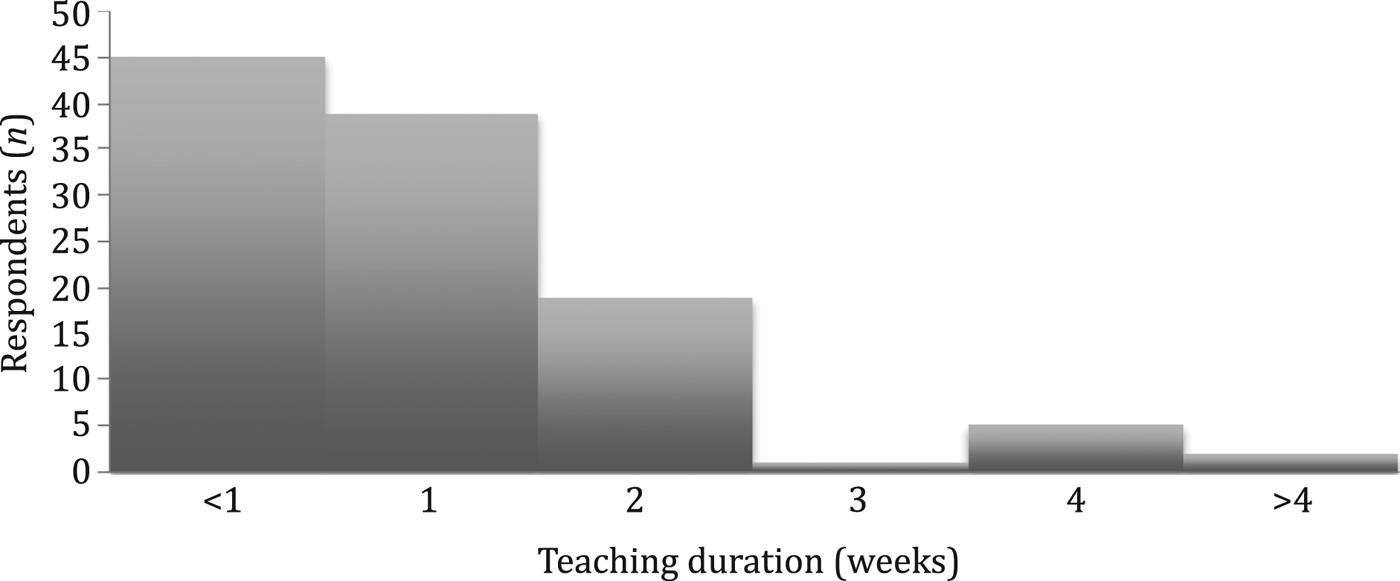
Of 241 junior doctors, 111 completed this survey, giving a response rate of 46 per cent. Sixty per cent were foundation year one doctors and 40 per cent were foundation year two doctors. The average undergraduate exposure to ENT surgery was 8.1 days (Figure 1).
Duration of undergraduate teaching in otolaryngology.

We asked junior doctors where direct pressure should be applied during epistaxis. Forty-one per cent reported that they would apply pressure to the nasal bones, whilst 59 per cent would correctly apply pressure to the ala nasi (cartilaginous part of the nose). On average, junior doctors reported that they would apply pressure for 15.8 minutes before re-examination. Sixty-six per cent would manage the patient with the head tilted forward, 26 per cent with the head in the neutral position and 8 per cent with the head tilted back. Thirty-six per cent were aware that ice could also be applied.
Only 18 per cent of foundation doctors felt confident in performing nasal cautery, whilst 82 per cent lacked confidence in this procedure. Thirty-three per cent could name a type of nasal packing that could be used. Twenty-three per cent were aware that balloon tamponade of the posterior choanae, using a Foley catheter or similar, could help arrest posterior epistaxis. Twenty-six per cent were aware of a single vessel that could be ligated to treat refractory epistaxis.
We asked junior doctors if they routinely provided patients with written epistaxis advice. Eighty-seven per cent do not provide written information routinely and 58 per cent of those were unaware of any relevant patient information.
Twenty-nine per cent (n = 32) had never managed epistaxis and 75 per cent lacked confidence in their current ability to manage epistaxis.
Fisher's exact test revealed a highly statistically significant difference in confidence when those who had one week or less exposure to otolaryngology as an undergraduate were compared to those who had two weeks or more exposure (p < 0.0001) (Table I).
Association between confidence in epistaxis management and duration of undergraduate ENT exposure

Total number of responses was 111. Fisher's exact test, p < 0.0001
Discussion
Epistaxis is the most common ENT emergency, accounting for 20 301 emergency admissions in the UK during 2013–2014.5 Its effective management relies upon a systematic approach. Non-ENT specialists often provide the initial management, typically front-line medical staff in A&E departments.
A previous survey from 1993 demonstrated deficits in understanding of basic epistaxis management amongst junior doctors and other staff in the emergency department.Reference McGarry and Moulton3 A range of health professionals working in the A&E department of a single hospital were surveyed. Over 50 per cent of the A&E senior house officers surveyed stated that they would control epistaxis with pressure to the nasal bones.Reference McGarry and Moulton3 It appears little improvement has been made since then. Our results demonstrate that junior doctors still lack understanding of first aid management of epistaxis, with 41 per cent reporting that they would incorrectly apply pressure to the nasal bones. This would appear to support the position that many newly qualified doctors are not proficient in managing common ENT problems.Reference Khan and Saeed2
Nasal cautery forms an important part of the first-line management, and is considered an important proficiency for anyone treating epistaxis.Reference Ho and Chan6 However, in our survey, only 18 per cent felt confident to perform this procedure. This could mean more patients receive nasal packs and subsequent hospital admissions that would otherwise be avoided.
Vital pieces of equipment are often unavailable in many A&E departments.Reference Ho and Chan6 The provision of post-graduate ENT training for junior doctors in these departments is often inadequate, and has been reported as non-existent for up to 20–50 per cent of trainees.Reference McGarry and Moulton3, Reference Sharma, Machen, Clarke and Howard7 In addition, the trend for senior house officer specialty cover in ENT means that junior doctors may be responsible for the initial management of out-of-hours emergencies. Junior doctors often have no previous experience, no confidence and no access to training in the specialty,Reference Davis and McDonald8 with patient safety implications. Without appropriate equipment and training, gaps in basic theoretical and practical knowledge of ENT may not be addressed.
The provision of undergraduate training in otolaryngology at UK medical schools is a longstanding concern amongst ENT surgeons.Reference Neil9 Our results demonstrate a highly significant difference in confidence level between those who had one week or less of undergraduate exposure to otolaryngology and those who had two weeks or more of exposure (p < 0.0001). On average, UK graduates will have 8 days mandatory teaching of otolaryngology during their training.Reference Khan and Saeed2 This was also the finding in our survey (mean, 8.1 days). This may represent the only ENT teaching they will receive in their medical training. There is limited opportunity to acquire the essential skills and understanding for common ENT problems. Furthermore, our results show that those with more exposure than the national average were almost eight times more likely to have confidence in managing epistaxis than those with one week or less of training.
By 2017, Health Education England will ensure that all junior doctors experience front-line community posts in foundation training.1 There is also a focus on more community delivered care, and a move to strengthen the general practitioner workforce, with a target of recruiting 50 per cent of UK medical graduates into general practitioner training by 2015.10 Common ENT problems, including epistaxis, form a quarter of adultReference Griffiths11 and half of paediatric consultations,Reference Donnelly, Quraishi and McShane12 emphasising the importance of adequate ENT training during undergraduate and foundation training years to enable these doctors to provide appropriate management.
• A survey was conducted, assessing current junior doctors' understanding and confidence in epistaxis management
• A significant proportion of junior doctors lacked understanding and confidence in basic first aid and adjunctive management of epistaxis
• Confidence in epistaxis management was significantly affected by the duration of specialty undergraduate teaching (p < 0.0001)
• Current limited undergraduate exposure to ENT surgery in UK medical schools (8.1 days) is likely to be an important factor
• A minimum emergency safe competency should be a priority during foundation training if this is not being achieved in UK medical schools
Junior doctors in A&E are keen to have more ENT post-graduate teaching to gain confidence and competency in basic skills.Reference Sharma, Machen, Clarke and Howard7 In addition, it has been suggested that ENT training could be moved to the post-graduate stage, where it may be more clinically relevant.Reference Sharma, Machen, Clarke and Howard7 Post-graduate ENT skills courses do exist, but giving responsibility to hospitals' busy ENT departments to co-ordinate these for all junior doctors will be logistically challenging, especially during a busy junior doctor's timetable. Perhaps short training sessions throughout the foundation training, whilst utilising existing e-learning resources such as e-Learning for Otolaryngology Head and Neck Surgery (‘e-lefENT’),13 would be more feasible.
Conclusion
Junior doctors still lack understanding and confidence in the management of epistaxis. This has patient safety implications as foundation doctors' involvement in A&E and primary care increases. The limited undergraduate exposure to ENT surgery in UK medical schools is likely to be an important factor and significantly affects junior doctors' confidence. Junior doctors recognise gaps in their knowledge and are keen to address them. E-learning resources may provide a useful tool to teach theory alongside practical skills sessions where closer tuition can be provided. Epistaxis is a common and potentially life-threatening emergency that non-ENT doctors may face at any stage of training; therefore, a minimum emergency safe competency should be a priority during foundation training if this is not being achieved in the short clinical attachments at UK medical schools.
Appendix 1. Epistaxis management: how confident are you?
Please complete the following questionnaire on the management of epistaxis (circle one response):
1. Current training grade:

FY1 FY2
2. During simple epistaxis, where should the patient apply pressure to the nose?
Point 1 Point 2
3. How long should pressure be applied before checking for haemostasis?
<5 mins 5–10 mins 10–15 mins 15–20 mins 20–25 mins >25 mins
4. How should the patient position their head?
Head tilted back Held in neutral position Head tilted forward
5. What additional first aid methods are you aware of?
_______________________________________________________________________________________
_______________________________________________________________________________________
6. Where should ice be placed for best results?
Bridge of nose Forehead Nape of neck Mouth
7. Are you confident in the technique of nasal cautery (silver nitrate)?
Yes No
8. Name two types of nasal pack used in the treatment of epistaxis
i)____________________________ ii)________________________________
9. What device can be used to tamponade posterior epistaxis? ______________________
10. Which vessels can be ligated to treat refractory severe epistaxis?
i)________________________ ii)________________________ iii)________________________
11a. Do you routinely provide written patient information following an episode of epistaxis?
Yes No
11b. If ‘No’, why not?
Unaware they existed Unavailable Poor quality
Other (please specify)_____________________________________________
12. Overall, how confident are you in managing epistaxis?
Not confident Confident Very confident
13. How much exposure to ENT surgery did you have in undergraduate training?
<1 week (__ days) 1 week 2 weeks 3 weeks 4 weeks >4 weeks