1. Introduction
Lamprophyres, lamproites and other mafic–ultramafic alkaline rocks (e.g. kimberlites and orangeites) record information on the depletion and metasomatic processes occurring as deep as the asthenospheric Earth’s mantle and are genetically linked to major events of supercontinent break-up and amalgamation (Krmíček & Chalapathi Rao, Reference Krmíček and Chalapathi Rao2022). Lamprophyres (see Le Maitre et al. Reference Le Maitre, Streckeisen, Zanettin, Le Bas, Bonin and Bateman2002; Krmíček & Chalapathi Rao, Reference Krmíček and Chalapathi Rao2022 for a review) are mesocratic and less commonly holomelanocractic, porphyritic rocks that usually occur as dykes and sills. They are characterized by phenocrysts of euhedral to subhedral mafic anhydrous (commonly hydrothermalized clinopyroxene ± olivine) and hydrous mafic (mica and/or amphiboles) minerals. These phenocrysts are immersed in a groundmass formed by the same mafic minerals in addition to occasional feldspars and/or feldspathoids. Lamprophyres are generally subdivided into three sub-groups, calc-alkaline, alkaline and ultramafic, with a further subdivision based on the proportion of light-coloured and mafic minerals. These rocks usually contain high amounts of K2O and/or Na2O, H2O, CO2, S, P2O5 and Ba. On the other hand, lamproites contain TiO2–Al2O3-poor phenocrystic phlogopite, groundmass poikilitic tetraferriphlogopite, TiO2–K2O richterite, forsteritic olivine, Al2O3–Na2O-poor diopside, non-stoichiometric Fe-rich leucite and Fe-rich sanidine (chemical ranges in Le Maitre et al. Reference Le Maitre, Streckeisen, Zanettin, Le Bas, Bonin and Bateman2002; see also Lustrino et al. Reference Lustrino, Agostini, Chalal, Fedele, Stagno, Colombi and Bouguerra2016 and Krmíček & Chalapathi Rao, Reference Krmíček and Chalapathi Rao2022). All these minerals are not required, but the presence of primary plagioclase, melilite, monticellite, kalsilite, nepheline and Na-rich alkali feldspar, among many others, precludes a rock from being a lamproite. Like lamprophyres, lamproite nomenclature is based on the occurrence of primary minerals. Additionally, lamproites are ultrapotassic (molar K2O/Na2O > 3), perpotassic (molar K2O/Al2O3 > 1), and peralkaline (molar K2O + Na2O/Al2O3 > 1) with Mg# (Mg/(Mg + Fe2+) > 70, FeOTot and CaO < 10 wt %, Ba > 2000 μg/g (commonly > 5000 μg/g), TiO2 from 1 to 7 wt %, Zr > 500 μg/g, Sr > 2000 μg/g, Zr > 500 μg/g and La > 200 μg/g (Foley et al. Reference Foley, Venturelli, Green and Toscani1987; Le Maitre et al. Reference Le Maitre, Streckeisen, Zanettin, Le Bas, Bonin and Bateman2002).
Despite these mineralogical and geochemical differences, lamproites and lamprophyres are produced through low degrees of partial melting of an extensively depleted peridotite subsequently enriched in incompatible elements. The peridotitic source(s) is expected to be refractory because of the high-Fo olivines, Cr-rich spinels, high whole-rock Mg# (>0.70) and low Al2O3–CaO–Na2O contents. In contrast, strong enrichments of large-ion lithophile elements over high-field-strength elements (i.e. high LILE/HFSE ratios) indicate fluids/melts derived by recycling of crustal components and/or carbonatitic metasomatism which results in the formation of phlogopite and/or amphibole-bearing peridotite or veined network (Foley, Reference Foley1992; Tappe et al. Reference Tappe, Jenner, Foley, Heaman, Besserer, Kjarsgaard and Ryan2004, Reference Tappe, Foley, Jenner, Heaman, Kjarsgaard, Romer, Stracke, Joyce and Hoefs2006, Reference Tappe, Foley, Kjarsgaard, Romer, Heaman, Stracke and Jenner2008; Prelević et al. Reference Prelević, Foley, Romer and Conticelli2008, Reference Prelević, Stracke, Foley, Romer and Conticelli2010; A Pandey et al. Reference Pandey, Chalapathi Rao, Chakrabarti, Pandit, Pankaj, Kumar and Sahoo2017 a, b; Fitzpayne et al. Reference Fitzpayne, Giuliani, Hergt, Phillips and Janney2018, Reference Fitzpayne, Giuliani, Roland, Hergt Janney and Phillips2019; Talukdar et al. Reference Talukdar, Pandey, Chalapathi Rao, Kumar, Pandit, Belyatsky and Lehmann2018; R Pandey et al. Reference Pandey, Pandey, Chalapathi Rao, Belyatsky, Choudhary, Lehmann, Pandit and Dhote2019; Choi et al. Reference Choi, Fiorentini, Giuliani, Foley, Stephen and Taylor2020; Casalini et al. Reference Casalini, Avanzinelli, Tommasini, Natali, Bianchini, Prelevic, Matteir and Conticelli2022 and references therein). In the case of highly advanced metasomatism, the primary (i.e. peridotitic) mineralogy can change into a mica–amphibole–rutile–ilmenite–diopside (MARID) assemblage (Foley, Reference Foley1992; Grégoire et al. Reference Grégoire, Bell and le Roex2002; Tappe et al. Reference Tappe, Foley, Kjarsgaard, Romer, Heaman, Stracke and Jenner2008; Conticelli et al. Reference Conticelli, Guarnieri, Farinelli, Mattei, Avanzinelli, Bianchini, Boari, Tommasini, Tiepolo, Prelević and Venturelli2009; Casalini et al. Reference Casalini, Avanzinelli, Tommasini, Natali, Bianchini, Prelevic, Matteir and Conticelli2022 and references therein). Notably, if any of the metasomatic assemblages described above undergoes low degrees (<5 %) of incongruent melting, it can alone reproduce the trace element patterns and isotopic features of lamproites and lamprophyres (and other mafic–ultramafic alkaline rocks like orangeites; Pilet et al., Reference Pilet, Baker and Stolper2008; Tappe et al. Reference Tappe, Foley, Kjarsgaard, Romer, Heaman, Stracke and Jenner2008; Conticelli et al. Reference Conticelli, Guarnieri, Farinelli, Mattei, Avanzinelli, Bianchini, Boari, Tommasini, Tiepolo, Prelević and Venturelli2009; Giuliani et al. Reference Giuliani, Phillips, Woodhead, Kamenetsky, Fiorentini, Maas, Soltys and Armstrong2015; Fitzpayne et al. Reference Fitzpayne, Giuliani, Hergt, Phillips and Janney2018, Reference Fitzpayne, Giuliani, Roland, Hergt Janney and Phillips2019; Casalini et al. Reference Casalini, Avanzinelli, Tommasini, Natali, Bianchini, Prelevic, Matteir and Conticelli2022).
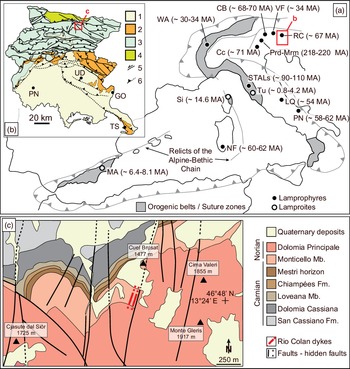
Lamprophyres and lamproites have been widely recognized along the European margin of the Western Mediterranean Sea (Fig. 1a; Section 2). Most of these mafic to ultramafic alkaline magmas are distributed in space and time over the Italian territory, allowing for a wide investigation of the evolution of the lithospheric and asthenospheric mantle underneath the whole peninsula. In this context, rare and small ultramafic dykes in the Julian Alps (Friuli Venezia Giulia Region; Fig. 1a, b; Carulli et al. Reference Carulli, Frizzo, Longo Salvdor, Semenza, Bianchin, Mantovani and Mezzacasa1987) can provide clues regarding the geochemical features of the northeasternmost sector of the mantle beneath the Italian peninsula. This work reports on new mineral chemistry, bulk-rock major, and trace elements for these ultramafic intrusions. We show that these magmas are lamprophyres (i.e. olivine minettes) from the mineralogical point of view but geochemically are more akin to lamproites or orangeites. The source of these occurrences underwent extreme depletion and metasomatic processes resulting in geochemical features distinct from the Western Mediterranean lamprophyre and lamproite magmas. Eventually, U–Pb apatite ages obtained via high-spatial-resolution laser ablation – multi-collector – inductively coupled plasma – mass spectrometer (LA-MC-ICP-MS) geochronology were used to constrain the age of these intrusions and frame them in a clear geodynamic context.
(a) Lamprophyre and lamproite occurrences in the present-day Western Mediterranean area (modified from Prelević et al. Reference Prelević, Foley, Romer and Conticelli2008; Stoppa et al. Reference Stoppa, Rukhlov, Bell, Schiazza and Vichi2014). RC: Rio Colan (this study); Prd-Mrm: Predazzo–Marmolada (Casetta et al. Reference Casetta, Ickert, Mark, Bonadiman, Giacomoni, Ntaflos and Coltorti2019; De Min et al. Reference De Min, Velicogna, Ziberna, Marzoli, Chiaradia and Alberti2020); VF: Val Fiscalina and CB: Corvara in Badia (Lucchini et al. Reference Lucchini, Simboli, Zenatti, Barbieri, Nicoletti and Petrucciani1983); Cc: Calceranica (Galassi et al. Reference Galassi, Monose, Ogniben, Siena and Vaccaro1994); WA: Western Alps (Owen, Reference Owen2008); STALs: Southern Tuscany Alkaline Lamprophyres (Stoppa et al. Reference Stoppa, Rukhlov, Bell, Schiazza and Vichi2014); Tu: Tuscany and MA: Murcia–Almeira (Casalini et al. Reference Casalini, Avanzinelli, Tommasini, Natali, Bianchini, Prelevic, Matteir and Conticelli2022 and references therein); LQ: La Queglia (Vichi et al. Reference Vichi, Perna, Ambrosio, Rosatelli, Cirillo, Broom-Fendley, Vladykin, Zacccaria and Stoppa2022); PN: Pietre Nere (Bigazzi et al. Reference Bigazzi, Laurenzi, Principe and Brocchini1996); NF: Nuraxi–Figus (Maccioni & Marchi, Reference Maccioni and Marchi1994). Age references as reported in the text. (b) Simplified map showing the geological domains and major tectonic lines of the northeastern Southern Alps (after Bressan et al. 2013, Reference Bressan, Barnaba, Bragato, Ponton and Restivo2018): 1. Quaternary deposits; 2. outer Dinaric domain; 3. Maastrichtian to Upper Carboniferous eastern Southern Alps domain; 4. Palaeocarnic Chain; 5. transcurrent faults; 6. major thrust faults. The red square indicates the location of the Rio Colan dykes. TS: Trieste; GO: Gorizia; UD: Udine; PN: Pordenone. (c) Simplified geological map of the Rio Colan Valley intruded by the Rio Colan olivine minettes (after Carulli et al. Reference Carulli, Frizzo, Longo Salvdor, Semenza, Bianchin, Mantovani and Mezzacasa1987). Black triangles indicate mountain peaks, with nearby their names and heights in metres.

2. Main features of the Western Mediterranean lamprophyres and lamproites
2.a. Lamproites
In the Western Mediterranean area, lamproites crop out (Fig. 1a) in Murcia–Almeria in the Betic zone (∼6.4–8.1 Ma; Spain), in northern Corsica (∼14.6 Ma; France) and in the Tuscany Region (∼0.8–4.2 Ma; Central Italy) (Prelević et al. Reference Prelević, Foley, Romer and Conticelli2008, Reference Prelević, Stracke, Foley, Romer and Conticelli2010; Conticelli et al. Reference Conticelli, Guarnieri, Farinelli, Mattei, Avanzinelli, Bianchini, Boari, Tommasini, Tiepolo, Prelević and Venturelli2009; ages are from Casalini et al. Reference Casalini, Avanzinelli, Tommasini, Natali, Bianchini, Prelevic, Matteir and Conticelli2022 and references therein). Overall, lamproites contain variable amounts of K2O (3.5–10.7 wt %) and Mg# (0.45–0.87) with Ni and Cr contents up to 849 and 1039 μg/g, respectively. They have high rare earth element (REE) contents, high LILE/HFSE ratios and show a marked positive Pb anomaly in the primitive-normalized (PM) diagrams. They are characterized by high Rb/Sr and low Ba/Rb ratios and a positive correlation between Th/La and Sm/La (Tommasini et al. Reference Tommasini, Avanzinelli and Conticelli2011). These features, coupled with crustal Sr, Nd and Pb isotopic compositions, imply derivation from the partial melting of a depleted peridotitic lithospheric mantle cross-cut by lawsonite- (i.e. high Th/La and Sm/La component; Tommasini et al. Reference Tommasini, Avanzinelli and Conticelli2011) and phlogopite-bearing (i.e. K-rich) veins which formed during two temporally different events of crustal metasomatism (i.e. vein-plus-wall-rock melting; Foley, Reference Foley1992; Casalini et al. Reference Casalini, Avanzinelli, Tommasini, Natali, Bianchini, Prelevic, Matteir and Conticelli2022 and references therein).
2.b. Lamprophyres
The oldest lamprophyres in Italy crop out at Predazzo and Marmolada (NE Alps; Fig. 1a) and represent the oldest alkaline intrusions in Italy (218–220 Ma, Casetta et al. Reference Casetta, Ickert, Mark, Bonadiman, Giacomoni, Ntaflos and Coltorti2019; De Min et al. Reference De Min, Velicogna, Ziberna, Marzoli, Chiaradia and Alberti2020 and references therein). They have a general potassic affinity (K2O up to ∼4 wt %), variable Mg# (0.30–0.70), Ni (27–237 μg/g) and Cr (14–585 μg/g), and have high light REE (LREE) over heavy REE (HREE) ratios. They do not show enrichment in LILEs and PM-normalized multi-element diagrams, lack Ti and Nb troughs and show negative Pb anomalies. Except for a few occurrences displaying high degrees of fractional crystallization and crustal contamination, Sr, Nd and Pb isotopes of the lamprophyres approach the mid-ocean ridge basalt (MORB) values (Casetta et al. Reference Casetta, Ickert, Mark, Bonadiman, Giacomoni, Ntaflos and Coltorti2019; De Min et al. Reference De Min, Velicogna, Ziberna, Marzoli, Chiaradia and Alberti2020), and it is generally agreed that they derive from the partial melting of phlogopite + amphibole-bearing spinel ± garnet lherzolite (Casetta et al. Reference Casetta, Ickert, Mark, Bonadiman, Giacomoni, Ntaflos and Coltorti2019, Reference Casetta, Ickert, Mark, Giacomoni, Bonadiman, Ntaflos, Zanetti and Coltorti2021; De Min et al. Reference De Min, Velicogna, Ziberna, Marzoli, Chiaradia and Alberti2020). However, whether these alkaline magmas represent a deep mantle section metasomatized during the Variscan orogeny or the transition towards a mantle source progressively exhausting its Varsican imprinting is still debated (see discussion in De Min et al. Reference De Min, Velicogna, Ziberna, Marzoli, Chiaradia and Alberti2020). In addition, Casetta et al. (Reference Casetta, Ickert, Mark, Bonadiman, Giacomoni, Ntaflos and Coltorti2019) reported a possibility of asthenospheric and carbonatitic components during this alkaline magmatism.
The other lamprophyre occurrences span from the Lower Cretaceous to the Oligocene and are localized (Fig. 1a) in the Western Alps (Sesia Lanzo: ∼33–30 Ma (Owen, Reference Owen2008; see Casalini et al. Reference Casalini, Avanzinelli, Tommasini, Natali, Bianchini, Prelevic, Matteir and Conticelli2022 and references therein for another interpretation)), NE Alps (Calceranica: ∼71 Ma (Galassi et al. Reference Galassi, Monose, Ogniben, Siena and Vaccaro1994); Corvara in Badia: ∼68–70 Ma; Val Fiscalina: ∼34 Ma (Lucchini et al. Reference Lucchini, Simboli, Zenatti, Barbieri, Nicoletti and Petrucciani1983)), Tuscany (Southern Tuscany Alkaline lamprophyres: ∼90–110 Ma (Vichi et al. Reference Vichi, Stoppa and Wall2005; Stoppa, Reference Stoppa and Vladykin2008; Stoppa et al. Reference Stoppa, Rukhlov, Bell, Schiazza and Vichi2014)), Abruzzo (La Queglia: ∼54 Ma (Vichi et al. Reference Vichi, Perna, Ambrosio, Rosatelli, Cirillo, Broom-Fendley, Vladykin, Zacccaria and Stoppa2022)), Puglia (Pietre Nere: ∼58–62 Ma (Bigazzi et al. Reference Bigazzi, Laurenzi, Principe and Brocchini1996)) and Southern Sardinia regions (Nuraxi Figus: ∼60–62 Ma (Maccioni & Marchi, Reference Maccioni and Marchi1994)). These magmas are mafic to ultramafic, alkaline and often carbonatitic (Vichi et al. Reference Vichi, Stoppa and Wall2005, Reference Vichi, Perna, Ambrosio, Rosatelli, Cirillo, Broom-Fendley, Vladykin, Zacccaria and Stoppa2022; Stoppa, Reference Stoppa and Vladykin2008 and references therein; Avanzinelli et al. Reference Avanzinelli, Sapienza and Conticelli2012; Stoppa et al. Reference Stoppa, Rukhlov, Bell, Schiazza and Vichi2014; Mazzeo et al. Reference Mazzeo, Arienzo, Aulinas, Casalini, Di Renzo and D’Antonio2018). They are sodic (mol. % K2O/Na2O < 1) to ultrapotassic (mol. K2O/Na2O ∼ 7) with generally high Mg# (0.50–0.91), Ni and Cr (up to 577 and 720 μg/g, respectively), implying they are overall primitive melts. They have high LREE/HREE ratios and show variable enrichments in HFSEs over LILEs. In PM diagrams, Nb, Ta and Ti do not show appreciable negative anomalies, while Pb is more variable, showing marked troughs and slightly positive anomalies (Lucchini et al. Reference Lucchini, Simboli, Zenatti, Barbieri, Nicoletti and Petrucciani1983; Galassi et al. Reference Galassi, Monose, Ogniben, Siena and Vaccaro1994; Vichi et al. Reference Vichi, Stoppa and Wall2005; Bianchini et al. Reference Bianchini, Beccaluva and Siena2008; Stoppa, Reference Stoppa and Vladykin2008; Conticelli et al. Reference Conticelli, Guarnieri, Farinelli, Mattei, Avanzinelli, Bianchini, Boari, Tommasini, Tiepolo, Prelević and Venturelli2009; Avanzinelli et al. Reference Avanzinelli, Sapienza and Conticelli2012; Stoppa et al. Reference Stoppa, Rukhlov, Bell, Schiazza and Vichi2014; Mazzeo et al. Reference Mazzeo, Arienzo, Aulinas, Casalini, Di Renzo and D’Antonio2018). The lamprophyres of the Western Alps and Corvara in Badia are somewhat distinct because they show enrichments in Ba, Th, U, La and Ce and are marked by positive Pb anomalies in PM diagrams, similar to lamproites (Lucchini et al. Reference Lucchini, Simboli, Zenatti, Barbieri, Nicoletti and Petrucciani1983; Peccerillo & Martinotti, Reference Peccerillo and Martinotti2006; Owen, Reference Owen2008; Stoppa, Reference Stoppa and Vladykin2008; Casalini et al. Reference Casalini, Avanzinelli, Tommasini, Natali, Bianchini, Prelevic, Matteir and Conticelli2022). Concerning the Sr, Nd and Pb isotopic compositions, the lamprophyres cover the range encompassing the DMM, HIMU, FOZO and ITEM (Italian End Member reservoir), pointing towards the EMI and EMII mantle reservoirs (Bianchini et al. Reference Bianchini, Beccaluva and Siena2008; Stoppa, Reference Stoppa and Vladykin2008; Conticelli et al. Reference Conticelli, Guarnieri, Farinelli, Mattei, Avanzinelli, Bianchini, Boari, Tommasini, Tiepolo, Prelević and Venturelli2009; Avanzinelli et al. Reference Avanzinelli, Sapienza and Conticelli2012; Stoppa et al. Reference Stoppa, Rukhlov, Bell, Schiazza and Vichi2014; Mazzeo et al. Reference Mazzeo, Arienzo, Aulinas, Casalini, Di Renzo and D’Antonio2018; Vichi et al. Reference Vichi, Perna, Ambrosio, Rosatelli, Cirillo, Broom-Fendley, Vladykin, Zacccaria and Stoppa2022). It is suggested that these magmas derive either from an asthenospheric source (FOZO-like) metasomatized by alkaline carbonatitic agents and another LILE- and volatile-rich reservoir (i.e. ITEM; Owen Reference Owen2008; Stoppa, Reference Stoppa and Vladykin2008; Stoppa et al. Reference Stoppa, Rukhlov, Bell, Schiazza and Vichi2014), or, as for the Pietre Nere and La Queglia lamprophyres, from low degrees (∼3.5–5 %) of partial melting of non-veined spinel- to garnet-peridotite source metasomatized by Na-rich HIMU components and low in k (232Th/238U) (Bianchini et al. Reference Bianchini, Beccaluva and Siena2008; Avanzinelli et al. Reference Avanzinelli, Sapienza and Conticelli2012; Mazzeo et al. Reference Mazzeo, Arienzo, Aulinas, Casalini, Di Renzo and D’Antonio2018; Vichi et al. Reference Vichi, Perna, Ambrosio, Rosatelli, Cirillo, Broom-Fendley, Vladykin, Zacccaria and Stoppa2022). Additionally, Avanzinelli et al. (Reference Avanzinelli, Sapienza and Conticelli2012) indicate that these lamprophyres might also have interacted with a component from the sub-continental lithospheric mantle having radiogenic Sr.
3. Geological background
The Friuli Venezia Giulia region hosts the easternmost portion of the Italian Alps where three chains are sealed together (Fig. 1b; Bressan et al. Reference Bressan, Bragato and Venturini2003, Reference Bressan, Barnaba, Bragato, Ponton and Restivo2018; Carulli, Reference Carulli2006; Ponton, Reference Ponton2010). To the north, the weakly metamorphosed Upper Ordovician to Upper Carboniferous turbiditic sequences with overall NW–SE and NE–SW Variscan structures form the Palaeocarnic Chain. The eastern Southern Alps represent the central part and consist of Upper Carboniferous to Maastrichtian carbonates and volcano-clastic sedimentary sequences. The outer Dinarides to the east comprise the Upper Maastrichtian to Miocene flysch and molasse-related sediments. The eastern Southern Alps and outer Dinarides chains developed from the Upper Cretaceous to the Quaternary period following the Adria microplate indentation with the Eurasian plate (e.g. Bressan et al. Reference Bressan, Bragato and Venturini2003, Reference Bressan, Barnaba, Bragato, Ponton and Restivo2018). Nonetheless, these orogenic processes only partially overprint the Middle Triassic and younger tectonic structures (Ponton, Reference Ponton2010).
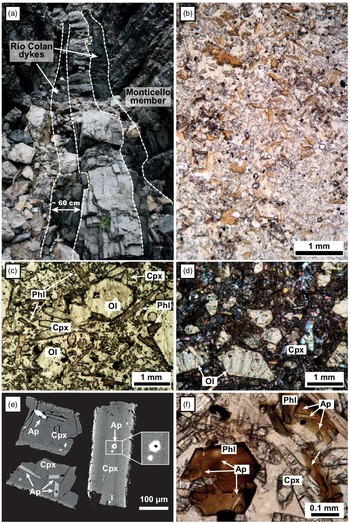
To the north of the eastern Southern Alps domain, within the Julian Alps, in the Rio Colan Valley (north of Aupa Valley; Fig. 1b), a few mafic dykes (up to 60 cm wide) crop out in a small area mainly encompassing the Upper Carnian to Upper Norian Monticello Member and Dolomia Principale Formation (Fig. 1c). The area is affected by major NNE–SSW Dinaric-related dextral faults and minor NW–SE and N–S Dinaric-related faults and fractures (Carulli et al. Reference Carulli, Frizzo, Longo Salvdor, Semenza, Bianchin, Mantovani and Mezzacasa1987). These lineaments are linked to the Meso- and Neoalpine orogenic stages, with some of them likely inherited from older extensional episodes (Carulli et al. Reference Carulli, Cozzi, Masetti, Penarcic, Podda and Ponton2003; Ponton, Reference Ponton2010). The mafic dykes cross-cut the thick (250–500 m) Monticello Member (Fig. 2a) deposited between the Upper Carnian and Lower Norian. This member consists of stratified grey dolostones with marl intercalations (Carulli et al. Reference Carulli, Frizzo, Longo Salvdor, Semenza, Bianchin, Mantovani and Mezzacasa1987; Carulli, Reference Carulli2006; Zanferrari et al. Reference Zanferrari, Masetti, Monegato and Poli2013).
(a) Example of Rio Colan dykes in the field. Note the lack of interaction with the wall rock and the absence of crustal xenoliths. (b, c) Phenocrysts of serpentinized olivines, biotites–phlogopites and clinopyroxene within a holocrystalline to ialocrystalline matrix with intergranular texture. Light brown groundmass represents zeolitized glass. (b) and (c) are high- and low-Mg olivine minette dykes, respectively. (d) Serpentinized olivine due to autohydrothermalism. Note that the matrix and other minerals do not show hydrothermal alteration. (e) Backscattered image of clinopyroxenes with apatite inclusions. Note that not all apatites are linked to fractures. (f) Apatite inclusions in biotite–phlogopite crystals of the high-Mg olivine minette in (b). Note that (f) is a zoom into a portion outside the area reported in (b).

4. Methods
Among four sampled dykes in the Rio Colan Valley near the Cuel Brusat Mountain (Fig. 1c), two were carefully selected for mineral chemical, geochemical and geochronological analyses. Due to the narrow width of the intrusions, six samples were collected from the central part and along the length of each dyke. RC1 (i.e. Rio Colan) to RC3 are from dyke 1, and RC4 to RC6 from dyke 2. RC1, RC2, RC3, RC4 and RC5 were selected for the petrographic and mineral chemical screening. Geochemical analyses were performed on RC2, RC3, RC4 and RC5 samples. Alteration products and secondary minerals were carefully removed using an optical microscope prior to sample preparation for geochemical analyses. Mineral chemical compositions were determined at the Department of Geoscience of the University of Padova, Italy. Whole-rock major and trace elements were analysed at the Department of Geoscience, University of Padua, Italy, and ACME Labs (Vancouver, Canada), respectively.
Samples RC2 and RC5 from dykes 1 and 2, respectively, were further selected to separate apatite crystals for U–Pb geochronology and apatite major element analyses. For both samples, clinopyroxenes were also separated to analyse their apatite inclusions. Apatite and clinopyroxene separation procedures, backscattered electron image (BSE), cathodoluminescence (CL) images and U–Pb dating were performed at the Microscopy and Microanalysis Laboratory (LMic) and Applied Isotope Research Group (AIR-G) of the Department of Geoscience of the Federal University of Ouro Preto, Brazil, following procedures in Lana et al. (Reference Lana, Farina, Gerdes, Alkmim, Gonçalves and Jardim2017, Reference Lana, Gonçalves, Mazoz, Buick, Kamo, Scholz, Wang, Moreira, Babinski and Queiroga2021). Further details on the methodologies adopted (Online Supplementary Materials) and tables (Online Supplementary Tables S1 to S4) are available at https://doi.org/10.1017/S0016756823000183.
5. Results
5.a. Field and petrographic relationships
Dykes are up to 60 cm wide (Fig. 2a) and cut only the local observable upper Triassic sequence. Their length cannot be assessed because they appear as columns of a few tens of metres along a sub-vertical rock face. They are discordant with respect to the stratification of the Monticello Member (Fig. 2a), showing a NE–SW orientation similar to some NNE–SSW and N–S (recent?) faults (Fig. 1c). Fractures likely related to Alpine deformations were also recognized. No crustal xenoliths are visible at the contact with the host rock, but possible crustal contamination will be discussed further below.
Rocks are dominated by abundant phenocrysts of olivine, biotite–phlogopite and clinopyroxenes (Fig. 2b–f). Only olivines are serpentinized and form ∼0.5 to ∼1.5 mm sized euhedral to sub-euhedral crystals (Fig. 2b–d). Biotite–phlogopites form principally laths (up to ∼1 mm in length; Fig. 2b, c) and, occasionally, euhedral hexagonal plats (up to ∼0.2 mm in diameter; Fig. 2f). Micas are occasionally rimmed by tetraferriphlogopite. Clinopyroxenes are elongated (from ∼0.2 to ∼0.5 mm in length), sub-euhedral and slightly zoned (Fig. 2b, d, e). The same minerals that form phenocrysts also form the groundmass and are immersed in a holocrystalline to ialocrystalline matrix with an intergranular texture (Fig. 2b–f). Apatite crystals are the most abundant primary accessory minerals and are frequently found as needles in the groundmass or as inclusions in micas and clinopyroxenes (Fig. 2f). In clinopyroxenes, apatite crystals are not always associated with fracture (Fig. 2e) which excludes them from being of secondary origin. Since apatites are included in micas and clinopyroxenes but not in altered olivines, olivines were the first to crystallize, followed by apatites, micas and clinopyroxenes. Other primary minerals are chromites, also included in serpentinized olivines (Fig. 2c, d), and in lesser amounts magnetites. Secondary phases (i.e. carbonate-filling vacuoles, zeolites substituting glassy patches and/or foids, and albite) are rare.
5.b. Mineral chemistry
Clinopyroxenes have homogeneous diopsidic composition (Wo46–55En30–46Fs6–21; Online Supplementary Table S2) being consistent with those documented in worldwide potassic-alkaline magmatic suites such as Asunción –Sapucai Graben (Cundari & Comin-Chiaramonti, Reference Cundari, Comin-Chiaramonti, Comin-Chiaramonti and Gomes1996) and Roman Province (Cundari & Ferguson, Reference Cundari and Ferguson1982) (Fig. 3a). Furthermore, Rio Colan clinopyroxenes plot above the Si + Al = 2 line (Fig. S1 in Online Supplementary Figures) corresponding to the full occupancy of Si and Al in the tetrahedral site. Consequently, a small amount of Al in the octahedral site is also present as AlVI. Ti vs AlTot (Fig. 3b) shows a positive relationship with clinopyroxenes plotting between the lamproite-transitional fields represented by the clinopyroxenes derived from mica-rich lamprophyres (i.e. minette) (Mitchell & Bergman, Reference Mitchell and Bergman1991; Lustrino et al. Reference Lustrino, Agostini, Chalal, Fedele, Stagno, Colombi and Bouguerra2016).
Clinopyroxenes classification. (a) Ca–Mg–Fe pyroxene classification diagram. RP cpx: Roman Province clinopyroxene from Cundari and Ferguson (Reference Cundari and Ferguson1982); ASU cpx: Asunción–Sapucai Graben clinopyroxene from Cundari and Comin-Chiaramonti (Reference Cundari, Comin-Chiaramonti, Comin-Chiaramonti and Gomes1996). (b) Ti vs AtTot for the Rio Colan clinopyroxenes (modified after Mitchell, Reference Mitchell1995; Lustrino et al. Reference Lustrino, Agostini, Chalal, Fedele, Stagno, Colombi and Bouguerra2016). Minette field from Mitchell (Reference Mitchell1995). T cpx: transitional clinopyroxenes from Lustino et al. (Reference Lustrino, Agostini, Chalal, Fedele, Stagno, Colombi and Bouguerra2016 and references therein).

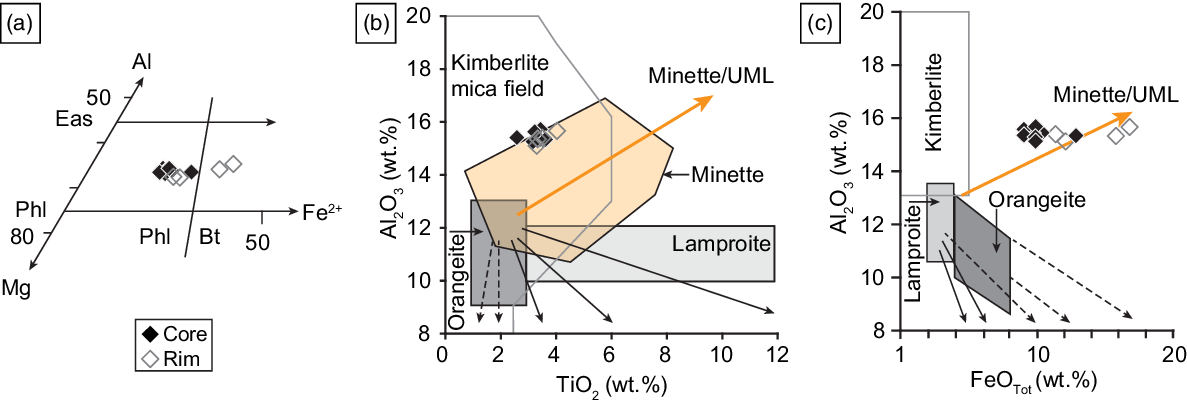
Micas are classified as biotite–phlogopites (Fig. 4a), with the Mg# ranging from 0.59 to 0.78 (Online Supplementary Table S2). Indeed, Al2O3 is high and similar between cores and rims around 15–16 wt %. TiO2 shows similar behaviour to that seen for Al2O3, while FeOTot is more enriched in the rims (11.40 to 16.81 wt %) than in the cores (9.06–12.87 wt %). In Fig. 4b (Al2O3 vs TiO2), micas plot at the limit between the minettes and kimberlite fields (Mitchell, Reference Mitchell1995; Chalapathi Rao et al. Reference Chalapathi Rao, Gibson, Pyle and Dickin2004), whereas with regard to FeOTot (Fig. 4c), the crystals plot along with the minette/ultramafic lamprophyre trend (Mitchell, Reference Mitchell1995; Tappe et al. Reference Tappe, Jenner, Foley, Heaman, Besserer, Kjarsgaard and Ryan2004).
Micas classification. (a) Mg–Al–Fe2+ diagram and (b) TiO2 vs Al2O3 and (c) FeOTot vs Al2O3 diagrams (in wt %) for the Rio Colan micas. Diagrams modified from Mitchell (Reference Mitchell1995), Chalapathi Rao et al. (Reference Chalapathi Rao, Gibson, Pyle and Dickin2004) and Tappe et al. (Reference Tappe, Jenner, Foley, Heaman, Besserer, Kjarsgaard and Ryan2004).

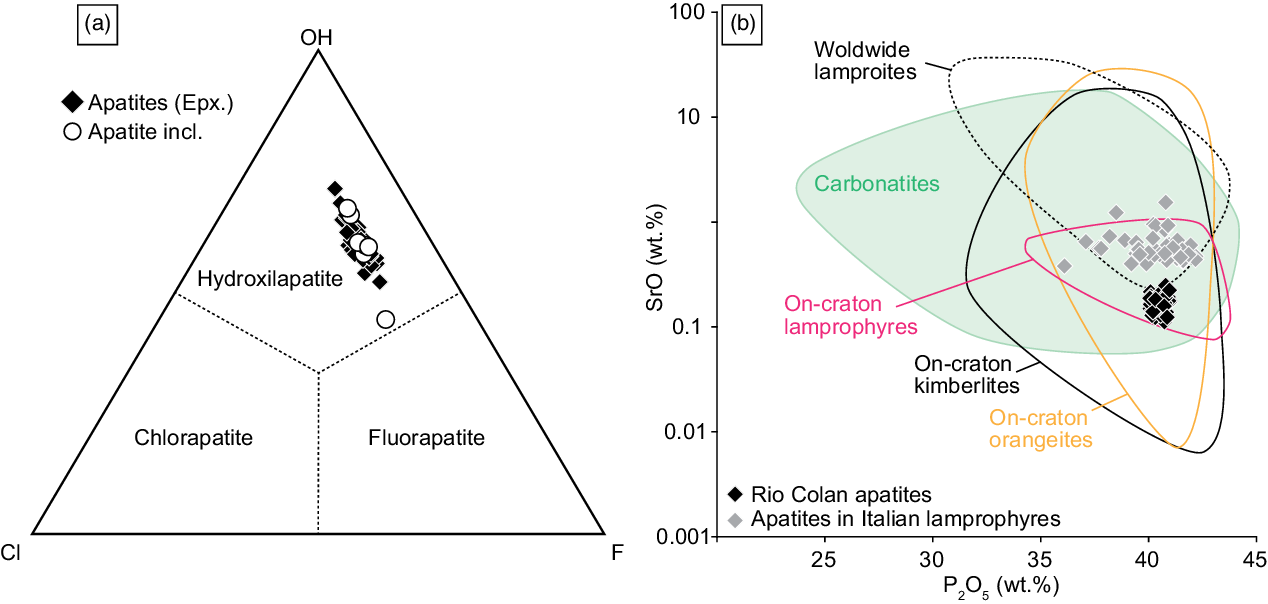
The chemical formula and OH contents of apatites were recalculated using Ketcham (Reference Ketcham2015) workflow (Online Supplementary Table S2). Handpicked apatites have low F (0.34–0.69 atom per formula unit (apfu)) and Cl (0.23–0.30 apfu) but high OH (1.04–1.43 apfu) contents. This classifies apatites as hydroxylapatite (Fig. 5a) because of their low F/OH and Cl/OH ratios (0.24–0.66 and 0.16–0.28, respectively). Apatite crystals included in clinopyroxenes are also hydroxylapatites (F = 0.42–0.79 apfu; Cl = 0.23–0.32 apfu; OH = 0.89–1.35 apfu; F/OH = 0.31–0.89; Cl/OH = 0.17–0.23). Note that all apatite crystals tend to have more F than Cl (F/Cl = 1.48–2.77). In addition, apatites show P2O5 (40.06–40.98 wt %) and SrO (0.09–0.25 wt %) contents comparable to similar crystals from calc-alkaline and ultramafic on-craton lamprophyres (Dalton et al. Reference Dalton, Giuliani, O’Brien, Phillips and Hergt2019; Choi et al. Reference Choi, Fiorentini, Giuliani, Foley, Stephen and Taylor2020; Soltys et al. Reference Soltys, Giuliani and Phillips2020), worldwide on-craton orangeites, on-craton kimberlites and carbonatites (data from Soltys et al. Reference Soltys, Giuliani and Phillips2020). Rio Colan apatites plot outside the area of worldwide lamproites (i.e. Soltys et al. Reference Soltys, Giuliani and Phillips2020) and show much lower SrO contents compared to other Italian lamprophyres (Stoppa, Reference Stoppa and Vladykin2008; Stoppa et al. Reference Stoppa, Rukhlov, Bell, Schiazza and Vichi2014). Note that the apatites from Italian lamprophyres have composition indistinguishable from other mafic–ultramafic on–off craton rocks.
(a) Apatites classification based on the Cl–F–OH diagram (after Patiño Douce et al. Reference Patiño Douce, Roden, Chaumba, Fleisher and Yogodzinski2011). Epx.: apatites mounted in epoxy resin and analysed before dating; incl.: apatites included in clinopyroxenes of Figure 2e. (b) P2O5 (wt %) vs SrO (wt %) diagram of apatites in mafic–ultramafic alkaline magmas. Apatites in Italian lamprophyres: Stoppa (Reference Stoppa and Vladykin2008) and Stoppa et al. (Reference Stoppa, Rukhlov, Bell, Schiazza and Vichi2014). Apatites in on-craton lamprophyres: Choi et al. (Reference Choi, Fiorentini, Giuliani, Foley, Stephen and Taylor2020), Dalton et al. (Reference Dalton, Giuliani, O’Brien, Phillips and Hergt2019) and Soltys et al. (Reference Soltys, Giuliani and Phillips2020). Apatite in lamproites, orangeites, kimberlites and carbonatites are from Soltys et al. (Reference Soltys, Giuliani and Phillips2020).

Spinels are all magnesio-chromites [Cr# (Cr/Cr + Al) = 0.70–0.78; Mg# (Mg/Mg + Fe2+) = 0.42–0.55], with low Fe2+/Fe3+ ratio (1.51–3.27), and relatively high TiO2 (0.52–1.38 wt %) and Al2O3 (10.12–12.18 wt %) except for one grain (Online Supplementary Table S2). These values would resemble those of magmatic spinels found in kimberlites and arc to alkaline–carbonate-rich magmas. Two oxides were also analysed and classified as Ti-magnetites (TiO2 = 5.17–5.26 wt %; FeOTot = 80.22–82.61 wt %). Eventually, the few analyses on groundmass feldspar grains classify them as FeOTot-poor (FeOTot = 0.24–0.69) orthoclase (Or53–78Ab18–35An1–12).
5.c. LA-MC-ICP-MS U–Pb apatite ages
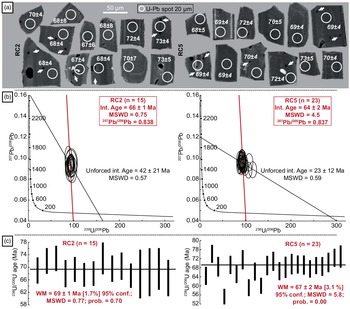
Handpicked apatite crystals under CL show euhedral to sub-euhedral stubby and prismatic shapes with a wide range of length:width ratios (0.5:1 < L:W < 2:2; Fig. 6a). Almost all the crystals have diameters ≤50 μm. The grains are fracture-free and show a core-to-rim magmatic oscillatory zoning. For RC2 and RC5 dykes, only 15 and 23 U–Pb apatite dates were suitable for the Tera–Wasserburg concordia diagram. Analyses are presented without correction for common Pb. Except for a few grains in RC5 (Fig. 6b), all remaining apatites have not developed enough spread in common Pb / radiogenic Pb (Fig. 6b), which would have resulted in a linear array on the concordia diagram (Chew et al. Reference Chew, Sylvester and Tubrett2011). Other low-U co-genetic minerals with very low in-growth radiogenic Pb were not analysed because they were absent (e.g. titanite) or rare and too small (e.g. feldspar). Therefore, to obtain the initial Pb composition, we used the same strategy adopted by Chew et al. (Reference Chew, Sylvester and Tubrett2011 and references therein), Pochon et al. (Reference Pochon, Poujol, Gloaguen, Branquet, Cagnard, Gumiaux and Gapais2016) and Lana et al. (Reference Lana, Gonçalves, Mazoz, Buick, Kamo, Scholz, Wang, Moreira, Babinski and Queiroga2021). On the Tera–Wasserburg diagram, we firstly projected the unforced discordia (black line in Fig. 6b) to obtain a lower intercept date (x-axes) to calculate the initial 207Pb/206Pb using the two-stage terrestrial Pb evolution model of Stacey and Kramers, (Reference Stacey and Kramers1975). Afterwards, the data were plotted again to construct a discordia anchored (red line) to the estimated 207Pb/206Pb from the evolution model. For the RC2 sample, the unforced lower intercept gives a date of 42 ± 21 Ma (2SE; MSWD = 0.56) identical, within the error, with the unforced discordia of RC5 dyke (23 ± 12 Ma 2SE; MSDW = 0.59). Once both ages are anchored to an estimated 207Pb/206Pb ratio of 0.838 for RC2 and 0.387 for RC5, the resulting forced discordia ages were 66 ± 1 Ma (2SE; MSDW = 0.75) and 64 ± 2 Ma (2SE; MSWD = 4.5) for RC5 and RC2, respectively (Fig. 6b). It is worth reporting that some spots (Fig. 6a) appear to have ablated zoned domains of the apatite grains. However, all but three weighted mean ages are consistent with each other, which excludes any mixed age (Fig. 6c). In this regard, the 207Pb/238U weighted average date for RC2 is 69 ± 1 Ma (2SE; MSWD = 0.77; n = 15) which is, considering the error, only 1 Ma older than the anchored age, and up to ∼30 Ma older than the unforced age. Conversely, the 207Pb/238U weighted average date of RC5 is 67 ± 2 Ma (2SE; MSWD = 5.8; n = 23), which is identical within the error with forced age, yet older by ∼45 Ma than the unforced age.
Apatites cathodoluminescence and geochronology. (a) CL images of the apatite crystals dated from the RC2 and RC5 dykes. White arrows indicate electron microprobe analyser (EMPA) spot analyses whose results are reported in Figure 5. Ages near the spots are 206Pb/238U weighted mean ages showing good age agreement despite some spots ablated zoned parts of the apatites. (b) Tera–Wasserburg concordia diagrams and (c) 206Pb/238U weighted mean ages of the Rio Colan apatites.

5.d. Whole-rock geochemistry
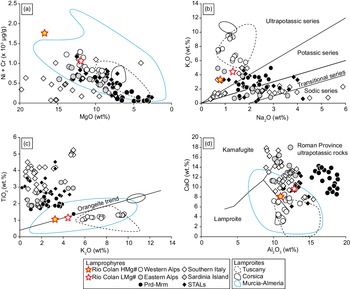
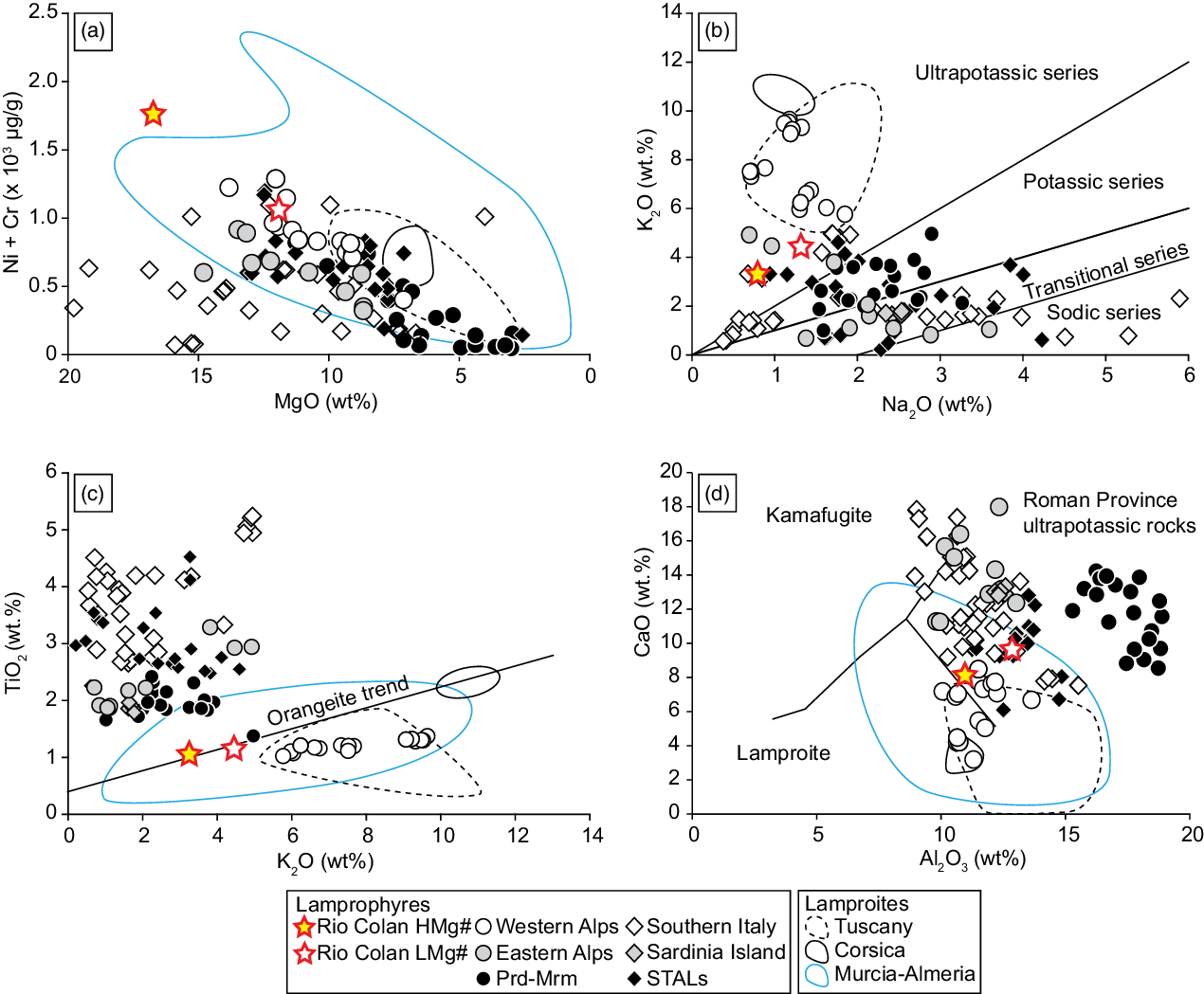
In the mafic–felsic-weathering (MFW) (Fig. S2 in Online Supplementary Figures) of Ohta and Arai (Reference Ohta and Arai2007), all whole-rock analyses show a weathering index W well below 30 % of the cut-off line diagram, indicating dykes 1 and 2 had negligible element mobility. Therefore, for each dyke, we used the averaged whole-rock analyses (Online Supplementary Table S1). The most striking difference between dykes 1 and 2 is the different MgO content (11.9 and 16.7 wt %, respectively) corresponding to an Mg# of 0.73 and 0.79 (for an assumed Fe2O3/FeO = 0.20), respectively. Dyke 1 with low Mg# (Rio Colan LMg#) shows Cr and Ni contents (862 and 198 μg/g, respectively) lower than those displayed by dyke 2 high in Mg# (Rio Colan HMg#; Cr and Ni = 1416 and 360 μg/g, respectively). Figure 7a reports the sum of these minor compatible elements against the relative MgO content of both dykes to highlight these features better. Rio Colan LMg# dyke is Ne-normative, has K2O + Na2O = 5.8 wt %, an agpaitic index (AI = (K + Na)/Al) mol.%) = of 0.54 and K2O/Al2O3 of 0.37 (mol. %). Rio Colan HMg# is Ol- and Hy-normative, has K2O + Na2O = 4.1 wt %, with A.I = 0.44 and K2O/Al2O3 of 0.32 (mol. %). Nevertheless, Rio Colan LMg# and HMg# dykes show nearly similar high K2O (3.3–4.4 wt %), CaO (8.2–9.6 wt %), Al2O3 (11–13 wt %) and TiO2 (1.07–1.13 wt %) contents (Fig. 7b–d). Both dykes display high abundances in Ba (3452–3974 μg/g) and La (113–135 μg/g), while Zr and Sr are relatively low (112–139 and 362–549 μg/g, respectively; Online Supplementary Table S1).
Major (wt %; loss-on-ignition-(LOI)-free basis) and minor elements (μg/g) variation diagrams. (a) MgO vs Ni + Cr, (b) Na2O vs K2O, (c) K2O vs TiO2 and (d) Al2O3 vs CaO. Note that in (a) the Rio Colan olivine minettes are one of the most primitive magmatic products among the lamprophyres and lamproites used for comparison, and in (c) the same rocks plot along with the orangeite trend like other lamproite magmas. Orangeite (i.e. South African group II kimberlites) trend from Becker and Le Roex (Reference Becker and Le Roex2006). (d) modified after Foley et al. (Reference Foley, Venturelli, Green and Toscani1987). Rio Colan HMg# and LMg# indicate Rio Colan dykes showing high and low Mg#, respectively. Lamprophyres: Prd-Mrm (Predazzo–Marmolada): Casetta et al. (Reference Casetta, Ickert, Mark, Bonadiman, Giacomoni, Ntaflos and Coltorti2019) and De Min et al. (Reference De Min, Velicogna, Ziberna, Marzoli, Chiaradia and Alberti2020); Eastern Alps (Corvara in Badia, Val Fiscalina and Calceranica): Lucchini et al. (Reference Lucchini, Simboli, Zenatti, Barbieri, Nicoletti and Petrucciani1983), Galassi et al. (Reference Galassi, Monose, Ogniben, Siena and Vaccaro1994) and Stoppa (Reference Stoppa and Vladykin2008); Western Alps: Owen (Reference Owen2008), Peccerillo and Martinotti (Reference Peccerillo and Martinotti2006); STALs (Southern Tuscan Alkaline Lamprophyres): Stoppa et al. (Reference Stoppa, Rukhlov, Bell, Schiazza and Vichi2014); Southern Italy (La Queglia and Punte Pietre Nere): Bianchini et al. (Reference Bianchini, Beccaluva and Siena2008), Stoppa (Reference Stoppa and Vladykin2008), Avanzinelli et al. (Reference Avanzinelli, Sapienza and Conticelli2012), Mazzeo et al. (Reference Mazzeo, Arienzo, Aulinas, Casalini, Di Renzo and D’Antonio2018) and Vichi et al. (2022); Sardinia Island (Nuraxi Figus): Maccioni & Marchi, Reference Maccioni and Marchi1994) and Stoppa (Reference Stoppa and Vladykin2008). Lamproites from Tuscany (Italy), Corsica Island (France) and Murcia–Almeira (Spain) are from Conticelli et al. (Reference Conticelli, Guarnieri, Farinelli, Mattei, Avanzinelli, Bianchini, Boari, Tommasini, Tiepolo, Prelević and Venturelli2009), Lustrino et al. Reference Lustrino, Agostini, Chalal, Fedele, Stagno, Colombi and Bouguerra2016) and Casalini et al. (Reference Casalini, Avanzinelli, Tommasini, Natali, Bianchini, Prelevic, Matteir and Conticelli2022). For the Pietre Nere we used only the less evolved magmas.
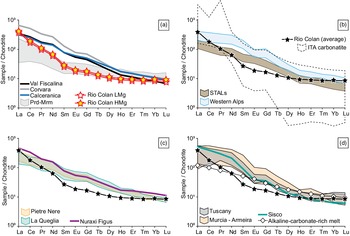
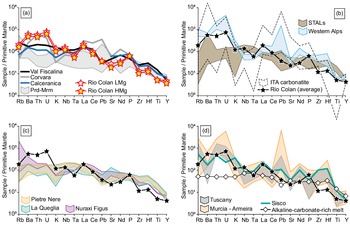
Chondrite-normalized diagrams (CN; recommended chondrite; Boynton Reference Boynton and Henderson1984) and primitive-mantle-normalized spider plots (PM; McDonough & Sun, Reference McDonough and Sun1995) are reported in Figures 8 and 9, respectively. Both Rio Colan LMg# and HMg# dykes show similar REE patterns as seen by the relatively uniform La/YbCN (42–49), La/CeCN (∼2.2) La/SmCN (14–15), Sm/DyCN (2.5–2.7), Dy/YbCN (1.1–1.3) and Eu/Eu* (0.85–0.93) ratios (Fig. 8a). These ratios indicate LREE enrichment over MREE and HREEs with a negligible Eu negative anomaly. Such homogeneity is also seen for the incompatible elements, with both dykes showing, in addition to high Ba, Th and U abundances, positive anomalies in Nb (La/NbPM = 1.4) and P (P/NdPM = 1.9–2.2) while no anomaly in Pb is detected (Fig. 9a).
Chondrite-normalized rare earth elements (REECN) patterns for the Rio Colan olivine minettes and the other lamprophyres and lamproites of the Western Mediterranean. From (a) to (d) Rio Colan REEs patterns are compared against those of the Italian lamprophyres and Italian, French and Spanish lamproites. In (b–d), Rio Colan magmas are reported as average. In (b), Italian carbonatitic magmatism is from Stoppa et al. (Reference Stoppa, Pirajno, Schiazza and Vladykin2016, Reference Stoppa, Schiazza, Rosatelli and Castorina2019). In (d), alkaline–carbonate-rich melt is from Suns and McDonough (Reference Sun and McDonough1989). Nuraxi Figus lamprophyres and Sisco lamproites are average values. Data sources as in Figure 7.


6. Discussions
6.a. Classification of the Rio Colan dykes
Rio Colan dykes show the preservation of equilibrium of phenocrysts of olivine + biotite–phlogopite + diopside + apatite ± opaques. This equilibrium implies these are mafic minettes, that is, primitive magmas (or primitive minettes) (Esperança & Holloway, Reference Esperança and Holloway1987; O’Brien et al. Reference O’Brien, Irving and McCallum1991; Tingey et al. Reference Tingey, Christiansen, Best, Ruiz and Lux1991; Canning et al. Reference Canning, Henney, Morrison and Gaskarth1996; Righter & Carmichael, Reference Righter and Carmichael1996; Rukhlov et al. Reference Rukhlov, Blinova and Pawlowicz2013), in agreement with their high Mg# (0.7 and 0.8), Cr (862 to 1416 μg/g) and Ni (198 to 360 μg/g). According to Esperança and Holloway (Reference Esperança and Holloway1987), the preservation of such mineralogical equilibrium indicates magmas were brought to the surface rapidly at ∼1000–1200 °C, a process that also precludes fractionation at lower pressure and temperatures (Esperança & Holloway, Reference Esperança and Holloway1987). This could explain the absence of plagioclase as it would have hampered it from nucleating in the groundmass. Furthermore, Rio Colan olivine minettes have LOI (loss-on-ignition) of 7–8, suggesting high content of volatiles (H2O and CO2), as also supported by the great abundance of hydroxylapatites (Fig. 5a). We argue that this would have suppressed plagioclase, enhancing biotite–phlogopite and diopside precipitation (e.g. Carmichael et al. Reference Carmichael, Lange and Luhr1996), and caused olivine autohydrothermalism (e.g. Tingey et al. Reference Tingey, Christiansen, Best, Ruiz and Lux1991).
Low agpaitic index, low molar K/Al ratio and the Ol- to Ne-normative character for the Rio Colan dykes would further support that these magmas are lamprophyres. The excess of Al in the clinopyroxene octahedral site (Fig. 3b), the high Al2O3 and FeOTot and low TiO2 in biotite–phlogopites (Fig. 4b, c) and FeOTot-poor orthoclases support that the dykes are minette. Likewise, since apatites were among the first minerals to crystallize, their chemistry reflects the nature of the magma. According to their chemistry, Rio Colan LMg# and HMg# magmas are more similar to lamprophyres than lamproites (Fig. 5b). High MgO, Cr, Ni (Cr + Ni), K2O and Al2O3 coupled with low CaO and NaO contents are possible features among lamprophyric magmas (Fig. 7a, b, d), in particular primitive alkaline magmas (Esperança & Holloway, Reference Esperança and Holloway1987; O’Brien et al. Reference O’Brien, Irving and McCallum1991; Tingey et al. Reference Tingey, Christiansen, Best, Ruiz and Lux1991; Canning et al. Reference Canning, Henney, Morrison and Gaskarth1996; Righter & Carmichael, Reference Righter and Carmichael1996; Stoppa, Reference Stoppa and Vladykin2008; Tappe et al. Reference Tappe, Foley, Kjarsgaard, Romer, Heaman, Stracke and Jenner2008; Rukhlov et al. Reference Rukhlov, Blinova and Pawlowicz2013; Stoppa et al. Reference Stoppa, Rukhlov, Bell, Schiazza and Vichi2014). However, in Rio Colan olivine minettes, LREE, LILEs (except for Pb) and HFSE variations are in between those reported for Corvara in Badia, Val Fiscalina, Calceranica, La Queglia and Pietre Nere lamprophyres, and to a lesser extent mirror the Western Alps minettes (Figs 8a–c, 9a–c; Bianchini et al. Reference Bianchini, Beccaluva and Siena2008; Owen, Reference Owen2008; Stoppa, Reference Stoppa and Vladykin2008; Conticelli et al. Reference Conticelli, Guarnieri, Farinelli, Mattei, Avanzinelli, Bianchini, Boari, Tommasini, Tiepolo, Prelević and Venturelli2009; Avanzinelli et al. Reference Avanzinelli, Sapienza and Conticelli2012; Mazzeo et al. Reference Mazzeo, Arienzo, Aulinas, Casalini, Di Renzo and D’Antonio2018). Less evident is a similarity with Southern Tuscany Alkaline Lamprophyres (STALs) and Predazzo–Marmolada counterparts (Figs 8a, b, and 9a, b; Stoppa et al. Reference Stoppa, Rukhlov, Bell, Schiazza and Vichi2014; Casetta et al. Reference Casetta, Ickert, Mark, Bonadiman, Giacomoni, Ntaflos and Coltorti2019; De Min et al. Reference De Min, Velicogna, Ziberna, Marzoli, Chiaradia and Alberti2020). On the other hand, major, minor and incompatible elements variations in Rio Colan olivine minettes also resemble those found in Tuscan, Sisco and Murcia–Almeria lamproites (Prelević et al. Reference Prelević, Foley, Romer and Conticelli2008, Reference Prelević, Stracke, Foley, Romer and Conticelli2010; Conticelli et al. Reference Conticelli, Guarnieri, Farinelli, Mattei, Avanzinelli, Bianchini, Boari, Tommasini, Tiepolo, Prelević and Venturelli2009; Casalini et al. Reference Casalini, Avanzinelli, Tommasini, Natali, Bianchini, Prelevic, Matteir and Conticelli2022). This is particularly evident considering the major element variation (Fig. 7) and the low Ti, Zr and Sr coupled with high Ba, Th, U and La concentrations (Fig. 9). Pb is less abundant and shows no anomaly with respect to lamproite magmas. We therefore argue that while Rio Colan magmas are olivine minettes from the petrographic and mineral chemistry point of view, their geochemical signature shares affinities with lamprophyres and lamproites.
6.b. Petrogenetic aspects
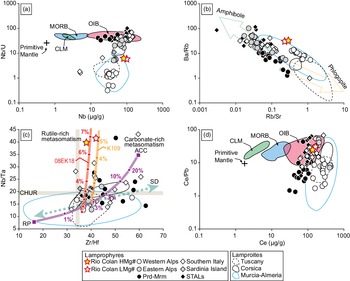
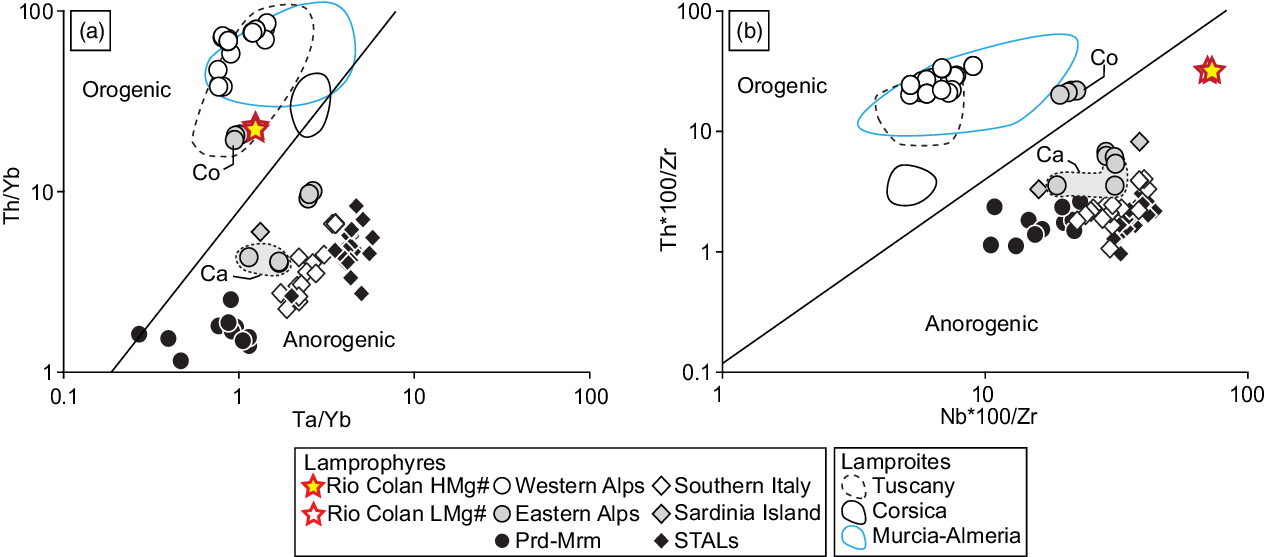
Rio Colan olivine minettes are one of the most primitive magmas among the Western Mediterranean lamprophyres and lamproites (Fig. 7a). The high MgO and Cr + Ni contents coupled with a low Dy/YbCN and flat HREE pattern (Fig. 8a) suggest that Rio Colan olivine minettes were derived from a depleted peridotitic source that underwent very low degrees of partial melting in the presence of possible residual olivine and garnet (e.g. Becker & Le Roex, 2007). On the other hand, high K2O content, high La/SmCN ratios, and LILE enrichments (Figs 7b, 8a, 9a, respectively) indicate that this depleted peridotitic source had been hydrated and enriched in incompatible elements prior to the melting event (Foley et al. Reference Foley, Venturelli, Green and Toscani1987; Tappe et al. Reference Tappe, Foley, Jenner, Heaman, Kjarsgaard, Romer, Stracke, Joyce and Hoefs2006, Reference Tappe, Foley, Kjarsgaard, Romer, Heaman, Stracke and Jenner2008; Conticelli et al. Reference Conticelli, Guarnieri, Farinelli, Mattei, Avanzinelli, Bianchini, Boari, Tommasini, Tiepolo, Prelević and Venturelli2009; Prelević et al. Reference Prelević, Stracke, Foley, Romer and Conticelli2010; Stoppa et al. Reference Stoppa, Rukhlov, Bell, Schiazza and Vichi2014; Fitzpayne et al. Reference Fitzpayne, Giuliani, Hergt, Phillips and Janney2018, Reference Fitzpayne, Giuliani, Roland, Hergt Janney and Phillips2019 and references therein; Lustrino et al. Reference Lustrino, Agostini, Chalal, Fedele, Stagno, Colombi and Bouguerra2016). However, it is unlikely that the recycling of oceanic crustal material triggered such metasomatism, given the lack of any positive Pb anomaly in the Rio Colan olivine minettes. Low Nb/U but high Nb (Fig. 10a) would argue against sediment-derived metasomatism, yet this is challenged by the ultrapotassic nature of the Rio Colan magmas, and their high Th/Yb (22 to 23; Fig. 11a) and Ba contents. The slightly negative Th anomaly and Th/UPM < 1 (0.73–0.80) indicate that crustal metasomatism would have acted in the form of melt(s) rather than fluid(s) (e.g. Conticelli et al. Reference Conticelli, Guarnieri, Farinelli, Mattei, Avanzinelli, Bianchini, Boari, Tommasini, Tiepolo, Prelević and Venturelli2009). Low Ba/Th (89 to 95) and high La/SmCN (14.4 to 14.9) ratios support this observation. This enrichment in incompatible elements allowed the precipitation of hydrated minerals in the source region. The Rb/Sr vs Ba/Rb diagram (Fig. 10b) would suggest an equal amount of phlogopite and amphibole, but the lack of amphibole in the Rio Colan olivine minettes would indicate the presence of phlogopite in the source.
Elemental ratios (μg/g). (a) Nb/U vs Nb, (b) Ba/Rb vs Rb/Sr, (c) Nb/Ta vs Zr/H and (d) Ce/Pb vs Ce. (a) and (d) are modified from Owen (Reference Owen2008); in (a) MORB is mid-ocean ridge basalt, OIB is ocean island basalt and CLM is continental lithosphere mantle. (b) is modified from Tommasini et al. Reference Tommasini, Avanzinelli and Conticelli2011) and (c) from Aulbach et al. (Reference Aulbach, O’Reilly and Pearson2011). In (c), carbonate-rich and rutile-rich metasomatism trends are from Aulbach et al. (Reference Aulbach, O’Reilly and Pearson2011) and Guo et al. (Reference Guo, Fan, Wang and Zhang2004), respectively; RP, ACC and SD represent the residual peridotite, the average composition of the carbonatite component and the silicate differentiation trend, respectively (after Aulbach et al. Reference Aulbach, O’Reilly and Pearson2011). Data sources as in Figure 7.

Tectonomagmatic diagrams. (a) Th/Yb vs Ta/Yb and (b) Th*100/Zr vs Nb*100/Zr. In both diagrams, Co and Ca indicate Corvara in Badia and Calceranica lamprophyres. Data sources as in Figure 7.

In addition, the Rio Colan minettes show superchondritic Nb/Ta ratios, higher than the other lamprophyres and lamproites reported here (Fig. 10c). Only a few Predazzo–Marmolada and STALs lamprophyres show high Nb/Ta ratios. Such high ratios exclude the involvement of amphiboles in the source or as a crystallizing phase because these minerals cannot produce superchondritic Nb/Ta ratios (Foley et al. Reference Foley, Barth and Jenner2000, Foley et al. Reference Foley, Tiepolo and Vannucci2002; Tiepolo et al. Reference Tiepolo, Vannucci, Oberti, Foley, Bottazzi and Zanetti2000; A Pandey et al. Reference Pandey, Chalapathi Rao, Chakrabarti, Pankaj, Pandit, Pandey and Sahoo2018 and references therein). This is consistent with the lack of this hydrous mineral in the source (Fig. 10b) and in the Rio Colan olivine minettes (Fig. 2b–f). Conversely, because rutile accommodates in its crystalline structure more Nb than Ta (Foley et al. Reference Foley, Barth and Jenner2000, Foley et al. Reference Foley, Tiepolo and Vannucci2002), high Nb/Ta ratios can reflect rutile-rich metasomatism (Guo et al. Reference Guo, Fan, Wang and Zhang2004; Moayyed et al. Reference Moayyed, Moazzena, Calagaria, Jahangiria and Modjarrad2008; A Pandey et al. Reference Pandey, Chalapathi Rao, Chakrabarti, Pankaj, Pandit, Pandey and Sahoo2018 and references therein; Talukdar et al. Reference Talukdar, Pandey, Chalapathi Rao, Kumar, Pandit, Belyatsky and Lehmann2018). For instance, Guo et al. (Reference Guo, Fan, Wang and Zhang2004) demonstrate that high Nb/Ta in the Sulu orogen lamprophyres might have been derived from a rutile-rich metasomatized source. After carbonatitic metasomatism, the source achieved a superchondritic Nb/Ta ratio when rutile was extracted from an ultra-high-pressure eclogite and dissolved in the melt that metasomatized the mantle (Guo et al. Reference Guo, Fan, Wang and Zhang2004). Aulbach et al. (Reference Aulbach, O’Reilly and Pearson2011) provide more constraints on this process, showing that it can be achieved when a mantle source, previously metasomatized by a carbonatitic agent, reacts with a Ti-rich (TiO2 > 2 wt %) ocean island basanite that can fractionate considerable amounts of rutile. According to those authors, in the case of MARID and metasomatized peridotite rocks, rutile must fractionate before the accumulation or addition of phlogopite, rutile, ilmenite and secondary clinopyroxene. Interestingly, by using the same modelling approach, the same geochemical parameters and alkaline–carbonate-rich melt composition (K109 basanite; TiO2 = 2.47 wt %; MgO = 15.5 wt %; Mg# = 0.71; Zr/Hf = 38.9; Nb/Ta = 16.4; Chauvel et al. Reference Chauvel, Hoffmann and Vidal1992; Pfänder et al. Reference Pfänder, Munker, Stracke and Mezger2007) adopted by Aulbach et al. (Reference Aulbach, O’Reilly and Pearson2011; and details therein) it was possible to explain the high Nb/Ta ratio of the Rio Colan LMg# olivine minette (faded orange trend a in Fig. 10c). Note that the Rio Colan HMg# olivine minette can be explained with a Ti-rich alkaline–carbonate-rich melt showing a lower Zr/Hf ratio. However, for our specific case, this alkaline–carbonate-rich melt must have percolated through the source before the intrusion of the Rio Colan magmas, must have been older than the Rio Colan dykes (see Section 6.c) and must crop out near the investigated area. In literature, hydrous alkaline magmatism that meets these requirements could be related to the middle- to late-Triassic magmatism of the Karawanken area (Miller et al. Reference Miller, Thöni, Goessler and Tessadri2011) and the Italian Dolomites (see Fig. 1a; Casetta et al. Reference Casetta, Ickert, Mark, Bonadiman, Giacomoni, Ntaflos and Coltorti2019; De Min et al. Reference De Min, Velicogna, Ziberna, Marzoli, Chiaradia and Alberti2020). Alkaline–carbonate-rich lamprophyres from the Dolomites cannot be used for our modelling because their Zr/Hf ratios are higher than those of the Rio Colan olivine minettes, or their TiO2 and/or Mg# are too low. On the other hand, the alkaline–carbonate-rich melt-like gabbro 08EK18 of the Karawanken area (Miller et al. Reference Miller, Thöni, Goessler and Tessadri2011; TiO2 = 2.9 wt %; MgO = 11.7 wt %; Mg# = 70; Zr/Hf = 36; Nb/Ta = 12) is close to the composition of K109 basanite and can explain the superchondritic Nb/Ta ratios of the Rio Colan HMg# dykes after fractionating between 6 and 7 % of rutile (Fig. 10c). Although the trajectory of this modelling would also explain the Nb/Ta value of the Rio Colan LMg# dyke, their different Zr/Hf ratios would imply some dependency on the Zr/Hf ratio of the alkaline–carbonate-rich melt that percolated through the carbonated peridotite. Regardless of this point, this alkaline–carbonate-rich melt-mediated rutile fractionation process (Aulbach et al. Reference Aulbach, O’Reilly and Pearson2011) explains why Rio Colan magmas are ultrapotassic, low in Nb/U ratio, high in Nb, and, being alkaline–carbonate-rich, melt-like as shown by the Ce/Pb vs Ce diagram (Fig. 10d). We further notice that the Nb/Ta – Zr/Hf ratios of some of the Western Alps, NE Alps, STAL and Southern Italy lamprophyres can be explained through the same modelling involving ∼4 % of rutile fractionation (Fig. 10c). This is consistent with the presence of Ti-rich minerals in the source of STALs (Stoppa et al. Reference Stoppa, Rukhlov, Bell, Schiazza and Vichi2014). Notably, Rio Colan olivine minettes and many South African on-craton orangeites share similar superchondritic Nb/Ta ratios (cf. Fig. 10c with fig. 6b in Aulbach et al. Reference Aulbach, O’Reilly and Pearson2011) and low TiO2 contents (Fig. 7c) as well as apatite compositions (Fig. 5b).
Another alternative expalanation for the high Nb/Ta ratios is the dependence of high Nb contents with respect to the depth of the source and Al solubility in clinopyroxene (e.g. Baier et al. Reference Baier, Audétat and Keppler2008; De Min et al. Reference De Min, Velicogna, Ziberna, Marzoli, Chiaradia and Alberti2020). Baier et al. (Reference Baier, Audétat and Keppler2008) showed that Nb content in clinopyroxene increases as both tetrahedral Al and the pressure increase. However, as Ta and Nb have the same solubility behaviour in clinopyroxene (Baier et al. Reference Baier, Audétat and Keppler2008), this would result in magmas with low Nb/Ta ratios, which are not observed here. Eventually, we exclude that these ratios reflect the assimilation of country rocks (i.e. carbonates) because (i) we did not see any evidence of carbonate xenoliths in the field (Fig. 2a), (ii) the mineralogy of the Rio Colan olivine minettes requires a high rate of emplacement and crystallization which prevents any crustal assimilation (Esperança & Holloway, Reference Esperança and Holloway1987), and (iii) the high LILE contents of the Rio Colan dykes (Fig. 9a) exclude limestone assimilation as this would lower their LILE contents (e.g. Vichi et al. Reference Vichi, Stoppa and Wall2005).
In summary, our observations imply a depleted peridotitic source(s) that reacted with fluids/melts derived by recycling of crustal components and underwent carbonatitic metasomatism. We stress that this carbonatitic metasomatism cannot be linked to the Quaternary Italian carbonatitic magmatism (Stoppa et al. Reference Stoppa, Pirajno, Schiazza and Vladykin2016, Reference Stoppa, Schiazza, Rosatelli and Castorina2019) due to different geochemical (Figs 8b, 9b; Section 5c) and, mostly, crystallization ages. Afterwards, distinct alkaline–carbonate-rich melts percolated through the metasomatized mantle source(s), leading to rutile-rich metasomatism. Since amphibole was not present in the sources of the Rio Colan magmas, a MARID-like source is excluded although some MARID xenoliths show Nb/Ta and Zr/Hf ratios similar to the Rio Colan olivine minettes (cf. fig. 6b in Aulbach et al. Reference Aulbach, O’Reilly and Pearson2011). Accordingly, we argue that the source(s) was probably a rutile–phlogopite-bearing carbonated peridotite(s). These observations support those studies (Prelević et al. Reference Prelević, Foley, Romer and Conticelli2008, Reference Prelević, Stracke, Foley, Romer and Conticelli2010; Stoppa et al. Reference Stoppa, Rukhlov, Bell, Schiazza and Vichi2014; A Pandey et al. Reference Pandey, Chalapathi Rao, Chakrabarti, Pandit, Pankaj, Kumar and Sahoo2017 a, b; Talukdar et al. Reference Talukdar, Pandey, Chalapathi Rao, Kumar, Pandit, Belyatsky and Lehmann2018; R Pandey et al. Reference Pandey, Pandey, Chalapathi Rao, Belyatsky, Choudhary, Lehmann, Pandit and Dhote2019 and references therein) arguing for multiple metasomatic agents in the genesis of on–off craton lamprophyres and lamproites.
6.c. Geochronological and geodynamic implications
The Rio Colan dykes have a thickness not exceeding 60 cm, implying rapid cooling after intrusion. Since Brime et al. (Reference Brime, Perri, Pondrelli, Spalletta and Venturini2008) showed that the NE sector of the Italian Alps did not experience any thermal heating exceeding 300 °C, we can conclude that the apatite dates represent the age of intrusion and crystallization of the Rio Colan minettes. Our conclusion is supported by Pochon et al.’s (Reference Pochon, Poujol, Gloaguen, Branquet, Cagnard, Gumiaux and Gapais2016) modelling. Firstly, they showed that regardless of host-rock temperature, a mafic dyke with a thickness of less than 1 m solidifies instantaneously (<40 years; cf. fig. 7 in Pochon et al. Reference Pochon, Poujol, Gloaguen, Branquet, Cagnard, Gumiaux and Gapais2016). Secondly, excluding post-emplacement high-temperature reheating, Pochon et al. (Reference Pochon, Poujol, Gloaguen, Branquet, Cagnard, Gumiaux and Gapais2016) demonstrated that the solidification time of a small-scale mafic/ultramafic intrusion and the time needed for an apatite to reach its closure temperature in a mafic system are almost identical. For instance, in a 60 m wide mafic body intruding a country rock at T = 300 °C and at a general cooling rate of 7 °C yr−1, an apatite with a radius up to 50 μm has a closure temperature between 770 and 870 °C, which is reached in <20 years (Pochon et al. Reference Pochon, Poujol, Gloaguen, Branquet, Cagnard, Gumiaux and Gapais2016). Given that Rio Colan dykes have a width 103 times smaller than the dykes used by Pochon et al. (Reference Pochon, Poujol, Gloaguen, Branquet, Cagnard, Gumiaux and Gapais2016) and that our apatites have a radius ≤50 μm, it is very likely that apatites reached their closure temperature and crystallized almost instantaneously.
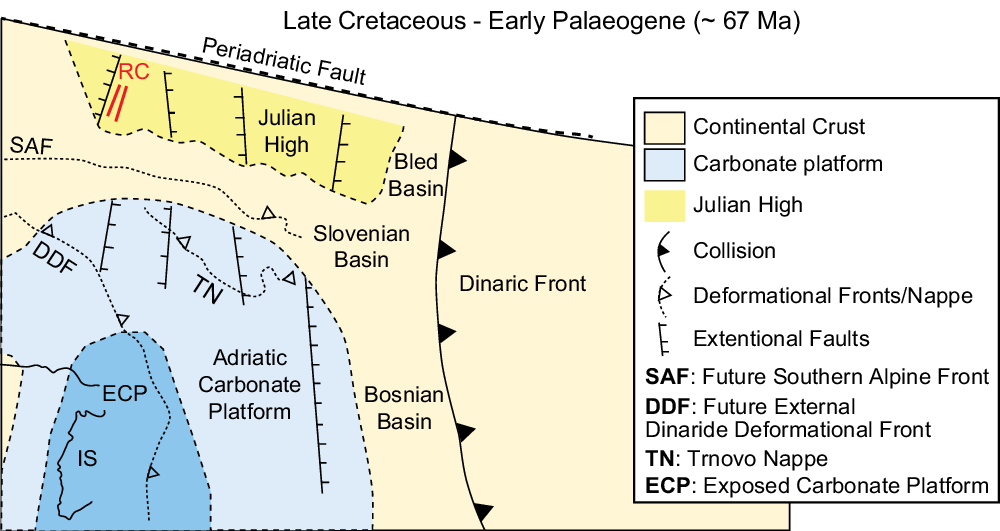
The unforced lower intercept ages of 23 ± 12 and 42 ± 21 Ma are similar within the error to those of the Oligocene (∼34 to 30 Ma) Val Fiscalina and Western Alps lamprophyres (Lucchini et al. Reference Lucchini, Simboli, Zenatti, Barbieri, Nicoletti and Petrucciani1983; Owen Reference Owen2008, and references therein), and consistent with the age of ∼26 Ma that Carulli et al. (Reference Carulli, Frizzo, Longo Salvdor, Semenza, Bianchin, Mantovani and Mezzacasa1987) previously suggested for the Rio Colan dykes, although no information was given about the methodology used to obtain that age. According to these ages, Rio Colan magmas would be linked to the Alpine–Apennine orogeny. Yet the unforced lower intercept ages show up to ∼45 Ma difference compared to the forced discordia ages. Such a significant age variation may be due to the fact that apatites did not develop enough spread in common Pb / radiogenic Pb and therefore may strongly depend on the initial 207Pb/206Pb correction based on the Stacey and Kramers (Reference Stacey and Kramers1975) evolution model. Nonetheless, these anchored ages are fairly similar to the 206Pb/238U weighted mean ages that appear insensitive to the correction used (i.e. Thomson et al. Reference Thomson, Gehrels, Ruiz and Buchwaldt2012). The forced concordia and weighted mean ages together suggest that Rio Colan olivine minettes intruded and crystallized at 67 ± 4 Ma (2SD; n = 4), as with the Corvara in Badia (68 ± 2 – 69 ± 3 Ma; Lucchini et al. Reference Lucchini, Simboli, Zenatti, Barbieri, Nicoletti and Petrucciani1983) and Calceranica (71 ± 2 Ma; Galassi et al. Reference Galassi, Monose, Ogniben, Siena and Vaccaro1994) lamprophyres, indicating that Rio Colan olivine minettes intruded the Julian Alps during a period of regional extensional tectonics (Fig. 12; Goričan et al. Reference Goričan, Žibret, Košir, Kukoč and Horvat2018). The general NE–SW Rio Colan dykes orientation (Fig. 1c) is consistent with the Late Cretaceous coaxial stresses generated during the Eoalpine compressive stages when the European and African continental plates started to collide and the oceanic lithosphere to subduct (e.g. Csontos & Vörös, 2004). In this context, the Julian Alps were the Dinaric flexural foreland basin undergoing N–S and NW–SE extensional tectonics caused by the advance of the Dinaric front due to the eastward subduction of the Adria plate (Ponton, Reference Ponton2006, Reference Ponton2010; Goričan et al. Reference Goričan, Žibret, Košir, Kukoč and Horvat2018).
Tectonic sketch map of the NE Alpine sector during the Late Cretaceous – Early Palaeogene limit (∼67 Ma; modified after Goričan et al. Reference Goričan, Žibret, Košir, Kukoč and Horvat2018). The location of the Rio Colan olivine minettes (in red) in the Julian High, which represents the modern-day Julian Alps, is approximate.

Further constraints are given by the Th/Yb vs Ta/Yb and Th*100/Zr vs Nb*100/Zr diagrams (Fig. 11a, b). These allow magmas generated from sources modified by subduction processes to be differentiated from those unrelated to such environments (e.g. Lustrino et al. Reference Lustrino, Agostini, Chalal, Fedele, Stagno, Colombi and Bouguerra2016). During melting, Th is a mobile element and its enrichment over Yb and Ta indicates a subduction-related component. Similar is the case for Th when compared against Zr and Nb. Moreover, normalizing to Yb and Zr reduces the fractionation effect of clinopyroxene, mica, amphibole and feldspar (e.g. Owen, Reference Owen2008). Rio Colan minettes show orogenic and anorogenic features (Fig. 11a, b), while the coeval Corvara in Badia and Calceranica lamprophyres plot in the orogenic and anorogenic fields, respectively. Because of this and the new ages here presented, we argue that the orogenic character shown in part by the Rio Colan magmas cannot be related to the Eoalpine orogeny but could reflect a local residual effect of an old orogenic event not completely exhausted. It must be noted that the volumes of the mantle source(s) involved in the Permo-Triassic magmatic event(s) in the Julian and Carnian Alps should have been orders of magnitude lower than in the neighbouring Dolomites, as evidenced by the strongly contrasting volumes of magmas emplaced between the two areas (e.g. De Min et al. Reference De Min, Velicogna, Ziberna, Marzoli, Chiaradia and Alberti2020). In other words, the peridotitic source(s) of the Rio Colan olivine minettes display an old orogenic component because the mantle was less affected by the Permo-Triassic events underneath this extreme sector of the Italian Southern Alps. Moreover, these magmas crop out in an area that underwent extensional movements during the Late Cretaceous and witnessed the Pangaea break-up during the Triassic (De Min et al. Reference De Min, Velicogna, Ziberna, Marzoli, Chiaradia and Alberti2020). As observed previously, it is interesting that high Nb/Ta ratios in many Lower Cretaceous to Miocene Italian lamprophyres can be explained by the percolation of alkaline–carbonate-rich melts through a carbonated peridotite. We argue that Middle Triassic alkaline–carbonate-rich melts triggered by the asthenospheric upwelling during the Pangaea break-up might have been the last agents that metasomatized the mantle before the Lower Cretaceous to Miocene Italian lamprophyric magmatism and would support the observations (i.e. Stoppa et al. Reference Stoppa, Rukhlov, Bell, Schiazza and Vichi2014) that there is no relationship between metasomatism and recent Tethyan subduction.
7. Conclusions
New ultramafic dykes were found in the Julian Alps, in NE Italy. Petrographic and mineral chemical data indicate that Rio Colan dykes are olivine minettes. Rio Colan olivine minettes are one of the most primitive magmas among the Western Mediterranean lamprophyres and lamproites. The Rio Colan intrusions were generated from a strongly depleted peridotitic source that underwent different metasomatic processes before melting, leading it to evolve into a rutile–phlogopite-bearing carbonated peridotite. LA-MC-ICP-MS U–Pb geochronology applied to magmatic apatite suggests that these magmas intruded the Julian Alps at ∼67 Ma during a period of extensional tectonics caused by the advance of the Dinaric front due to Alpine subduction towards the E. As this age is consistent with other Late Cretaceous lamprophyres cropping out in the Dolomitic sector, such extensional events might have affected larger parts of NE Italy. Given the above observations and the fact that Rio Colan olivine minettes intruded an area already affected by the tectonics related to the Triassic Pangaea break-up, the crustal and carbonatitic metasomatism may reflect some local residual effect of an old orogenic event not completely exhausted. In addition, the evidence that high Nb/Ta ratios in Rio Colan and other lamprophyres could be explained through middle-Triassic-related alkaline–carbonate-rich magmatism might imply that the last metasomatic event is not related to younger Tethyan subduction but rather to the Pangaea break-up.
Supplementary material
To view supplementary material for this article, please visit https://doi.org/10.1017/S0016756823000183
Acknowledgements
Backscattered images of the clinopyroxenes and cathodoluminescence of apatites analysed during this work were acquired by the Microscopy and Microanalysis Laboratory (LMic) of the Universidade Federal de Ouro Preto, a member of the Microscopy and Microanalysis Network of Minas Gerais State/Brazil/FAPEMIG. FN acknowledges Cristiane Gonçalves and Débora Vasconcelos de Oliveira (DEGEO/UFOP). FN thanks Cristiano Lana (DEGEO/AIRG/UFOP) for providing the U–Pb apatite ages and for taking part during the early stages of the manuscript. The manuscript benefited from discussions with Marco Venier (DMG/UNITS), Ana Černok (DMG/UNITS), Luca Ziberna (DMG/UNITS) and Samuel Bersan (UERJ). We thank Sarah Sherlock for the editorial handling. Three anonymous referees and reviews by Federico Casetta significantly improved the quality of the manuscript. No financial support was needed.
Conflicts of interest
The authors declare that they have no competing interests.