INTRODUCTION
Assessment of palliative patients' needs is one of the key issues in palliative care (Sepúlveda et al., Reference Sepúlveda, Marlin and Yoshida2002), mainly because inadequately met needs significantly impair the quality of life for dying persons. Recognition of the individual needs of palliative care patients and their family members form a basis for providing individualized care. Needs assessment allows identification of the areas that patients and their families consider important and where they need help and support (Waller et al., 2012). Implementation of care based on needs assessment requires a change in and especially a consensus on how to define individual needs and how and when to measure them (Carslon et al., Reference Carslon, Morrison and Bradley2008).
Richardson et al. (Reference Richardson, Sitzia and Brown2005) analyzed more than 30 tools for assessing the needs of patients in cancer care. The purposes of these assessment tools were to identify and prioritize patients' actual problems, to identify their preferences regarding treatment and care, and to monitor changes in their symptoms, functioning, and well-being (Richardson et al., Reference Richardson, Sitzia and Brown2005). In their systematic review, Osse et al. (Reference Osse, Vernooij-Dassen and de Vree2000) evaluated nine questionnaires used to assess patients' needs in palliative care. Assessment tools may also be utilized for hospital inpatients with life-threatening diseases. They may serve as an instrument for evaluating treatment outcomes (Osse et al., Reference Osse, Vernooij-Dassen and Schadé2007) and for developing communication between caregivers and patients (Weissman & Meier, Reference Weissman and Meier2011) and, possibly, their families as well (Tamburini et al., Reference Tamburini, Gangeri and Brunelli2000; Wen & Gustafson, Reference Wen and Gustafson2004). The potential benefit of assessment tools employed in both patients and their relatives has been reported in several studies (Sanson-Fisher et al., Reference Sanson-Fisher, Girgis and Boyes2000; Deeken et al., Reference Deeken, Taylor and Mangan2003; Wen & Gustafson, Reference Wen and Gustafson2004; Davidson et al., Reference Davidson, Cockburn and Daly2004; Grimshaw et al., Reference Grimshaw, Winkens and Shirran2005).
The need for improved care for patients with life-threatening or life-limiting conditions is unquestionable. A multidisciplinary team in hospice care is usually ready to solve patients' needs and problems. However, implementation of palliative care principles in the hospital setting is often problematic. Not all hospitals have multidisciplinary palliative care teams, and there are workforce shortages combined with tenuous funding (Weissman & Meier, Reference Weissman and Meier2011). Using assessment tools in patients eligible for palliative care while in hospital and subsequently dealing with important unmet needs identified by the patients may be one step toward individualized care.
The vast majority of published needs assessment tools come from the United States (Ganz et al., Reference Ganz, Schag and Lee1992; Gates et al., Reference Gates, Lackey and White1995; Coyle et al., Reference Coyle, Goldstein and Passik1996; Emanuel et al., Reference Emanuel, Alpert and Emanuel2001; Fortner et al., Reference Fortner, Okon and Schwartzberg2003), Great Britain (Cull et al., Reference Cull, Stewart and Altman1995; Thomas et al., Reference Thomas, Soothill and McIllmurray2001; Lidstone et al., Reference Lidstone, Butters and Seed2003; Ewing & Grande, 2012), Canada (Crooks et al., Reference Crooks, Whelan and Reyno2004), and Italy (Tamburini et al., Reference Tamburini, Gangeri and Brunelli2000), The Netherlands (Osse et al., Reference Osse, Vernooij-Dassen and Schadé2007) and Australia (Waller et al., Reference Waller, Girgis and Currow2008; Reference Waller, Girgis and Lecathelinais2010; Bonevski et al., Reference Bonevski, Sanson-Fisher and Girgis2000). These questionnaires are multidimensional and employ various approaches to compiling lists of needs. In the Czech Republic, there is no suitable instrument for identifying the needs of a palliative care patient or for assessing quality of care. There are only Czech versions of questionnaires for assessment of quality of life in cancer patients, such as the European Organization for Research and Treatment of Cancer Quality of Life Questionnaire–Core 30 (EORTC QLQ–C30).
Given the fact that the importance of (particularly psychosocial and spiritual) needs and their assessment may be influenced by the sociocultural context, it may not be sufficient to translate an already-existing standardized instrument produced within a different cultural setting. We therefore took the decision to develop our own questionnaire, one that may also be suitable for other Central European countries where there is no such tool.
Our objectives were to produce an adequate tool for identification of the needs of patients receiving palliative care and to verify its psychometric properties.
METHODS
Designing a Questionnaire
The questionnaire items were compiled based on a literature review (Liang et al., Reference Liang, Dunn and Gorman1990; Diwan & Moriarty, Reference Diwan and Moriarty1995; Tamburini et al., Reference Tamburini, Gangeri and Brunelli2000; Kellehear, Reference Kellehear2000; Soothill et al., Reference Soothill, Morris and Harman2001; Edmonds et al., Reference Edmonds, Karlsen and Khan2001; McIllmurray et al., Reference McIllmurray, Francis and Harman2003; Davies & Higginson, Reference Davies and Higginson2005; Richardson et al., Reference Richardson, Sitzia and Brown2005; Fitzsimons et al., Reference Fitzsimons, Mullan and Wilson2007; Currow et al., Reference Currow, Agar and Sanderson2008; Wijk & Grimby, Reference Wijk and Grimby2008), an analysis of foreign tools (Richardson et al., Reference Richardson, Sitzia and Brown2005; Osse et al., Reference Osse, Vernooij-Dassen and Schadé2007), and qualitative research (focus groups). According to Richardson et al. (Reference Richardson, Sitzia and Brown2005), the selection of individual items related to needs is dependent on a professional's experience, that is, which information they perceive as important for clinical evaluation.
As a part of qualitative research, 5 focus groups were held, comprising a total of 30 participants, including 16 general nurses (hospice, home care, nursing home, long-term care facility, oncology department, and internal medicine department), 3 physicians (long-term care facility and hospice), 4 social workers, 2 clergypersons, 1 cancer patient, and 2 family members caring for terminally ill patients. On average, each focus group lasted for two hours. The sessions were held in two phases and conducted by a single moderator. During the first phase, the problems and needs of the palliative care patients were discussed. This basic question was addressed: “Based on your experiences, what are the biological, psychological, social, and spiritual needs of patients with respect to the quality of their lives?” All focus-group interviews were recorded and transcribed. Subsequently, quantitative data analysis was employed to define both domains related to the needs of palliative care patients.
In the second focus-group phase, foreign tools for needs assessment were discussed and individual items suitable for use in Czech patients analyzed. Questions were formulated by proposing domains and searching for suitable wording understandable to respondents. After all focus groups were completed, participants were once again asked whether individual items were appropriate for inclusion in the questionnaire and whether the wording was suitable for palliative care patients (as per the opinions of experts).
When developing the assessment tool, emphasis was placed on content validity, namely, the measurement aim, the target population, the concept to be measured, item selection and item reduction, and interpretability of items (Terwee et al., Reference Terwee, Bot and de Boer2007).
Evaluation of the Psychometric Properties of the Questionnaire
Subjects
Psychometric properties were evaluated in a group of 349 patients terminally ill with a chronic disease or cancer resident in University Hospital Ostrava and receiving palliative care. The criteria for inclusion in the study group were as follows: age over 18 years, and cancer or other terminal disease (e.g., end-stage chronic heart failure, chronic obstructive pulmonary disease, cirrhosis of the liver, kidney disease, such neurological disorders as dementia and multiple sclerosis, and polymorbid “frail” geriatric patients).
All patients were informed about the study objective and gave informed consent. The research was approved by the ethics committees of the University Hospital Ostrava and the Faculty of Medicine.
Validity and Reliability Criteria
The relevance of items was evaluated through item–response frequencies. After pilot testing of the questionnaire, its final version only contained those items that were related to needs identified as important by at least 10% of patients.
Convergent Validity
The convergent validity of the questionnaire was determined by confirmatory factor analysis. The robust maximum likelihood estimation was found correcting for nonnormal distribution of items. For individual models, the chi-squared value (χ2), number of degrees of freedom (df), and their ratio were stated, together with the root-mean-square error of approximation (RMSEA), the comparative fit index (CFI), the Tucker–Lewis index (TLI), and the standardized root-mean-square residual (SRMR).
To confirm a good fit between the model and the data, the χ2 value should be ≥0.05 (Barrett, Reference Barrett2007). Hooper et al. (Reference Hooper, Coughlan and Mullen2008) reported limitations in the use of the χ2 test, particularly its sensitivity to sample size and normality of distribution. Therefore, researchers tried to find alternative markers for testing goodness of fit. An option is to determine the ratio of χ2 to its degrees of freedom (Wheaton et al., Reference Wheaton, Muthén and Alwin1977). The recommended cutoff value for the χ2/df ratio is 2.0, with the upper limit being 5.0. For RMSEA, the recommended cutoff is a value close to 0.06 (Hu & Bentler, Reference Hu and Bentler1999), with a stringent upper limit of 0.07 (Steiger, Reference Steiger2007). The RMSEA confidence interval lower limit should be close to 0, and the upper limit should not exceed 0.08 (Hooper et al., Reference Hooper, Coughlan and Mullen2008). The CFI and TLI values should be close to 1.0 or at least exceed 0.90 (Hooper et al., Reference Hooper, Coughlan and Mullen2008). The SRMR values should be less than 0.05, though values less than 0.08 are acceptable (Hu & Bentler, Reference Hu and Bentler1999).
Reliability
Internal consistency was determined using Cronbach's α. Usually, the acceptable minimum is set at 0.70 (Terwee et al., Reference Terwee, Bot and de Boer2007; Aaronson et al., Reference Aaronson, Alonso and Burnam2002; Peterson, Reference Peterson1994). Streiner and Norman (Reference Streiner and Norman2003) reported an acceptable minimum as low as α = 0.65–0.70. This criterion was also utilized in our study.
Moreover, a corrected item–total correlation was performed, with an acceptable minimum of 0.40 (Ware & Gandek, Reference Ware and Gandek1998). Test–retest reliability was verified using Spearman's correlation coefficient, with an acceptable minimum of 0.70 (Terwee et al., Reference Terwee, Bot and de Boer2007). In repeated tests within 5 days, a total of 35 patients participated. Usually, 10% of subjects are used to assess test–retest reliability.
Construct Validity
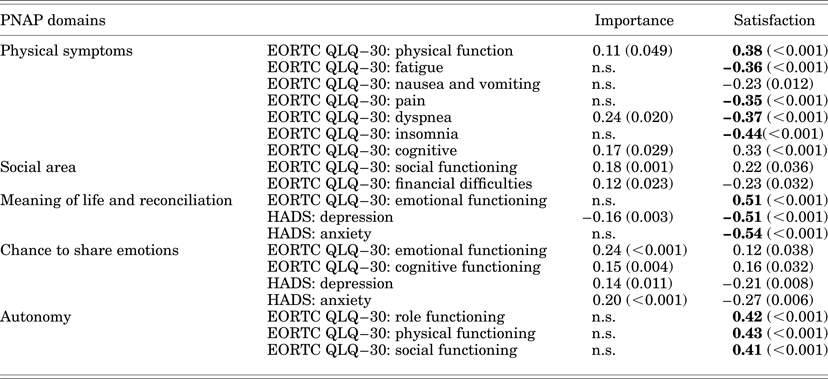
Construct validity was verified using Spearman's correlation coefficient between selected patient needs assessment in palliative care (PNAP) questionnaire domains and selected domains of the EORTC QLQ–C30 (Fayers et al., Reference Fayers, Aaronson and Bjordal2001), and the Hospital Anxiety and Depression Scale (HADS) (Zigmond & Snaith, Reference Zigmond and Snaith1983). A nonparametric Spearman's correlation coefficient was employed because of the nonnormal distribution of data (the Kolmogorov–Smirnov test). The levels of association were those applied by Feeny et al. (Reference Feeny, Farris and Côté2005) as follows: high, r > 0.50; moderate, r = 0.35–0.50; weak, r ≤ 0.34. Unmet needs for care are not only dependent on existing problems, but also on the desire to get help and the availability of care, and are thus expected to correlate less directly with quality of life (Osse et al., Reference Osse, Vernooij-Dassen and Schadé2007). Therefore, at least a moderate correlation (r > 0.35) was expected between unmet needs and a lower quality of life in the related EORTC QLQ–C30 dimensions. Furthermore, an association between unmet needs in the emotional functioning domain and the HADS questionnaire was expected. All statistical tests were performed at a level of statistical significance of 5%. The data were analyzed using Stata (v. 10) software.
RESULTS
Constructing Questionnaire Domains, Facets, and Items: Content Validity
Construction of questionnaire domains, facets, and individual items was based on the first focus group phase. The qualitative analysis identified 5 categories (domains of needs), 16 subcategories (facets of needs), and individual needs considered as important by the focus-group participants (46 items). The domains were as follows: physical functioning (facets: daily activities and symptoms; 14 items), psychological needs (facets: cognitive functioning, adaptation to disease, and reduction of anxiety and fear; 7 items), social needs (facets: social relations, support from caregivers, social inclusion, and security; 11 items), spiritual needs (facets: religious needs, meaning of life, and aesthetic needs; 10 items), and autonomy (facets: continuity of life, decision-making, dignity, and information; 4 items). The second phase of focus groups was aimed at searching for suitable wording of individual items and developing methods.
As an effective method for assessing the outcome of care, determination of the level of so-called unmet needs was selected. Unmet needs are defined as those identified by a patient as important and, at the same time, unsatisfied (Richardson et al., Reference Richardson, Sitzia and Brown2005). Two scales have been created: (1) Importance and (2) Satisfaction. The former is a 5-point scale on which the patient rates how important a particular item has been for him during the past week, ranging from 1 (not at all) to 5 (very important). The latter is a 5-point scale on which the respondent rates how an item (need) that is important for him or her is met, ranging from 1 (not at all) to 5 (yes, very much). Unmet needs are those identified by the respondent as both important (score 4–5) and unmet (score 1–2).
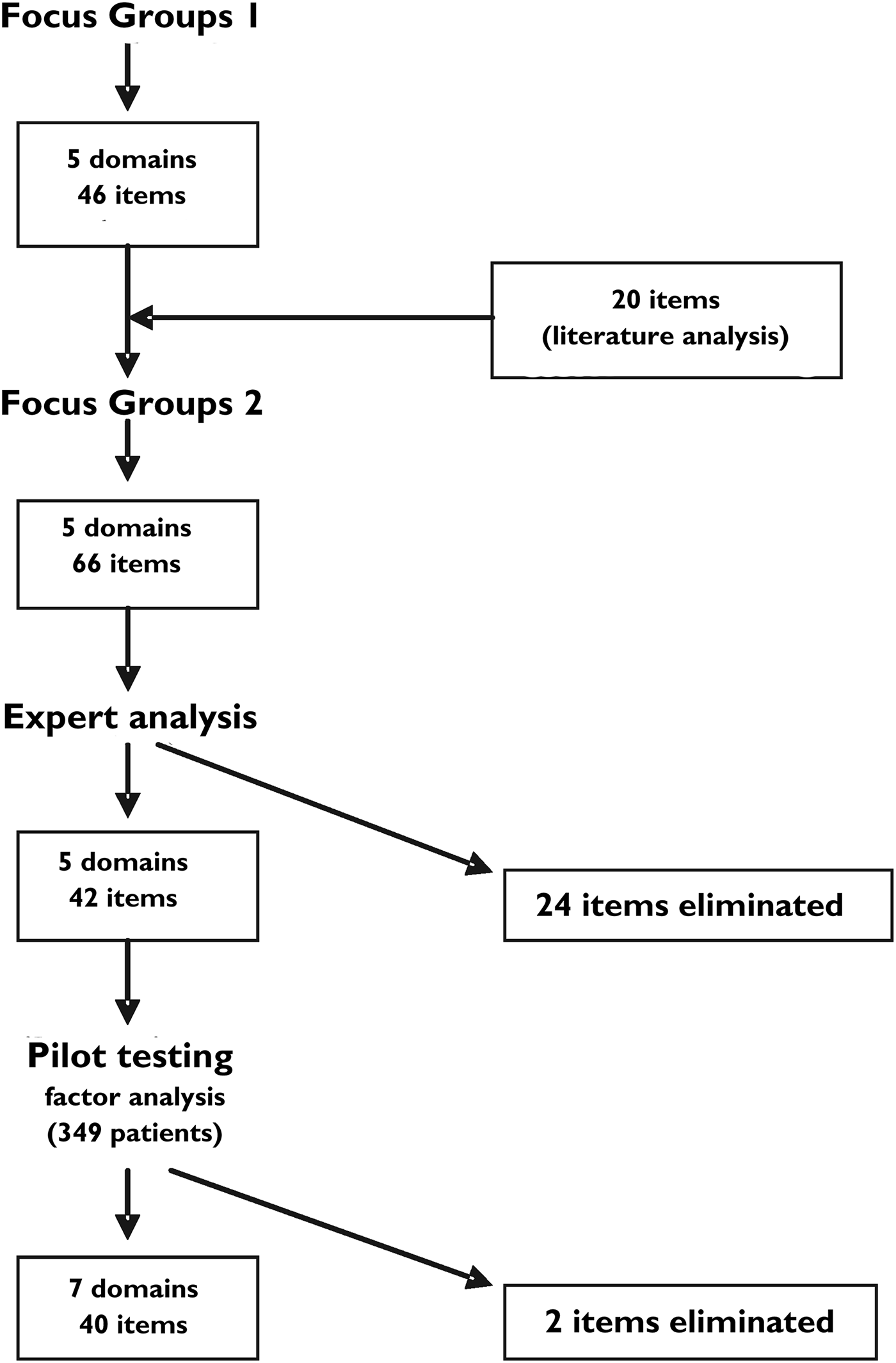
After completion of the focus groups, an expert analysis was carried out that selected 42 (of 66 proposed) items for pilot testing of the questionnaire. The process of questionnaire development is schematized in Figure 1.
Process of PNAP questionnaire development

Assessing Psychometric Properties of the Questionnaire
Subjects
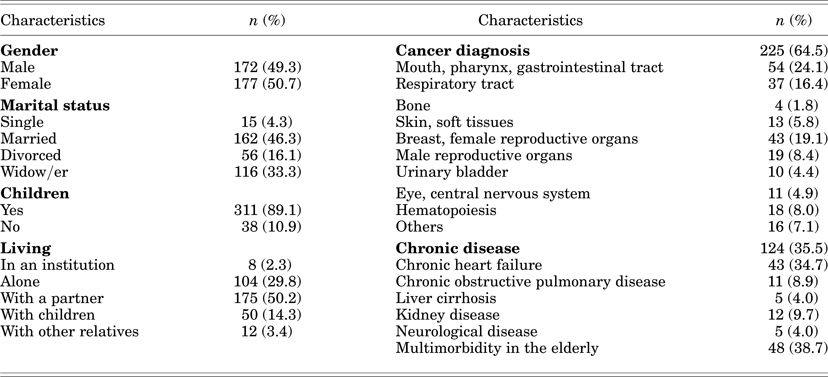
The psychometric properties of the questionnaire were tested in a group of 349 patients with end-stage chronic disease or cancer patients who had discontinued curative treatment. The patients' mean age was 68.1 years (SD = 12.8). Their sociodemographic characteristics are shown in Table 1.
Sociodemographic characteristics of the group (n = 349)
Item–Response Frequencies
After evaluation of individual items, the following two items with an importance less than 10% were eliminated (Figure 1): to have a chance to talk to someone about sexual needs and to solve problems with one's partner.
Confirmatory Factor Analysis
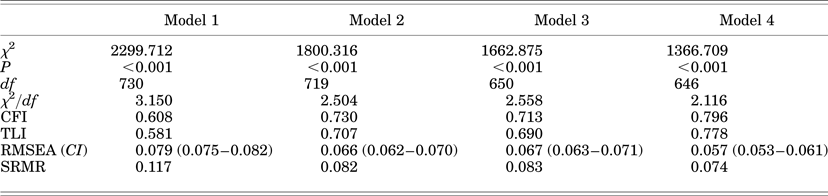
Confirmatory factor analysis was utilized to test the fit between the model and the data. In all models, the χ2 was statistically significant, suggesting their refusal. However, the χ2/df ratio was within the recommended range in all models, with model 4 being closest to the cutoff of 2.0.
The main aim of confirmatory factor analysis was to test the validity of the original model produced during questionnaire development. Model 1 contained five domains covering physical, psychological, social, and spiritual needs, as well as autonomy. The results in Table 2 clearly show that the fit between the model and the data was not good.
Goodness of fit indices for the four factor models
χ2 (chi-squared test of model fit), df (degrees of freedom), CFI (comparative fit index), TLI (Tucker–Lewis index), RMSEA (root mean square error of approximation), SRMR (standardized root mean square residual), CI (confidence interval).
Therefore, a model 2 was produced that comprised seven factors (domains: physical symptoms, social area, respect and support from health professionals, meaning of life and reconciliation, autonomy, chance to share emotions, and religious needs). This second model showed a better fit with the data, but this fit was still not good enough. A problematic factor was domain 7 (religious needs), which only contained two items and, moreover, did not correlate with the other factors. Therefore, this domain was not included in model 3. Another problematic issue was item 3 (ability to concentrate), which was transferred from the domain “physical symptoms” to the domain “autonomy” in model 4. This model, containing six factors and the transferred item 3, showed the best fit between model and data. The χ2/df ratio of 2.116, RMSEA of 0.057, and SRMR of 0.074 demonstrated an acceptable fit between model and data. However, the CFI and TLI values did not meet the required criterion (>0.9) in any of the models.
The final version of the questionnaire was based on model 4 (item 3 transferred to the domain “autonomy”). However, domain 7 (“religious needs”) remained in the final version. It is our opinion that religious needs comprise an important domain for holistic needs assessment.
Reliability
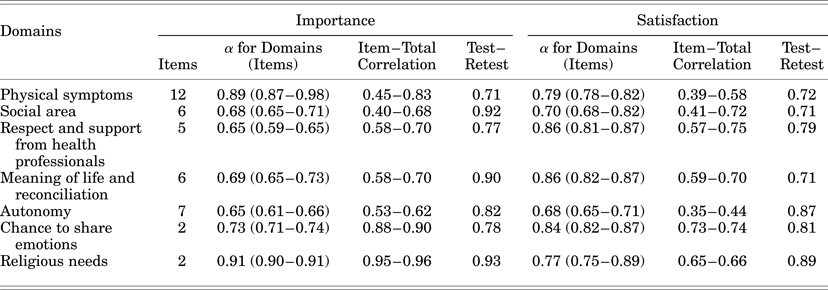
Cronbach's α for the entire PNAP questionnaire was 0.89 on the importance scale and 0.80 on the satisfaction scale. A Cronbach's α > 0.65 was found for all PNAP questionnaire domains in both the importance and satisfaction scales. Also, item–total correlation was higher than 0.4 for all items (Table 3), with the exception of two items in the domains “physical symptoms” and “autonomy” in the satisfaction scale. Test–retest reliability was higher than 0.7 for all domains in both scales.
Assessment of the PNAP questionnaire reliability
When comparing Cronbach's α for individual PNAP questionnaire domains in patients with chronic disease and cancer, no significant differences were found. Chronic patients were found to have a Cronbach's α of 0.91 (domains: 0.69–0.89) in the importance scale and 0.83 (domains: 0.67–0.91) in the satisfaction scale. Cancer patients had a Cronbach's α of 0.88 (domains: 0.69–0.92) in the importance scale and 0.79 (domains: 0.60–0.88) in the satisfaction scale. Questionnaire reliability, expressed as a Cronbach's α > 0.65, was demonstrated for individual domains in both patient groups, the only exception being the domain “autonomy” in the satisfaction scale.
Construct Validity
In the satisfaction scale, a Spearman's correlation coefficient of r > 0.35 was found only for the domains “physical symptoms,” “meaning of life,” and “reconciliation and autonomy.” For the domains “social area” and “chance to share emotions,” a correlation was also found, but a very weak one (r = 0.12–0.27). In the importance scale, a very low correlation (r = 0.11–0.24) was found and in only some domains (Table 4).
Correlation among the PNAP, EORTC QLQ–C30, and HADS
Spearman's correlation coefficient r > 0.35 printed in bold type.
DISCUSSION
Although in most existing needs assessment tools psychometric properties have been published, not all meet the criteria of validity, reliability, responsiveness, and burden (Osse et al., Reference Osse, Vernooij-Dassen and de Vree2000; Wen & Gustafson, Reference Wen and Gustafson2004). Good reliability for the Needs Evaluation Questionnaire in assessing the needs of hospitalized cancer patient was reported by Tamburini et al. (Reference Tamburini, Gangeri and Brunelli2000).
The newly constructed PNAP questionnaire covers the area of the most frequent biopsychosocial and spiritual needs. It was created for palliative care patients dying of end-stage chronic disease or cancer with the aim of identifying unmet needs related to health and social care.
The originally proposed version of the questionnaire contained 42 items and 5 domains but did not show goodness of fit between model and data when confirmatory factor analysis was carried out. The final version of the questionnaire comprises 40 items grouped into 7 domains. Confirmatory factor analysis confirmed only part of the assumed structure.
The questionnaire was found to have borderline psychometric properties. The overall reliability of the questionnaire, determined by Cronbach's α, was good for both scales (α > 0.8). In the importance scale, the coefficient was only borderline (α = 0.65–0.70) for certain domains (social area, respect and support from health professionals, meaning of life, and reconciliation and autonomy). When assessing psychometric properties of the Problems and Needs in Palliative Care Questionnaire, Osse et al. (Reference Osse, Vernooij-Dassen and Schadé2007) reported a Cronbach's α < 0.65 for two domains (“physical symptoms” and “social issues”) in the importance scale.
In our study, the acceptable minimum was noted in test–retest reliability, and item–total correlation was observed for all domains.
The content validity of the questionnaire was ensured by an expert analysis performed by professionals who provide palliative care. Yet the domain “physical symptoms” may not include all problems related to a particular condition. Therefore, it would be advisable to produce special modules of the questionnaire covering the specific physical problems of a particular disease.
Social needs are covered by the questionnaire domains called “social area” and “respect and support from health professionals.” Social needs are often created and also satisfied through social relations and communication. Social relations are a form of interpersonal interaction among individuals and groups (Tomágová, M. & Bóriková, Reference Tomágová and Bóriková2008). For end-of-life patients, two social groups are important: their families and multidisciplinary teams of caregivers (McIllmurray et al., Reference McIllmurray, Francis and Harman2003). The primary social need is usually a visit from family members. In their systematic review, Davies and Higginson (Reference Davies and Higginson2005) claimed that cancer patients also seek psychosocial support from their caregivers. Therefore, support from both their families and caregiver teams were included in the questionnaire. And so were finances, which may be an important priority toward the end of life (Wijk & Grimby, Reference Wijk and Grimby2008).
In the area of psychological needs, aside from a chance to share one's emotions, attention was also paid to needs related to adaptation to disease and acceptance of one's situation. Wijk and Grimby (Reference Wijk and Grimby2008) stressed the need to be free to express emotions, talk about them, and feel safe toward the end of life. Therapeutic interviews with patients and venting their emotions may reduce anxiety and fear. Yet, the questionnaire cannot be used to assess patients' mental health, anxiety, and depression. To determine the levels of anxiety and depression in palliative patients, another, already existing, tool should be used, such as the HADS (Holtom & Barraclough, Reference Holtom and Barraclough2000; Mitchell et al., Reference Mitchell, Meader and Symonds2010).
Another important studied area was that of needs related to autonomy. Toward the end of life, the need for appreciation and self-esteem becomes increasingly important. Autonomy is defined as the ability to direct, govern, and influence everyday life by one's own rules and ideas. This includes a capability to organize one's life, make one's own decisions, understand one's situation, and develop and implement plans (Scott et al., Reference Scott, Välimäki and Leino-Kilpi2003).
An integral part of care is supporting the maintenance of independence, with respect to the illness, as much and for as long as possible, and of control over one's life, as well as of a chance to make decisions about oneself and one's care (McIllmurray et al., Reference McIllmurray, Francis and Harman2003). Also important is self-actualization through daily activities (Liang et al., Reference Liang, Dunn and Gorman1990).
Situational needs were included among the spiritual needs grouped into the domain “meaning of life and reconciliation” (Kellehear, Reference Kellehear2000), the aim of which was finding meaning and a goal in life, seeking hope and reassurance. The task is to find the meaning of life, gain hope, and maintain a social role within the setting of a progressive disease. Patients need help in coping with changes within their body or changes in the way they perceive them (McIllmurray et al., Reference McIllmurray, Francis and Harman2003). At the top of the hierarchy of needs are the need for self-actualization and the metaphysical needs that are specific toward the end of life. Frankl (Reference Frankl1959) referred to these needs as the search for meaning. If this is unmet, existential frustration occurs.
A special domain was that of religious needs, involving spiritual support, ceremonies, and pastoral visits. Given the fact that the Czech Republic is an atheistic country (Nešpor, Reference Nešpor2012), the spiritual dimension of needs had to be divided into two domains (“religious needs” and “meaning of life and reconciliation”). The reason was that religious needs were markedly less important than needs related to the search for meaning and reconciliation. According to the pilot survey, this greatly contributed to a lower score for spiritual needs (Bužgová et al., Reference Bužgová, Hajnová and Sikorová2013). The lesser importance attributed to religious needs was also problematic when assessing the goodness of fit between the models and the data using confirmatory factor analysis. Therefore, the domain was eliminated from model 4.
Construct validity was confirmed by a correlation between selected domains of the PNAP, EORTC QLQ–C30, and HADS. In the satisfaction scale, most domains were found to correlate with selected domains of both the EORTC QLQ–C30 and HADS. In particular, there was an association between quality of life and unmet needs. In the importance scale, there was a significant but weak correlation for only 10 out of 19 tested variables.
One drawback of the use of the PNAP instrument may be the burden on health professionals or the patients themselves involved in filling out the questionnaires. On average, a questionnaire takes 45 minutes to complete. Based on a systematic search of needs assessment instruments, Wen and Gustafson (Reference Wen and Gustafson2004) reported a completion time of up to 43 minutes, while Osse et al. (Reference Osse, Vernooij-Dassen and de Vree2000) reported 20–45 minutes. Similarly, Richardson et al. (Reference Richardson, Sitzia and Brown2005) stated potential barriers to the use of assessment tools—namely, training of health professionals who carry out assessments and the time required to complete assessments.
Further testing of the instrument should focus on the use of the PNAP in other Central European countries with similar sociocultural conditions as well as its use in clinical practice.
CONCLUSION
The results of testing of the psychometric properties of the PNAP questionnaire showed at least satisfactory validity and reliability. The instrument can be used to assess the needs of palliative care patients, particularly those in Central European countries. Needs assessment is an important tool for understanding patients' priorities and serves as a basis for planning individualized care.
ACKNOWLEDGMENTS
The authors thank Ing. Hana Tomášková, Ph.D., and Mgr. Stanislav Ježek, Ph.D., for statistical analysis of the data. The study is a part of the Czech Ministry of Health project NT 13417-4/2012, “Identification of Patient and Family Needs in Palliative Care Related to Quality of Life.”