INTRODUCTION
Caregivers are part of the unit of care in palliative care (Hudson, Reference Hudson2003; World Health Organization, 2002), so that adequate provision of psychological support to caregivers is a priority for palliative care clinical staff (e.g., nurses, doctors, social workers), who usually work closely with caregivers leading up to a patient's death. They are therefore in a prime position to monitor caregiver psychological well-being and identify when a caregiver might require referral for specialist psychological support. However, identifying those who need or would benefit from psychological support can be a complex task. It requires an understanding of the range of stress and grief responses, as well as a working knowledge of various psychological disorders, while managing patient care and multiple time and resource constraints.
The capacity and initiative of clinical staff to offer referrals to a psychological intervention for caregivers underlies, in part, the successful implementation of any particular intervention within a health service. A study investigating palliative care nurse confidence in identifying and managing depression in palliative patients identified the need for further training in the signs and symptoms of depression, issues around discussing depression with patients and their family members, and difficulty differentiating depressive symptoms from grief (McCabe et al., Reference McCabe, Mellor and Davison2012). Gaining an understanding of such areas, in which clinical staff are more and less confident in their knowledge and skills in identifying and managing caregiver distress, is likely to be important to the successful implementation of a psychological intervention. The acceptability of a particular approach is also likely to be key in promoting the intervention (e.g., Lovell et al., Reference Lovell, Bower and Richards2008; Webster et al., Reference Webster, Thompson and Norman2017). Further, clinical staff engagement with interventions implemented prior to a patient's death and with an explicit intent to prevent prolonged grief disorder (PGD) might be affected by attitudes about both grief intervention and PGD as a diagnosis. How one conceptualizes the appropriateness of another's grief has been shown to influence perceptions of the warranted level of social support and the willingness or people to be with the griever (Dyregrov, Reference Dyregrov2003; Thornton et al., Reference Thornton, Robertson and Mlecko1991). Such research indicates that attitudes about grief have the potential to influence behavioral intentions to help. One Australian survey of psychologists' and counselors' opinions regarding PGD showed a strong level of clinical support for the recognition of PGD (73%), but many had concerns about the implications of pathologizing grief (Ogden & Simmonds, Reference Ogden and Simmonds2014). This tension between support and concern was also reflected in an international survey of members of the general public, in which 75% agreed that grief could be considered a mental disorder, but they also had reservations about potential medicalization and stigmatization of grief (Breen et al., Reference Breen, Penman and Prigerson2015). It is possible that such concerns about pathologizing and intervening with respect to caregiver grief could influence the likelihood of clinical staff making referrals for psychological intervention.
We recently developed a self-help intervention for grief and psychological distress in caregivers of patients in palliative care that is being tested in a feasibility trial (Davis et al., Reference Davis, Deane and Lyons2016). Consequently, the capacity of clinical staff to act as referrers to such an intervention and the potential barriers to implementation were of particular interest. We therefore sought to: (1) examine the acceptability of a self-help psychological intervention for caregivers among palliative care clinical staff who were likely to be primary referrers; (2) examine potential attitudinal barriers to PGD as a diagnosis and interventions for grief; and (3) determine staff confidence in skills and knowledge in identifying and managing caregiver distress.
METHODS
Participants
Participants were recruited in 2016 from two inpatient palliative care units and two community health centers in the Illawarra–Shoalhaven region of New South Wales. Eligible clinical staff were healthcare workers (including nurses, and doctors) who provided direct care to patients and caregivers as part of the palliative care service at participating sites. Further eligibility criteria included being aged 18 years or over and having sufficient comprehension of English to be able to understand and complete the study documents.
Procedure
Clinical staff were invited to complete a questionnaire broadly about the acceptability of psychological interventions for caregivers. Clinical staff did not need to have been involved in recruitment of caregiver participants to the feasibility trial of the self-help intervention. Line managers and the director of the palliative care service notified clinical staff of the questionnaire at routine staff meetings. They were informed of the purpose of the research and the voluntary nature of participation. The questionnaire was anonymous, and paper copies were provided in meeting rooms along with a participant information sheet. Completed questionnaires were collected by a researcher (ED) between two to three weeks after administration.
Measures
Demographics
Background information collected about participants included gender, age range, current occupation, duration of time spent in current role, and proportion of time spent working in community versus inpatient settings.
Acceptability of Psychological Intervention for Caregivers
A short paragraph describing guided self-help was provided, after which respondents completed five items adapted from a modified version of the Treatment Evaluation Inventory (TEI; Kazdin, Reference Kazdin1980; Kelley et al., Reference Kelley, Heffer and Gresham1989). The TEI has been used to compare perceptions of acceptability for different depression treatments, including self-help (Hanson et al., Reference Hanson, Webb and Sheeran2016; Landreville & Guerette, Reference Landreville and Guerette1998). Items assess how acceptable clinical staff found guided self-help for psychological distress in caregivers (e.g., “I would be willing to suggest guided self-help to caregivers I see” and “I think guided self-help is an acceptable approach to help with a caregiver's psychological distress”) and are rated on a 5-point scale ranging from 1 (strongly disagree) to 5 (strongly agree). One item was reverse-scored so that higher scores indicated higher ratings of acceptability. Cronbach's alpha indicated that the internal reliability of the measure in the current study was satisfactory (α = 0.79).
Confidence in Skills and Knowledge
A total of 17 items assessed clinical staff confidence in identifying and distinguishing between different presentations of abnormal psychological distress (i.e., anxiety, depression, and grief) and managing such presentations in caregivers (e.g., “Knowing when it is time to raise concerns about a caregiver who might have abnormal psychological distress”). The items were modified from a 16-item questionnaire that assessed nursing staff confidence in skills and knowledge for managing depression in palliative care patients (McCabe et al., Reference McCabe, Mellor and Davison2012). The items were reworded from being about the patient and depression to being about the caregiver and abnormal psychological distress. An additional item was added to emphasize the issue of normal distress in the context of grief (e.g., “Being able to recognize that a caregiver might have normal levels of psychological distress”). Items were rated on a 4-point scale ranging from 1 (not at all confident) to 4 (very confident), with higher total scores indicating higher levels of confidence. The internal reliability of this scale has been reported as high (α = 0.94) among Australian nurses (McCabe et al., Reference McCabe, Mellor and Davison2012). Reliability in our current study using Cronbach's α was also high (α = 0.95).
Attitudes about PGD as a Diagnosis
A modified version of an 8-item questionnaire developed to measure attitudes of psychologists and counselors toward classifying PGD as a psychiatric disorder (Ogden & Simmonds, Reference Ogden and Simmonds2014) was employed. Items were reworded to be more understandable to staff without a psychology background and changed from being about clients to being about caregivers. The item “I would use this diagnosis if it were available” was deleted, as it was not considered applicable, leaving a total of seven items. Proposed diagnostic criteria of PGD from the ICD–11 (Maercker et al., Reference Maercker, Brewin and Bryant2013) were provided, and clinical staff rated their agreement to items (e.g., “I think that recognition of PGD may lead to the pathologization of “normal” grief” and “Diagnosing PGD will increase caregiver likelihood of getting the best help possible”). Items were rated on a 5-point Likert-type scale ranging from 1 (strongly disagree) to 5 (strongly agree). Three items were reverse-scored to calculate the total score; however, Cronbach's α indicated that internal reliability in the current study was poor (α = 0.56). This is not uncommon when positive and negative items are included together (e.g., Solís Salazar, Reference Solís Salazar2015). To address this, the four positively worded items were separated from the three negatively worded items to create a PGD positive attitude subscale (α = 0.78) and a PGD negative attitude subscale (α = 0.75) with improved reliability. Higher scores on PGD positive attitude indicated more positive attitudes about PGD as a diagnosis while higher scores on PGD negative attitude indicated more negative attitudes.
Attitudes about Grief Intervention
Attitudes about intervention for grief (pre- or post-loss) was measured by four purpose-designed items (e.g., “People should move through their grief without psychological intervention” and “It is best to leave people to move through grief in their own way and in their own time”). Clinical staff rated agreement with the items on a 5-point Likert-type scale ranging from 1 (strongly disagree) to 5 (strongly agree). Three items were reverse-scored, so that higher scores indicated more positive attitudes about grief intervention. The value of Cronbach's α indicated that the internal reliability of the current study was satisfactory (α = 0.75)
Data Analysis and Management
Missing data values were examined. If more than 80% of values were available within a scale, the mean of the available data for an individual participant was used (prorated scores). If less than 80% of values were available, the participant was removed from the sample. Based on these criteria, 5 cases were prorated and 1 case removed, for a total sample size of 46.
The data were also examined for outliers, and casewise diagnostics were used to detect any problematic cases, of which none were found. Normality plots and statistical tests of normality were inspected and showed that all variables approximated normality.
Mean scores and frequencies were used to summarize participants' demographic details and scores on the outcome variables. Examination of potential differences in outcome variables based on demographics was examined in relation to age, years spent in their current role, and primary workplace (community or inpatient). Independent t tests and analysis of variance (ANOVA) were employed to analyze age and primary workplace and Pearson's correlations for years spent in role. The relationships between acceptability of self-help intervention, confidence in skills and knowledge, attitudes about PGD diagnosis, and attitudes about grief intervention were explored using correlation analyses. All correlations used Pearson's correlations and were two-tailed since no specific directional hypotheses were predicted.
RESULTS
Sample
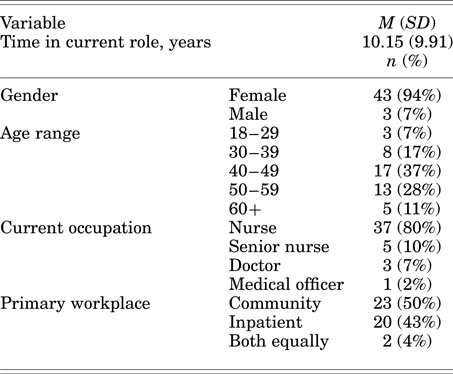
Across sites, there was an estimated 127 clinical staff employed during the time the survey was administered (121 nurses, 3 senior physicians, and 3 registrars/residents), of which 47 responded (~37% response rate), and 46 provided sufficient data for analyses. The demographics are presented in Table 1. The majority of participants were female (94%) and 40 years of age or older (76%). Most were in a nursing role (90%), while approximately equal proportions worked primarily in inpatient (43%) and community settings (50%). On average, the sample had a decade of experience (M = 10.15, SD = 9.91). Only two participants (4%) indicated that they were involved in recruitment for the feasibility trial of the self-help intervention, which was recently completed at the inpatient sites.
Demographics of clinical staff (N = 46)

Total may not add up to 100% due to rounding up and missing data.
Differences in outcome variables based on demographics were examined. The results showed that staff working primarily in a community setting had significantly higher confidence scores in identifying and managing caregiver psychological distress (n = 23, M = 3.16, SD = 0.57) than staff working primarily in an inpatient setting (n = 20, M = 2.77, SD = 0.52; t 41 = 2.38, p = 0.02). It is possible that longer duration in their current role could potentially lead to greater confidence in skills and knowledge. To explore this further, we used an independent t test to determine whether community staff had a longer duration in their current role, on average, compared to inpatient staff.. However, the results showed no statistically significant difference (p > 0.05), and no other demographic analyses were statistically significant (p > 0.05).
Outcome Descriptives
Acceptability of Self-Help Intervention
Most participants indicated that they had at least “a little experience” with self-help interventions (n = 33, 72%). The mean acceptability score indicated that self-help intervention for caregivers was at least moderately acceptable to clinical staff on average, being past the midrange of “neither agree nor disagree” (M = 3.42, SD = 0.48, range = 1–5). Approximately two-thirds of participants agreed or strongly agreed that guided self-help is an acceptable (n = 30, 65%) and an effective (n = 29, 63%) approach for caregivers. Similarly, approximately two-thirds of participants (n = 31, 67%) indicated that they would be willing to suggest guided self-help to caregivers that they saw, with none or very few (n = 2, 4%) indicating disagreement. One-third agreed or strongly agreed that risk in undergoing guided self-help was a concern (n = 15, 33%), while half neither agreed nor disagreed (n = 23, 50%).
Confidence with Skills and Knowledge in Assessing Caregiver Psychological Distress
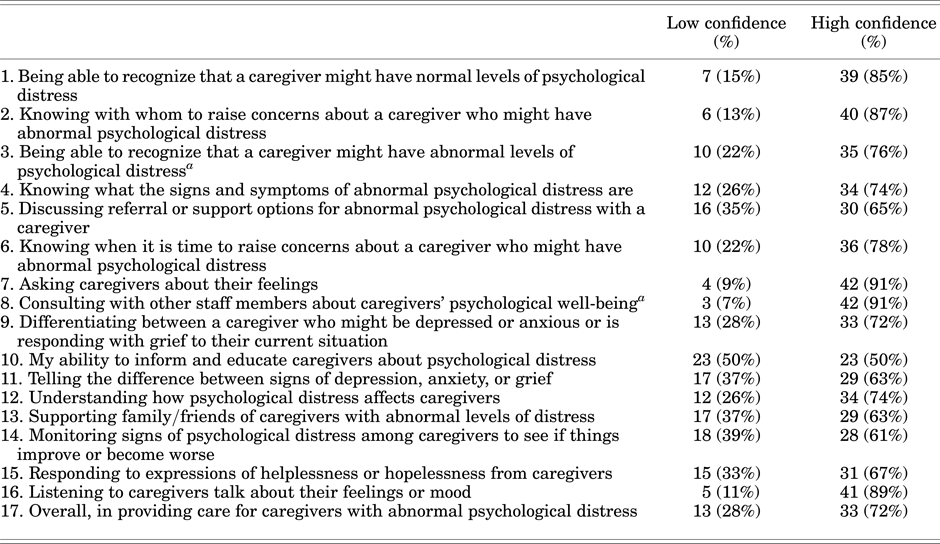
Mean confidence scores indicated that clinical staff, on average, were mostly confident about their skills and knowledge in identifying and managing caregiver distress (M = 2.99, SD = 0.56, range = 1–4). Table 2 shows the proportion of participants scoring low (scores 1–2) versus high (3–4) for each confidence item. It is evident that the vast majority of staff showed high confidence in most skills or knowledge areas. The most notable exception was “ability to inform and educate caregivers about psychological distress,” where half of staff indicated low levels of confidence. Other areas of relatively low confidence involved: discussion of referral or support options (35%), supporting those close to caregivers with abnormal levels of distress (37%), monitoring changes in psychological distress (39%), and responding to expressions of helplessness or hopelessness (33%).
Proportion of clinical staff indicating low versus high confidence in their skills and knowledge

Low confidence = scores 1–2; high confidence = scores 3–4.
a n = 45 due to missing data.
Attitudes about PGD
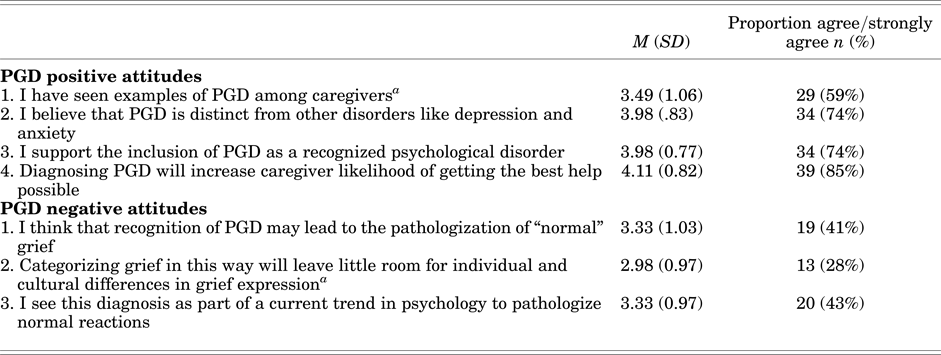
The mean scores on positive (M = 3.89, SD = 0.68, range = 1–5) and negative (M = 3.22, SD = 0.81, range = 1–5) attitudes about a PGD diagnosis were both past the scale midpoint, indicating the simultaneous presence of both positive and negative attitudes about PGD. Table 3 shows the mean scores and proportion agreeing to the PGD attitude items. The vast majority of clinical staff agreed or strongly agreed that diagnosing PGD would increase caregiver likelihood of getting the best help (85%), while three-quarters agreed or strongly agreed (74%) that PGD is distinct from other disorders and should be recognized as a psychological disorder. Nonetheless, staff opinions were more split regarding how a PGD diagnosis reflects pathologization of normal reactions. Notable proportions agreed that recognition of PGD may lead to pathologization of “normal” grief (41%) and reflects a trend in psychology to pathologize normal reactions (43%).
Mean scores and proportion indicating agreement with PGD attitude items

a n = 45 due to missing data.
Attitudes about Grief Interventions
Staff attitudes about grief intervention were on average positive, with the mean score slightly above the “agree” response anchor (M = 4.18, SD = 0.59, range = 1–5). The majority of clinical staff disagreed or strongly disagreed that professional help for grief should always be a last resort (n = 45, 98%) and that any psychological intervention disrupts a natural grieving process (n = 38, 83%). Instead, the vast majority agreed that psychological intervention can be valuable to those who are struggling with their grief (n = 42, 98%). However, while most staff disagreed (n = 28, 61%) that it was always best to leave people to move through grief in their own way and time, another quarter were neutral on this item (neither agreed nor disagreed, n = 12, 26%).
Correlations
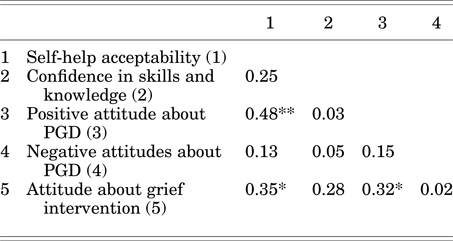
Table 4 shows results from the correlation analyses on mean total scores of the study variables. Higher acceptability ratings of self-help for caregivers were associated with more positive attitudes about PGD as a diagnosis and intervention for grief. More positive attitudes about PGD were also associated with more positive attitudes toward grief intervention. No other correlations were statistically significant (p > 0.05), although there was a trend toward greater levels of confidence in skills and knowledge being associated with more positive attitudes about intervention for grief (p = 0.06).
Correlations between study measures

*Significant at the 0.05 level; **significant at the 0.01 level.
Since an assumption of this study was that clinical staff might be less likely to refer to a guided self-help intervention for PGD if they had negative attitudes about PGD (e.g., pathologizing grief), we correlated the item “I would be willing to suggest guided self-help to caregivers I see” with the two PGD attitudes scales. It was found that holding more positive (r = 0.34, p = 0.02) and somewhat surprisingly more negative (r = 0.30, p = 0.02) attitudes about PGD were both significantly related to greater clinical staff willingness to suggest guided self-help to caregivers.
DISCUSSION
This study found that clinical staff were overall positively oriented toward self-help for caregivers, accepting of PGD as a diagnosis while concurrently harboring reservations, approving of intervention for grief, and largely confident in their skills and knowledge to identify and manage caregiver psychological distress appropriately. These results are useful in informing the research team of a few broad issues to be considered should a self-help intervention for caregivers be implemented in the healthcare service.
Clinical staff perceptions of the acceptability of a guided self-help intervention for caregivers showed that the majority felt positively toward it, although it would be beneficial to explicitly identify potential risks and outline how to manage them. Likewise, the attitudes of clinical staff about a PGD diagnosis and intervention for grief were overall positive, with the majority indicating that grief intervention is valuable and that a PGD diagnosis would help caregivers get the best help possible. The proportion supporting the inclusion of PGD as a diagnosis (74%) is strikingly similar to that found among international members of the general public (75%; Breen et al., Reference Breen, Penman and Prigerson2015) and Australian psychologists and counselors (73%; Ogden & Simmonds, Reference Ogden and Simmonds2014). However, negative attitudes about a PGD diagnosis were also prevalent in the current sample, although to a lesser degree. Notable proportions expressed concern about the potential for pathologization of grief (41%) and reduced consideration of individual differences in grief expression (28%), although these proportions are considerably smaller compared to those reported for psychologists and counselors (56 and 55%, respectively; Ogden & Simmonds, Reference Ogden and Simmonds2014). While it overall was positive attitudes toward grief intervention and PGD that were associated with the acceptability of guided self-help for caregivers, it is important to note that both positive and negative PGD attitudes were associated more specifically with the willingness to refer caregivers to such an intervention. On the surface, this is a somewhat contradictory finding. However, it could be that concerns about the pathologizing effects of PGD are intertwined with overall concerns about the negative consequences of PGD on caregivers. If this were the case, then clinical staff would be more inclined to refer caregivers in need to self-help interventions for PGD. Similarly, a qualitative study among social workers found that many participants held to both medicalized/diagnostic and contextual (individual interacting with their environment) views of mental health; participants maintained that withholding a psychiatric diagnosis when truly indicated would result in an equivalent disservice to an individual's care as would attributing a problem resulting from contextual issues to internal dysfunction (Probst, Reference Probst2013). Alternatively, it may be that self-help interventions as opposed to face-to-face psychotherapy is considered a particularly non-pathologizing approach for helping caregivers. Thus, those with concerns about the pathologizing consequences of PGD as a diagnosable disorder may view self-help approaches as more appropriate. At this stage, we can only speculate, but future research may be able to test these hypotheses. Pragmatically, our findings suggest that, in order to optimally promote referral to the intervention among clinical staff, it may generally be effective to emphasize the benefits of a PGD diagnosis without needing to address the negative concerns about PGD pathologizing grief.
Clinical staff indicated generally satisfactory levels of confidence in their skills and knowledge. At least three-quarters of participants indicated high confidence in differentiating between normal and abnormal psychological distress in caregivers and knowing when it was time to raise concerns about caregiver distress and thereby initiate referral for support. However, a third of our participants demonstrated low confidence in discussing referral or support options for abnormal psychological distress with a caregiver. Given that the clinical staff in this study were on the frontline in interacting with patients and their caregivers, it would be advantageous to increase skills and confidence around these issues.
It is interesting that the staff working primarily in the community showed significantly higher levels of confidence compared to staff working primarily in an inpatient unit. Our results indicate that this was not likely to be due to a longer duration spent in their current role for community staff compared to inpatient staff. Thus, we can only speculate about the source of the differences in confidence between community and inpatient staff. For example, some prior research raises the possibility that the confidence differences are due to training differences (McCabe et al., Reference McCabe, Russo and Mellor2008). Using a similar confidence scale, McCabe and colleagues (Reference McCabe, Russo and Mellor2008) found that professional caregivers who had received previous training in depression had greater levels of confidence in identifying and managing depression in elderly patients than caregivers who had received no training. It is also possible that the difference observed in the present study can be attributed to the greater level of contact community staff have with caregivers. While these suggestions are speculative, further research might be able to clarify these issues in order to ensure continuity of confidence across community and inpatient settings.
LIMITATIONS OF THE STUDY
There are a number of limitations to this study that should be noted. The passive recruitment method may have introduced selection bias, so that the results could not be confirmed as representative of all clinical staff. Generalizability is also limited by the small sample size and by clinical staff being recruited from the same broad health service and comprised mostly of nurses. Future research would benefit from recruiting across different health services and broadening the staff composition, particularly to include allied health. This would also allow us to compare responses from mental health and non-mental-health clinical staff, which have been shown to differ at least in PGD attitudes based on the comparisons with psychologists and counselors highlighted above (Ogden & Simmonds, Reference Ogden and Simmonds2014). Also, although we adapted measures from prior research, there is little reliability and validity data for most of these measures. Future research in refining and validating measures to evaluate clinical staff attitudes is needed.
It is also important to note that most participants would not have had much opportunity to observe PGD in caregivers because contact ordinarily ceases following the death of the patient. Thus, these results more likely reflect clinical staff opinion about PGD in general than how it specifically relates to caregivers. However, this enabled clinical staff to base their responses on a richer and broader knowledge base from their own life experience of grief. Related to this, these results permit us to only consider how acceptability of guided self-help is associated with attitudes about grief specifically (not other common presentations of depression or anxiety) and are thus limited in applicability to interventions for grief. Nonetheless, grief is an important focus given the controversial nature of its diagnosis and perceived needs for intervention.
CONCLUSIONS
Our results indicate that clinical staff were largely positive about self-help and grief interventions for caregivers and thus generally likely to act as key allies in implementing such interventions. Clinical staff held both positive and negative attitudes about PGD as a diagnosis, but both orientations appeared to be associated with a greater willingness to refer to self-help for caregivers. To optimize referral, the results suggest that educating staff about the benefits of a PGD diagnosis and the logistics of the referral process to the intervention would be helpful. Future research would benefit from an examination of clinical staff attitudes about different diagnoses and treatment approaches in order to better understand how to work alongside staff when implementing interventions in their health service.
ACKNOWLEDGMENTS
The authors gratefully acknowledge the clinical staff who participated in our study. We also thank Ms. Kay Cope for her assistance in liaising with sites to implement the study. This research was conducted with the support of an Australian Government Research Training Program Scholarship.