Introduction
The number of individuals having dementia is projected to grow as the elderly population in the United States (US) continues to rapidly increase (Hebert et al., Reference Hebert, Scherr, Bienias, Bennett and Evans2003). The growth of the population of older adults from minority ethnic (ME) groups is expected to increase at a markedly faster rate than that of non-Hispanic White (NHW) Americans (US Census Bureau, 2008). Therefore, it is predicted that there will be a growing prevalence of dementia among ME older adults given that increasing age is a prominent risk factor for Alzheimer's disease (AD) and other dementias (Zarit and Zarit, Reference Zarit and Zarit2007).
The Sociocultural Health Belief Model
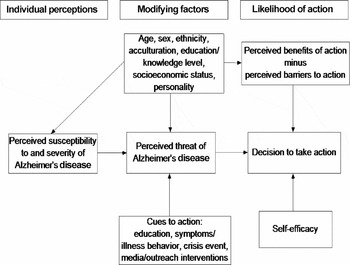
This conceptual review provides a foundation for the Sociocultural Health Belief Model (SHBM) as applied to dementia care-seeking, which is derived from the Health Belief Model (HBM; Rosenstock et al., Reference Rosenstock, Stretcher and Becker1988). The HBM is perhaps the most commonly used conceptual model in research involving factors that lead to or hinder obtaining a dementia diagnosis. The model was originally proposed to aid in the study and promotion of the use of health services. This model posits that an individual's decision to initiate a health-related behavior, such as obtaining a dementia evaluation, depends on that individual's perceptions of (1) his or her susceptibility to the disease, (2) the severity of the disease, and (3) the benefits of and (4) the barriers to taking action to reduce susceptibility to or severity of the condition. Before an individual takes action, the anticipated benefits must outweigh the anticipated barriers. Self-efficacy and cues to action (e.g. trigger events and symptom/illness behavior) have been incorporated into some adaptations of the HBM (Janz et al., Reference Janz, Champion, Strecher, Glanz, Rimer and Lewis2002). In addition, other modifying variables, such as demographic, psychosocial, and structural variables, may also have a significant effect on health-related behaviors according to the HBM. Figure 1 provides an illustration of the HBM that has been adapted to both incorporate cues to action and self-efficacy and to be specific to AD care-seeking.
The Adapted Health Belief Model for health behavior actions.
Sources. Hughes et al., Reference Hughes, Tyler, Danner and Carter2009 and Janz et al., Reference Janz, Champion, Strecher, Glanz, Rimer and Lewis2002.

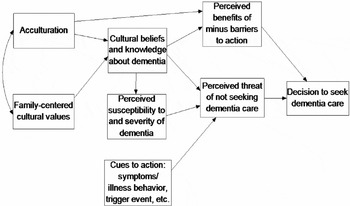
The HBM serves as a useful framework for research on the variables that affect dementia care-seeking behaviors. However, this model can be improved by explicitly accounting for the effects of culturally associated factors on other variables in the model that can contribute to dementia care-seeking. This modification is based on studies discussed in this review that point to the conclusion that social and cultural variables associated with ethnicity (defined as membership in a group that shares a specific heritage and collection of beliefs, values, and customs; Phinney, Reference Phinney1996), rather than ethnicity per se, are likely driving many of the ethnic-group differences in dementia-related issues. Such variables include family-centered cultural values, acculturation, and culturally associated beliefs about dementia. Therefore, we propose an adapted version of the HBM called the SHBM as applied to dementia care-seeking (see Figure 2). The modifications to the HBM pertain to cultural variables that may improve the explanatory value of the model, namely acculturation, family-centered cultural values, and cultural beliefs and knowledge about dementia. The SHBM views these culturally associated factors as having indirect effects on the likelihood of seeking dementia care. Specifically, the SHBM posits that both acculturation and family-centered cultural values (e.g. filial piety and familism) directly affect cultural beliefs and knowledge about dementia, which in turn influence perceptions of: susceptibly to and severity of dementia; barriers to dementia care; and the threat associated with not seeking care. Consistent with the HBM, cues to action are viewed as directly influencing the perceived threat linked with not seeking dementia care. Finally, perceptions of barriers to dementia care and the threat associated with not seeking care are hypothesized as having direct effects on the decision to obtain a dementia evaluation. Self-efficacy is not included in the SHBM as there is no research to our knowledge regarding the influence of self-efficacy on the decision to seek a dementia evaluation.
The Sociocultural Health Belief Model for dementia care-seeking.
Note. Though the model we present here includes only key variables, demographic variables (e.g. age, education) should be included as background variables in any analysis plan. It should also be noted that acculturation only applies to immigrants and certain minority ethnic individuals (e.g. those with fewer generations of US residency). All variables need not be examined at once in any individual analysis or study. In addition, the correlations among the endogenous variables should be examined before running any analyses; the relations presented in this model are hypothesized based on prior research and theory. Finally, this model can also be adapted for conditions other than dementia for which the key variables may be relevant.

Background and rationale
The purpose of this conceptual review is to develop and propose an empirically based model depicting variables that influence dementia care-seeking among older ME adults. We summarize and analyze the main findings from the literature regarding cross-cultural differences in the area of dementia diagnosis and barriers to dementia care-seeking among African, Hispanic, and Asian and Pacific Islander (API) Americans. In doing so, we provide a foundation for the SHBM to aid in future research and service planning. A literature search using both PsycINFO and PubMed resulted in several studies on the topics of: barriers to dementia diagnosis, screening, and evaluation; and racial, ethnic, and cultural differences; and disparities in dementia diagnosis; care-seeking and access; knowledge and beliefs about dementia; and behavioral and psychological symptoms of dementia (BPSD; e.g. behavioral problems, apathy, hallucinations, and personality changes) among ME groups and in comparison to NHWs in the US. Papers were excluded if they did not involve US ME groups. We begin by summarizing descriptive information regarding cross-cultural differences in the level of cognitive impairment and BPSD at the time of initial evaluation as well as in the length of time before receiving a dementia screening, evaluation, and diagnosis. We then discuss a number of barriers and facilitators to seeking a dementia evaluation and how such factors may differ across ethnic groups.
Before we begin, it should be noted that Hispanic Americans are quite ethnically and racially diverse and that this ethnic category is a socially constructed term rather than a distinct racial group. The US Census developed the term Hispanic to group people of Spanish-speaking Latin American descent, which is composed of a total of 21 different and diverse countries (Suárez-Orozco and Páez, Reference Suárez-Orozco, Páez, Suárez-Orozco and Páez2002). In addition, although there is disagreement about which individuals fall into the API category, the US Census Bureau (2002) defined “Asians” as individuals with origins in any of the original peoples of the Far East, Southeast Asia, or the Indian Subcontinent. In addition, they defined “Pacific Islanders” as individuals with origins in any of the original peoples of Hawaii, Guam, Samoa, and other Pacific islands. Similarly, African Americans are not a homogenous group. The US Census Bureau (2000) defines this group as individuals with origins in any of the black racial groups of Africa and so combines African Americans with centuries of family history in the US with more recent Afro-Caribbean and African immigrants. Clearly, all ME groups are diverse in terms of cultural practices and beliefs, language, length of time in the US, and so forth. Therefore, caution must be used when drawing conclusions about these groups, as is the case with any ME group.
Cross-cultural differences in impairment level at and time to initial evaluation
Obtaining a timely diagnosis of dementia has both medical and practical benefits. First, timely diagnosis can help provide a clinical explanation for dementia-related complaints. Second, the provision of educational information about dementia can assist patients and their families with understanding the nature of the disease. Third, an early diagnosis can afford patients and their families with ample time to discuss and prepare for the future (e.g. institutionalization options and advance directives) while the patient is still competent. Fourth, caregivers and family members can be prepared to handle emerging dementia-related symptoms and understand what kinds of symptoms they can expect in the future. Fifth, patients and their families can be given referral information for support groups, agencies, and other community resources to assist them with dementia- and caregiving-related issues. Finally, patients and families can be provided with both pharmacological and non-pharmacological treatment options for cognitive, behavioral, and medical problems associated with dementia (Boyle et al., Reference Boyle, Ismail, Porsteinsson, Agronin and Maletta2006). With regard to pharmacological treatments, medications that have long been approved for use among patients in the earlier stages of AD can decelerate the cognitive deterioration associated with the disease (e.g. Rogers et al., Reference Rogers, Farlow, Doody, Mohs and Friedhoff1998). The need for a timely dementia diagnosis could become even more significant should more effective AD medications be developed and marketed. In sum, the primary aim of obtaining a timely and correct dementia diagnosis is to reduce patients’ and family members’ burden and improve the quality of life of the patient for as long as possible.
Level of cognitive impairment at and time to initial evaluation among minority ethnic groups
Numerous studies have pointed to the general conclusion that individuals from ME groups may be more impaired in terms of cognitive abilities as well as dementia-related BPSD at the time of initial evaluation and present for dementia evaluations at later stages in the disease process than NHWs. A meta-analysis by Cooper et al. (Reference Cooper, Tandy, Balamurali and Livingston2010) reported that the results from a number of studies suggest that ME (primarily African, Korean, and Hispanic American) people with dementia were more cognitively impaired than their NHW counterparts. ME groups from three studies included in their meta-analysis scored significantly lower than NHWs on the Mini-Mental State Examination (MMSE). Ethnicity remained a significant predictor of MMSE scores even after controlling for education level in two of these three studies. The authors also reported that the Hispanic American outpatients reported a significantly longer duration of memory loss than the NHW outpatients at the time of referral to diagnostic dementia services.
Other studies have found that African Americans also present for an initial dementia evaluation at a later stage in the disease process and may be more cognitively impaired at the time of evaluation than NHWs. For example, in a study examining impediments to a timely diagnosis of AD among African Americans evaluated at both inner-city and suburban outpatient memory clinics, Clark et al. (Reference Clark2005) found that some caregivers reported a delay of up to seven years between noticing symptoms of AD and seeking an evaluation by a physician. Watari and Gatz (Reference Watari and Gatz2004) found that their African American dementia outpatient sample in Los Angeles, California, had significantly lower scores on the MMSE than their NHW sample. Being African American remained a significant predictor of total MMSE scores even when controlling for level of education.
Similarly, some studies (e.g. Chen et al., Reference Chen, Sullivan, Lu and Shibusawa2003) have reported that API Americans may present for a dementia evaluation later than NHWs, though the research involving this group is scant. However, Watari and Gatz (Reference Watari and Gatz2004) did not find evidence for a statistically significantly longer delay to dementia diagnosis among their sample of Korean American dementia outpatients as compared to their NHW counterparts. These authors provided a potential explanation for this unanticipated finding, which was that those with higher levels of acculturation may be more willing to participate in research studies. In other studies, API Americans were unlikely to be diagnosed with AD until the disease had progressed to later stages than those of NHWs (e.g. Hinton et al., Reference Hinton, Guo, Hillygus and Levkoff2000). Further evidence both in favor of and against this conclusion is discussed below in the next section on dementia-related BPSD.
Levels of behavior and psychological symptoms at initial evaluation among minority ethnic groups
Though dementia-related symptoms such as BPSD may be shared with other diagnoses, they are a very common problem in dementia and have been found to occur in 80%–90% of patients with dementia (e.g. Steinberg et al., Reference Steinberg2004). Given that ME older adults appear to present for an initial dementia evaluation at a later stage in their disease process than NHW older adults, it appears likely that ME informants would report higher levels of dementia-related BPSD than NHW informants. However, the evidence for cross-cultural differences in total levels as well as syndromes (i.e. patterns) of dementia-related BPSD is mixed. Only a few studies have found evidence for cross-cultural differences in levels of total dementia-related BPSD. For example, a study involving a community sample of Hispanic American and NHW outpatients with AD from the Los Angeles metropolitan area found that Hispanics presented to their initial evaluation with significantly more BPSD than NHWs. The authors also reported that the proportion of Hispanic patients with BPSD was significantly higher than that of the NHW patients (Ortiz et al., Reference Ortiz, Fitten, Cummings, Hwang and Fonseca2006). Similarly, Sink et al. (Reference Sink, Covinsky, Newcomer and Yaffe2004) reported that African and Hispanic American community-dwelling Medicare patients with moderate to severe dementia across eight US sites had a significantly higher prevalence of dementia-related BPSD than NHWs.
In contrast, other studies have failed to find significant ethnic-group differences in total dementia-related BPSD. Watari and Gatz (Reference Watari and Gatz2004) reported that ME individuals had higher mean levels of dementia-related problems at the time of diagnosis, which included wandering, problems with activities of daily living, physical aggression, and depression. However, an analysis of covariance controlling for education and income to test for the significance of differences in the numbers of such dementia-related problems across four ethnic groups approached but did not reach statistical significance, with African Americans having the most dementia-related problems, followed by (in descending order) Hispanic Americans, Korean Americans, and NHWs. Power analyses revealed that their sample was large enough to detect a medium effect size if one existed. The authors suggested that the lack of across-group differences may have been attributable to the over-representation of low socioeconomic (SES) participants in their study, which may lead to comparably high levels of BPSD at the time of initial evaluation. Yeo et al. (Reference Yeo, Gallagher-Thompson, Lieberman, Yeo and Gallagher-Thompson1996) also failed to find significant ethnic-group differences in mean total numbers of BPSD among African, Hispanic, API, and NHW American dementia patients evaluated at one of nine AD diagnostic and treatment centers in California. Clearly, the evidence for cross-cultural differences in total dementia-related BPSD is inconclusive.
Stronger evidence for cross-cultural differences in dementia-related BPSD comes from studies examining specific patterns of BPSD rather than total amounts of BPSD. Sink et al. (Reference Sink, Covinsky, Newcomer and Yaffe2004) found that BPSD such as combativeness, episodes of unreasonable anger, wandering, and hallucinations were more common among Hispanic American as compared to NHW community-dwelling Medicare patients with moderate to severe dementia when controlling for several potentially confounding variables (e.g. age, sex, and MMSE score). In addition, African Americans were found to have more BPSD such as being constantly talkative, having hallucinations, exhibiting episodes of unreasonable anger, wandering, and waking their caregiver as compared to their NHW counterparts. Cohen and Magai (Reference Cohen and Magai1999) also conducted a study examining syndromes of BPSD among 240 NHW, African American, and Afro-Caribbean outpatients with AD in the New York City area. The authors reported that after controlling for 14 potentially confounding variables (e.g. age, sex, and education), ME status had a significant independent effect on the levels of psychotic and depressive symptoms, with the psychotic symptoms being higher among the combined African American and Afro-Caribbean group and the depressive symptoms being higher among the NHW group.
Similar findings regarding the increased risk for depressive symptomatology, in addition to apathy, among NHW AD outpatients have been reported in a study comparing BPSD among African American, Hispanic, and NHW AD and mixed dementia outpatients in Northern California. Specifically, the authors found that the risk of depressed mood was significantly lower among African American and Hispanic American AD patients as compared to the NHW AD outpatients. In addition, the authors also reported a significantly lower risk of anxiety among these African American patients as compared to the NHW patients. Apathy was also found to be more common among the NHWs with mixed dementia as compared to their Hispanic counterparts (Hargrave et al., Reference Hargrave, Stoeklin, Haan and Reed2000). Similarly, Ortiz et al. (Reference Ortiz, Fitten, Cummings, Hwang and Fonseca2006) found that apathy, in addition to depression, was the most common BPSD among their NHW AD sample.
Summary and discussion
Evidence suggests that individuals from ME groups are likely more cognitively impaired (i.e. as measured by the MMSE) at the time of initial evaluation than NHWs, even when controlling for education level, and seek care for dementia at later stages in the disease process. Studies that have examined syndromes of BPSD, rather than simply total BPSD levels, call attention to potential differences in the presentation of dementia across racial and ethnic groups. In general, ME individuals with AD may exhibit more hallucinations, episodes of unreasonable anger, and wandering, whereas NHWs with dementia may be more likely to display depressive symptomatology. Findings on this topic with regard to API Americans are lacking.
One potential explanation that could account for these findings comes from the description of the prototypical trajectory of dementia-related BPSD progression (e.g. Serra et al., Reference Serra2010). Though cognitive changes are often accompanied by mood and behavioral symptoms associated with dementia, behavioral changes in the earlier stages tend to be marked by concern, anxiety, and flattened affect, whereas later-stage symptoms tend to be more severe and overt (e.g. hallucinations and paranoid behavior). Therefore, NHWs, who are more likely to present for dementia evaluations at earlier stages in the disease process, would accordingly be more likely to endorse mood symptoms such as depression that are often an early-stage response to cognitive decline. In contrast, ME individuals with dementia may exhibit more severe BPSD, consistent with the findings of this review. It should be noted, however, that there is no single trajectory of dementia progression that applies to all individuals with dementia.
Additionally, some studies have found that ME caregivers may be more sensitive to BPSD and more likely to seek a dementia evaluation when behavioral changes arise as compared to NHW caregivers (e.g. Watari and Gatz, Reference Watari and Gatz2004). Conversely, NHW caregivers may be more likely than ME caregivers to seek a dementia evaluation in light of cognitive changes, such as episodic memory decline (Hinton et al., Reference Hinton, Franz and Friend2004; Ortiz et al., Reference Ortiz, Fitten, Cummings, Hwang and Fonseca2006). Thus, NHWs may be more likely to present with cognitive complaints in the earlier stages of the disease, whereas ME older adults may tend to present later and emphasize BPSD.
Barriers to a timely dementia evaluation among minority ethnic groups
Taken together, these previously discussed findings suggest that ME older adults access or seek dementia care later in the development of the disease. Indeed, Wackerbarth and Johnson (Reference Wackerbarth and Johnson2002) found that perceptions of barriers to obtaining a diagnostic assessment for dementia were significantly correlated with the number of months delayed before obtaining an evaluation among their sample of 528 caregivers from both rural and urban Kentucky. Several systemic and perceived barriers that contribute to this delay to diagnosis that have been reported in various studies involving individuals from diverse groups are discussed below. It should be duly noted that many of these barriers may apply to non-ME groups as well. However, we discuss these barriers in the context of ME groups, as they may play a particularly salient role in the dementia care-seeking process for many individuals from these groups.
Lower levels of acculturation
Some studies have reported that lower levels of acculturation in the US may be associated with a longer delay to a dementia diagnosis among individuals from ME groups. For example, Watari and Gatz (Reference Watari and Gatz2004) found that lower levels of acculturation among their Korean American caregiver sample, as measured primarily by the Suinn-Lew Asian Self-Identity Acculturation Questionnaire, were associated with less positive attitudes toward treatment of dementia-like symptoms. In another study, Jang et al. (Reference Jang, Kim and Chiriboga2010) reported that lower levels of education and acculturation, the latter measured with a 12-item inventory designed to measure acculturation among Asian Americans, were both significant predictors of less knowledge of AD among their sample of 675 Korean American older adults. Likewise, Lee et al. (Reference Lee, Lee and Diwan2010) reported that among their sample of Korean American immigrants, those who were less acculturated, as measured by eight multiple-choice items assessing such areas as language usage regarding television, radio, and newspaper, friendship, lifestyle, and way of thinking, were more likely to have less knowledge about AD, which the authors believed served as a barrier to timely recognition of and intervention for AD. Acculturation was the most robust predictor of AD knowledge in their study, calling attention to the importance of this variable with regard to dementia knowledge and care-seeking.
Culturally associated beliefs and values about memory loss and dementia
Cultural values and beliefs about illness and disease can shape the way older ethnic minorities assign meaning to dementia and influence the level and type of help they seek to address the problem (Dilworth-Anderson and Gibson, Reference Dilworth-Anderson and Gibson2002). Hinton et al. (Reference Hinton, Franz, Yeo and Levkoff2005) reported that African, Asian, and Hispanic family dementia caregiver participants were significantly more likely to conceptualize dementia in ways that differed from the widely accepted biomedical model as compared to their NHW participants, even after controlling for education level. Below, we discuss a number of culturally associated beliefs and values that may influence dementia care-seeking among ME individuals.
Memory loss as normal aging
One common example of a personal belief that serves as a barrier to a timely dementia evaluation is the view that memory loss is a part of normal aging. A number of studies have reported that ME caregivers were more likely to believe that memory decline is a normal part of aging than their NHW counterparts (e.g. Zhan, Reference Zhan2004; Neary and Mahoney, Reference Neary and Mahoney2005; Connell et al., Reference Connell, Roberts and McLaughlin2007; Gray et al., Reference Gray, Jimenez, Cucciare, Tong and Gallagher-Thompson2009). For example, Roberts et al. (Reference Roberts, Connell, Cisewski, Hipps, Demissie and Green2003) reported that African Americans were significantly more likely to view dementia symptoms as a normal part of getting older than NHWs in the Southeastern US. Similarly, in a qualitative study involving a small sample of African American family caregivers in central Kentucky, Hughes et al. (Reference Hughes, Tyler, Danner and Carter2009) found that nearly half of their participants initially attributed cognitive changes in their relatives to normal aging, with a gradual decline in mental abilities, and changes in personality and behavior being perceived as due to normal aging as well. Other studies have reported that viewing memory loss as consistent with normal aging was a common barrier to obtaining a dementia evaluation among African Americans (Clark et al., Reference Clark2005; Jett, Reference Jett2006). Among Hispanic American family caregivers, Gelman (Reference Gelman2003) found that the perception of dementia-related symptoms as a normal part of aging was a reason for a delay to evaluation. Similar findings have been found in studies involving samples of Asian Indian (Otilingam and Gatz, Reference Otilingam and Gatz2008), Vietnamese (Braun et al., Reference Braun, Takamura and Mougeot1996), Chinese, Japanese, and Korean Americans (Jones et al., Reference Jones, Chow and Gatz2006) as well as Korean American immigrants (Lee et al., Reference Lee, Lee and Diwan2010).
In sum, these findings suggest that some milder cognitive changes may be viewed as normal among many ME groups. These personal beliefs about memory loss and aging may delay help-seeking activities for these patients and their family caregivers. Perhaps in the earlier stages of dementia, when cognitive and behavioral symptoms are milder, ME older adults are more likely to attribute such changes to normal aging. However, as the symptoms progress and become more disruptive, they may be viewed as insanity or spiritual curses, for example, as discussed below.
Beliefs emphasizing mental disorders and insanity
Individuals from ME groups may be more likely to obtain a diagnosis of dementia at a later time than NHWs due to culturally associated beliefs that emphasize perceiving dementia symptoms as due to mental disorders or insanity rather than neurodegenerative brain diseases. Gaines (Reference Gaines1989) reported that many African Americans from the Southern US believed that cognitive deficits can be attributed to excessive worrying or thinking rather than a brain-based disease, a belief also held by some Chinese American caregivers (Zhan, Reference Zhan2004). Watari and Gatz (Reference Watari and Gatz2004) and Lee et al. (Reference Lee, Lee and Diwan2010) found that many of the Korean American caregivers in their studies viewed AD as a form of insanity or a failure to stay mentally active. Attributing dementia to “craziness” has been reported in studies involving Chinese American caregivers (Zhan, Reference Zhan2004) as well as African, Asian, and Hispanic American older adults (Ayalon and Areán, Reference Ayalon and Areán2004). Finally, among Hispanic Americans, those with dementia may be viewed as “crazy” or having “bad blood,” a dishonor shared among the entire family due to collectivistic, family-centered cultural values (e.g. Neary and Mahoney, Reference Neary and Mahoney2005). Perceiving dementia and its symptoms as such may also serve to hinder some ME older adults from seeking dementia care.
Religious and spiritual views
Religious and spiritual views can also affect how some individuals from certain cultural groups view dementia-related symptoms, such as BPSD. For example, religious beliefs held by some Hispanic American individuals can encourage the labeling of behavioral changes associated with dementia as “evil” or resulting from possession by evil spirits, leading these family members to have different views about what constitutes dementia. Fatalism, the belief that all things are God's will, is common among many ME groups regardless of religion and may result in neglect of psychological symptoms (e.g. Ibrahim et al., Reference Ibrahim, Ohnishi and Sandhu1997). Jett (Reference Jett2006) found that some African American participants provided spiritual explanations for dementia-related symptoms, attributing the cognitive impairment to an “act of God” or a curse. Zhan (Reference Zhan2004) reported that many Chinese American caregivers offered spiritual explanations, including “fate,” retribution for prior misconduct in life, or “bad feng shui.” In these cases, help-seeking may not include the use of outside formal interventions or services (Dilworth-Anderson and Gibson, Reference Dilworth-Anderson and Gibson2002).
Shame, stigma, and cultural values
Shame and stigma surrounding dementia have also been reported as barriers to evaluation among ME individuals, especially among API American groups (e.g. Jones et al., Reference Jones, Chow and Gatz2006). Sue (Reference Sue, Zane, Takeuchi and Young1994) reported that many Asian caregivers perceive shame in their culture for having a family member with dementia. For example, in Japan, the moral status of individuals who are categorized as senile is tarnished because they fail to sustain social relationships in a mutual, culturally expected fashion (Traphagan, Reference Traphagan1998). This finding is similar in some aspects to the finding that senility may be stigmatized in Chinese families because it represents the “unbalanced” and thus “undisciplined” person (Hinton et al., Reference Hinton, Guo, Hillygus and Levkoff2000). In addition, stigmatization of a family member with AD was highlighted in studies involving Hispanic American caregivers (e.g. Neary and Mahoney, Reference Neary and Mahoney2005). Of note, there is no solid evidence that African Americans attach a significant amount of stigma to dementia-related symptoms (Dilworth-Anderson and Gibson, Reference Dilworth-Anderson and Gibson2002).
Shame and stigma in the context of collectivistic, family-centered cultural values may serve as significant barriers to obtaining a formal evaluation for dementia because families may choose to keep potentially embarrassing dementia-related problems in the privacy of the family unit (Gallagher-Thompson et al., Reference Gallagher-Thompson, Solano, Coon and Aréan2003). Alternatively, families may look for guidance or assistance from informal sources, thereby making the seeking of a formal evaluation for a family member a last resort (Salman et al., Reference Salman, Diamond, Jusino, Sanchez-Lacay, Liebowitz and Friedman1997). Regardless, feelings of shame are most likely associated with a delay in seeking an evaluation (e.g. Leong and Lau, Reference Leong and Lau2001).
Lack of accurate knowledge about dementia
In contrast to the previously discussed beliefs about dementia, knowledge about dementia refers to an individual's accurate understanding of dementia. Morhardt et al. (Reference Morhardt, Pereyra and Iris2010) noted that individuals try to understand aspects of their medical problems based on the knowledge they have, which in turn affects whether they choose to seek evaluation or treatment. Moreover, culture can affect knowledge of a medical problem, such as AD (Jones et al., Reference Jones, Chow and Gatz2006).
Individuals from certain ME groups may be less likely to have information about dementia and more likely to rely on culturally based ideas and beliefs, which could result in the postponement of help-seeking (e.g. Hinton and Levkoff, Reference Hinton and Levkoff1999). A systematic review of both quantitative and qualitative studies by Mukadam et al. (Reference Mukadam, Cooper and Livingston2011) revealed that a lack of knowledge about dementia was a barrier to seeking care among Hispanic and African Americans in several studies. Roberts et al. (Reference Roberts, Connell, Cisewski, Hipps, Demissie and Green2003) found that African Americans more often incorrectly believed that aluminum is a risk factor for AD and that medications are available to reduce the risk of developing AD. Among Hispanic Americans, Gelman (Reference Gelman2003) reported that many Hispanic caregivers lacked information about AD in general as well as about diagnostic and treatment services for AD.
In a study of 215 Hispanic, Chinese, and NHW American female dementia caregivers, Gray et al. (Reference Gray, Jimenez, Cucciare, Tong and Gallagher-Thompson2009) reported that their Hispanic and Chinese caregiver samples were significantly less knowledgeable about the epidemiology and etiology of AD than their NHW sample. Similar findings were reported by Ayalon and Areán (Reference Ayalon and Areán2004) in that African, Asian, and Hispanic American older adults in their sample were significantly less knowledgeable about AD than their NHW older adult sample. Other studies have reported lower levels of accurate knowledge of dementia among various API groups, including Chinese and Korean Americans (e.g. Watari and Gatz, Reference Watari and Gatz2004; Zhan, Reference Zhan2004; Lee et al., Reference Lee, Lee and Diwan2010). Of note, many of these differences were found to be attributable to factors associated with ethnicity (e.g. English-speaking ability and education level) rather than ethnicity per se.
In sum, lack of education and isolation from dementia-related information appear to be common among individuals from some ME and lower SES groups. Such a lack of information can shape the process of interpretation and the range of alternative explanations for and meaning of the illness (Dilworth-Anderson and Gibson, Reference Dilworth-Anderson and Gibson2002), which could result in a delay in seeking a dementia evaluation. Additionally, unlike the findings regarding culturally associated beliefs, lack of knowledge about dementia appears to be attributable to differences in education and language proficiency.
Health system barriers
Finally, health systems barriers, including prejudice and the dearth of either culturally or linguistically appropriate services, may serve as impediments to obtaining care and a dementia evaluation. For example, Hughes et al. (Reference Hughes, Tyler, Danner and Carter2009) found that many African American caregivers in their samples had encountered healthcare workers who readily dismissed patients’ concerns about dementia-related symptoms and instead focused on other chronic conditions. Fear of racism was raised as a potential barrier to help seeking among African American community members in another study (Jett, Reference Jett2006). Dilworth-Anderson et al. (Reference Dilworth-Anderson, Hendrie, Manly, Khachaturian and Fazio2008) also reported that many African American older adults, particularly men, are suspicious of clinics and clinicians’ motivations. In addition, some of the Chinese American caregivers in their sample noted that physicians did not spend adequate time addressing the caregivers’ questions and concerns about the dementia diagnosis (i.e. information about next steps). Feeling wary of healthcare services as a result of prior experiences with discrimination or racism was also noted as a concern in a qualitative study involving a small sample of Chinese American caregivers (Hinton et al., Reference Hinton, Franz and Friend2004). Such perceptions of the US healthcare system may lead to a reluctance to seek a dementia evaluation among some older ME adults.
Ortiz and Fitten (Reference Ortiz and Fitten2000) reported that language proficiency barriers were the second most commonly endorsed (33%) barriers to seeking a dementia evaluation among Hispanic older adults in Southern California. Similarly, Gelman (Reference Gelman2003) also found that language barriers were perceived as preventing access to a dementia evaluation and treatment among Hispanic Americans. Language barriers were also raised as a concern among some Asian American caregivers in other studies (Braun et al., Reference Braun, Takamura and Mougeot1996; Hinton et al., Reference Hinton, Franz and Friend2004).
In addition, older adults from ME groups tend to be poorer and more likely to lack supplemental health insurance, both of which may hinder access to formal care and, thus, diagnostic assessment for dementia (e.g. Miles, Reference Miles and Miles1999). For example, Morgan et al. (Reference Morgan2008) reported that lack of familiarity with Medicare was associated with a greater likelihood of delayed care among Hispanics from metropolitan and non-metropolitan areas across the US as compared to NHWs. In addition, poor economic status was the third most commonly endorsed (13%) barrier to seeking a timely dementia evaluation among a sample of Hispanic caregivers in Southern California (Ortiz and Fitten, Reference Ortiz and Fitten2000). Economic constraints were also noted as a barrier to care-seeking among some Asian American caregivers in the Braun et al. (Reference Braun, Takamura and Mougeot1996) study and among some Hispanic American caregivers in Gelman (Reference Gelman2003) study. In general, minority patients have comparatively poorer access to healthcare than NHWs (Smedley et al., Reference Smedley, Stith and Nelson2003), which could hinder ME older adults from obtaining a dementia evaluation in a timely fashion.
Summary and discussion
A substantial literature exists documenting a number of barriers to a timely dementia diagnosis among ME older adults as compared to NHW older adults. Lower levels of acculturation may be associated with a later time to diagnosis or evaluation. Acculturation may play a significant role in affecting ME older adults’ perceptions and knowledge of AD, which could in turn affect the length of time that passes before seeking a dementia evaluation for themselves or their family members. Clearly, the range of both systemic and perceived barriers ME individuals face is wide, with some more difficult to alter through interventions than others.
Discussion
We aimed to create and propose a conceptual model to illustrate variables that affect dementia care-seeking among ME older adults. The findings of the studies discussed in this review call attention to the importance of updating the HBM to account for the effects of cultural variables on dementia care-seeking. Evidence suggests that ME older adults present later for dementia evaluations and may be more impaired in terms of both cognitive functioning and BPSD than NHWs. A number of culturally associated barriers to dementia care-seeking may contribute to these delays to care-seeking. Based on these findings, we now discuss several recommendations for future research in this field using the SHBM.
Recommendations for future research
Diverse ethnic groups and subgroups
While there needs to be more research on cross-cultural differences in general, many ME groups, such as API Americans, are severely under-represented in the literature. Future studies should include a wider range of ME groups and subgroups both within and across studies. In addition, specific subgroups within broader ethnic groups should be examined separately in studies rather than lumped into broader ethnic categories generally created or defined by NHWs. For example, among Hispanics, Mexican, Cuban, and Puerto Rican groups have distinct cultural influences, and there are increasing numbers of Hispanic Americans from Central and South American nations as well. The same need for specificity applies to API American groups as well, which are even less homogenous than the Hispanic population with regard to language and other major cultural influences.
Mechanisms underlying cross-cultural differences
Future research should examine the mechanisms underlying these cross-cultural differences rather than simply relying on ethnicity as a proxy variable for such differences. Dilworth-Anderson et al. (Reference Dilworth-Anderson, Hendrie, Manly, Khachaturian and Fazio2008) argued that future research in the field of cross-cultural differences in dementia-related issues should not simply quantify across-group differences but rather examine the cultural forces behind the observed differences by accounting for the potential effects of religion, language, geographical region, quantity and quality of education, literacy, SES, and acculturation. Within the SHBM, the focus is particularly on family-centered cultural values, cultural beliefs and knowledge about dementia, and acculturation, as well as the cross-cultural measurement properties of the measures used to assess these variables.
Knight and Sayegh (Reference Knight and Sayegh2010) recommended that pertinent group-specific cultural values be explicitly measured and evaluated as potential mechanisms for cross-cultural differences in dementia caregiving issues. In this review, collectivistic, family-centered cultural values were shown to result in delays in dementia care-seeking among some individuals from ME groups due to shame and stigma and so these variables may be important predictors of various dementia-related outcomes such as care-seeking. In addition, ME older adults and their families may rely more on cultural beliefs rather than accurate knowledge about dementia (e.g. Hinton and Levkoff, Reference Hinton and Levkoff1999), which may hinder care-seeking. Therefore, the examination of relevant group-specific cultural values such as familism among some Hispanics and filial piety among some API Americans using empirically validated and reliable scales that have been assessed for cross-cultural factorial invariance can advance the understanding of barriers to dementia care.
In order to evaluate cultural values, beliefs, and knowledge, the evaluation of the cross-cultural psychometric properties of many of the assessment tools used in the diagnosis of dementia is a sine qua non. Researchers have long challenged the cross-cultural equivalence of standard scales for use among diverse populations (e.g. Hui and Triandis, Reference Hui and Triandis1985). Specifically, researchers have expressed doubt about the ability to make meaningful comparisons across ethnic and cultural groups when using measures that were not normed on the groups to whom they are being administered (Chapleski et al., Reference Chapleski, Lamphere, Kaczynski, Lichtenberg and Dwyer1997). Accordingly, more research is needed that focuses on the cross-cultural factor structures of measures used to assess informant-based reports regarding symptoms associated with dementia (for example) across diverse ethnic and cultural groups to determine whether interpretable and meaningful cross-cultural comparisons can in fact be made.
A related recommendation is to refine the measurement of the construct of acculturation. In many of the studies discussed here, acculturation was assessed unidimensionally (i.e. only with respect to mainstream, NHW American culture) and by using proxy measures (e.g. language preference and education level). However, a more nuanced conceptualization of the construct of acculturation posits that acculturation is best viewed as a multidimensional construct involving the convergence of the practices, values, and identification of both the culture of heritage and the dominant American culture (see Schwartz et al., Reference Schwartz, Unger, Zamboanga and Szapocznik2010, for a review).
A role for self-efficacy
Self-efficacy is included in adapted versions of the HBM as a variable that directly affects the likelihood of deciding to take action regarding a health behavior. Though no research to our knowledge has investigated the role of self-efficacy on the decision to obtain a dementia evaluation, future research should be conducted to determine its potential role in the dementia care-seeking process across diverse groups.
Clinical and service implications
The SBHM points to family-centered cultural values and culturally associated beliefs and knowledge about dementia as key foci for interventions to improve the acceptability of and cultural access to diagnosis and dementia-related services among ME groups. It should be noted that the various culturally associated beliefs and folk knowledge about dementia hold their own subjective merit within and across various cultures, and it is strategically wise to show respect for such beliefs while working to increase biomedical, psychological, and scientific knowledge about dementia. It does appear as though high levels of culturally associated beliefs are often related to a later presentation for a dementia evaluation. Therefore, both in clinical and research settings, culturally competent interventions aimed at changing traditional cultural beliefs with regard to dementia are needed in order to best comprehend barriers and improve access to timely evaluation.
The SBHM and the literature reviewed in this paper suggest a particular emphasis on psychoeducational topics that would clarify the differences between normal aging and dementia in order to decrease the likelihood of diagnosis and services being delayed, as early- to middle-stage symptoms of dementia are often construed as normal. Another focus would be finding culturally appropriate ways to educate people on the differences between dementia and psychosis and improving acceptance of dementia symptoms as due to disease. Finding culturally sensitive ways to anticipate and decrease the shame and stigma, both individual and family-wide, that may be associated with dementia symptoms would be another key element. In some ethnic groups, it seems likely that enlisting religious authority figures who can handle questions about dementia symptoms and being punished by God would be an important element of the outreach.
While some of these barriers may be difficult to alter, such as deep-seated, longstanding cultural beliefs or values or SES disparities among ME individuals, efforts may be directed at increasing knowledge of dementia in a culturally sensitive fashion. For example, Areán and Gallagher-Thompson (Reference Areán and Gallagher-Thompson1996) noted that both the awareness of and sensitivity to culturally based values and beliefs are necessary precursors to altering beliefs, attitudes, and knowledge about AD to be more in line with what is deemed to be the most empirically validated knowledge base regarding this disease. In tune with this suggestion, some authors have reported that reframing and defining behaviors associated with dementia as due to a brain-based disease rather than as a form of insanity, for example, among individuals from some ME groups may influence whether the behaviors and symptoms of individuals with dementia are brought to the attention of medical professionals or whether they are seen as normal or are self-treated (e.g. Dilworth-Anderson and Anderson, Reference Dilworth-Anderson, Anderson, Light, George and Lebowitz1994). These suggestions have clear clinical relevance in terms of developing interventions aimed at providing psychoeducation about dementia in a culturally competent fashion, which could ultimately lead to seeking a timelier dementia evaluation and the ability to benefit from the various advantages of an earlier diagnosis (Boyle et al., Reference Boyle, Ismail, Porsteinsson, Agronin and Maletta2006).
An ethnographic case study by Elliott and Di Minno (Reference Elliott and Di Minno2006) revealed that lack of familiarity with Chinese culture resulted in an increased likelihood of the culturally conventional American clinicians misconstruing the behavior of elderly Chinese-speaking patients and their families. For example, the belief in supernatural beings, common among many Chinese, may be misinterpreted as a symptom of dementia among elderly Chinese being evaluated by American neurologists. As a result, the clinicians were more likely to incorrectly diagnose such patients and provide culturally inappropriate recommendations. However, this propensity was attenuated when pertinent cultural knowledge was integrated into the clinical evaluation through the inclusion of members with an understanding of Chinese culture in the clinical evaluation team, suggesting that increasing clinicians’ cultural competency and knowledge of culturally associated beliefs about dementia may improve diagnosis and treatment.
Additionally, given the findings that have shown that some ME older adults expressed disappointment with or distrust of their clinicians as well as concerns regarding prejudice, providing information and services related to dementia should occur in settings that are comfortable to the population of interest. For example, one intervention study reported promising results regarding the successful dissemination of psychoeducational information regarding dementia in primarily African American churches (Danner et al., Reference Danner, Smith, Jessa and Hudson2008). Another study found that rural African Americans clergy members in particular may serve as useful disseminators of AD knowledge with some additional psychoeducation of their own (Stansbury et al., Reference Stansbury, Marshall, Harley and Nelson2010). Thus, the awareness of the importance of accessibility combined with the lack of satisfaction with and distrust of the US healthcare system and its workforce among many ME older adults should call attention to the need to develop and test interventions in which dementia information and services are offered in conveniently located and non-threatening environments in order to allow for a timelier diagnosis and treatment for these individuals.
Facilitators to a dementia evaluation could also be used for the benefits of patients and families in clinical intervention studies. For example, emphasizing the benefits of potential treatments for dementia (e.g. medications that may slow cognitive decline or reduce BPSD intensity and frequency) may encourage Hispanic Americans to seek a dementia evaluation or screen, given that they have been shown in two studies (Connell et al., Reference Connell, Roberts and McLaughlin2007; Williams et al., Reference Williams, Tappen, Rosselli, Keane and Newlin2010) to endorse such optimism about treatment more so than NHWs. Moreover, concern about memory or being worried about having a problem with memory represented a significant pathway to dementia screening among African Americans in the Williams et al. study, which could also be used to tailor and empirically test interventions that are both sensitive to this concern and also provide guidance regarding obtaining an evaluation to address their concerns.
Conclusion
As the ME older adult population and dementia prevalence continue to surge in the US, more research is needed to help examine and better understand cross-cultural differences in dementia-related issues. Many ME older adults with dementia may be more impaired at the time of initial evaluation and present for evaluations later than their NHW counterparts due to a number of barriers to care-seeking, many of which are culturally influenced. The existing literature summarized in this review supports the modifications in the SHBM as derived from the HBM. It appears as though culturally associated beliefs and knowledge about dementia, family-centered cultural values, and acculturation affect perceived barriers to dementia care-seeking, which may result in delays to care-seeking among ME individuals. The SHBM can serve as a useful framework under which to investigate pathways and barriers to dementia care-seeking across ME groups while accounting for specific, important cultural variables that underlie cross-cultural differences.
The findings gleaned from this review have clear clinical implications in terms of guidance for the development of interventions aimed at reducing diagnostic delays to care-seeking and improving dementia diagnostic validity among ME groups. Psychological interventions to improve access to screening, diagnosis, and symptom-focused interventions for dementia among ME groups should occur in easily accessible settings, be provided by culturally competent professionals, and address the values and beliefs that delay service access in a culturally sensitive manner. These interventions should be rooted in an evidenced-based understanding of the specific group rather than on providers’ stereotypes, however positive in tone and well intentioned.
Conflict of interest
None.
Description of authors’ roles
P. Sayegh conducted the literature review for this paper and created an initial draft of both the manuscript and conceptual model presented in this manuscript. B. Knight reviewed the original and prior drafts of this manuscript and provided suggestions for revision for both the manuscript and conceptual model.