Introduction
There is a severe shortage of geriatric mental health professionals. Currently in the U.S.A., data suggest that there are only 55% of the psychiatrists, 18% of the social workers, and 10% of the psychologists needed to treat the geriatric population (Halpain et al., Reference Halpain, Harris, McClure and Jeste1999; Jeste et al., Reference Jeste1999). By 2030, it is estimated that we will only have 27% of needed psychiatrists, 9% of needed social workers, and 5% of needed psychologists (Halpain et al., Reference Halpain, Harris, McClure and Jeste1999; Jeste et al., Reference Jeste1999). This situation is reflected internationally. A lack of mental health professionals, particularly psychiatrists and psychologists, is also evident in Europe (Fernández-Ballesteros et al., Reference Fernández-Ballesteros, Pinquart, Torpdahl and Fernández-Ballesteros2007) and Australia (Snowdon et al., Reference Snowdon, Ames, Chiu and Wattis1995). In Asia this shortage is particularly evident in specialist services such as dementia care (Chiu and Chiu, Reference Chiu and Chiu2005). A recent survey (Melding, Reference Melding2005) of psychiatric services in New Zealand showed that little progress in staffing levels had been made since a prior survey was conducted in 1998; indeed, the recommended benchmarked 1998 service provision levels had not yet been achieved.
This shortage of mental health professionals trained in geriatric service delivery has effects on the provision of mental health services across disciplines and treatment settings. For example, data from the World Health Organization (WHO) suggests that even in countries with a relatively high (and growing) proportion of older adults, specialist geriatric mental health services are often in short supply (see Shah, Reference Shah2008 for data on availability of specialist geriatric mental health services internationally). Lack of trained specialists in geriatric liaison psychiatry was cited as partially underpinning dissatisfaction with such services in a recent U.K. survey (Holmes et al., Reference Holmes, Bentley and Cameron2003). Similar issues concerning mental health training and service delivery for older populations have been raised by other professions (e.g. social work; Cummings and DeCoster, Reference Cummings and DeCoster2003).
Among all health professionals, there are signs that shortages in psychologists trained to work with older populations will be among the most acute. In the U.S.A., data from Qualls and colleagues (Reference Qualls, Segal, Norman, Niederehe and Gallagher-Thompson2002) suggest that among practicing psychologists, only about 3% view work with older adults as their primary area of practice and only 28% of all clinical psychologists have some graduate training in geriatrics. Data from Australia (Snowdon et al., Reference Snowdon, Ames, Chiu and Wattis1995) suggest that while staff–patient ratios were low among many mental health professions, the ratio of psychologists to older adults in Australia was lowest among the health professions surveyed.
Researchers and educators in a variety of disciplines have highlighted the lack of health professionals who are receiving adequate training in the skills necessary to work with an older adult population (e.g. Molinari et al., Reference Molinari, Kier and Kunik2002). The literature in this area has addressed curricular changes that could be instituted to address training needs (Zweig et al., Reference Zweig2005; Knight et al., Reference Knight, Karel, Hinrichsen, Qualls and Duffy2009) and the needs of practicing professionals who wish to acquire the necessary skills to work with this population (Pachana et al., Reference Pachana, Knight, Karel, Beck, Gallagher-Thompson, Thompson and Steffan2008). National surveys of clinical psychology training programs have highlighted curricular advances, placement issues, and the shaping of training opportunities to meet specified competencies (e.g. Hinrichsen et al., Reference Hinrichsen, Myers and Stewart2000; Pachana et al., Reference Pachana, O'Donovan and Helmes2006). In an effort to reduce potential barriers to training in geropsychology and geriatrics, several studies have also examined potential mechanisms for overcoming student bias against study in aging (Koder and Helmes, Reference Koder and Helmes2008; Voogt et al., Reference Voogt, Mickus, Santiago and Herman2008).
Clinical training itself is also becoming more internationalized, with more opportunities to obtain specialized geropsychology training. To this end, many degree programs in Europe (for example the Master of Gerontology) operate across national borders, with students studying in different capital cities at different points in their training. This allows students to take full advantage of strong centers of excellence in particular areas, and provides opportunities to develop a broad understanding of a variety of health care systems.
International survey comparison of geropsychology training
In 2005, the fifth author of this paper established a presidential initiative of the Society of Clinical Geropsychology (SCG, also known as Division 12, Section II of the American Psychological Association), which involved the creation of an Education and Training Task Force. The Task Force was charged with beginning a multi-phase project to understand the current limits of geropsychology education in graduate clinical and counseling psychology programs in the U.S.A., then to identify and create needed geropsychology training resources to fill existing gaps in training. As the initial survey was being created in the U.S.A., members of the Task Force suggested collaboration with international colleagues in this survey for comparison. Psychologists from Australia and Canada agreed to join the project. These three countries offer opportunities for interesting international comparisons of training content and placement opportunities in geropsychology.
Prior surveys
There have been a few published studies in the U.S.A. that have presented survey data on the amount and type of training opportunities available to students interested in geropsychology. The first survey study of geropsychology training opportunities at the graduate and internship level was published by Siegler et al. (Reference Siegler, Gentry and Edwards1979). At this time, only one graduate program offered geropsychology training as a subspecialty, and no internship programs offered geropsychology as a main area of specialization. Approximately one-quarter of the surveyed internship programs offered some formal experience in working with older adults, and approximately one-third of the sampled graduate programs offered at least one formal course devoted to the psychology of aging.
Cohen and Cooley (Reference Cohen and Cooley1983) surveyed APA-approved clinical and counseling doctoral and internship programs, finding that 41% of responding internship sites offered formal training in geropsychology. Out of 127 surveyed clinical and counseling psychology doctoral programs, six offered a formal program in aging and 21 offered informal programs grouped around faculty areas of interest. Gallagher-Thompson and Thompson (Reference Gallagher-Thompson, Thompson, Knight, Teri, Wohlford and Santos1995) found that, compared to previously published surveys, there was an increase in the number of internship sites offering major or minor rotations in geropsychology, as reported in the Directory of Internship and Postdoctoral Programs in Professional Psychology (APPIC, 1993). However, the nature of these experiences was not reported.
Most recently, Hinrichsen and colleagues (Reference Hinrichsen, Myers and Stewart2000) surveyed 65 internship sites in the U.S.A. who indicated in their descriptions that the internship provided an opportunity to work with “geriatric patients.” Approximately one-third of the sites offered geropsychology specialty slots to potential interns, and 60% of the sites offered two or more geropsychology rotations. On average, these 65 sites had 2.59 supervising psychologists within geropsychology placements (range 0–9), with 1.73 of those psychologists citing a primary interest in geropsychology (range = 0–5). The most common sites for a geropsychology internship experience included nursing homes, psychiatric inpatient and outpatient facilities, medical inpatient, and inpatient rehabilitation units. The most commonly provided services on these rotations were assessment opportunities and psychotherapy opportunities. Notably, very few internship sites reported training opportunities focused on the use of empirically supported treatments within geropsychology.
While not a specialized geropsychology survey, Perry and Boccaccini (Reference Perry and Boccaccini2009) recently surveyed 231 APA-accredited graduate program websites seeking evidence of any type of specialty track offered. The most commonly reported specialties were child (83), health (66), neuropsychology (47), and forensic (38). In their survey, 10 programs were described as offering specialized training in clinical geropsychology. By way of contrast, Australia has two programs with a specialty track in clinical gGeropsychology, and Canada has none.
At this time there have been no surveys of geropsychology training in Canada. In his 1994 survey of geriatric content within Australian clinical psychology training programs, Kneebone (Reference Kneebone1996) found that such content averaged only 3.5% of total teaching content within these programs. By contrast, over 20% of program content at the time was child specific. Program directors reported only two courses focused on geropsychology within such training programs, each representing roughly 12 hours of training within their programs, or what represents an hour of contact a week for one semester. Kneebone also found that a disproportionate portion of the curriculum on aging was focused on assessment at the expense of treatment. While other studies (e.g. Helmes and Pachana, Reference Helmes and Pachana2006) have touched on geropsychology training experiences, no subsequent formal surveys of clinical training programs in Australia have been conducted. The current study greatly expands the detail of Kneebone's first survey in Australia 1994, and provides data from which to gauge progress in geropsychology course work and practical placements in clinical psychology training programs in Australia over the past decade.
Methods
Survey materials
The content of the survey used in the present study was developed by a panel of expert geropsychologists from the SCG in the U.S.A. The panel examined past training surveys to identify items to best assess the nature of geropsychology training at the graduate and internship levels. Additional items were written to be comprehensive in understanding existing and desired training opportunities. Consensus was established on item content and language. Surveys were pilot tested with Directors of Clinical Training (DCTs) from panel member training programs, and adjusted for clarity and length.
The survey content was modified for use in both the Canadian and Australian contexts. In the Canadian version, respondents were also asked about the types of resources that would be helpful in increasing the amount of aging content in the curriculum. The main changes in the Australian version included accommodation for the fact that there is not one large internship year but rather a programmatic series of supervised clinical experiences over a number of settings during the course of postgraduate clinical psychology training. Small changes in wording of the surveys were made to improve readability and comprehension for an Australian audience.
Procedures
Potential graduate program participants in the U.S.A. were identified via the American Psychological Association (APA) website listing of APA-accredited training programs. Training directors were contacted via email with a request for participation. Potential internship site participants in the U.S.A. were identified with the assistance of the president of the major organizational group for internship sites in the U.S.A. (Association of Psychology Postdoctoral and Internship Centers; APPIC). An email was also sent through the APPIC listserv with a request for participation from the APPIC President. Three email requests were sent to encourage participation. For the third email request, individual emails were sent to training directors of programs that had not yet responded to initial requests. Each recruitment email contained an electronic link to the appropriate survey (graduate program survey or internship survey). Surveys were administered on the world wide web utilizing electronic survey software, which was administered through the Simon Fraser University website (host of the SCG website). This procedure was approved by the Rush University Medical Center Institutional Review Board.
In Canada the survey was mailed to the DCTs in all accredited doctoral-level clinical and counseling psychology programs and adult internship programs (Konnert et al., Reference Konnert, Dobson and Watt2009). It was accompanied by a letter outlining the purpose of the study and a request for participation. DCTs were advised that the project had been approved by the University of Calgary Research Ethics Board, and that completion of the survey would be taken as tacit consent. Reminders were sent electronically about 4 weeks later, followed by a telephone call to those who had not responded at 8 weeks.
Similarly, in Australia the survey was emailed to all Australian Psychological Society (APS) accredited postgraduate clinical psychology training programs. All DCTs in Australia subscribe to an email listserv and participate in practice surveys via this means. All DCTs and their externship practice coordinators were emailed this survey by the first author, who maintains the listserv. Ethics approval was obtained from the University of Queensland Human Ethics Committee; participants were advised that returning the completed survey would be taken as tacit consent. Following the initial email contact, reminder emails were sent at 4 weeks (to all programs) and 10 weeks (for those programs who had yet to respond). Each recruitment email contained an attachment with the survey provided in a word document. The vast majority of returned surveys (95%) were filled in electronically and sent back to the first author. Survey data were entered and checked by a research assistant, who also telephoned two programs to clarify responses on those surveys.
As indicated, survey methods varied, as U.S. and Australian participants were contacted via email, while Canadian participants received paper surveys through postal mail, with electronic and telephone reminders. The latter method was adopted due to response rates of 100% in previous Canadian studies of diversity training that used this procedure (e.g. Hertzsprung and Dobson, Reference Hertzsprung and Dobson2000). However, this method was not feasible in the U.S.A. and Australia due to the large number of programs and internships in these countries.
Results
U.S. data
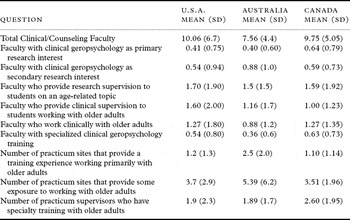
From the APA website, 310 potential graduate programs were identified. After three email requests, 46 programs responded (response rate of 15%). Eleven percent of respondents (n = 5) reported that they had a formal concentration in geropsychology, with 32.6% of programs (n = 15) reporting that their institution had a gerontology department. Faculty who had primary or secondary interests in geropsychology, or had specialized training in geropsychology, represented a small proportion of total faculty, as indicated in Table 1. Among those programs that reported minimal geropsychology training experiences, training directors reported that they were limited by having no geropsychology faculty, no means of attracting faculty with a geropsychology interest, too many classes already offered/required, no institutional support for geropsychology, and no access to a geriatric population. One graduate training director (2.2% of total) reported that his faculty was “very interested” in increasing the amount of aging content in the curriculum, as compared to 6.5% (n = 3) reporting that they were “interested,” 63.0% (n = 29) reporting that they were “somewhat interested,” and 26.0% (n = 12) reporting that they were “not interested.”
Graduate programs: geropsychology faculty and practicum opportunities

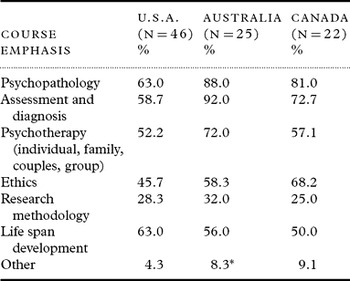
Course offerings for geropsychology topics were sparse. When considering course work offerings in geropsychology, 28.3 percent of surveyed graduate programs (n = 13) offered a geropsychology course, no programs had a required clinical geropsychology course, and 67.4% of programs (n = 31) did not offer any course work specific to geropsychology. Thirty-seven percent of programs (n = 17) offered a course on gerontology, 2.2% (n = 1) required a course on gerontology, and 56.5% of programs (n = 26) did not offer gerontology courses. As indicated in Table 2, graduate programs were most likely to offer geropsychology content in courses on psychopathology and in life-span development courses.
Graduate programs: types of courses offering clinical geropsychology content

*Other specified as “Neuropsychology” = 84% in Australia.
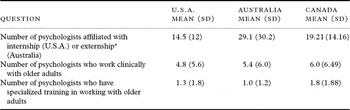
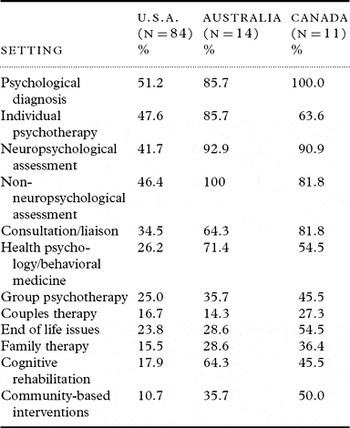
Of the 424 APA-approved internship programs, 84 completed the online survey (20% response rate). As indicated in Table 3, when compared to our data from graduate programs, internship sites had slightly more faculty working directly with older adults. Thirty-two percent of surveyed programs (n = 27) reported offering a major rotation in geropsychology, with 41% offering a minor rotation (n = 34). Among those internship sites that offered a major or minor rotation in geropsychology, the settings for those rotations included inpatient psychiatric facilities (23.8%; n = 20), inpatient medical facilities (22.6%; n = 19), nursing homes (21.4%; n = 18), outpatient psychiatric facilities (21.4%; n = 18), medical outpatient settings (11.9%; n = 10), and inpatient acute rehabilitation settings (10.7%; n = 9). The most common types of experiences that interns received while on the major or minor geropsychology rotations are listed in Table 4. Training directors were also asked to estimate the perceived importance of geropsychology training among the core internship faculty. A majority of training directors reported that it was “somewhat” important (63.4%; n = 52), with 23.2% (n = 19) reporting it as “essential” and 13.4% (n = 11) reporting it as “not at all important.”
Internship programs: faculty statistics

*Externships, generally speaking, are the Australian equivalent of the internship in Canada and U.S.A. (15 externship sites surveyed as part of the Australian data).
Internship/externship training experiences offered by sites with geropsychology rotations

Australian data
All postgraduate clinical psychology training programs at the time of the survey (N = 36) were contacted. After three email requests, 25 programs responded, for a response rate of 70%. Two out of the 36 programs reported that they had a formal concentration in geropsychology (although a third program is listed on paper, it is inactive and not taking students), with five out of 36 programs reporting that their institution had a gerontology department. Faculty who had primary or secondary interests in geropsychology, or had specialized training in geropsychology, represented a small proportion of total faculty, as indicated in Table 1.
As with the U.S. survey, among those programs that reported minimal geropsychology training experiences, training directors reported that they were limited by having no geropsychology faculty, no means of attracting faculty with a geropsychology interest, too many classes already offered/required, no institutional support for geropsychology, and no access to a geriatric population. The percentage of training directors reporting that their faculty were “very interested”, “interested”, “somewhat” or “not interested” were 12%, 44%, 40% and none, respectively.
Course offerings for geropsychology topics, while less commonly offered in Australian universities, were better represented with respect to required offerings than in the U.S.A. When considering course work offerings in geropsychology, while 73.9% did not offer such a course, over a quarter of surveyed programs (26.1%) offered such a course, with the course being compulsory in 17.4%. A course on gerontology more broadly was offered in 16.7% of programs surveyed; 12.5% required a course on gerontology, and 83.3% of programs did not offer gerontology courses. As indicated in Table 2, graduate programs were most likely to offer geropsychology content in courses on assessment and diagnosis and psychopathology.
As explained above, a formal internship year is lacking in Australian postgraduate training in clinical psychology. Students undertaking Masters level training undertake two external placements, while Professional Doctoral level students undertake three externships. The response rate of externship coordinators was less than for graduate programs, with 20 valid responses returned; however, not all coordinators answered all questions. Again, in line with the U.S. data, as indicated in Table 3, when compared to data from postgraduate training programs, external training sites had more staff working directly with older adults. From 17 responses, 59% of surveyed programs reported offering a major rotation in geropsychology; from 16 valid responses, 19% reported offering a minor rotation in geropsychology.
Among those internship sites that offered a major or minor rotation in geropsychology, and that responded to this question (N = 14), the settings for those rotations included inpatient psychiatric facilities (64.3%), inpatient medical facilities (28.6%), nursing homes (28.6%), outpatient psychiatric facilities (57.1%), medical outpatient settings (21.4%), and inpatient acute rehabilitation settings (21.4%). The most common types of experiences that interns received while on the major or minor geropsychology rotations are listed in Table 4. When asked to estimate the perceived importance of geropsychology training, a majority of externship coordinators reported that it was “somewhat” important (45%), with 55% reporting it as “essential” and no one reporting it as ether “very essential” or “not at all important.”
Canadian data
DCTs from 22 of the 24 accredited programs returned surveys for a response rate of 92%. None of these programs had formal concentrations or tracks in geropsychology. Half of the programs were in institutional settings that had gerontology programs and the primary collaborative activities were research (73%) and course work (55%). Consistent with the U.S. and Australian surveys, faculty and practicum resources in geropsychology were sparse (Table 1). Approximately half of the DCTs reported that they had no faculty members with specialized training in geropsychology, or faculty with aging as a primary or secondary research interest. When DCTs were asked to assess the level of interest among faculty members in increasing aging content, 19% were interested or very interested, 62% were somewhat interested, and 19% were not at all interested.
In 60% of programs, there were no required courses in either geropsychology or gerontology, a figure that is quite comparable to the U.S. data. However, 20% of programs required a course in geropsychology, similar to the 17.4% in Australia. Geropsychology and gerontology were offered as elective courses in 20% and 35% of programs respectively. As in the U.S.A. and Australia, aging content was included primarily in psychopathology and assessment/diagnosis courses (Table 2). Like the U.S.A., Canadian programs devote less attention to aging issues in courses on psychotherapy. The resources for increasing aging content in the curriculum that were rated by DCTs as either helpful or very helpful were as follows: reference lists on specific topics (77.3%), case study material with discussion points (72.8%), lists of relevant Web sites (68.2%), fact sheets (63.7%), general readings for candidacy lists (63.6%), and PowerPoint presentations (40.9%).
DCTs from 21 of the 23 at accredited internship sites returned surveys, for a response rate of 91%. As indicated in Table 3, internships/external placements in all countries employ more psychologists who work clinically with older adults and have specialized training in geropsychology compared to graduate programs. Among Canadian internships, 40% offer a major rotation in geropsychology, and 48% had minor rotations. Inpatient settings were psychiatric (67%), medical (36%), acute medical rehabilitation (27%), and nursing homes (27%). Outpatient settings were psychiatric (73%), medical clinics (45%), and a range of specialty services (e.g. dementia clinics). The most common types of experiences that interns received while on the major or minor geropsychology rotations are listed in Table 4.
Discussion
Although there are many differences in the training of clinical psychologists across these three countries, meaningful trends are apparent in how aging content is incorporated into such training, including the barriers associated with increasing geropsychology training content and increasing the number of professionals with geropsychology training. It was clear in all three countries that applied placements were a student's best chance of gaining exposure to clinical psychologists trained in working with older adults. This is both interesting as well as potentially promising for the profession, as research across a variety of disciplines suggests that participation in clinical practice with older clients is a strong predictor of future interest in working with this population professionally (Cummings and Galambos, Reference Cummings and Galambos2002; Koder and Helmes, Reference Koder and Helmes2008). However, both clinical staff (McLafferty and Morrison, Reference McLafferty and Morrison2004) as well as instructors (Sheffler, Reference Sheffler1995) also influence students’ attitudes about working with older adults. It may be less likely that students seek clinical placement experiences with older adults if they have not encountered faculty within their training programs who specialize in older adults. Further, didactic education about older adults and aging can significantly enhance the student's ability to provide appropriate clinical care.
Thus, it is imperative that students are exposed to aging content early in their training, in both course work and clinical placements. This exposure should begin at the undergraduate level and be integrated throughout the undergraduate curriculum (Whitbourne and Cavanaugh, Reference Whitbourne and Cavanaugh2003) and at the graduate level. Moreover, developmental psychology should not be interpreted as child and adolescent psychology, as it is in many psychology departments, but rather as life span developmental psychology. Development does not end at the beginning of adulthood. This point is critical for training, as every practice guideline in geropsychology emphasizes the need for knowledge about normal aging, content that is typically included in life span developmental courses. In addition, this life span perspective is essential for understanding psychopathology in old age, as many disorders have an early onset and require an understanding of their developmental trajectories.
It was also interesting to note in the present results that course content within training programs appears to emphasize training in diagnosis and assessment of older adults at the expense of interventions, particularly in Australia and Canada. This may send students the message that when interacting with an older population, the goal is more oriented around finding and labeling problems rather than embarking on rehabilitation or therapy. Unfortunately, this trend neglects the growing body of literature that supports the effectiveness of evidence-based treatments for older adults and their family caregivers, and the growing recognition that these can be adapted quite successfully for older adults with a range of cognitive impairments (Zarit and Zarit, Reference Zarit and Zarit2007). Ultimately, a selective training focus on diagnosis and assessment does a major disservice to older adults who are suffering from mental health problems.
Finally, many barriers to hiring more staff with a specialization in aging or geropsychology were cited in all countries. Some of these barriers (e.g. insufficient access to older patient populations) may be more in the minds of administrators than reflective of the realities of an aging population and the unmet need for mental health services within this population. A major barrier to the hiring of sufficiently trained staff is the paucity of training programs offering geropsychology training, and the resulting small number of individuals graduating with experience and training with older adults. This barrier also decreases the likelihood that a critical mass of researchers at any one institution might accrue, limiting the potential for larger scale programmatic research agendas to be pursued. Moreover, it is worth noting that concerns about meeting the needs of an aging population are not limited to geropsychology but are shared across all allied health care providers and researchers (LaMascus et al., Reference LaMascus, Bernard, Barry, Salerno and Weiss2005; Institute of Medicine, 2008).
In 2005, Gerontology and Geriatrics Education (volume 25, issue 4) described models of geropsychology training across educational levels and sites, with helpful suggestions for making these programs work effectively and noting the implementation challenges. Similarly, Zweig et al. (2006) reported on integrating gerospychology training into primary care. While these training initiatives have involved primarily psychologists, there is tremendous opportunity to collaborate with mental health providers from other disciplines due to the interdisciplinary nature of gerontological practice and the emerging interest in interprofessional models of training. In addition, increasing didactic content in graduate and internship programs may be as simple as making resources readily available.
The relatively low response rate for the U.S. survey not only limits generalizability of these data to the U.S. context, but also invites speculation as to causative factors. It could be that the most enthusiastic responses to the survey were from programs that offer aging content. While the Canadian response rate was almost perfect and offers little in comparison, the responses from the Australian universities did seem to reflect programs that offer courses or specialist degree programs in aging (true of 5 of the 27 responding universities but true of none of the 30% of non-responders).
It is interesting to note that our U.S. results varied considerably from the results obtained by prior surveys in that country. Our results indicated that 28.3% of graduate programs offered a geropsychology course, whereas Siegler et al. (Reference Siegler, Gentry and Edwards1979) found that 33% offered at least one course. At the internship level, our results indicated that 32% offered a major rotation in geropsychology, compared to 25% that offered a formal experience with older adults (Siegler et al., Reference Siegler, Gentry and Edwards1979), and 41% that had formal training devoted to working with older adults (Cohen and Cooley, Reference Cohen and Cooley1983). With the exception of the study by Hinrichsen et al. (Reference Hinrichsen, Myers and Stewart2000) which found that 60% of sites offered two or more geropsychology training opportunities, a comparison of our results with those of other studies suggest that opportunities for geropsychology training have potentially not increased significantly since the 1970s, despite increasing demand for geropsychologists.
In light of these results, trainees and professionals might wonder how to obtain needed experiences in order to provide services competently to an increasing population of older adults. A recent article outlining the Pikes Peak Model for training in professional geropsychology (Knight et al., Reference Knight, Karel, Hinrichsen, Qualls and Duffy2009) discusses these concerns, particularly in relation to post-licensure psychologists who would like additional specialized training in geropsychology, and highlights the development of the Council of Professional Geropsychology Training Programs. Together with SCG, this group is currently compiling information about available training opportunities and will serve as a forum for training opportunities at all levels of professional development. The Canadian data from this study suggest that the majority of DCTs perceived reference lists, case studies and readings for candidacies to be potentially helpful in increasing aging content in their programs.
Future directions to pursue with respect to the current study include gathering follow-up data in order to track changes in geropsychology training program content and makeup across the three countries. This is already in process in the U.S.A. It would also be useful to include other countries in a future study. For example, the U.K. would be an interesting comparator, as until recently their postgraduate clinical psychology trainees had to complete a compulsory geropsychology rotations as well as compulsory geropsychology course work.
Conflict of interest declaration
Nancy A. Pachana is a deputy editor of International Psychogeriatrics. She is also the guest editor for this special issue of International Psychogeriatrics.
Description of authors' roles
N.A. Pachana, E. Emery and C. Konnert formulated the basic premise of the study and wrote the paper. B. Edelstein and E. Woodhead contributed major sections, revised drafts and assisted with writing the paper.