1. Introduction
Policies that emphasize the use of incentives to conserve ecosystems such as forests have emerged as potentially cost-effective alternatives to command-and-control instruments (Ferraro and Kiss, 2009; Bulte and Engel, Reference Bulte, Engel, López and Toman2006). In particular, payments are offered directly, sometimes in the form of cash subsidies, to policy recipients in exchange for conserving forest, e.g., Payments for Environmental Services (Pagos por Servicios Ambientales; PES) in Costa Rica (Pagiola, Reference Pagiola2008). Incentives can also be provided indirectly by donors via some associated input to the joint production of private and public goods, e.g., subsidies for capital inputs to eco-tourism or forest honey production (Wunder, Reference Wunder2000; Bluffstone, Reference Bluffstone1995). In developing countries, such interventions often aim to improve the incomes and livelihoods of the poor while conserving ecosystems.
A trade-off between inducing cost-effective forest conservation and raising the profits of an ‘eco-entrepreneur’ was demonstrated by Ferraro and Simpson (Reference Ferraro and Simpson2002). They show that, when markets are perfect and side payments are not possible, a budget-constrained donor always prefers PES to the more indirect approach due to the former's cost effectiveness. The eco-entrepreneur, say a local eco-tourist operator or honey producer, on the other hand, prefers the indirect approach since she profits from the additional transfers required. Cost effectiveness is thus analyzed in terms of the relative deadweight losses associated with each type of policy. Groom and Palmer (Reference Groom and Palmer2010), on the other hand, show that where eco-entrepreneurs face market and institutional constraints, e.g., input constraints or credit rationing, policies which relax these may be both cost effective for donors and profit enhancing for the eco-entrepreneur.Footnote 1 This is due to released rents over and above the donor's payments, known as constraint rents. Therefore, relaxing a constraint is more cost-effective than PES if these rents outweigh the relative deadweight losses.
The theoretical results derived by Groom and Palmer (Reference Groom and Palmer2010) are not closed-form solutions and raise questions about the precise conditions under which PES or relaxing constraints are cost effective. They are also silent on how one might identify and evaluate market constraints. In this paper, we provide explicit solutions and show how the theory could be operationalized in a real-world policy setting: forest honey production in Madagascar. Honey production has been promoted by non-governmental organizations (NGOs) and donors both as a means of improving livelihoods and conserving forests in some developing countries (see Bradbear, Reference Bradbear2009). Since Ferraro and Simpson (Reference Ferraro and Simpson2002) utilized this setting, we compare their results to our own. The constraint identified in Madagascar is technological and typical of those faced by producers in many developing countries. We first extend the theory developed by Groom and Palmer (Reference Groom and Palmer2010) in order to characterize this constraint. The relative cost effectiveness of relaxing constraints versus PES is then evaluated by calibrating the model using survey data. In a further departure from the earlier paper, this allows for an exploration of three new dimensions for the analysis of policy cost effectiveness. First, how different types of production process might influence policy cost effectiveness and second, how cost effectiveness varies under different market conditions. Finally, we relax the assumption that production is efficient with respect to the use of inputs. Specifically, we examine how cost-effectiveness varies when producers are technically inefficient.
Insights from our analysis could potentially guide policy makers who have limited information regarding market and institutional conditions. In particular, the technological constraint observed in Madagascar applies to capital inputs used in production, which are subsidized and purchased by local NGOs. Relaxing this constraint enables producers to switch from traditional to semi-modern beehives. We test the sensitivity of the results to relative price and technological parameters. Further simulations reveal that, while relaxing constraints to forest honey production is unlikely to be cost effective compared to PES from the perspective of the donor, it might be more cost effective overall in the sense of minimizing the deadweight losses of the intervention. Cost effectiveness is also shown to be highly dependent on the nature of the technology, particularly returns to scale and input complementarity. Our innovative method of characterizing the constraint could potentially be applied to other eco-production activities such as sustainable forest management (SFM) and shade coffee production. Once a constraint has been identified, it could be used to evaluate policy cost effectiveness and efficiency and hence contribute to deliberations on policy choice prior to implementation.
The results are important because, contrary to the perfect market and institutional setting of Ferraro and Simpson (Reference Ferraro and Simpson2002), constraints, institutional failures and market failures are the rule rather than the exception in many developing countries (Ellis, Reference Ellis1998; de Janvry and Sadoulet, Reference de Janvry, Sadoulet, de Janvry and Kanbur2005). Therefore, providing credit, expertise and technology, or more secure land rights in such settings might be a more cost effective intervention for increasing forest cover compared with the use of financial incentives such as PES. Our results also indicate that the analysis of cost effectiveness for the donor is not sufficient to evaluate the desirability of the programme. In a constrained world, efficiency and distributional issues are also important determinants of success (FAO, 2009).
The paper proceeds as follows. From Ferraro and Simpson (Reference Ferraro and Simpson2002) and Groom and Palmer (Reference Groom and Palmer2010), we first restate the conditions necessary for efficiency, cost effectiveness to the donor and the impact on the eco-entrepreneur's profits, in section 2. The conditions for cost effectiveness when producers are technically inefficient are presented in section 3. The model is then calibrated for forest honey producers using data collected from Madagascar, in section 4. We develop a method of defining the technological constraint and assessing the policy that was implemented to relax this. In section 5, we present our results, including a comparison with those of Ferraro and Simpson (Reference Ferraro and Simpson2002). Following from a sensitivity analysis in section 6, section 7 discusses the results before concluding.
2. Conditions for efficiency and the preferences of the donor and eco-entrepreneur
We begin by summarizing the theoretical conditions for efficiency, cost effectiveness to the donor and the impact on the eco-entrepreneur's profits (or income) of conserving forest either indirectly via the expansion of a joint production activity or directly via payments for forest land. These conditions form the basis for the empirical simulation. Groom and Palmer (Reference Groom and Palmer2010) extended Ferraro and Simpson (Reference Ferraro and Simpson2002) to develop these conditions for a profit-maximizing yet input-constrained producer with concave production function Q = F(K, F) using capital (K) and forest (F) as inputs. Prices for output, Q, and inputs are given by P
Q
, P
K
and P
F
, respectively. Market and institutional imperfections are introduced via the presence of a binding constraint on capital,
 $\bar{K}$
. The conditions follow from the comparative statics of the constrained profit function, in contrast to the unconstrained case analyzed by Ferraro and Simpson (Reference Ferraro and Simpson2002). In particular, when input (output) markets are constrained and rationing by quantity occurs, the relevant decision price for the entrepreneur is no longer the market price P
K
but the higher (lower) ‘virtual’ price, P
v
, which is the price that would have to prevail in order for an unconstrained entrepreneur to choose the constrained input level. Hence, in the case of an input a constraint rent exists, P
v
− P
K
, which measures the value of relaxing the constraint. We first state the conditions found by Groom and Palmer (Reference Groom and Palmer2010) under technical efficiency. The appendix provides technical details under technical inefficiency, where the efficiency parameter θ < 1. The following results can be established under the assumption that the efficiency parameter is equal to unity: θ = 1.
2.1. Overall cost effectiveness
Overall cost effectiveness is evaluated by comparing the deadweight losses and gains associated with relaxing constraints with those of paying for the conservation of forest land through a PES scheme. The latter payment is given by dP
F
. The appendix shows that, for an eco-entrepreneur facing a capital constraint
 $\bar{K}\comma \; $
where the unit resource cost of relaxing the constraint is the underlying market price P
K
, forest-land payments are more cost effective if:
 $$dC={1 \over 2}\left[{\partial F^{C} \over \partial P_{F}}\lpar dP_{F}\rpar ^{2}-{\partial P_{v} \over \partial K}\lpar dK\rpar ^{2}\right]-\left(P_{v}^{0}-P_{K}\right)dK \gt 0$$
Groom and Palmer (Reference Groom and Palmer2010) show that this can be restated as:
 $$dC = \mathop{{dK \over 2}\left[-dP_{v}^{I}-dP_{v}^{D}\right]}\limits_{{\rm relative\, deadweight\, losses}} -\mathop{\left(P_{v}^{0}-P_{K}\right)dK}\limits_{{\rm constraint\, rent}} \gt 0$$
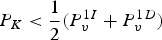
where dC is the incremental cost of relaxing constraints compared to forest-land payments, dK is the amount of capital required to increase forest land, and P v 0 is the initial virtual price of capital.Footnote 2 The term dP v I is the change in the virtual price of capital as a consequence of relaxing the constraint on capital while dP v D is the change in the virtual price of capital as a consequence of the forest-land payment. Given the assumptions, the former is negative and the latter is positive. The second term is the constraint rent associated with relaxing the constraint, and is positive. Hence, the sign of dC, and the relative efficiency of the two policies is indeterminate.
2.2. The donor's preferred policy
The donor must either pay −FdP F , directly for forest land, or P K dK under the policy of relaxing constraints. A donor concerned solely with cost effectiveness prefers payments if it costs less:
 $$-FdP_{F} \lt P_{K}dK$$
As shown by Groom and Palmer (Reference Groom and Palmer2010), this condition becomes:
 $${\eta_{KF}^U \over \eta_{FF}^C} \lt \eta_{KK}^U + {1 \over K} {\partial K \over \partial P_v} \left(P_v^0 - P_K \right)$$
where η ij C is the constrained elasticity of demand for input i with respect to the price of input j, and η ij U is the unconstrained equivalent. This reveals the dependence on features of the technology: the virtual price elasticity of demand for capital, η KK U ; the constraint rent associated with the constraint, (P v 0 − P K ); the unconstrained cross-price elasticity of inputs, η KF U ; and the constrained own-price elasticity of demand for forest land, η FF C . Condition (3) states that the donor prefers forest payments to relaxing constraints when: the constraint rent is low; the demand for forest is inelastic with respect to price; and capital and forests are highly complementary (high η KF U ). Note, however, that the virtual price P v depends on the elasticities.
2.3. The eco-entrepreneur's preferred policy
When the eco-entrepreneur is constrained in an input market, for small changes in P F or K, her profits will change, respectively, as follows:
 $$\eqalign{d\Pi_{F}^C &= {\partial \Pi^C \over \partial P_F} dP_{F} = - FdP_F \cr d\Pi_K^C &= {\partial \Pi^C \over \partial K} dK = P_v^0 dK}$$
Hence, if the donor pays the resource cost of relaxing the constraint, the eco-entrepreneur prefers a payment for forest land if:
 $$-FdP_{F} \gt P_v^0 dK$$
This condition becomes:
 $${\eta_{KF}^U \over \eta_{FF}^C} \gt \eta_{KK}^U$$
The analysis shows that when the demand for forest land and capital are highly complementary, in the sense of there being a large, positive, unconstrained cross-price elasticity, η KF U , and where the constrained own-price elasticity of forest, η FF C , is inelastic, then the eco-entrepreneur will prefer to participate in PES since it requires a larger payment. It is in direct tension with condition (3) for the donor.
However, despite this tension, when the constraint rent is positive, P v 0 > P K , conditions (2) and (4) can hold simultaneously in favour of relaxing constraints so that both the donor and eco-entrepreneur will prefer this. The area of agreement is large whenever the constraint rent is large, i.e., due to a high, positive value of P v 0. Relaxing constraints can, in principle, provide cost effective conservation of forest land for the donor while also providing a large transfer to the eco-entrepreneur through the released constraint rent. Once again, since the virtual price, P v , depends on the elasticities in condition (3) and (5), more investigation is required to illustrate which intervention is preferred and under what circumstances.
In summary, given the technological assumptions, three outcomes are possible depending on the cost of the intervention: (i) donors prefer forest-land payments through a PES scheme and producers prefer relaxation of constraints; (ii) both parties prefer relaxation of constraints; (iii) donors prefer relaxing constraints and eco-entrepreneurs prefer PES. While Ferraro and Simpson's (Reference Ferraro and Simpson2002) results held for all homothetic technologies, this result does not depend primarily on homotheticity and may hold for a wider variety of technologies.
3. Cost effectiveness with technical inefficiency
Thus far, we have assumed that production is always efficient with respect to the use of inputs. When producers in developing countries are technically and/or allocatively inefficient, there are likely to be implications for the relative cost effectiveness and welfare impacts of PES and policies to relax constraints. To illustrate, we focus on the case of a technically inefficient producer. This choice is motivated by our examination of the technological constraint in honey production (see next section). Arnade and Trueblood (Reference Arnade and Trueblood2002) define the input distance function: D I (Q,F,K) = θ−1 where θ ≤ 1, and production is technically inefficient when θ < 1. Given duality between the distance function and the cost function (C(Q,P K ,P F )), the profit maximization problem for a homogeneous technology then becomesFootnote 3 :
 $$\Pi \left(\theta P_{Q}\comma \; P_{K}\comma \; P_{F} \right)= \max_{y}P_{Q}y - \theta^{-1} C \left(Q\comma \; P_{K}\comma \; P_{F}\right)$$
Via Shephard's Lemma the demand for input i becomes: ∂Π (θ P Q ,P K ,P F )/ ∂ P i = −θ−1 x i (θ P Q ,P K ,P F ), and the input demand becomes:
 $$-\theta \Pi_i = x_i \left(P_Q\comma \; P_K\comma \; P_F \right)$$
The appendix shows that with technical inefficiency the condition for relative efficiency becomes:
 $$\eqalign{dC_{\theta} &= {1 \over 2} \left[{\partial F^{C} \over \partial P_F} \lpar dP_F\rpar ^2 - {\partial P_v \over \partial K} \lpar dK\rpar ^2 \right]- \lpar P_v^0 - P_K\rpar \, dK \cr &\quad + \left({\theta -1 \over \theta} \right)\left(\left({\partial F^C \over \partial P_F} dP_F + F_0 \right)\, dP_{F} - P_v^0\, dK \right)}$$
If this is positive, PES is preferred. The first two terms are essentially identical to those under technical efficiency (θ = 1) in equation (1). The third term arises as a consequence of technical inefficiency. Inefficiency changes the relative efficiency of the two policies in an indeterminate way which will depend on the nature of the technology. A simulation in the following section illustrates this. Nevertheless, technical efficiency as it is modelled here leaves the preferences of the donor and the producer over policies unaffected. The donor is still only interested in relative costs and will prefer PES over relaxing constraints if −FdP F < P K dK. The recipient prefers PES if:
 $$d\Pi_{F}^{C} \gt d\Pi_K^C \Longleftrightarrow -\theta ^{-1} FdP_F \gt \theta^{-1} P_v^0 dK$$
which reduces to the same condition as under technical efficiency.
4. Policy choice to conserve forest in Central Menabe, Madagascar
4.1. Background
The eco-entrepreneur in our case study is the forest honey producer of Central Menabe, located on the west coast of Madagascar. They are observed to receive a new and more productive technology for honey production as the result of a donor intervention. This strategy is observed to relax a technological constraint on production. Market and institutional constraints have long been observed in Madagascar, particularly in agricultural and credit markets. These contribute to poverty among rural households (see, for example, Barrett and Dorosh, Reference Barrett and Dorosh1996; Minten and Barrett, Reference Minten and Barrett2008).Footnote 4
Honey-producing households reside in poor, resource-dependent communities located at the edge of a bio-diverse rich, dry forest. Preserving biodiversity in the area, including a number of endemic and currently endangered animal species, is one of the greatest ecological challenges that Madagascar faces (Nicoll, Reference Nicoll, Goodman and Benstead2003). Deforestation via slash-and-burn agriculture occurs at an annual rate of 1 per cent (Scales, Reference Scales2007).
Numerous NGOs, both local and international, and donors alike operate in the region primarily (but not necessarily exclusively) to conserve biodiversity. For example, the Durrell Wildlife Trust has been experimenting with an environmental auction among local communities to participate in biodiversity monitoring. Conservation payments were paid out to the ‘winners’ of the auction. In our study area, NGOs have been considering various interventions including PES and eco-tourism as a means of raising incomes and conserving forest (Dirac Ramohavelo, Reference Dirac Ramohavelo2009). They have also been providing support to households for the expansion of beekeeping and honey production.
Beekeeping and honey production is well established in Central Menabe, although usually only as an income complement to agriculture.Footnote 5 Bees forage in diverse natural and secondary forest formations in the vicinity of beehives. Households engaged in honey production are observed to use two types of beehive, typically located in and around villages: traditional and semi-modern. In traditional beekeeping, beehives are typically single, large empty logs found in the forest, closed on each side with only very small apertures for the bees. For semi-modern beekeeping, farmers use semi-modern beehives, generally Langstroth or Kenyan models. Semi-modern hives are more spacious than the traditional ones with honey produced on ‘cadres’ inside, which need to be periodically removed and the honey gathered (Dirac, personal communication).
To calibrate the model we use primary data on agricultural activities and non-timber forest products, including beekeeping, collected between 2005 and 2007 (Dirac Ramohavelo, Reference Dirac Ramohavelo2009).Footnote 6 On average, a honey-producing household owns 1.84 beehives, of which 1.2 and 0.64 are classified as traditional and semi-modern, respectively. Including labour costs to build and maintain over the course of a year, traditional beehives cost US$ 8.10 per unit while semi-modern hives cost US$ 23.82. Note, however, that semi-modern hives are not constructed locally. Instead, they are donated by local NGOs. Hence, the price of semi-modern hives is the market price paid by the NGO in addition to the costs of training local households to use the hives effectively. No market for semi-modern hives exists in the study-area villages. A traditional beehive produces an average of 15 litres of honey per year while the more productive semi-modern type produces 32 litres annually. Honey is typically sold in the villages, either to locals or to middlemen who then sell the honey in more distant markets. During the study period, honey prices remained stable at around US$ 2.87 per litre.
Honey production requires forest land as an input. Indeed, honey yield has been found to increase with proximity to forest (see Sande et al., Reference Sande, Crewe, Raina, Nicolson and Gordon2009). It also requires labour and capital inputs more or less in fixed proportions. In principle, therefore, a donor wishing to conserve forests could purchase forest land or capital inputs. Both would simultaneously enhance honey production while employing more forest land in production.
4.2. Calibration of constrained honey production
4.2.1. The technology
Ferraro and Simpson (Reference Ferraro and Simpson2002) characterize the semi-modern technology of honey production in Madagascar. Given our limited data, we return to their characterization of the following Cobb-Douglas production function: Q = AK α F β, where Q is honey production, A is a productivity parameter, α and β are the elasticities of capital and forest, respectively, K and F. Due to gaps in our own data, we utilize the following parameter values estimated by Ferraro and Simpson (Reference Ferraro and Simpson2002). The technology has strong diminishing returns to scale in that α = 0.36 and β = 0.15, with A = 48. In addition, α and β reflect a low output elasticity of capital, K, and particularly forest, F. This deterministically captures the low complementarity between F and K and the loose relationship between honey production and forests that might arise from non-rivalry. The exposition here assumed technical efficiency: θ = 1.
4.2.2. The constraint and behavioural assumptions
Our data contain no explicit definition of the individual constraints faced by honey producers. Nevertheless, the presence of two types of beehive in the sample, semi-modern and traditional, allows us to identify and characterize the production constraint when combined with assumptions concerning the production technology. In particular, semi-modern beehives are twice as productive as traditional ones, and are only used by recipients of assistance from NGOs working in the area. This provides a prima facie case for the existence of a technological constraint underpinned by a capital constraint, which is being relaxed by external donor intervention. We characterize the constraint as follows.
We first define the traditional technology as being a nested version of the semi-modern technology, differing only in the effective capital embodied in each beehive. Thus, we define the technology in terms of effective capital EK: Q = A(EK)α
F
β, where E = 1 for the traditional technology, and E > 1 for the semi-modern technology. K represents the number of beehives and E represents the differences in the construction of traditional and semi-modern. EK can be understood as the interior surface area for honey production.Footnote
7
Characterizing the technology in this way allows us to represent the traditional technology as a capital-constrained version of the semi-modern technology. In what follows, we calibrate the values of E and
 $\bar{K}$
.
We assume that both traditional and semi-modern producers are profit maximizers conditional on their own technology and the associated prices. This defines supply functions: Q T(P K T , P F ; E T = 1) and Q SM (P K SM ,P F ;E SM ), for each technology. These differ only because of the values of the parameter E and the price of traditional and semi-modern beehives, P K T and P K SM , respectively. To define the parameter E for semi-modern producers we use the observation that the profit-maximizing output of traditional production is approximately half that of unconstrained semi-modern production: Q SM = 2Q T . This leads to the following definition of E SM :
 $$Q^{SM}\left(P_{K}^{SM}\comma \; P_{F}\semicolon \; E^{SM}\right)= 2Q^{T}\left(P_{K}^{T}\comma \; P_{F}\semicolon \; E^{T}=1\right)$$
With E
SM
defined, it is then possible to define the effective capital constraint,
 $\bar{K}$
, faced by traditional producers in terms of the semi-modern technology:
 $$Q^{SM}\left(P_{K}^{SM}\comma \; P_{F}\semicolon \; E^{SM}\right)=2Q^{SM}\left(P_{K}^{SM}\comma \; P_{F}\semicolon \; E^{SM}\comma \; \bar{K}\right)$$
The implication of (8) and (9) is that
 $Q^{SM}\left(P_{K}^{SM}\comma \; P_{F}\semicolon \; E^{SM}\comma \; \bar{K}\right)=Q^{T}\left(P_{K}^{T}\comma \; P_{F}\semicolon \; E^{T}=1\right)$
. That is, unconstrained traditional producers are modelled as constrained semi-modern producers.
The assumptions underlying our method of characterizing the capital constraint have the following implications. Both the traditional and the constrained semi-modern producers have constrained supply curves (Q) and constrained demand curves for forest, F C (.), that are identical in P F − space. However, the demand for effective capital differs between these two technologies, with the latent demand for effective capital much higher for semi-modern capital due to its higher productivity. Relaxing the capital constraint assumes that the honey producer is assisted in shifting from one technology to another as additional semi-modern hives are provided as part of the policy approach. Thus, the impact of this approach is analyzed along the semi-modern demand curve rather than the traditional.
There are two possible constrained scenarios when considering forest-land payments. First, a partially constrained analysis in which payments induce additional traditional hives to be employed, Δ K
T
. Second, a totally constrained scenario in which capital remains constrained at
 $\bar{K}$
. We compare both scenarios to relaxing the constraint,
 $\bar{K}$
, with semi-modern capital.
4.3. Defining the constraint: the constrained and unconstrained solutions
We use the following parameter values from the data for the simulation: [α,β, A, P K SM , P K T , P Q , Q SM /Q T ] = [0.36,0.15,48,24,8,3,2]. Table 1 shows the solutions to the traditional technology, the semi-modern and the constrained semi-modern technologies.
Characterization of the technology constraint

Solving for E
SM
using (8) leads to E
SM
= 7.7. The semi-modern technology, with its greater effective capital, produces greater quantities and profits while using more forest with fewer beehives. Using (9) to solve for the capital constraint yields:
 $\bar{K}=2.4$
. This reflects the ‘effective’ capital constraint faced by producers using traditional technology in terms of the semi-modern technology, as seen in the semi-modern constrained scenario in row three of table 1.Footnote
8
The simulation has two parts. First, we estimate the forest payment, dP F , and the amount of capital, dK, required to increase forest. We follow Ferraro and Simpson (Reference Ferraro and Simpson2002) in analyzing the cost of the intervention required to effect a 0.1 ha change in forest for a single producer, assuming that 10 producers are subject to the intervention. We estimate forest-land payments for the two possible constrained scenarios described above, partial and total. Second, we undertake a comparison of these results to the case where market conditions are ignored; that is, where it is assumed that the producer is unconstrained and responds to payments, either to forest land or capital, dP F and dP K . In all cases we treat both capital and forest-land inputs as a flow despite the potential for capital to be a one-off intervention.
5. Results: forest payments vs. relaxation of the constraint
5.1. What is cost effective overall?
The intervention that is cost effective overall is determined by condition (1). If the incremental cost, dC, is negative then the honey producer prefers constraints to be relaxed.Footnote 9 Given the technological assumptions this condition holds and the cost effective intervention, i.e., that which minimizes the deadweight losses, is for constraints to be relaxed.Footnote 10
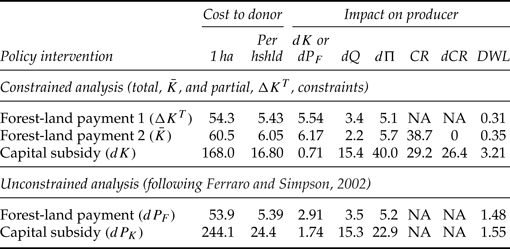
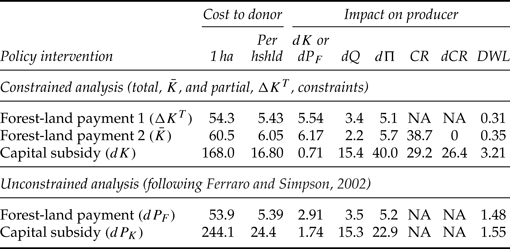
Table 2 details the impact of the interventions. In the totally constrained case, the deadweight loss when constraints are relaxed is US$ 3.2 compared to one of US$ 0.35 when a forest-land payment is made. However, there is a large efficiency gain as a consequence of relaxing the constraint, which is measured by the released constraint rent of US$ 26.4. The incremental cost of employing a payment rather than relaxing the capital constraint in this case is therefore US$ 23.6.
Price subsidies vs. relaxing constraints, constrained vs. unconstrained (US$)
In effect, the donor's contributions release extra resources which contribute both to the environmental objective and the welfare of the producer and, hence, could improve the latter. But if the donor is concerned only with the much narrower objective of cost effectiveness, then it will prefer forest payments to supplying capital inputs, as shown below.
5.2. What the donor prefers
The donor's preferences are determined by equation (3). With the decreasing returns to scale (DRS) technology of honey production this condition becomes: βP v 0 − P K < 0. That is, the donor prefers to make a forest-land payment if the ‘augmented’ constraint rent, βP v 0 − P K is less than zero, which is the case with the parameter values used here.Footnote 11 Table 2 shows the implications for the producer's profits and donor's costs in both the partially and totally constrained cases. In the latter, US$ 6.17 is required to induce an increase of 0.1 ha. Since the donor must pay for all units of forest employed, on average 0.98 ha, not just the marginal units, the total cost per producer is: −FdP F = 6.05. The total cost over 10 producers is US$ 60.5.Footnote 12 In the former, producers are more responsive and the cost to the donor is reduced to US$ 54.3. Reflecting equation (3), this shows that forest-land payments become less cost effective the more constrained the honey producer.
Table 2 also shows the outcome of an intervention to relax constraints.Footnote 13 Although 0.7 additional units of capital (approximately 1.5 beehives) are required to induce the required increase in forest land, the donor's cost across 10 households is US$ 168 where P K SM = 24. On the basis of cost effectiveness for the donor, it is clear that the donor would prefer the payment for forest land. This would save around US$ 108 per ha of forest conserved, with a greater saving if producers can introduce more traditional beehives in response.
5.3. What the honey producer prefers
The honey producer's preferences are determined by the inequality shown in (4). With the DRS technology he will prefer the intervention to relax constraints if β < 1, which is clearly the case since β = 0.15. Table 2 shows the implications for the producer's profits and the donor's costs in both the partially and totally constrained scenarios. The increase in profits from the forest-land payment is only US$ 5.1 or US$ 5.7 in these respective scenarios. While these payments are increasingly desirable to the producer when it is more constrained, the impact on profit should be compared to a change of over US$ 40 when constraints are relaxed. A significant portion of the latter is the released constraint rent ((P v 0 − P K SM ) dK), which is indicated by dCR in table 2 and estimated to be approximately US$ 26.4.Footnote 14
In summary, when considering market conditions for the case of Malagasy honey producers, the preferences of the donor and the producer remain in tension regardless of whether the producer can adjust traditional capital or not. This finding accords with Ferraro and Simpson (Reference Ferraro and Simpson2002) who ignored market conditions. Hence, even where honey producers are technologically constrained, conservation and income objectives remain in tension from the perspective of the donor: the cost effective strategy does not induce the greatest transfer to the producer.
5.4. What if we ignore market conditions?
The lower part of table 2 shows the results when honey producers are assumed to be unconstrained profit maximizers. We analyze the response of an unconstrained semi-modern producer to forest payments or subsidies to capital, rather than relaxing capital constraints. As well as placing donor and producer in tension, ignoring market conditions makes these transfers look more cost effective than they actually are. This can be seen in the underestimation of the costs to the donor of US$ 53.9 rather than US$ 60.5 per ha of conserved forest for a totally constrained producer. On the other hand, the benefits to producers are underestimated: US$ 5.2 instead of US$ 5.7.
6. Sensitivity analysis
In the case of Madagascar the donor prefers payments for forest land even when market conditions are considered. The producer, on the other hand, prefers capital constraints to be relaxed. Overall, the cost effective course of action is to relax constraints in honey production. As the following sensitivity analysis illustrates, these results are sensitive to the nature of the joint production technology, technical inefficiency as well as the relative prices of inputs and outputs.
We focus on parameters that describe the Cobb–Douglas technology: α, β and the returns to scale k = α+ β, and the level of technical inefficiency reflected by the parameter θ. We restrict attention to the more plausible DRS case. In the DRS case the conditions under which the donor and eco-entrepreneur both prefer to relax constraints (conditions (2) and (4), respectively) can be combined to yield P v 0 > βP v 0 > P K (Groom and Palmer (Reference Groom and Palmer2009)). The first inequality shows that in most circumstances the eco-entrepreneur will prefer constraints to be relaxed, since it requires β < 1. This leaves two of the possible outcomes outlined in section 2.3: either the donor prefers the forest payment and the eco-entrepreneur prefers relaxing constraints, or both agree on relaxing constraints. Whether or not tension exists between the agents on the appropriate intervention depends on the donor's preferences. In the Cobb–Douglas case the donor prefers to relax constraints if the augmented constraint rent is positive:
 $$\beta P_{v}^{0}-P_{K} \gt 0$$
The augmented constraint rent is closely related to the constraint rent P
v
0 − P
K
, which conditions (2) and (4) showed to be pivotal in general. Taking
 $\bar{K}$
as given, the sensitivity of the donor's preferred choice of intervention to technological parameters α and β can be evaluated by plotting those values that equate the augmented constraint rent to zero: βP
v
0 − P
K
= 0.Footnote
15
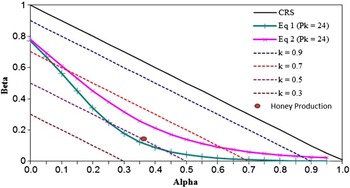
This yields the upper curved line in figure 1, which is given by equation (2). To compare this to other DRS technologies, combinations of α and β such that α + β= k are also plotted. Values of α and β above the upper curved line such that α + β< 1 yield a positive, augmented constraint rent.
Figure 1 reveals that the characteristics of the technology determine whether the augmented constraint rent is positive for any given constraint. Agents might agree to relax constraints when there is large α and β, which has two interesting interpretations in the Cobb–Douglas case. First, the constrained elasticity of forest with respect to the capital constraint,
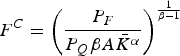
 $\eta_{F\bar{K}}^{C} = \alpha/\lpar 1 - \beta\rpar $
, is increasing in α and β. This indicates that where forest and capital are highly complementary in production, the donor will prefer to relax constraints because only small increments of capital are required to achieve an increase in forest conservation. Second, large α and β indicates higher returns to scale. Figure 1 shows that the closer technology is to constant returns to scale (CRS) the more likely it is that the donor will prefer relaxing constraints to forest-land payments. In sum, increased complementarity and higher returns to scale increase the augmented constraint rent and make relaxing constraints more favourable.Footnote
16
Donor's preferences over policy intervention and relaxing constraints: variation with technological parameters and returns to scale (α, β and k = α+ β)

Fixing returns to scale such that α + β= k reveals that intermediate, rather than extreme, values of α and β are more likely to lead to the relaxation of constraints being preferred by donors. In the Cobb–Douglas case a general interpretation of this observation is that donors are less likely to prefer to relax constraints where technologies are either highly capital or forest intensive. This reflects the tradeoff between complementarity, forest-price elasticity and other determinants of the augmented constraint rent. For instance, holding returns to scale fixed, an increase in β towards extreme values simultaneously decreases complementarity and increases the price elasticity of demand for forest (η FF C = 1/(β − 1)), thus making forest-land payments preferable to the eco-entrepreneur. Furthermore, although high values of α increase complementarity, when returns to scale are held constant the augmented constraint rent eventually declines as β diminishes. Figure A1 in the appendix shows that the precise relationship depends on relative prices.
The parameter values for forest honey production are indicated in figure 1. Here, returns to scale are strongly decreasing since k = α+ β =0.51. Complementarity between forest and capital is low since β and α are small: α /(β − 1) = −0.42. The constrained price elasticity of forest demand, on the other hand, is relatively large, at −1.56. Ultimately, the donor prefers forest-land payments, and there are no values of α and β such that the donor would prefer to relax constraints at the existing returns to scale.
Similar results hold when one abstracts from the individual agents and considers overall efficiency (equation (1)). In figure 1 the lower curved line plots values of α and β for which forest-land payments and relaxing constraints are equally cost effective overall. Above the line relaxing constraints is cost effective and the range of values for which this is the case is larger and includes honey production. This reflects the fact that the full welfare effect includes the released constraint rent over and above any payments. Hence, if a Coasian bargain over the constraint rent could be struck between donor and eco-entrepreneur then the donor might be persuaded to opt for relaxing constraints.
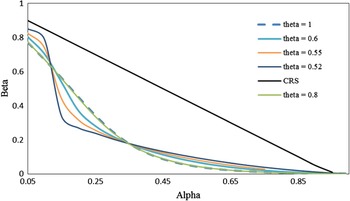
Lastly, figure 2 shows the impact of technical inefficiency. In the Cobb-Douglas case, lower levels of technical efficiency make relaxing constraints more efficient to PES for certain parameter values, while less efficient at other parameter values. This reflects the inderterminate effect of inefficiency highlighted in the previous section. Technical inefficiency tends to accentuate the importance of complementarity and scale discussed above, introducing the interesting possibility that, even for a given technology, the cost-effective policy will vary with technical efficiency. Again this makes it important that the production process is understood when determining the intervention.
Donor's preferences over policy intervention: technology (α and β) and technical efficiency (θ)

7. Discussion and conclusions
In addressing the cost effectiveness of conservation payments, Ferraro and Simpson (Reference Ferraro and Simpson2002) abstracted from the important fact that there are likely to be multiple market failures in developing world conservation-related enterprises. Their finding that direct approaches to conservation are much more cost effective than indirect approaches is therefore suspect. In this paper we investigate empirically the market, institutional and technological conditions under which different policy interventions to induce forest conservation are cost effective and agreed upon by donor and eco-entrepreneur alike. Identifying these conditions may assist in the choice of policy instrument in constrained market and institutional settings, and indicate when dual environmental and income-enhancing goals are likely to be achieved via conservation payments.
The main finding in relation to honey production in Madagascar is that relaxing constraints is unlikely to be cost effective for the donor, despite a clear technological constraint. Stark DRS and weak relationships between capital and forest inputs tend to favour payments to conserve forest land despite the severity of the constraint. These quantitative results are strengthened when one considers what is left out of the production analysis. For example, the link between capital and forest might be weaker still considering the public good nature of forests, to the extent that this is not reflected in the DRS technology. The honey producer, however, prefers technological constraints to be relaxed due to the transfer of constraint rents. Without side payments the two actors prefer different interventions, and hence environmental and income-generation objectives are in tension. Such tensions can be detrimental to the success of conservation schemes (FAO, 2009).
Nonetheless, even in the case of forest honey production relaxing constraints generates an overall welfare gain since the released constraint rent is larger than any deadweight loss. Hence, relaxing constraints could be preferred by both parties (Pareto improving) if side payments/matching funds (lower P K ) or some other form of Coasian bargain were possible. Alternatively, if the donor factors in efficiency gains, i.e., both environmental and development goals, into its objective, then again, the two objectives could be achieved simultaneously. This might be the case, for example, for donors looking to include poverty alleviation as a ‘co-benefit’ of policy to Reduce Emissions from Deforestation and Degradation (REDD).
Eco-production is unlikely to be efficient with respect to the use of inputs. Technical inefficiency is shown to change the relative cost effectiveness of both policy approaches. Subsidies to inputs will reduce costs (increase profits) to the producer over and above the donor's outlay. For a technically inefficient producer, relative cost effectiveness then depends on the initial expenditure on each input. The goal of cost effectiveness will favour targeting the input with the highest initial expenditure, since this will offer the greatest potential cost reduction. This mechanism is very similar to the release of the constraint rent and raises issues of payment targeting on the basis of technical efficiency. Qualitatively similar results can be obtained when the producer is allocatively inefficient. A more detailed analysis of technical inefficiency along with other types of production inefficiencies is left for future work.
Our analysis of relaxing market/institutional constraints can be applied to other joint production activities. Of particular relevance is the characterization of relaxing constraints as the provision of input-augmenting technological change. For instance, one of the main constraints to SFM and agro-forestry activities such as shade coffee production is technical capacity (FAO, 2009). Capacity building by donors and governments can be represented in our framework by a labour-augmenting technological change. Such interventions are frequently implemented by NGOs and international donors. Another technological constraint to the specific example of SFM concerns capital in the form of monitoring and verification technologies, which have also been the subject of donor intervention, e.g., in Ecuador.
Yet, we acknowledge that informational requirements are likely to vary from one activity to the next. Indeed, misidentifying constraints could lead to policy failure. Where constraints are readily identifiable using basic survey data, as in the case of honey production, then our method of characterizing these could be applied. But where they are more difficult to identify the data requirements will be more demanding. Different methods may also be needed in order to analyze these data. To illustrate how constraints could be identified in more challenging settings, Blackman et al. (Reference Blackman, Albers, Avalos-Sartorio and Crooks2005) analyzed land-use (satellite) and socio-economic (survey) data in order to examine how shade coffee impacts on land clearing in Oaxaca, Mexico. They find that the existence of worker cooperatives is negatively correlated with clearing. Such cooperatives tend to subsidize postharvest processing, quality control and agricultural extension. On the basis of these results, they conclude that policies intended to benefit farmers such as promoting marketing initiatives and subsidizing inputs may help preserve tree cover when the output is a non-timber agroforestry crop.
Although not technological, credit rationing is also a common constraint. For example, credit constraints were found to be a major cause of the abandonment of shade coffee plantations in Mexico (see Blackman et al., Reference Blackman, Albers, Avalos-Sartorio and Crooks2005). Credit rationing is also a constraint to SFM, which has high initial costs of tree planting. Financial instruments such as forestry funds and environmental bond guarantees could help relax these constraints (FAO, 2009). Our analysis shows that such interventions could be cost effective. Yet, since credit is highly fungible, it would need to be targeted in such a way as to prevent ecosystem conversion or provided conditional on being used for certain, pre-specified activities (see below).
More generally, Groom and Palmer (Reference Groom and Palmer2009) show that there is a symmetrical problem in which relaxing constraints can reduce input use in activities which degrade or convert forest, such as agriculture. A typical example is off-farm labour constraints, which can reduce on-farm labour and land use if these inputs are complementary. Not only are such constraints commonplace, but input complementarity in this context is arguably more plausible than in the case of an eco-entrepreneur. Marchand (Reference Marchand2010) and Groom et al. (Reference Groom, Grosjean, Kontoleon, Swanson and Zhang2010) found such agricultural technologies in the Brazilian Amazon and China, respectively. CRSs are also more likely in such cases (e.g., Cornia, Reference Cornia1985; Marchand, Reference Marchand2010).
The idea of relaxing constraints to off-farm activities in order to induce cost effective forest conservation has also been examined in numerous studies. Off-farm labour constraints, such as those documented in Nepal, the Philippines, and China (e.g., Bluffstone, Reference Bluffstone1995; Shively and Pagiola, Reference Shively and Pagiola2004; Grosjean and Kontoleon, Reference Grosjean and Kontoleon2009) arise due to involuntary unemployment, weak land tenure and missing property rights, and institutional constraints to mobility, e.g., the Hukou system in China.Footnote 17 Relaxing such constraints may achieve dual environmental and income-generating objectives. For example, in the Sloping Lands Conversion Programme (SLCP), the relaxation of liquidity and off-farm labour market constraints succeeded in both reducing poverty and providing environmental benefits (Gauvin et al., Reference Gauvin, Uchida, Rozelle, Xu and Zhan2009; Uchida et al., Reference Uchida, Rozelle and Xu2009; Groom et al., Reference Groom, Grosjean, Kontoleon, Swanson and Zhang2010). Shively and Pagiola (Reference Shively and Pagiola2004) find similar results in the Philippines. Such cases illustrate the additional benefit of harmonizing the preferences of stakeholders, an oft-cited requirement for the success of conservation schemes (FAO, 2009).
There are some obvious limitations to the analysis, however. One caveat is that the results are underpinned by profit maximization. If agricultural producers are satisficing, relaxing input constraints would be much less effective in conserving forest and improving welfare. Forest-land payments via a PES scheme would also be ineffective in this case.Footnote 18 Relaxing constraints in agricultural technology, on the other hand, could reduce agricultural land use. Similarly, where cash payments are used, ineffectiveness may be further reinforced by local resistance to the use of such payments, as has been observed in Madagascar (see, for example, Hockley and Andriamarovololona, Reference Hockley and Andriamarovololona2007; Pollini, Reference Pollini2009). Our model also assumes that producers engage in a single activity. Where recipients engage in several activities, it may be possible for the physical or human capital supplied in an intervention to be deployed in a non-conservation activity. As noted, credit is particularly fungible. This issue of fungibility speaks to the broader issue of monitoring and enforcement, which affects both types of intervention considered. Lastly, while we have been able to characterize and quantify the constraint in the case of honey production, relaxing some of the other constraints discussed is often more difficult. Governments' attempts to relax credit constraints or improve market access, for instance, have not always led to welfare improvements.
There are also dynamic issues to consider. One question is whether one of these types of policy intervention could be more easily adapted over time as circumstances change. However, the relative flexibility of PES vis-á-vis relaxing constraints is not clear cut. For example, it may be easier to adjust PES than to alter, say, the quantity of the input provided. Yet in a dynamic context, relaxing a constraint may lead to a greater flexibility on the part of the producer to respond to external changes. Both types of intervention have informational requirements in order for adjustments to be made by policy makers over time. A dynamic extension of our model along with potential empirical applications is left for future work.
Ultimately, the fact that relaxing constraints may in some circumstances be preferred by both parties indicates that it is possible to meet environmental and poverty alleviation goals simultaneously. This observation and the general discussion suggest a need for targeting not only with respect to choice of technology but also with respect to space. While macro-level studies suggest a direct correlation between poverty and environment (see Sachs et al., Reference Sachs, Baille, Sutherland, Armsworth and Ash2009), micro-level evidence suggests that policies such as PES are not necessarily benefiting the poor for various reasons including the presence of market and institutional constraints (see Engel et al., Reference Engel, Pagiola and Wunder2008). Conversely, targeting PES towards the poor may have reduced environmental benefits in some schemes, e.g., the SLCP in China (Uchida et al., Reference Uchida, Rozelle and Xu2009). Nevertheless, where constrained producers and environmental assets coincide, approaches that relax market and institutional constraints could well represent both a cost effective and welfare-enhancing alternative to PES.
Appendix
Donor's preferences over price intervention and relaxing constraints: dependence on β and α and the price of capital (P K )

Direct payments
A second-order approximation for the change in profits when additional forest is provided via PES. Dropping z for brevity we get:
 $$\eqalign{\Pi^{C}\lpar P_{Q}\comma \; P_{F} + dP_{F}\comma \; P_{K}\semicolon \; \bar{K}\rpar &\approx \Pi^{C}\lpar P_{Q}\comma \; P_{F}\comma \; P_{K}\semicolon \; \bar{K}\rpar \cr &\quad +\Pi_F^C dP_F + {1 \over 2} \Pi_{FF}^C \lpar dP_F\rpar ^2}$$
The total cost of the intervention can be calculated by subtracting from this expression the overall cost of PES to the donor. This cost is given by the right-hand side of the following expression
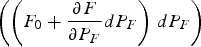 $\left(\left(F_0 + {\partial F \over \partial P_F} dP_F \right)\, dP_F \right)$
, where F
0 is the initial level of forest cover, and the right-hand side is the deadweight loss:
 $$\eqalign{&\Pi ^{C}\left(P_{Q}\comma \; P_{F} + dP_{F}\comma \; P_{K}\semicolon \; \bar{K} \right)-\Pi^{C} \left(P_{Q}\comma \; P_{F}\comma \; P_{K}\semicolon \; \bar{K} \right)+\left(F_0 + {\partial F^C \over \partial P_F} dP_F \right)dP_F \cr &\quad \approx \Pi_F^C dP_F + {1 \over 2}\Pi_{FF}^C \left(dP_F \right)^2 + \left(-\theta \Pi_F^C - \theta \Pi_{FF}^C dP_F \right)dP_F \cr &\quad \approx \left(1 - \theta \right)\Pi_F^C dP_F + \left(1- {1 \over 2\theta} \right){\partial F^C \over \partial P_F} \left(dP_F \right)^2 \cr &\quad \approx {1 \over 2} {\partial F^C \over \partial P_F} \left(dP_F \right)^2 + \left({\theta -1 \over \theta} \right)\left({\partial F^C \over \partial P_F} dP_F + F_0 \right)dP_F}$$
The second term arises as a consequence of inefficiency. Note that with perfect technical efficiency (θ = 1) this additional term disappears.
Relaxing constraints
Following the same procedure yields an expression for the change in profits following the relaxation of capital constraints:
 $$\eqalign{&\Pi^{C}\left(P_{Q}\comma \; P_{F}\comma \; P_{K}\semicolon \; \bar{K}+d\bar{K}\right)\cr &\quad \approx \Pi^{C}\left(P_{Q}\comma \; P_{F}\comma \; P_{K}\semicolon \; \bar{K}\right)+\Pi _{\bar{K}}^{C}d\bar{K}+{1 \over 2}\Pi _{\bar{K}\bar{K}}^{C}\left(dK\right)^{2} \cr &\quad \approx \Pi ^{C}\left(P_{Q}\comma \; P_{F}\comma \; P_{K}\semicolon \; \bar{K}\right)+\theta ^{-1}P_{v}^{0}dK+{1 \over 2}\Pi _{\bar{K}\bar{K}}^{C}\left(dK\right)^{2}}$$
where it is assumed that the donor pays P K and the recipient receives the virtual price, P v . Subtracting the resource cost of the policy, P K dK, the net deadweight losses become:Footnote 19
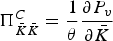
 $$\eqalign{&\Pi^{C}\left(P_{Q}\comma \; P_{F}\comma \; P_{K}\semicolon \; \bar{K}+dK\right)-\Pi ^{C}\left(P_{Q}\comma \; P_{F}\comma \; P_{K}\semicolon \; \bar{K}\right)\cr &\qquad \approx {1 \over 2} {\partial P_{v} \over \partial \bar{K}}\lpar dK\rpar ^{2} + \theta ^{-1}P_{v}^{0}dK - P_{K}dK}$$
where P
v
0 is the initial virtual price of capital at
 $K=\bar{K}$
. Clearly the quota rent is now inflated by technical inefficiency (when θ < 1).
Cost effectiveness
Taking (A2) from (A1) yields an expression for the incremental cost of relaxing constraints relative to PES:
 $$\eqalign{dC_{\theta } &= {1 \over 2}\left[{\partial F \over \partial P_{F}}\left(dP_{F}\right)^{2}-{\partial P_{v} \over \partial K}\lpar dK\rpar ^{2} \right]-\left(\theta ^{-1}P_{v}^{0}-P_{K}\right)dK \cr &\quad +\left({\theta -1 \over \theta}\right)\left({\partial F \over \partial P_{F}} dP_{F}+F_{0}\right)dP_{F} \cr &= {1 \over 2}\left[{\partial F \over \partial P_{F}}\left(dP_{F}\right)^{2}- {\partial P_{v} \over \partial K}\left(dK\right)^{2}\right]-\left(P_{v}^{0}-P_{K}\right)dK \cr &\quad +\left({\theta -1 \over \theta }\right)\left(\left({\partial F \over \partial P_{F}}dP_{F}+F_{0}\right)dP_{F}-P_{v}^{0}dK\right)}$$
If this is positive then forest-land payments are preferred by the donor. Once again, the introduction of technical inefficiency leads to an indeterminate result on cost effectiveness. The technical inefficiency parameter affects the virtual price and the quota rent, in favour of relaxing constraints, and introduces an additional profit term which favours PES. Figure 2 shows how technical inefficiency affects cost effectiveness in the Cobb–Douglas case.