Introduction
Children have a higher incidence of foreign body aspiration than adults. Such aspiration can cause significant morbidity and mortality.Reference Tan, Brown, McGill, Kenna, Lund and Healy1
In any children at the age of exploring their surroundings with their mouths, foreign body aspiration should always be a differential diagnosis for paediatric stridor and respiratory distress.Reference Tan, Brown, McGill, Kenna, Lund and Healy1 Although the majority of patients with foreign body aspiration present within a day of the incident,Reference Aydogan, Tuncer, Soylu, Kiroglu and Ozsahinoglu2 the diagnosis of foreign body aspiration can be delayed. Scoring systems have been developed to aid diagnosis and thus facilitate early removal.Reference Kadmon, Stern, Bron-Harlev, Nahum, Battat and Schonfeld3 Although foreign body aspiration is an uncommon cause of paediatric laryngotracheal obstruction, accounting for approximately 5 per cent of cases,Reference Bent4 delayed diagnosis can lead acutely to death, and in the longer term to chronic pulmonary problems such as bronchiectasis and lung abscess.Reference Karakoc, Cakir, Ersu, Uyan, Colak and Karadag5 In some cases, foreign body aspiration may be sub-clinical, as the foreign body may not cause complete obstruction but may instead give rise to inflammatory and granulation tissue, causing later symptoms.Reference Mathiasen and Cruz6
Given that a variety of foods may be aspirated, the cultural influences on individual families may have an effect on the type of foreign body aspiration encountered. This study aimed to assess the correlation between the type and frequency of foreign body aspiration, and the language spoken in the patient's home.
The potential exists for public education regarding withholding certain foods until children are mature enough to chew and swallow adequately. This is particularly important in certain ethnic groups, which may unknowingly encourage children to eat foods which are commonly aspirated.
Materials and methods
A retrospective medical record review was performed for all children coded for admission with suspected foreign body aspiration over a 10-year period (2000–2009). All children were admitted to the Children's Hospital at Westmead, Sydney, New South Wales, Australia, a tertiary paediatric referral hospital servicing both local and state-wide patients. The local area is diversely multicultural, with a broad range of cultures and languages spoken.
The information obtained from the medical record included patient age and sex, type of foreign body found on direct laryngobronchoscopy, length of hospital stay, complications (if any) and, importantly for this study, the language spoken by the patient's parents at home.
Data on foreign body type were obtained from each patient's surgical record. The language spoken at home was obtained from the carer's response when asked at the hospital triage desk, ‘What is the main language spoken at home?’.
Statistical analysis comparing nut foreign body aspirations in English versus non-English speakers was performed using a two-way contingency table, and tested for significance using Fisher's exact test (the appropriate test for the sample size).
Results and analysis
We reviewed 184 patient medical records coded for ‘foreign body in airway/larynx/bronchus’. Of these, 52 were excluded as the patient had been miscoded and did not have a true foreign body aspiration, but, rather, other conditions (e.g. aspiration of vomitus or other causes of paediatric stridor). This left a series of 132 patients encountered over a 10-year period with suspected foreign body, who went on to direct laryngobronchoscopy.
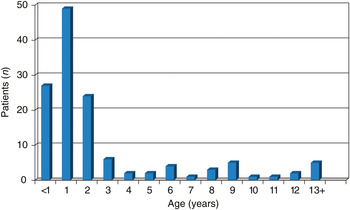
The mean age of these foreign body aspiration patients was 32 months (2.67 years); the range is depicted in Figure 1. The incidence of foreign body aspiration was higher in boys (75/132) than girls (57/132), giving a male:female ratio of 1.31:1. The average number of bed days required per case was 2.0 days (range 1 to 28 days).
Age distribution of patients with foreign body aspiration.

Two patients died, both of whom had arrested on arrival at the emergency department and were unable to be resuscitated. These children had a clear history of choking on a foreign body (one child had aspirated a metal screw, the other a piece of apple) and developing sudden-onset acute respiratory distress.
Two patients had foreign bodies which could not be removed by direct laryngobronchoscopy, requiring a thoracotomy.
Foreign body types
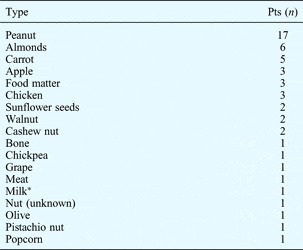
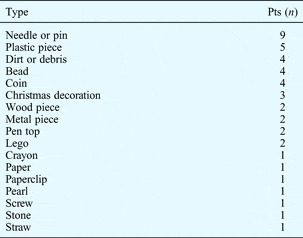
Types of foreign bodies are summarised in Tables I and II. Foreign bodies were broadly categorised as food, non-food, a negative endoscopy (i.e. no foreign body found on direct laryngobronchoscopy) or unknown. The latter category was attributed when a foreign body was removed at direct laryngobronchoscopy but no clear documentation of its composition could be identified from the medical or surgical records.
Food foreign body types

*Fluid requiring suctioning. Pts = patients
Non-food foreign body types

Pts = patients
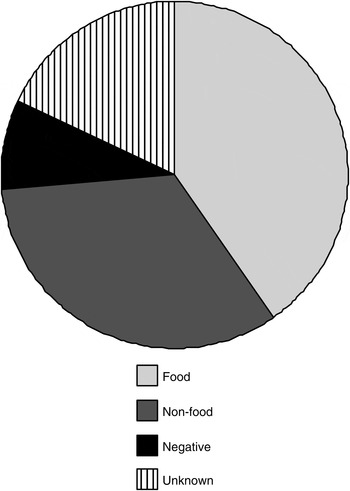
Food matter accounted for the largest proportion of aspirated foreign bodies (53/132, 40.1 per cent), followed by non-food matter (44/132, 33.33 per cent). Negative endoscopies made up 11 of the 132 cases (8.33 per cent). The nature of the foreign body was unknown in 24 of the 132 cases (18.2 per cent) (see Figure 2).
Types of foreign bodies aspirated, and relative proportions. Negative = no foreign body on endoscopy

Nuts (including all types of nuts and seeds) made up the biggest proportion of food foreign bodies, accounting for 31 of the 53 such cases (58.5 per cent). Peanuts were the commonest nut involved (accounting for 54.8 per cent of nut aspiration cases). This is in keeping with other findings; one study reported that peanuts accounted for the greatest proportion (40.7 per cent) of aspirated foreign body cases.Reference Tan, Brown, McGill, Kenna, Lund and Healy1 The shape and texture of peanuts makes them easily aspirated by children. Furthermore, the arachis oil they contain may cause airway inflammation and granulation tissue formation.
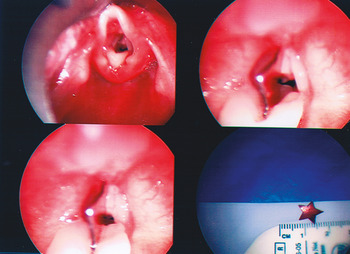
Three patients had aspiration of Christmas decorations (all these cases occurred between 28 November and 22 December). Two of these patients came from an English-speaking home and one from a Gujarati-speaking home. Figure 3 depicts intra-operative findings.
Intra-operative laryngobronchoscopic views of aspirated Christmas decoration.

Aspirated non-food foreign bodies comprised a broad range of common small household items, including pins, small toys, beads and coins. All these objects are frequently within easy reach of children, and the risk of aspiration is to a large extent unavoidable.
Language spoken at home
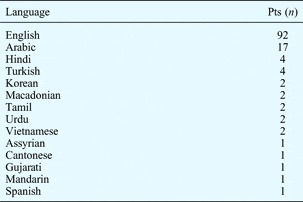
The languages spoken in the homes of children with foreign body aspiration are summarised in Table III.
Language spoken at home

Pts = patients
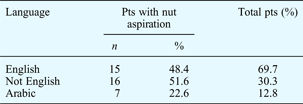
Patients from English-speaking homes constituted the majority (92/132; 69.7 per cent). Such patients accounted for 58 per cent of food aspiration cases and 48.4 per cent of nut aspiration cases.
Patients from non-English-speaking homes accounted for 30.3 per cent of the patient series. These patients accounted for 42 per cent of food aspiration cases and 51.6 per cent of nut aspiration cases (see Table IV).
Patient distribution by home language and foreign body type
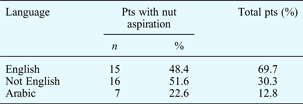
There was a statistically significant association between non-English-speaking background and nut foreign body aspiration; two-tailed p = 0.0065.
Discussion
Our findings are comparable with those of other studies assessing paediatric foreign body aspiration.
In our patients, the mean age for foreign body aspiration was 32 months (2.67 years); this is similar to other reported results, which range from 25.5Reference Kiyan, Gocmen, Tugtepe, Karakoc, Dagli and Dagli7 to 38.1 months.Reference Tan, Brown, McGill, Kenna, Lund and Healy1 In one study assessing all children presenting with signs of laryngotracheal obstruction (irrespective of cause), the mean patient age was 28 months (2.3 years).Reference Bent4
Our male:female ratio was 1.31:1, which is lower than figures reported by other studies, e.g. 2.3:1Reference Kiyan, Gocmen, Tugtepe, Karakoc, Dagli and Dagli7 and 1.8:1Reference Tan, Brown, McGill, Kenna, Lund and Healy1.
Our patients required an average of 2.0 bed days, similar to the 1.97 days (range 1–26 days) reported by another study.Reference Tan, Brown, McGill, Kenna, Lund and Healy1
In our study, the commonest foreign body type was food, accounting for 40.1 per cent of cases. Other studies also observed food to be the commonest foreign body type; one study found that up to 85 per cent of foreign bodies were organic in nature, upon direct laryngobronchoscopy.Reference Chung, Jeong, Ahn, Park, Cho and Son8
The negative endoscopy rate in our study (8.33 per cent) was lower than that reported in a recent study of 207 patients (28.2 per cent).Reference Kiyan, Gocmen, Tugtepe, Karakoc, Dagli and Dagli7
• Foreign body aspiration should always be considered in the differential diagnosis of paediatric stridor and airway obstruction
• Aspirated foreign bodies are more commonly food than non-food items
• Direct laryngobronchoscopy is often required, if only to exclude foreign body aspiration
• Cultural influences play a large role in foods given to children, and therefore influence the risk of foreign body aspiration
• In this study, a non-English-speaking home background was a significant risk factor for food foreign body aspiration, particularly nut aspiration
We encountered two deaths over the 10-year study period, demonstrating that foreign body aspiration is potentially lethal and can occur with common small household objects or food items.
To a certain extent, food foreign body aspiration can be averted if inappropriate foods are avoided before children have a sufficiently mature swallow mechanism. Many of the food items in Table I should be avoided until the child is five to six years of age, and should certainly not be given at the age of two to three years, the average age of our patients.
From our findings, we were able to establish a statistically significant link between certain types of foreign body aspiration and the language spoken in the patient's home (p = 0.0065). Food foreign body aspiration has a higher incidence in patients from non-English-speaking backgrounds. In particular, nut aspiration has a higher incidence in such patients, particularly those with Arabic-speaking parents.
Efforts to prevent food foreign body aspiration could involve raising parents’ awareness that certain foods, particularly nuts, should be avoided until their child is mature enough to chew and swallow adequately. Parents should also avoid solid foods such as carrot and apple, which need to be adequately chewed and have a tendency to slip, until the child is mature enough to chew well. On this point, cultural influences are important. The incidence of foreign body aspiration could be significantly decreased if family doctors and paediatricians took on the role of informing and educating parents about the need to avoid feeding their child certain foods, especially nuts, until the age of five to six years. A local doctor who speaks the parents’ language and who is aware of their culture and common foods may be more able to motivate parents to avoid feeding their child foods that could potentially be aspirated. We would therefore encourage targeted community awareness initiatives in order to publicise the dangers to which young children are exposed by inappropriately early presentation of hard foods.
Other studies have demonstrated cultural influences on both poison ingestion and foreign body aspiration. In Israel, children from Arab communities ingested poisonous pesticides more commonly than non-Arabic children.Reference Uziel, Adler, Aharonowitz, Franco, Fainmessesr and Wolach9 In Malaysia, weaning children to soft food mixed with cooked items such as fish and prawns (which may contain hard shells and bones) or uncooked leafy vegetables resulted in incidents of aspiration.Reference Indudharan, Ram and Didek10 In this study, the language spoken at home was considered an indicator of cultural practice.
In the current study, we accept that accurate assessment of the language(s) spoken at home may be difficult. Firstly, the triage clerk may not ask the question, depending on the urgency of triage, and may document ‘English’. Secondly, many parents in the region may be bilingual, and speak their native language at home but state at the hospital that they speak English. Finally, although parents may be English speakers, they may still have strong cultural links and beliefs which affect the foods they give to their child, irrespective of the language they speak at home. Despite the observed statistically significant association between nut foreign body aspiration and language, it is still likely that this study underestimated the effect of a non-English-speaking background on food foreign body aspiration.
Conclusion
Food foreign body aspiration, particularly of nuts, occurs significantly more in non-English-speaking communities. Thus, language and cultural factors should be considered risk factors when assessing a child with airway obstruction. There is considerable potential for raising community awareness about this potentially fatal problem.