Introduction
The cotton leaf roller (Haritalodes derogata), a significant polyphagous pest, primarily affects plants in the Malvaceae family but can also damage various other crops like cotton, okra, and jute (Hongsheng and Chunli, Reference Hongsheng and Chunli2016). Cotton (Gossypium hirsutum) is a globally important industrial crop cultivated in over 50 countries, with Turkey producing 2.1 million tonnes of seed cotton in the 2023/24 season (Nix et al., Reference Nix, Paull and Colgrave2017). Okra (Abelmoschus esculentus), also from the Malvaceae family, is widely grown for its edible parts and holds economic importance, with global production reaching 11.23 million metric tonnes in 2022, including 30,484 tonnes from Turkey. The economic significance of crops like cotton and okra, coupled with the pest’s destructive impact, underscores the importance of H. derogata as a major agricultural threat (Can et al., Reference Can, Mart, Ödemiş, Akişcan, Matthews and Miller2022). The pest was first identified in Turkey in 2024, specifically in the coastal city of Trabzon (Sezen et al., Reference Sezen, Güney Aydın, Yıldız, Yıldız, Can, Ghanbari and Toprak2024). After its initial appearance, subsequent field studies in the area revealed that it continued to spread across the city, inflicting greater harm on rose mallow trees than in past years. This continued expansion poses a serious risk to Turkey’s agricultural sectors, especially with regard to future cotton and okra production.
The use of synthetic insecticides remains the most common method for controlling this pest (Dhawan et al., Reference Dhawan, Simwat and Sidhu1988; JianHui et al., Reference JianHui, Zhen, ShunXiang and HuiPing2008). However, due to their negative impacts on beneficial organisms, the environment, and human health, reliance on chemicals is becoming less desirable. Consequently, there is an urgent need to develop alternative pest management strategies. Entomopathogens serve as promising biocontrol agents with the potential to become a significant component in sustainable pest management. A wide range of entomopathogens have been studied and used as microbial insecticides, including the soil bacterium Bacillus thuringiensis (Sevim et al., Reference Sevim, Eryuzlu, Demirbag and Demir2012), baculoviruses (Demir et al., Reference Demir, Nalcacioglu, Mohammad Gholizad and Demirbag2013) and entomopathogenic fungi such as Metarhizium and Beauveria species (Sonmez et al., Reference Sonmez, Sevim, Demirbag and Demir2016).
However, microbial control of H. derogata using entomopathogens has been limited. Gahramanova et al. (Reference Gahramanova, Mamay and Mammadov2020) reported that BitoxybacillinTM, a commercially available product of B. thuringiensis var. thuringiensis, caused 100% mortality on second larval stage of H. derogata. In another study, the indigenous B. bassiana isolate Bb2, isolated from Benin, was reported to cause 73% mortality on the third larval stage (Fabrice et al., Reference Fabrice, Kobi, Joelle, Desire, Valerian, Elie, Thomas, Maurille and Denis2021). In the same study, it was also shown that exotic B. bassiana isolates caused only 26% mortality. The use of indigenous entomopathogens, which are adapted to the specific local environmental parameters such as host insect ecotypes, temperature, humidity, surrounding flora and fauna, soil composition, and pH, are known to be more effective as biological control agents against local pest populations than non-indigenous microbial applications (Eski et al., Reference Eski, Biryol, Acici and Demir2022a; Quesada-Moraga et al., Reference Quesada-Moraga, González-Mas, Yousef-Yousef, Garrido-Jurado and Fernández-Bravo2024).
Therefore, the aim of this study is to evaluate the efficacy of different pathogens – bacteria, fungi, and viruses – in the biological control of H. derogata larvae. To best of our knowledge, this is the first documented study on microbial control of this pest in Turkey.
Material and methods
Origin of the entomopathogenic agents
All microbial pathogens used in this study (with the exception of AcMNPV) are indigenous strains previously isolated from significant agricultural and forestry pests or from soil samples collected in Turkey. These strains are known for their high virulence on various agricultural and forestry pests. They were obtained from the entomopathogen culture collection of the Microbiology Research Laboratory, Department of Biology, Faculty of Science, Karadeniz Technical University, Trabzon, Turkey (table 1).
Entomopathogens used in this study and their origin

Propagation of B. thuringiensis strains
Five different strains of B. thuringiensis (Bt) were tested for their efficacy against the larvae of H. derogata. Each Bt strain was cultured on nutrient agar medium and the inoculum of these pure cultures was transferred to a nutrient broth medium. The cultures were then incubated overnight in a shaker at 180 rpm and 30°C. Subsequently, 5 mL of the culture was centrifuged at 3000 rpm for 10 minutes. The resulting pellet was resuspended in 5 mL of sterile phosphate buffered saline (PBS). Bacterial density was measured at an optical density of 600 nm and adjusted to 1.89 (approximately 1.8 × 10⁹ cfu/mL) for use in the bioassays (Eski et al., Reference Eski, Demir, Sezen and Demirbag2017).
Propagation of fungal isolates
Three strains of B. bassiana and two strains of Metarhizium spp. were cultured on potato dextrose agar (PDA) medium and incubated at 28°C for 14 days. The fungal conidia were harvested from the Petri dishes using a sterile spatula and then suspended in 10 mL of sterile distilled water supplemented with 0.01% Tween80. The suspension was homogenised by vortexing for 2 minutes and then filtered through two layers of sterile muslin to remove fungal debris. The filtrate containing the conidia was examined under a light microscope using a Neubauer hemocytometer and the conidia concentration was determined by direct counting. The suspension was adjusted to a final concentration of 1 × 10⁷ conidia/mL. Only suspensions with a germination rate of more than 95% were used for the bioassay (Biryol et al., Reference Biryol, Araz, Eski, Akturk, Aksu, Gokturk, Bilgin and Demir2021a).
Propagation of baculoviruses
For virus propagation, AcMNPV was cultured in IPLB-Sf21 cells from Spodoptera frugiperda (Vaughn et al., Reference Vaughn, Goodman, Tomkins and McCawley1977) according to the method of Demir and Demirbag, (Reference Demir and Demirbag2006). The other viruses (DapuNPV-T1, HycuGV, LdMNPV-T2 and SeMNPV-U) were propagated in the larvae of Dasychira pudibunda (L.), Hyphantria cunea (Drury), Lymantria dispar (L.) and Spodoptera exigua (Hübner), respectively. All larvae used for virus production were collected from the field, transported to the laboratory in ventilated boxes with suitable food, and only healthy larvae that showed normal behavior were selected for virus propagation. Polyhedral inclusion bodies (PIBs) of the individual viruses were applied to the leaves of the host plants on which the insects naturally feed (beech leaves for D. pudibunda, mulberry leaves for H. cunea, oak leaves for L. dispar and maize leaves for S. exigua). The virus-contaminated leaves were placed separately in plastic boxes with third instar larvae. The experimental setup was monitored daily and all dead larvae were removed from the boxes and stored at 4°C. At the end of the experiment, the viruses were isolated separately from the dead larvae.
Individual infected larvae were homogenised in 1 mL of 0.1% sodium dodecyl sulphate (SDS) and filtered through cheesecloth. An equal volume of 0.1% SDS was added and the procedure was repeated. The resulting filtrate was centrifuged at 7,840× g for 30 minutes at 4°C. The supernatant was discarded and the pellets were suspended in dH2O. A sucrose gradient (30–80% w/v) was prepared in Beckman Avanti centrifuge tubes (Beckman Coulter Inc., CA, USA) and stored overnight at 4°C. Viral suspensions were loaded onto a sucrose gradient and centrifuged at 30,000× g for 30 minutes at 4°C in a Beckman Avanti (J-30I) ultracentrifuge. The visible PIB bands in the centre of the tube were extracted with a pipette, placed in a new sterile tube, filled to the brim with dH2O, and centrifuged again at 30,000× g for 30 minutes at 4°C. The final pellets were resuspended with dH2O and PIBs were visually quantified using a Neubauer hemocytometer under a phase contrast microscope (Nikon Eclipse LH-M100C1, Tokyo, Japan) at 400×. The concentrations of the purified viral suspension were adjusted to 1 × 10⁷ PIB/mL (Bayramoglu et al., Reference Bayramoglu, Gencer and Demir2021).
Collection of the pest
In August 2024, the larvae of H. derogata were collected from the marshmallow tree (Hibiscus syriacus, Malvaceae) in Trabzon, Turkey. The larvae and associated feeding damage were documented photographically (fig. 1). Collected specimens were transported to the laboratory in ventilated containers and reared on marshmallow leaves under controlled conditions (26 ± 1 °C, 70 ± 5% relative humidity, and a 12:12 h light:dark photoperiod) in a climate chamber. The healthy larvae were used for the insecticidal activity tests.
Damage of Haritalodes derogata larvae: (A) healthy H.derogata larvae on Hibiscus syriacus leaf, (B) early stage of the damage of H. derogata larvae on marshmallow tree and (C) late stage of damage of the H. derogata larvae on marshmallow tree.

Screening pathogenicity assay
In insecticidal activity experiments, bacterial and viral agents were applied to the relevant leaves using the contamination method and fungi were applied to the insect using the spray method. In the screening tests, concentrations of 1 × 10⁹ cfu/mL for bacteria, 1 × 10⁷ conidia/mL for fungi and 1 × 10⁷ PIB/mL for baculoviruses were used.
One millilitre of suspensions of bacterial and viral pathogens was applied to fresh marshmallow leaves and dried in the air. The larvae of H. derogata were then placed in separate boxes and fed with the contaminated leaves. The control groups were fed with untreated marshmallow leaves. The conidial suspensions of the fungal strains were administered separately to the H. derogata larvae using a mini hand sprayer. The control group was treated with a 0.01% Tween 80 solution. When the leaves were dried, they were replaced with fresh, uncontaminated leaves. Experiments were performed with 30 larvae per microbial and virus strain and repeated three times. The boxes were kept at 28 ± 2 °C and 70% relative humidity with a 16:8 light:dark photoperiod for 15 days (Bayramoglu et al., Reference Bayramoglu, Gencer and Demir2021).
Concentration dependent virulence assay
Based on the results of the screening pathogenicity assays, the most virulent isolates, B. thuringiensis subsp. kurstaki Bn1 (Btk-Bn1), B. bassiana Pa4 (Bb-Pa4), Hyphantria cunea granulovirus (HycuGV), and Spodoptera exigua nucleopolyhedrovirus (SeMNPV), were selected for virulence assays. Stock suspensions of each isolate were serially diluted to obtain five different concentrations. Specifically, suspensions of Btk-Bn1 at 109, 108, 107, 106, and 105 cfu/ml; Bb-Pa4 at 108, 107, 106, 105, and 104 conidia/ml; and SeMNPV at 107, 106, 105, 104, and 103 PIB/ml were prepared and applied to H. derogata larvae, following the same procedure as described in the screening pathogenicity assays.
Assessment of mortality in larvae and detection of pathogens
Verification of larvae that died during both pathogenicity and virulence assays was performed. The larvae used in the applications were examined every day. The behaviour, movement, and food consumption speed of the larvae were monitored. Morphological characteristics of the dead larvae, such as colour, larval size, and body structure, were checked, and changes were recorded (Lacey, Reference Lacey2012). While these symptoms may indicate infection, definitive confirmation was achieved through laboratory analyses. To confirm B. thuringiensis and baculovirus infections, cadavers were homogenised using a tissue homogenizer, and the homogenates were examined under a light microscope via slide-coverslip preparations. B. thuringiensis infection was confirmed by the presence of spores and crystal inclusions (Milutinović et al., Reference Milutinović, Höfling, Futo, Scharsack and Kurtz2015), while baculovirus infection was identified by the detection of PIBs (Gencer et al., Reference Gencer, Eski, Acici and Demir2025). To confirm the fungal infection, cadavers were surface-sterilised with 70% ethanol and incubated in a moist chamber to promote external fungal growth, enabling morphological identification of the pathogen (Hajek et al., Reference Hajek, Everest and Clifton2023).
Statistical analysis
Mortality data were corrected using Abbott’s formula (Abbott, Reference Abbott1925) and subjected to analysis of variance, followed by comparison of means with Tukey’s test to compare test isolates with each other and with the control group (p < 0.05). The normality of the data and the homogeneity of variance were checked using the Shapiro–Wilk test and the Bartlett’s test, respectively. Virulence assays data were analysed using probit regression analysis to estimate the LC50 values of the entomopathogens. In addition, survival analysis was performed using the Kaplan–Meier method and survival characteristics were analysed using log-rank tests with the Holm–Sidak method for multiple comparisons to compare different survival curves. The analysis was performed with SPSS Statistics 20.0.
Results
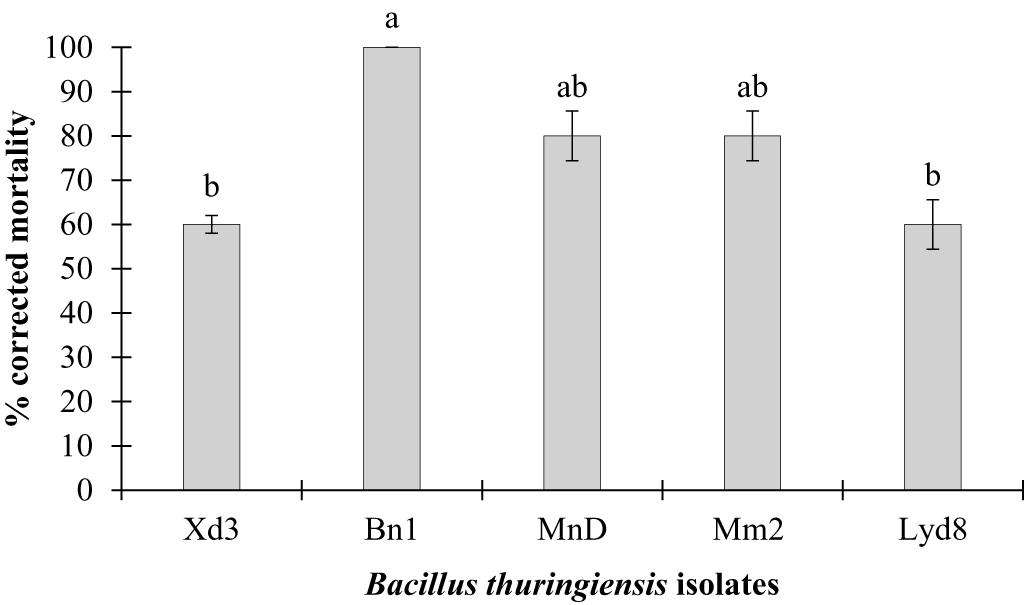
All tested entomopathogens were pathogenic for the larvae of H. derogata. However, their virulence varied between 60% and 100%. Among the bacterial isolates, Btk-Bn1 was the most virulent, followed by the other bacterial isolates. It showed 100% mortality on the larvae of H. derogata, while B. thuringiensis subsp. tenebrionis Xd3 showed the lowest mortality of 60% (F = 16.11; df = 5; p < 0.05) (fig. 2). The mortality caused by the Bt strains resulted in some morphological changes in the larvae. Compared to healthy larvae, changes such as lethargy, cessation of feeding and yellow and black body coloration were observed in larvae infected with Bt strains.
Corrected mortality (mean ± SE) cotton leaf roller larva treated with native Bacillus thuringiensis strains at a concentration of 109 cfu/mL. Mean values labelled with the different letters represent statistically significant differences in mortality 15 days after treatment, according to ANOVA analysis followed by Tukey’s multiple comparison test (p < 0.05).

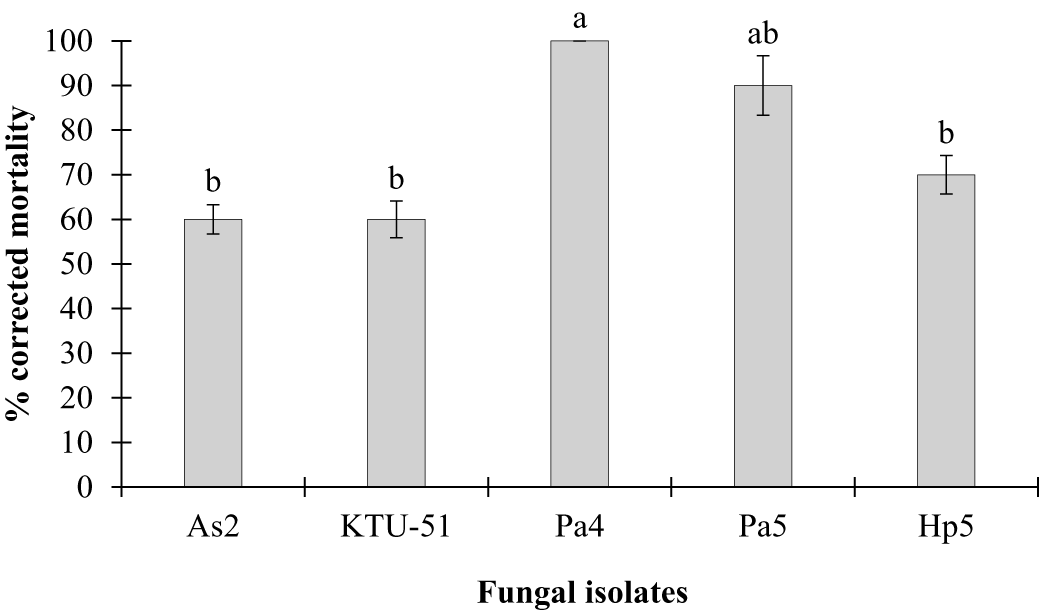
As a result of the screening pathogenicity assays of different Metarhizium sp. and B. bassiana isolates, it was found that B. bassiana isolates had a higher virulence than Metarhizium isolates. Of the B. bassiana isolates, isolate Pa4 caused 100% mortality, while isolates Pa5 and Hp5 caused 90% and 70% mortality, respectively (F = 18.75; df = 5; p < 0.05). On the other hand, the isolates M. flavoviride As2 and M. anisopliae KTU-51 caused 60% mortality on the larvae of H. derogata (fig. 3). The fungal infection generally led to a reduction in body weight and volume. The cadavers showed a hard and rigid appearance.
Corrected mortality (mean ± SE) cotton leaf roller larva treated with indigenous entomopathogenic fungal isolates at a concentration of 107 conidia/mL. Mean values labelled with the different letters represent statistically significant differences in mortality 15 days after treatment, according to ANOVA analysis followed by Tukey’s multiple comparison test (p < 0.05). As2, M. flavoviride; KTU-51, M. anisopliae; Pa4, Pa5 and Hp5, B. bassiana.

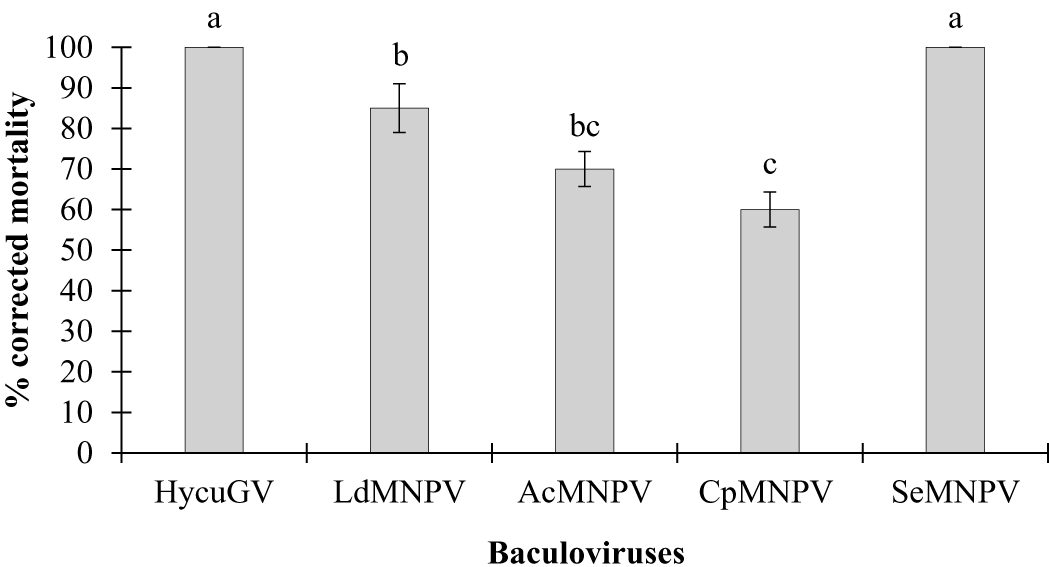
Among the virus isolates, the isolates of SeMNPV and HycuGV caused 100% mortality, while the other baculovirus isolates caused mortality between 60% and 85% (F = 12.29; df = 5; p < 0.05) (fig. 4). As a result of the virus infection, typical baculovirus infection symptoms such as whitening and thinning of the cuticle, lack of moulting, swelling of the body, diarrhoea and liquefaction of the body were observed in the larvae.
Corrected mortality (mean ± SE) cotton leaf roller larva treated with Baculoviruses at a concentration of 107 PIB/mL. Mean values labelled with the different letters represent statistically significant differences in mortality 15 days after treatment, according to ANOVA analysis followed by Tukey’s multiple comparison test (p < 0.05).

Btk-Bn1, Bb-Pa4, HycuGV and SeMNPV were used for virulence assays as they caused complete mortality in the screening pathogenicity assays. The LC50 value of Btk-Bn1 for H. derogata larvae was determined to be 7.1 × 10⁴ cfu/mL (table 2). Figure 5A shows the survival curves of larvae infected with Btk-Bn1 at different concentrations. The control group had the highest survival rate, while the larvae exposed to Btk-Bn1 at a concentration of 109 cfu/mL did not survive four days after treatment. Even at the lowest concentration of 105 cfu/mL, the survival rate ten days after treatment was less than 50%. While there was a statistical difference in survival between the concentrations of 109 and 108 cfu/mL, there was no difference in survival between the concentrations of 107, 106 and 105 cfu/mL (table 3).
Kaplan–Meier survival diagram for Haritalodes derogata exposed to Btk-Bn1 (A), Bb-Pa4 (B), SeMNPV (C) and HycuGV (D) at different concentrations.

Median lethal concentrations (LC50) of entomopathogens on Haritalodes derogata

SE: standard error, X2: chi-square, df: degree of freedom, p: significance.
Log-rank (Mantel–Cox) analysis result of Haritalodes derogata larvae exposed to different concentrations of Btk-Bn1

X2: chi-square, p: significance at 0.05.
Figure 5B shows the survival curves of the larvae infected with Bb-Pa4. The control group had the highest survival rate, while the larvae exposed to Bb-Pa4 at a concentration of 108 conidia/mL did not survive 13 days after treatment. It was observed that the survival rates at all applied concentrations were statistically significantly lower than the control group, however, the survival rates at concentrations 104, 105 and 106 conidia/ml were not statistically different (table 4). In addition, although there was no significant difference between the survival rates at 107 and 108 conidia/mL concentrations, it was observed that they were significantly different from the survival rates observed at other concentrations. The LC50 value of Bb-Pa4 for H. derogata larvae was determined to be 3.3 × 10³ conidia/mL (table 2).
Log-rank (Mantel–Cox) analysis result of Haritalodes derogata larvae exposed to different concentrations of Bb-Pa4

X2: chi-square, p: significance at 0.05.
Figure 5C and 5D show the survival curves of larvae infected with SeMNPV and HycuGV, respectively. While the larvae exposed to SeMNPV at a concentration of 107 PIB/mL did not survive six days after treatment, the larvae infected with HycuGV at the same concentration did not survive seven days after treatment. Log-rank analysis revealed that there was no statistically significant difference between the survival rates at concentrations of 103 and 104 PIB/mL and between the survival rates at concentrations of 105 and 106 PIB/mL, while the survival rate at a concentration of 107 PIB/mL was significantly different from the survival rates at other concentrations (table 5). Similarly, the survival rate of larvae infected with HycuGV at a concentration of 107 PIB/mL was significantly different from the control and the other concentrations (table 6). The LC50 values of SeMNPV and HycuGV for the larvae of H. derogata were determined to be 1.2 × 10³ and 1 × 10³ PIB/mL, respectively (table 2).
Log-rank (Mantel–Cox) analysis result of Haritalodes derogata larvae exposed to different concentrations of SeMNPV

X2: chi-square, p: significance at 0.05.
Log-rank (Mantel–Cox) analysis result of Haritalodes derogata larvae exposed to different concentrations of HycuGV

X2: chi-square, p: significance at 0.05.
Discussion
Entomopathogenic organisms are among the most important biological control agents, playing a key role in maintaining insect populations in natural ecosystems below the economic damage threshold. While these microorganisms are typically effective against their natural hosts, they can also act as opportunistic pathogens and successfully control pests outside their original host range (Kaya and Vega, Reference Kaya, Vega, Vega and Kaya2012). In this study, the pathogenicity of indigenous B. thuringiensis, B. bassiana, M. flavoviride, M. anisopliae, and Baculovirus isolated from different sources was evaluated against the larvae of H. derogata, a recently detected pest in Turkey that exhibits a rapid dispersal trend. This is the first time these indigenous microbial agents have been tested against H. derogata, and all were found to possess insecticidal potential.
Among them, the Btk-Bn1 used in virulence assays caused the highest larval mortality in H. derogata. This strain was originally isolated from Balaninus nucum L. (Coleoptera: Curculionidae), an important pest of hazelnuts. In previous studies, Btk-Bn1 caused 45% mortality in its original host at a concentration of 1.8 × 10⁹ cfu/mL (Sezen and Demirbag, Reference Sezen and Demirbag1999). It also demonstrated 90% mortality against Malacosoma neustria L. (Lepidoptera: Lasiocampidae) and Lymantria dispar L. (Lepidoptera: Lymantriidae), while producing 25% mortality on Leptinotarsa decemlineata (Coleoptera: Chrysomelidae), although no LC₅₀ value was reported for Btk-Bn1 (Kati et al., Reference Kati, Sezen, Nalcacioglu and Demirbag2007a). In a recent study by Eski et al. (Reference Eski, Erdoğan, Demir and Demirbağ2024), the LC50 value of an indigenous B. thuringiensis strain Ta1, isolated from Tuta absoluta (Lepidoptera: Gelechiidae), was determined to be 1.2 × 10⁶ cfu/mL on its host. Similarly, Eski et al. (Reference Eski, Bayramoğlu, Sönmez, Biryol and Demir2022b) reported an LC50 value of 1.76 × 10⁶ cfu/mL for the B. thuringiensis Xd3 strain, isolated from Xyleborus dispar (Coleoptera), when tested against L. decemlineata larvae. In the present study, although Btk-Bn1 was isolated from a different host, its LC50 value on H. derogata larvae was determined to be 7.1 × 10⁴ cfu/mL, which is notably low and thus highly significant. This value is lower than those reported in the literature, indicating that H. derogata larvae are highly sensitive to this bacterial strain. Additionally, Btk-Bn1 exhibited higher virulence against H. derogata (Family: Crambidae), a pest taxonomically distant from the other Lepidoptera species previously tested, such as M. neustria and L.dispar. These results collectively suggest that Btk-Bn1 exerts its most potent and rapid effect on H. derogata to date. The only other study investigating the larvicidal effect against cotton leaf roller was conducted by Gahramanova et al. (Reference Gahramanova, Mamay and Mammadov2020) in Azerbaijan. In their study, a commercial product, Bitoxybacillin™ which contains spores and crystals of B. thuringiensis var. thuringiensis was tested on cotton leaf roller larvae at concentrations of 0.3 and 0.5 g/L, resulting in mortality rates ranging from 50% to 100%, respectively. Our findings are consistent with these results, confirming the high sensitivity of cotton leaf roller larvae to B. thuringiensis. Furthermore, both studies demonstrate that larval mortality accelerates with increasing bacterial concentration. The effectiveness of B. thuringiensis strains against the larvae, along with the observed increase in mortality rate and speed with higher concentrations, aligns well with previous literature (Eski et al., Reference Eski, Demir, Güllü and Demirbag2018; Karshanal and Kalia, Reference Karshanal and Kalia2023). The exceptional efficacy of Btk-Bn1 on cotton leaf roller larvae, combined with the well-known specificity and safety of B. thuringiensis strains, makes it a highly promising and practical agent for pest control. Importantly, these bacteria pose no risks to human or animal health or the environment, supporting their use in sustainable pest management strategies.
Fungi are among the most effective groups of entomopathogens used in pest management, with numerous strains identified that can infect a wide range of insect and mite species (Zimmerman, Reference Zimmerman2007). Notably, fungal pathogens are capable of attacking all developmental stages of their hosts. Furthermore, compared to chemical pesticides, the use of entomopathogenic fungi is considered environmentally friendly and poses no significant risk to human health (Faria and Wraight, Reference Faria and Wraight2001). The first report in the literature on fungal infection in cotton leaf roller dates back to the study by Kuruvilla and Jacob, (Reference Kuruvilla and Jacob1980), in which Paecilomyces farinosus was identified as a pathogen of this pest. Prior to the present study, the most comprehensive investigation into the use of entomopathogenic fungi for controlling cotton leaf roller was conducted by Fabriceet al. (Reference Fabrice, Kobi, Joelle, Desire, Valerian, Elie, Thomas, Maurille and Denis2021). In their study, 13 strains of B. bassiana were initially screened at a concentration of 1 × 10⁷ conidia/mL against third-instar larvae. Among these, the highest mortality rate was recorded as 73% for the isolate B. bassiana Bb2. In subsequent virulence assays, the maximum mortality achieved was 76% at a higher concentration of 1 × 10⁹ conidia/mL. The results from both the initial screening pathogenicity assays and the subsequent virulence assays in our study indicate that the fungal strains tested are among the most effective strains reported to date against the cotton leaf roller. Among these, B. bassiana strains exhibited a stronger insecticidal effect on H. derogata compared to the Metarhizium strains. The B. bassiana strain Bb-Pa4, which was used in the virulence assays, was originally isolated from Pristiphora abietina (Christ.) (Hymenoptera: Tenthredinidae) and has been shown to be highly effective against its original host (Biryol et al., Reference Biryol, Araz, Eski, Akturk, Aksu, Gokturk, Bilgin and Demir2021a). Although B. bassiana strains are commonly isolated from a wide range of insect hosts, numerous studies have demonstrated that they can also be effective against species outside of their original host range. For example, Bb-Pa4 caused 50% mortality in Leptoglossus occidentalis (Heidemann) (Heteroptera: Coreidae) (Eski et al., Reference Eski, Biryol, Acici and Demir2022a), 60% in Orosanga japonica (Hemiptera: Ricaniidae) (Biryol et al., Reference Biryol, Guney, Eski, Bayramoglu, Sezen, Demirbağ and Demir2021b), and 100% in Dermanyssus gallinae (Arachnida: Dermanyssidae) (Bayramoglu et al., Reference Bayramoglu, Bayramoglu, Aydın, Zengin, Çırak, Demirbag and Demir2024). The LC50 value of the Bb-Pa4 strain on its natural host, P. abietina larvae, was previously determined to be 1.7 × 10³ conidia/mL (Biryol et al., Reference Biryol, Guney, Eski, Bayramoglu, Sezen, Demirbağ and Demir2021b). In addition, the same strain exhibited an LC₅₀ value of 3.2 × 10⁴ conidia/mL against nymphs of D. gallinae, a parasitic mite of poultry (Bayramoglu et al., Reference Bayramoglu, Bayramoglu, Aydın, Zengin, Çırak, Demirbag and Demir2024). In the present study, the LC50 value of Bb-Pa4 on H. derogata larvae was calculated as 3.3 × 10³ conidia/mL. These findings demonstrate that Bb-Pa4 is a highly effective fungal pathogen across a wide range of arthropod pests from different orders. Its strong pathogenicity against H. derogata is also in line with previously reported results, supporting its potential as a versatile and potent biocontrol agent.
Insect viruses are among the rarest and most challenging groups of entomopathogens to study. To date, there have been no recorded cases of virus detection or pathogenicity in the cotton leaf roller (H. derogata). A study by Silvie et al. (1993) involving a virus specific to Mamestra brassicae (Lepidoptera: Noctuidae) demonstrated that this virus had no effect on cotton leaf roller larvae. Thus, our research represents the first report on the pathogenicity of baculoviruses against the cotton leaf roller. Interestingly, baculoviruses typically known for their narrow host range exhibited exceptionally high efficacy against cotton leaf roller larvae. For example, Bayramoglu et al. (Reference Bayramoglu, Gencer and Demir2023) reported that HycuGV-Hc1 achieved 99.86% mortality in its primary host at a concentration of 1 × 10⁸ PIB/mL, with an LC50 value of 6.4 × 10⁵ PIB/mL. Remarkably, in our study, the same virus caused equivalent mortality in H. derogata larvae within seven days of infection, even at a tenfold lower concentration. We determined the LC50 value for HycuGV-Hc1 on H. derogata to be 1 × 10³ PIB/mL, suggesting that significantly lower concentrations are more effective on this non-primary host than on the virus’s natural host. Similarly, Gencer et al. (Reference Gencer, Bayramoglu, Çetin and Demir2022) showed that SeNPV-U, which induces high mortality in S. exigua larvae, achieved 100% mortality at 1 × 10⁹ PIB/mL, with an LC50 of 1 × 10⁵ PIB/mL. In our study, however, the same virus resulted in 100% mortality in H. derogata larvae at a much lower concentration of 1 × 10⁷ PIB/mL within six days, and the LC50 was found to be 1.2 × 10³ PIB/mL. This indicates that SeNPV-U is approximately 100 times more effective on H. derogata than on its original host. Furthermore, we found HycuGV-Hc1 to be even more effective than SeNPV-U against cotton leaf roller larvae. While most baculoviruses exhibit a narrow host range, field studies and genomic analyses have revealed that certain baculoviruses can naturally infect multiple host species. Autographa californica multiple nucleopolyhedrovirus (AcMNPV) is capable of infecting up to 35 insect species across several lepidopteran genera. In a study by Rodríguez et al. (Reference Rodríguez, Belaich, Quintana, Cap and Ghiringhelli2012) the host range of Rachiplusia nu multiple nucleopolyhedrovirus (RanuMNPV) was characterised, revealing that RanuMNPV was ineffective against S. frugiperda larvae, while it caused 100% mortality in Anticarsia gemmatalis larvae. The genetic determinants underlying host range specificity have been investigated, with certain viral genes reported to facilitate expanded host infectivity. For example, the expression of host cell factor-1 (hcf-1) gene allowed Hyphantria cunea MNPV to replicate in non-permissive TN-368 cells (Kong et al., Reference Kong, Zuo, Zhu, Hu, Chen, Yang, Lv, Yao and Chen2018). Another gene, host range factor-1 (hrf-1), encoded by Lymantria dispar MNPV (LdMNPV), allows AcMNPV to replicate in L. dispar larvae by enabling translation to proceed. A homolog of hrf-1 is also present in Orgyia pseudotsugata MNPV (OpMNPV), a virus capable of replicating in L. dispar, suggesting that acquisition of hrf-1 may have been essential for these viruses to productively infect this host (Thézé et al., Reference Thézé, Takatsuka, Nakai, Arif and Herniou2015). Therefore, our findings provide valuable insights into the potential expansion of baculovirus host ranges and contribute in understanding their application in biological control.
The fact that all microbial agents used in the study are pathogenic to the cotton leaf rollers, and some of these agents even have a very high virulence is important for the use of these microbial agents as efficient and environmentally safe options for biological control of H. derogata. In future studies, mass production of highly virulent entomopathogens should be pursued, along with formulation development and optimisation to enhance protection against abiotic factors such as temperature and UV radiation. Additionally, their efficacy should be evaluated under field conditions.
Acknowledgements
I would like to thank Prof. Dr. Feza CAN for her help in identifying the pest species.
Competing interests
We hereby declare that there is no conflict of interest that could have arisen from the work presented in this paper.