


Longitudinal studies of infants of mothers who have experienced postnatal depression indicate impaired developmental outcomes, including language and cognitive problems (Reference Cogill, Caplan and AlexandraCogill et al, 1986; Reference MurrayMurray, 1992; Reference Sharp, Hay and PawlbySharp et al, 1995; Reference Murray, Hipwell and HooperMurray et al, 1996a ; Reference Hay, Pawlby and SharpHay et al, 2001; Reference Murray, Cooper and GoodyerMurray & Cooper, 2003), impaired attachment relationships (Reference Lyons-Ruth, Zoll, Connell, Field and TronickLyons-Ruth et al, 1986; Reference Teti, Gelfand and MessingerTeti et al, 1995) and behavioural problems (Reference MurrayMurray, 1992). Murray (Reference Murray1992; Reference Murray, Hipwell and HooperMurray et al, 1996a ) has suggested that deficits in the interaction experience of the young infant sensitive to disturbances might act as a mediator of poor outcome.
Measures
The Global Ratings Scales of Mother-Infant Interaction (Reference Murray, Fiori-Cowley and HooperMurray et al, 1996b ) were developed to assess differences in mother-infant interaction between groups of women with or without postnatal depression. Using these scales, Murray et al reported significantly reduced ‘sensitivity’ towards the infant for mothers who had experienced postnatal depression. These findings, using a relatively low-risk sample, are consistent with those of other researchers who have noted distinctly impaired interaction styles for mothers experiencing postnatal depression in high-risk samples (e.g. Reference Field, Sandberg and GarciaField et al, 1985; Reference Cohn, Matias, Tronick, Tronick and FieldCohn et al, 1986). The scales have also been used with different clinical groups such as mothers with schizophrenia (Reference Riordan, Appelby and FaragherRiordan et al, 1999) and borderline personality disorder (Reference Crandell, Patrick and HobsonCrandell et al, 2003). Furthermore, the scales have been successfully used by researchers in cross-cultural settings: Cooper et al (Reference Cooper, Tomlinson and Swartz1999) found that the scales could discriminate between the maternal interactions of well women and those with depression in a South African peri-urban sample, while Sepulveda et al (Reference Sepulveda, Lapez and Azar1999) reported the sensitivity of the scales to the impact of interventions in samples of women with depression and women living in conditions of adversity in a Venezuelan study. The scales have also been found to predict infant and child cognitive outcome at 18 months and 5 years of age (Murray et al, Reference Murray, Hipwell and Hooper1996a ,Reference Murray, Fiori-Cowley and Hooper b ).
The instrument was chosen for use in our study because it is neither a time-consuming microanalytic scale nor overly global; it is thus relatively quick to rate, while maintaining clinical sensitivity. It has been shown to be sensitive to impaired interaction even in low-risk samples, and has further been found to discriminate between families who are or are not living in conditions of adversity (Reference Murray, Fiori-Cowley and HooperMurray et al, 1996b ).
The Global Ratings Scales are a video-based assessment of the quality of mother-infant engagement that can be applied from 2 months to 6 months post-partum. With increasing infant age some scales are sensitively adjusted so that dimensions are comparable across ages. Five-minute video recordings of mother-infant face-to-face interactions are made either in the mother's home or in a laboratory setting. Mothers are instructed simply to play with their infants in any way they choose without the use of toys. Maternal behaviour is rated on four dimensions that describe the degree to which a mother's behaviour is appropriately adjusted to her infant: sensitivity, intrusiveness, remoteness, and overt behaviour relevant to clinical levels of depression (such as happiness, energy level, self-absorption and tension). Infant behaviour is rated on three dimensions, describing the infant's positive engagement in the interaction, and behaviour on a lively-inert scale and on a fretful-contented scale. A final dimension assesses the quality of the overall interaction between mother and infant.
In addition to impaired proximal interaction styles of mothers experiencing postnatal depression, another mediator of poor outcome may be the overall quality of the child's home environment (Reference Duncan, Brooksgunn and KlebanovDuncan et al, 1994; Reference Hurt, Malmud and BraitmanHurt et al, 1998; Reference Petterson and AlbersPetterson & Albers, 2001). The maternal behaviour of mothers with depression has been described as generally less competent than that of those who are not depressed, being more helpless, disorganised, hostile and critical, and less responsive and active (Reference Gelfand and TetiGelfand & Teti, 1990; Reference Goodman, Walker, Dworkin and CornblattGoodman, 1992). It is likely, therefore, that the overall quality of the home environment will be reduced.
The Infant-Toddler version of the Home Observation for the Measurement of the Environment (IT-HOME; Reference Caldwell and BradleyCaldwell & Bradley, 1984) assesses the quality and quantity of stimulation and support available to the child in the home environment. As a predictor of later development, IT-HOME scores show significant relationships with children's later language development, intellectual performance and academic achievement (Reference Bradley, Mundfrom and WhitesideBradley et al, 1994). As an outcome measure, the HOME has significant relationships with poverty, social class, marital status, maternal age, education and mental health status (Reference Watson, Kirby and KelleherWatson et al, 1996). The instrument has been used in many studies in the USA and elsewhere, including South America, Europe, Asia, Africa and Australia. Items in the inventory are based on reviews of child development theory and research and information from professionals working with children. Items are traditionally clustered into six sub-scales based on content, item and factor analysis. Bradley et al (Reference Bradley, Mundfrom and Whiteside1994) reported differences in the factor structure of the IT-HOME for White, Black and Hispanic Americans and recommended examination of the factor structure for other cultural groups. Caution was urged in using the sub-scales in cultural groups whose child-rearing practices differ substantially from those of the dominant American culture.
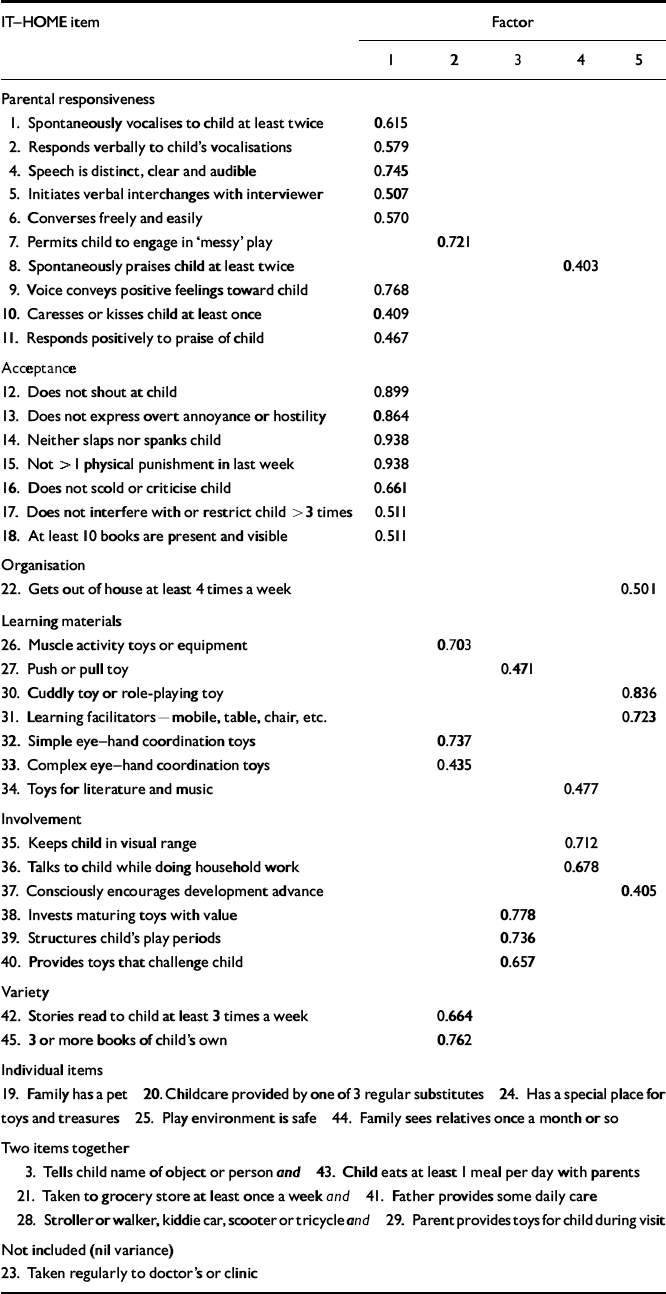
The IT-HOME is administered in the home, with the baby and caregiver present and the baby awake. About half of the items are scored from observation and about half from interview. There is no standard question format or probe - interviewers are advised to ask questions in their own way and adjust questions in light of answers already given, although the training manual provides some suggested probes to introduce topics. There are 45 binary choice (yes/no) items clustered into six sub-scales: parental responsiveness, acceptance of the child, organisation of the environment, learning materials, parental involvement and variety of stimulation (see Table 3).
Principal components analysis of items on the Infant–Toddler Home Observation for the Measurement of the Environment (IT–HOME)
| IT—HOME item | Factor | ||||
|---|---|---|---|---|---|
| 1 | 2 | 3 | 4 | 5 | |
| Parental responsiveness | |||||
| 1. Spontaneously vocalises to child at least twice | 0.615 | ||||
| 2. Responds verbally to child's vocalisations | 0.579 | ||||
| 4. Speech is distinct, clear and audible | 0.745 | ||||
| 5. Initiates verbal interchanges with interviewer | 0.507 | ||||
| 6. Converses freely and easily | 0.570 | ||||
| 7. Permits child to engage in ‘messy’ play | 0.721 | ||||
| 8. Spontaneously praises child at least twice | 0.403 | ||||
| 9. Voice conveys positive feelings toward child | 0.768 | ||||
| 10. Caresses or kisses child at least once | 0.409 | ||||
| 11. Responds positively to praise of child | 0.467 | ||||
| Acceptance | |||||
| 12. Does not shout at child | 0.899 | ||||
| 13. Does not express overt annoyance or hostility | 0.864 | ||||
| 14. Neither slaps nor spanks child | 0.938 | ||||
| 15. Not > 1 physical punishment in last week | 0.938 | ||||
| 16. Does not scold or criticise child | 0.661 | ||||
| 17. Does not interfere with or restrict child > 3 times | 0.511 | ||||
| 18. At least 10 books are present and visible | 0.511 | ||||
| Organisation | |||||
| 22. Gets out of house at least 4 times a week | 0.501 | ||||
| Learning materials | |||||
| 26. Muscle activity toys or equipment | 0.703 | ||||
| 27. Push or pull toy | 0.471 | ||||
| 30. Cuddly toy or role-playing toy | 0.836 | ||||
| 31. Learning facilitators—mobile, table, chair, etc. | 0.723 | ||||
| 32. Simple eye—hand coordination toys | 0.737 | ||||
| 33. Complex eye—hand coordination toys | 0.435 | ||||
| 34. Toys for literature and music | 0.477 | ||||
| Involvement | |||||
| 35. Keeps child in visual range | 0.712 | ||||
| 36. Talks to child while doing household work | 0.678 | ||||
| 37. Consciously encourages development advance | 0.405 | ||||
| 38. Invests maturing toys with value | 0.778 | ||||
| 39. Structures child's play periods | 0.736 | ||||
| 40. Provides toys that challenge child | 0.657 | ||||
| Variety | |||||
| 42. Stories read to child at least 3 times a week | 0.664 | ||||
| 45. 3 or more books of child's own | 0.762 | ||||
| Individual items | |||||
| 19. Family has a pet 20. Childcare provided by one of 3 regular substitutes 24. Has a special place for toys and treasures 25. Play environment is safe 44. Family sees relatives once a month or so | |||||
| Two items together | |||||
| 3. Tells child name of object or person and 43. Child eats at least 1 meal per day with parents 21. Taken to grocery store at least once a week and 41. Father provides some daily care 28. Stroller or walker, kiddie car, scooter or tricycle and 29. Parent provides toys for child during visit | |||||
| Not included (nil variance) | |||||
| 23. Taken regularly to doctor's or clinic | |||||
Transcultural Study of Postnatal Depression
The primary aim of the Transcultural Study of Postnatal Depression (TCS-PND) was to develop (or modify), translate and validate research instruments that could be used in future studies of postnatal depression in different countries and cultures. The instruments were chosen to assess key aspects of the maternity experience, namely clinical diagnosis, the psychosocial context of pregnancy and motherhood, maternal attachment style, mother-infant interaction, the child's environment, and health service structure, use and its associated costs. The modified and translated research tools were piloted to test how well they worked in a perinatal setting and in other languages and populations. This paper reports on the piloting of two of these instruments: the Global Ratings Scales to assess mother-infant interactions, and the IT-HOME.
METHOD
Study sites
Details of the study sites are given by Asten et al (Reference Asten, Marks and Oates2004, this supplement). For the Global Ratings Scales, four sites (Bordeaux, Porto, Vienna and Zurich) all completed the filming of mother-infant play and assessment of mother-infant interaction. Three of these sites (Bordeaux, Porto and Vienna) and one other (Florence) also administered the IT-HOME.
Sample
Eligible women were recruited in antenatal clinics or classes by a researcher who obtained informed consent from those who agreed to take part. Sample sizes in each centre varied from 20 to 60, with a total of 296 for the study as a whole. The Global Ratings Scales and the IT-HOME were administered to sub-samples of the 248 women interviewed postnatally: 144 for the Global Ratings Scales and 114 for the IT-HOME. Demographic characteristics of the centre samples are described by Asten et al (Reference Asten, Marks and Oates2004, this supplement).
Other measures
The Structured Clinical Interview for DSM-IV Axis I Disorders (SCID-I; Reference First, Spitzer and GibbonFirst et al, 1994) is a semi-structured interview for making the major DSM-IV diagnoses (American Psychiatric Association, 1994). In this study a research version of SCID-I designed for use with non-patient populations (SCID-I/NP; Reference First, Gibbon and SpitzerFirst et al, 1996) was modified to produce an instrument for assessing postnatal depression in different cultural contexts: the SCID-PND (Reference Gorman, O'Hara and FigueiredoGorman et al, 2004, this supplement). The SICD-PND was administered at both antenatal and postnatal interviews, thus providing a continuous assessment of depressive disorder from the beginning of pregnancy up to 6 months postnatally.
A combined variable of either major or minor depression with an onset date within 6 months of delivery was used in this study. Rates of postnatal depression differed between centres: five women (31%) in the Bordeaux sample reported an episode of postnatal depression (before filming at 6 months), compared with ten (22%) of the Porto sample (before filming at 3 months) and four (22%) of Vienna's sample (before filming at 6 months). None of the Florence or Zurich samples reported any postnatal depression.
The Contextual Assessment of Maternity Experience (CAME) was developed to assess the psychosocial context of the maternity experience in different cultural settings (Reference Bernazzani, Conroy and MarksBernazzani et al, 2004, this supplement). The CAME includes assessment of recent life adversity in eight domains (marital, social, parental, health, housing and financial, work, criminal and legal, and geopolitical); emotional support, and feelings about the pregnancy and motherhood. Severe and non-severe adversity were distinguished in each domain separately and in all domains together. All centres had comparable levels of severe adversity at postnatal interview (26-44%). Two variables distinguishing poor emotional support in the postnatal period were used: poor support from the woman's partner; and poor overall support from the partner, one ‘very close other’ and all others in the woman's social network. A lower proportion of women in Bordeaux had poor support from their partner (10% compared with 31-41% elsewhere) and a higher proportion of women in Porto than in the other centres had poor overall support (50% compared with 20-28% elsewhere), although neither difference was statistically significant.
Procedure
Postnatal interviews were conducted at around 6 months following delivery (4 months in Zurich), and the Global Ratings Scales and the IT-HOME were administered at the same time as the other study instruments, except in the case of Porto where the Global Ratings Scales and the IT-HOME were administered at around 3 months post-partum. Video recordings for the Global Ratings Scales were mainly conducted in the maternal home, with the mother sitting facing her baby, who was seated in an infant chair. A mirror was placed next to the baby and the interaction was filmed from behind the mother's shoulder, so that the frame included the infant's face and whole body as well as a full-face reflection of the mother. Scoring was conducted by raters masked to the mother's psychiatric status. The IT-HOME was, of course, always administered in the maternal home.
Training and reliability
The original manual for rating the Global Ratings Scales (Reference Gunning, Fiori-Cowley and MurrayGunning et al, 1999) was revised for the study to include details on the procedure for conducting the assessment, and further details on a number of the rating definitions. Raters were trained over a comprehensive 3-day course, with subsequent refresher sessions. Following training, selected teams translated the rating schedule. A Portuguese version of the scales was already available. To gain reliability raters had to score ten standard interactions, rating the first five for practice and feedback and an additional five as the final reliability check. Where necessary, further training feedback was supplied to ensure consistent ratings. All four centres passed this reliability assessment with intra-class correlations ranging from 0.70 to 0.89. Further to this, a transcribed copy of a tape from the rater's sample was sent to M.G. for a comparative analysis as a final check of consistency.
A training video and manual for the IT-HOME produced by the instrument's authors were used for training purposes (Reference Caldwell and BradleyCaldwell & Bradley, 1984). Following training, selected teams translated the inventory items (and suggested interview probes) into their own language. A Portuguese translation was already available. Since administration of the IT-HOME is based on observations made and questions asked during the course of a home visit, format checks of interrater reliability between centres were not considered feasible.
Analyses
Comparisons of mean summary scores by centre were conducted using one-way analysis of variance (ANOVA) where data upheld assumptions of a normal distribution and homogeneity of variance, and a Kruskal-Wallis test where the data did not meet parametric assumptions. Relationships with independent variables were examined using t-tests. Principal components analysis was used to examine the factor structure of the IT-HOME and internal consistency was measured using Cronbach's α.
RESULTS
Global Ratings Scales
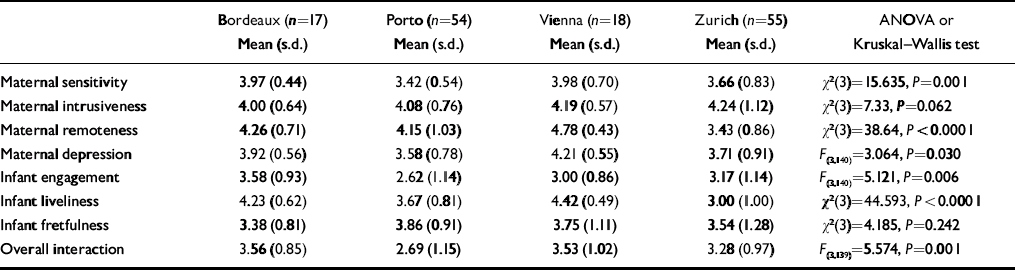
The individual dimensions were grouped into summary scores as per the ratings manual. Table 1 shows the spread of the means across centres. All summary scales represent behaviours on a scale from 1 (poor) to 5 (optimal). Scores for maternal sensitivity were significantly different between centres, with the spread of means indicating that the Porto sample had lower scores than those in Bordeaux, Vienna and Zurich. No centre difference was found for ratings of intrusiveness. Remoteness scores were significantly different, with the spread of means indicating that those for Zurich were lower than for the other three centres. Scores on the depression summary variable also differed, with the Porto sample having significantly lower ratings than those of Vienna. Porto's infant engagement scores were significantly lower than those of Bordeaux. Infant liveliness scores also differed by centre, with the spread of means indicating that those for Zurich were lower than those for Bordeaux, Porto and Vienna. No significant difference was found for infant fretfulness scores. Overall interaction scores showed significantly lower ratings for the Porto group relative to Bordeaux, Vienna and Zurich.
Global Ratings Scales mother–infant interaction summary scores for each study site
| Bordeaux (n=17) Mean (s.d.) | Porto (n=54) Mean (s.d.) | Vienna (n=18) Mean (s.d.) | Zurich (n=55) Mean (s.d.) | ANOVA or Kruskal-Wallis test | |
|---|---|---|---|---|---|
| Maternal sensitivity | 3.97 (0.44) | 3.42 (0.54) | 3.98 (0.70) | 3.66 (0.83) | χ2(3)=15.635, P=0.001 |
| Maternal intrusiveness | 4.00 (0.64) | 4.08 (0.76) | 4.19 (0.57) | 4.24 (1.12) | χ2(3)=7.33, P=0.062 |
| Maternal remoteness | 4.26 (0.71) | 4.15 (1.03) | 4.78 (0.43) | 3.43 (0.86) | χ2(3)=38.64, P<0.0001 |
| Maternal depression | 3.92 (0.56) | 3.58 (0.78) | 4.21 (0.55) | 3.71 (0.91) | F (3,140)=3.064, P=0.030 |
| Infant engagement | 3.58 (0.93) | 2.62 (1.14) | 3.00 (0.86) | 3.17 (1.14) | F (3,140)=5.121, P=0.006 |
| Infant liveliness | 4.23 (0.62) | 3.67 (0.81) | 4.42 (0.49) | 3.00 (1.00) | χ2(3)=44.593, P<0.0001 |
| Infant fretfulness | 3.38 (0.81) | 3.86 (0.91) | 3.75 (1.11) | 3.54 (1.28) | χ2(3)=4.185, P=0.242 |
| Overall interaction | 3.56 (0.85) | 2.69 (1.15) | 3.53 (1.02) | 3.28 (0.97) | F (3,139)=5.574, P=0.001 |
The Porto centre scores, therefore, were lower than the three other centres for three scales: sensitivity, depression and overall interaction. Since past research had revealed the sensitivity dimension to be particularly important, an explanation for the differences on this scale was sought. The Porto sample had significantly higher proportions of ‘manual social class’ mothers (χ2=25.97, d.f.=3; P<0.0001) and fathers (χ2=14.09, d.f.=3; P=0.003), and of mothers with low educational levels (χ2=41.58, d.f.=3; P<0.0001), relative to Bordeaux, Vienna and Zurich.
Analyses of mother's class, partner's class and mother's education in relation to sensitivity scores showed that the sensitivity score was significantly lower where the partner's class was manual (F (1,137)=3.275; P=0.01). After controlling for the effects of partner's class, the centre differences in mean sensitivity scores were no longer significant. There was a similar trend for depression ratings (F (1,137)=3.258; P=0.073), and a significant difference for the overall interaction ratings (z=-2.005; P=0.045), whereby lower mean scores obtained where partner's class was manual. When centre effects on these dimensions were re-examined controlling for social class they were found to be non-significant.
Depression
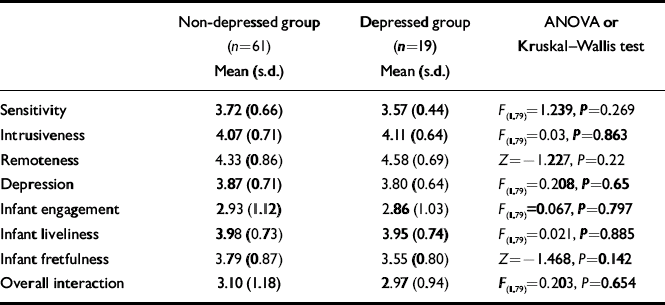
Global Ratings for the Zurich sample were not included in depression analyses since no index group was available for comparison. Since the numbers of participants with depression within individual centres' samples were low, an analysis of the pooled sample was conducted. Table 2 shows the spread of the pooled Global Ratings summary score means by depression status. Although scores for sensitivity, depression, infant engagement, infant ‘fretfulness’ and overall interaction were lower for the depression group, the differences were not statistically significant. Internal correlations of maternal and infant Global Ratings indicated that higher levels of maternal sensitivity were associated with better infant engagement ratings (r=0.57), better infant liveliness scores (r=0.44) and less infant fretfulness (r=0.36); all P<0.0001. When the effects of depression status were tested, sensitivity remained correlated with infant engagement and liveliness ratings only for the non-depressed group. For the depressed group non-intrusive maternal interaction was negatively correlated with infant engagement scores (r=-0.63; P=0.004), indicating that more intrusive styles were associated with better infant engagement. Furthermore, a more remote style was associated with poor infant liveliness scores (r=0.55; P=0.015).
Global Ratings Scales mother–infant interaction summary scores categorised by postnatal depression status
| Non-depressed group (n=61) Mean (s.d.) | Depressed group (n=19) Mean (s.d.) | ANOVA or Kruskal-Wallis test | |
|---|---|---|---|
| Sensitivity | 3.72 (0.66) | 3.57 (0.44) | F (1,79)=1.239, P=0.269 |
| Intrusiveness | 4.07 (0.71) | 4.11 (0.64) | F (1,79)=0.03, P=0.863 |
| Remoteness | 4.33 (0.86) | 4.58 (0.69) | Z=-1.227, P=0.22 |
| Depression | 3.87 (0.71) | 3.80 (0.64) | F (1,79)=0.208, P=0.65 |
| Infant engagement | 2.93 (1.12) | 2.86 (1.03) | F (1,79)=0.067, P=0.797 |
| Infant liveliness | 3.98 (0.73) | 3.95 (0.74) | F (1,79)=0.021, P=0.885 |
| Infant fretfulness | 3.79 (0.87) | 3.55 (0.80) | Z=-1.468, P=0.142 |
| Overall interaction | 3.10 (1.18) | 2.97 (0.94) | F (1,79)=0.203, P=0.654 |
Adversity
Univariate tests revealed no significant effects for the presence of total antenatal or postnatal adversity on Global Ratings summary variables where centre data were pooled. However, women who experienced severe antenatal adversity in the social domain (no adversity, n=129; adversity, n=15) showed some evidence of lower scores on the sensitivity scale, and there was an indication that severe postnatal adversity in the reproduction/parenthood domain (no adversity, n=118; adversity, n=12) was associated with lower depression ratings on the Global Ratings Scales (F (1,142)=3.178; P=0.077; F (1,128)=3.48; P=0.064, respectively).
Support
Poor overall emotional support (good support, n=85; poor support, n=44) was related to lower mean sensitivity scores (F (1,127)=4.084; P=0.045). Analyses of between-group differences revealed that mean sensitivity scores of women who were not depressed and had good postnatal support were significantly higher than those of women who had experienced depression in conjunction with poor postnatal support (z=-2.403; P=0.016), suggesting an additive effect.
IT-HOME
In light of the cautioning by Bradley et al (Reference Bradley, Mundfrom and Whiteside1994) on the use of IT-HOME sub-scale scores with different cultural groups, it seemed appropriate to examine the factor structure of the instrument in this study. Principal components analysis for the pooled sample showed a different factor structure from that of the conventional sub-scales, with 13 factors with eigenvalues greater than 1 being retained. Closest to the original sub-scales was a factor consisting of the majority of items from the responsiveness and acceptance sub-scales. No consistent pattern was apparent for the remaining factors. Table 3 shows individual item loadings on the first five factors. One item (‘child taken regularly to doctor's or clinic’) had to be excluded owing to zero variance across all four centres. Unfortunately, it was not possible to conduct meaningful principal components analyses separately for each centre, owing to the large number of items with zero variance in one or other centre. In light of these findings, total IT-HOME scores rather than sub-scale scores were used in further analyses.
Internal consistency
Reliability analyses indicated that one item (‘family has a pet’) was inconsistent with others in the total IT-HOME scale. Internal consistency, measured using Cronbach's α, for the resulting 44-item scale for the pooled sample was 0.86. The α values for each separate centre were also adequate (Bordeaux 0.73, Porto 0.84, Vienna 0.81), apart from in Florence, where α=0.64.
Mean scores
A total score was computed by adding together all 44 items, with higher scores indicating that more items were credited. A comparison of mean total scores using one-way ANOVA showed a significant difference between centres (F (3,110)=18.86; P<0.001), with post hoc tests revealing that scores in Porto and Florence were lower than those in Bordeaux and Vienna. As with the Global Ratings scores, possible explanations were sought for the discrepancies between centres by examining the effects of demographic variables. Pooled scores showed expected relationships with social class and maternal education. Scores were significantly higher where the mother had been educated to the level of diploma or degree, compared with high school or less (t=5.94; P<0.001), and where both mother's and father's social class was non-manual (mother's social class, t=3.71, P<0.001; partner's social class, t=3.33, P=0.001). There was a non-significant trend for higher scores where the baby was first-born (t=1.80, P=0.074) but no difference in scores according to maternal age.
Unlike the Porto sample, parents' social class and mother's educational level in the Florence sample were similar to those in Bordeaux and Vienna. The main way in which the Florence sample differed was in a higher proportion of first-born babies, which would tend to imply higher scores. Likely explanations for centre differences with Florence, therefore, remained unclear. Although the social class of both parents and maternal educational level were closely related to IT-HOME total scores, and varied between centres, controlling for these variables did not entirely remove the significant differences between centres. In further analyses, therefore, controls were made for centre status. The IT-HOME scores did not, on the whole, show the relationships with other variables that might have been expected. In particular, there was no difference in scores according to depression status, nor were there any effects for antenatal or postnatal adversity, whether examined as adversity in any of the eight domains or as separate domains. However, scores were significantly lower where the mother was rated as receiving poor support from her partner (F=5.47; P=0.02).
Correlations with Global Ratings Scales
As expected, pooled IT-HOME total scores correlated with several Global Ratings Scales (controlling for centre differences) - in particular, with maternal sensitivity (r=0.29; P=0.007), remoteness (r=0.31; P=0.004) and depression (r=0.24; P=0.03). Interestingly, when the effect of depressed status was tested, the correlations were stronger for the non-depressed group and were no longer significant for the depressed group.
DISCUSSION
Postnatal depression affects the ability to interact on an interpersonal level. This impairment has been reported when early mother-infant interactions are assessed relative to a non-depressed control group. Long-term detrimental effects on the infant due to maternal postnatal depression are thought to be mediated by the nature of early mother-infant interactions.
A comparison of the Global Ratings Scales summary scores by centre revealed lower scores for the Porto sample on the key dimension of sensitivity in addition to the depression and overall interaction dimensions. This could be attributed to the greater proportions of parents of lower social class and lower maternal education in the Porto sample. When social class was controlled for, the differences between centres were no longer significant.
Analysis of depression did not yield significant findings when considered alone. There are a number of reasons why this might be the case: first, it could in part reflect the fact that this was mostly a self-selected, low-risk sample, among whom marked impairments in interactive behaviour in the context of depression were unlikely. It could also reflect the fact that, even when samples were pooled, the number of mothers with depression was low (n=19), and the study might have been insufficiently powered to detect significant differences according to depression status. Finally, by the time of the observations of mother-infant interactions, a number of women categorised as depressed because they had experienced depression at some point between birth and 6 months might have recovered, and their interactions might have correspondingly improved. However, analysis of internal correlations between maternal and infant scales of the Global Ratings showed that higher maternal sensitivity scores were associated with better infant communication and liveliness, and less fretfulness. When the effects of depression were considered, the above relationship remained true only for the non-depressed group, whereas scores for the depressed group showed associations between non-intrusiveness and poorer infant engagement, and remote maternal interaction and low levels of infant activity. The pattern of results for the depressed group suggests a more withdrawn style of maternal interaction where the infant is inactive. It is not clear from the data, however, whether the latter finding is due to the depressed group's tendency towards remoteness, which would also preclude a high intrusiveness score. That the association between maternal sensitivity and better infant performance during the interaction was true only for the non-depressed group indicates that where behaviour is not compromised by depression, mother and infant act to sustain each other's smooth interaction. Where depression exists, the relationship is not found and effects are less clear. These findings reflect those of Murray et al (Reference Murray, Fiori-Cowley and Hooper1996b ), who reported a significant correlation between sensitivity and infant engagement where a main effect for depression had also been demonstrated.
Although the experience of general adversity in this sample was not clearly related to the quality of mother-infant interactions, there was consistent evidence that maternal sensitivity was reduced in the context of social adversity (both experienced antenatally, and in terms of poor overall support from a mother's partner, other significant relationships and ‘others’), and this was particularly marked for mothers who were also depressed. It is possible that the symptoms of mothers with depression within this group were more marked within the interpersonal domain. If so, it would be unsurprising that the intensely interpersonal nature of the mother-infant relationship should also prove difficult to negotiate. It is worth noting that, in the study by Murray et al (Reference Murray, Fiori-Cowley and Hooper1996b ), it was similarly the case that general adversity was unrelated to poor mother-infant attachment, whereas adversity concerning poor relations with the woman's own mother was strongly related to this outcome.
Principal components analysis of IT-HOME scores revealed a different factor structure from that of the conventional sub-scales, thus limiting the use of the instrument in this sample to analyses using total scores. The IT-HOME total scores differed by centre, with Porto and Florence having lower scores than Bordeaux and Vienna. Unlike the Global Rating Scales analyses, controlling for relevant demographic variables did not entirely remove the significant centre differences. Since no formal checks of interrater reliability between centres were undertaken for the IT-HOME, it is possible that differences between centres might have arisen from differences in administration and coding of the instrument. The IT-HOME scores did not show anticipated relationships with either depression status or adversity, although scores were lower where the mother had poor support from her partner. Correlations between IT-HOME scores and several of the Global Ratings Scales demonstrate convergent validity between the two measures.
Reviewing the research literature on the use of the HOME across cultures, Bradley et al (Reference Bradley, Corwyn and Whiteside-Mansell1996) noted limited variability in HOME scores obtained in European studies, with mean scores tending to be close to those for middle-class US families. Possible reasons included more homogeneity in many European samples than in the original American norming sample, and the instrument's aim being to distinguish environments posing a risk for children's development from those offering adequate support and stimulation. State welfare provision in European countries means that living conditions are generally better than those of chronically poor US families. It is likely, therefore, that within this small, predominantly middle-class sample the IT-HOME did not discriminate between groups owing to limited variability in scores. Although centres found the instrument easy and quick to administer, some items were considered inappropriate for use with 6-month-old babies. In light of these results, the IT-HOME does not appear to be an ideal instrument to examine the effects of postnatal depression on the home environment of infants in a European setting.
It is of note that only four centres finalised reliability and filming for the Global Ratings Scales assessment. Centres indicated that obtaining equipment and recruiting additional raters who could be masked to mothers' depression status were the main difficulties preventing participation. However, a positive outcome of the study is that most centres found the dimensions of the tool relevant for use in clinical settings in addition to research. Furthermore, following the completion of the European Union study, one European centre and one in Japan have successfully used the scales in further research: the Porto group found the scales effective in assessing the impact on mother-infant interaction of an intervention programme for adolescent mothers (Reference Figueiredo, Matos, Magarinho, Ribeiro, Leal and DiasFigueiredo et al, 2000), and a group in Mie has conducted a preliminary study of postnatal depression and mother-infant interaction in a Japanese sample (Reference Okano, Onozawa and RyiOkano et al, 2002).
In summary, where centres had the means to conduct filming and recruit additional raters, the Global Ratings Scales were successfully used to detect differences in mother-infant interactions between women with postnatal depression and a non-depressed control group, particularly in the presence of poor social support. Further to the TCS-PND study, the assessment is being used by centres within and beyond Europe, indicating the success of the primary aim of the European Union study - the harmonisation of research methods for use in future studies of postnatal depression.
Clinical Implications and Limitations
CLINICAL IMPLICATIONS
-
▪ The reliable use of the Global Ratings Scales in different European centres indicates that they can be used as an assessment of mother–infant interaction in varied international contexts.
-
▪ Postnatal depression and poor postnatal support appear to exert an additive detrimental effect on maternal sensitivity as measured by the Global Ratings Scales.
-
▪ There was little support for the use of the Infant–Toddler version of the Home Observation for Measurement of the Environment (IT–HOME) in these European settings.
LIMITATIONS
-
▪ Samples may not be representative of post-partum women in each centre.
-
▪ Larger samples are needed to disentangle the effects of depression from other factors that may also influence maternal sensitivity.
-
▪ Formal reliability procedures were not undertaken for the IT–HOME.




eLetters
No eLetters have been published for this article.