INTRODUCTION
For late Pleistocene researchers, knowing the ages of their samples is very important to help interpret the paleoecology and extinction of the studied taxa (e.g., Barnosky and Lindsey, Reference Barnosky and Lindsey2010; Dantas et al., Reference Dantas, Missagia, Dutra, Raugust, Silva, Delicio, Reno and Cherkinsky2020).
The accelerator mass spectrometry radiocarbon technique allows the collection of well-preserved bone samples in the collagen fraction (14Ccollagen), up to approximately 50 ka (Cook and Van der Plicht, Reference Cook and Van der Plicht2007). However, in tropical regions, there is one main problem: the lack of collagen as a result of diagenetic processes (Hedges, Reference Hedges2002).
Cherkinsky (Reference Cherkinsky2009) presented an option to perform radiocarbon dating on bioapatite (14Cbioapatite) in the absence of collagen, arguing that the mineral fraction survives much better than organic fractions, suffering only small changes through diagenesis.
Since then, several papers dealing with the chronology and paleoecology of the meso-megamammals from the Brazilian Intertropical Region (BIR) have been published using this technique and presenting the occurrence of this fauna in the late Pleistocene, between 32 and 9 cal ka BP (e.g., Dantas et al., Reference Dantas, Cherkinsky, Bocherens, Drefahl, Bernardes and França2017, Reference Dantas, Missagia, Dutra, Raugust, Silva, Delicio, Reno and Cherkinsky2020, Reference Dantas, Liparini, Asevedo, França and Cherkinsky2022).
However, some authors (Zazzo and Saliège, Reference Zazzo and Saliège2011; Zazzo, Reference Zazzo2014) suggest that during diagenesis, bioapatite exchanges carbon with a 14C-enriched (i.e., younger) carbon source, which results in younger 14Cbioapatite dates compared with 14Ccollagen. The difference between them increases with the age of the samples. Thus, Zazzo (Reference Zazzo2014) recommended that 14Cbioapatite should be considered a minimum age estimate.
Based on this observation, we propose and test regressions that could convert radiocarbon dating in bioapatite to collagen in samples collected from different climatic zones (boreal, temperate, subtropical, and tropical).
MATERIALS AND METHODS
In this study, we used published results for pairs of collagen and bioapatite dates obtained from the same bone samples with relatively good preservation. The degree of preservation estimated on the yield of collagen is more than 5%, and the C/N ratio is below 3.5 (Cherkinsky, Reference Cherkinsky2009; Zazzo, Reference Zazzo2014 and references therein; Cherkinsky et al., Reference Cherkinsky, Glassburn and Reuther2015).
Reduced major axis (RMA; model II) regressions were produced using the entire sample set to create a general regression and specific regressions for each climatic zone (boreal, temperate, subtropical, and tropical; Table 1), because RMA (1) deals better with extrapolation than ordinary least squares (OLS; model I); (2) incorporates an assumption that there is an error in X; and (3) is symmetric, meaning that the slope of the line does not differ depending on which variable is identified as X or Y (Smith, Reference Smith2009; Halenar, Reference Halenar2011 and references therein). This method uses the slope (b OLS) found in OLS, the mean values of x and y, and the absolute value of the correlation of Pearson (r) to estimate a new slope (b RMA; Eq. 1) and intercept (a RMA; Eq. 2) (Harper, Reference Harper2016).


Values of the reduced major axis (RMA) regressions, coefficient of determination (R 2), average percent prediction error (%PE), and standard error of the estimate (%SEE) obtained for each climatic zone (CZ).

As the radiocarbon dates do not present a normal distribution (Shapiro-Wilk test, p < 0.05), these data were transformed to logarithmic values (at base 10) to approximate a log-normal distribution, because they assign equal weights to all data points in a regression (e.g., Smith, Reference Smith1993 and references therein).
As a high correlation does not mean that the regression is a good predictor (e.g., Smith, Reference Smith1984), we calculated the percent predicted error (%PE) and the standard error of the estimate (%SEE).
The %PE of each sample was calculated using Eq. 3 (Valkenburgh, Reference Valkenburgh, Damuth and MacFadden1990 and references therein; Halenar, Reference Halenar2011), and then an average of the absolute %PE mean of the variables was calculated. This index provides a comparative value for determining the predictive accuracy of regressions.

To estimate %SEE, we uses Eq. 4, which reflects the ability of the independent variable to predict the dependent variable (Valkenburgh, Reference Valkenburgh, Damuth and MacFadden1990 and references therein). SE is standard error (standard deviation, √n).

To test whether statistical differences between the proposed regressions exist, we performed an analysis of covariance (ANCOVA; 1 factor, α = 0.05) in the PAST v. 3.11 software (Hammer et al., Reference Hammer, Harper and Ryan2001).
The best estimated regression (see “Results and Discussion”) was used to convert the bioapatite radiocarbon dates to suggested collagen dates of eight extinct meso-megamammals from the BIR (sensu Cartelle, Reference Cartelle1999; Table 2).
Radiocarbon dating in bioapatite (14Cbioapatite) converted to collagen (14Ccollagen), presence of modern carbon (pMC), difference between 14Ccollagen and 14Cbioapatite (14Δbioapatite-collagen), and calibrated ages (SHCal20 curve) for extinct late Pleistocene meso-megamammal taxa from the Brazilian Intertropical Region.

a BA, Bahia; RN, Rio Grande do Norte; SE, Sergipe.
b Dantas et al. (2017 and references therein).
c Dantas et al. (2020 and references therein).
d Greco et al. (Reference Greco, Dantas and Cozzuol2022).
e Dantas et al. (Reference Dantas, Liparini, Asevedo, França and Cherkinsky2022).
f Lessa et al. (Reference Lessa, Gomes, Cherkinsky and Dantas2021).
RESULTS AND DISCUSSION
Converting 14Cbioapatite into 14Ccollagen
The radiocarbon-dated samples (dated for both bioapatite and collagen) came from different locations in boreal, temperate, subtropical, and tropical climatic zones (Supplementary Table S1), which provided, in general, younger bioapatite radiocarbon ages than collagen ages from the same samples (Cherkinsky, Reference Cherkinsky2009; Zazzo, Reference Zazzo2014 and references therein; Cherkinsky et al., Reference Cherkinsky, Glassburn and Reuther2015).
Using these data, we estimated regressions for each climatic zone, plus a general one, and noted that they are similar (ANCOVA, F obs = 1.98, p = 0.10; Table 1), with strong correlations and similar slope (m) values; however, they showed different %PE and %SEE values.
The slopes of these RMA regressions created with the available data allowed us to infer that the bioapatite radiocarbon dates tended to be slightly younger than those of collagen in boreal (m = 1.09), temperate (m = 1.15), and subtropical climate zones (m = 1.04) and worldwide (m = 1.09). In tropical climate zones, bioapatite radiocarbon dates tended to be slightly older than collagen dates (m = 0.97).
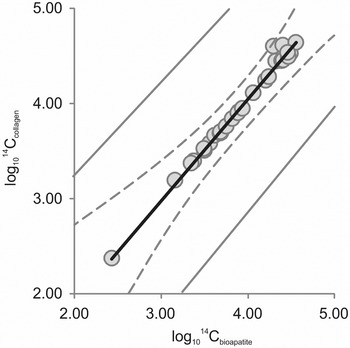
If we choose to use the regressions for each climatic zone, corrected collagen dates tend to cluster by zone (e.g., those from temperate climatic zones tend to be higher than those in the other zones). To avoid this, as all regressions are similar, we suggest the use of a general regression (Fig. 1), as it shows a strong correlation (R 2 = 0.98, p < 0.05), lower mean %PE (= 0.01; Table 1), and average %SEE (= 21.83; Table 1).

Reduced major axis regression of log radiocarbon dating (bioapatite) and log radiocarbon dating (collagen) using 28 samples (Supplementary Table S1). Regression line (black solid line), confidence intervals (gray dotted lines), and prediction intervals (gray solid lines).

The best regressions must have higher values of correlation and lower values of %PE (<15%) and %SEE (Delson, et al., Reference Delson, Terranova, Jungers, Sargis and Jablonski2000; Ruff, Reference Ruff2003), showing that the predicted values are similar to those observed, which this general equation reached.
Limit of conversion
The radiocarbon calibration curve could allow the estimation of the age of terrestrial samples to approximately 50 ka, which is the limit of the method (Cook and Van der Plicht, Reference Cook and Van der Plicht2007; Wood, Reference Wood2015). As stated before, the bioapatite radiocarbon dates are considered to be minimum ages, and our regression can convert the 14Cbioapatite to 14Ccollagen; however, observing the limit of the method (50 ka), our regression should be used to convert only 14Cbioapatite to ~39,400 yr. Older converted collagen dating could not be calibrated in the CALIB v. 8.1 program (Reimer et al., Reference Reimer, Austin, Bard, Bayliss, Blackwell, Ramsey and Butzin2020) because of the extrapolation of the limit of 50 ka.
Study Case: Converting the 14Cbioapatite of the meso-megamammals from the BIR
Using the developed regression, we converted the bioapatite radiocarbon dates to the suggested collagen ones for eight extinct meso-megamammal taxa that lived in the BIR and later calibrated them into calendar ages before present, applying the same standard error found in the 14Cbioapatite and using the CALIB v. 8.1 program (Reimer et al., Reference Reimer, Austin, Bard, Bayliss, Blackwell, Ramsey and Butzin2020), SHCal20 curve (Hogg et al., Reference Hogg, Heaton, Hua, Palmer, Turney, Southon and Bayliss2020), and 2σ measured ages reported in Table 2. The use of Northern (Reimer et al., Reference Reimer, Austin, Bard, Bayliss, Blackwell, Ramsey and Butzin2020) and Southern Hemisphere (Hogg et al., Reference Hogg, Heaton, Hua, Palmer, Turney, Southon and Bayliss2020) curves gives small differences (<7%) between the calibrated data.
The difference between the radiocarbon dating of bioapatite and the dates converted to collagen showed a variation between 1141 and 7187 yr (Table 1), while the difference between the calibrated dates was in the range of 1166 to 7523 cal yr older than previously thought (Cherkinsky et al., Reference Cherkinsky, Dantas and Cozzuol2013; Dantas et al., Reference Dantas, Cherkinsky, Bocherens, Drefahl, Bernardes and França2017; Fig. 2).
Radiocarbon chronology in collagen (white circles) of extinct meso-megamammals from the Brazilian Intertropical Region. The gray shadow represents the interval found in radiocarbon dating performed on bioapatite. The dotted gray line represents the limit between the Pleistocene and Holocene. Abbreviations: Cc, Catonyx cuvieri; El, Eremotherium laurillardi; Hm, Hemiauchenia mirim; Nm, Nothrotherium maquinense; Np, Notiomastodon platensis; Pm, Palaeolama major; Tp, Toxodon platensis; Vb, Valgipes bucklandi.

The diagenesis could promote small alterations in 14C/12C in bioapatite carbonate, leading to younger dates; however, this alteration is not significant in the ratio of stable isotopes of carbon (13C/12C) for at least the last 40,000 yr (Zazzo, Reference Zazzo2014).
When diagenesis affects the bioapatite, the substitutions are mainly in the hydroxyl position in the phosphate, and even with a carbonate substitution, the isotope signature in stable and radioactive carbon maintains the original signature (Cherkinsky, Reference Cherkinsky2009).
The available δ13C associated with the converted 14Ccollagen for the megafauna of the BIR provides paleoecological information for a time span ranging ~12,700 to 42,100 yr (Fig. 2) and allows us to suggest that these meso-megamammals lived in the BIR at least until 12 ka. Considering other dating techniques, such as electron spin resonance, this time span can be expanded to 9 ± 2 ka (Ribeiro et al., Reference Ribeiro, Kinoshita, Figueiredo, Carvalho and Baffa2013).
CONCLUSIONS
In this paper, we propose a regression to convert radiocarbon dating performed in bioapatite to collagen, allowing for the comparison of radiocarbon dates worldwide.
Using this new tool, we converted the radiocarbon dating performed on bioapatite in fossils of meso-megamammals from Brazil and suggest that these dates are 1–7 cal ka BP older than previously thought.
Acknowledgments
We thank the Conselho Nacional de Desenvolvimento Científico e Tecnológico (CNPq) for the research fellowship in MATD (PQ/CNPq 311003/2019-2). We also thank Lais Alves Silva, who critically reviewed the manuscript, and the anonymous reviewers and editors, whose critiques helped improve the quality of the article.
Supplementary material
The supplementary material for this article can be found at https://doi.org/10.1017/qua.2023.19.