Contamination obsessions and washing compulsions are among the most common concerns of individuals with obsessive-compulsive disorder (OCD) (Rasmussen & Eisen, Reference Rasmussen and Eisen1992). Patients with contamination symptoms typically experience intrusions about potential contaminants, followed by urges and attempts to avoid the contamination threat by performing neutralizing behaviors such as washing and avoiding potential contaminants. Cognitive-behavioral OCD theories posit that key elements in contamination-OCD development/ maintenance are dysfunctional beliefs and appraisals about thoughts and negative emotional responses (Rachman, Reference Rachman2004).
Among the beliefs about thoughts that have been proposed as vulnerability factors for the development/ maintenance of OCD (e.g., over-importance of thoughts, responsibility, control importance, overestimation of threat, intolerance to uncertainty, perfectionism; Obsessive Compulsive Cognitions Working Group, 1997), research suggests that the most relevant factors in predicting contamination obsessive-compulsive symptoms are overestimation of threat and responsibility beliefs (e.g., OCCWG, 2005; Tolin, Brady, & Hannan, Reference Tolin, Brady and Hannan2008). However, there are inconsistencies among studies, and the specific weight of these beliefs in the explanation of OCD, and especially contamination symptoms, seems to be limited (García-Soriano & Belloch, Reference García-Soriano and Belloch2013). In this regard, Wheaton, Abramowitz, Berman, Riemann, and Hale (Reference Wheaton, Abramowitz, Berman, Riemann and Hale2010) reported that responsibility/overestimation of threat beliefs only explained a small amount (11%) of the contamination severity variance in OCD patients. Other proposals suggest that illness threat beliefs are also a relevant cognition in fear of contamination (e.g., Rachman, Reference Rachman2004), which predicts OCD-related washing distress (Thorpe, Patel, & Simonds, Reference Thorpe, Patel and Simonds2003).
These general beliefs will probably influence appraisals of specific situations that are assumed to be involved in the perception of threat. Contamination-related OCD has been associated with specific dysfunctional appraisals, such as the overestimation of the likelihood of becoming contaminated and the seriousness or severity of the consequences of this contamination (Rachman, Reference Rachman2004), as well as misinterpretations about the likelihood and severity of becoming ill (Jones & Menzies, Reference Jones and Menzies1997). In this vein, results show that illness overestimation/danger expectancies are associated with washing symptoms and predict the urge to hand wash (Thorpe, Barnett, Friend, & Nottingham, Reference Thorpe, Barnett, Friend and Nottingham2011), disgust responses, and behavioral avoidance (Dorfan & Woody, Reference Dorfan and Woody2011).
Finally, regarding emotions, although contamination OCD has traditionally been associated with fear (e.g., Rachman, Reference Rachman2004), a growing number of studies suggest that disgust also plays a role in contamination OCD (e.g., Cisler, Olatunji, & Lohr, Reference Cisler, Olatunji and Lohr2009; Olatunji, Cisler, McKay, & Phillips, Reference Olatunji, Cisler, McKay and Phillips2010). Thus, increased disgust propensity and sensitivity are suggested to be vulnerability factors for the maintenance and/or development of contamination-related OCD. Along these lines, research shows that contamination-related OCD symptoms are associated with both disgust propensity and sensitivity (e.g., Mancini, Gragnani, & D’Olimpio, Reference Mancini, Gragnani and D’Olimpio2001; Mitte, Reference Mitte2008; Nicholson & Barnes-Holmes, Reference Nicholson and Barnes-Holmes2012; Olatunji, Reference Olatunji2010). Moreover, individuals with high (versus low) contamination symptoms show higher washing behavior and avoidance on behavioral approach/avoidance tasks (BAT) involving disgusting stimuli (e.g., Olatunji, Lohr et al., Reference Olatunji, Cisler, Deacon, Connolly and Lohr2007; Woody & Tolin, Reference Woody and Tolin2002). Nevertheless, the specific role played by disgust as an OCD vulnerability factor has not yet been determined. In fact, studies have suggested that the variable influencing washing behavior could be the disgust state, but not the trait (Woody & Tolin, Reference Woody and Tolin2002). It is important to note that most of these studies appraise disgust without considering its physiological correlates. Along these lines, disgust has been associated with increased parasympathetic activity, a decreased heart rate, lower blood pressure, and a distinctive physiological manifestation (i.e., nausea), although these responses may depend on the specific stimulus that evokes the disgust (for a review: Kreibig, Reference Kreibig2010).
Both anxiety and disgust sensitivity have been postulated as vulnerability factors in contamination-related OCD (e.g., Arnáez, García-Soriano, & Belloch, Reference Arnáez, García-Soriano and Belloch2015; Mitte, Reference Mitte2008; Olatunji, Cisler, Deacon, Connolly, & Lohr, Reference Olatunji, Cisler, Deacon, Connolly and Lohr2007; Wheaton, Mahaffey, Timpano, Berman, & Abramowitz, Reference Wheaton, Mahaffey, Timpano, Berman and Abramowitz2012) that predict unique portions of the variance. From this perspective, disgust or anxiety will only be a problem in individuals who appraise them as threatening or meaningful (Cisler, Brady, Olatunji, & Lohr, Reference Cisler, Brady, Olatunji and Lohr2010), or in people who use emotional reasoning (Mitte, Reference Mitte2008). Moreover, another line of research has emphasized that the individual’s perceived threat from emotions is associated with OCD symptomatology (McCubbin & Sampson, Reference McCubbin and Sampson2006), although the findings have been inconsistent (Smith, Wetterneck, Hart, Short, & Björgvinsson, Reference Smith, Wetterneck, Hart, Short and Björgvinsson2012).
Thus, from theoretical and empirical perspectives, contamination-related OCD has been associated with different cognitive and emotional variables. Studies theoretically and/or empirically integrating those variables (e.g., Adams, Cisler, Brady, Lohr, & Olatunji, Reference Adams, Cisler, Brady, Lohr and Olatunji2013) suggest that neither general beliefs nor disgust experiences may be sufficient for the development/ maintenance of contamination-related OCD.
The present study aimed to shed light on the comprehension of the contamination-OCD phenomenon by exploring the influence of a set of emotional and cognitive variables highlighted from different perspectives as potential variables influencing the development/maintenance of contamination-related OCD. Therefore, we aimed to: (1) explore the responses to a contamination-based stimulus in individuals with high contamination OCD symptoms, high checking OCD symptoms, and low psychopathological symptoms; and (2) test the relevance of different emotional and cognitive mechanisms in predicting the contamination symptoms evoked by a contamination-based stimulus.
In order to fulfill these objectives, participants were asked to engage in a contamination-based behavioral approach task. The BAT consisted of seven approach steps to a contamination-based stimulus (i.e., plastic garbage bag containing dirty underwear). Unlike in previous studies (i.e., Cougle, Wolitzky-Taylor, Lee, & Telch, Reference Cougle, Wolitzky-Taylor, Lee and Telch2007; Olatunji, Lohr et al., Reference Olatunji, Cisler, Deacon, Connolly and Lohr2007), participants were not asked to have direct contact with a potentially contaminating stimuli, and the BAT was not an objective threat situation, as the stimulus touched (plastic bag) could be contaminated only through contact with another possibly contaminated object (i.e., dirty underwear). Thus, sympathetic magic beliefs will probably be activated during the task (e.g., McKay, Reference McKay2006). Using this BAT, we aimed to evoke a common OCD scenario where contamination-related OCD symptoms are activated toward objects and situations (e.g., door handle, shaking hands) without intrinsic contamination-related properties (Adams et al., Reference Adams, Cisler, Brady, Lohr and Olatunji2013). In order to analyze whether the responses were specific to contamination-OCD, three groups of participants completed the task: a group with high contamination-OCD symptoms, a group with high checking-OCD symptoms, and a non-clinical group. A checking comparison group was included, as it is one of the most prevalent OCD contents in clinical and non-clinical samples (García-Soriano & Belloch, Reference García-Soriano and Belloch2013), and it has previously been associated with high disgust (Mancini et al., Reference Mancini, Gragnani and D’Olimpio2001). We have appraised cognitive and emotional variables, differentiating between cognitive and emotional vulnerability/trait variables and responses to the BAT. Overall, we predicted that disgust would be the main emotional reaction in all the groups. Moreover, we predicted that the BAT would generate a higher emotional, cognitive and behavioral response in the group with high contamination symptoms, and a decreased heart rate. Regarding the second objective, we hypothesized that the disgust experienced, as well as the appraisals of threat from emotion and contamination and illness likelihood/severity, would be relevant variables in predicting the urge to wash.
Method
Participants
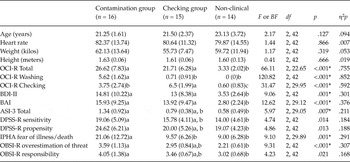
The sample for this study consisted of forty-five women extracted from a large pool of undergraduate students (N = 403; M = 21.62 (SD = 3.91) years old; 85.80% women) based on their scores on three screening measures (Obsessive-Compulsive Inventory-Revised (OCI-R, Foa et al., Reference Foa, Huppert, Leiberg, Langner, Kichic, Hajcak and Salkovskis2002); Beck Depression Inventory–II (BDI-II; Beck, Steer, & Brown, Reference Beck, Steer and Brown1996) and Beck Anxiety Inventory (BAI; Beck & Steer, Reference Beck and Steer1993)). Participants with severe depressive (BDI-II > 28) or anxious (BAI > 35) scores were excluded. Three groups were selected: (1) A high obsessive-compulsive contamination symptom group (contamination group), composed of participants scoring in the 90th percentile or above on the OCI-R washing scale (≥ 4). Of the 21 participants who met the criteria, 16 participated in the study (M = 21.25 (SD = 1.61) years old); (2) a high obsessive-compulsive checking symptom and low contamination-OCD group (checking group), composed of individuals scoring in the 90th percentile or above on the OCI-R checking scale (≥ 6) and in the 25th percentile or below on the washing OCI-R subscale (≤ 2). Twenty-four participants met the criteria, and 15 of them participated in this study (M = 21.50 (SD = 2.37) years old); and (3) a group of individuals (non-OCD) who scored low on the screening measures, that is, below the 25th percentile on the OCI-R subscales (≤ 2) and low on mild depressive and anxious symptoms (BDI and BAI ≤ 13). Thirty-one individuals met the criteria, and 14 of them took part in the study (M = 23.13, SD = 3.72) years old). Only women were included in this study. This decision was made because women made up the majority (95.65 %) of the eligible participants for the contamination group, and gender seems to be a variable that can influence the OCD clinical presentation and course (Torresan et al., Reference Torresan, Ramos-Cerqueira, Shavitt, do Rosário, de Mathis, Miguel and Torres2013), as well as some of the variables included in the study, such as disgust (Olatunji, Sawchuk, Arrindell, & Lohr, Reference Olatunji, Sawchuk, Arrindell and Lohr2005; Thorpe et al., Reference Thorpe, Patel and Simonds2003), anxiety sensitivity (Schmidt & Koselka, Reference Schmidt and Koselka2000) and contamination fears (Olatunji et al., Reference Olatunji, Sawchuk, Arrindell and Lohr2005). Demographic and psychopathology scores are displayed in Table 1.
Demographic and self-questionnaire (screening and pre-BAT) measures

Note: Contamination group = high obsessive-compulsive contamination symptom group; Checking group = high obsessive-compulsive checking symptom group; non-clinical: group of individuals low on the screening measures. OCI-R = Obsessive-Compulsive Inventory-Revised; BDI-II = Beck Depression Inventory–II; BAI = Beck Anxiety Inventory; ASI-3 = Anxiety Sensitivity Index-3; DPSS-R = Disgust Propensity and Sensitivity Scale-Revised; IPHA = Aiglé Hypochondria worries inventory; OBSI-R= Obsessive Beliefs Spanish Inventory-Revised.
BF = Brown-Forsythe (when homogeneity could not be assumed)
Subscripts indicate post-hoc comparisons (Tukey or Games-Howell when homogeneity could not be assumed).
* Indicates significant differences after Bonferroni adjustment.
The use of an analog sample composed of participants who scored high on contamination and checking obsessive-compulsive (OC) symptoms was considered appropriate for this study, given that research suggests that non-clinical populations exhibit intrusions, control strategies, and beliefs about intrusions similar to those found in clinical populations of OCD patients, but with less frequency and distress, while sub-clinical samples fall in between (i.e., Abramowitz et al., Reference Abramowitz, Fabricant, Taylor, Deacon, McKay and Storch2014 for a review; García-Soriano & Belloch, Reference García-Soriano and Belloch2013). Consequently, non-clinical samples are extensively used in OCD research and have been considered highly relevant for understanding OC symptoms (Abramowitz et al., Reference Abramowitz, Fabricant, Taylor, Deacon, McKay and Storch2014). Additionally, the effects of other variables used, such as illness expectancies, are also similar in studies using both clinical and sub-clinical samples (Cougle et al., Reference Cougle, Wolitzky-Taylor, Lee and Telch2007).
Measures
Materials and apparatus
The materials consisted of a closed, black plastic garbage bag with clothes inside it (subjects were told that it contained dirty underwear), disinfecting gel, a chocolate-covered wafer biscuit bar (it included two bars, each bar’s size was: length- 6.2 cm; width- 1 cm; height- 1 cm) and gluten-free breadsticks.
A Polar©RS800cx watch (Polar CIC, USA), consisting of a chest belt for detection and transmission of the heartbeat and a watch, was used to record heart rate responses. The Polar watch records R-R intervals with a sampling frequency of 1000 Hz, providing a time resolution of 1ms for each R-R interval. This device is valid to measure HR (Cassirame, Tordi, Mourot, Rakobowchuk, & Regnard, Reference Cassirame, Tordi, Mourot, Rakobowchuk and Regnard2007; Shkolnikova et al., Reference Shkolnikova, Baturova, Medvedev, Veleslavova, Shubik, Jdanov and Shkolnikov2011). Heart rate was measured continuously.
Screening measures
The Obsessive-Compulsive Inventory-Revised (OCI–R; Spanish: Belloch et al., Reference Belloch, Roncero, García-Soriano, Carrió, Cabedo and Fernández-Álvarez2013) is an 18-item self-report questionnaire assessing distress associated with various obsessive-compulsive symptoms (6 subscales: washing, checking, ordering, obsessing, hoarding and neutralizing). In the present study, Cronbach’s Alpha = .87.
The Beck Anxiety Inventory (BAI; Beck & Steer, Reference Beck and Steer1993) is a 21-item self-report questionnaire measuring anxiety symptoms (in the present sample, α = .87).
The Beck Depression Inventory–II (BDI-II; Beck et al., Reference Beck, Steer and Brown1996) is a widely used self-report instrument to measure depressive symptoms (in the present study, α = .90).
Pre-BAT measures
The Anxiety Sensitivity Index-3 (ASI-3; Spanish version: Sandin, Valiente, Chorot, & Santed, Reference Sandin, Valiente, Chorot and Santed2007) is an 18-item self-report that appraises the tendency to be concerned about possible negative consequences of anxiety. The total score has been used (in the present sample, α = .92).
The Disgust Propensity and Sensitivity Scale-Revised (DPSS-R; Spanish version: Sandin, Chorot, Olmedo, & Valiente, Reference Sandin, Chorot, Olmedo and Valiente2008) is a 16-item questionnaire measuring disgust sensitivity and propensity (in the present study, propensity α = .89; sensitivity α = .74).
The Aiglé Hypochondria worries inventory (IPHA; Belloch, Fernández-Álvarez, & Castañeiras, Reference Belloch, Fernández-Álvarez and Castañeiras2004) is a 30-item questionnaire developed to appraise hypochondriasis worries and concerns. Only the Fear of illness and death scale (α = .89) will be analyzed.
Obsessive Beliefs Spanish Inventory-Revised (OBSI-R; Belloch et al., Reference Belloch, Morillo, Luciano, García-Soriano, Cabedo and Carrió2010): 50-item self-report questionnaire that includes eight scales appraising OCD relevant beliefs about thoughts. Only the Overestimation of threat (α = .80) and Responsibility (α = .81) subscales will be analyzed.
Behavioral/avoidance approach task
A seven-step behavioral approach/ avoidance task was designed. Participants were asked to approach a garbage bag with underwear that was described as dirty. The stimulus was selected in order to conduct a BAT with a stimulus that was not necessarily disgusting or threatening to the general population, but was specifically relevant to OCD patients, especially patients with contamination obsessions. Each step lasted 30 seconds (except steps 6 and 7, which lasted 40”) and asked them to: (1) approach the bag and look at it; (2) look at the bag and touch it with a paper tissue; (3) touch the bag with a finger with enough pressure to perceive the content (and look); (4) touch the bag with one hand (and look); (5) touch the bag with both hands (and look); (6) touch the bag (10”) (and look) and touch their faces with their hands (30”); and (7) touch the bag (10”), have one chocolate bar in each hand (30”) and eat the items. Participants could choose two gluten-free breadsticks instead of the chocolate bar; all the participants chose the chocolate bar. The BAT ended when the participant refused to go on to the next step or after the participant ate at least one chocolate bar. Participants were instructed that they were free to refuse to do any or all of the steps. The experimenter used latex gloves to manipulate the stimulus.
Peri- and during the BAT measures
After presenting the stimulus (peri-BAT) and after each step of the BAT (during-BAT), participants provided subjective ratings of state emotions (anxiety and disgust) and behavioral (urge to wash) and physiological (urge to vomit) responses (from 0 to 10). Using the scores on these dimensions during the BAT steps, the following indices were calculated as average ratings: anxiety, disgust, urge to vomit, and urge to wash.
Heart rate acceleration was calculated by finding the difference between the heart rate means during step 7 and during step 1.
Behavioral approach was calculated using the number of completed steps.
Post-BAT measures
Structured-interview. Participants were asked a set of questions regarding:
-
(1) Emotional reaction to the BAT. Participants chose their most intense emotional reaction to the BAT from a list of seven emotional categories: sad/blue; joyful; angry, irritated, mad; fearful/anxious; disgusted; surprised; embarrassed.
-
(2) Perception of threat from the most intense emotion experienced during the BAT. Participants appraised to what degree (5-point Likert scale) the emotion identified as the most intense: (1) feels like it will last forever; (2) it is important to stop feeling it; (3) could cause a loss of control; (4) is dangerous; (5) frightening or (6) bad. Questions were based on the McCubbin and Sampson (Reference McCubbin and Sampson2006) proposal. Present study α = .83.
-
(3) Overestimation of the likelihood and severity of becoming contaminated or ill (based on Jones & Menzies Reference Jones and Menzies1997). Four items asked about the perceived probability of having become contaminated/ill after doing the task, and the severity of this contamination/illness (from 0 to 10).
Procedure
The study consisted of three differentiated phases: (1) 544 undergraduate students were invited to participate, and 79.59 % participated by completing a set of questionnaires; (2) participants who met the inclusion criteria (screening measures) and reported not having current mental health problems and/or taking psychotropic medication were invited to participate in the second part of the research in exchange for one USB pen drive; (3) participants who decided to participate were met individually and completed a battery of questionnaires (pre-BAT measures). Then, the BAT was conducted while registering the peri- and during BAT measures. Next, a face-to-face interview was conducted (post-BAT measures). Experimenters were blind to the group assignment of each individual. This study was approved by the ethics committee of the institution, and all individuals provided informed consent.
Statistical analyses
First, in order to analyze differences among groups in the relevant variables, ANOVAs were computed using F or Brown-Forsythe, depending on the homogeneity of the group variances. Tukey or Games-Howell post-hoc statistics were conducted, depending on the homogeneity of the group variances, to examine the source of between-group differences. Bonferroni tests were used for post hoc comparisons when appropriate. Next, a series of hierarchical multiple regression analyses were conducted with the whole sample to analyze which variables contributed to predicting the urge to wash evoked by the BAT. Group was dummy-coded and entered as a predictor in the first step, while emotional responses during the BAT (disgust, anxiety) and appraisals after the BAT (threat from emotion, contamination likelihood and severity, illness likelihood and severity) were entered in step 2. Urge to wash was chosen as the dependent variable, as it is a particularly relevant OC symptom in contamination-related OCD; moreover, it was the outcome variable, showing higher between-group differences. Then, a series of regression analyses were conducted with the variables that entered in the final equation model as different dependent variables, and group (step 1) and vulnerability variables (ASI-3, DPSS-R propensity, DPSS-R sensitivity, IPHA-fear of illness/ death, OBSI overestimation of threat and OBSI responsibility) were entered as predictors (step 2). In this way, we examined the contribution of vulnerability variables to the BAT response after controlling for differences in group assignment. The stepwise statistical procedure was used to enter predictors, given the large number of predictors and the sample size available (Tabachnick & Fidell, Reference Tabachnick and Fidell2007). The stepwise procedure only enters predictors in the equation that statistically add explained variance. Collinearity statistics were examined and found to be adequate (in all cases, tolerance > 0.76 and variance inflation factor < 1.4). All analyses were conducted with IBM SPSS Statistics 21.
Results
Preliminary analysis: participants’ characteristics
First, differences between groups of participants on demographic, physiological, screening and general vulnerability variables were examined (see Table 1). There were no differences between groups on demographic or physiological/anthropometrical variables (age, heart rate, weight and height). As expected, participants differed on the screening measures (OC, depressive and anxiety symptoms), with the contamination and checking groups having higher total scores on the OCI-R, BDI-II, and BAI than the non-clinical group; the contamination group scored higher on OCI-R washing, and the checking group scored higher on OCI-R checking. In addition, regarding the pre-BAT measures, the contamination group scored higher on fear of illness/death, and the contamination and checking groups scored higher than the non-clinical group on anxiety sensitivity and overestimation of threat. Significant differences showed large effect sizes. Differences in responsibility beliefs, disgust propensity and sensitivity were no longer significant after Bonferroni correction was applied.
Differences between participants in their response to the BAT
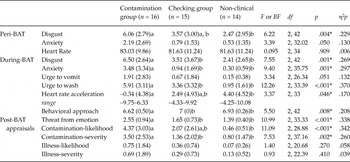
Second, a series of one-way ANOVA was conducted to compare the groups on the responses evoked by the stimulus used in the BAT. Significant differences with large effect sizes appeared in most of the variables (Table 2). Post-hoc analyses indicated that when the stimulus was presented to participants (peri-BAT measures), it produced greater disgust in the contamination group than in the non-clinical individuals, with the checking group lying between them. Moreover, throughout the BAT (during-BAT measures), contamination participants, in comparison with the other two groups, reported higher subjective disgust, anxiety and urge to wash, lower approach behavior, and higher heart rate deceleration. Data also showed a marginally higher urge to vomit in the contamination group, although post-hoc analysis did not reveal differences.
Mean comparisons between groups on the emotions, appraisals, behavioral response, and heart rate evoked by the behavioral approach task (BAT) (appraised before, during and after de BAT)

Note: Contamination group = high obsessive-compulsive contamination symptom group; Checking group = high obsessive-compulsive checking symptom group; Non-clinical: group of individuals low on the screening measures.
Peri-BAT = before the BAT/stimulus presentation; During the BAT = average ratings during all the BAT steps; Post-BAT = after the BAT (without letting participants wash hands).
Data offered as Mean (SD); BF=Brown-Forsythe (when homogeneity could not be assumed); Subscripts indicate post-hoc comparisons (Tukey or Games-Howell when homogeneity could not be assumed). *Indicates significant differences after Bonferroni adjustment.
Regarding the way participants appraised their experience with the BAT (post-BAT measures), the contamination group reported higher perception of threat from emotion and contamination severity than the other two groups, and higher contamination likelihood than the non-clinical participants. There were no differences between groups for illness probability and severity appraisals.
Finally, in order to further analyze the most relevant emotion evoked by the BAT, a series of paired-sample t-tests was conducted separately for each group, comparing the disgust and anxiety ratings during the BAT. Results indicated that disgust was significantly higher than anxiety in the three groups (contamination group: t(15) = 5.09, p = .001; checking group: t(13) = 3.45, p = .004; non-clinical: t(14) = 3.69, p = .002).
Relationships between urge to wash, emotional and cognitive responses to the BAT and vulnerability variables
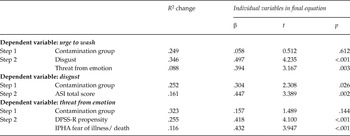
A series of regression analyses was conducted within the whole sample to analyze which variables contributed to predicting the urge to wash (dependent variable) evoked by the BAT. Group was dummy-coded and entered as a predictor in the first step, while emotional ratings during the BAT (disgust, anxiety) and appraisals (threat from emotion, contamination likelihood and severity, illness likelihood and severity) were entered in step 2 (Table 3). Results indicated that the final model accounted for 68% of the urge to wash variance F(3, 36) = 25.902, p < .001, with only disgust and threat from emotion entering in the last regression model.
Summary statistics for the final step of the regression equations

Note: Contamination group = adscription to the high contamination-obsessive-compulsive disorder symptom group; IPHA = Aiglé Hypochondria worries inventory; DPSS-R = Disgust Propensity and Sensitivity Scale-Revised; ASI-3 = Anxiety Sensitivity Index
Then, a series of regression analyses were conducted with the variables that entered the final equation model as dependent variables (i.e., disgust and threat from emotion), and the group (step 1) and vulnerability variables (ASI-3, DPSS-R, IPHA, OBSI-R) as predictors (step 2). Regarding the first regression analysis, results indicated that the final model accounted for 41.3% of the disgust experienced during the BAT F(2, 42) = 14.776, p < .001, with the contamination group and ASI total score entering in the last regression model. When predicting Threat from emotion, the final equation model accounted for 69.4% of the variance F(3, 42) = 31.024, p < .001, with fear of illness/death and disgust propensity entering in the final equation model.
Discussion
Contamination-related OCD has received a great deal of attention from researchers in recent decades, although the mechanisms underlying contamination symptoms are still not defined. This study was developed to better delineate the emotional and cognitive variables involved in the contamination-OCD phenomenon, first, by analyzing the emotional and cognitive response when approaching a contamination-based stimuli and, second, by exploring the relevance of these variables in explaining the urge to wash experienced.
Results show that the vulnerability variables appraised (disgust propensity, disgust and anxiety sensitivity, fear of illness/death, overestimation of threat and responsibility beliefs) are relevant for patients with high contamination OCD symptoms, as previously suggested in the literature (i.e., Cougle, Lee, Horowitz, Wolitzky-Taylor, & Telch, Reference Cougle, Lee, Horowitz, Wolitzky-Taylor and Telch2008; Tolin et al., Reference Tolin, Brady and Hannan2008). Nevertheless, only fear of illness/death was specific to contamination-OCD. These data support studies suggesting that beliefs are not specific to some OCD symptoms (i.e., Wheaton et al., Reference Wheaton, Abramowitz, Berman, Riemann and Hale2010), as well as the previously reported relationships between trait disgust and other OCD symptoms such as checking (i.e., Mancini et al., Reference Mancini, Gragnani and D’Olimpio2001; Thorpe et al., Reference Thorpe, Patel and Simonds2003; Tolin, Woods, & Abramowitz, Reference Tolin, Woods and Abramowitz2006). More importantly, they emphasize that illness threat beliefs, a variable that has not been studied much in contamination-OCD (i.e., Thorpe et al., Reference Thorpe, Patel and Simonds2003), was the only variable that was higher in the contamination-OCD group than in the control group.
Regarding the first objective, and supporting our first hypothesis, data suggest that disgust was the primary emotional response to the task for all the participants. Moreover, those with high contamination-OCD symptoms experienced greater disgust and anxiety than the other participants. These results replicate those found in previous studies using BATs with stimuli with higher contamination or disgusting properties (i.e., bedpan with urine or rotting foods) (i.e., Olatunji, Lohr et al., Reference Olatunji, Cisler, Deacon, Connolly and Lohr2007). They are relevant because they show that the emotional response is similar when using objects with no intrinsic contamination-related properties. Clinical practice shows that OCD patients frequently experience stimuli that the general population would not consider a threat as disgusting or contaminating. In fact, when the plastic bag was shown (with the message that dirty underwear was inside), non-clinical individuals appraised the stimulus as not very disgusting. At the same time, the stimulus already evoked moderate-high disgust in high contamination-OCD individuals. The higher disgust response during the task in the group with high contamination-OCD symptoms was supported through the three-response system of emotions. These participants also showed a higher urge to wash and lower heart rate acceleration and approach behavior. Thus, this study supports the relevance of the disgust response in contamination-related OCD, in contrast to authors who suggest that the relationship between disgust and anxiety disorders, including OCD, could be illusory (Thorpe & Salkovskis, Reference Thorpe and Salkovskis1995) or due to a labeling problem (Woody & Teachman, Reference Woody and Teachman2000). High contamination-OCD individuals also felt more threatened by their main emotion (i.e., disgust) and appraised the BAT as involving more severe contamination. Thus, the results mainly support our second hypothesis, as contamination-OCD participants responded with higher emotional, cognitive and behavioral (avoidance) responses to the BAT; however, no differences were found for illness likelihood/ severity. In fact, the stimulus hardly activated illness threats in any of the groups, perhaps due to the low direct contamination properties of the task and the fact that it took place in a “secure” environment, which seemed to activate contamination but not illness threats.
Regarding the second objective, the urge to wash experienced during the task was predicted by the level of disgust and by appraisals of this emotional reaction as a threat. These results are consistent with others emphasizing the relevance of state disgust (i.e., Woody & Tolin, Reference Woody and Tolin2002) and the perception of threat from emotions (i.e., McCubbin & Sampson, Reference McCubbin and Sampson2006) in obsessionality, a relevance that has not always been supported (i.e., Smith et al., Reference Smith, Wetterneck, Hart, Short and Björgvinsson2012). In general, our results support the third hypothesis; however, in contrast with this hypothesis, danger appraisals (contamination or illness) do not seem to have as much influence on predicting the urge to wash evoked by the BAT. In addition, state disgust explained a higher percentage of the urge to wash variance than emotional appraisals. At the same time, state disgust was predicted by anxiety sensitivity, and threat from emotion was predicted by disgust propensity and fear of illness/death. Surprisingly, disgust propensity did not predict state disgust, a result that contrasts with other studies (i.e., Goetz, Lee, Cougle, & Turkel, Reference Goetz, Lee, Cougle and Turkel2013). However, the results are not unlike proposals suggesting that state, and not trait, disgust is relevant (Woody & Tolin, Reference Woody and Tolin2002). Neither disgust nor anxiety sensitivity, proposed as trait emotional dysfunctional appraisals, predicted threat from emotion appraisal. Finally, it is worth mentioning that disgust sensitivity and dysfunctional beliefs did not enter the regression equations. Results are coherent with those giving a greater role to disgust propensity, rather than sensitivity, in predicting washing symptoms and avoidance on behavioral avoidance/approach tasks (Goetz et al., Reference Goetz, Lee, Cougle and Turkel2013).
Findings should be interpreted in the context of a number of limitations. First, results could be different in clinical samples, although the participants were carefully selected from a large sample, taking into account the cut-off points on a widely-used OCD measure (the OCI-R), and the use of analog samples is considered highly relevant for understanding OC symptoms (i.e., Abramowitz et al., Reference Abramowitz, Fabricant, Taylor, Deacon, McKay and Storch2014). Second, this study was conducted with a limited sample consisting only of female participants. Future studies should test whether the results could be replicated in a male sample and in larger samples. Third, some research has suggested that contamination is a heterogeneous construct with different pathways. Therefore, some contamination-related OCD patients could be focused on disgust and the discomfort of feeling disgust, whereas others could be focused on the fear of these contaminants (Feinstein, Fallon, Petkova, & Liebowitz, Reference Feinstein, Fallon, Petkova and Liebowitz2003). Thus, although our results find more support for the former “subtype”, future studies should further analyze this latter possibility. Along these lines, Cougle et al. (Reference Cougle, Wolitzky-Taylor, Lee and Telch2007) reported that, after exposure, the urge to wash declined more in individuals with high contamination-related OCD symptoms primarily concerned with illness than in those with non-illness threats. Finally, future studies should also analyze the role played by other possible vulnerability variables in contamination symptoms, such as the relevance that domains like being “clean” or “uncontaminated” have for the self (García-Soriano & Belloch, Reference García-Soriano and Belloch2012; Woody & Teachman, Reference Woody and Teachman2000).
In spite of these limitations, the present study offers relevant conclusions from a study that, through an interview, carefully appraises a wide range of potentially relevant variables influencing contamination OCD. Taken together, our results show that: (1) only one vulnerability variable, fear of illness, was specific to contamination-OCD participants; (2) during the task, participants from the contamination group experienced a greater urge to wash and more avoidance, disgust, anxiety, threat from emotions and misinterpretations about contamination than the checking and non-clinical participants; and (3) the disgust response and the misinterpretation of this response as threatening are the main variables predicting the urge to wash. Moreover, general vulnerability factors, such as being threatened by anxiety, having previous experiences of feeling disgust, and being threatened by the fear of getting ill, could be influencing these variables, whereas overestimation of threat, responsibility or disgust sensitivity seem to be less relevant. The results imply that feeling the urge to wash in a non-objective threatening situation is associated with experiencing disgust and appraising it as a threatening or dangerous emotion. Thus, both the emotion and its appraisal seem to influence the need to wash frequently seen in OCD patients. These results could help to develop more accurate contamination-OCD cognitive models, and they suggest that it may be relevant to develop specific OCD treatments depending on the main symptomatology. Contamination OCD treatments should take variables into account such as state disgust, its appraisal as threatening or dangerous, and general beliefs like illness fear. Moreover, it is necessary to further analyze the role of illness fear, a frequently-studied variable associated with health anxiety that was shown in this study to be a relevant and specific vulnerability variable in contamination OCD.