Introduction
Paediatric pulmonary arterial hypertension is a progressive disorder characterised by increasing pulmonary vascular resistance, right ventricular failure, and premature mortality despite advances in targeted therapy. Reference Rosenzweig, Abman and Adatia1 Risk stratification using parameters such as tricuspid annular plane systolic excursion, World Health Organization functional class, 6-minute walk distance, and N-terminal pro-B-type natriuretic peptide guides goal-directed management. Reference Hansmann, Koestenberger and Alastalo2 Current guidelines recommend escalation to parenteral prostacyclin therapy for high-risk patients. Reference Ivy, Rosenzweig and Abman3 However, in many low-and middle-income countries, long-term parenteral prostacyclin therapy is limited by high cost, infrastructure requirements, and the need for continuous infusion systems.
Creation of an atrial-level shunt may augment left ventricular preload and cardiac output but at the expense of reduced systemic oxygen saturation. Transcatheter atrial shunt therapies, including the atrial flow regulator, have emerged as technically feasible strategies for providing controlled interatrial shunting. Reference Butera, Piccinelli and Kolesnik4,Reference Bianco, Sabaté-Rotés, Torrent-Vernetta and Betrián-Blasco5 Early reports suggest favourable haemodynamic and clinical effects in selected patients with pulmonary arterial hypertension. Reference Bianco, Sabaté-Rotés, Torrent-Vernetta and Betrián-Blasco5,Reference Youssef, Averin and Richards6 However, the procedure carries potential risks, particularly in patients with markedly elevated right atrial pressure, baseline cyanosis, significant lung disease, or thromboembolic predisposition.
In resource-limited settings where access to advanced pharmacologic therapies may be restricted, device-based approaches such as atrial flow regulator implantation may represent an alternative adjunctive strategy for carefully selected patients. This study describes our single-centre experience with transcatheter atrial flow regulator implantation in children with severe World Health Organization Group 1 pulmonary arterial hypertension and evaluates early clinical and functional outcomes following the procedure.
Methods
This single-centre retrospective study was approved by the institutional ethics committee (NHH/AEC-CL-2019-427). Baseline evaluation included demographic and anthropometric data, assessment for secondary causes of pulmonary hypertension, background pharmacotherapy, and functional status according to World Health Organization functional class. Functional capacity was assessed using the 6-minute walk test, and plasma N-terminal pro-B-type natriuretic peptide levels were measured as a biomarker of cardiac stress.
All patients underwent comprehensive evaluation, including transthoracic echocardiography, cardiac magnetic resonance imaging, and right-heart catheterisation. Right ventricular–pulmonary arterial coupling was quantified using the cardiac magnetic resonance imaging-derived stroke volume-to-end-systolic volume ratio, a validated surrogate of right ventricular contractile function–afterload interaction. Reference Shahim and Hahn7 Patients remained in World Health Organization functional class III or IV despite combination oral therapy with a phosphodiesterase-5 inhibitor and an endothelin receptor antagonist and were offered atrial flow regulator implantation as adjunctive therapy after parental informed consent and patient assent.
Atrial flow regulator implantation was performed via femoral venous access under fluoroscopic and echocardiographic guidance using intravenous sedation and local anaesthesia; no patient required general anaesthesia. The procedure included right-heart catheterisation, transseptal puncture, device deployment, and post-implant haemodynamic assessment. Device size was individualised according to interatrial septal dimensions and transseptal pressure gradients. Suitability for implantation and fenestration sizing were determined primarily by mean right atrial pressure and septal morphology. Implantation was not pursued in patients with a mean right atrial pressure greater than 18 mmHg because of the increased risk of precipitating right ventricular failure. All implanted devices were Occlutech@ atrial flow regulator models with 21-mm discs, an 8-mm fenestration, and a 5-mm waist height. Technical success was achieved in all cases without periprocedural mortality.
Post-implant antithrombotic therapy consisted of aspirin (3–5 mg/kg/day) for six months in all patients, with selective short-term anticoagulation reserved for patients at increased thrombotic risk. Reference Monagle, Azzam and Bercovitz8 Long-term antiplatelet or anticoagulant therapy was individualised because of the competing risk of haemoptysis in advanced pulmonary arterial hypertension. Patients were followed clinically at 1, 3, and 6 months and at 1, 2, and 3 years. Outcome measures included changes in N-terminal pro-B-type natriuretic peptide levels, 6-minute walk distance, and survival. Follow-up duration was calculated from the date of atrial flow regulator implantation to last clinical contact or death.
Results
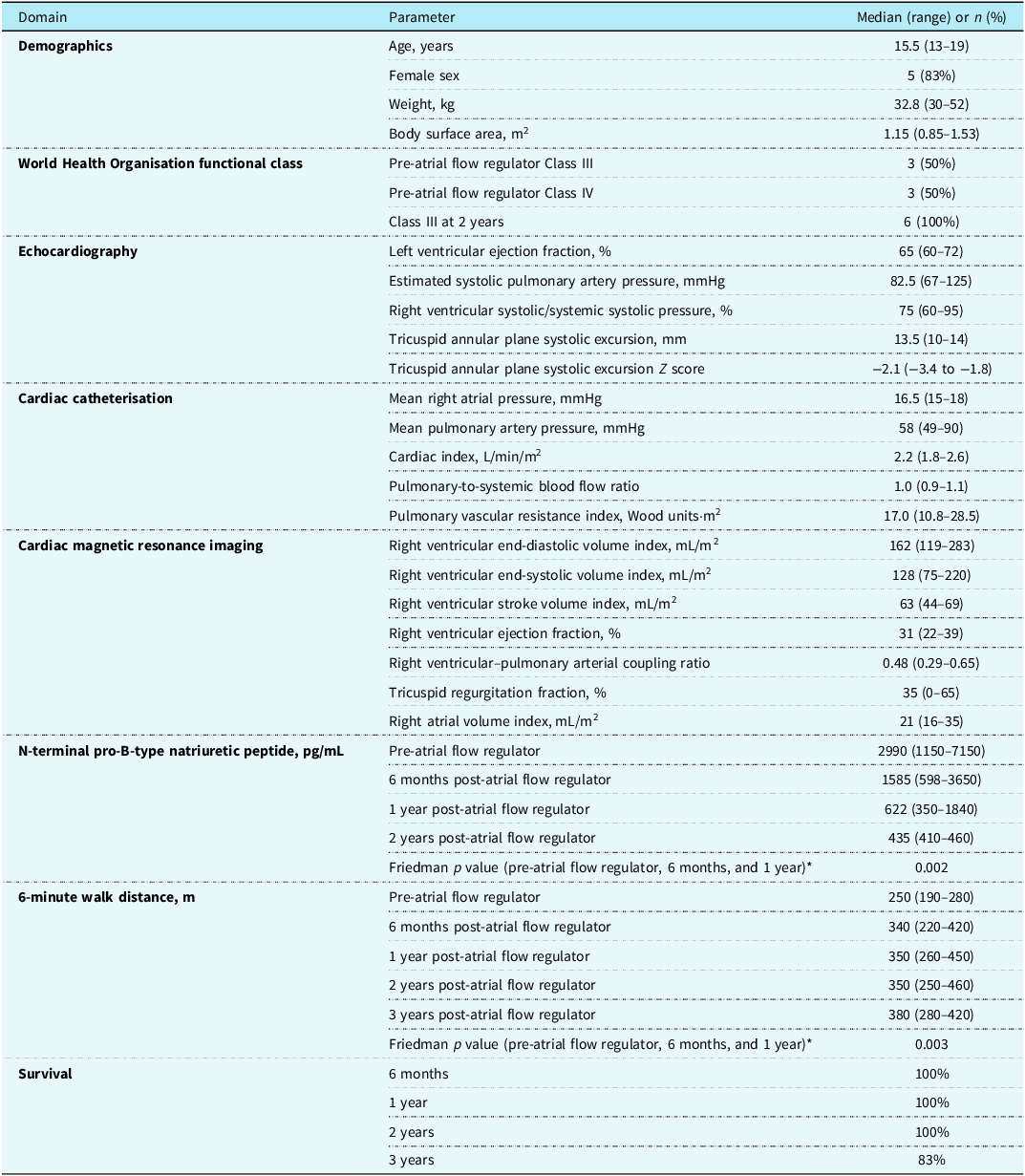
Patients demonstrated advanced pulmonary vascular disease at baseline (Table 1). Median indexed pulmonary vascular resistance was 17.0 Wood units·m2 (10.8–28.5), with reduced right ventricular ejection fraction of 31% (22–39), impaired right ventricular–pulmonary arterial coupling of 0.48 (0.29–0.65), and decreased tricuspid annular plane systolic excursion of 13.5 mm (10–14; z-score −2.1 [−3.4 to −1.8]).
Baseline characteristics, haemodynamics, imaging findings, and longitudinal clinical outcomes following atrial flow regulator implantation (n =6)

Table 1. Long description
The table presents data on six patients who underwent atrial flow regulator implantation. It includes demographics, World Health Organisation functional class, echocardiography results, cardiac catheterisation data, cardiac magnetic resonance imaging findings, N-terminal pro-B-type natriuretic peptide levels, 6-minute walk distance, and survival rates. The table has 12 rows and 3 columns, with column headers being Domain, Parameter, and Median (range) or n (%). Row-wise data includes: Demographics: Age, years: 15.5 (13-19); Female sex: 5 (83%); Weight, kg: 32.8 (30-52); Body surface area, m2: 1.15 (0.85-1.53). World Health Organisation functional class: Pre-atrial flow regulator Class III: 3 (50%); Pre-atrial flow regulator Class IV: 3 (50%); Class III at 2 years: 6 (100%). Echocardiography: Left ventricular ejection fraction, %: 65 (60-72); Estimated systolic pulmonary artery pressure, mmHg: 82.5 (67-125); Right ventricular systolic/systemic systolic pressure, %: 75 (60-95); Tricuspid annular plane systolic excursion, mm: 13.5 (10-14); Tricuspid annular plane systolic excursion Z score: -2.1 (-3.4 to -1.8). Cardiac catheterisation: Mean right atrial pressure, mmHg: 16.5 (15-18); Mean pulmonary artery pressure, mmHg: 58 (49-90); Cardiac index, L/min/m2: 2.2 (1.8-2.6); Pulmonary-to-systemic blood flow ratio: 1.0 (0.9-1.1); Pulmonary vascular resistance index, Wood unitsm2: 17.0 (10.8-28.5). Cardiac magnetic resonance imaging: Right ventricular end-diastolic volume index, mL/m2: 162 (119-283); Right ventricular end-systolic volume index, mL/m2: 128 (75-220); Right ventricular stroke volume index, mL/m2: 63 (44-69); Right ventricular ejection fraction, %: 31 (22-39); Right ventricular-pulmonary arterial coupling ratio: 0.48 (0.29-0.65); Tricuspid regurgitation fraction, %: 35 (0-65); Right atrial volume index, mL/m2: 21 (16-35). N-terminal pro-B-type natriuretic peptide, pg/mL: Pre-atrial flow regulator: 2990 (1150-7150); 6 months post-atrial flow regulator: 1585 (598-3650); 1 year post-atrial flow regulator: 622 (350-1840); 2 years post-atrial flow regulator: 435 (410-460); Friedman p value (pre-atrial flow regulator, 6 months, and 1 year): 0.002. 6-minute walk distance, m: Pre-atrial flow regulator: 250 (190-280); 6 months post-atrial flow regulator: 340 (220-420); 1 year post-atrial flow regulator: 350 (260-450); 2 years post-atrial flow regulator: 350 (250-460); 3 years post-atrial flow regulator: 380 (280-420); Friedman p value (pre-atrial flow regulator, 6 months, and 1 year): 0.003. Survival: 6 months: 100%; 1 year: 100%; 2 years: 100%; 3 years: 83%.
* Friedman test applied to repeated measures at baseline, 6 months, and 1 year after atrial flow regulator implantation. Later time points are presented descriptively because of incomplete follow-up.
AFR = atrial flow regulator; LV = left ventricle; NT-proBNP = N-terminal pro–B-type natriuretic peptide; PAP = pulmonary artery pressure; PVRi = pulmonary vascular resistance index; Qp:Qs = pulmonary-to-systemic blood flow ratio; RAP = right atrial pressure; RV = right ventricle; RVEDVi = right ventricular end-diastolic volume index; RVEF = right ventricular ejection fraction; RVESVi =right ventricular end-systolic volume index; RVSVi = right ventricular stroke volume index; RV–PA = right ventricular–pulmonary arterial; sPAP = systolic pulmonary artery pressure; TAPSE = tricuspid annular plane systolic excursion; TR = tricuspid regurgitation; WHO = World Health Organization; 6MWD = 6-minute walk distance.
The median N-terminal pro-B-type natriuretic peptide concentration was 2,990 pg/mL (1,150–7,150), and the median 6-minute walk distance was 250 m (190–280). During follow-up after atrial flow regulator implantation, N-terminal pro-B-type natriuretic peptide values were numerically lower and 6-minute walk distance values numerically higher than baseline. Friedman testing across repeated measures (baseline, 6 months, and 1 year) demonstrated statistically significant differences over time for N-terminal pro-B-type natriuretic peptide (p = 0.002) and 6-minute walk distance (p = 0.003). Given the very small sample size, these findings should be considered exploratory and hypothesis-generating.
Discussion
Management of paediatric pulmonary arterial hypertension is guided by risk stratification and treatment response, with high-risk patients typically receiving parenteral prostacyclin therapy in combination with oral agents such as phosphodiesterase-5 inhibitors and endothelin receptor antagonists. Reference Ivy, Rosenzweig and Abman3 However, access to continuous prostacyclin therapy remains challenging in many low-and middle-income countries.
In India, parenteral treprostinil is not locally manufactured and depends on costly imported formulations, with the active pharmaceutical ingredient alone priced at approximately $1,200 USD per gram. As a result, annual therapy costs may exceed the national per-capita income (∼$2,700 USD). In contrast, the total cost of atrial flow regulator implantation, including device procurement and right-heart catheterisation, typically ranges from $2,000 to $2,500 USD. Although formal cost-effectiveness analyses are lacking, this difference highlights the substantially lower upfront financial burden of atrial flow regulator therapy. Continuous prostacyclin treatment also carries risks such as catheter-related bloodstream infection, infusion interruption, pump malfunction, and systemic hypotension, complications that may be difficult to manage in settings without reliable emergency infrastructure. Consequently, children with advanced pulmonary arterial hypertension who fail oral combination therapy may face a therapeutic gap, prompting consideration of alternative device-based strategies.
Atrial shunting does not reduce pulmonary vascular resistance directly; rather, it improves systemic blood flow by decompressing the failing right ventricle and augmenting left ventricular preload. Interventional approaches aimed at right ventricular decompression, including balloon atrial septostomy and reverse Potts shunt creation, have been used as palliative or bridging therapies in advanced disease. Reference Hayes, Jennerich and Coleman9,Reference Grady, Canter and Wan10 Compared with balloon septostomy, the predefined orifice of the atrial flow regulator offers more stable shunt physiology and reduces the risk of spontaneous closure.
Optimal fenestration size and long-term antithrombotic management after atrial flow regulator implantation remain uncertain in paediatric pulmonary arterial hypertension. Larger fenestrations may be better tolerated in patients with preserved right ventricular–pulmonary arterial coupling, whereas patients with advanced disease may require more restrictive shunting. Similarly, the benefits of prolonged antiplatelet therapy must be balanced against the risk of haemoptysis.
Post-implantation follow-up requires serial echocardiographic assessment to confirm device position and shunt patency and to monitor atrial remodelling. Although reported complication rates are low, potential concerns include device malposition, shunt imbalance, arrhythmia, and thrombus formation. Careful device sizing is particularly important in children because of smaller left atrial dimensions and proximity to adjacent cardiac structures. Nevertheless, published experience suggests that atrial flow regulator implantation is feasible and safe when performed in experienced centres. Reference Butera, Piccinelli and Kolesnik4
Conclusion
In this small cohort of children with advanced pulmonary arterial hypertension, atrial flow regulator implantation was technically feasible and was associated with favourable trends in biomarker and functional measures during follow-up. In resource-constrained settings where advanced pharmacologic therapies and lung transplantation may not be readily available, atrial flow regulator implantation may represent a reasonable adjunctive strategy for carefully selected high-risk patients. Larger multicentre studies with longer follow-up are needed to better define patient selection, optimal timing of intervention, and long-term outcomes.
Acknowledgements
The authors sincerely thank Dr. Satheesh Siddaiah and Dr. Prakash Ramchandra (Faculties, Pediatric Cardiology, Narayana Institute of Cardiac Sciences, India) for their valuable insight and expertise in patient management.
Financial support
None.
Competing interests
The authors declare that they have no known competing financial interests or personal relationships that could have appeared to influence the work reported in this paper.
Ethical standard
The study was approved by the Institutional Review Board and conducted in accordance with the ethical principles of the Declaration of Helsinki.