The Communist Party of China (CPC) has shown an increasing tendency toward achieving the unification of Taiwan and Mainland China through military force. In 2016, Tsai Ing-wen of the Democratic Progressive Party won the presidential election in Taiwan, leading to a tougher stance on unification from the CPC (Feng et al., Reference Feng, Renwei, Bo, Ying and Jisi2017). This is largely due to the fact that President Tsai refuses to acknowledge both the ‘1992 Consensus’ and the ‘One China Policy.’ Nevertheless, the General Secretary of the CPC, Xi (Reference Xi2017), declared the 1992 Consensus to be the key to ensuring the peaceful development of relations across the Taiwan Strait. With progressive expansions of China's influence, an increasing number of people in Mainland China have suggested escalating the pace of the unification of Taiwan and Mainland China, with some even advocating the use of military force to achieve this end (Pan et al., Reference Pan, Wu and Chang2017). The American political scientist John Mearsheimer (Reference Mearsheimer2014) predicted that Taiwan would eventually be unified with China under the CPC.
Enhancing the CPC's confidence in promoting unification through exchanges can prevent it from coercing Taiwan into unification through military force. However, the 2014 ‘Sunflower Student Movement’ has led to the general belief that Taiwanese youths are largely anti-China (Liu and Li, Reference Liu and Li2017), which has undermined the CPC's confidence in peaceful reunification (Enav, Reference Enav2017). Following the Sunflower Movement, the CPC expanded and introduced innovations in its exchange programs targeting Taiwanese youths. In addition to programs that focus on travel and leisure, the CPC has implemented programs such as internships, training, and academic seminars (Wang, Reference Wang2015). Premier Li (Reference Li2017) declared in a government report that the Chinese government had prioritized the creation of more convenient opportunities for Taiwanese youths to study, work, start their own businesses, and live in Mainland China. In the report of the 19th National Congress of the Communist Party of China (19th CPC National Congress), Xi (Reference Xi2017) further suggested that the Chinese government should gradually extend the treatment provided to the citizens of Mainland China to the Taiwanese. These efforts by the CPC are intended to serve as an institutional preparation for the peaceful unification of Taiwan and China. If the aforementioned exchange programs enhance the pro-China political identity among Taiwanese youths and convince the CPC that a peaceful unification in the future remains the primary option, then the likelihood of the CPC using military force against Taiwan should decrease (Office of the Secretary of Defense, 2017). This does not necessarily mean that Taiwan and China will be unified by the CPC; rather, this gives Taiwan more time to strengthen its own influence and the opportunity to wait for further changes in China (Wang, Reference Wang2016).
There is a need to develop new indicators to assess the effectiveness of the promotion of cross-strait exchanges by the CPC. The most commonly adopted indicators used in assessing the effectiveness of the exchange programs include the recognition of Chinese identity and a positive attitude toward unification. However, the recognition of the Taiwanese identity has continued to rise among the residents of Taiwan (Li, Reference Li2014; Zhong, Reference Zhong2016), while the proportion of people who identify with a Chinese identity has remained below 5% throughout the last decade (The Election Study Center, 2018a). In addition, fewer than 2.3% have expressed an urge for reunification (The Election Study Center, 2018b). In 2013, during the author's attendance at a private forum held in a Taiwanese school, it was declared by officials from the Taiwan Affairs Office of the People's Republic of China (PRC) State Council that the cross-strait exchanges have been criticized in Mainland China for alienating Taiwanese people rather than enhancing cross-strait relations. However, the basis for such criticism has never been verified, nor has there been an attempt to explore the effectiveness of the exchange programs comprehensively. It is likely that such criticisms indicate single-dimensional judgments based on limited observations.
A One China identity scale can be used to assess the effectiveness of the CPC's exchange programs and efforts to promote unification. The China model has become the best demonstration of authoritarian values (Plattner, Reference Plattner2015). The violation of liberal democracy by China's sharp power has attracted global attention (Cardenal, Reference Cardenal, Walker and Ludwig2017). Hence, whether Taiwanese youths visiting Mainland China would alter their political identity has become a topic of interest for governments on both sides of the Taiwan Strait and for other democracies across the world. Although the ultimate goal of the CPC's policies toward Taiwan is to unify Taiwan and China, the contents of the policies are diverse, and the goal itself is to be achieved in stages. For that reason, the application of a single-indicator assessment is insufficient. This study attempted to construct a five-dimensional One China identity scale. The study also aimed to explore the effectiveness of the experience of visiting China on the development of the sense of a One China identity among Taiwanese students, as well as the factors that influence any changes in their sense of the One China identity.
1. Literature review and research hypotheses
1.1 Definition of the One China identity
The One China identity is a type of national identity (Billig, Reference Billig1995). National identity includes the dimensions of nationality, legality, territory, economy, and politics (Smith, Reference Smith1992). For example, while the components of American identity previously included ethnic, racial, cultural, and political dimensions, its core element now is a political principle that revolves around the concept of a belief in freedom and democracy (Huntington, Reference Huntington2004). If national factors are classified into people, land, and government, national identity can be divided into ethnic, cultural, and institutional identities. Ethnic identity emphasizes the recognition of ethnic origin. Cultural identity refers to the psychological association with a given history, culture, and tradition. Institutional identity focuses on citizens' sense of identity with a given political, social, and economic system (Jiang, Reference Jiang1997).
In most cases, individuals are able to live happily with multiple identities and switch from one to another as the environment demands it (Smith, Reference Smith1992). Since Taiwan and Mainland China share the same language and similar cultures, the experience of visiting Mainland China tends to change Taiwanese students' perceptions of having a One China identity (Rousseau and Garcia-Retamero, Reference Rousseau and Garcia-Retamero2007). This study summarizes the CPC's policies toward Taiwan and proposes defining the One China identity in five dimensions: national sentiment, policy preferences, acceptance of the negotiation precondition, Taiwan's global status, and attitude toward the legitimacy of China. National sentiment involves both ethnicity and culture and is related to ethnic identity and cultural identity. The remaining four dimensions are political and involve institutional identity. The applicability of the five dimensions, as well as their specific implications, is presented below.
National sentiment. The CPC regards Taiwanese people as members of the Chinese nation. They advocate that ‘China's complete reunification is in the fundamental interests of the Chinese nation’ (Taiwan Affairs Office, 2000). Xi (Reference Xi2014) has further proposed that ‘[p]eople on both sides of the Taiwan Straits are all of one family.’ Xi (Reference Xi2017) declared that ‘blood is thicker than water. People on both sides of the Taiwan Straits are brothers and sisters; we share the bond of kinship.’ Therefore, the significance of including national sentiment in the One China identity scale lies in its implication that the presumed Taiwanese compatriots are members of the extended family of the Chinese nation.
Policy preferences. The ‘One Country, Two Systems’ principle is the core proposition of the CPC's Taiwan policy, as well as one of the political options adopted by the academic community while investigating cross-strait relations (Gries and Su, Reference Gries and Su2013). Chinese scholars have claimed that the ‘One Country, Two Systems’ principle is the best solution (Li, Reference Li2009). Furthermore, Xi (Reference Xi2017) reemphasized the upholding of the principle of ‘peaceful reunification’ through maintaining the cross-strait ‘one country, two systems’ status quo. For that reason, the inclusion of policy preferences in the One China identity scale implies that ‘One Country, Two Systems’ is the best model for cross-strait reunification.
Preconditions for negotiation. Sovereignty is the most crucial topic in the reunification process (Bush, Reference Bush2005). For that reason, while Taiwan cannot participate in regional economic integration entirely, its participation in international organizations is limited (Wang et al., Reference Wang, Lee and Yu2011). In order to resolve these problems, Taiwan needs to negotiate with the CPC (Wenger and Chen, Reference Wenger and Chen2017). However, the precondition and foundation set by the CPC for political negotiation is the ‘only one China’ rule. Xi (Reference Xi2014) pointed out that the Mainland government is ‘willing to carry out equal negotiation with Taiwan under the One China framework.’ Xi (Reference Xi2017) also stated in his report at the 19th CPC National Congress the importance of ‘[r]ecogniz[ing] … that the two sides both belong to one China, and then our two sides can conduct dialog.’ Therefore, the acceptance of the negotiation precondition in the One China identity scale implies that the ‘One China’ principle is the foundation for political negotiations between Taiwan and Mainland China.
Taiwan's global status. The CPC's statement on Taiwan's global status continually establishes the premise that ‘there is only one China in the world’ prior to elaborating upon the relationship between Taiwan and Mainland China. In addition, their description of Taiwan's status has changed from ‘Taiwan is an inalienable part of China’ in 1993 to ‘Taiwan is a part of China’ in 2000 (Taiwan Affairs Office, 1993, 2000). Moreover, the Anti-Secession Law states that ‘[b]oth the mainland and Taiwan belong to one China. China's sovereignty and territorial integrity brook no division.’ Xi (Reference Xi2017) himself more recently stated that the Mainland government ‘will never allow anyone, any organization, or any political party, at any time or in any form, to separate any part of the Chinese territory from China!’ On that account, Taiwan's global status in the One China identity scale implies that there is only one China in the world and that Taiwan is an inalienable part of China.
The attitude toward the legitimacy of China. The CPC first defines Taiwan's status as being subordinate to that of Mainland China, and then asserts that ‘[t]he seat of China's central government is in Beijing’ and ‘the Central People's Government of the PRC [is] the only legal government of the whole of China’ (Taiwan Affairs Office, 1993, 2000). Furthermore, the CPC denies the existence of the Republic of China (Shaw, Reference Shaw2011). In 2017, Panama broke off diplomatic ties with Taiwan and established diplomatic relations with the PRC. The communiqué on the establishment of diplomatic relations between the PRC and Panama clearly states that the government of the PRC is the sole legitimate government representing China, and that Taiwan is an inalienable part of China's territory (Ministry of Foreign Affairs, 2017). For that reason, the attitude toward the legitimacy of China in the One China identity scale implies that the government of the PRC is the only legitimate government in the whole of China, including Taiwan.
To sum up, this study defines the One China identity as a sense of belonging to China, which includes the following beliefs: the Taiwanese people are members of the extended family of the Chinese nation; the ‘One Country, Two Systems’ principle is the best model for cross-strait reunification; reunification should be achieved through negotiation, which is founded upon the One China principle; there is only one China in the world, Taiwan is an inalienable part of China rather than a separate government representing China; and the government of the PRC is the only legitimate government representing the whole of China, including Taiwan.
1.2 Factors that affect the One China identity
The literature review presented above shows that the One China identity discussed in this study is a new concept. Thus far, no research has offered theoretical foundations to understand the One China identity. Therefore, with reference to past studies, the author intends first to establish a conceptual framework and then to apply the proposed framework to explain the changes in One China identity. Since the One China identity is a type of national identity, the author adopts theories on national identity as a starting point and then proceeds to deduce factors that may affect the sense of the One China identity.
Although primordialism, instrumentalism, and constructivism can all be used to explain the development of national identity, each viewpoint offers a different perspective (Thananithichot, Reference Thananithichot2011). Primordialism emphasizes that identity is rooted in blood and culture (Jubulis, Reference Jubulis2000; Smith, Reference Smith2010). Instrumentalism asserts that identity is based on an individual's rational choices (Akerlof and Kranton, Reference Akerlof and Kranton2000). Constructivism proposes that identity is established through human-based social constructions (Cerulo, Reference Cerulo1997). This study intends to explore the change in the sense of One China identity among Taiwanese students and assumes that these changes were triggered by their visits to Mainland China. The author assumes that visiting Mainland China is a type of cross-group contact that may change the students' impression of Mainland China, as well as their acceptance of the Chinese government. In addition, by comparing the development of Taiwan and Mainland China, students may change their institutional preferences. These changes, in relation to their impressions, sense of acceptance, and preferences, involve three theories: social contact theory, political socialization theory, and rational choice theory. The first and second theories can be viewed from the perspective of constructivism, whereas rational choice theory can be considered a form of instrumentalism. In the following section, these three theories are adopted as a foundation to test the research hypotheses.
1.2.1 Social contact and changes in students' impression of Mainland China
Cross-strait exchange programs provide opportunities for members from two different societies to connect with one another. Repetitive instances of social contact reduce personal bias and ethnic discrimination (Powers and Ellison, Reference Powers and Ellison1995; Pettigrew, Reference Pettigrew1998). Friendships that further minimize discrimination and hostility can be built through such social contact. Thus, individuals of different races are likely to manifest both lower levels of racial discrimination and also a higher acceptance of immigration (Hamberger and Hewstone, Reference Hamberger and Hewstone1997; Hayes and Dowds, Reference Hayes and Dowds2006). A majority of studies have found that with increased cross-group contact, prejudice is lowered significantly (Pettigrew and Tropp, Reference Pettigrew and Tropp2006). Pettigrew (Reference Pettigrew1998) found that factors that contribute to good contact outcomes include equal status, common goals, and cross-community cooperation among interactive groups; receiving official support; and nurturing potential friendships. Friends serve as the main point of contact between true acquaintances. Because of mutual trust and understanding, it is easier for true acquaintances to eliminate prejudice (Allport, Reference Allport1954). A study of Taiwanese people by Wu (Reference Wu2017) found that when compared to an increase in the exchange frequency, an increase in willingness to exchange and interact has a greater positive impact on trust and cooperation between people from Taiwan and Mainland China.
Taiwanese students participate in Taiwanese delegations to Mainland China on a voluntary basis. As such, they display the willingness to engage, exchange, and interact with people from Mainland China. They undertake three types of activities during their visit to Mainland China: sightseeing, subject talks, and social life. The ‘2016 Chinese Culture Summer Camp: Beijing Group’ is an illustrative example. The sightseeing destinations for the students in this group included the Museum of the War of Chinese People's Resistance Against Japanese Aggression, Prince Gong's Mansion, the Palace Museum, Tiananmen Square, Tiantan Park, the Summer Palace, the Badaling section of the Great Wall, the National Stadium, the Beijing Planning Exhibition Hall, and Peking University. The subject talks included talks on Peking Opera and Chinese culture. One particular talk, titled ‘Analysis of the Economic Situation and Taiwanese Students’ Employment in Mainland China,’ was delivered by Wang Xiaobing, the Deputy Secretary-General of the Association for Relations Across the Taiwan Strait. As a part of their experience of Chinese social life, they visited places like the Xidan Books Building, Skewed Tobacco Pouch Street, Shichahai, Southern Gong, Drum Lane, and Wangfujing Street.
The costs of the visit only include airfare and visa fees. Costs incurred throughout their stay in Mainland China, such as accommodation, transportation, and tour expenses, are all handled by the Chinese government. In addition, the personnel in charge of the reception continuously strive to make the Taiwanese students feel comfortable (Wang and Li, Reference Wang and Li2012). This exchange method is similar to facilitating contact among true acquaintances. It is expected that the exchange can modify the students' negative stereotypes of Mainland China. The Taiwanese students' impressions of Mainland China can be divided into three categories: impressions of Chinese citizens, impressions of Mainland Chinese leaders, and overall the impression of Mainland China (Wu et al., Reference Wu, Liao and Yang2016). Such negative stereotypes may also be altered on the basis of their actual contact with Mainland China and witnessing its economic development first hand. Therefore, regardless of whether the driver of change stems from true acquaintance-style contacts or personal experience, students' impression of Mainland China is likely to change, which may thereby change their sense of the One China identity. Bearing all this in mind, the author proposes the following for a first hypothesis (H1):
H1:
Changes in the impression of Mainland China are positively correlated with changes in the sense of a One China identity.
1.2.2 Political socialization and changes in students' acceptance of the CPC regime
Political socialization can take place at the individual and community levels. At the individual level, political socialization focuses on individuals' political learning in all stages of life and emphasizes the unique growth of each individual (Greenstein, Reference Greenstein and Sills1968). At the community level, political socialization focuses on political and cultural transmission from one generation to the next and emphasizes the importance of an awareness of a social system is instilled (Langton, Reference Langton1969). Individuals' political attitudes may also change throughout their lifespans (Mishler and Rose, Reference Mishler and Rose2007). However, the likelihood of change may not necessarily signify the occurrence of actual change (Jennings and Niemi, Reference Jennings and Niemi1981). Changes in individuals' political attitudes depend on the existence of unexpected information and event experiences (Tyler and Schuller, Reference Tyler and Schuller1991). The sources of such information and experiences are the agent for political socialization.
The four main agents of political socialization are family, school, public media, and peer groups (Chaffee et al., Reference Chaffee, Ward and Tipton1970). Political socialization through family, school, and the public media can be characterized as occurring at the community level, while political socialization through peer groups can be regarded as occurring at the individual level. Since family serves to satisfy the basic and innate needs of individuals, it is the core agent that shapes individuals' political personalities (Davies, Reference Davies1965). Through observation and interaction, children learn their parents' attitudes and viewpoints toward political affairs (Verba et al., Reference Verba, Schlozman, Burns and Zuckerma2005). Meanwhile, teachers in schools are responsible for passing on the general image and social values of the political system to their students (Patrick, Reference Patrick and Renshon1977) as well as for instilling the civic values of patriotism and respect for the state system in those students (Druckman, Reference Druckman1994). The media promotes citizens' political interest, learning, efficacy, and participation (Camaj, Reference Camaj2014; Chang, Reference Chang2017). By providing school education and exerting control over the media, the government is able to promote its regime legitimacy and discourage criticism (Yang and Tang, Reference Yang and Tang2010). Social networks tend to affect individuals' political attitudes and behaviors (Settle et al., Reference Settle, Bond and Levitt2011). In addition, greater homogeneity within peer groups is likely to strengthen members' existing experiences and values, whereas greater heterogeneity tends to encourage lower- and middle-class members to change their attitudes to cater to the opinions of the upper class (Langton, Reference Langton1967).
The acceptance of the CPC regime, shaped by four types of political socialization agents, can be used as an indicator for the impact of political socialization on changes in the sense of a One China identity. Regime acceptance can be defined as individuals' psychological attachment to the government; in addition to approving of the government's performance, individuals show a willingness to be governed (Wang, Reference Wang2018). Therefore, it can be inferred that the acceptance of the CPC regime is positively correlated to the sense of the One China identity. Faced with the CPC's refusal to renounce the application of military force against Taiwan and obstruction of Taiwan's participation in international organizations and activities, the acceptance by Taiwanese youth of the CPC regime, under the influence of the four political socialization agents, may be low. However, visiting Mainland China is, in essence, a political learning process that allows Taiwanese students to develop new social networks, receive new information, gain new experiences, and thereby alter their sense of acceptance of the CPC regime. Such an inference has been supported by empirical studies among Mainland Chinese students in Taiwan (Wang, Reference Wang2016). Research targeting Taiwanese people has also found that acceptance of the CPC regime among individuals who had visited Mainland China was significantly greater than that of individuals with no such experience (Wang, Reference Wang2018). In addition to the influence of social contact, such differences are also caused by political learning at the individual level of political socialization. Therefore, it can be inferred that Taiwanese students' acceptance of the CPC regime may change following their visit to Mainland China. It may also be inferred that such visits may alter their sense of a One China identity. Hence, the author proposed the second hypothesis.
H2:
Changes in the acceptance of the CPC regime are positively correlated with changes in One China identity.
1.2.3 Rational choice and changes in students' preferences for authoritarianism
Rational choice theory advocates that changes in identity are interest based and are individuals' choices made through careful consideration and rational thinking. The theory assumes that actors have preferences and are able to make their choices based on their prioritized preferences (Riker, Reference Riker1977). Actors' preferences are derived from the institutional and social structures with which they interact, as institutions define actors' choices as well as prompt their personal interests. Moreover, individuals' interests are dependent on their relationships with other individuals, that is, their position in the social structure (Dowding and King, Reference Dowding and King1995). Self-interest theory emphasizes the maximization of interests, which is the core concept of rational choice that affects individuals' political advocacy (Lau and Heldman, Reference Lau and Heldman2009). The theory claims a self-centered mentality and a materialized perspective, both of which determine personal behavior in the short-to-medium term (Sears et al., Reference Sears, Lau, Tyler and Allen1980).
It is natural for visitors to compare the governance achievements of the two governments after visiting both sides of the Taiwan Strait. The experience of Taiwanese students in Mainland China provides them with an opportunity to compare the societies of both Taiwan and Mainland China. As a result, the students may re-evaluate the values of the Chinese political model and thereby change their democratic beliefs and sense of a One China identity. Empirical studies have shown that a higher evaluation of foreign socio-economic conditions tends to lead to individuals' lower evaluation of and trust in their own government. The key to such a change lies in the changes of reference points (Huang, Reference Huang2015). Compared to that of Mainland China, the political system in Taiwan appears to be more democratic and free. According to the Democratic Index in 2017, Taiwan ranked 33rd in the world and was defined as a ‘flawed democracy,’ while Mainland China ranked 139th and was defined as ‘authoritarian’ (Economist Intelligence Unit, 2018). Nevertheless, the legitimacy of the CPC's rule is not based on democracy but, rather, on the maintenance of social stability and sustainable development of the economy (Yang, Reference Yang2016). China criticizes Western democracy as being characterized by endless factional conflict and policy changes that hinder economic and social progress, as well as ignoring the interests of the majority of the people (Li, Reference Li2017). The conflicts between the Pan-Blue and Pan-Green Coalitions in Taiwan and the slower economic growth compared to Mainland China, appear to corroborate the CPC's arguments.
China is the most prominent authoritarian country and has faced a decline in the popularity of democracy and a revival of popular support for authoritarianism (Plattner, Reference Plattner2015). The rise of the Chinese model demonstrates the appropriateness and effectiveness of authoritarianism for all countries, and represents political values oriented by the accumulation of wealth rather than political freedom. In addition, such values could be disseminated to other countries through cross-border economic and trade activities and interpersonal exchanges (Ambrosio, Reference Ambrosio2010). Xi (Reference Xi2017) summarized China's development experience through the Chinese people's ‘four confidences’: confidence in their chosen path, confidence in their political system, confidence in their guiding theories, and confidence in their culture. It is easy for Taiwanese students to observe the affluence of China. However, it is not easy for them to notice that political freedom is being suppressed by the CPC (Shambaugh, Reference Shambaugh2016; Yang, Reference Yang2017). Hence, they are likely to attribute the achieved wealth to the wisdom of the CPC leaders (Chen and Naughton, Reference Chen and Naughton2017), and, thus, may even shift their political beliefs to favorability toward authoritarian governance and their preferences toward powerful leaders, rather than toward a system of checks and balances.
Taiwanese students' evaluation of and trust in the Taiwanese government will be influenced and may be changed by the receipt of foreign media messages or their personal overseas experiences (Huang, Reference Huang2015; Li and Feng, Reference Li and Feng2018). If their evaluation of China's development improves after visiting Mainland China, it means that they acknowledge the China model, the probability of them seeking employment in Mainland China and even of accepting the CPC's regime would increase. Their sense of a One China identity may also increase because of the rationalization of their evaluations as well as their behaviors and their desire for a smooth career development trajectory in Mainland China. Hence, the author proposes the third hypothesis.
H3:
Changes in the preference for authoritarianism are positively correlated with changes in the sense of a One China identity.
In addition to the three independent variables (changes in the impression of Mainland China, regime acceptance, and preference for authoritarianism), this study also introduces gender, previous experience of visiting Mainland China, and the timing of delegations visiting as control variables. The purpose of introducing these three variables was to avoid any interference with the results.
2. Sources of data and measurement of variables
2.1 Sources of data
This study targeted Taiwanese youths who visited Mainland China in the winter and summer vacations of 2016 and 2017. Each participant was asked to answer the questionnaire twice: while traveling on the plane prior to landing in Mainland China (prior to landing), and then on the return flight prior to landing in Taiwan. A comparison was then made to investigate the changes in their ratings between the two surveys. A total of 271 panel samples from seven Taiwanese delegations to Mainland China were collected. The detailed information is as follows.
The first delegation was the ‘2016 Chinese Culture Winter Camp – Beijing Group’ that visited Beijing from 25 January to 1 February 2016. There were 27 students in the group. Of the 27 questionnaires distributed, all were recovered, and 26 valid responses were obtained. The second delegation was the ‘2016 Chinese Culture Summer Camp – Beijing Group’ that visited Beijing from 18 to 26 July 2016. The delegation included 32 students. Of the 30 questionnaires distributed, 27 were recovered (recovery rate 90%), and 22 valid responses were obtained. The third delegation was the ‘2016 Chinese Culture Summer Camp – Shanghai, Huzhou and Suzhou Group’ that visited Shanghai, Huzhou, and Suzhou from 25 August to 3 September 2016. All 45 students were given questionnaires, and 42 were recovered (recovery rate 93%) all of which were valid. The fourth delegation was the ‘2016 Chinese Culture Summer Camp – Weihai and Qingdao Group’ that visited Weihai and Qingdao (Shandong Province) from 30 August to 7 September 2016. It comprised 15 students. Of the 15 questionnaires distributed, all were recovered and considered valid. The fifth delegation was the ‘2017 Chinese Culture Winter Camp – Beijing Group’ that visited Beijing from 14 to 22 January 2017. All 43 students participated in the study, and 39 valid responses were collected. The sixth delegation was the ‘2017 Chinese Culture Winter Camp – Shanghai Group’ that visited Shanghai from 9 to 17 February 2017. All 58 students were invited to participate in the study, 56 of whom submitted their responses (recovery rate 97%), out of which 50 were valid. The seventh delegation was the ‘2017 Chinese Culture Summer Camp – Shanghai Group’ that visited Shanghai, Hangzhou, and Suzhou from 2 to 10 August 2017. A total of 82 questionnaires were distributed to all students in the delegation, of which 80 were recovered (recovery rate 98%), and 77 were valid.
Since the surveys on cross-strait issues tended to involve sensitive topics, the respondents may have withheld their true viewpoints or may have refused to participate. In order to make the respondents feel comfortable about answering the questions, the survey was anonymous, and the questionnaires were not coded. To conduct the panel study, the respondents' email addresses were used to identify the two questionnaires from the same respondent; however, some respondents provided different email addresses in each round. In order to identify these respondents, their birth year, gender, educational background, county, city, and province of residence were also utilized. Because of missing basic information, some questionnaires could not be paired successfully. Therefore, although 290 responses were recovered, only 271 could be used for the panel study.
Of the 271 participants, 28% were male and 72% were female. Approximately half (53%) of the students were visiting Mainland China for the first time, while the other half (47%) had visited Mainland China previously. Among the students investigated, 70% were college students, 23% were graduate students, and 7% were students who had recently graduated from high school, college, or graduate school. The majority (76%) of the participants were Hoklo Taiwanese, followed by Hakkas (12%), while participants originating from cities and provinces in Mainland China formed the smallest group (6%). Approximately 96% of the participants were born between 1991 and 1999 (18–26 years old at the time of the study). Further, the registered residences of the participants were spread over 20 cities and counties of northern Taiwan (37%, Keelung, Taipei, New Taipei, Taoyuan, Hsinchu, and Miaoli), central Taiwan (18%, Taichung, Changhua, Nantou, Yunlin, and Chiayi), southern Taiwan (42%, Tainan, Kaohsiung, and Pingtung), eastern Taiwan (2%, Ilan, Hualien, and Taitung), and surrounding islands (1%, Kinmen).
2.2 Measurement of variables
The dependent variable used in the study was the change in the sense of the One China identity, and the independent variables were the changes in the impression of Mainland China, regime acceptance, and preference for authoritarianism. The measurement of the four variables is described as follows.
2.2.1 Changes in One China identity
One China identity was measured from five dimensions. Participants were asked to express the extent of their agreement with the following five statements. National sentiment was measured by responses to the statement that ‘Taiwanese compatriots are members of the extended family of the Chinese nation.’ Policy preferences were measured by responses to the statement that ‘‘One Country, Two Systems’ is the best model for cross-strait reunification.’ Acceptance of the precondition for negotiation was measured by responses to the statement that ‘the ‘One China’ principle is the foundation for political negotiation between Taiwan and Mainland China.’ Sentiment toward Taiwan's global status was measured by responses to the statement that ‘there is only one China in the world and Taiwan is an inalienable part of China.’ Finally, the attitude toward the legitimacy of China was measured by responses to the statement that ‘the government of the PRC is the only legitimate government in the whole of China (including Taiwan).’ A 4-point Likert-type scale was used to rate the five statements (‘1’ = ‘totally disagree,’ ‘2’ = ‘disagree,’ ‘3’ = ‘agree,’ and ‘4’ = ‘totally agree’). Higher ratings indicate a greater sense of One China identity. Cronbach's α for the five items was 0.73 and 0.83 in the first and second rounds of the survey, respectively. Therefore, the reliability of the internal consistency of the scale is satisfactory.
Theoretically, it is believed that a higher sense of One China identity suggests an inclination toward unification, while a lower sense of One China identity suggests an inclination toward separation. Hence, participants' attitudes toward unification may be used to assess the criterion validity of the scale. The author assigned a 6-point Likert-type scale (1 = ‘to seek independence from China quickly’ and 6 = ‘to seek unification with China quickly’) to measure participants' attitude toward the unification of Taiwan and Mainland China. The correlation coefficients (r) between an attitude supporting unification and the sense of One China identity were 0.42 (P < 0.001, N = 266) and 0.48 (P < 0.001, N = 265), in first and second rounds of the survey, respectively, indicating that the scale has good criterion validity.
The mean value of the ratings of the five items was used to determine the perceived sense of One China identity. Subtracting the rating of the One China identity in the first round from that in the second round of surveys yielded the value that signified the change in the sense of One China identity (with a maximum possible change of −3 to 3). A positive value obtained from the subtraction indicates a positive change in the sense of the One China identity.
2.2.2 Changes in the impression of Mainland China
The scale used to measure participants' impressions of Mainland China included three items: ‘What is your impression of the people of Mainland China?’ ‘What is your impression of the national leaders of Mainland China?’ and ‘What is your overall impression of Mainland China?’ A 4-point Likert-type scale was used to rate the three items (1 = ‘very bad,’ 2 = ‘bad,’ 3 = ‘good,’ and 4 = ‘very good’). Cronbach's α for the three items was 0.67 and 0.69 in the first and second rounds of the survey, respectively. The mean value of the ratings of the three items was used as the rating for the impression of Mainland China. Subtracting the rating of the impression of Mainland China in the first round from that of the second round of surveys yielded the value that signified the change in the impression of Mainland China (a maximum possible range of −3 to 3). A positive value obtained from the subtraction indicates a positive change in the impression of Mainland China.
2.2.3 Changes in the acceptance of the CPC regime
The item used to measure participants' acceptance of the CPC regime was ‘On a scale from 0 to 10 (0 means “very much dislike” and 10 means “like very much”), what is the rating you would give to the government of Mainland China?’ Subtracting the rating of the regime acceptance in the first round of surveys from the second round of surveys yielded the value that signified the change in regime acceptance (a maximum possible range of −10 to 10). A positive value obtained from the subtraction indicates a positive change in the acceptance of the regime.
2.2.4 Changes in preference for authoritarianism
The item used to measure participants' preference for authoritarianism was ‘Strong and powerful leaders are more important than sound laws.’ A 4-point scale was adopted (1 = ‘totally disagree,’ 2 = ‘disagree,’ 3 = ‘agree,’ and 4 = ‘totally agree’). Subtracting the rating of the preference for authoritarianism in the first round of surveys from that in the second round of surveys yielded the value that signified the changes in the preference for authoritarianism (a maximum possible range of −3 to 3). A positive value obtained from the subtraction indicates a positive change in the preference for authoritarianism.
2.2.5 Control variables
A dummy variable was introduced to measure gender (‘male’ = 1 and ‘female’ = 0). Previous experiences visiting Mainland China were measured using the following item: ‘How many times have you been to Mainland China, with the exception of the present trip?’ A dummy variable was introduced to measure prior experience (‘with prior experience of visiting Mainland China’ = 1 and ‘without prior experience visiting Mainland China’ = 0). The timeline of the delegation's visit to Mainland China was calculated by subtracting the inauguration date of President Tsai Ing-wen (20 May 2016) from the days between the departure date of the latest trip. The result was then converted to the number of months by dividing it by 30. If the departure date of the trip was prior to the inauguration day, the value was negative; otherwise, the value was positive.
3. Data analysis and discussion
3.1 Changes in the sense of One China identity
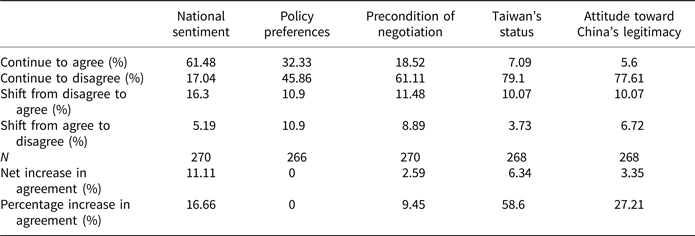
To illustrate changes in the Taiwanese students' sense of One China identity before and after the exchange, ‘totally agree’ and ‘agree’ were combined into ‘agree,’ and ‘totally disagree’ and ‘disagree’ were combined into ‘disagree.’ Four outcomes were then obtained through cross-comparison: ‘continue to agree,’ ‘continue to disagree,’ ‘shift from disagree to agree,’ and ‘shift from agree to disagree.’ Changes in the five dimensions are presented in Table 1.
Changes in the five dimensions of Taiwanese students' One China identity before and after exchange

Source: Compiled by the current study.
Table 1 shows that 21.49% of participants demonstrated change in attitude toward the statement related to national sentiments: 16.30% changed from ‘disagree’ to ‘agree,’ and 5.19% changed from ‘agree’ to ‘disagree.’ Hence, the net increase in agreement with the statement (i.e., in the percentage of participants who changed their attitude from ‘disagree’ to ‘agree’ minus those that changed from ‘agree’ to ‘disagree’) was 11.11%, and the number of participants who agreed with the statement increased by 16.66%. Approximately one-fifth (21.80%) of participants demonstrated change in attitude toward the statement related to the policy preference: 10.90% of the participants' attitude changed from ‘disagree’ to ‘agree,’ and 10.90% changed from ‘agree’ to ‘disagree.’ Hence, the net increase in agreement with the statement was 0%. Approximately one-fifth (20.37%) of the participant experienced a change in attitude toward the statement related to the precondition of negotiation: 11.48% of the participants' attitude changed from ‘disagree’ to ‘agree,’ while 8.89% changed from ‘agree’ to ‘disagree.’ Thus, the net increase in agreement with the statement was 2.59% and the number of participants who agreed with the statement increased by 9.45%. Participants with a changed attitude toward the statement related to Taiwan's status accounted for 13.80% of the total number of participants: 10.07% of the participants' attitude had changed from ‘disagree’ to ‘agree,’ while 3.73% changed from ‘agree’ to ‘disagree.’ The net increase in agreement with the statement was 6.34%, and the number of participants who agreed with the statement increased by 58.60%. Regarding the attitude toward the legitimacy of China, 16.79% of participants experienced a change in attitude: 10.07% of the participants' attitudes changed from ‘disagree’ to ‘agree,’ and 6.72% changed from ‘agree’ to ‘disagree.’ The net increase in agreement with the statement was 3.35%, and the number of participants that agreed with the statement increased by 27.21%.
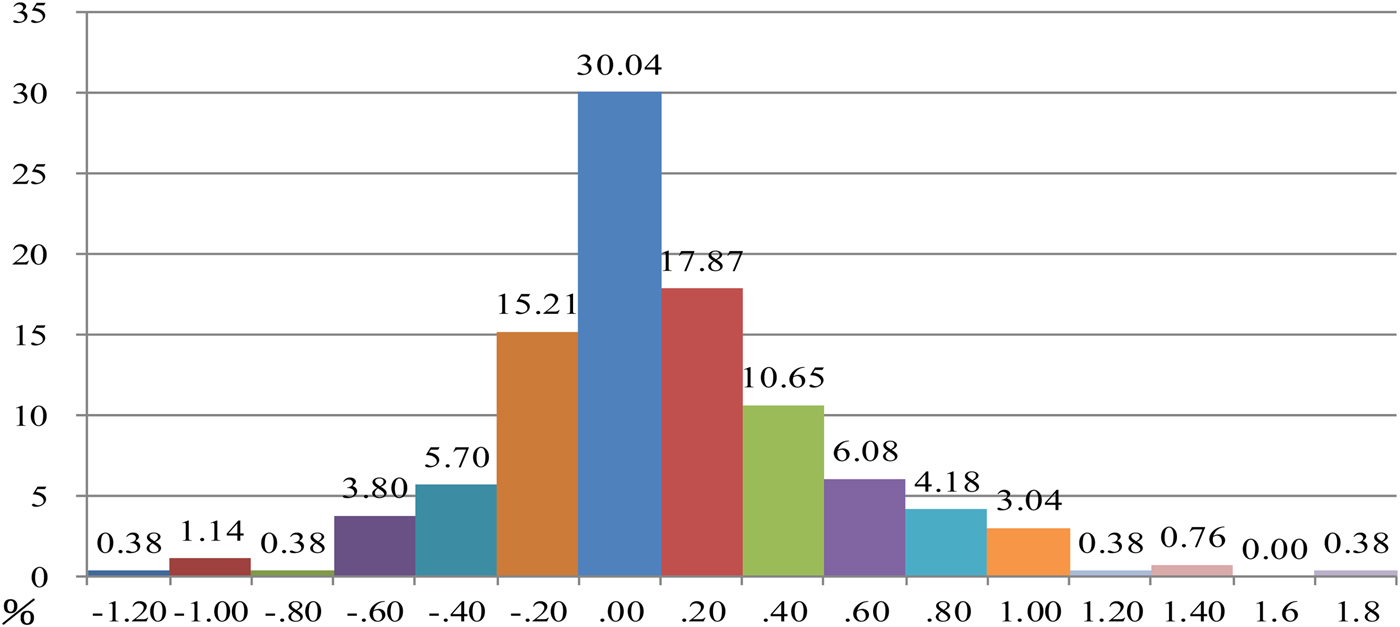
The mean values of the ratings of the five items were used to measure participants' sense of One China identity. The theoretical value of the ratings of One China identity ranged from 1 to 4 (1 = ‘very low sense of One China identity,’ 2 = ‘low sense of One China identity,’ 3 = ‘high sense of One China identity,’ and 4 = ‘very high sense of One China identity’). The mean value of participants' One China identity prior to and following the visit was 2.12 (standard deviation [S.D.] = 0.49) and 2.23 (S.D. = 0.55), respectively. A t-test showed that the increase (0.11, 5.19%) in the sense of One China identity after visiting Mainland China was statistically significant (P < 0.001). If we consider that 2.5 is the threshold between low, moderate, and high sense of One China identity, then although participants' sense of One China identity increased following their visit, their overall sense of One China identity remained low. The changes in participants' sense of One China identity (0.11, S.D. = 0.42) are presented in Figure 1. The theoretical values of the changes in participants' sense of One China identity should be between −3 and 3, whereas the actual values were between −1.2 and 1.8. As can be seen from Figure 1, 26.62% of the participants had a lower sense of One China identity following the visit (Mean = −0.36, S.D. = 0.23, Min = −1.20, Max = −0.20), 16.72% less than the participants that had a higher sense of One China identity (43.34%, mean = 0.46, S.D. = 0.32, Min = 0.20, Max = 1.80). The sense of One China identity of 30.04% of the participants remained unchanged.
Changes in the sense of One China identity among students who visited Mainland China. N = 263.

3.2 Regression analysis of the changes in the sense of One China identity
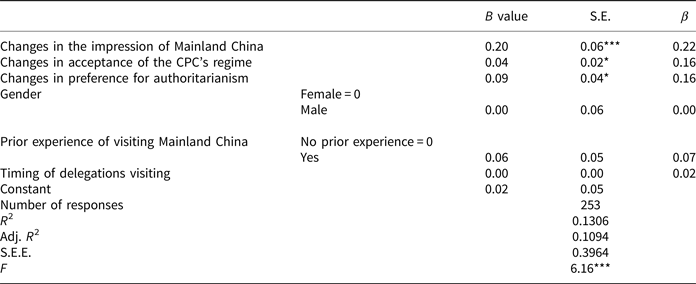
This section provides a descriptive analysis of three independent variables. The mean value of the changes in the impression of Mainland China was 0.11 (S.D. = 0.47, Min = −2.33, Max = 1.67), that of the changes in regime acceptance was 0.46 (S.D. = 1.71, Min = −6.00, Max = 6.00), and that of the changes in preference for authoritarianism was 0.06 (S.D. = 0.71, Min = −3.00, Max = 3.00). Since the independent variables were continuous, the author adopted the ordinary least squares (OLS) regression method to examine the influence of independent variables on the dependent variable (Table 2). The results showed that F = 6.16 (P < 0.001), suggesting that the model could be used to explain the dependent variable. The adjusted R 2 was 0.1094, indicating that the model could explain 10.94% of the total variances in the dependent variable.
OLS regression model of changes in the sense of One China identity among students who visited Mainland China

Source: Compiled by the current study.
*P < 0.05, ***P < 0.001.
Specifically, for every unit of increase in the participants' impression of Mainland China, their sense of One China identity increased by 0.22 (P < 0.001). Hence, H1 was supported. When the Taiwanese students arrived in Mainland China, they were received with a warm welcome. In addition to enjoying the goodwill of the people of Mainland China, trust and friendship were established during their stay. Moreover, their personal experiences and witnessing of the economic development of Mainland China were likely to alter their negative stereotypes and even thereby enhance their sense of One China identity. This result supported the influence of true acquaintance contacts on change in national identity.
According to Table 2, for every unit increase in the participants' acceptance of the CPC's regime, their sense of One China identity increased by 0.16 (P < 0.05). Hence, H2 was supported. By visiting Mainland China, Taiwanese students were likely to develop new networks, receive new information, and obtain new experiences that could shift the extent of their acceptance of the CPC regime and thereby enhance their sense of the One China identity. One such example was that, in Taiwan, the students were likely to resent the claim that the CPC was not going to surrender the right to use military force against Taiwan. They were also likely to resent the CPC's obstruction of Taiwan's participation in international organizations and activities. However, the information they received during their stay in Mainland China tended to focus on the study and employment opportunities that the PRC government provided to Taiwanese students. This result supported the influence of political learning on change in national identity.
Table 2 also showed that for every unit increase in participants' preference for authoritarianism, their sense of One China identity increased by 0.16 (P < 0.05). Thus, H3 was supported. The rise of the China model made China the most representative country in terms of the value of authoritarian power. During their visits to Mainland China, the Taiwanese students may have easily observed China's affluence, in turn acknowledging the CPC's authoritarian regime. The probability of their seeking employment in Mainland China and even their acceptance of the CPC regime were likely to increase. Their sense of a One China identity was also likely to increase because of the rationalization of their evaluation as well as their behaviors and their desire for smooth career development in Mainland China. This result supported the influence of the maximization of self-interests on change in national identity.
The above regression analysis results were obtained from all cluster tracking samples (N = 253). The change in the understanding of the One China identity can be classified as either a Positive Change (N = 107) or a Negative Change (N = 68). Accordingly, the dependent variables that were closely related to the independent variables differed. In the Positive Change group, the three independent variables all positively correlated with the dependent variables, but only the Changes in Acceptance of the CPC Regime reached statistical significance (β = 0.22, P = 0.03). In the Negative Change group, the three independent variables also all positively correlated with the dependent variables, but only the Changes in the Impression of Mainland China reached statistical significance (β = 0.23, P = 0.07). There were some similarities in the results of the two regression analyses above and those of Table 2, but there were also some differences. The main reason for these differences, apart from the differing sample numbers, may be the heterogeneity of dependent variables. This requires further study for confirmation.
4. Conclusions
Since 2016, the CPC has appeared to be more inclined to apply military force to unify Taiwan. This paper therefore argued that enhancing the CPC's confidence in promoting reunification through cross-strait exchanges is beneficial to peaceful cross-strait relations. However, the existing indicators to measure the effectiveness of the CPC's exchange programs tend to be oversimplified and one-dimensional. As a result, the effectiveness of the programs is likely to be misinterpreted. Thus, constructing a set of indicators to reflect the core of the CPC's policy toward Taiwan has both academic and practical value. On the basis of the CPC's political advocacy and actions toward Taiwan, this study constructed a five-dimensional One China identity scale. The constructed scale was then applied to the panel data of students from Taiwanese delegations to Mainland China in order to investigate the impact of the visit on their sense of One China identity and the corresponding influential factors. This study makes the following academic and practical contributions to the literature.
The first academic contribution is the construction of a One China identity scale with satisfactory reliability (α = 0.83) and validity (r = 0.48). The second academic contribution is the discovery of the factors that may significantly correlate with changes in one's understanding of the One China identity, which is a new concept that falls under the category of national identity. Therefore, based on the instrumentalist and constructivist theories of national identity and with reference to the theories of social contact, political socialization, and rational choice, the author proposed three factors that correlate with changes in one's sense of One China identity: changes in the impression of Mainland China, in regime acceptance, and in preference for authoritarianism. On the basis of the empirical results, all three hypotheses were supported. In summary, true acquaintance contact (social contact theory), political learning (political socialization theory), and maximization of self-interest (rational choice theory) have significant correlations with changes in one's sense of the One China identity. However, future research should explain whether the correlation between the three independent variables and the dependent variables mentioned above are related to short-term results or long-term effects.
The practical contribution of the study lies in serving as a reference for both governments across the Taiwan Strait to make optimal political choices. For the ‘doves’ inside the CPC, the findings of this study can confirm the effectiveness of the policy promoting unification through exchanges; it can also refute the argument that the exchange programs between Taiwan and Mainland China appear to have alienated the two sides rather than enhanced relations between them. It is suggested that the CPC should continue to expand its exchanges with Taiwan in the future rather than revert to the policy of unification through military force as advocated by the ‘war hawks.’
According to the findings in this study, instead of limiting cross-strait exchanges, Taiwanese leaders should strengthen the CPC's confidence by encouraging exchanges for four reasons. First, banning cross-strait exchanges is not feasible, as it would likely lead to public rejection in Taiwan. Second, 26.62% of the Taiwanese students who had visited Mainland China had a lower post-visit sense of One China identity (mean = −0.36, S.D. = 0.23). Hence, the United Front Work Department's idea of getting the students to visit Mainland China will not necessarily foster the development of a favorable perception of Mainland China among students who participate; instead, the students are likely to see through the ulterior motive of the CPC's political propaganda campaigns. To help Taiwanese students better identify the tricks of the CPC's United Front Work Department, the Taiwanese government can improve the students' understanding of the real situation in Mainland China through education. Third, after returning to Taiwan, the preferences and choices of the students may change again because of political socialization and new information, and therefore their increased sense of One China identity can decrease. Nevertheless, this does not mean that their sense of a One China identity will necessarily change after their return. The actual changes are yet to be discussed in subsequent studies. Fourth, cross-strait exchanges are conducive to the maintenance of peaceful relations and can help the Taiwanese government buy more time to develop Taiwan further, and also represent an opportunity to wait for further changes in China.
Due to this study included only a sample of 271 students and the data were not obtained through a random sampling method, the findings of the study cannot be used to explain changes in the sense of the One China identity of all Taiwanese students from all exchange programs. However, since the population of students enrolled in exchange programs each year cannot be easily defined, it would be impossible to conduct random sampling. Given that the data used in this study were obtained over a period of 20 months and that this study included students from seven exchange groups, applied an anonymous self-reported survey, covered participants from 20 counties and cities, and adopted a panel study method, the results can be considered reasonably reliable. Unless better sampling can be conducted in the future, the reference value of this study cannot be ignored. In addition to continuing to explore the reasons for the changes in the sense of One China identity, future research should pay more attention to the changes in the subjects' impressions of Mainland China, regime acceptance, and preference for authoritarianism.
Financial support
This study is supported by Taiwan's Ministry of Science and Technology (MOST 105-2410-H-214-002-MY2).
Chia-Chou Wang is Professor at the Department of Public Policy and Management, I-Shou University. His recent publications are in China: An International Journal, Journal of Contemporary China, Democratization, Asian Survey, Japanese Journal of Political Science, and Paci fic Focus.