Introduction
Hulled wheats are the wild or cultivated species of the Triticum genus, which have glumes that tightly enclose the grains, even after normal threshing. In Spain, three species of hulled wheats were widely cultivated until the late 1960 s: Triticum monococcum L. ssp. monococcum (2n = 2x = 14, AA), T. turgidum ssp. dicoccum Schrank em. Thell. (2n = 4x = 28, AABB) and T. aestivum ssp. spelta L. em. Thell. (2n = 6x = 42, AABBDD). Nowadays, only emmer and spelt wheat are still cultivated, and solely in marginal farming areas of Asturias (North of Spain). Fortunately, some of the biodiversity that once existed is conserved in germplasm banks. Due to the growing interest in natural food, some of these ancient crops are undergoing a revival in European agriculture. In the last decade, our research group has investigated three important collections of Spanish hulled wheats, mainly for genetic variation in seed storage proteins (Caballero et al., Reference Caballero, Martín and Alvarez2001, Reference Caballero, Martín and Alvarez2004a, Reference Caballero, Martín and Alvarezb; Pflüger et al., Reference Pflüger, Martín and Alvarez2001; Alvarez et al., Reference Alvarez, Moral and Martín2006). The high variability detected in these species suggests that these collections are useful gene reservoirs that can be used in breeding programmes.
The starch composition of wheat grain has a primary influence on flour quality. Wheat starch consists of two types of glucose polymers, the essentially linear amylose and the highly branched amylopectin, in a ratio of 22–35:68–75%. Synthesis of amylose in the seed endosperm is carried out by the waxy proteins or granule-bound starch synthases that are encoded by genes located in the Wx locus on the homoeologous group 7 chromosomes (Ainsworth et al., Reference Ainsworth, Clark and Balsdon1993). In common wheat, the Wx-A1 locus is located on chromosome 7AS, the Wx-B1 locus on 4AL (a segment of chromosome 7BS that has been translocated) and the Wx-D1 locus on chromosome 7DS. Since starch properties such as gelatinization, pasting and gelation depend on the amylose:amylopectin ratio (Zeng et al., Reference Zeng, Morris and Batey Wrigley1997), these proteins are very important in terms of flour quality.
The aim of this study was to assess waxy protein polymorphism in a broad collection of Spanish hulled wheats.
Material and methods
Plant material
In the current study, 536 Spanish hulled wheat lines (29 lines of einkorn, 87 lines of emmer and 420 lines of spelt) were analyzed. These lines were derived by single seed selection from an equal number of accessions obtained from the National Small Grain Collection (Aberdeen, MD, USA), the Center for Genetic Resources (The Netherlands) and the Centro de Recursos Fitogenéticos-INIA (Alcalá de Henares, Spain). The plants were grown under field conditions during 2008, and several spikes per plant were protected to prevent random crossings. Durum wheat cultivars (cvs). Langdon and Mexicali and common wheat cultivar (cv). Chinese Spring were used as standards.
Starch extraction and electrophoretic analysis
Twenty milligrams of flour were mixed with 1 ml of distilled water and incubated at 4°C for 24 h. The homogenate was filtered through Miracloth and centrifuged at 14,000 g for 1.5 min. The pellet was washed with 1 ml of buffer A (55 mM Tris–HCl, pH 6.8, 2.3% (w/v) SDS, 2% (w/v) dithiothreitol (DTT) and 10% (v/v) glycerol), according to the method of Echt and Schwartz (Reference Echt and Schwartz1981). Then, 1 ml of buffer A was added to the pellet and left for 30 min at room temperature. The pellet was washed three times with distilled water, once with acetone and then air-dried. The residue was mixed with 80 μl of buffer A, heated in a boiling water bath for 2 min, cooled on ice and centrifuged.
Aliquots of supernatant (20 μl) were loaded in vertical SDS-PAGE slabs in a discontinuous Tris–HCl–SDS buffer system (pH: 6.8/8.8) at a polyacrylamide concentration of 12% (w/v, cross-linker (C): 0.44%). The Tris–HCl/glycine buffer system of Laemmli (Reference Laemmli1970) was used. Electrophoresis was performed at a constant current of 30 mA/gel at 18°C, continuing for 4 h after the tracking dye migrated off the gel. Protein bands were visualized by silver staining.
For two-dimensional PAGE (2D-PAGE), 8.0 mg of starch was soaked at room temperature in 300 μl of lysis buffer (8 M urea, 2% ampholine pH 3.5–10 (Pharmacia) and 5% DTT). After centrifugation, the supernatant containing the solubilized proteins was subjected to 2D-PAGE using isoelectric focusing (IEF) for the first dimension and SDS-PAGE for the second. IEF gels contained 2.5% (v/v) ampholines (pH 3–10/5–8 and 8–10, 1:1). Focusing commenced from the acidic end (0.01 M H3PO4) at 200 V for 30 min, and continued at 400 V for 17 h, and then at 800 V for 1 h at room temperature. After IEF, SDS-PAGE was conducted as described above.
Results and discussion
The studies carried out on waxy proteins polymorphism have shown that variability is relatively low compared with other cereal grain proteins, such as seed storage proteins. However, Yamamori et al. (Reference Yamamori, Nakamura, Endo and Nagamine1994, Reference Zeng, Morris and Batey Wrigley1995) found five alleles for the Wx-A1 gene in common wheat, and another six alleles have been described for the Wx-B1 gene in common and durum wheats (Rodríguez-Quijano et al., Reference Rodríguez-Quijano, Nieto-Taladriz and Carrillo1998). More recently, Caballero et al. (Reference Caballero, Bancel, Debiton and Branlard2008) reported high variability for these proteins in some ancient wheats and related species.
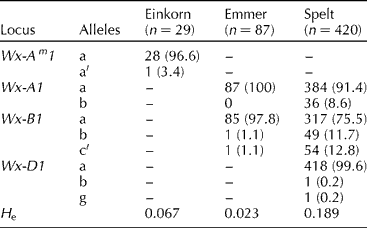
Ten waxy alleles (two for Wx-A m1 locus, two for Wx-A1, three for Wx-B1 and three for Wx-D1) were detected in the lines herein evaluated (Table 1). In all cases, one of these alleles was clearly predominant, while the others were rare or very rare. For the Wx-A m1 locus, the allele Wx-A m1a′ that exhibited lower mobility than the Wx-A m1a was only found in a single accession (BGE-014269). Both alleles showed higher mobility than that of the Wx-A1a allele detected in polyploid wheat (emmer and spelt). This is in agreement with studies that suggest that the A genome of einkorn is substantially different from the A genome present in emmer and spelt (Dvorak et al., Reference Dvorak, Terlizzi, Zhang and Resta1993).
Variability and allelic frequencies (in brackets) detected for waxy genes in the three collections evaluated

Emmer did not show polymorphism for the Wx-A1 locus, whereas in spelt 36, accessions that presented the Wx-A1b allele (null type) were detected. The Wx-A1a alleles detected in both species were similar to the allele detected in the durum and common wheat cultivars used as standards (Langdon and Mexicali, and Chinese Spring, respectively).
The variability for the Wx-B1 locus was higher in both polyploid species. However, most of the emmer accessions present the Wx-B1a allele, similar to the alleles found in cvs. Langdon and Chinese Spring. The other two alleles were very rare. Because SDS-PAGE can occasionally generate overlapping bands that yield misleading results, the accessions that presented the null allele were analyzed by two-dimensional electrophoresis (IEF × SDS-PAGE). The data revealed that the Wx-B1 gene is not expressed in this accession (Fig. 1).
Electrophoresis separation of waxy proteins in tetraploid wheats. One-dimensional SDS-PAGE (up) and two-dimensional IEF × SDS-PAGE (down). Lanes are as follows: 1, KU 4213D (Wx-A1a and Wx-B1d); 2 and 4, Emmer-71 (Wx-A1a and Wx-B1a); 3 and 7, cv. Langdon (Wx-A1a and Wx-B1a); 5, cv. Mexicali (Wx-A1a and Wx-B1c′); 6, Emmer-49 (Wx-A1a and Wx-B1c′); 8, Emmer-52 (Wx-A1a and Wx-B1b).

The results were very similar for the Wx-D1 locus, with all accessions showing the Wx-D1a allele with exception of one accession that presented the Wx-D1b allele and another a novel allele named Wx-D1 g, which exhibited a slightly lower electrophoretic mobility than the Wx-D1a allele.
The mean expected heterocigosity (H e) values were very low for all species (Table 1), representing approximately 13.4, 5.5 and 48.6% of the genetic diversity for einkorn, emmer and spelt, respectively, if the allelic variants of each locus were distributed randomly.
In conclusion, the current study has shown that Spanish hulled wheats exhibit significant waxy protein variation, with some novel alleles at risk of erosion by genetic drift. Consequently, the safeguarding of these and other hulled wheat accessions stored in germplasm banks is fundamental for the maintenance of genetic diversity. This diversity may be of use in breeding programmes focussed on starch quality, for both modern wheats and these ancient crops that are undergoing such a revival.
Acknowledgements
This research was supported by grant AGL2007-65685-C02-02 from the Spanish Ministry of Science and Innovation and the European Regional Development Fund (FEDER) from the European Union. The first author thanks to the Spanish Ministry of Education and Science (FPU programme) for a predoctoral fellowship.