Introduction
The Voltziales encompasses a diverse array of extinct conifers that are believed to be transitional between the Palaeozoic conifers and the modern Coniferales (e.g. Florin Reference Florin1938–45, Rothwell et al. Reference Rothwell, Mapes and Hernandez-Castillo2005, Taylor et al. Reference Taylor, Taylor and Krings2009). The majority of voltzialean taxa have been described from the upper Palaeozoic (e.g. Rothwell et al. Reference Rothwell, Mapes and Hernandez-Castillo2005). There are, however, fossils of this ancient conifer group that occur in deposits as young as the Early Jurassic (Taylor et al. Reference Taylor, Taylor and Krings2009), or possibly even Early Cretaceous (Miller Reference Miller1977).
Several Northern Hemisphere representatives of Mesozoic voltzialean conifers have been intensely studied and are known in remarkable detail (e.g. Grauvogel-Stamm Reference Grauvogel-Stamm1978). By contrast, knowledge about the Gondwanan Voltziales has remained very incomplete. This is remarkable, because voltzialean conifer leaves have been described from the Gondwanan Triassic since the first half of the 19th century (e.g. Morris Reference Morris1845, Feistmantel Reference Feistmantel1889). These leaves have initially been assigned to a variety of morphogenera, including Zeugophyllites Brongniart, Podozamites Braun, Phoenicopsis Heer, Desmiophyllum Lesquereux, and Noeggerathiopsis Feistmantel, but the vast majority were later merged into a single species Heidiphyllum elongatum (Morris) Retallack (Retallack Reference Retallack1981). Heidiphyllum is currently recognized as the most widespread conifer leaf in the Triassic of the Southern Hemisphere. It is frequently found together with the supposedly affiliated seed cone Telemachus Escapa, Decombeix, Taylor & Taylor (Anderson Reference Anderson1978, Retallack Reference Retallack1981, Yao et al. Reference Yao, Taylor and Taylor1993, Axsmith et al. Reference Axsmith, Taylor and Taylor1998, Nielsen Reference Nielsen2005, Escapa et al. Reference Escapa, Decombeix, Taylor and Taylor2010). Further evidence for Triassic transitional conifers from the Southern Hemisphere has come from permineralized deposits of the central Transantarctic Mountains, which have yielded various anatomically preserved conifer organs, including stems and leaves of Notophytum krauselii Meyer-Berthaud & Taylor (Meyer-Berthaud & Taylor Reference Meyer-Berthaud and Taylor1991, Axsmith et al. Reference Axsmith, Taylor and Taylor1998), seed cones of Parasciadopitys aequata Yao, Taylor & Taylor (Yao et al. Reference Yao, Taylor and Taylor1997), and the pollen cone Leastrobus fallae Hermsen, Taylor & Taylor (Hermsen et al. Reference Hermsen, Taylor and Taylor2007). The affinities and interrelationships of these fossils continue to remain largely obscure. At least some of these morphotaxa, however, are regarded as being the permineralized equivalents of the compression taxa Heidiphyllum and Telemachus (e.g. Axsmith et al. Reference Axsmith, Taylor and Taylor1998, Escapa et al. Reference Escapa, Decombeix, Taylor and Taylor2010, Schwendemann et al. Reference Schwendemann, Taylor, Taylor and Krings2010).
Even though voltzialean foliage and seed cones are common elements in Gondwanan Triassic floras and have (in part) been known for more than 150 years, information on the corresponding pollen cones has remained very limited. This may be due to the small size and ephemeral nature of these pollen cones (Rothwell & Mapes Reference Rothwell and Mapes2001, Hermsen et al. Reference Hermsen, Taylor and Taylor2007). In this contribution we present the first record of voltzialean pollen cone compressions from the Triassic of Antarctica. The specimens are assigned to Switzianthus Anderson & Anderson, a morphogenus that was previously thought to belong to an enigmatic group of pteridosperms from the Molteno Formation of South Africa (Anderson & Anderson Reference Anderson and Anderson2003). By contrast, the similarities in cuticle and pollen morphology, together with the co-occurrence at all known localities, lead us to the conclusion that Switzianthus probably represents the pollen cone of the ubiquitous Heidiphyllum/Telemachus plant.
Material and methods
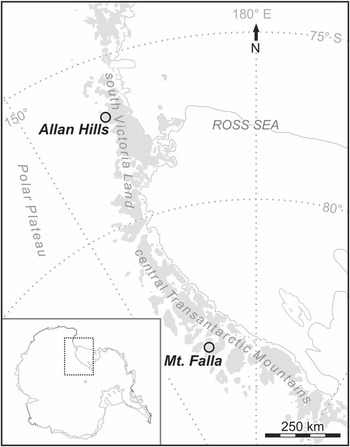
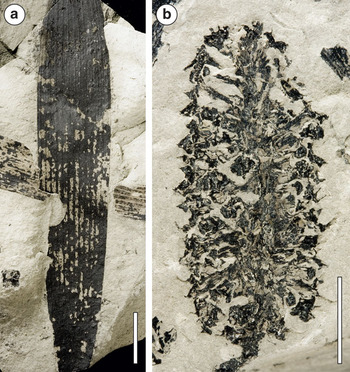
Most specimens were collected from the type section of the Falla Formation on the northern flank of the western ridge of Mount Falla (Queen Alexandra Range, central Transantarctic Mountains; 84°22′S, 164°55′E) (Fig. 1). Plant fossils occur within a 16 m thick mudstone interval (Level 14, Profile 2 in Barrett Reference Barrett1969) with intercalated coaly layers and thin sheets of light-grey, very fine-grained sandstone. The Falla Formation is interpreted as deposits of a low-sinuosity braided-stream system with a high proportion of lacustrine and paludal overbank fines (e.g. Barrett et al. Reference Barrett, Elliot and Lindsay1986). A single additional specimen comes from Member C of the Lashly Formation in the Allan Hills, south Victoria Land (Fig. 1). At both sites, the specimens co-occur with abundant Heidiphyllum leaves (Fig. 2a) and Telemachus seed cones (Fig. 2b). The age of the plant-bearing horizons is considered to be Carnian or Norian (early or middle Late Triassic) based on microfloras (Kyle & Schopf Reference Kyle and Schopf1982, Farabee et al. Reference Farabee, Taylor and Taylor1989).
Locality map showing the fossil sites in south Victoria Land and the central Transantarctic Mountains, East Antarctica. Light grey tones indicate areas of rock outcrop.

Voltzialean foliage and seed cone from the Upper Triassic of the Allan Hills, south Victoria Land, East Antarctica. Scale bars = 1 cm. a.Heidiphyllum elongatum (Morris) Retallack. T11-582a. b.Telemachus antarcticus Escapa, Decombeix, Taylor & Taylor. T11-411.

Hand specimens were photographed with a Nikon D100 digital camera. Macroimages were taken with a Leica DC500 digital camera mounted on a Leica MZ16 stereo dissecting microscope. Cuticle and in situ pollen samples were freed from the matrix using 48% hydrofluoric acid (HF) for several days, and then carefully neutralized by repeated washing with distilled water. Organic residues were further macerated using Schulze's reagent (40% nitric acid (HNO3) with a few crystals of potassium chlorate (KClO3)) for several hours, and subsequently cleaned and bleached using a 4% potassium hydroxide solution (KOHaq) for a few seconds. Cuticle and pollen were finally dehydrated in glycerol and mounted on permanent slides using glycerol jelly.
Hand specimens and slides are stored in the Paleobotanical Collections of the Department of Ecology and Evolutionary Biology, and Natural History Museum and Biodiversity Institute, University of Kansas, Lawrence (KS), USA.
Systematics
Phylum CONIFEROPHYTA
Class CONIFEROPSIDA
Order VOLTZIALES
Family incertae sedis
Genus Switzianthus Anderson & Anderson
Type species. Switzianthus moriformis Anderson & Anderson, Reference Anderson and Anderson2003
Switzianthus sp.
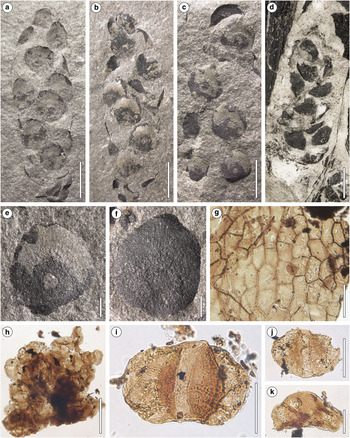
(Fig. 3a–k)
Gross morphology, cuticle features, and in situ pollen of the voltzialean pollen cone Switzianthus sp. from the Upper Triassic of the Transantarctic Mountains. a. Intact pollen cone. Note that the spiny aspect of some sporophyll apices along the cone margin is due to individual superpositioned sporophylls being cross-sectioned. Mount Falla, T7-185a. Scale bar = 5 mm. b. Counterpart of the same specimen. T7-185b. Scale bar = 5 mm. c. Partially disintegrated pollen cone. Mount Falla, T7-172b. Scale bar = 5 mm. d. Comparatively intact pollen cone. Allan Hills, T8-229b. Scale bar = 5 mm. e & f. Details of individual ovate distal microsporophyll laminae with a slightly displaced central pedicel scar, a surrounding rugose area, and a distal portion with fine radiating striations. Scale bar = 1 mm. g. Cuticle of the presumably outer (i.e. abaxial) surface of the distal microsporophyll lamina from a partially disintegrated pollen cone from Mount Falla (T5-111), showing the outlines of more or less longitudinally aligned, elongated rectangular to polygonal cells. Slide 24033. Scale bar = 50 μm. h. Large cluster of Alisporites Daugherty type pollen grains isolated from a partially disintegrated cone from Mount Falla (T5-111). Slide 24034. Scale bar = 100 μm. i–k. Individual pollen grains in polar (i & j) and lateral (k) view. Slides 24033 (j & k) and 24037 (i). Scale bars = 25 μm.

Material: Eight specimens from Mount Falla on the following seven slabs: T5-69, 79, 86, 111, T7-161, 172, 185 (Upper Triassic, Falla Formation, Mount Falla, Queen Alexandra Range; 84°22′S, 164°55′E); one additional specimen T8-229 from the Allan Hills (Upper Triassic, Member C, Lashly Formation, Allan Hills, south Victoria Land). Cuticle and pollen preparations of specimen T5-111 on slides 24026–24038.
Description: Cylindrical pollen cones, 2.7–c. 4 cm long and 0.8–1.5 cm in diameter, more or less compact, composed of helically arranged microsporophylls with each helix comprising c. 6–10 scales (Fig. 3a–d). Scales robust, peltate, each with a delicate pedicel and an ovate distal portion with an obtuse to acuminate apex (Fig. 3a–c, e & f); distal microsporophyll portions c. 4–6 mm long and 3–5 mm wide; adaxial surface with a circular pedicel scar of c. 1 mm diameter positioned slightly below the centre, a surrounding thickened area with a granulose surface, and a thin, woody distal portion with radiating striations (Fig. 3e & f). Cuticle fragments thin, showing a pattern of more or less longitudinally aligned, elongated rectangular to polygonal cells 30–40 μm long and 20–30 μm wide (Fig. 3g).
Pollen grains bisaccate, measuring between 60 x 38 μm and 100 x 60 μm (Fig. 3h–k). Sacci narrow-elliptical in polar view (Fig. 3h–j), proximally attached in equatorial region, distally inclined (Fig. 3k). Corpus outline circular to narrow-elliptic in polar view, approximately half as wide as the entire grain; cappa generally thickened, with smooth or finely reticulated to rugose surface; distal surface with a sharply defined, narrow-rectangular longitudinal sulcus of c. 10–12 μm width (Fig. 3i & j).
Remarks: The material agrees in all comparable features with the pollen cone genus Switzianthus from the Upper Triassic Molteno Formation of South Africa, including: 1) organization of a more or less compact cone, 2) the size range (2.8–4.5 cm long), 3) number of scales per helix, 4) dimension, morphology and texture of the sporophylls, and 5) the in situ pollen grains. Compared to the South African specimens, the cuticle fragments probably derive from the distal microsporophyll portion (see Anderson & Anderson Reference Anderson and Anderson2003 pl. 56, fig. 1).
Two species have been described in the South African material, i.e. S. moriformis Anderson & Anderson and S. crispiformis Anderson & Anderson. The present material more closely resembles S. crispiformis due to its relatively small size and well-defined pedicel scar. However, as both species lack well-defined diagnostic criteria and remain poorly understood, we refrain from attempting a species determination until additional and better preserved material becomes available.
Essential details on pollen-sac morphology and attachment in Switzianthus remain uncertain. Following Anderson & Anderson (Reference Anderson and Anderson2003), we suggest that the pitted area around the pedicel scar on the adaxial microsporophyll surface may be the area of former pollen-sac attachment. In none of the specimens so far described, however, are the actual pollen sacs preserved. This may indicate that the pollen-sac material was very delicate and already withered away when the cones became buried.
In situ palynological samples were taken by carefully removing organic material from the microsporophylls of a disintegrated cone. The recovered palynomorphs consist exclusively of microsporophyll cuticle fragments and the above described bisaccate pollen grains, many of the latter occurring in distinct clusters (Fig. 3h).
Discussion
Switzianthus has previously been affiliated with the enigmatic and poorly defined pteridosperm leaf Dejerseya Herbst, based on what have been described as similar cuticle features and co-occurrence at some localities. By contrast, we interpret Switzianthus as a voltzialean pollen cone that probably belongs to the Antarctic Heidiphyllum/Telemachus conifer. This determination is based on: 1) structural correspondence to other voltzialean pollen cones, 2) similarities in cuticle and pollen morphology, and 3) co-occurrence at all known localities.
Structural correspondence
The morphology of Switzianthus is unlike that of any known pteridosperm pollen organ. By contrast, the helical arrangement of peltate microsporophylls with ovate, bilaterally symmetrical distal portions indicates affinities with either conifers or cycads (e.g. Taylor et al. Reference Taylor, Taylor and Krings2009). A cycadalean affinity of Switzianthus can be excluded because fossil cycads are known to have produced simple, monocolpate Cycadopites Wodehouse pollen, whereas in situ pollen of Switzianthus is bisaccate non-taeniate, and of the Alisporites Daugherty type (= Alisporites sensu lato; see Balme Reference Balme1995, Anderson & Anderson Reference Anderson and Anderson2003).
Structurally, Switzianthus agrees with many of the well-known Triassic pollen-cone compressions from the Northern Hemisphere, including Ruehleostachys Roselt emend. Arndt (= Willsiostrobus Grauvogel-Stamm & Grauvogel), Darneya Schaarschmidt & Maubeuge emend. Grauvogel-Stamm, and Sertostrobus Grauvogel-Stamm (see Grauvogel-Stamm Reference Grauvogel-Stamm1978, Arndt Reference Arndt2002). These taxa are distinguished primarily by the morphology and mode of attachment of the pollen sacs (e.g. Grauvogel-Stamm & Schaarschmidt Reference Grauvogel-Stamm and Schaarschmidt1979). Because evidence for pollen-sac morphology and attachment in Switzianthus is still lacking, more detailed comparisons cannot be made. Several types of voltzialean pollen cones have recently also been described from the Molteno Formation of South Africa (Anderson & Anderson Reference Anderson and Anderson2003). These differ from Switzianthus primarily in the larger size and the more complex cone structure, some with up to 30 variably ornamented microsporophyll scales per helix (Anderson & Anderson Reference Anderson and Anderson2003).
Until now only two conifer pollen cones are known from the Triassic of Antarctica. The voltzialean pollen cone Leastrobus fallae is based on anatomically preserved material from an outcrop at the base of Mount Falla (Hermsen et al. Reference Hermsen, Taylor and Taylor2007). The cone structure of Switzianthus corresponds well with that of Leastrobus, although the latter appears to be much smaller, with microsporophyll laminae measuring only up to 1.2 mm wide (Hermsen et al. Reference Hermsen, Taylor and Taylor2007). Cantrill et al. (Reference Cantrill, Drinnan and Webb1995) described charcoalified remains of an undetermined conifer cone from the Upper Triassic of the Amery Group, Prince Charles Mountains. This cone is characterized by helically arranged, peltate scales with obovate distal portions that are superficially similar to those of Switzianthus. The size range of the microsporophylls, with distal portions being 0.6–3.2 mm long by 0.5–2.3 mm wide, appears to be somewhat intermediate between those of Leastrobus and the specimens described here. Hence, these three Antarctic taxa may be interpreted as forming an intergrading series within a group of structurally similar conifer pollen cones.
Similarities in cuticle and pollen morphology
The cuticles recovered from the Antarctic cones are poorly preserved and demonstrate only few diagnostically relevant details. Well-preserved cuticles of microsporophylls of Switzianthus have been described from South Africa (Anderson & Anderson Reference Anderson and Anderson2003). The sporophyll laminae are hypostomatic, and the stomata are surrounded by a ring of five to six strongly cutinized subsidiary cells. Guard cell cutinizations are not preserved. The cuticle of regular epidermal cells and subsidiary cells has been described to be nonpapillate. Judging from the illustrations, however, papillae occur on the lower sporophyll surface of at least some of the specimens (Anderson & Anderson Reference Anderson and Anderson2003 pl. 56, fig. 1).
Although these features agree to some extent with the cuticle morphology of Dejerseya (Anderson & Anderson Reference Anderson and Anderson1989), as suggested by Anderson & Anderson (Reference Anderson and Anderson2003), they are also well in accordance with those of Heidiphyllum and Telemachus. Heidiphyllum leaves are hypostomatic to weakly amphistomatic (Anderson Reference Anderson1978, Anderson & Anderson Reference Anderson and Anderson1989, Axsmith et al. Reference Axsmith, Taylor and Taylor1998). In Heidiphyllum and Telemachus, the stomata are surrounded by a ring of five to six variably thickened subsidiary cells (Anderson Reference Anderson1978, Anderson & Anderson Reference Anderson and Anderson1989, Yao et al. Reference Yao, Taylor and Taylor1993, Axsmith et al. Reference Axsmith, Taylor and Taylor1998). The development of papillae on regular epidermal cells and subsidiary cells is variable in Heidiphyllum, with papillae on the lower leaf surface being strongly developed (e.g. Axsmith et al. Reference Axsmith, Taylor and Taylor1998), weakly developed (e.g. Anderson Reference Anderson1978 pl. 9, fig. 5), or absent (Anderson & Anderson Reference Anderson and Anderson1989 pl. 251, figs 6 & 7). Papillae are also absent in Telemachus (Yao et al. Reference Yao, Taylor and Taylor1993). Hence, the cuticle features of Switzianthus, which were suggested as indicating affinities with the pteridosperm Dejerseya, are at least as close to those of the Voltziales.
The bisaccate, non-taeniate, sulcate pollen of Switzianthus corresponds to the dispersed pollen genus Alisporites (e.g. Balme Reference Balme1995). Yao et al. (Reference Yao, Taylor and Taylor1993) reported large numbers of similar grains attached to the cuticles of Telemachus cones, which led these authors to suggest that the parent plant of Telemachus may have produced Alisporites-type pollen (Yao et al. Reference Yao, Taylor and Taylor1993). This interpretation is further supported by the fact that several voltzialean pollen cones from the Triassic of the Northern Hemisphere, e.g. Ruehleostachys bromsgrovensis (Grauvogel-Stamm) Roselt emend. Arndt, R. rhomboidalis (Grauvogel-Stamm) Roselt emend. Arndt, and R. willsii (Townrow) Roselt emend. Arndt, produced Alisporites-type pollen as well (see Grauvogel-Stamm Reference Grauvogel-Stamm1978, Balme Reference Balme1995, Arndt Reference Arndt2002). Also the Antarctic cone Leastrobus fallae contains morphologically similar pollen. The grains differ mainly in the smaller size and in the more clearly developed, fine corpus reticulation (Hermsen et al. Reference Hermsen, Taylor and Taylor2007).
Co-occurrence
Switzianthus has been affiliated with Dejerseya foliage in part because of the co-occurrence at some localities in South Africa (Anderson & Anderson Reference Anderson and Anderson2003). A particular reference for this hypothesis is supposed to be a large collection of plant fossils from the Lit111 site, where Dejerseya leaves account for c. 20% of the foliage taxa and Switzianthus is the most common pollen organ (Anderson & Anderson Reference Anderson and Anderson2003). However, nineteen other gymnosperm foliage genera and not less than six other pollen organ genera occur at the Lit111 site. An affiliation based on the quantitative occurrences of individual taxa in this assemblage must therefore remain questionable. Moreover, Switzianthus is now known from several extensively sampled plant fossil localities in which Dejerseya is absent (Table I). This is remarkable, as it can be assumed that the pollen organs of an individual plant are far less likely to become preserved in a fossil assemblage than the affiliated foliage (e.g. Rothwell & Mapes Reference Rothwell and Mapes2001).
Comparison of localities where Switzianthus Anderson & Anderson has been found (data for South Africa are taken from Anderson & Anderson Reference Anderson and Anderson2003).

By contrast, Switzianthus is associated with Heidiphyllum leaves at all known localities (Table I). In the present collections from Allan Hills and Mount Falla, Heidiphyllum forms a dominant component on many of the slabs. The intact Switzianthus cone from Allan Hills occurs on a slab that otherwise bears only Heidiphyllum leaves.
Conclusions
Taken together, the evidence leads us to the conclusion that Switzianthus is a voltzialean pollen cone that probably belonged to the same parent plants that produced the Heidiphyllum leaves and Telemachus seed cones of the Antarctic Triassic. Only a single morphospecies of Heidiphyllum, i.e. H. elongatum, is currently recognized in the Triassic of Antarctica and South Africa (Anderson & Anderson Reference Anderson and Anderson2003). At the same time, however, at least five different species of voltzialean pollen cones have been described from the Molteno Formation, and possibly two further distinct taxa are known from the Triassic of Antarctica (Cantrill et al. Reference Cantrill, Drinnan and Webb1995, Hermsen et al. Reference Hermsen, Taylor and Taylor2007). If future studies should confirm that our interpretation of Switzianthus as yet another type of pollen cone to be affiliated with H. elongatum is accurate, this would indicate that a remarkable, yet previously unrecognized diversity and morphological disparity of natural conifer species may be hidden among the uniform morphology of voltzialean foliage and seed cones in the Triassic of Gondwana.
Acknowledgements
We wish to thank Ignacio Escapa (Trelew, Chubut, Argentina) and Hans Kerp (Münster, Germany) for valuable discussion, and gratefully acknowledge helpful comments and suggestions by Brian Axsmith (Mobile, AL, USA) and David Cantrill (Melbourne, Australia). Financial support has been provided by the Deutsche Forschungsgemeinschaft (DFG grant KE584/16-2) and in part by the National Science Foundation (NSF grant DPP 88-15976 to E.L.T. and T.N.T).