Introduction
According to the Australian Bureau of Statistics report (2008) of the National Survey of Mental Health and Wellbeing (NSMHWB) smoking rates for people with mental illness is almost double (36.2%) that of the general population (18.8%). This figure was supported later by a study that used data from surveys in Australia and the USA (Lawrence et al., Reference Lawrence, Mitrou and Zubrick2009). Literature suggested over a decade ago that smoking rates for people with mental illness was two to three times higher than that of the general population (Elkins et al., Reference Elkins, Curry, Harrigan and McGorry1997; Polgar, McGartland & Hales, Reference Polgar, McGartland and Hales1997; Hill & White, Reference Hill and White1995). In addition, they are more likely to be heavier smokers and the process of quitting is longer (Tsoi, Porwal & Webster, Reference Tsoi, Porwal and Webster2010; ABS, 2008; AIHW, 2008; Steven & Schroeder, Reference Steven and Schroeder2004; et-Guebaly et al., Reference el-Guebaly, Cathcart, Currie, Brown and Gloster2002; Lawn, Pols & Barber, Reference Lawn, Pols and Barber2002). Smoking consumes approximately one third of this population's income which adds burden to existing health problems (Ragg & Ahmed, Reference Ragg and Ahmed2008). A need for smoking cessation support programmes for disadvantaged groups was identified (Bryant et al., Reference Bryant, Bonevski, Paul, O'Brien and Oakes2010; Krueger, Reference Krueger1998), however, few successes have been documented especially for people with mental illness.
A study on group intervention programmes reported that group support initiatives were better than self-help and other interventions to bring success in smoking cessation (Stead & Lancaster, Reference Stead and Lancaster2009). Another study (Saxon, Reference Saxon, Baer, Davis, Sloan, Malte, Fitzgibbons and Kivlahan2003) focused on group based intervention showed an achievement in reduction in number of cigarettes smoked by participants, but not in quitting smoking, and there was a high dropout rate which caused concern about participant retention.
Literature indicates that effective use of NRT (Ashton et al., Reference Ashton, Miller, Bowden and Bertossa2010; Currie et al., Reference Currie, Karltyn, Lussier, de Denus, Brown and el-Guebaly2008; Saxon et al., Reference Saxon, Baer, Davis, Sloan, Malte, Fitzgibbons and Kivlahan2003) as well as household smoking bans can lead to successful quit attempts (Pizacani et al., Reference Pizacani, Martin, Stark, Koepsell, Thompson and Diehr2004; Farkas et al., Reference Farkas, Gilpin, Distefan and Pierce1999). There is evidence to support the use of combination NRT therapy, especially for heavily dependent smokers (Bittoun, Reference Bittoun2006) yet reports are also limited on group interventions supported by nicotine replacement therapy (NRT) particularly for community mental health outpatients.
This article describes the process and evaluation of a 12-week group-based smoking cessation support model for community mental health clients piloted by the South Western Sydney and Sydney Local Health Districts in two community mental health services in Sydney.
Methods
The project objective included encouraging and supporting smoking cessation for clients of community mental health services through the use of education, motivation and nicotine replacement therapy; and offering training to enhance the skills of the clinical staff in providing support to people attempting to quit.
Setting and recruitment
Two community mental health services located in Bankstown and Redfern, Sydney, providing intensive case management and rehabilitation support to people affected by mental illness participated in the pilot programme.
The programme was offered to all clients who were aged 18 years or over and currently smoking. However, initially few clients volunteered or expressed interest in participating. A total of 18 men and 11 women participated initially through self-referral or referrals from mental health clinicians; women who were pregnant or planning to become pregnant were excluded.
In Bankstown a very few (three clients) showed interest in participating but they continued for a few weeks and then stopped attending the programme. Most of the participants (26 clients) were recruited from Redfern, however, within four weeks there was a drop of 6 participants (n = 20) and at week ten (n = 14).
Group process
The pilot programme had two project components: establishment of cessation support groups and provision of free NRT products. A weekly group session was run for one hour for 12 consecutive weeks during May–September 2010, co-facilitated by clinical and health promotion staff who received training in the subject area. One Health Promotion Officer (HPO) attended a Nicotine Addiction and Smoking Cessation 3-Day Training course, other HPOs and the clinical staff attended a half day training programme conducted by the NSW Health Department.
The participants received education on harmful effects of smoking, nicotine dependence and correct use of NRT, withdrawal support, and the benefits of quitting. Participants who received free NRT products each week were encouraged to use a combination of patch plus gum or inhaler, and those who were unable to tolerate patches due to minor side effects such as skin irritation and nightmares used only the gum and inhaler. Dosage was calculated using the Fagerstrom Test for dependence (Fagerstrom, Reference Fagerstrom1978). Participants were encouraged to share experiences of previous quit attempts and give feedback on smoking-related behaviour.
The participants had their breath carbon monoxide level measured and recorded, and they received the readings as a means of motivation and encouragement.
Evaluation
The objective of the evaluation was to assess the group-based smoking cessation pilot programme that provided encouragement and support to smoking cessation for clients of community mental health services through the use of education, motivation and nicotine replacement therapy.
Qualitative and quantitative data were collected at baseline using face-to-face interviews and one, three and six month follow-up through either face-to-face, telephone or postal survey using a semi-structured questionnaire that was originally used in other studies implemented by the South Western Sydney and Sydney Local Health Districts and developed based on literature / study (Ajzen & Fishbein, Reference Ajzen and Fishbein1980; Prochaska, DiClemente & Norcross, Reference Prochaska, DiClemente and Norcross1992). The questionnaire was modified for this study (Eccles et al., Reference Eccles, Knowlden, Rich, Perusco, Mathews, Grootemaat and Williams2006). No further validity of the tool was tested.
Questions included knowledge of smoking related harm, smoking practice (how many cigarettes smoked per day, time to first cigarette), previous quit attempts and methods, quit plan and NRT use. To measure how confident they were in quitting smoking the question ‘how likely or unlikely is it you would be able to stop smoking’ was asked. This question was only asked in the follow-up survey. Mental health issues were measured by asking if they had experienced anxiety, depression, hearing voices or suicidal thoughts during previous quit attempts. The Fagerstrom Tool for Nicotine Dependence was used.
Descriptive statistics were performed using SPSS (Version 19) and the Fagerstrom dependency scores were summed to create the composite variable of low, moderate or high dependence.
Limitation
A small sample size, particularly the number of participants at one site (three in Bankstown), limited the scope of separate data analysis for each site, and the low retention was also a limitation of this pilot programme.
Results
Eighteen men and 11 women participated at the start, participants’ average age was 45 years, 93% (n = 29) reported English as the first language, 48% (n = 29) participants attended six or more sessions.
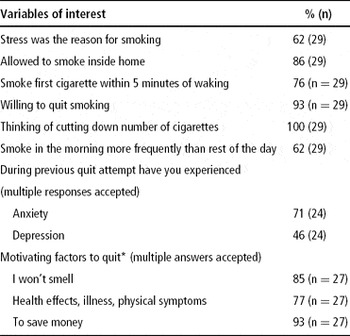
In the baseline survey (Table 1, n = 29) 62% of the participants reported ‘handling stress’ as a reason for smoking, 86% stated that they were allowed to smoke inside their home, 93% expressed willingness to quit smoking while 100% were thinking of cutting down the number of cigarettes smoked. Seventy-six per cent smoked within five minutes of waking and 62% smoked in the morning more frequently than the rest of the day.
Smoking history (baseline)

Note: There are some missing values, * Combined responses of all true: slightly, somewhat, mostly and extremely (to measure motivating factors a 5 point scale was used).
Twenty-four participants responded to the questions on mental health issues (n = 24), 71% experienced anxiety and 46% experienced depression during previous quit attempts.
Twenty-seven participants (n = 27) reported the following reasons as motivating factors in their attempts to get rid of bad odour (85%), concerns of health / illness / physical symptoms (77%) and saving money (93%).
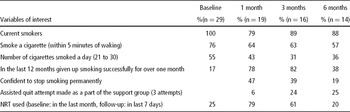
Table 2 shows improvement trends in the rates of ‘current smokers’ (baseline 100% n = 29, at six months 88% n = 15), number of cigarettes smoked a day (55% vs 36%), smoke a cigarette within 5 minutes of waking (76% vs 57%) and in the variable ‘three quit attempts made’ (after one month 6% n = 19, at six months 25% n = 14). Initially, at one month follow-up, 47% (n = 19) of participants were optimistic about stopping smoking permanently but only 19% (n = 14) reported the same at six months. However there was no significant difference in results.
Comparison between baseline and follow-up surveys

Note: there are some missing values.
Discussion
It was stated in the introduction that evidence is limited on group interventions, however, the project team of the Health Promotion Service of the South Western Sydney and Sydney Local Health Districts works within a population health framework and is not involved in individual treatment programmes. This is the rationale for using a group support model for smoking cessation which was developed based on the needs of mental health service consumers in the local community.
The major shortcoming of this pilot included a small sample size, inadequate number of education sessions, low attendance and funding constraints. Another issue is inconsistent sample size in the study areas. The number of participants was too low in one of the two study areas (Bankstown) which restricted data analysis. These factors limit the scope of the evaluation as well as a claim to any achievement; nevertheless the results from the evaluation were encouraging.
Compared to women more men participated in the programme which may be due to an increased number of male smokers with mental health problems or that men were more interested in quitting smoking. This issue needs further investigation for future direction and initiatives. The attendance at the group sessions was low which is consistent with other studies (Ashton et al., Reference Ashton, Miller, Bowden and Bertossa2010; Saxon et al., Reference Saxon, Baer, Davis, Sloan, Malte, Fitzgibbons and Kivlahan2003). Low attendance may be due to lack of motivation or other personal issues that took priority over the group sessions. To address this issue, qualitative assessment might be useful to learn of barriers that prevented participants in attending most sessions. A holistic and coordinated strategy between the programme facilitators, care managers, researchers and participants is essential to enhance participants’ commitment towards attending sessions.
Over 60% of the participants indicated that ‘handling stress’ was a reason for smoking which supported the study of Ragg and Ahmed (Reference Ragg and Ahmed2008). It is important to focus on positive coping strategies that may alleviate clients’ distress. Concerns of health effects or physical symptoms of smoking are well documented in the literature which was reflected in the results (77%, n = 27) as one of the motivating factors for participants wanting to quit smoking. Over 90% of participants mentioned financial cost as a driving cause to quit attempts which should also be an area to concentrate on in designing interventions. Thorough investigation is important and attention should be given to these issues as encouraging factors in future programmes.
Participants revealed a positive attitude towards quitting, but it did not translate into action. Participants’ level of confidence to quit was high at one month and dropped considerably at six months indicating a reflection of the study by Currie et al. (Reference Currie, Karltyn, Lussier, de Denus, Brown and el-Guebaly2008). There may be underlying factors that prevented them achieving the expected outcome of smoking cessation which are yet to be identified and this warrants further investigation. Nevertheless the improvements in some of the areas such as number of cigarettes smoked per day and time to first cigarette are encouraging.
Participants’ experience from previous quit attempts provided valuable insights to group discussions. Many experienced anxiety and depression during previous quit attempts which might act as a barrier for future quit attempts and this should be addressed in future programmes.
Most participants smoked inside their home. This is reflective of the reinforcing behaviour of friends, peers and acquaintances who smoke. Literature suggests an association between successful quit attempts and household smoking restrictions (Pizacani et al., Reference Pizacani, Martin, Stark, Koepsell, Thompson and Diehr2004; Farkas et al., Reference Farkas, Gilpin, Distefan and Pierce1999) which is important to consider for future initiatives. To increase the level of motivation a peer support approach could be implemented, and a multi-strategic intervention programme would be beneficial.
Conclusions
The study highlights the need for intensive collaboration between researchers and programme managers, and also a need for further investigation with a larger sample in community mental health settings.
Acknowledgement
The authors acknowledge the participation of the Bankstown and Redfern Community Mental Health Services and the consumers.
Financial support
This study received no specific grant from any funding agency, commercial or not-for-profit sectors.
Conflict of interest
None
Ethical standard
Ethical approval to undertake this study was granted by the Sydney Local Health Districts Human Ethics Review Committee (SSA X09-0258; HREC/09/RPAH/424). The authors assert that this work complies with the ethical standards of the relevant national and institutional committees on human research and with the Helsinki Declaration of 1975, as revised in 2008.