Introduction
Impaired emotion recognition in the behavioral-variant subtype of frontotemporal dementia (bvFTD) is evident particularly for negative emotions, whereas the recognition of positive emotions is generally intact (Kumfor & Piguet, Reference Kumfor and Piguet2012). One limitation, however, is that emotion stimuli sets typically contain more negative than positive emotions. The widely used Ekman 60 Faces Test, for example, consists of four negative emotions (anger, fear, disgust, and sad) and only one prototypical positive (happiness) emotion. Moreover, happiness is visually distinctive (curved lips representing a smile) and is easier to differentiate than the other negative facial emotions in this test. Experimentally validated non-verbal vocalizations have recently become available which communicates several positive (e.g., cheers for triumph) and negative (e.g., retching for disgust) emotions (Sauter & Scott, Reference Sauter and Scott2007). Importantly, vocalizations do not contain linguistic information but are able to encompass a wider range of emotions that may not necessarily be expressed in prosody (e.g., groans or bursts of laughter) and are thought to be auditory equivalent to facial emotions (Belin, Fecteau, & Bedard, Reference Belin, Fecteau and Bedard2004). An opportunity exists to investigate whether emotion processing deficits are present also for positive vocalizations in bvFTD. The recognition of positive and negative emotions using vocalizations as well as that of facial emotions (Ekman 60 Faces Test) was investigated in bvFTD in comparison to Alzheimer's disease (AD) group and an age- and education-matched control cohort.
Methods
Participants
Eighteen patients (9 bvFTD; 9 AD) were recruited from the Frontier Frontotemporal Dementia Research Group where they were diagnosed by a senior neurologist (J.R.H.). Behavioral-variant FTD patients met current consensus criteria for FTD (Rascovsky, et al., Reference Rascovsky, Hodges, Knopman, Mendez, Kramer, Neuhaus and Miller2011) and were characterized by an insidious onset of decline in social behavior (e.g., disinhibition, apathy, loss of empathy), cognition (e.g., executive deficits with relative sparing of other cognitive functions), as well as functional abilities. Imaging results showed predominantly bifrontal atrophy on 3 Tesla magnetic resonance imaging scanner. AD patients met the consensus criteria for probable AD (McKhann et al., Reference McKhann, Knopman, Chertkow, Hyman, Jack, Kawas and Phelps2011) and were characterized by prominent deficits in episodic memory as well as mild impairment in other non-memory domains (e.g., visuospatial, language, and executive functions); social behavior was relatively preserved. Control participants were selected from a healthy volunteer panel and were excluded if they had any neurological (e.g., epilepsy, prior significant head injury) or psychiatric (e.g., depression) conditions. All controls scored above the cutoff (88/100) on a cognitive screening measure, the Addenbrooke's Cognitive Examination – Revised (ACE-R) (Mioshi, Dawson, Mitchell, Arnold, & Hodges, Reference Mioshi, Dawson, Mitchell, Arnold and Hodges2006). All participants provided informed consent for the study; dual consent was obtained from the carer for some patients. Participants volunteered their time but were reimbursed for travel costs where required. This study was approved by the Southern Sydney and Illawarra Area Health Service and the University of New South Wales ethics committees.
Emotional Stimuli and Procedure
Experimentally validated sets of emotional stimuli were used. Vocalizations included five positive (achievement, amusement, pleasure, relief, and triumph) and four negative (anger, disgust, fear, and sadness) emotions. Ten items were used per category, which resulted in a total set of 90 stimuli (Sauter & Scott, Reference Sauter and Scott2007). Each vocalization lasted approximately 1 s. Facial expressions of emotion consisted of the Ekman 60 Faces Test (Young, Perrett, Calder, Sprengelmeyer, & Ekman, Reference Young, Perrett, Calder, Sprengelmeyer and Ekman2002), which consisted of two positive (happiness, surprise) and four negative (fear, disgust, sadness, and anger). Each facial emotion was displayed on the computer for 5 s. The two emotion tests were counter-balanced across participants.
On a forced-choice recognition task, participants were required to select one label from a list of choices for each stimulus. The list of response choices was visible throughout testing and consisted of all of the emotion labels available for the test being administered; in other words, the response list contained nine labels for the vocalization test (achievement, amusement, pleasure, relief, triumph, anger, disgust, fear, and sadness) and six labels for the facial emotion test (happiness, surprise, fear, disgust, sadness, and anger). No time limit was enforced for each trial; subsequent trials did not proceed until a response was recorded. Participants were able to listen to the vocalization a second time, if requested. All testing was performed in a quiet room. Practice trials were administered to the participants to ensure that they could see and hear the stimuli being presented.
Statistical Analyses
Data were analyzed using IBM SPSS Statistics (Version 20). Consistent with previous work, scores on the individual vocalizations and facial emotions were averaged to form two composite scores: positive and negative emotions (Hsieh, Hornberger, Piguet, & Hodges, Reference Hsieh, Hornberger, Piguet and Hodges2012). Because of the sample size, correct responses for the individual emotions and misrecognition errors were not analyzed separately, but this information is provided in the Appendix. First, a Diagnosis (bvFTD, AD, controls) × Emotion (positive, negative) mixed analysis of variance (ANOVA) was conducted separately for the set of facial emotions and vocalizations. Next, group comparisons for the recognition of positive and negative emotions were analyzed using one-way ANOVA with post hoc comparisons using the Tukey HSD test. The Kruskal-Wallis test was used where data were non-parametric, followed by post hoc testing using the Mann-Whitney U test. A p value of <.05 was adopted.
Results
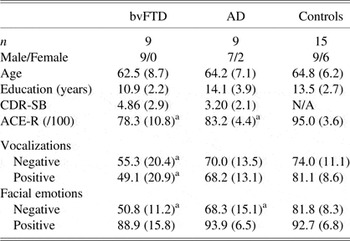
As can be seen in Table 1, groups were matched for age [H(2) = 0.12; p > .05] and years of education [F(2,32) = 3.14; p > .05]. Significant group differences on the ACE-R [F(2,32) = 20.7; p < .05; η2 = 0.58] indicated that, as expected, each patient group scored below the control group (p < .05 for all pairwise comparisons). Patient groups did not differ on the ACE-R (p > .05). Patient groups were also matched on the Clinical Rating Scale-Sum of Boxes score (CDR; Berg et al., Reference Berg, Miller, Baty, Rubin, Morris and Figiel1992) (U = 10.0; Z = −1.22; p > .05). While there were more men than women, sex distribution was not statistically different between groups (Fisher exact test = 0.48; p > .05; Cramer's V = 0.39; p > .05).
Demographic data and recognition accuracy of positive and negative vocalisations and facial emotions in the patient and control groups

Standard deviation is presented in brackets. ap < .05 vs. controls
CDR-SB = Clinical Dementia Rating-Sum of Boxes score; ACE-R = Addenbrooke's Cognitive Examination-Revised
The overall 3 × 2 ANOVA on the composite negative and positive vocalizations across groups revealed a significant Diagnosis × Emotion interaction [F(2,30) = 4.41; p < .05; η2 = 0.23] indicating that the recognition of positive and negative vocal emotions differed across the diagnostic groups as a function of the stimuli valence. The main effect of Diagnosis was significant [F(2,30) = 10.3; p < .05; η2 = 0.41] with recognition accuracy significantly worse in the bvFTD than AD and control groups (p < .05 for both comparisons). The main effect of Emotion was not significant (p > .05). To clarify the interaction further, separate analyses were conducted on each composite score. These analyses showed a significant group effect for both positive [F(2,32) = 14.6; p < .05; η2 = 0.49] and negative [F(2,32) = 4.67; p < .05; η2 = 0.24] emotions. Post hoc comparisons revealed that the bvFTD group was significantly worse in comparison to controls for both positive and negative vocalizations (p < .05 for all comparisons); the AD group, in contrast, did not differ significantly from controls (p > .05 for both comparisons). In addition, the bvFTD group was also significantly worse than the AD group at the recognition of positive vocalizations (p < .05).
The overall 3 × 2 ANOVA on the composite negative and positive facial emotion scores across groups revealed a significant Diagnosis × Emotion interaction [F(2,30) = 15.3; p < .05; η2 = .51] indicating that the recognition of positive and negative facial emotions also differed across the diagnostic groups as a function of the stimuli valence. The main effects of Diagnosis [F(2,30) = 10.9; p < .05; η2 = 0.42] and Emotion [F(1,30) = 136.5; p < .05; η2 = 0.82] were also significant. Again, the bvFTD group was significantly worse at recognizing facial emotions when compared to AD and control groups. Further analyses were conducted on each of the composite scores for positive and negative facial emotions separately to clarify the previous interaction. These analyses showed a significant group effect for negative emotions only [F(2,32) = 21.5; p < .05; η2 = 0.59]. Post hoc comparisons revealed that both patient groups differed significantly from controls (p < .05 for both comparisons). The bvFTD cohort was also significantly worse than the AD group at recognizing negative facial emotions (p < .05). As expected, patient groups did not differ in the recognition of positive facial emotions [F(2,32) = 0.64; p > .05].
Discussion
This study is the first to show that the recognition of a range of positive vocalizations is impaired in bvFTD. Findings are consistent with recent work showing impaired identification of positive emotions in non-facial modalities, such as music, and also in the comprehension of emotion words in bvFTD (Hsieh et al., Reference Hsieh, Foxe, Leslie, Savage, Piguet and Hodges2012; Omar et al., Reference Omar, Henley, Bartlett, Hailstone, Gordon, Sauter and Warren2011). This study highlights, therefore, that the disproportionate bias against the recognition of negative emotions reported in the literature may be partially attributed to the stimulus sets used in previous studies.
The pattern of performance between the dementia groups differed according to modality and valence: the bvFTD group was impaired in the identification of emotions in faces and vocalizations, with the exception of positive emotion conveyed by faces. In contrast, AD cohort was impaired only in the recognition of negative facial emotions. These findings emphasize the primary emotion processing deficit characteristic of bvFTD. In addition to the orbitofrontal-insular and anterior temporal cortices, atrophy in bvFTD also involves the amygdala, a structure central to the processing of emotional stimuli. We would like to suggest that it is, therefore, likely that amygdalar atrophy underlies this deficit in bvFTD. The role of the amygdala in the processing of facial expressions of emotion is well recognized in both lesion studies as well as neuroimaging work (Adolphs, Tranel, Damasio, & Damasio, Reference Adolphs, Tranel, Damasio and Damasio1994; Phelps & LeDoux, Reference Phelps and LeDoux2005). Involvement of the amygdala in the processing of negative as well as positive emotional vocalizations has been demonstrated in recent fMRI work (Fecteau, Belin, Joanette, & Armony, Reference Fecteau, Belin, Joanette and Armony2007). In AD, however, impaired performance across the two emotion modalities may be attributable, at least in part, to concurrent cognitive deficits (such as visuospatial deficits) that are found in the disease. Loss of gray matter in posterior parietal and occipital cortices is more severe in AD than in FTD whereas lesions to the limbic system in FTD outweigh those found in AD (Rabinovici et al, Reference Rabinovici, Seeley, Kim, Gorno-Tempini, Rascovsky, Pagliaro and Rosen2008). The pattern of performance in the AD group highlights the need to examine the integrity of auditory and visual systems and determine their contribution to the network of structures involved for emotion processing (Rohrer, Sauter, Scott, Rossor, & Warren, Reference Rohrer, Sauter, Scott, Rossor and Warren2012).
We were not able to examine the individual emotions separately. Such an approach could help characterize the positive emotion deficits in bvFTD. This issue is relevant particularly for the emotion surprise; whether this emotion is regarded as positive, negative, or exists separately as a category of its own (Toivonen et al., Reference Toivonen, Kivela, Saramaki, Viinikainen, Vanhatalo and Sams2012), remain contentious. Furthermore, analyses of misrecognition errors for individual emotion categories in future work may also reveal response biases that differentiates between bvFTD and AD cohorts. It is possible that bvFTD patients use some labels disproportionately (e.g., confusing amusement with disgust or fear; see Appendix) which are not present in either the AD or control groups. A useful statistical method which takes into account the disproportionate use of a particular category on forced-choice paradigms is that of the “Hu” score, which calculates an unbiased hit rate based upon the participant's use of the different response alternatives (Wagner, Reference Wagner1993).
Finally, a useful adjunct to pursue in the future is to further examine the neural correlates of individual emotion categories; certain brain regions are thought to be biased for specific emotions (e.g., insula for disgust; Chapman & Anderson, Reference Chapman and Anderson2012) but those for positive emotions remain elusive. The neural basis of non-verbal auditory emotions has been examined in the dementias using total recognition scores (Omar et al., Reference Omar, Henley, Bartlett, Hailstone, Gordon, Sauter and Warren2011; Rohrer et al., Reference Rohrer, Sauter, Scott, Rossor and Warren2012; Hsieh, Hornberger, et al., Reference Hsieh, Hornberger, Piguet and Hodges2012). The lack of differentiation, particularly for positive emotions, in the literature so far is likely to have resulted from the loss of statistical power from ceiling effects for the recognition of happiness using stimuli that were previously available. While sample sizes in the patient groups in this study are in keeping with the cohorts that have been studied (e.g., n = 7; Drapeau, Gosselin, Gagnon, Peretz, & Lorrain, Reference Drapeau, Gosselin, Gagnon, Peretz and Lorrain2009), larger cohorts will be needed to examine the neural correlates of vocal emotion recognition.
Acknowledgments
This research was supported by a National Health and Medical Research Council (NHMRC) of Australia Project Grant (510106) and the ARC Centre of Excellence in Cognition and its Disorders (CE110001021). J.R.H. is supported by an Australian Research Council Federation Fellowship (FF0776229). O.P. is supported by an NHMRC Clinical Career Development Fellowship (APP1022684). We thank participants who support the Frontier Frontotemporal Dementia Research Group. There are no conflicts of interest.
Confusion matrices in the patient groups and controls for the nine non-verbal vocalizations