INTRODUCTION
Seed of improved crop varieties can greatly increase the productivity, profitability and sustainability of agriculture production systems in developing countries (Cromwell, Reference Cromwell and Tripp1997). However, in many developing countries farmers have limited access to seeds of modern high-yielding varieties because of constraints in production and distribution (Cromwell et al., Reference Cromwell, Frii-Hansen and Turner1992).
In many countries of Asia and Africa, despite substantial funding for the strengthening of seed supply organizations, the formal sector only supplies a small proportion of the seed that is sown. Most is supplied in the informal seed supply system made up of a network of farmers and small-scale merchants. Seed sourced from the public sector and commercial companies constitutes at most 10% and often as little as 2% of seed supply in developing countries (Almekinders et al., Reference Almekinders, Louwaars and de Bruijn1994; CIAT, 1982). The principle seed source for most farmers is seed saved on-farm from the previous harvest (about 60–70%) while most of the remainder comes from off-farm local sources (Franzen et al., Reference Franzen, Ay, Begemann, Wadsack and Rudat1996; Tripp, Reference Tripp1997).
Since the formal sector has failed to supply a significant proportion of the seed that is sown, many projects and agencies have attempted to develop local seed supply systems that depend on action by local communities. A major constraint to this approach is the very high transaction cost of delivering seed to marginal and rural areas that make it unprofitable (Wiggins and Cromwell, Reference Wiggins and Cromwell1995). Hence, Tripp and Rohrbach (Reference Tripp and Rohrbach2001) report there is no example of a sustainable local-level seed production and marketing enterprise emerging from project-supported community-based seed production as, invariably, once support of the implementing agency was withdrawn, group activities ceased.
In Nepal, the failure of centralized seed supply was recognized by government and donors and the Food and Agriculture Organization of the United Nations (FAO) established SPIN (Special Programme in Nepal) that was jointly implemented with District Agriculture Development Offices (DADOs) and District Irrigation Offices to promote decentralized seed production with farmers' groups (SPIN, 1997). Poudel et al. (Reference Poudel, Chaudhary, Chowin and Ghimire2003) reviewed some of these efforts in SPIN on the establishment of seed producer groups in five districts: Chitwan, Jhapa, Ilam, Syangja and Nawalparasi. Within these districts, activities were implemented from October 1995 to August 1997 in 19 sites (villages). The farmer training concentrated on increasing yield by the application of the recommended package of inputs and cultivation practices. The application of the package was supported by the project that fully or partially subsidised all of the required inputs including seed, fertilizer, and chemical pesticides and the necessary sprayers. The aim was to demonstrate to the farmers that the complete package of practices produced high yields so that even when the project ended they would continue to apply the package. However, farmers reported that after the termination of the project subsidies they discontinued its use. Although there was also training in seed production issues, particularly on the maintenance of genetic purity and physical quality, there was no training in business skills and marketing (Poudel et al., Reference Poudel, Chaudhary, Chowin and Ghimire2003). After the project, no group from the sample of 16 groups studied was active in producing seeds for sale in an organized manner and only five groups remained active for any activity, e.g. savings and credit. During the project the groups did not have to sell seed to be profitable – they were receiving subsidies – and much of the seed was used by the project and the farmers themselves. Once the project finished the groups lacked the skills and experience needed to sell seed at the required premium price for quality seed.
Our particular interest in seed supply followed from the successful breeding of new rice varieties using participatory, client-oriented breeding (COB) approaches (Joshi et al., Reference Joshi, Musa, Johansen, Gyawali, Harris and Witcombe2007; Witcombe et al., Reference Witcombe, Joshi, Gyawali, Musa, Johansen, Virk and Sthapit2005) and participatory varietal selection (PVS) (Joshi and Witcombe, Reference Joshi and Witcombe2002). Although we had developed and employed efficient ways to deliver seeds of these new varieties to many farmers (Joshi et al., Reference Joshi, Sthapit, Subedi, Witcombe, Cleveland and Soleri2002) they were project-based and donor-financed. Hence, we began to assist the development of local farmer groups to establish a sustainable means of delivering seeds of new varieties. We reviewed case studies of previous attempts at establishing such groups and applied the lessons to help establish three new seed producer groups in Chitwan. We report on the performance of these groups and examine how well they helped meet our objective of scaling-out seed of new varieties from COB and PVS.
METHODS
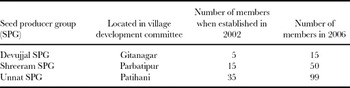
A research team from the Local Initiatives for Biodiversity, Research and Development (LI-BIRD) and CAZS Natural Resources (CAZS-NR), with the help of the local DADO in Chitwan facilitated three existing agriculture production groups to produce and market seed (Table 1).
The three seed producer groups in Chitwan district, Nepal, that were studied.

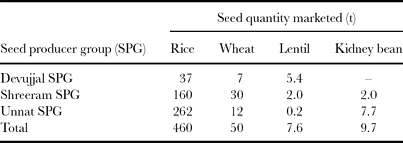
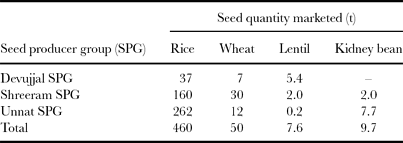
Crops marketed by six community-based seed producer groups in Chitwan district, Nepal, 2006.
In 2001, LI-BIRD and CAZS-NR organized three days training for selected executive members from existing farmer groups of Chitwan that had been formed for purposes other than seed production. About 25% of the participants were women farmers. Following the lessons from SPIN (Poudel et al. Reference Poudel, Chaudhary, Chowin and Ghimire2003) – reviewed in the Introduction – the importance of training in marketing skills was recognized, so two key trainers were from the Market Access for Rural Development (MARD) and the Seed Sector Support Project (SSSP), who had years of experience and in-depth knowledge of seed production, marketing and quality control. They focused the training on building the marketing skills of the farmers, while the methods for producing quality seed took second place.
Staff from LI-BIRD and CAZS-NR were operating their research project in Chitwan and so had continuing interactions with the groups and provided, or facilitated access to, source seed and helped in establishing market links. They also provided technical advice when requested.
In November–December 2006, we assessed the success of three seed producer groups (Table 1). Members of these groups were interviewed to collect information on the amount of seed produced and marketed by crop and variety. We were allowed access to group records up to 2006 including annual seed production statistics (crop, variety, farmer's name and location used for seed production, amount produced and seed quality category), and annual marketing records (how much seed of each crop and variety was sold, to whom and at what price). There was also institutional information including records of share members, profile of the share members and their committee membership, and who participated in what group activities. By interviewing the group members we determined all of the assistance the group received from outside bodies and all external financial support. Frequent visits were made to the groups to directly observe the group activities and have informal discussions with group members.
The survey findings for the Unnat Seed Producers' Group (SPG), Patihani, are reported in most detail as this group had the greatest interaction with LI-BIRD and CAZS-NR. We also followed up the 2006 survey with further informal group discussions with committee members in 2008, 2009 and 2010.
Key organizations in seed production, distribution and quality control were also contacted to cross-check the support they had provided with the support reported by the groups. These included the DADO, Chitwan; Seed Quality Control Centre (SQCC) of the Ministry of Agriculture and Cooperatives; and one non-governmental organization (NGO) – the Forum for Rural Welfare and Agricultural Reform for Development (FORWARD).
RESULTS
The market-based approach to training
The training course included the business opportunities possible in seed production and sales. Hence it covered information on business development services such as the availability of grants, subsidies for the transportation of source seed, and the availability at no charge of technical advice by governmental organizations and NGOs. The training by MARD and SSSP concentrated on marketing, i.e. establishment of market prices, estimation of seed demand, identification of seed traders and markets, establishing business contacts, obtaining market information and networking. This course proved to be effective in motivating existing groups to establish new seed enterprises. We found from our interviews that two executive members who participated in the 2001 course played a vital role in establishing the Unnat SPG in 2002. Most members of this new group belonged to an existing agriculture production group – Hariyali Krishak Samuha (meaning the greenery agriculture group) – that had established links with DADO Chitwan by participating in their cereal plot demonstrations and trials and field visits. As well as the Unnat SPG, two other groups had two executive members who attended the course, the Shree Ram Group (a general purpose farmer group) and the Devujjal Group (also a general purpose farmer group) and both groups were motivated to start seed enterprises. Two groups in Gulmi district, the Reshunga Multipurpose SPG and the Malika Multipurpose SPG, were already producing and selling seed and two executive members each from all these groups attended the 2001 training. After training, support to them was limited to facilitating the supply of source seed and providing occasional technical advice, and both were still actively engaged in seed production and marketing in 2010.
Effectiveness of the seed producer groups in Chitwan
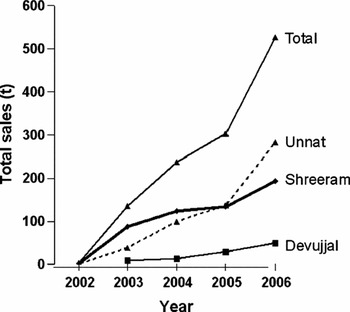
These three new groups all increased the amount of seed they produced each year (Figure 1). By 2006 the total seed produced and sold of the three groups had grown from an insignificant amount to over 500 t.
Sales by three seed producer groups in Chitwan, 2002 to 2006.

In interviews in 2010 Unnat and Shreeram had further increased sales and were functioning well. However, the Devujal Group were no longer in the seed business. This was the smallest and most diversified group and several of the leading members of the group had left the village. However, they had invested in a rice mill and the processing of rice had become the major activity of the group. Another factor in withdrawal from seed production was that Devujjal was in close proximity to the other two groups who were efficient competitors with better economies of scale.
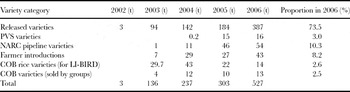
The groups provide certified seed of released varieties, but also truthfully labelled seed of unreleased varieties. These included varieties not recommended for Nepal but introduced into Nepal by farmers, usually from India, and released varieties identified by PVS or bred by COB (Table 3). However, over 80% of the seed produced was of released varieties. Of the non-released varieties, in 2006 only about 5% of the production was of the rice varieties from COB and only half of that was independently marketed by the groups.
Varieties marketed by category by three community-based seed producers groups in Chitwan district, Nepal, 2002 to 2006.

PVS: participatory varietal selection; NARC: Nepal Agricultural Research Council; COB: client-oriented breeding.
The Unnat Seed Producers' Group
Evolution of the group and financial management. Until 2004, the Unnat group, Phatiani village, had 35 local members all of whom produced seed on their farms for the group. In 2004, further share members, who were no longer required to produce seed for the group, were enrolled following a public announcement. People with professions outside farming and from places outside the village of Patihani and even beyond Chitwan district were allowed to join the group as investors, and hence could participate in group meetings. The share members were school and university teachers, other professionals, staff of government organizations and NGOs, and even political leaders. The members were predominantly male, higher caste (Brahmin and Chhetri) farmers with medium to large landholdings for the Nepal terai of over 1.0 ha. Over 80% of the group members had at least a High School level education while around 10% had graduate-level education. By 2007, the Unnat group had 99 general share members, of whom 28 were also producers. (The Shreeram group also attracted additional shareholders but in this case most, i.e. 75%, of the shareholders were also producers.) The Unnat group had a total of 331 shares – the maximum permitted per member was six – purchased for 5000 Nepali rupees (Rs) each, having a total value of about US $23 000.
The share members elect a 13-member executive committee with a two-year term. There were five sub-committees: construction (for buildings and physical assets), accounting, marketing management, technical and advisory.
The group opened a bank account in the nearest large town, Bharatpur, jointly operated by the chairperson, treasurer and accountant with the accountant and one other required to sign each cheque. The petty cash was handled by the accountant. The accounts were audited and any queries from the auditor were dealt with by the executive committee. The Shree Ram Group had a similar structure of sub-committees.
Start-up and later support. Significant start-up support was provided to the group in the form of source-seed of released and unreleased varieties of rice, wheat, maize, grain legumes and oil seed crops at cost price from government crop commodity programmes. The SQCC and the Regional Seed Testing Laboratories assisted in quality control by inspecting the field for certification purposes free of charge and by the laboratory testing of seeds at nominal charge. In Chitwan DADO provided need-based training for seed production, helped in crop protection, field inspection and assisted in the procurement of source seeds in the initial years. All the services provided by DADO were free of charge as was the advice provided by LI-BIRD and CAZS-NR. There was a one-time financial support of Rs 60 000 (about US $850) from the district level seed self sufficiency programme in 2004.
By 2005 the effectiveness of the group was recognized by the Agriculture Engineering Directorate of the Department of Agriculture for its marketing of seed in more than 35 districts of Nepal. It provided a grant of around US $100 000 that covered, with expenditure scheduled from 2005–2010, about 80% of the total cost of a seed-processing plant, threshing floor, rice mill, cold storage and an agriculture machinery workshop. None of this contributed to the profits of the group (see below) as all of the grant was used for capital expenditure and contributed to assets in the financial reports of the group.
Marketing strategy – quality control. The group produces mainly ‘certified’ but also some ‘truthfully labelled’ seed. The group organizes refresher training on each crop by inviting trainers from organizations such as DADO Chitwan, LI-BIRD, CAZS-NR and the Seed Testing Laboratory. Members of the technical sub-committee visit the farmers and their seed production plots to discuss issues relating to seed quality and particularly the importance of maintenance of isolation and observe the standing crops and post-harvest operations, e.g. threshing, drying and grading. In addition, the Regional Laboratories of SQCC check seed plots in the field for isolation distances, crop health and purity. After laboratory tests, the seeds are tagged. The groups use their own labelled bags and tags for the marketing of seed.
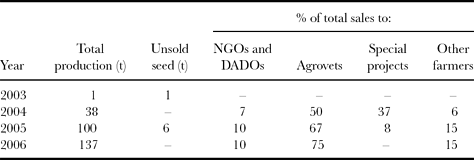
Marketing strategy – sales and linkages. In 2003, the Unnat group produced 1 t of seed but did not sell any of it – but this was the only year in which there was unsold seed. In 2004 LI-BIRD purchased around 37% of the total seed produced for project activities and assisted the group by providing information on market demand from other agencies and projects. By 2005 the group independently sold 92% of their production and by 2006 all of it (Table 3). Hence, despite the training in marketing the group needed time to build up its independent sales and the initial support of LI-BIRD as a guaranteed purchaser.
In the training course on marketing the identification of outlets was stressed. Members of the group developed business relationships by visiting nearby Agrovets (private commercial company dealing in agricultural supplies) to get market information and to obtain advance orders for seed to produce seed to order. Production was usually done on trust without a written contract and when seed was supplied to the Agrovets they paid for it in full within 1–3 months of delivery. (These advance orders from the Agrovets is one reason why the portfolio of varieties produced by the groups consisted of a large proportion of old varieties and so few COB varieties). The group also relied on past sales to plan the following year's production by assuming that the demand from Agrovets and other sources would not vary substantially from year to year.
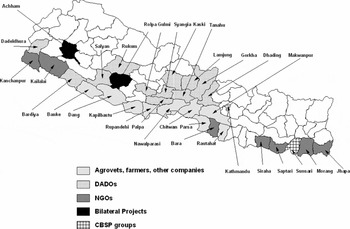
The strong linkages that had developed with the Agrovets resulted in them purchasing most of the substantially increased quantities of seed (Table 4); other buyers were other private and public sector organizations and individual farmers throughout many districts (Figure 2). To increase demand the management sub-committee arranged advertisements through pamphlets, leaflets and FM radio.
Seed production and sales, by purchaser category, of the Unnat Seed Producer Group, Patihani, Chitwan, 2002–2006.
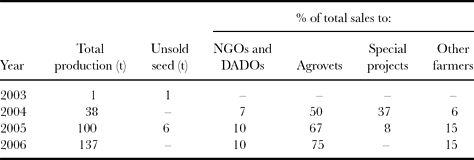
NGO: non-governmental organization; DADO: District Agriculture Development Offices.
Geographical location and institutions involved in distribution and sale of seed produced by Unnat Seed Producer's Group, Patihani, Chitwan, 2006. DADOs: District Agriculture Development Offices; NGOs: non-governmental organizations; CBSP: community based seed production.

Profitability and benefits to members. The Unnat SPG was first profitable in 2004 when it made $240. By 2005 this increased to $2030 and by 2006 to $2530. These cash totals represent a modest 5% margin on total seed sales after all the costs were accounted for and initially these costs did not include the time of the executive members. However, since 2007, allowances for attendance at meetings and travel costs have been paid. Because of this low profit margin only about 5% of the Group's substantial capital reserves and assets were from undistributed profit. Most of the reserves came from the sale of shares.
The profits made by the group were after purchasing seed from its producer members at a premium price for quality seed. Hence, the total profits do not account for the total benefits accruing to all of the members. In 2009, the growers got a margin of Rs. 2–3 kg−1 representing an increase of about 10% over grain production. Hence, the greatest beneficiaries of the group were those members who were also producers. For the shareholders who were not producers the benefits are yet to be realized. No dividend had been paid on the shares by 2010. However, the total assets of the company had substantially increased along, presumably, with the share value but by May 2010 no one had traded their shares to test this assumption.
Becoming a private sector seed company. The Unnat SPG plans to become a company. There are sound legal reasons for becoming a private-sector company and it brings well-established procedures for shareholdings, meetings and accounting under the Companies Act. The group, at present, by having shareholders who are not producers does not follow the usual model for a farmers' group or a cooperative.
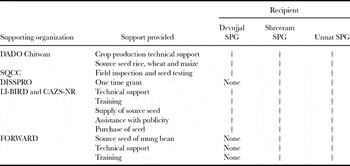
Support. The discussions with Unnat SPG revealed multiple sources of support. From interviews with other groups we found out this was typical (Table 5).
Forms of assistance given to the three groups in Chitwan as determined from discussions with group members.

‡ None = no support provided, † = support provided.
DADO: District Agriculture Development Office; SQCC: Seed Quality Control Centre; DISSPRO: district level seed self sufficiency programme; LI-BIRD: Local Initiatives for Biodiversity, Research and Development; CAZS-NR: CAZS Natural Resources; FORWARD: Forum for Rural Welfare and Agricultural Reform for Development.
DISCUSSION
Tripp and Rohrbach (Reference Tripp and Rohrbach2001) describe experiences in community-based seed production that we briefly review here. They report on numerous projects in Africa, Asia and Latin America where NGO or project staff encourage farmers to work as a group in seed production. The farmers are loaned source seed and, after training on seed multiplication techniques, are expected to multiply this seed and to repay the loan with fresh seed. The farmers are expected to use some of the seed they have produced on their farms, and to sell the rest to neighbouring farmers in the hope that a financially viable village-level enterprise will emerge. However, they report that there is no case where this has happened. Tripp and Rohrbach (Reference Tripp and Rohrbach2001) explain that there is simply not sufficient demand at the individual village level to maintain a commercial seed enterprise, and farmer seed producers usually have few contacts outside their villages. A few projects resolved this constraint by collecting seed for sale to government or NGOs but this is unsustainable in the long run as none of these projects have developed retail trading networks. Also, getting full cost recovery is hard as neighbouring farmers do not recognize any added value of locally produced seed. If the full costs of source seed, seed inspections and advisory services are included, the probability of maintaining a financially viable enterprise after the termination of project support is very low.
There have been several prior attempts in Nepal and elsewhere at building sustainable seed producer groups from community-based organizations, and they have met with a similar fate to the projects described by Tripp and Rorbach (Reference Tripp and Rohrbach2001). However, in the Chitwan SPGs some of the major constraints described by these authors were largely resolved. Although seed production was local, the target for seed sales was broadened from neighbouring farmers at the outset. There was an initial emphasis on creating sufficient demand by training in marketing and by helping the groups build up sales networks that included public- and private-sector organizations and individuals outside of the project. Establishing links between producer groups and the Agrovets that could purchase large quantities of seed was crucial, while a reasonable price for quality seeds was achieved by quality bagging and labelling.
A major factor not discussed by Tripp and Rohrbach (Reference Tripp and Rohrbach2001) was the need for a business-oriented approach. By 2008 all of the groups were self financing as they had accumulated sufficient capital to cover the cost of purchasing seed from growers before the cash is recouped from seed sales. However, the groups generated these reserves from shareholder funds rather than retained profits. This contrasts greatly with the conventional DADO-supported approach where groups with very substantial turnover have accumulated little or even no cash reserves.
The Chitwan-based community based seed production (CBSP) groups also had some inherent advantages. The seed production environment was good (high yields with more assured irrigated production). A large potential market could be easily accessed by road as Chitwan is centrally located and a commercial centre in the terai (albeit with the possible disadvantage of increased exposure to competition). Chitwan also has a corporate business culture and these groups benefited from that favourable business environment as it allowed the two successful groups to raise shareholder funds. In addition, government policies and support on encouraging farmers' groups in seed production and sales were favourable. The technical difficulties of producing seed of most of the selected crops was low as they were self-pollinating so did not need to be grown in isolated plots. Even after consideration of these favourable factors, the increasing quantities of seed produced by the two successful groups provides strong evidence that community-based SPGs can grow into large volume, profitable seed businesses.
Building on established groups
In all cases the SPGs were built on existing groups that were originally established for other agricultural purposes. This increased the chances of success since the members of each group had already had knowledge of crop production, group management and demonstrated the ability to work together, and it saved the higher transaction costs and time for establishing a new group from scratch. It also had the advantage that there was some group-oriented managerial skills right at the start of the enterprise. The established groups, in general, were comprised of the better-off members of the community and this had advantages for sustainability: better-off farmers have more fertile, irrigated land that produces the high yields needed for profitability, have more resources to devote to a new enterprise and a better capacity to cope with the risks presented by a new enterprise. Many development practitioners may consider this inequitable and many development projects involved in seed production specifically attempt to include the disadvantaged in the community-based producer groups. However, the poor have the smallest capacity to undertake a successful seed enterprise. In the longer term, involving better-off farmers provides a more equitable development approach as it makes it more likely that the benefits of quality seed supply will be delivered to all wealth classes in the community.
Initial support
Assistance in funding and in managerial and technical skills is typically required in the start-up of any new enterprise as the first trading years are usually the most difficult. All of the SPGs received help at the beginning. The detailed example of the Unnat SPG was also typical in that it received limited early help but atypical in that it is the only successful group that has been able to attract further funding. This start-up support is not an indicator of non sustainability – the key indicator of sustainability is the survival of the groups after the initial support is withdrawn.
The reasons groups had failed to be sustainable in the past almost always involved an inability to sell the seed they produced so initial training was given on marketing. However, support in the start-up stage by the guaranteed purchase of seed by a project combined with putting the group in touch with potential markets was crucial. The existence of a guaranteed purchaser can reduce the motivation to seek other markets so the staged removal of project support, as exemplified in the case of the Unnat SPG, was important.
This model cannot be universally applied
The model used in Chitwan for the major cereals and legumes cannot be applied to all agricultural situations even within Nepal. Groups in other districts in the terai that are less well placed for markets may find it more difficult to achieve sufficient sales, and CBSP groups in remote areas in the hills are unlikely ever to be independently sustainable. For example, in the mid hills maize is the most important crop, but its production is constrained by difficult growing environments, a small potential market with very poor physical access and technical difficulties in maintaining genetic purity as maize is a cross-pollinated crop. It is unsurprising, therefore, that only two CBSP groups for hill maize varieties could be given as examples for potential scaling-up by Mathema and Gurung (Reference Mathema and Gurung2006), and no arguments that these could be sustainable were presented.
New varieties from PVS and COB programmes do not get priority
Some of the groups marketed seed of new varieties including those that were not released. However, despite the strong linkages with LI-BIRD and CAZS-NR that resulted in the groups having a good knowledge of the new varieties (they were involved in the PVS programmes) and access to source seed of them, commercial considerations meant that these formed only a small part of their business. They produced seed of varieties that were in demand from their customers. This was always of varieties that were already popular. There is little incentive to produce newer varieties with higher genetic yield potential or improved quality since the seed business is not highly competitive – there is a large unfilled demand for quality seed of varieties irrespective of their age. Until this demand is met there is no financial incentive for a CBSP group to distinguish itself by establishing a reputation for the genetic potential of the varieties. On the contrary, there is a disincentive to produce new varieties because, unless a demand is created for them by expenditure on advertising, there is a greater risk of not selling the seed.
The establishment of the groups will eventually help the promotion of the PVS and COB varieties. Once they become better known and there is a demand for them the groups are likely to include them in their portfolio of varieties. Exceptional, easily distinguished new varieties where relevant information can more easily travel along with the seed may be taken up with less delay. The Shreeram group is currently marketing considerably more Sunaulo Sugandha, a recently released rice variety from COB, than any other new or pipeline variety. This aromatic variety yields much more than the alternative aromatic landraces and presents a very profitable option for farmers – because it is unusual and the seed is easily distinguished by its aroma and glume colour, information on it spreads easily from farmer to farmer.
Client-oriented breeding varieties could be promoted by continuing efforts by the organizations that bred them. However, LI-BIRD and CAZS-NR have no sustainable funding for COB activities. Plant breeding is seen as the responsibility of government-financed national research institutes or donor-funded international agricultural research centres, and alternative models are yet to be appreciated at a policy level. As is the case for the CBSPs, the only sustainable solution would appear to be a business-oriented approach. We are currently, with support from the UK Department for International Development Research into Use Programme, attempting to establish private-sector companies that will have COB as a core activity.
Government policy could assist in the promotion of new varieties. When a new variety is released in Nepal there is limited publicity: only 5000 leaflets are produced for distribution by DADOs in the entire country and there are no advertisements on radio and television. There are no differential subsidies for new varieties so they are treated the same as an old variety released decades earlier. Released varieties that are no longer grown are sometimes denotified (officially removed from the list) in Nepal. However, this has never been done for old varieties that are still widely grown by farmers even when they are becoming increasingly disease susceptible. A change in policy by withdrawing the official stamp of approval – notification – from such ageing varieties would make it easier to provide newer and better alternatives.
Acknowledgements
This document is an output from Plant Sciences Research Programme projects including R6748, R7122, and R7542, funded by the UK Department for International Development (DFID) and administered by CAZS Natural Resources for the benefit of developing countries. The views expressed are not necessarily those of DFID. The authors would like to thank the farmers' groups for their cooperation in this research and their willingness to share information. The contributions of many staff from LI-BIRD are gratefully acknowledged.