1. Introduction
Referential metonymy is a variety of figurative language use that involves referring to a target object/individual in terms of a distinctive or saliently associated feature.Footnote 1 Referential metonymy thus fulfils the crucial communicative function of facilitating identification of the speaker’s intended referent. This is illustrated by (1), where referring to the target jogger in terms of his distinctive facial hair enables a listener to pick him out from among other people in the park:

One of the key advantages of referential metonymy is that it allows the speaker to make reference even when she does not know the conventional name for her intended referent, similarly to other innovative referring strategies like noun–noun compounds (e.g., ‘lettuce woman’ = the type of diet-conscious woman who always orders salad when dining in a restaurant; ‘business pyjamas’ = smarter, more formal nightwear, to be worn during the day whilst working from home (attested examples)) (see Clark & Clark, Reference Clark and Clark1979). In addition, referential metonymy may be shorter and less formally complex than a literal means of referring to the same target entity (e.g., for (1), the literal definite description ‘the man with the bushy beard’), thereby reducing both processing costs for the listener and production costs for the speaker (Bowerman, Reference Bowerman2019; Jiang, Reference Jiang2013; Papafragou, Reference Papafragou1996; Rebollar, Reference Rebollar2015). Finally, a metonymically used referring expression may serve not only to facilitate identification of the speaker’s intended referent, but also to highlight a specific, relevant aspect of the target entity and/or the scenario at hand, such that the ‘reference point’ (Langacker, Reference Langacker1993) helps to determine how the interpreter comes to think of the target. For example, in (1), the speaker’s utterance foregrounds the metonymic source – the jogger’s bushy beard – while the target, the bearded jogger himself, is backgrounded. This ‘highlighting’ may activate for the listener background assumptions about bushy beards, including assumptions about the types of men that sport them (e.g., that such men are typically fashion-conscious, cosmopolitan ‘hipsters’, and far from serious joggers), thereby leading to a more nuanced and finely tuned construal of the intended individual and/or of the situation described, which may increase the relevance of the speaker’s utterance. Thus, as Barcelona (Reference Barcelona, Dirven and Pörings2003, p. 226) notes, referring metonymically may affect our conceptualisation of the target referent.
Focusing on the gap-filling and effort-reducing roles played by referential metonymy, these functions in particular suggest that metonymic reference-making may be highly attractive to language-learners, who may need to find a way to compensate for vocabulary gaps and/or limited expressive capacities. Existing research on first language (L1) development points to metonymy emerging early, from as young as three years old (Falkum, Recasens & Clark, Reference Falkum, Recasens and Clark2017). Yet, how is referential metonymy acquired by individuals who are learning an additional language (L2)? In particular, what happens when the process of acquisition takes place in pragmatically mature adults (≥ 18 years old)? The current study investigates these issues by examining metonymy comprehension and production in Japanese adults who are learning English as an additional language (EAL).
1.1. referential metonymy in acquisition
Falkum et al. (Reference Falkum, Recasens and Clark2017) investigated referential metonymy comprehension and production in L1 acquisition, yielding three key findings. First, in a picture-selection comprehension task, children from as young as three years old were able to correctly identify the intended referent of novel metonyms, such as ‘the helmet’ for a girl pictured wearing a bicycle helmet. Further, two elicited production tasks (game-naming, character-naming) revealed that they could produce (i) metonymic ‘shorthands’ of the form ‘play NP’ to refer to a novel game (e.g., ‘play marbles’ = game involving marbles); and (ii) metonymic names for animate characters (people, animals, and fantasy creatures), by using an expression that literally refers to a distinctive characteristic of the target individual (e.g., ‘The Moustache’ for a man with a large moustache).
Adult L2 acquisition both resembles and differs from children’s L1 acquisition. The drive to compensate for vocabulary gaps and/or limited expressive abilities that is argued to motivate metonymic usages in child language acquisition (Falkum et al., Reference Falkum, Recasens and Clark2017, p. 107) is plausibly present for adult L2 learners too. Additionally, adult L2 learners are fully developed in terms of the pragmatic capacities necessary for creative/non-literal language use, in particular (i) theory of mind (ToM), which is required for assessing shared background knowledge and for judging what will be relevant to others; and (ii) metalinguistic awareness. They are also mature in terms of more general aspects of cognition that are important for language use, such as memory and the planning and implementation of goal-directed actions. Thus, they contrast with pragmatically immature children acquiring their L1, whose ToM abilities, perspective-taking skills, and metalinguistic awareness are generally thought not to emerge until around four years of age (e.g., Baron-Cohen, Leslie, & Frith, Reference Baron-Cohen, Leslie and Frith1985; Doherty & Perner, Reference Doherty and Perner1998; Wimmer & Perner, Reference Wimmer and Perner1983).Footnote 2 A specific consequence of this is that adult L2 learners may be more proficient than children in the production of metonymic names in particular (e.g., ‘The Helmet’, ‘The Moustache’), because the use of a familiar expression to pick out a novel referent is claimed to require more advanced metalinguistic abilities (Falkum et al., Reference Falkum, Recasens and Clark2017, p. 112).
Yet we must also ask whether adult L2 learners will favour referential metonymy (e.g., ‘The Moustache’) over other reference-making strategies available in English; namely, compounding (e.g., ‘Moustache Man’) and literal descriptive expressions (e.g., ‘the man with the large moustache’). Referential metonymy is typically shorter and more formally simple than compounds and literal descriptions, thereby allowing the language user to reduce production effort. However, the greater explicitness of compounds and literal descriptive expressions may lead to heavier reliance on these strategies in contexts such as language acquisition, where the language user may be motivated to adopt a ‘cautious’ approach to communication with the aim of avoiding costly misunderstandings. We are assuming, in line with a well-established tradition in much work in the cognitive sciences, that the language user’s preferred strategy may be equated with the least effortful strategy. This, in turn, is indicated by the fastest response time. While the assumption may not fully capture the nuances of language users’ preferences, and the ways in which these preferences are made manifest, it nevertheless is highly useful, as it allows for valuable estimates to be made.
The likelihood that even children acquiring L1 may exercise ‘communicative caution’, in particular regarding the production of innovative and/or non-literal language, is suggested by Rabagliati, Marcus, and Pylkkänen’s (Reference Rabagliati, Marcus and Pylkkänen2010) experiment on metonymic sense extensions of familiar words (as in, ‘the boy began the book’ = book → content of the book). In a production task, children aged three to eight years old were observed to display conservative behaviour, rephrasing unlicensed extensions to render them felicitous (e.g., ‘Could a song be shiny?’ → ‘Could a CD be shiny?’) (Rabagliati et al., Reference Rabagliati, Marcus and Pylkkänen2010, p. 32). The researchers therefore hypothesised that children may try to minimise the risk of misunderstandings and breakdowns in communication, as these may be cognitively costly to repair (2010, p. 33).
Will adult L2 learners also show evidence of ‘caution’ in figurative language production (i.e., a desire to avoid communicative breakdowns, and/or to ensure maximum clarity)? In which contexts may communicators be more vs. less likely to adopt a cautious approach? One possibility is that, in ‘high-pressure’ situations (e.g., under time limits), the speaker’s key priority will be to maximise production speed and minimise production costs; thus she will take a less cautious approach. This may involve the use of formally simpler expressions (literal and figurative); or greater reliance on L1 (e.g., literal translations into L2 of L1 structures, use of L1 vocabulary, etc.).
An additional question concerns whether, for adult L2 learners, exposure to target-language examples of a particular construction/type of usage (e.g., non-literal usage) will facilitate its production, as it appears to do in L1 acquisition, especially for younger, less linguistically and pragmatically competent three-year-old children (see Falkum et al., Reference Falkum, Recasens and Clark2017, p. 112, on metonymic ‘property for individual’ names). It is plausible that the presence of a ‘model’ may tacitly signal the acceptability of the form/usage in question, and its likelihood of being understood, thereby making the speaker more confident to employ it herself. Moreover, a sensitivity to metonymic patterns is reported for adults in L1 (Frisson & Pickering, Reference Frisson and Pickering2007).
1.2. japanese adult eal learners
Japanese adult EAL learners are a population in whom the above hypotheses regarding metonymy comprehension and production, communicative caution, and the effects of ‘modelling’ may be especially productively investigated. This is because the Japanese language shows several particularly relevant similarities with English.
First, Japanese resembles Germanic languages like English in that compounding (e.g., ‘city boy’, ‘dog bed’, etc.) is an especially frequent and productive means of deriving novel referring expressions (Snyder, Reference Snyder1995; Sugisake & Isobe, Reference Sugisaki, Isobe, Billerey and Lillehaugen2000). Moreover, despite Japanese having Subject–Object–Verb word order, whereas English has Subject–Verb–Object, in both Japanese and English noun–noun compounds, the head noun – i.e., the noun that specifies the semantic type of the entity denoted by the compound; for example, a ‘dog bed’ is a kind of bed (see Bezuidenhout, Reference Bezuidenhout, Scott, Clark and Carston2019) – is on the right (Emura et al., Reference Emura, Kimura, Lupsa, Kim, Yamaguchi, Hagiwara and Yusa2014): compare Japanese ‘kawa (modifier) zakana (head)’ with its English translation ‘river (modifier) fish (head)’. This is important with respect to Japanese EAL leaners because, as Bhela (Reference Bhela1999, p. 23) argues, L1 interference in L2 acquisition (e.g., the use of English words in Japanese structures) is more likely when the learner assumes or predicts formal and/or functional equivalence between the target L2 construction and a given L1 construction.
Second, regarding referential metonymy specifically, a complex picture emerges, wherein the acceptability of metonymic reference-making varies according to the communicative context. Ten Japanese native speakers, who were consulted as informants in our study, attest that spontaneous, one-off metonymic usages such as ‘the ham sandwich’ in (2), to refer non-literally to a restaurant customer who ordered a ham sandwich, are certainly possible in Japanese, yet cases of this kind were perceived by nine out of the ten informants to be unnatural, and extremely uncommon in everyday, polite usage.

Informants agreed that such usages would be deemed more felicitous if the target referent (the specific restaurant customer) were known to always order a ham sandwich, i.e., with ‘the ham sandwich’ functioning as a more stable label akin to a nickname. However, literal descriptive expressions (e.g., ‘the customer who ordered the ham sandwich’) were judged to be preferable in more formal contexts.
Yet, in other contexts, there are well-established, highly conventionalised metonymic ‘patterns’ of reference-making; for example, referring to a specific diner in terms of his/her table number is common practice among restaurant servers, as in (3):

Moreover, ‘ad hoc’ cases of referential metonymy are used naturally in everyday, informal/‘frank’ conversation (e.g., between direct peers in a relaxed, social setting).Footnote 3 This confirms the availability of metonymy as a reference-making strategy in Japanese; however, it remains to be determined whether native Japanese speakers will also exploit metonymy when communicating in an L2.
1.3. the current study
In this study, we set out to answer five key research questions. First, will Japanese adult EAL learners be able to both comprehend and produce novel referential metonyms in English? Second, does referential metonymy offer adult EAL learners a linguistically (and possibly, conceptually) less demanding means of referring than other strategies such as compounds and literal descriptions? Third, are Japanese adult EAL learners able to produce metonymic names for individuals based on the ‘property–individual’ relation? Fourth, is metonymic name production affected by exposure to examples? Finally, does a high-pressure context (limited time to respond) affect reference-making?
We investigate these questions using three tasks, presented to a group of Japanese adult EAL learners and a control group of adult native English speakers: a picture-selection comprehension task and two elicited production tasks, closely following those used by Falkum et al. (Reference Falkum, Recasens and Clark2017). The picture-selection task compares performance in a metonymic and a literal condition (within subjects), where the target sentence features either a metonymic or a literal referring expression, for which participants must choose the best-match picture from a choice of three (metonymic referent, literal referent, and distractor). One elicited production task targets the ability to use metonymic ‘shorthands’ of the form ‘play NP’ to refer to novel learning games (where ‘NP’ = a salient aspect of the target game); the other, the ability to produce metonymic names for story characters based on a distinguishing feature of the character. In the character task, we use two manipulations: ± exposure to examples of metonymic names (e.g., ‘The Cupcake’ for a woman pictured with a giant cupcake), as per Falkum et al. (Reference Falkum, Recasens and Clark2017); and ± time pressure (a time limit within which participants must respond).
Our main hypotheses are as follows. First, given that Japanese adult EAL learners are fully mature in terms of pragmatic abilities (in particular, ToM and metalinguistic awareness), they should be able to successfully comprehend transparent novel metonyms that use familiar vocabulary. It is also plausible that Japanese adult EAL learners will be able to produce examples of referential metonymy, making innovative use of established words as a ‘gap-filling’ strategy, comparably to young children acquiring L1 (see Falkum et al., Reference Falkum, Recasens and Clark2017). Moreover, based on Falkum et al.’s finding that linguistically ‘immature’ children (three- to five-year-olds) favour metonyms over compounds and literal descriptions, we predict that, in the two elicited production tasks, Japanese adult EAL learners will also predominantly produce formally more simple referring expressions (e.g., metonyms > compounds > literal descriptions). Further, this tendency may be more pronounced for less proficient learners.
Regarding the character-naming elicited production task, the derivation of metonymic names is argued to require higher-level metalinguistic abilities (Falkum et al., Reference Falkum, Recasens and Clark2017). We therefore predict that Japanese adult EAL learners, whose pragmatic capacities are fully developed, will be able to produce metonymic names. In this task, we also examine whether production will be affected by prior exposure to examples of ‘property for individual’ metonymic names (e.g., ‘The Ice-Cream’ for a man pictured holding a giant ice-cream). We hypothesise that, with examples, production of metonymic names will increase, due to the availability of what Japanese adult EAL learners may take to be a model of a conventional, culturally acceptable means of naming individuals in English.
Finally, the character-naming task also manipulates time pressure. We predict that in the ‘+time pressure’ conditions, Japanese adult EAL leaners will show evidence of adopting a less ‘cautious’ approach to reference-making; for example, using simple noun phrases (both literal and metonymic) more frequently than more explicit, yet more formally complex, literal descriptive expressions. While the notion of a ‘cautious’ approach to reference-making may appear to conflict with our hypothesis regarding gap-filling and the likelihood of a preference for formally simple referring expressions, it may be that different strategies are employed in different contexts, a possibility that the time-pressure manipulation allows us to investigate.
2. The experiment
2.1. participants
Data were collected from 34 Japanese adult EAL learners, university students attending an English-language summer school in the UK (16 female; age range 18–27 years; mean age 19.74). English-language learning experience ranged from 6 to 17 years of study (M= 9.35). None of the participants were classed as ‘native’ or ‘near-native’ during initial speaking and writing assessments to assign students to one of the summer school’s three ability groups (Beginner = 8 participants, Intermediate = 11 participants, Advanced = 14 participants, Unspecified = 1 participant); nor were there any individuals who had had privileged exposure to English through living for a substantial period (five or more years) in an English-speaking country and/or through having a native English-speaking parent.
Data collection took place during the summer school. Prior to completing the tasks, participants were informed that they were taking part in a study concerning creative uses of language. After completing each task, participants were invited to rate the suitability of the activity and its materials for teaching. These responses were fed back to the summer school director and teaching staff to help improve programme content. Each participant received a selection of souvenirs and British confectionary for taking part (e.g., mugs, keyrings, traditional shortbread biscuits, etc.).
Additionally, data were collected online from 31 monolingual English-speaking university students (19 female; age range 19–29 years; mean age 24.58). These participants were recruited via an advertisement placed on university course and society mailing lists and social media, with two key criteria: (i) English as native language, and (ii) currently studying at university. Control-group participants were given the option to submit their email address in order to enter into a prize draw to win one of twenty £10 Amazon gift vouchers (in practice, the 17 participants who provided contact details all received a voucher). The control group were also invited to give feedback on the suitability of the activities used in the tasks for EAL learners.
Both groups completed the same three experimental tasks. The order of presentation of the tasks was fully randomised across participants. The experimental tasks were implemented using the online behavioural experiment builder Gorilla (www.gorilla.sc). Participants accessed the tasks via their web browsers, from a laptop computer or a smartphone. The Japanese participants completed the study in the classroom, while the native-speaker participants completed the study remotely. Consent was obtained from all participants, who were also informed of their right to drop out of the study at any point (although none did).Footnote 4
2.2. picture-selection comprehension task
This task compared participants’ ability to comprehend referring expressions in two conditions: metaphoric and literal. Participants were required to select the picture that best matched the target sentence in which the critical referring expression appeared, from a choice of three options: (i) the metonymic referent, (ii) the literal referent, and (iii) a distractor.
2.2.1. Method
Materials
The stimuli consisted of 14 sets of four pictures: two warm-up sets, and the experimental materials, which consisted of six metonymic sets and six literal sets. The metonymic condition used the same materials as in Falkum et al. (Reference Falkum, Recasens and Clark2017): transparent, novel cases of referential metonymy based on the associative relation between an individual and his/her (perceptually) salient properties, e.g., the expression ‘the moustache’ used to refer to a man with a big black moustache. The target metonyms therefore all depended on immediately visually accessible information, rather than on potentially culturally specific background knowledge. Also, employing novel metonyms helped to exclude the possibility that participants’ interpretations were reliant upon established knowledge of the meaning of conventionalised metonyms in English, rather than on context-dependent pragmatic processing proper. The pictures in the literal condition were novel for this study. They were constructed following the same model as the pictures in the metonymic condition, as shown in Figures 2 and 4.
Each set of pictures had two components. First, there was an introductory ‘context’ picture. The context picture portrayed a scenario involving two or more people, one of whom had a salient characteristic, e.g., a brightly-coloured hat, a moustache, a big backpack, etc. (see Figures 1 and 2).
Comprehension task stimulus, metonymic condition: introductory ‘context’ picture for the ‘moustache’ story.

Comprehension task stimulus, literal condition: introductory ‘context’ picture for the ‘ham sandwich’ story.

Each context picture was accompanied by a short story in English, the last part of which contained the target sentence with the critical referring expression. The linguistic context of the story supported the intended (metonymic or literal) reading of the critical referring expression. The stories and the target sentences were piloted with 20 native Japanese speakers (competent in English) to ensure that participants would be familiar with the vocabulary, and would be able to comprehend the critical referring expressions. In the metonymic condition, the expression referred metonymically to the individual with the salient characteristic, as in (4); while in the literal condition, the critical referring expression picked out its literal referent, as in (5):

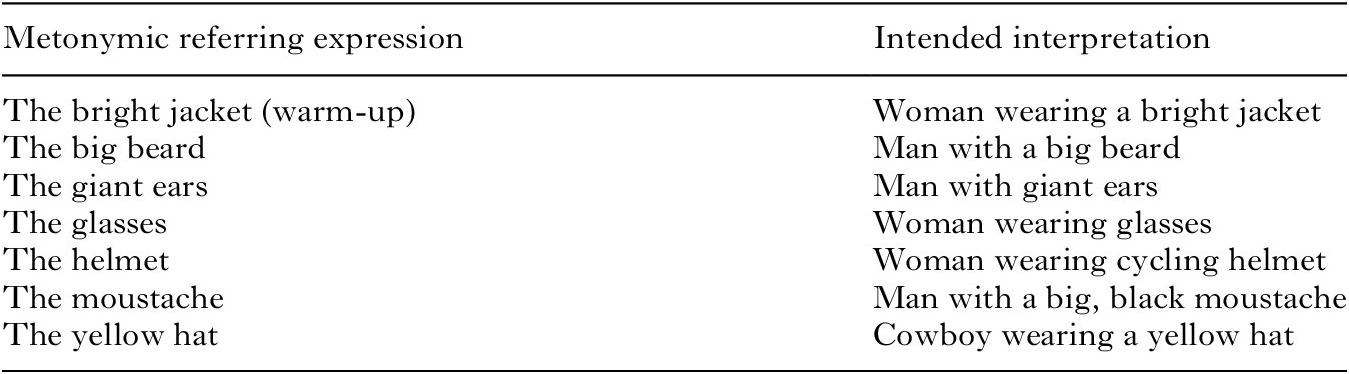
The metonymic materials (warm-up and experimental) are presented in Table 1.
Comprehension task metonymic materials

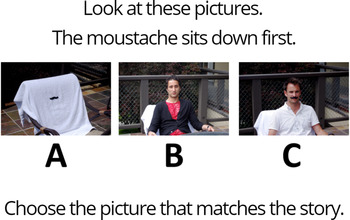
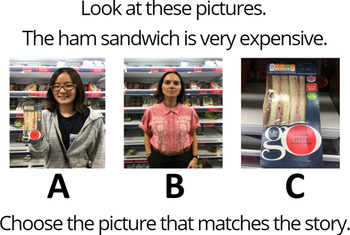
The second component of the set was a trio of smaller pictures, presented together. These pictures showed each individual in the story, and the salient characteristic by itself. The pictures were accompanied by (i) the task instructions, and (ii) a repetition of the target utterance, presented above the pictures (see Figures 3 and 4).
Comprehension task stimulus, metonymic condition: picture choices for the ‘moustache’ story.

Comprehension task stimulus, literal condition: picture choices for the ‘ham sandwich’ story.

Procedure
Participants first saw two warm-up picture sets (one metonymic, one literal), followed by 12 experimental trials. For each experimental trial, participants viewed the ‘context’ picture while reading a short story in English. The critical referring expression occurred in the final sentence of the story. Participants then advanced to another screen, where they were asked to select the picture that best matched the story from the following three choices: (i) metonymic referent: the bearer of the salient characteristic (option C in Figure 3); (ii) literal referent: the characteristic by itself (option A in Figure 3); and (iii) distractor: another participant in the story (option B in Figure 3). In the metonymic condition, the metonymic referent was the target referent, while the literal referent was the incorrect interpretation of the critical referring expression. In the literal condition, the metonymic referent was the incorrect interpretation, while the literal referent was the target. The position (left, middle, right) in which the pictures appeared was counterbalanced, while the order of presentation of the trials was fully randomised across subjects.
2.2.2. Results
Japanese adult EAL learners vs. native English speakers
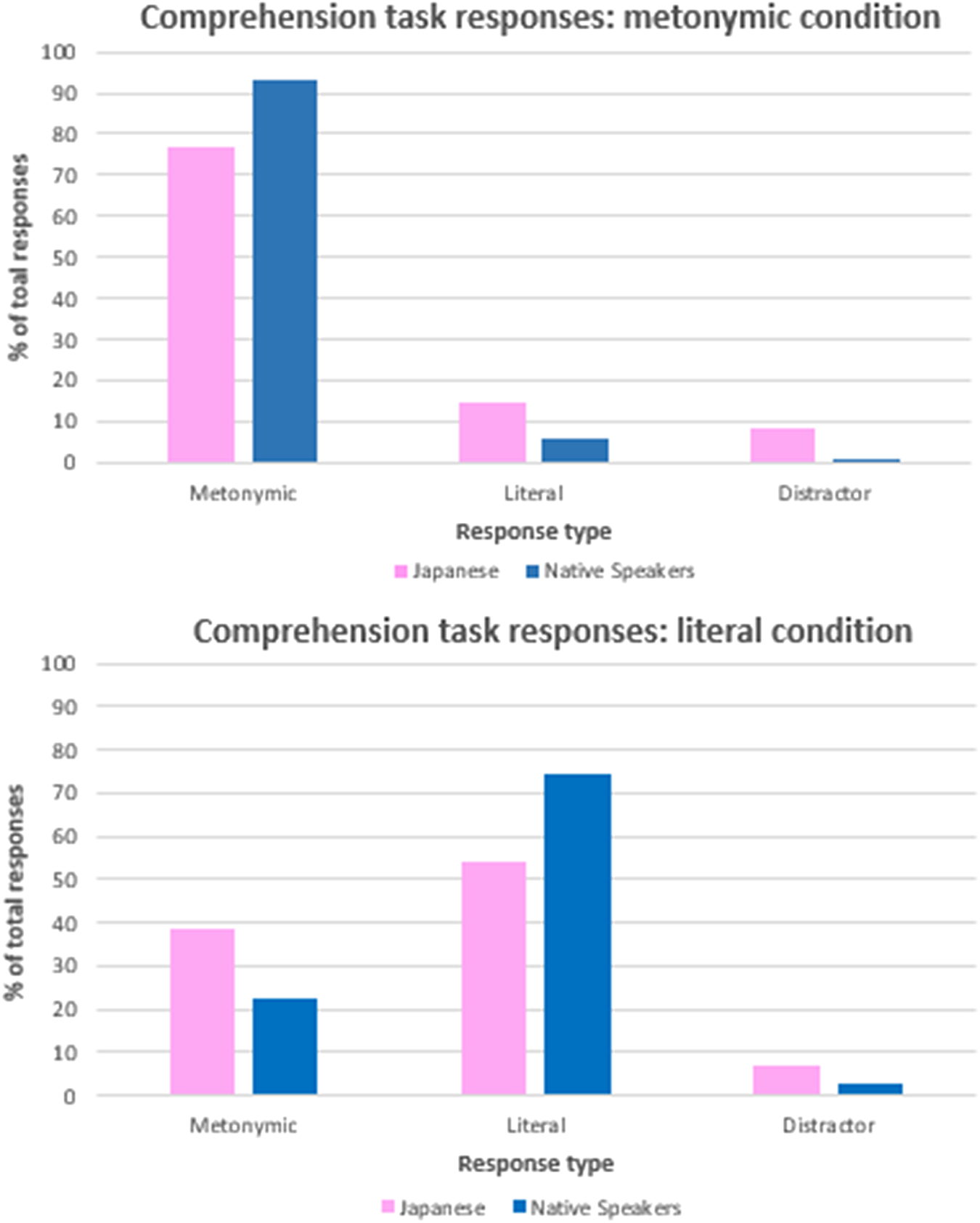
The participants’ answers to the 12 picture-selection questions were treated as a categorical variable with three levels: Metonymic reading, Literal reading, and Distractor. Given that we were dealing with categorical data, we performed a binary logistic regression analysis, which is more appropriate for this type of data than ANOVA (cf. Jaeger, Reference Jaeger2008). All analyses were carried out using SPSS 22. First, we examined comprehension of the metonymic referring expressions, i.e., metonymic responses vs. all other responses in the metonymic condition (see Figure 5). Our predictor variables were: (i) L1 (Japanese vs. English, English as baseline), and (ii) condition (metonymic vs. literal, metonymic as baseline). To further tease apart L1 effects on comprehension in the two conditions, we included an interaction term, L1*condition. The analysis revealed a significant main effect of L1 (p < .001) and a significant L1*condition interaction (p < .001). Specifically, Japanese adult EAL learners were significantly less likely than native English speakers to choose a metonymic reading for a metonymic target referring expression (B = –2.588, OR = 0.114, 95% CI [0.052, 0.251]).
Percentages of metonymic, literal, and distractor responses in the two conditions (metonymic vs. literal targets), by L1.

We also examined L1-determined differences within the literal condition (see Figure 5), by conducting an additional binary logistic regression analysis, with the same dependent and predictor variables as before, but with ‘literal’ as the baseline for condition. Once again, we found a significant main effect of L1 on comprehension (p < .001). Compared to native English speakers, Japanese adult EAL learners were significantly less likely to choose a literal reading for a literal target referring expression (B = –1.927, OR = 0.146, 95% CI [0.063, 0.339]). Thus, the performance of the Japanese adult EAL learners was not as successful as that of native English speakers. Nevertheless, the Japanese participants were able to comprehend both metonymic and literal referring expressions in English, choosing the correct reading at above-chance levels.
Finally, a multinomial logistic regression analysis of the effect of condition (metonymic vs. literal) on the dependent variable of response-type (metonymic, literal, distractor) showed a clear effect of condition on response-type, with both Japanese adult EAL learners and native English speakers being more likely to select a metonymic reading than a literal or a distractor reading in the metonymic condition, compared to in the literal condition (literal: p < .001, B = 2.829, OR = 16.298, 95% CI [11.395, 25.145]; distractor: p = .005, B = 0.996, OR = 2.629, 95% CI [1.335, 5.174]). Taken together, these results further suggest that, despite showing poorer performance overall than native English speakers, Japanese adult EAL learners are indeed able to comprehend novel metonymic referring expressions in English.
Japanese adult EAL learners: a closer look
We examined the data from the Japanese participants alone, in order to determine whether performance on the comprehension task was affected by English-language ability level. One of the Japanese participants neglected to state their English-language ability level; therefore, their responses were omitted from the following analyses, and from all further analyses for the game-naming and character-naming tasks in which ability level was a predictor.
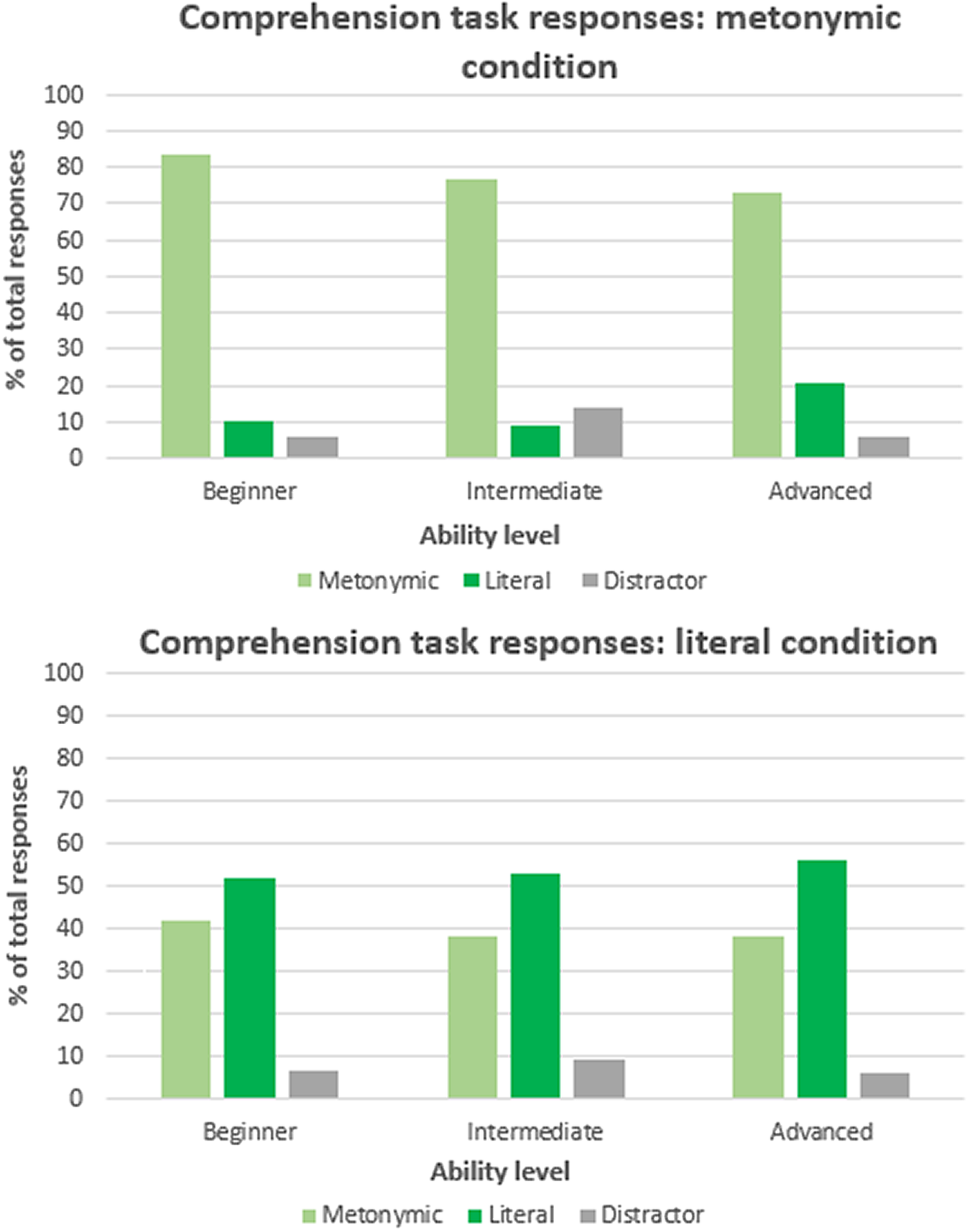
As with the Japanese/English comparison analyses, we performed a binary logistic regression to examine comprehension of the target referring expressions, this time using the predictors ability level (Beginner vs. Intermediate vs. Advanced, Beginner as baseline) and condition (metonymic vs. literal, metonymic as baseline), and including an ability level*condition interaction term. Ability level and the ability level*condition interaction were found to be non-significant in both the metonymic condition (ability level: p = .894, ability level*condition: p = .274) and the literal condition (ability level: p = .377, ability level*condition: p = .695) (see Figure 6). The multinomial logistic regression analysis of the effect of condition (metonymic vs. literal) on the dependent variable of response-type (metonymic, literal, distractor) showed a clear effect of condition on response-type (p < .001, B = 1.999, OR = 7.382, 95% CI [4.496, 12.123]): across ability levels, participants were more likely to choose the metonymic response in the metonymic condition than in the literal condition.
Percentages of metonymic, literal, and distractor responses in the two conditions (metonymic vs. literal targets), by ability level.

2.2.3. Discussion
The results of the comprehension task show that even Beginner-level Japanese adult EAL leaners are able to comprehend novel cases of referential metonymy, at considerably above chance level – albeit not as successfully as native speakers, though this is most plausibly due to the fact that the Japanese participants have yet to achieve native-like competence in English. The results therefore suggest that the Japanese participants were able to grasp the conceptual principle exploited in the metonymic condition (referring to a person in terms of a salient characteristic), and to understand its productive use in reference-making in English, indicating that the strategy of drawing on a contextually relevant relation of contiguity in order to make reference may be equally available in both L1 Japanese and an L2 (English, in this case).
2.3. game-naming production task
This task investigated the ability of Japanese adult EAL learners to use metonymic referring expressions as a ‘shorthand’ means of picking out novel objects. Specifically, we asked whether Japanese adult EAL learners would be able to make metonymic reference to a series of novel learning games in terms of the games’ distinctive features.
2.3.1. Method
Materials
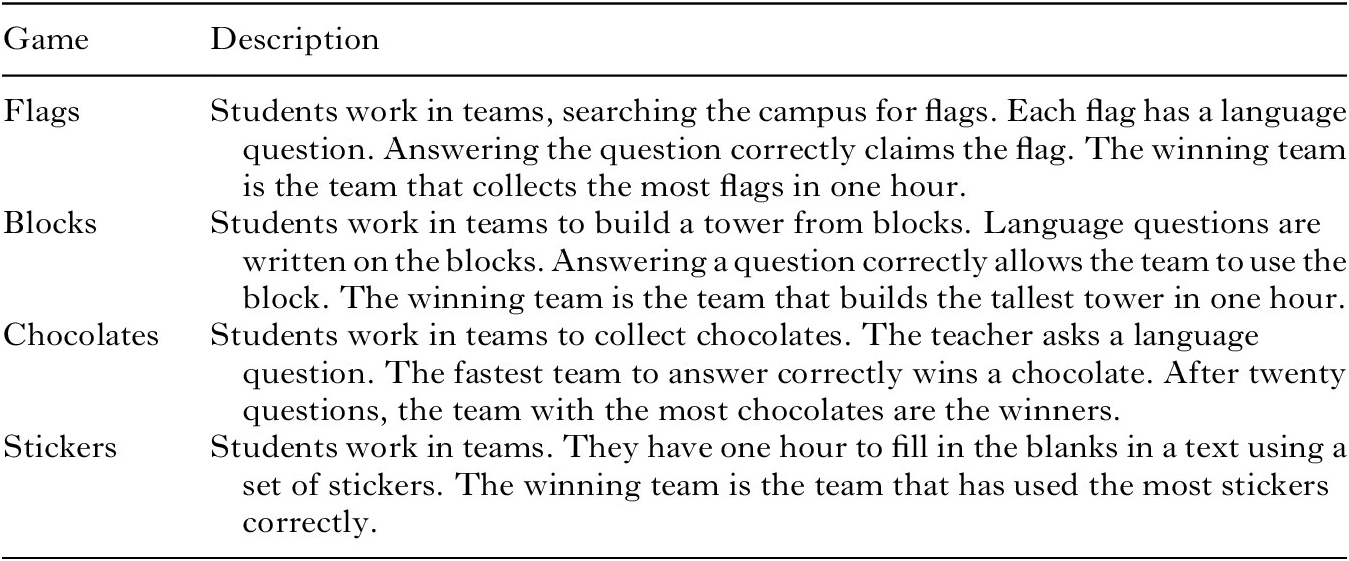
Four novel learning games appropriate for use during the summer school were designed specifically for this task, following the same pattern as Falkum et al. (Reference Falkum, Recasens and Clark2017) (see Table 2).
Learning games used in the game-naming production task

Procedure
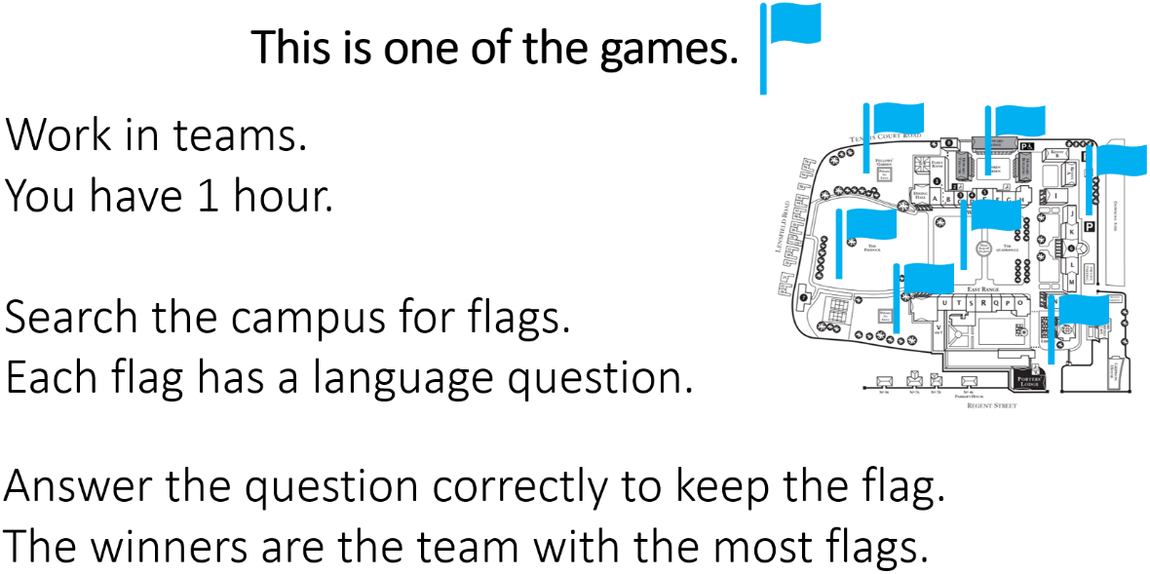
The task was presented as an exercise to elicit feedback regarding a set of new activities for teaching English grammar. Participants first saw an instruction screen, then advanced to access two of the novel learning games, presented one after the other. For each game, the rules were stated in simple, clear language, accompanied by a colourful diagram to represent the key aspects of the game (see Figure 7).
Game-naming task stimulus: rules and diagram for ‘flags’ game.

The games were not named. Each game was introduced by stating simply ‘this is one of the games’. This was to avoid inducing any biases in participants’ responses by providing them with strategies that could be made use of in referring to the games during the elicited production stage of the task; for example, if the games were introduced by stating ‘this is the first game … this is the second game’, participants may have produced the referring expressions ‘the first (game)’, ‘the second (game)’ at above-chance levels.
After seeing two of the games, participants advanced to the first response screen, where a referring expression was elicited for one of the games (‘Which game would you prefer to play?’). Subsequently, a referring expression was elicited for the other game in the pair (‘Can you remember the other game? Which game is it?’). After this, the same procedure was followed for the remaining two games, thereby eliciting two more referring expressions. The order of presentation of the four learning games was fully randomised.
Coding of responses
Participants’ responses were classified according to the following coding framework:
-
(i) Metonym, e.g., the flags, the chocolates
-
(ii) Compound, e.g., the flags game, the chocolates one
-
(iii) Literal Description, e.g., the game with the flags, the game where we have to collect chocolates
-
(iv) Verb Phrase, e.g., hunt flags, win chocolates
-
(v) Reference To Number/Order, e.g., 1, the former, (a)
-
(vi) Other, e.g., both sound good to me; also, responses with no obvious relation to the target game, e.g., lol
-
(vii) Don’t Remember/NA
Categories (i), (ii), (iii), (vi), and (vii) were also used by Falkum et al. (Reference Falkum, Recasens and Clark2017). However, categories (iv) and (v) are new additions to account for trends specific to the Japanese participants’ responses. These categories are of theoretical interest. Verb Phrase responses, while ‘metonymic’ in that they refer to the target game in terms of an identifying action, nevertheless differ from Metonym responses, as they are both more formally complex and more explicit. It is therefore an open question as to whether, compared to Metonym responses, Verb Phraseresponses will be dispreferred on account of their greater complexity, or preferred on account of their greater explicitness.
Reference to Number/Order responses, such as ‘the first’ or ‘2’, offer clear advantages to speakers: they are quick and easy to produce, and impose a low memory load, because the participant need only recall the sequence in which the two games were encountered, rather than the distinguishing features of each game (as would be required for a Metonym response). For this reason, it is of interest to determine the relative frequency of this response-type, in order to elucidate the importance of effort-reduction as a factor influencing language users’ choice of reference-making strategy.
2.3.2. Results
Japanese adult EAL learners vs. native English speakers
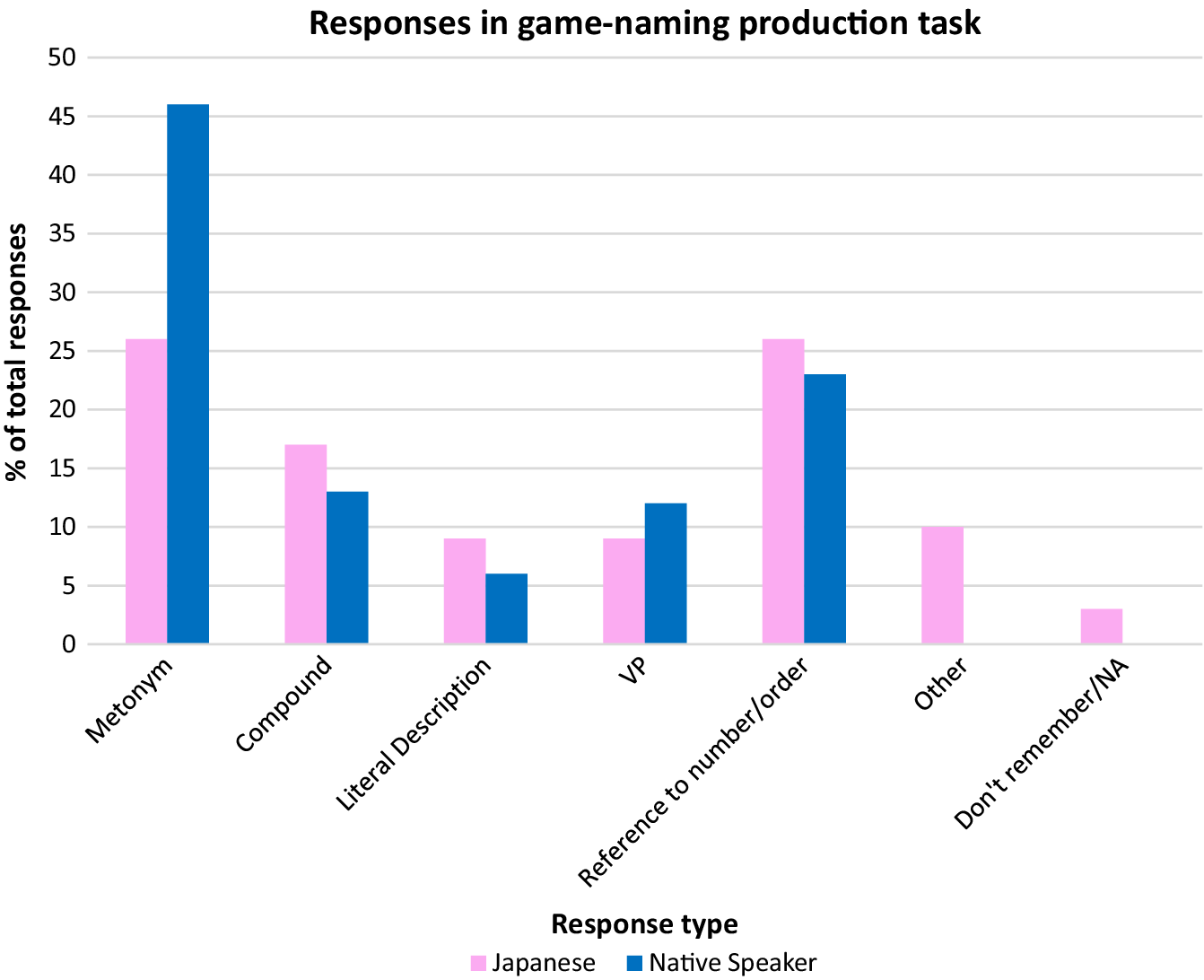
Figure 8 presents the percentages of responses in categories (i)–(vii), comparing the Japanese adult EAL learners with the native-speaker control group (all responses for this task can be found in the OSF repository).
Responses in game-naming production task, for Japanese adult EAL learners and native English speakers.

In analysing the response data, the dependent variable response-type was treated in two different ways. First, we tested the hypotheses that (i) Japanese adult EAL learners may make metonymic use of familiar words in order to fill vocabulary gaps and/or reduce the production costs associated with communicating in a non-native language, and (ii) compared to native English speakers, Japanese adult EAL learners may favour formally simpler constructions, such as metonyms, over more complex referring expressions, such as literal definite descriptions. Each response-type (i)–(vii) was treated as a dichotomous variable (i.e., Metonym vs. all other responses, etc.), and we ran binary logistic regression analyses.
Of particular interest were the categories Metonym, Compound, Literal Description, and Reference to Number/Order. Metonyms and references to number/order are both linguistically simple, thus it is plausible that the Japanese participants would rely more heavily on these strategies than the native English speakers, in order to minimise the challenges of communicating in an L2. Japanese participants may also produce fewer examples of more complex literal descriptions than native English speakers. Further, EAL learners may turn to L1 strategies to ‘bootstrap’ communication in their L2, especially in high-pressure contexts such as participating in an experiment. Thus, given the prevalence of compounding in Japanese, the Japanese EAL-learner participants may produce a greater number of compounds than the native-speaker control group.
In the binary logistic regression analyses, the predictor variable was L1, with English as the baseline. These analyses revealed a significant effect of L1 on metonym production (p = .003): native English speakers were more likely than Japanese adult EAL learners to come up with metonymic names for the novel learning games (B = 0.755, OR = 2.127, 95% CI [0.279, 0.794]). However, L1 was not significant for any of the other response categories of interest (Compound: p = .504, Literal Description: p = .164, Reference to Number/Order: p = .279). This suggests that, in terms of referring to novel objects, Japanese adult EAL learners do essentially what native English speakers do, although, regarding metonymy production, to a rather lesser degree.
Next, in order to compare the production of response-types (i)–(vii) for Japanese adult EAL learners vs. native English speakers, we treated response-type as a multilevel categorical variable and ran multinomial regression analyses, with Metonym as the baseline for response-type, and English as the baseline for L1. For Compound vs. Metonym, there were no significant L1-dependent differences (p = .086); nor were there for Reference to Number/Order vs. Metonym (p = .467). For Literal Description vs. Metonym, native English speakers produced far fewer literal descriptions than metonyms, compared to Japanese adult EAL learners (p = .034, B = –1.153, OR = 0.316, 95% CI [0.109, 0.916]). Likewise, for Verb Phrase vs. Metonym and Other vs. Metonym, the production of verb phrases and other responses was significantly lower than the production of metonyms for native English speakers compared to Japanese adult EAL learners (Verb Phrase: p = .031, B = –0.711, OR = 0.491, 95% CI [0.257, 0.938]; Other: p = .013, B = –2.657, OR = 0.070, 95% CI [0.009, 0.577]). This suggests that, in comparison to the native-speaker group, who primarily produced Metonym responses, Japanese adult EAL learners used a wider variety of forms to refer to the novel learning games.
Japanese adult EAL learners: a closer look
Focusing solely on the Japanese data, we tested the prediction that less proficient learners of English may favour linguistically simpler reference-making strategies such as metonymy.
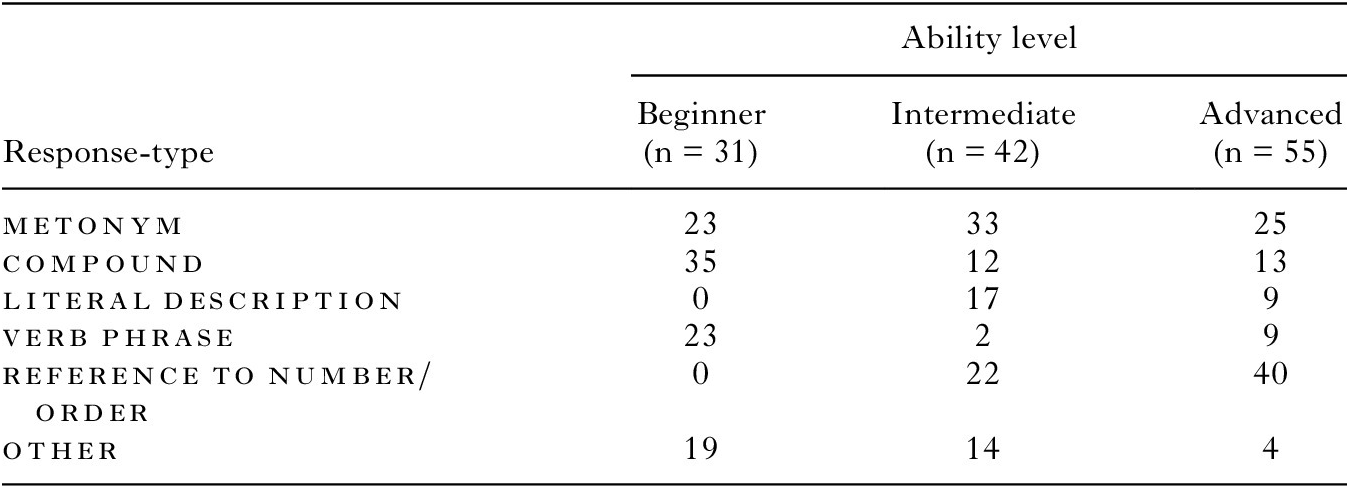
We ran the same set of binary regression analyses as for the Japanese/English comparison, examining the effects of L2 proficiency on each response-type (see Table 3), beginning with the production of Metonym responses as a function of ability level (Beginner, Intermediate, Advanced; Beginner as baseline). Here, the effect of ability level was not significant (p = .479). Regarding the other response-types, ability level was not significant for the response-types Compound (p = .275), Literal Description (p = .982), Verb Phrase (p = .054), or Other (p = .127). However, for Reference to Number/Order responses, there was a significant effect of ability level (p = .016), with Beginner-level participants differing from both Intermediate-level and Advanced-level participants. Contrary to expectations, Beginner-level participants produced significantly fewer examples of this response-type than more proficient participants (Beginner vs. Intermediate: p = .011, B = –2.74, OR = 0.065, 95% CI [0.008, 0.527]; Beginner vs. Advanced: p = .004, B = –3.10, OR = 0.048, 95% CI [0.006, 0.381]).
Percentages of response-types elicited in the game-naming task, by English-language ability level

In the second, multinomial regression analysis, we investigated the dependent variable of response-type as a function of ability level, with Metonym as the baseline for response-type, and Beginner as the reference category for ability level. Focusing on the response-types of key interest (Compound, Literal Description, Reference to Number/Order), there were no significant differences from Metonym at any ability level for Compound and Literal Description (p values > .05). However, for Reference to Number/Order, Advanced-level participants were more likely to produce this response-type than Metonym responses, compared with Beginner-level participants (p = .023, B = 2.53, OR = 12.57, 95% CI [1.42, 111.68]). This result supports the surprising preference, first revealed in the binary logistic regressions, for references to number/order among more proficient participants.
2.3.3. Discussion
The results of the game-naming production task show that, as predicted, Japanese adult EAL learners are able to produce novel examples of referential metonymy as ‘shorthands’ for referring to objects. Further, the results suggest that adult EAL learners are able to draw upon the apprehension of contextually relevant associative relations (in this case, between games and their distinctive components) to produce novel referring expressions in L2.
For both the Japanese adult EAL learners and the native-speaker participants, the most frequently produced response-types for referring to the novel learning games were metonyms and references to number/order. These two referring strategies were equally prevalent in the responses of the Japanese participants (total metonyms produced = total references to number/order produced = 35). This suggests that, in the absence of an established expression for a target object, both metonymy and references to number/order may offer communicative advantages that make these strategies especially attractive to adult EAL learners as ways of compensating for vocabulary gaps and/or limited expressive capacities. In particular, metonyms and references to number/order are formally more simple than other types of referring expression, such as noun–noun compounds (e.g., ‘the flags game’) or full descriptive phrases (e.g., ‘the game where you have to collect flags’); and may also impose fewer cognitive demands in terms of short-term memory load or planning for speaking. These factors are likely to be important when an individual is already faced with the challenge of communicating in L2, and may therefore have fewer cognitive resources to spend on formulating and holding in mind longer, more complex constructions.
Contrary to our initial prediction that Beginner-level participants would rely more heavily on metonymy than Intermediate- and Advanced-level participants, due to having more limited expressive capacities, English-language proficiency level did not affect metonym production. Rather, it appears that referential metonymy is equally attractive as a reference-making strategy across L2 proficiency levels. Intriguingly, however, there was a significant effect from ability level on the production of Reference to Number/Order responses. Given the relative formal and conceptual simplicity of this response-type, it was predicted to be more prevalent among Beginner-level participants than Intermediate- and Advanced-level participants. Instead, Intermediate- and Advanced-level participants produced significantly more references to number/order than Beginners. This finding may plausibly be explained by appealing to the notion of ‘communicative caution’, i.e., the drive to reduce the risk of misunderstandings and breakdowns in communication (cf. Rabagliati et al., Reference Rabagliati, Marcus and Pylkkänen2010).
Of the response-types (i)–(vii), references to number/order are arguably the least explicit. For this reason, they may be classed as a riskier, ‘low-caution’ means of reference-making: there is a chance that the audience may misremember the order of presentation of the games, and consequently may fail to correctly identify the intended game. In contrast, more explicit response-types, like literal descriptions, are ‘higher caution’, because they overtly spell out more of the speaker’s intended meaning, thereby reducing the amount of defeasible pragmatic reasoning required for utterance interpretation.
We hypothesise that very low-caution strategies like references to number/order may be dispreferred by Beginner-level participants, for whom interactions in L2 are likely to be especially demanding, due to limited vocabulary and syntactic knowledge. This potentially leaves them with fewer cognitive resources for carrying out repair operations in the event of unsuccessful communication; therefore, they may instead adopt a cautious approach to communication from the outset, in order to minimise the risk of costly misunderstandings. However, more proficient L2 learners, like the Intermediate- and Advanced-level participants, are plausibly more confident, both in their ability to communicate successfully the first time round, and also in their ability to resolve cases of miscommunication. Hence, they may display reduced communicative caution compared to less proficient learners, prioritising instead goals such as the reduction of production effort. This may account for the observed preference for the maximally simple response-type Reference to Number/Order among these participants.
2.4. character-naming production task
This task investigated whether, in addition to novel metonymic labels for objects (as in the game-naming production task), Japanese adult EAL learners are also able to produce metonymic names for story characters, by exploiting the relationship between an individual and his/her distinctive features. In the task, we manipulated two factors: (i) the amount of time participants had to respond (no time limit vs. 20-second time limit), and (ii) whether or not participants were exposed to examples of metonymic names prior to beginning the task.
2.4.1. Method
Materials
Eighteen pairs of pictures depicting an individual with a distinctive feature/characteristic (e.g., a brightly coloured item of clothing, a moustache, a big sandwich, etc.) were created using digital pictures taken from open sources on the Internet. Nine pairs featured pictures of humans, while nine pairs featured pictures of animals (e.g., a rabbit, a fox, a cow, etc.). The animals were chosen to ensure that, across L2 ability levels, participants would be able to recognise the target animal and produce the correct name in English. The two individuals in each pair were visually identical except for one distinctive feature. The target individual in the pair, for whom participants were required to provide a name, was indicated by a large (red) arrow (see Figure 9).
Character-naming production task stimuli: human and animal targets.

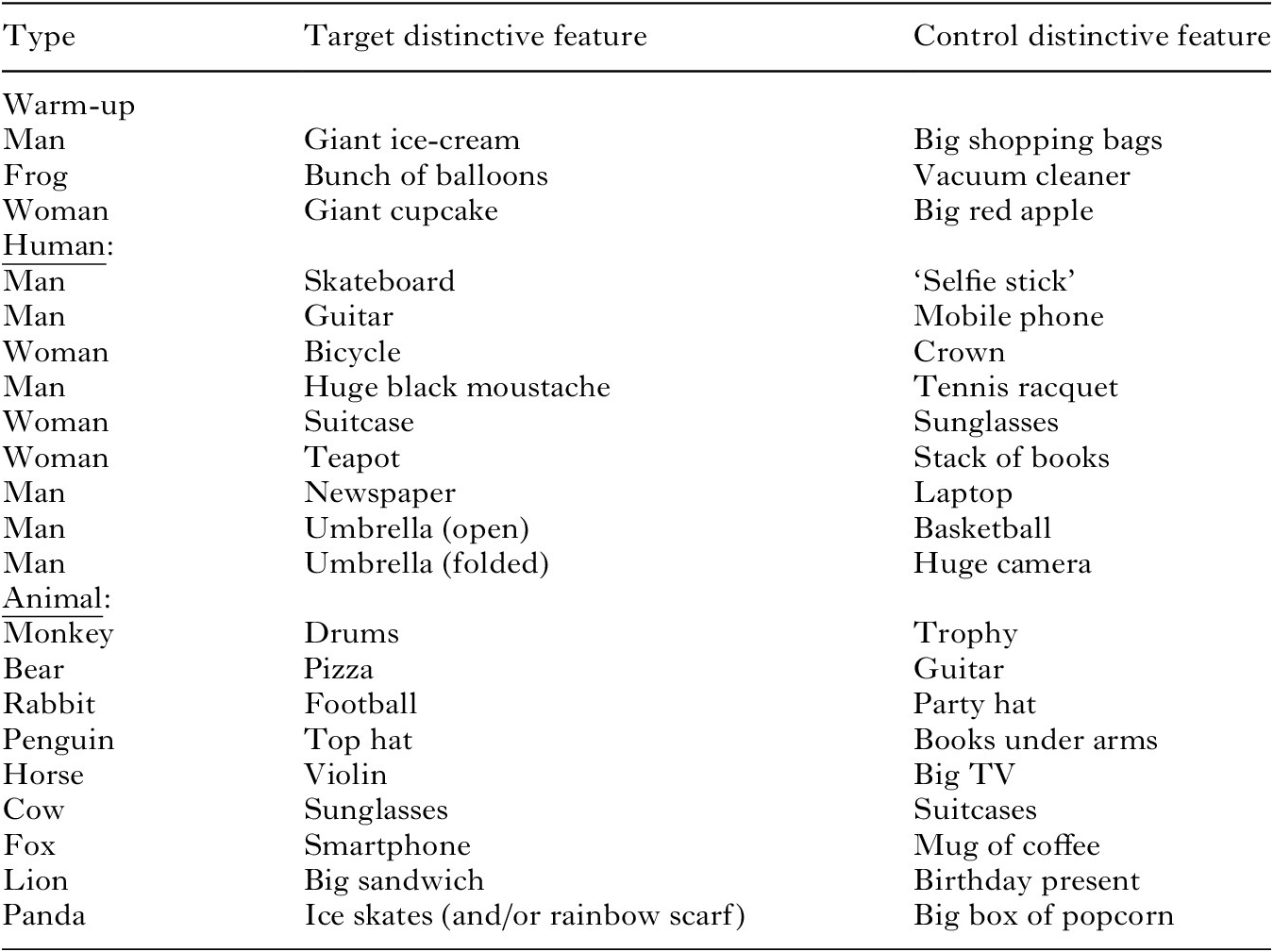
A further three pairs (two human, one animal) were created for use in warm-up trials for participants in the ‘+exposure’ conditions, who saw examples of names based on the metonymic pattern ‘property for individual’. The full list of character-pairs (including ‘+exposure’ condition warm-ups) are presented in Table 4.
Character pairs in character-naming production task: type and distinctive feature

Procedure
After the first, task-introduction screen, participants were randomly assigned to one of four conditions created by manipulating (i) time pressure, and (ii) exposure to examples of metonymic names instantiating the ‘property for individual’ metonymic pattern. The resulting combinations of manipulations are presented in Table 5.
The four experimental conditions resulting from combining the manipulations (i) ±time pressure, and (ii) ±exposure to examples

Participants in the [–pressure, –exposure] group were simply instructed to provide a name, in English, for the character marked with the arrow. They then advanced through the 18 experimental trials. Each pair of pictures was presented one at a time. The side on which the arrow appeared (left vs. right) was counterbalanced 50/50 across the pairs, and the order of presentation of the 18 pairs was randomised for each participant. Participants responded by typing a name into a text box. The task was formatted so that participants could not move on without providing a response.
The task was identical for participants in the [+pressure, –exposure] group; however, participants were warned that they had only 20 seconds to provide a name. For participants in the ‘+exposure’ groups, three examples were given before the experimental trials started (see Figure 10). Participants in the [–pressure, +exposure] group were not given a time limit, whereas participants in the [+pressure, +exposure] group were given a 20-second time limit.
Example for character-naming production task ‘+exposure’ conditions.

Coding of responses
Participants’ responses were classified according to the same coding framework used by Falkum et al. (Reference Falkum, Recasens and Clark2017) for their character-naming task:
-
(i) Metonym, e.g., Violin, Skates; cases where the L1 Japanese word is used metonymically, as in Hige (= beard/moustache).
-
(ii) Compound, e.g., suitcase woman, pizza bear. Also, novel portmanteau words that can plausibly be treated as the phonological contraction of a compound, e.g., iphox = iphone fox, sandlion = sandwich lion. For a response to count as a compound, both components must contribute to reference resolution. For example, in the response skating panda, one component specifies the category of entity to which the referent belongs (the character is a panda), while the other specifies an identifying property of the referent (the target character is skating, which distinguishes it from the non-target character, a panda who is eating popcorn). Compare the response pizza slice, to refer to a bear who is pictured with a slice of pizza. Although this response has two components, it is nevertheless a metonym, not a compound, because it denotes only the distinguishing feature of the target referent (vs. e.g., pizza slice bear, which specifies both the referent’s category and an identifying aspect).
-
(iii) Literal, covering both (a) cases where the literal name for the target character is used, e.g., cow, man etc.; and (b) literal descriptions, e.g., the woman with the teapot.
-
(iv) Proper name (English or Japanese), e.g., Dave, Yumiko.
-
(v) Other (made-up/nonsense names; other unclassifiable responses), e.g., kuroon, me, my shoe size is 7.
-
(vi) Na (no answer; incomplete answer; participant responds I don’t know).
Names formed through use of the agentive morpheme -er (e.g., drummer, skater, etc.) are classed as Metonym responses, as are names that make reference to the character’s profession (e.g., entrepreneur), due to the fact that the names in question are based on a salient, defining aspect of the target character (i.e., what the character does, or his/her occupation). Thus, they instantiate the same principle as cases of metonymic naming proper, wherein a character is named in terms of a relevant attribute or of something closely related to him/her.
Further, responses of the type exemplified by cases such as rhythm (= man playing the guitar), café (= lady with a teapot) and yamee ‘yummy’ (= lion eating a sandwich) are also treated as instances of the Metonym category. These names are not based on the directly perceivable identifying characteristic of the target (i.e., the guitar, the teapot, the sandwich), yet nevertheless pick up on some relevant aspect of background knowledge that is associated with the distinctive feature in question (e.g., that guitars/guitar-players have rhythm, that people typically serve tea from a teapot in a café, that a big sandwich would taste yummy, etc.). They may therefore be analysed as exploiting metonymic relations, between the target character and other relevant entities or properties that are made accessible through the character’s defining aspect.
Finally, names of the form ‘Mr/Mrs X’ are coded in terms of the conceptual basis of ‘X’. Hence, a name such as Mrs Pot (= lady with a teapot) is a Metonym response, because it exploits the relationship between the character and her distinctive feature (the teapot); whereas a name such as Mr Bunny (= rabbit with a football) is a Literal response, because the target character is a literal rabbit. This procedure allows for a better understanding of the degree to which, across a range of different possible name-forms, the perception of metonymic ‘individual-property’ relations is drawn upon in order to name characters.
2.4.2. Results
Japanese adult EAL learners vs. native English speakers
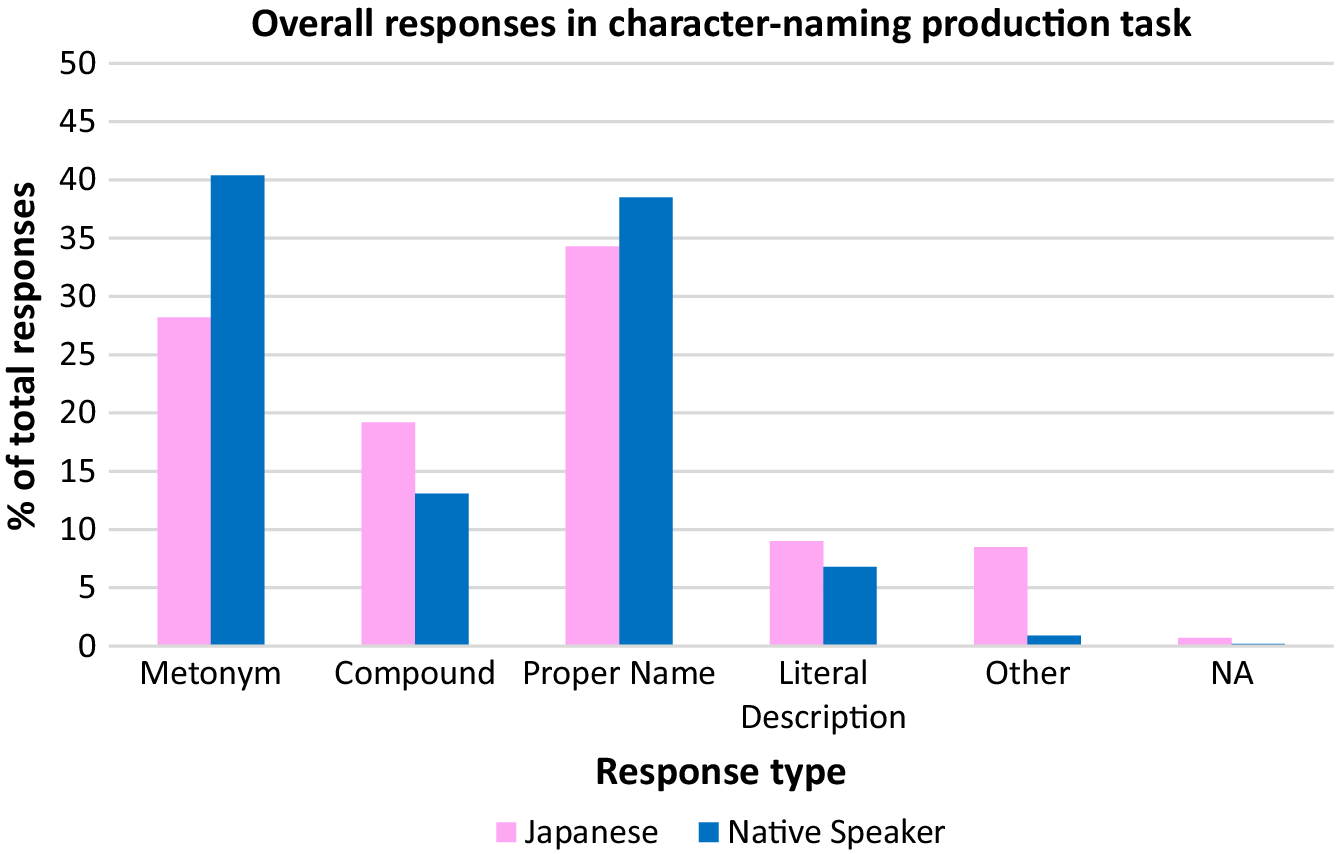
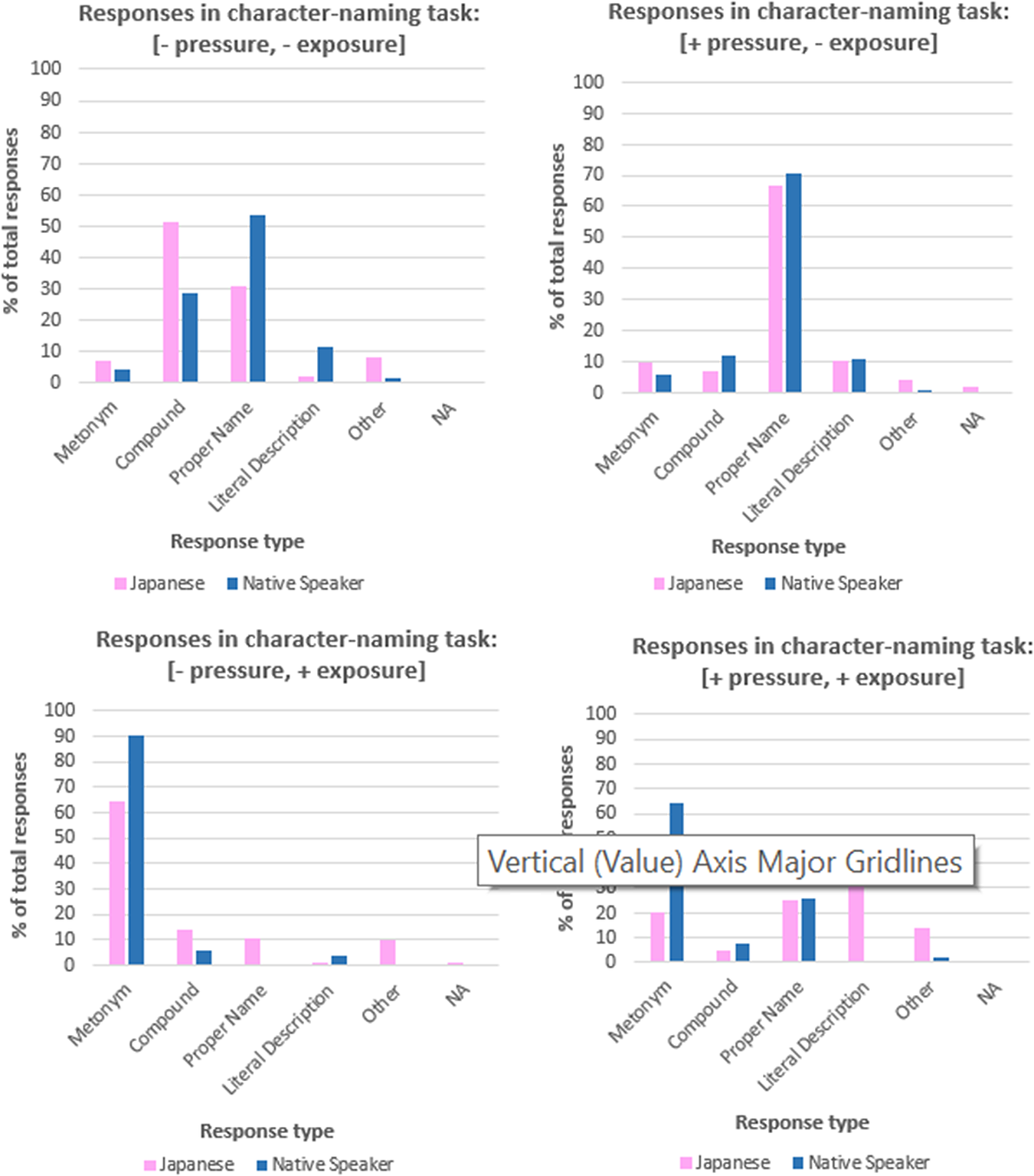
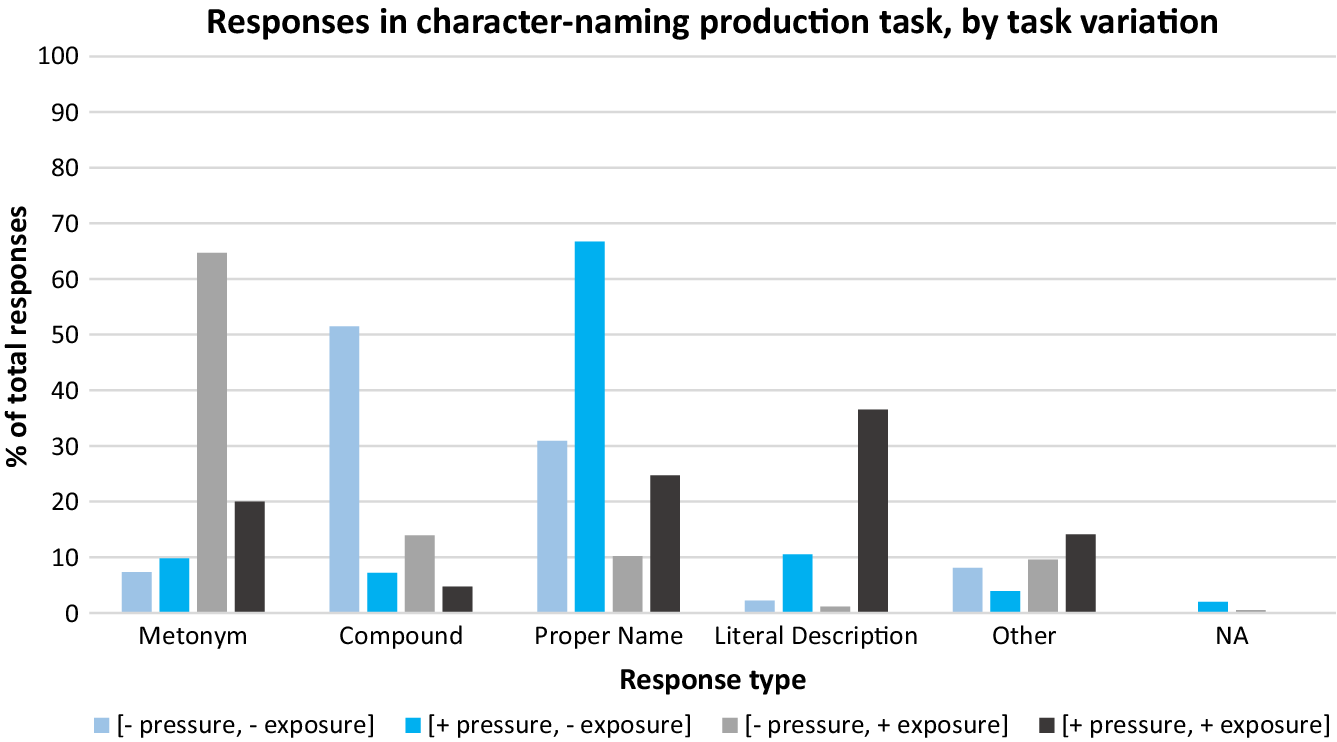
Figure 11 presents the overall percentages of responses in categories (i)–(vi), comparing the Japanese adult EAL learners with the native-speaker control group; while Figure 12 shows responses for the two groups, critical and control, by task variation (see the OSF repository for all responses).
Overall responses in character-naming production task, for Japanese EAL learners and native English speakers.

Responses in character-naming production task, for Japanese EAL learners and native English speakers, by task variation.

Following the same procedure used for the game-naming production task, the character-naming data was analysed in two different ways. First, in order to ascertain whether Japanese adult EAL learners are able to produce metonymic names for story characters, and to compare their output with that of the native-speaker control group, we focused on participants’ Metonym responses, which were treated as a dichotomous variable (Metonym vs. all other response-types) and analysed using binary logistic regression. The predictor variables were L1, with English as the baseline, and task variation, with the [–pressure, –exposure] condition as the baseline. An interaction term, L1*task variation, was also included, to investigate how Japanese adult EAL learners’ sensitivity to the ‘time pressure’ and ‘exposure’ manipulations may differ from that of native speakers.
The analysis revealed a significant main effect from L1: Japanese adult EAL learners were less likely to produce metonymic names than native speakers (p < .001, B = –1.979, OR = 0.138, 95% CI [0.072, 0.265]). However, Japanese adult EAL learners were still able to formulate a considerable number of metonymic names, which comprised 28.2% of their overall output, making metonyms the second most prevalent response-type after proper names (34.3% of total responses). There was also a significant main effect from task variation (p < .001). For both Japanese and native-speaker participants, the production of metonymic names increased in the two [+exposure] conditions ([–pressure, +exposure]: p = .004, B = 1.261, OR = 3.528, 95% CI [1.493, 8.336]; [+pressure, +exposure]: p = .035, B = 0.811, OR = 2.250, 95% CI [1.060, 4.778]). However, in the [+pressure, –exposure] condition, production of metonymic names significantly decreased (p < .001, B = –1.961, OR = 0.141, 95% CI [0.076, 0.259]) (see Figure 12). Finally, the interaction between L1 and task variation was also significant (p < .001). The effects of exposure appear to be more pronounced for individuals who are more proficient in the target language: in the two ‘+ exposure’ conditions, the increase in production of metonymic names was greater for the native-speaker control group than for the Japanese participants ([–pressure, +exposure]: p < .001, B = 2.555, OR = 12.868, 95% CI [4.378, 37.823]; [+pressure, +exposure]: p < .001, B = 2.459, OR = 11.695, 95% CI [3.195, 42.806]).
These results suggest that Japanese adult EAL learners are indeed able to successfully produce metonymic names for individuals, especially when exposed to examples of this type of name. The fact that production of metonymic names was adversely affected in the [+pressure, –exposure] condition, for both the Japanese and the native-speaker participants, may indicate that the production of metonymic names requires a certain degree of time and cognitive effort.
Additionally, we compared the production of response-types (i)–(vi) for Japanese adult EAL learners vs. native English speakers, by treating response-type as a multilevel categorical variable and running multinomial regression analyses. Metonym was the baseline for the dependent variable of response-type, English was the baseline for the predictor L1, and the [–pressure, –exposure] condition was the baseline for the predictor task variation. This analysis brought to light additional effects from L1. Most notably, Japanese participants produced significantly more compounds than native speakers (p < .001, B = 1.221, OR = 3.389, 95% CI [2.154, 5.333]; however, there were no significant L1 effects for proper names (p = .801) or for literal descriptions (p = .996).
The effects of the [+exposure] conditions were also highlighted. Compared to metonyms, the production of Compound responses decreased significantly in the [–pressure, +exposure] condition (p < .001, B = –4.179, OR= 0.015, 95% CI [0.008, 0.030]), and in the [+pressure, +exposure] (p < .001, B = –3.881, OR = 0.159, 95% CI [0.072, 0.384]). Likewise for Proper name responses, production fell in the [–pressure, +exposure] condition (p < .001, B = –4.723, OR = 0.009, 95% CI [0.004, 0.019]) and in the [+pressure, +exposure] condition (p < .001, B = –2.591, OR = 0.075, 95% CI [0.039, 0.114]); and the same went for Literal DESCRIPTION responses ([–pressure, +exposure]: p < .001, B = –3.898, OR = 0.019, 95% CI [0.006, 0.053]; [+pressure, +exposure]: p = .003, B = –1.267, OR = 0.282, 95% CI [0.114, 0.643]). Lastly, the production of Other responses also declined relative to that of Metonym responses in the [–pressure, +exposure] condition (p < .001, B = –2.989, OR = 0.050, 95% CI [0.028, 0.128]). This again shows that exposure to examples of metonymic ‘property for individual’ names has a facilitatory effect on participants’ own production of such names. The odds ratios suggest that this effect was largest in the [–pressure, +exposure] condition, where participants plausibly had time to reflect on the examples they had seen, and consider how they might be used in formulating responses.
Japanese adult EAL learners: a closer look
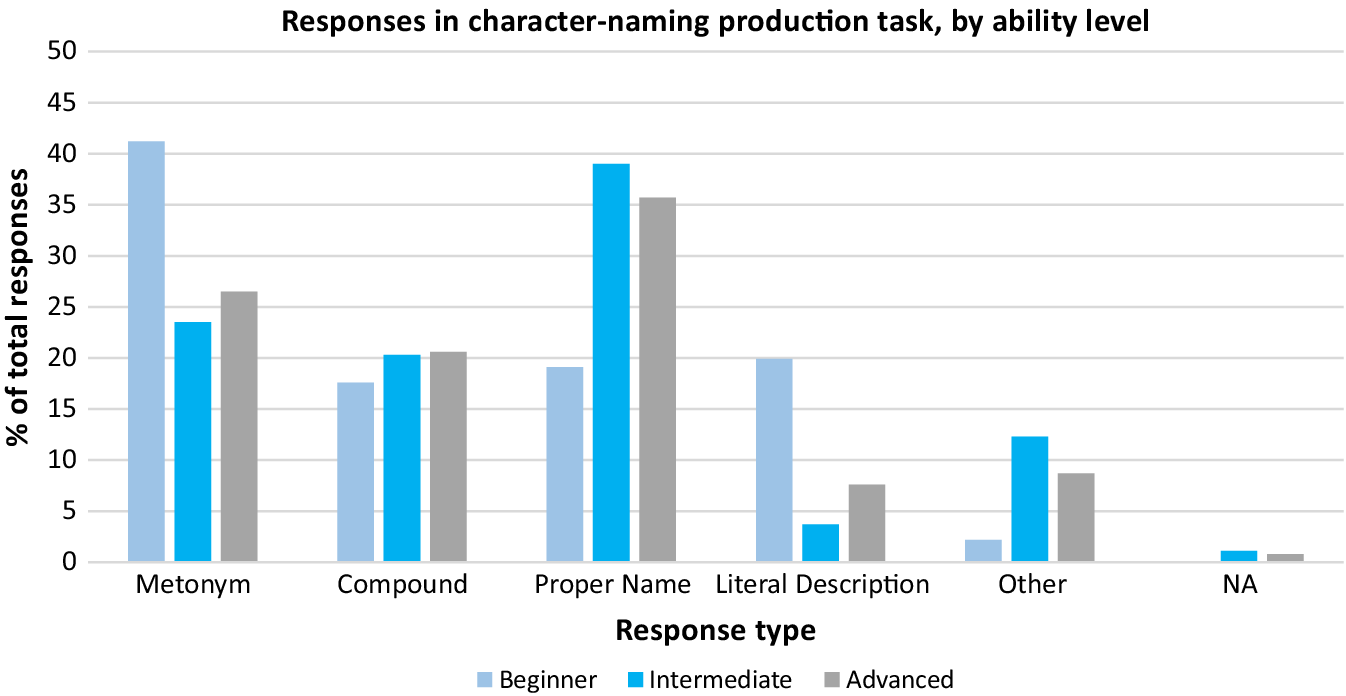
We examined the Japanese data on its own, in order to determine (i) whether English-language proficiency level affected participants’ performance, and (ii) whether there were any group-specific effects of the time-limit and exposure manipulations. Figure 13 shows responses by English-language proficiency level, while Figure 14 shows responses by task variation.
Japanese adult EAL learners’ responses in character-naming production task, by English-language proficiency level (Beginner, Intermediate, Advanced).

Japanese adult EAL learners’ responses in character-naming production task, by task variation (manipulations ±pressure, ±exposure to examples).

First, we ran a binary regression analysis, with Metonym production as the dependent variable. The predictors were (i) ability level (Beginner, Intermediate, Advanced; Beginner as baseline), and (ii) task variation ([–pressure, –exposure] as baseline). We also included an interaction term, ability level*task variation, to ascertain whether sensitivity to time pressure and/or exposure to examples differed across English-language ability levels. The analysis revealed no significant effect of ability level (p = .839). However, there was a main effect of task variation (p < .001), and a significant interaction between ability level and task variation (p = .028). Participants produced a significantly greater number of metonyms than other response-types in the [–pressure, +exposure] task variation, compared to in the [–pressure, –exposure] variation (p < .001, B = 2.316, OR = 10.131, 95% CI [2.905, 35.276]). Regarding the ability level*task variation interaction, for Advanced-level participants, production of metonymic names increased significantly more than for Beginner-level participants in the [–pressure, + exposure] task variation (p = .002, B = 3.656, OR = 38.694, 95% CI [3.633, 412.144]). This further supports the conclusion that exposure to examples of metonymic names significantly increases their production, and again suggests that this effect may be enhanced for individuals who are more proficient in the target language.
Additionally, we compared the production of metonymic names against that of the other response-types by treating response-type as a multilevel categorical variable and performing multinomial regression, with Metonym as the baseline response-type. The baselines for the predictors were identical to those in the binary logistic regression analyses. The most significant result is that exposure to examples of metonymic naming in the absence of time constraints on responding – i.e., the [–pressure, +exposure] task variation – had a significant effect on all answer-types, leading to a decrease in their production relative to that of metonymic names (Compound: p < .001, B = –4.077, OR = 0.017, 95% CI [0.007, 0.042]; Literal Description: p = .001, B = –3.159, OR = 0.042, 95% CI [0.006, 0.297]; Proper name: p < .001, B = –3.803, OR = 0.022, 95% CI [0.009, 0.057]; Other: p < .001, B = –2.315, OR = 0.099, 95% CI [0.033, 0.296]). Also, similarly to in the game-naming task, where the maximally low-effort response-type Reference to Number/Order was preferred by the more proficient participants (see §2.3.2), Intermediate-level and Advanced-level participants were found to produce significantly more Proper name responses than Beginner-level participants (Intermediate: p = .010, B = 0.997, OR = 2.711, 95% CI [1.269, 5.791]; Advanced: p < .001, B = 1.762, OR = 5.823, 95% CI [2.734, 12.403]).
2.4.3. Discussion
The results from this task provide further evidence that Japanese adult EAL learners can indeed produce novel cases of referential metonymy in English: not only are they able to refer metonymically to objects (learning games, in the game-naming task), they are also capable of deriving metonymic names for individuals, some of which were highly creative and vividly imagistic; for example ‘Cactus Skateboard’ for a man pictured holding a skateboard, ‘Diamond Case’ for a woman pictured with a shiny suitcase, and ‘Mr Sassy’ for a cow wearing sunglasses (where the character was named in terms of a distinctive personality trait, sassiness, evidenced by the wearing of sunglasses).
In line with our predictions, we found that prior exposure to examples of metonymic ‘property for individual’ names had a significant facilitatory effect on production, for both Japanese adult EAL learners and native speakers. There are two possible explanations for this (both of which may have applied simultaneously). First, exposure to the examples may have raised the salience, and thus the accessibility of the associative relation between individuals and their distinctive features. It may also have been the case that the examples increased metonymic name production by making metonymy itself (as a communicative strategy) more easily available than other means of reference-making. For the Japanese participants, this may have reduced L1 interference, specifically from compounding (e.g., ‘moustache man’ for the character pictured with a big black moustache), which is highly productive in Japanese.
Without exposure to examples, and with the additional pressure of a strict time limit within which to respond (i.e., the [+pressure, –exposure] task variation), both Japanese and native-speaker participants resorted to using proper names (Japanese: 67% of responses for the condition; native speakers: 71% of responses for the condition). This may suggest that, for both groups of participants, the use of proper names represents a ‘good enough’ strategy for naming individuals. Unlike with metonymic names, proper names need not be ‘grounded’ (i.e., there need not be a relevant relation, like the ‘property for individual’ relation, between the name and the target referent). Proper names are therefore maximally quick and easy to produce when under time pressure, yet still serve to successfully identify the target individual. Indeed, this plausibly explains why, for the Japanese adult EAL learners, proper names were the most prevalent response-type overall, with just 16% of the 199 instances observed in total being ‘motivated’ (e.g., ‘Cowy’ for a cow wearing sunglasses; ‘Messi’ for a rabbit with a football, after the soccer star Lionel Messi).
A final point of note is that, as in the game-naming task, Intermediate-level and Advanced-level Japanese participants significantly preferred proper names – the least explicit, most formally simple reference-making strategy – over all other answer-types, and produced considerably more of these responses than did Beginner-level participants. This ran counter to our initial predictions, and to Falkum et al.’s (Reference Falkum, Recasens and Clark2017) findings for children: in their character-naming task, run with three-, four-, and five-year-olds and adults, it was the least proficient participants (the three-year-olds) who produced the higher number of proper names. This again points to a link between L2 proficiency, confidence in one’s communicative skills and ability to resolve misunderstandings, and a lower degree of communicative caution, evidenced by the use of less explicit forms (see game-naming task discussion, §2.3.3).
3. General discussion
Given the gap-filling and effort-reducing functions of referential metonymy, and the advantages it plausibly affords during language acquisition, the main goal of this study was to investigate Japanese adult EAL learners’ comprehension and production of novel cases of referential metonymy in English, in order to determine the role of referential metonymy in adult L2 acquisition: Would it provide adult L2 learners with a means of compensating for vocabulary gaps and limited expressive capacities to successfully make reference to target objects and individuals, as it is claimed to do in children’s L1 acquisition (cf. Falkum et al., Reference Falkum, Recasens and Clark2017)?
The study revealed that Japanese adult EAL learners do indeed use referential metonymy as a means of facilitating efficient reference-making. In both comprehension and production, their performance resembles that of native English speakers; albeit slightly less successful, most likely due to still-developing English-language abilities. The absence of any effects from English-language proficiency level (Beginner, Intermediate, Advanced) on metonymy comprehension and production may plausibly be explained by the fact that the Japanese participants are pragmatically mature adults; therefore, regardless of English-language abilities, they possess the ToM and metalinguistic capacities required for making innovative, non-literal use of established expressions.
Our picture-selection comprehension task showed that Japanese adult EAL leaners have no difficulty interpreting transparent novel metonyms in English (e.g., ‘the big beard’ for a man with a bushy grey beard). The next step is to build on this finding by determining, for L2 learners, the role played in comprehension by context; for example, by manipulating the presence vs. absence of licensing context in order to investigate how this may affect (i) the ability to predict upcoming content, and (ii) use of inferential pragmatic processes to arrive at a meaningful interpretation (cf. Schumacher, Reference Schumacher, Meibauer and Steinbach2011; Reference Schumacher2014).
Regarding referential metonymy production, the results of the game-naming task suggest that Japanese adult EAL learners are able to use referential metonymy to come up with ‘shorthand’ expressions for referring to objects (novel learning games). Likewise, in the character-naming task, Japanese adult EAL learners were able to produce metonymic names for individuals (story characters), and displayed the same facility in the character-naming task as in the game-naming task. Thus, unlike with children acquiring L1, for fully pragmatically competent adult L2 learners, the metonymic naming of individuals does not appear to be more challenging than the metonymic labelling of objects (see Falkum et al., Reference Falkum, Recasens and Clark2017, on L1 acquisition). The character-naming task further revealed that prior exposure to examples of metonymic names in English has a significant facilitatory effect on production, for both Japanese adult EAL learners and native speakers.
Taken together, these results suggest that, for adult L2 learners as much as for children acquiring L1 (Falkum et al., Reference Falkum, Recasens and Clark2017), referential metonymy may serve an important gap-filling function that allows the language-learner to compensate for a limited vocabulary by ‘repurposing’ existing words in reference-making. Metonymy is therefore an important skill for learners to master, because it increases the likelihood of successful reference resolution through drawing attention to a distinctive aspect of the target referent, yet does not impose unnecessary processing costs on the hearer; nor it is overly demanding for speakers to produce (see Bowerman, Reference Bowerman2019, pp. 25–26).
This has clear pedagogical implications. The use of metonymy (and other innovative and/or non-literal ‘repurposings’ of familiar vocabulary, such as metaphor and compounding) could be promoted in the EAL classroom to enhance learners’ expressive capacities, in particular in communicative scenarios where fluency (i.e., the expression of longer, more complex messages, and the maintenance of sustained discourse) is the main aim. Such a focus may help learners to derive maximum utility from their existing vocabulary in English, as well as building learners’ confidence, and facilitating interactions in English, both within and outside the classroom, by showing that successful communication may be achieved even in the absence of the ‘correct’ words. As suggested by the results of the character-naming task, use of innovative and/or non-literal phenomena may be enhanced by ‘modelling’.
A final, crucial, point is that the facilitation of efficient reference-making is not the only function of referential metonymy. Metonymy may also lead to additional relevant effects, such as the creation of vivid, amusingly surreal imagery (e.g., for the utterance ‘the moustache ( = man with a moustache) sits down first’, the mental picture of a huge moustache occupying a chair), or the expression of attitudinal/affective information towards the intended referent (for example, metonymic nicknaming, which often depends on privileged background information shared only between the nickname user(s) and the nickname bearer, may signal affection and social closeness). The same goes for other innovative usages of language, such as metaphor, which may even be especially effect-rich compared to metonymy. Thus, in many cases, innovative usages of language may not be motivated by considerations of efficiency alone, but also (even, primarily) by the desire to communicate additional effects (e.g., Bowerman, Reference Bowerman2019, pp. 26–27).
This suggests that a vital component of communicative competence is the ability to deploy innovative and/or non-literal usages of language to serve both motivations. If L2 education should promote linguistic innovations as efficiency-enhancing, gap-filling strategies, it should also aid learners in mastering ‘effect-creating’ linguistic innovations. This would help the L2 learner come closer to achieving native-like proficiency in terms of the ways in which s/he deploys established vocabulary, as well as having a general beneficial effect on expressive abilities.
Overall, this study shows that, for adult L2 learners (as is the case for children acquiring L1) referential metonymy is a useful and productive strategy for gap-filling and/or reducing effort in reference-making. In addition to being able to comprehend novel instances of referential metonymy in the target language, adult L2 learners are able to make metonymic use of familiar vocabulary as an innovative means of referring to both objects and individuals. This suggests that referential metonymy, and other phenomena of innovative and/or non-literal language use, may help adult L2 learners to become more fluent and competent communicators in the target language. Therefore, L2 educators may wish to actively promote the use of strategies like referential metonymy and compounding, a practice which may be facilitated by ‘modelling’.