Introduction
The plant kingdom is a vast storehouse of chemical substances manufactured and used by plants for defence against attack by insects. These substances may elicit strong physiological responses in various stages of an insect's life. Since these naturally occurring phytochemicals are usually biodegradable and non-toxic to plants and animals, they offer the potential for safe and effective control of stored product pests (Rembold, 1994). More than 30,000 secondary metabolites have been reported from plants (Wink, Reference Wink1988), with major groups of compounds with insecticidal activity being alkaloids, amines, non-protein amino acids, cyanogenic glycosides, glucosinolates, lectins and protease inhibitors – all of which are nitrogen-containing allelochemicals. Other allelochemicals are monoterpenes, sesquiterpenes, diterpenes, triterpenes/steroids, tetraterpenes, polyketides, polyacetylenes, flavonoids and phenylpropanoids (Nakanishi and Suzuki, Reference Nakanishi and Suzuki1998).
The problems caused by synthetic pesticides and their residues have increased the need for effective, biodegradable pesticides with greater selectivity. Alternative strategies have included the search for new types of insecticides and the re-evaluation, as well as the use, of traditional botanical pest control agents (Obeng-Ofori and Akuamoah, 1998). Common insecticides of plant origin are pyrethrum from Chrysanthemum cinerariifolium (Trevir.) Vis. (Asteraceae), which is the best known natural insecticide containing six active components in varying proportions with the most active being pyrethrins (Escoubas et al., Reference Escoubas, Lajide and Mizutani1994). Pyrethrum breaks down rapidly when exposed to sunlight or strong artificial light and is therefore not suitable for residual surface treatments. However, the toxicity of pyrethrum is increased by the addition of a synergist such as piperonyl butoxide. Azadirachtin obtained from the neem tree, Azadirachta indica A. Juss and Melia azedarach L. (both Meliaceae), is a tetranortriterpenoid and effective against a wide range of insect pests by acting as a growth regulator and feeding deterrent (Schmutterer, Reference Schmutterer1995; Addae-Mensah, 1998, Akhtar et al., Reference Akhtar, Yeoung and Isman2008, Reference Akhtar, Isman, Lee, Lee and Lee2012). The plant extracts of A. indica (neem), A. excelsa (Jack) M. Jacobs (sentang), M. volkensii Gürke, M. azedarach (chinaberry) and Trichilia americana (Sesse and Moc.) T. D. Penn. (all Meliaceae), along with some commercial botanical insecticides (ryania, pyrethrum and rotenone), were active growth inhibitors, contact toxins and significant feeding deterrents against the two noctuids Trichoplusia ni (Hübner) and Pseudaletia unipuncta (Haworth) (Akhtar et al., Reference Akhtar, Yeoung and Isman2008). Quinolizidine alkaloids have insecticidal and insect-deterrent properties and are found in many Leguminosae (Wink, Reference Wink, van Beek and Breteler1993). Other compounds with insecticidal and insect-deterrent properties are quassin, ryanodine, veratrum, anonain and phototoxic alkaloids, N-alkylamides and the acetogenins.
The use of various products derived from certain plants is an age-old practice for the protection of field crops and stored grains against damage by pests (Biller et al., Reference Biller, Boppre, White and Hartman1994). Other products obtained from plants include nicotine from tobacco and rotenone from Derris elliptica (Wallich) Benth. (Fabaceae). Native farmers in many parts of the world have used these plants and usually great results are always obtained. Phenolic compounds, often tannins and non-tannins in cereal grains that are found primarily in the pericarp and the pigmented inner integument layer of kernels, are associated with resistance to insect attack on grain crops in the field (Bottenberg and Singh, Reference Bottenberg and Singh1996; Wongo, Reference Wongo1998). The present study therefore aimed at investigating the different chemical groups or compounds present in Dracaena arborea (Willd.) Link (Asparagaceae) that could be utilized for insecticidal activity against Sitophilus zeamais (Motsch.) (Coleoptera: Curculionidae) and Callosobruchus maculatus (Fab.) (Coleoptera: Chrysomelidae) as serious primary insect pests attacking stored maize and cowpea, respectively. Dracaena arborea, commonly called dragon tree, belongs to the plant family Asparagaceae and is characterized by fibrous and often tough leathery leaves with all the nerves running parallel with the margin. It is a tropical plant often utilized as a boundary plant for the demarcation of plots of land and abounds all year round. It has also been reported to have astringent and healing properties while there are claims to anti-parasitic and anti-fungal compounds present in the plant (Okunji et al., Reference Okunji, Iwu, Jackson and Tally1996).
Materials and methods
Standard methods as outlined by Sofowora (Reference Sofowora1993) were employed in phytochemical screening tests for various chemical groups including alkaloids, saponins, anthraquinones, terpenes and flavonoids.
Preparation of the plant material and ethanol extract
The leaves of D. arborea were collected once and in the morning hours from the wild in the Uyo metropolis, Akwa Ibom State, Nigeria and chopped into pieces to facilitate easy drying and grinding into powder. The leaves were spread in a thin layer and left for 2 weeks to dry at room temperature in a shade at the Pharmacognosy Laboratory, University of Uyo, Nigeria. The air-dried materials were powdered using a laboratory mortar and pestle, and extracted at room temperature with 90% ethanol by maceration. The ethanol extract was concentrated to dryness in a vacuum using a rotary evaporator.
Fractionation of the dried extract
The solvent-free extract was dissolved in 200 ml of distilled water and then transferred to a separating funnel and partitioned between ethyl acetate, chloroform, n-hexane and n-butanol. Each fraction was concentrated to dryness using a rotary evaporator at 40°C for 8 h (Udo et al., Reference Udo, Obeng-Ofori and Owusu2004).
Chromatographic techniques
Spotting and development of the chromatogram
One gram of each extract was dissolved in 5 ml of methanol in a small beaker. The solution was applied to each thin layer chromatography (TLC) plate as a single small spot of about 2 mm on the origin (1 cm from the bottom of the plate) using a capillary tube. The spots were then allowed to dry in air at ambient temperature for about 30 min. The dry plates were placed in the developing chambers and covered, and left to stand undisturbed. The plates were developed in an ascending manner as the solvent travelled by capillary action to the solvent front (1 cm from the top of the plate). The plate was then removed and the solvent front marked with a pencil. Drying in air later took place for about 15 min before the detection of spots.
Detection of spots
Detection of spots was done using an ultraviolet (UV) lamp (λ 366 nm). The UV lamp was held over each plate to visualize the spots, which were circled lightly with a pencil and the retention factor (R f) was thus calculated for each spot:
 $$\%\,Weight\,loss = \frac {[Ua N - ( U + D )]}{Ua N }\times 100, $$
Contact toxicity of the extract fractions by a topical application
Ten adult S. zeamais and C. maculatus were placed in Petri dishes (11.0 cm diameter) lined with moist filter paper (Obeng-Ofori et al., Reference Obeng-Ofori, Reichmuth, Bekele and Hassanali1998). Insects were picked individually and with the aid of a micropipette. Then, 20 μl/ml of the various extract fractions were applied to the dorsal surface of the thorax of each insect. Distilled water was used in the controls and each treatment replicated four times. Insects were examined daily for mortality up to 96 h. Any insect that did not move or respond to three probings with a blunt probe was considered dead.
Contact toxicity of the extract fractions by grain treatment
Toxicity of the different extract fractions on maize and cowpea grains was tested in the laboratory by applying 200 and 400 mg/kg dosages to 50 g of grains in a 200 ml plastic cup (Bekele, 1994; Epidi et al., Reference Epidi, Udo and Osakwe2009). The extracts were allowed to dry for 30 min before introducing ten pairs of each insect into the plastic cups, which were then covered with white muslin cloth held in place with rubber bands. The control was treated with distilled water only. Mortality was recorded after 24 h and up to 96 h. Insects were presumed dead on failure to respond to three probings of a blunt probe after a 5-min recovery period.
Ability of the extract fractions to protect grains from damage
Maize and cowpea grains were treated with 200 and 400 mg/kg of the different extract fractions and ten pairs of each insect species introduced into treated and untreated grains as the control. Each treatment plastic cup was covered with white muslin cloth and held in place with rubber bands and left to stand undisturbed for 4 weeks. Samples of 100 grains were taken from each cup, and the number of damaged grains (grains with characteristic holes) and undamaged grains were counted and weighed. Per cent weight loss was calculated following the method of FAO (1985) as follows:
 $$\begin{eqnarray} \end{eqnarray}$$
where U is the weight of the undamaged fraction in the sample; N is the total number of grains in the sample; Ua is the average weight of one undamaged grain; and D is the weight of the damaged fraction in the sample.
Effect of the extracts on progeny production
One hundred grams of maize and cowpea grains were measured into 200 ml plastic cups and 200 mg/kg as well as 400 mg/kg of the various extract fractions added. Controls were treated with distilled water and each treatment was replicated four times. The experiment was left to run undisturbed for 5 weeks (Epidi et al., Reference Epidi, Udo and Osakwe2009). The number of insects that emerged was counted after 24 h up to the 96 h of the sixth week.
Repellency bioassay
Using a choice bioassay system, baked wheat flour cakes were used according to the method described by Udo (2000). Wheat flour was purchased from the Uyo main market, Akwa Ibom State, Nigeria and 100 g of flour were mixed with 1 litre of water, and the resultant dough made into small round balls of about 10 g each and a total of 160 cakes baked in the oven at 40°C for 6 h. Two baked cakes were treated with each extract fraction at the rate of 100 mg/kg, while two other baked cakes were treated with distilled water to serve as the control. The treated and control cakes were air-dried for 1 h before introducing ten adults of each insect species into the centre of Petri dishes (11.0 cm diameter) containing the cakes. The treated and control cakes were separated by a space in the centre of the Petri dish and each treatment replicated four times. The number of insects present on the control (N c) and treated (N t) cakes was recorded after 1 h and up to 6 h. Per cent repellency (PR) was computed using the formula:
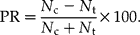 $$\begin{eqnarray} \end{eqnarray}$$
Negative PR values were treated as zero.
Data analysis
All data generated were analysed using analysis of variance. Data involving counts were transformed using the square root, while those involving percentages were transformed using arcsine before analysis (Wahua, Reference Wahua1999). Correction for natural mortality in the control treatment was carried out using the standard formula described by Abbott (Reference Abbott1925):
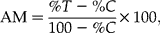 $$\begin{eqnarray} \end{eqnarray}$$
where AM is the adjusted mortality; %T is the per cent treated mortality; and %C is the per cent control mortality.
Results
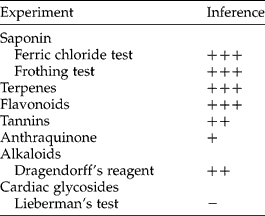
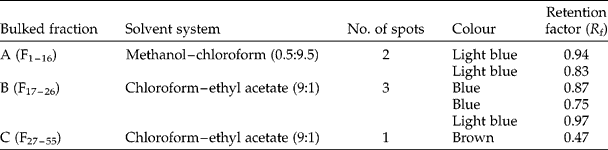
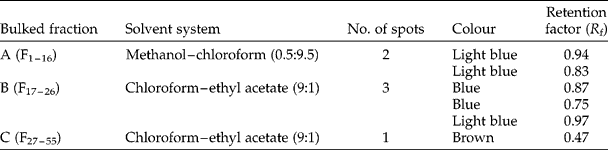
Phytochemical screening of the plant revealed the presence of chemical groups such as saponins, terpenes, flavonoids, tannins, alkaloids and anthraquinones. Lieberman's test showed the absence of cardiac glycosides (Table 1). The TLC results showed the movement of the spots well above the centre of origin, which is useful in determining the nature of secondary chemicals present in the plant (Table 2).
Phytochemical screening of the crude extract of Dracaena arborea
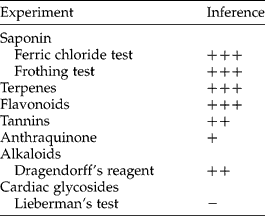
+++, Strongly positive; ++, positive; +, traces; − , negative.
TLC results of the bulked column fractions of Dracaena arborea showing retention factor values
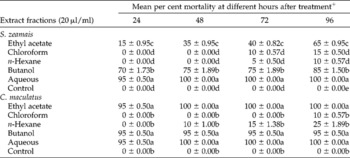
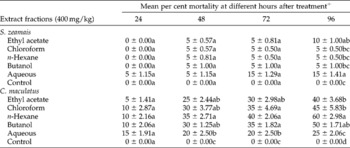
Insect mortality recorded by the topical application of the extract fractions of D. arborea differed significantly (P< 0.05) for both S. zeamais and C. maculatus (Table 3). The aqueous fraction produced 100% mortality in both insect species, while the ethyl acetate fraction produced 100% mortality in C. maculatus after 96 h of treatment. The chloroform and n-hexane fractions showed very little or no mortality and were not significantly different (P< 0.05) over the control. However, insect mortality observed on grains treated with the extract fractions of D. arborea showed different levels of bioactivity against the two insect species (Table 4). Sitophilus zeamais was less affected compared with C. maculatus, but in all, except for the butanol fraction applied against S. zeamais, there was significant mortality (P< 0.05) over the control treatment. After 96 h of exposure to the treated grains, the aqueous fraction produced 15% mortality against S. zeamais, while a mortality of 60% was observed in the n-hexane fraction against C. maculatus.
Toxicity of the extract fractions of Dracaena arborea applied topically against Sitophilus zeamais and Callosobruchus maculatus

+ Means are percentages of four replicates of ten insects each. Means within the same column and for each insect species followed by different letter(s) are significantly different (Duncan's multiple range test, P< 0.05).
Contact toxicity of the extract fractions of Dracaena arborea applied on grains against Sitophilus zeamais and Callosobruchus maculatus

+ Means are percentages of four replicates of 20 insects each. Means within the same column and for each insect species followed by different letter(s) are significantly different (Duncan's multiple range test, P< 0.05).
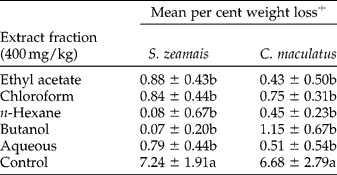
The extract fractions of D. arborea tested at 400 mg/kg significantly (P< 0.01) reduced damage caused by S. zeamais and C. maculatus to stored maize and cowpea, respectively. A minimal weight loss of 0.08 and 0.43% was observed for maize and cowpea, respectively, from the n-hexane and ethyl acetate fractions against S. zeamais and C. maculatus (Table 5).
Effect of the extract fractions of Dracaena arborea on damage caused by Sitophilus zeamais and Callosobruchus maculatus
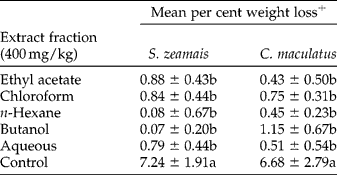
+ Means within the same column followed by different letter(s) are significantly different (Duncan's multiple range test, P< 0.05).
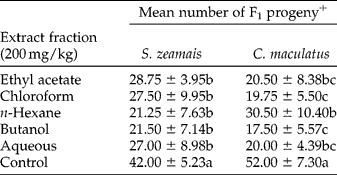
Progeny produced by both insect species was significantly (P< 0.01) affected by the various extract fractions applied at 200 mg/kg to 100 g of maize and cowpea grains, respectively. The butanol fraction inhibited the number of F1 progeny produced in the two insects compared with the other fractions. Altogether, the extracts reduced the number of F1 progeny of both insect species when compared with the control treatments (Table 6).
Effect of the extract fractions of Dracaena arborea on progeny produced by Sitophilus zeamais and Callosobruchus maculatus
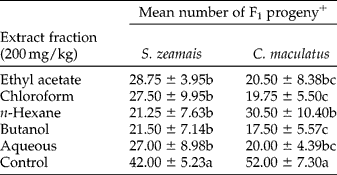
+ Means of four replicates of 20 insects each. Means within the same column followed by different letter(s) are significantly different (Duncan's multiple range test, P< 0.01).
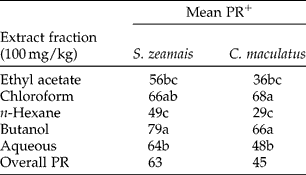
Repellency bioassay using the choice test showed that the extract fractions of D. arborea significantly (P< 0.01) repelled S. zeamais with an overall repellency of 63% (Table 7). Callosobruchus maculatus was also significantly repelled with an overall repellency of 45%. The butanol fraction produced the highest repellent effect of 79% against S. zeamais, while chloroform repelled C. maculatus by 68%.
Mean per cent repellency (PR) values for the extract fractions of Dracaena arborea on Sitophilus zeamais and Callosobruchus maculatus in a choice test
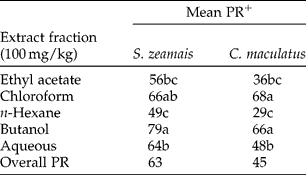
+ Means of four replicates of 10 insects each. Means within the same column followed by different letter(s) are significantly different (Duncan's multiple range test, P< 0.01).
Discussion
The phytochemical screening results revealed the presence of saponins, tannins, anthraquinones, flavonoids and terpenes as secondary metabolites. Their detection was possible because of the reaction of the functional groups with reagents to produce different colours and changes in physical nature (Adesina, Reference Adesina1986; Trease and Evans, Reference Trease and Evans1989). The reduction of the plant extract fractions by Fehling's solution was an indication of the presence of triterpene saponins, and this probably resulted in the oily nature of the isolates obtained (Harborne, Reference Harborne1973).
The TLC results using chloroform–ethyl acetate (4:1) showed a separation of the extract into different components with pre-coated TLC plates. The different components separated were probably non-polar because they tend to be soluble in non-polar solvents and were solvated by the non-polar mobile phase, which moved them rapidly up the plate. The various retention factor (R f) values obtained showed the differences in partition coefficients, with the component having the highest R f value indicating the highest partition coefficient (Elujoba and Nagels, Reference Elujoba and Nagels1985). Spectral characterization of the isolates showed various proton shifts, indicating a cloud or shift in electron charges between CH3 and CH2. The 13C spectral results revealed the presence of between 18 and 20 carbon atoms besides the ester peak noticed. With the hydrolysis of esters and further spectral characterization using GC–MS equipment, structure elucidation of the actual chemical compound would be possible. The results of the spectral characterization are in line with the nature of isolates obtained which were oily in nature (Okunji et al., Reference Okunji, Iwu, Jackson and Tally1996).
The results of the contact toxicity of the extract fractions applied on grains were significantly different from the control, while the topical application was more effective. The insects appeared to avoid the treated grains as some were observed hanging on the inside of the cups and the underside of the muslin cloth, without contact with the treated grains. Secondary plant chemicals are known to attract or repel insects and influence their locomotion, oviposition, feeding behaviour, developmental and physiological process as well as behavioural patterns (Obeng-Ofori et al., Reference Obeng-Ofori, Reichmuth, Bekele and Hassanali1998). It is, therefore, possible that the two insect species were repelled from the treated grains.
The significant reduction in damage caused to the stored grains as well as high insect mortality could be attributable to the presence of toxic secondary metabolites in D. arborea as reported previously (Okunji et al., Reference Okunji, Iwu, Jackson and Tally1996; Momeni et al., Reference Momeni, Djoulde, Akam and Kimbu2005). It is known that some secondary metabolites may act both as insecticides and anti-feedants as had been observed for rotenone against the red flour beetle Tribolium castaneum (Herbst) (Nawrot et al., Reference Nawrot, Harmstha, Kostova and Ognyanov1988) and other rotenoids against lepidopteran pests such as the African armyworm Spodoptera exempta (Walker), the African sugarcane borer Eldana saccharina Walker and the legume pod borer Maruca vitrata (Fab.) (Hassanali and Lwande, Reference Hassanali and Lwande1989). The results obtained suggest good potential for the use of D. arborea in stored product pest management particularly in the tropics.
The extract fractions were effective in reducing the progeny produced in both insect species, and this suggests the presence of ovicidal and larvicidal properties in the plant. It would appear that progeny inhibition of S. zeamais and C. maculatus in the treated grains could also arise from the inability of last larval instars of insects to chew through the seed coats of the treated grains due to the presence of phenolic compounds (Wongo, Reference Wongo1998; Boeke et al., Reference Boeke, Barnaud, van Loon, Kossous, van Huis and Dicke2004).
In conclusion, some of the fractions from the leaf extract of D. arborea demonstrated toxicity, repellent effects and a reduction in the progeny of the two pest species, S. zeamais and C. maculatus. However, interspecific differences were observed. Many studies have shown that even closely related species can differ markedly in susceptibility to the same plant extract or pure allelochemical (Akhtar et al., Reference Akhtar, Isman, Lee, Lee and Lee2012). Botanical pesticides represent an important component of integrated pest management systems in traditional grain storage, as they are broad spectrum in action, based on local materials and potentially less expensive. Many are also safe to the environment and harmless to humans and other mammals.